Department of Information Technology
TITLE
“AI-driven Sentiment Analyzer ”
Guide
Mr. Komal Champanerkar
1
⮚ Introduction
⮚ Problem statement
⮚ Objective
⮚ Literature Review
⮚ Applications
⮚ conclusion
⮚ References
2
Contents:
3
Introduction:-
With the vigorous development of various Internet technologies, more and more electronic
business platform, social platforms, news platforms, film and television platforms have
emerged. People only need to browse other people’s comments on commodities or movies
online as a reference to filter out the commodities they want to buy or the movies they want to
watch.
Whether it is communication, shopping, movie watching, study, work, etc., users just need to
take advantage of the Internet to obtain a large amount of relevant information and post their
opinions, emotions, attitudes online, therefore while people enjoy this lifestyle, innumerable
opinions with user’s emotion began to appear and made a huge impact on events, goods,
services, topics, organizations, etc.
As the platform side, they collect user comments or evaluations for analyzing user’s sentiment
and satisfaction. For instance, news platforms want to analyze the opinions and sentiments of
netizens, business platform platforms hope to get user reviews to improve products .With so
many demands, sentiment analysis has become a very active field.
Problem statement:-
Social media is swinging with millions of user-generated posts and content. Most users go to social media to
convey their personal views, opinions and share feelings through images and words. But there lies the biggest
challenge in accurately understanding the feelings or sentiments behind such user-generated posts.
Modern social media firms like Snapchat, Facebook, Linked In, Twitter, etc., and online food delivery services
are spending large budgets on projects to understand human sentiments and feelings. Analyzing the texts and
images to understand the sentiments would make these firms recognize user behavior easily. Based on such
analysis, companies can cater to improved customer service, hence increasing customer satisfaction.
Objective:-
⮚The main objective of this research is to develop a sentiment analyzar
system, the system can discover and extract hidden sentiment associated
with text.
⮚ To help avoid human biases.
9
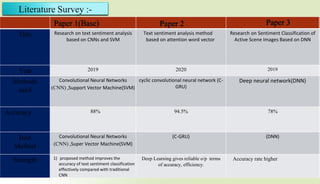
Title Research on text sentiment analysis
based on CNNs and SVM
Text sentiment analysis method
based on attention word vector
Research on Sentiment Classification of
Active Scene Images Based on DNN
Year 2019 2020 2019
Methods
used
Convolutional Neural Networks
(CNN) ,Support Vector Machine(SVM)
cyclic convolutional neural network (C-
GRU)
Deep neural network(DNN)
Accuracy 88% 94.5% 78%
Best
Method
Convolutional Neural Networks
(CNN) ,Super Vector Machine(SVM)
(C-GRU) (DNN)
Strength 1) proposed method improves the
accuracy of text sentiment classification
effectively compared with traditional
CNN
Deep Learning gives reliable o/p terms
of accuracy, efficiency.
Accuracy rate higher
Literature Survey :-
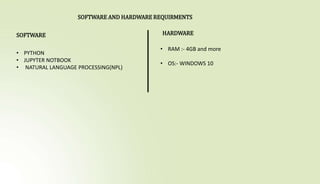
SOFTWARE AND HARDWARE REQUIRMENTS
SOFTWARE
• PYTHON
• JUPYTER NOTBOOK
• NATURAL LANGUAGE PROCESSING(NPL)
HARDWARE
• RAM :- 4GB and more
• OS:- WINDOWS 10
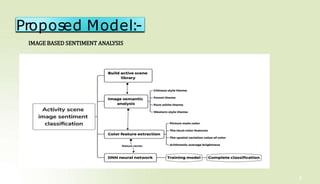
Proposed Model:-
8
IMAGE BASED SENTIMENT ANALYSIS
⮚ Product analysis:-
Discover how a product is perceived by your target audience, which elements of your
product need to be improved, and know what will make your most valuable customers
happy. All with sentiment analysis.
 Social media monitoring:-
With the help of sentiment analysis software, you can wade through all that data in
minutes, to analyze individual emotions and overall public sentiment on every social
platform.
Applications:-
CONCLUSION
References:-
⮚ [1] Research on text sentiment analysis based on CNNs and SVM :-Yuling Chen,Zhi Zhang -
(2019).
⮚ [2] Text sentiment analysis method based on attention word vector:-zhigang Xu,kai Dong,
honglei Zhu – 2019.
⮚ [3] Research on Sentiment Classification of Active Scene Images Based on DNN: Jiajie Tang, Liandong Fu,
Chong Tan, Mingjun Peng
⮚ [4] WWW.PROJECT.IO
THANK
YOU!
16

BE-IT01 (1).pptx

  • 1.
    Department of InformationTechnology TITLE “AI-driven Sentiment Analyzer ” Guide Mr. Komal Champanerkar 1
  • 2.
    ⮚ Introduction ⮚ Problemstatement ⮚ Objective ⮚ Literature Review ⮚ Applications ⮚ conclusion ⮚ References 2 Contents:
  • 3.
    3 Introduction:- With the vigorousdevelopment of various Internet technologies, more and more electronic business platform, social platforms, news platforms, film and television platforms have emerged. People only need to browse other people’s comments on commodities or movies online as a reference to filter out the commodities they want to buy or the movies they want to watch. Whether it is communication, shopping, movie watching, study, work, etc., users just need to take advantage of the Internet to obtain a large amount of relevant information and post their opinions, emotions, attitudes online, therefore while people enjoy this lifestyle, innumerable opinions with user’s emotion began to appear and made a huge impact on events, goods, services, topics, organizations, etc. As the platform side, they collect user comments or evaluations for analyzing user’s sentiment and satisfaction. For instance, news platforms want to analyze the opinions and sentiments of netizens, business platform platforms hope to get user reviews to improve products .With so many demands, sentiment analysis has become a very active field.
  • 4.
    Problem statement:- Social mediais swinging with millions of user-generated posts and content. Most users go to social media to convey their personal views, opinions and share feelings through images and words. But there lies the biggest challenge in accurately understanding the feelings or sentiments behind such user-generated posts. Modern social media firms like Snapchat, Facebook, Linked In, Twitter, etc., and online food delivery services are spending large budgets on projects to understand human sentiments and feelings. Analyzing the texts and images to understand the sentiments would make these firms recognize user behavior easily. Based on such analysis, companies can cater to improved customer service, hence increasing customer satisfaction.
  • 5.
    Objective:- ⮚The main objectiveof this research is to develop a sentiment analyzar system, the system can discover and extract hidden sentiment associated with text. ⮚ To help avoid human biases.
  • 6.
    9 Title Research ontext sentiment analysis based on CNNs and SVM Text sentiment analysis method based on attention word vector Research on Sentiment Classification of Active Scene Images Based on DNN Year 2019 2020 2019 Methods used Convolutional Neural Networks (CNN) ,Support Vector Machine(SVM) cyclic convolutional neural network (C- GRU) Deep neural network(DNN) Accuracy 88% 94.5% 78% Best Method Convolutional Neural Networks (CNN) ,Super Vector Machine(SVM) (C-GRU) (DNN) Strength 1) proposed method improves the accuracy of text sentiment classification effectively compared with traditional CNN Deep Learning gives reliable o/p terms of accuracy, efficiency. Accuracy rate higher Literature Survey :-
  • 7.
    SOFTWARE AND HARDWAREREQUIRMENTS SOFTWARE • PYTHON • JUPYTER NOTBOOK • NATURAL LANGUAGE PROCESSING(NPL) HARDWARE • RAM :- 4GB and more • OS:- WINDOWS 10
  • 8.
  • 9.
    ⮚ Product analysis:- Discoverhow a product is perceived by your target audience, which elements of your product need to be improved, and know what will make your most valuable customers happy. All with sentiment analysis.  Social media monitoring:- With the help of sentiment analysis software, you can wade through all that data in minutes, to analyze individual emotions and overall public sentiment on every social platform. Applications:-
  • 10.
  • 11.
    References:- ⮚ [1] Researchon text sentiment analysis based on CNNs and SVM :-Yuling Chen,Zhi Zhang - (2019). ⮚ [2] Text sentiment analysis method based on attention word vector:-zhigang Xu,kai Dong, honglei Zhu – 2019. ⮚ [3] Research on Sentiment Classification of Active Scene Images Based on DNN: Jiajie Tang, Liandong Fu, Chong Tan, Mingjun Peng ⮚ [4] WWW.PROJECT.IO
  • 12.