National surveillance of sexual health testing practices and sexual behaviours  Dr. Iryna Zablotska, NCHSR 22 May 2009
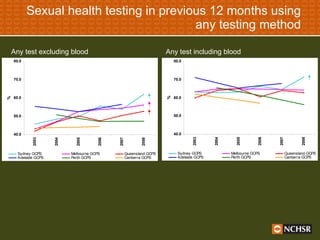
In this presentation Trends in sexual heath testing Testing by HV serostatus and  sexual practices Reasons for and patterns  of testing Issues in sexual health testing Data from six Australian Gay Community Periodic Surveys (1998-2008)
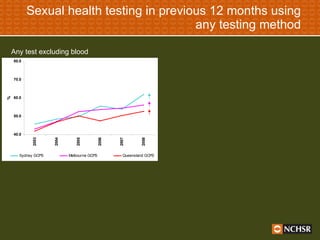
Sexual health testing in previous 12 months using any testing method Any test excluding blood
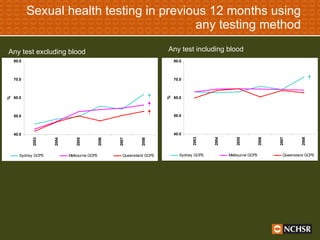
Sexual health testing in previous 12 months using any testing method Any test excluding blood Any test including blood
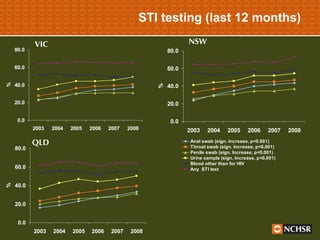
STI testing (last 12 months) VIC QLD NSW
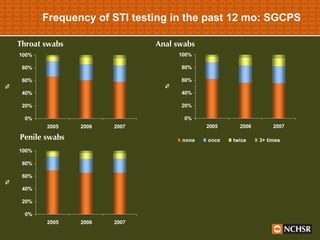
Frequency of STI testing in the past 12 mo: SGCPS Anal swabs Throat swabs Penile swabs
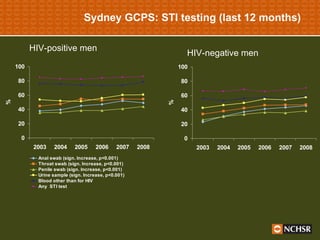
Sydney GCPS: STI testing (last 12 months) HIV-positive men HIV-negative men
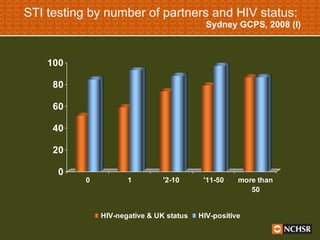
STI testing by number of partners and HIV status:  Sydney GCPS, 2008 (I)
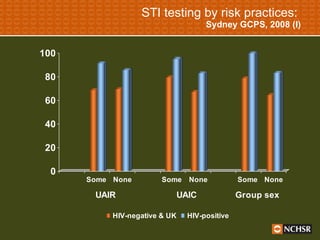
STI testing by risk practices:  Sydney GCPS, 2008 (I)
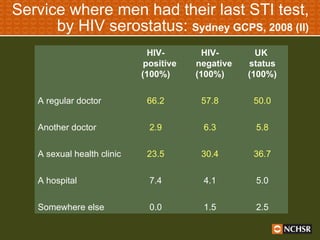
Service where men had their last STI test, by HIV serostatus:  Sydney GCPS, 2008 (II) 2.5 1.5 0.0 Somewhere else 5.0 4.1 7.4 A hospital 36.7 30.4 23.5 A sexual health clinic 5.8 6.3 2.9 Another doctor 50.0 57.8 66.2 A regular doctor UK  status (100%) HIV-negative (100%) HIV-positive (100%)
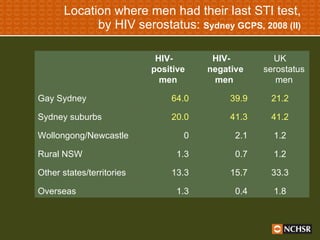
Location where men had their last STI test,  by HIV serostatus:  Sydney GCPS, 2008 (II) 0.4 15.7 0.7 2.1 41.3 39.9 HIV-negative men  1.8 1.3 Overseas 33.3 13.3 Other states/territories 1.2 1.3 Rural NSW 1.2 0 Wollongong/Newcastle 41.2 20.0 Sydney suburbs 21.2 64.0 Gay Sydney UK serostatus men HIV-positive men
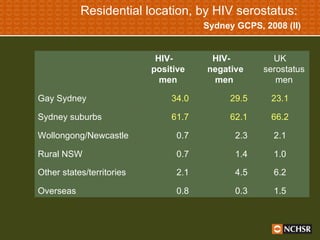
Residential location, by HIV serostatus:    Sydney GCPS, 2008 (II) 0.3 4.5 1.4 2.3 62.1 29.5 HIV-negative men  1.5 0.8 Overseas 6.2 2.1 Other states/territories 1.0 0.7 Rural NSW 2.1 0.7 Wollongong/Newcastle 66.2 61.7 Sydney suburbs 23.1 34.0 Gay Sydney UK serostatus men HIV-positive men
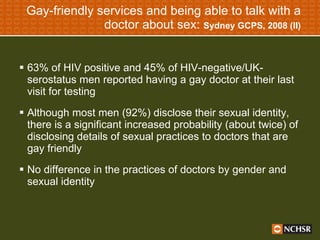
Gay-friendly services and being able to talk with a doctor about sex:  Sydney GCPS, 2008 (II) 63% of HIV positive and 45% of HIV-negative/UK-serostatus men reported having a gay doctor at their last visit for testing Although most men (92%) disclose their sexual identity, there is a significant increased probability (about twice) of disclosing details of sexual practices to doctors that are gay friendly No difference in the practices of doctors by gender and sexual identity
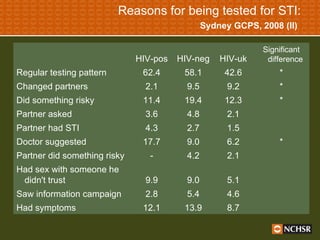
Reasons for being tested for STI:   Sydney GCPS, 2008 (II)   8.7 13.9 12.1 Had symptoms 4.6 5.4 2.8 Saw information campaign 5.1 9.0 9.9 Had sex with someone he didn't trust 2.1 4.2 - Partner did something risky * 6.2 9.0 17.7 Doctor suggested 1.5 2.7 4.3 Partner had STI 2.1 4.8 3.6 Partner asked * 12.3 19.4 11.4 Did something risky * 9.2 9.5 2.1 Changed partners * 42.6 58.1 62.4 Regular testing pattern Significant difference HIV-uk HIV-neg HIV-pos
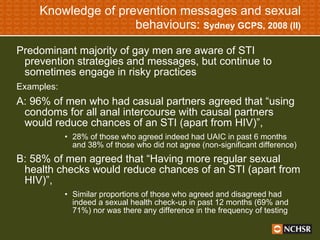
Knowledge of prevention messages and sexual behaviours:  Sydney GCPS, 2008 (II) Predominant majority of gay men are aware of STI prevention strategies and messages, but continue to sometimes engage in risky practices Examples: A: 96% of men who had casual partners agreed that “using condoms for all anal intercourse with causal partners would reduce chances of an STI (apart from HIV)”,  28% of those who agreed indeed had UAIC in past 6 months and 38% of those who did not agree (non-significant difference) B: 58% of men agreed that “Having more regular sexual health checks would reduce chances of an STI (apart from HIV)”,  Similar proportions of those who agreed and disagreed had indeed a sexual health check-up in past 12 months (69% and 71%) nor was there any difference in the frequency of testing
Summary Improvement in HIV testing, increased comprehensiveness and frequency of STI testing  Remaining issues in STI testing: Some men are still not being tested for HIV and other STI, some are tested for one but not the other Testing behaviours are associated with risk taking Continuing discrepancy in both the prevalence of STI and STI testing by HIV serostatus  HIV-negative men access services of gay-friendly doctors less often. They may not be able to disclose to their doctors all information that is important for STI testing Although STI prevalence is higher among HIV-positive men, STI testing for HIV-negative and unknown-serostatus men should not be neglected Remaining challenge: Although all men (independent of serostatus) understand the risk of STI and know how to reduce the risk, still a substantial proportion engage in risky practices

Iryna Zablotska: Behavioural Surveillance: Testing And Sexual Behaviour

  • 1.
    National surveillance ofsexual health testing practices and sexual behaviours Dr. Iryna Zablotska, NCHSR 22 May 2009
  • 2.
    In this presentationTrends in sexual heath testing Testing by HV serostatus and sexual practices Reasons for and patterns of testing Issues in sexual health testing Data from six Australian Gay Community Periodic Surveys (1998-2008)
  • 3.
    Sexual health testingin previous 12 months using any testing method Any test excluding blood
  • 4.
    Sexual health testingin previous 12 months using any testing method Any test excluding blood Any test including blood
  • 5.
    Sexual health testingin previous 12 months using any testing method Any test excluding blood Any test including blood
  • 6.
    STI testing (last12 months) VIC QLD NSW
  • 7.
    Frequency of STItesting in the past 12 mo: SGCPS Anal swabs Throat swabs Penile swabs
  • 8.
    Sydney GCPS: STItesting (last 12 months) HIV-positive men HIV-negative men
  • 9.
    STI testing bynumber of partners and HIV status: Sydney GCPS, 2008 (I)
  • 10.
    STI testing byrisk practices: Sydney GCPS, 2008 (I)
  • 11.
    Service where menhad their last STI test, by HIV serostatus: Sydney GCPS, 2008 (II) 2.5 1.5 0.0 Somewhere else 5.0 4.1 7.4 A hospital 36.7 30.4 23.5 A sexual health clinic 5.8 6.3 2.9 Another doctor 50.0 57.8 66.2 A regular doctor UK status (100%) HIV-negative (100%) HIV-positive (100%)
  • 12.
    Location where menhad their last STI test, by HIV serostatus: Sydney GCPS, 2008 (II) 0.4 15.7 0.7 2.1 41.3 39.9 HIV-negative men 1.8 1.3 Overseas 33.3 13.3 Other states/territories 1.2 1.3 Rural NSW 1.2 0 Wollongong/Newcastle 41.2 20.0 Sydney suburbs 21.2 64.0 Gay Sydney UK serostatus men HIV-positive men
  • 13.
    Residential location, byHIV serostatus: Sydney GCPS, 2008 (II) 0.3 4.5 1.4 2.3 62.1 29.5 HIV-negative men 1.5 0.8 Overseas 6.2 2.1 Other states/territories 1.0 0.7 Rural NSW 2.1 0.7 Wollongong/Newcastle 66.2 61.7 Sydney suburbs 23.1 34.0 Gay Sydney UK serostatus men HIV-positive men
  • 14.
    Gay-friendly services andbeing able to talk with a doctor about sex: Sydney GCPS, 2008 (II) 63% of HIV positive and 45% of HIV-negative/UK-serostatus men reported having a gay doctor at their last visit for testing Although most men (92%) disclose their sexual identity, there is a significant increased probability (about twice) of disclosing details of sexual practices to doctors that are gay friendly No difference in the practices of doctors by gender and sexual identity
  • 15.
    Reasons for beingtested for STI: Sydney GCPS, 2008 (II) 8.7 13.9 12.1 Had symptoms 4.6 5.4 2.8 Saw information campaign 5.1 9.0 9.9 Had sex with someone he didn't trust 2.1 4.2 - Partner did something risky * 6.2 9.0 17.7 Doctor suggested 1.5 2.7 4.3 Partner had STI 2.1 4.8 3.6 Partner asked * 12.3 19.4 11.4 Did something risky * 9.2 9.5 2.1 Changed partners * 42.6 58.1 62.4 Regular testing pattern Significant difference HIV-uk HIV-neg HIV-pos
  • 16.
    Knowledge of preventionmessages and sexual behaviours: Sydney GCPS, 2008 (II) Predominant majority of gay men are aware of STI prevention strategies and messages, but continue to sometimes engage in risky practices Examples: A: 96% of men who had casual partners agreed that “using condoms for all anal intercourse with causal partners would reduce chances of an STI (apart from HIV)”, 28% of those who agreed indeed had UAIC in past 6 months and 38% of those who did not agree (non-significant difference) B: 58% of men agreed that “Having more regular sexual health checks would reduce chances of an STI (apart from HIV)”, Similar proportions of those who agreed and disagreed had indeed a sexual health check-up in past 12 months (69% and 71%) nor was there any difference in the frequency of testing
  • 17.
    Summary Improvement inHIV testing, increased comprehensiveness and frequency of STI testing Remaining issues in STI testing: Some men are still not being tested for HIV and other STI, some are tested for one but not the other Testing behaviours are associated with risk taking Continuing discrepancy in both the prevalence of STI and STI testing by HIV serostatus HIV-negative men access services of gay-friendly doctors less often. They may not be able to disclose to their doctors all information that is important for STI testing Although STI prevalence is higher among HIV-positive men, STI testing for HIV-negative and unknown-serostatus men should not be neglected Remaining challenge: Although all men (independent of serostatus) understand the risk of STI and know how to reduce the risk, still a substantial proportion engage in risky practices