


bcn checkpoint 
V I H - S I D A ▪ I T S ▪ S E X U A L I T A T ▪ H O M E S ▪ S A L U T 
Results and Next Steps 
Michael Meulbroek 
Projecte dels NOMS-Hispanosida 
Challenges and opportunities for community testing centres 
Barcelona, 5 October de 2014
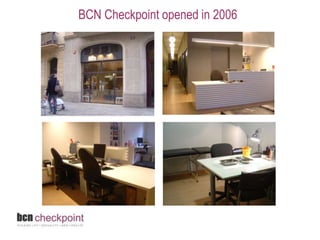
BCN Checkpoint opened in 2006
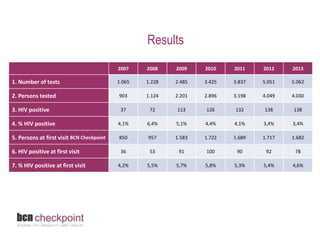
Results 
2007 2008 2009 2010 2011 2012 2013 
1. Number of tests 1.065 1.228 2.485 3.425 3.837 5.051 5.062 
2. Persons tested 903 1.124 2.201 2.896 3.198 4.049 4.030 
3. HIV positive 37 72 113 126 132 138 138 
4. % HIV positive 4,1% 6,4% 5,1% 4,4% 4,1% 3,4% 3,4% 
5. Persons at first visit BCN Checkpoint 850 957 1.583 1.722 1.689 1.717 1.682 
6. HIV positive at first visit 36 53 91 100 90 92 78 
7. % HIV positive at first visit 4,2% 5,5% 5,7% 5,8% 5,3% 5,4% 4,6%
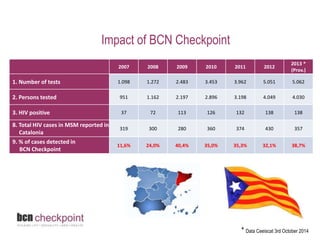
Impact of BCN Checkpoint 
2007 2008 2009 2010 2011 2012 
2013 * 
(Prov.) 
1. Number of tests 1.098 1.272 2.483 3.453 3.962 5.051 5.062 
2. Persons tested 951 1.162 2.197 2.896 3.198 4.049 4.030 
3. HIV positive 37 72 113 126 132 138 138 
8. Total HIV cases in MSM reported in 
Catalonia 
319 300 280 360 374 430 357 
9. % of cases detected in 
BCN Checkpoint 
11,6% 24,0% 40,4% 35,0% 35,3% 32,1% 38,7% 
* Data Ceeiscat 3rd October 2014
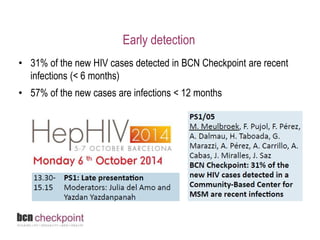
Early detection 
• 31% of the new HIV cases detected in BCN Checkpoint are recent 
infections (< 6 months) 
• 57% of the new cases are infections < 12 months
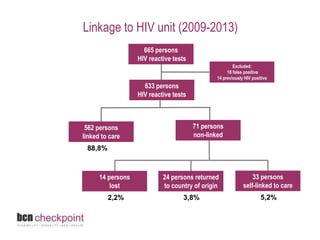
Linkage to HIV unit (2009-2013) 
665 persons 
HIV reactive tests 
633 persons 
HIV reactive tests 
562 persons 
linked to care 
14 previously HIV positive 
71 persons 
non-linked 
24 persons returned 
to country of origin 
18 false positive 
33 persons 
Excluded: 
self-linked to care 
88,8% 
14 persons 
lost 
2,2% 3,8% 5,2%
Next Steps 
Community Research
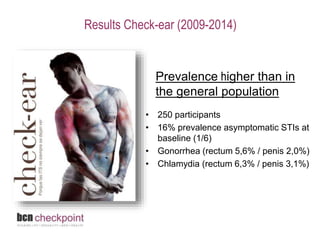
Results Check-ear (2009-2014) 
Prevalence higher than in 
the general population 
• 250 participants 
• 16% prevalence asymptomatic STIs at 
baseline (1/6) 
• Gonorrhea (rectum 5,6% / penis 2,0%) 
• Chlamydia (rectum 6,3% / penis 3,1%)
Results Check-ear (2009-2014) 
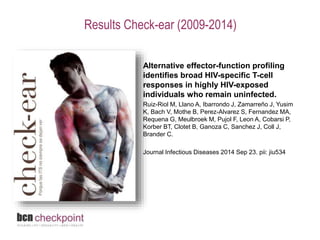
Alternative effector-function profiling 
identifies broad HIV-specific T-cell 
responses in highly HIV-exposed 
individuals who remain uninfected. 
Ruiz-Riol M, Llano A, Ibarrondo J, Zamarreño J, Yusim 
K, Bach V, Mothe B, Perez-Alvarez S, Fernandez MA, 
Requena G, Meulbroek M, Pujol F, Leon A, Cobarsi P, 
Korber BT, Clotet B, Ganoza C, Sanchez J, Coll J, 
Brander C. 
Journal Infectious Diseases 2014 Sep 23. pii: jiu534
Next Steps 
Implementation of new services: 
 Syphilis, Chlamydia, Gonorrhea and HCV testing 
 Hepatitis A and B vaccination
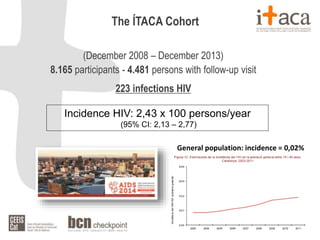
The ÍTACA Cohort 
(December 2008 – December 2013) 
8.165 participants - 4.481 persons with follow-up visit 
223 infections HIV 
Incidence HIV: 2,43 x 100 persons/year 
(95% CI: 2,13 – 2,77) 
General population: incidence = 0,02%
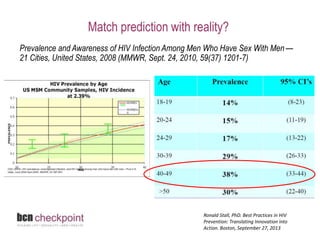
Match prediction with reality? 
Prevalence and Awareness of HIV Infection Among Men Who Have Sex With Men — 
21 Cities, United States, 2008 (MMWR, Sept. 24, 2010, 59(37) 1201-7) 
Ronald Stall, PhD. Best Practices in HIV 
Prevention: Translating Innovation into 
Action. Boston, September 27, 2013
Next Steps 
So, we know what means an high HIV incidence… 
What are the behavior surveys we need? 
“HIV is increasing among MSM not because of greater risk-taking 
behavior, but simply because HIV is so prevalent among their sex partners 
that even one or two slip-ups can have devastating consequences.” 
Susan Buchbinder 
FDA Advisory Committee for PrEP approval 
10th May 2012
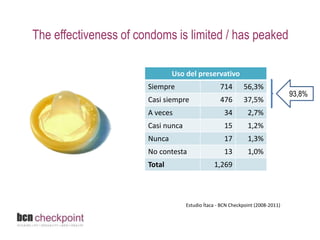
The effectiveness of condoms is limited / has peaked 
Uso del preservativo 
Siempre 714 56,3% 
Casi siempre 476 37,5% 
A veces 34 2,7% 
Casi nunca 15 1,2% 
Nunca 17 1,3% 
No contesta 13 1,0% 
Total 1,269 
Estudio Ítaca - BCN Checkpoint (2008-2011) 
93,8%
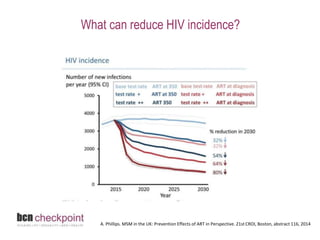
What can reduce HIV incidence? 
A. Phillips. MSM in the UK: Prevention Effects of ART in Perspective. 21st CROI, Boston, abstract 116, 2014
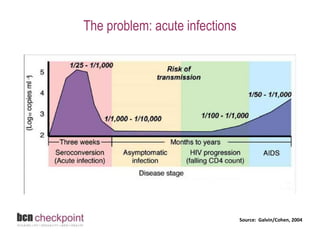
The problem: acute infections 
Source: Galvin/Cohen, 2004
Next Steps: more regular testing
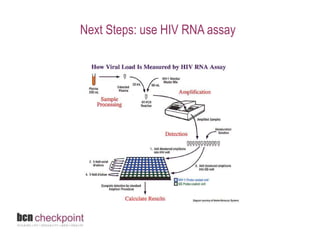
Next Steps: use HIV RNA assay
Next Steps: Pre-Exposure Prophylaxis
Acknowledgements

Bcn checkpoint - Michael Meulbroek

  • 1.
    bcn checkpoint VI H - S I D A ▪ I T S ▪ S E X U A L I T A T ▪ H O M E S ▪ S A L U T Results and Next Steps Michael Meulbroek Projecte dels NOMS-Hispanosida Challenges and opportunities for community testing centres Barcelona, 5 October de 2014
  • 2.
  • 3.
    Results 2007 20082009 2010 2011 2012 2013 1. Number of tests 1.065 1.228 2.485 3.425 3.837 5.051 5.062 2. Persons tested 903 1.124 2.201 2.896 3.198 4.049 4.030 3. HIV positive 37 72 113 126 132 138 138 4. % HIV positive 4,1% 6,4% 5,1% 4,4% 4,1% 3,4% 3,4% 5. Persons at first visit BCN Checkpoint 850 957 1.583 1.722 1.689 1.717 1.682 6. HIV positive at first visit 36 53 91 100 90 92 78 7. % HIV positive at first visit 4,2% 5,5% 5,7% 5,8% 5,3% 5,4% 4,6%
  • 4.
    Impact of BCNCheckpoint 2007 2008 2009 2010 2011 2012 2013 * (Prov.) 1. Number of tests 1.098 1.272 2.483 3.453 3.962 5.051 5.062 2. Persons tested 951 1.162 2.197 2.896 3.198 4.049 4.030 3. HIV positive 37 72 113 126 132 138 138 8. Total HIV cases in MSM reported in Catalonia 319 300 280 360 374 430 357 9. % of cases detected in BCN Checkpoint 11,6% 24,0% 40,4% 35,0% 35,3% 32,1% 38,7% * Data Ceeiscat 3rd October 2014
  • 5.
    Early detection •31% of the new HIV cases detected in BCN Checkpoint are recent infections (< 6 months) • 57% of the new cases are infections < 12 months
  • 6.
    Linkage to HIVunit (2009-2013) 665 persons HIV reactive tests 633 persons HIV reactive tests 562 persons linked to care 14 previously HIV positive 71 persons non-linked 24 persons returned to country of origin 18 false positive 33 persons Excluded: self-linked to care 88,8% 14 persons lost 2,2% 3,8% 5,2%
  • 7.
  • 8.
    Results Check-ear (2009-2014) Prevalence higher than in the general population • 250 participants • 16% prevalence asymptomatic STIs at baseline (1/6) • Gonorrhea (rectum 5,6% / penis 2,0%) • Chlamydia (rectum 6,3% / penis 3,1%)
  • 9.
    Results Check-ear (2009-2014) Alternative effector-function profiling identifies broad HIV-specific T-cell responses in highly HIV-exposed individuals who remain uninfected. Ruiz-Riol M, Llano A, Ibarrondo J, Zamarreño J, Yusim K, Bach V, Mothe B, Perez-Alvarez S, Fernandez MA, Requena G, Meulbroek M, Pujol F, Leon A, Cobarsi P, Korber BT, Clotet B, Ganoza C, Sanchez J, Coll J, Brander C. Journal Infectious Diseases 2014 Sep 23. pii: jiu534
  • 10.
    Next Steps Implementationof new services:  Syphilis, Chlamydia, Gonorrhea and HCV testing  Hepatitis A and B vaccination
  • 11.
    The ÍTACA Cohort (December 2008 – December 2013) 8.165 participants - 4.481 persons with follow-up visit 223 infections HIV Incidence HIV: 2,43 x 100 persons/year (95% CI: 2,13 – 2,77) General population: incidence = 0,02%
  • 12.
    Match prediction withreality? Prevalence and Awareness of HIV Infection Among Men Who Have Sex With Men — 21 Cities, United States, 2008 (MMWR, Sept. 24, 2010, 59(37) 1201-7) Ronald Stall, PhD. Best Practices in HIV Prevention: Translating Innovation into Action. Boston, September 27, 2013
  • 13.
    Next Steps So,we know what means an high HIV incidence… What are the behavior surveys we need? “HIV is increasing among MSM not because of greater risk-taking behavior, but simply because HIV is so prevalent among their sex partners that even one or two slip-ups can have devastating consequences.” Susan Buchbinder FDA Advisory Committee for PrEP approval 10th May 2012
  • 14.
    The effectiveness ofcondoms is limited / has peaked Uso del preservativo Siempre 714 56,3% Casi siempre 476 37,5% A veces 34 2,7% Casi nunca 15 1,2% Nunca 17 1,3% No contesta 13 1,0% Total 1,269 Estudio Ítaca - BCN Checkpoint (2008-2011) 93,8%
  • 15.
    What can reduceHIV incidence? A. Phillips. MSM in the UK: Prevention Effects of ART in Perspective. 21st CROI, Boston, abstract 116, 2014
  • 16.
    The problem: acuteinfections Source: Galvin/Cohen, 2004
  • 17.
    Next Steps: moreregular testing
  • 18.
    Next Steps: useHIV RNA assay
  • 19.
  • 20.