


Case Study: Behavioral Segmentation
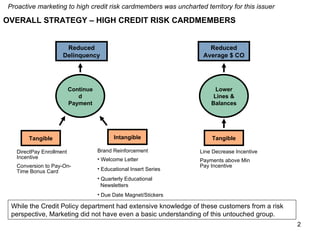
Continued Payment Lower Lines & Balances Reduced Average $ CO Reduced Delinquency Intangible Tangible Tangible Brand Reinforcement Welcome Letter Educational Insert Series Quarterly Educational   Newsletters Due Date Magnet/Stickers Line Decrease Incentive Payments above Min  Pay Incentive DirectPay Enrollment Incentive Conversion to Pay-On-Time Bonus Card Proactive marketing to high credit risk cardmembers was uncharted territory for this issuer OVERALL STRATEGY – HIGH CREDIT RISK CARDMEMBERS While the Credit Policy department had extensive knowledge of these customers from a risk perspective, Marketing did not have even a basic understanding of this untouched group.
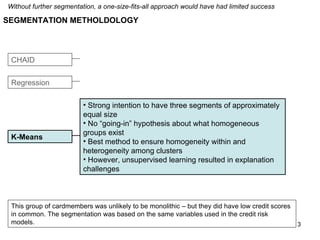
Without further segmentation, a one-size-fits-all approach would have had limited success SEGMENTATION METHOLDOLOGY This group of cardmembers was unlikely to be monolithic – but they did have low credit scores in common. The segmentation was based on the same variables used in the credit risk models. Strong intention to have three segments of approximately equal size No “going-in” hypothesis about what homogeneous groups exist Best method to ensure homogeneity within and heterogeneity among clusters However, unsupervised learning resulted in explanation challenges  K-Means CHAID Regression
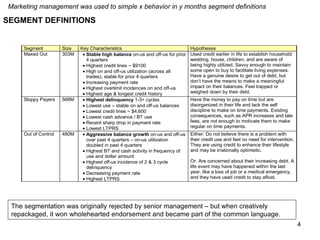
Marketing management was used to simple x behavior in y months segment definitions SEGMENT DEFINITIONS The segmentation was originally rejected by senior management – but when creatively repackaged, it won wholehearted endorsement and became part of the common language.
A complete picture of the segments was pursued DESCRIBING & INSIGHT Hypotheses confirmed, all the pieces of the puzzle were fit together – creating the most comprehensive insight base for any group of this issuer’s cardmembers Qualitative Research Past Behavior Profile Segmentation Model Factors Modeled Predicted Behavior
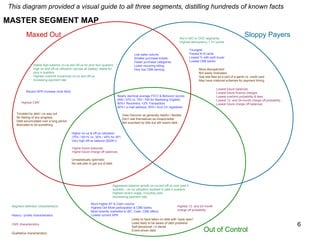
This diagram provided a visual guide to all three segments, distilling hundreds of known facts MASTER SEGMENT MAP Maxed Out Sloppy Payers Out of Control Lowest future balances Lowest future finance charges Lowest overlimit probability & fees Lowest 12- and 24-month charge off probability Lowest future charge off balances Highest CMV CMV characteristics History / profile characteristics Qualitative characteristics Stable high balance on-us and off-us for prior four quarters High on and off-us utilization (across all trades), stable for prior 4 quarters Highest overlimit incidences on-us and off-us Increasing payment rate Unrealistically optimistic No real plan to get out of debt Likely to have taken on debt with “eyes open” Least likely to be aware of debt problems Self-delusional / in denial Event-driven debt Troubled by debt / no way out No feeling of any progress Debt accumulated over a long period Motivated to do something More disorganized Not easily motivated See late fees as a part of a game vs. credit card May have irrational schemes for payment timing View Discover as generally helpful / flexible Don’t see themselves as irresponsible Not surprised by bills but still resent debt Segment definition characteristics Aggressive balance growth on-us and off-us over past 4 quarters – on-us utilization doubled in past 4 quarters Highest recent usage, including cash Decreasing payment rate Not in MO or OOC segments Highest delinquency 1-3+ cycles Highest 12- and 24-month charge off probability Much higher BT & Cash volume Highest Get More participation & CBB banks Most recently marketed to (BT, Cash, CBB offers) Lowest current APR Low sales volume Smaller purchase tickets Fewer purchase categories Lower recurring billing Very low CBB earning Nearly identical average FICO & Behavior scores (640 / 670 vs. 755 / 760 for Marketing Eligible) 90%+ Revolvers; <2% Transactors 50%+ e-mail address; 50%+ Acct Ctr registered Youngest Fewest # of cards Lowest % with auth buyer Lowest CBB banks Recent APR increase most likely Higher future balances Higher future charge off balances Higher on-us & off-us utilization (75% / 60+% vs. 30% / 45% for SP) Very high off-us balance ($20K+)
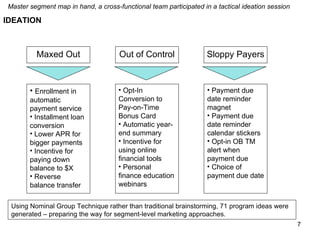
Maxed Out Enrollment in automatic payment service Installment loan conversion Lower APR for bigger payments Incentive for paying down balance to $X Reverse balance transfer Out of Control Opt-In Conversion to Pay-on-Time Bonus Card Automatic year-end summary Incentive for using online financial tools Personal finance education webinars Sloppy Payers Payment due date reminder magnet Payment due date reminder calendar stickers Opt-in OB TM alert when payment due Choice of payment due date Master segment map in hand, a cross-functional team participated in a tactical ideation session IDEATION Using Nominal Group Technique rather than traditional brainstorming, 71 program ideas were generated – preparing the way for segment-level marketing approaches.
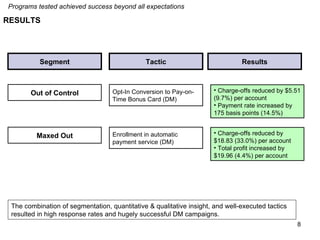
Programs tested achieved success beyond all expectations RESULTS The combination of segmentation, quantitative & qualitative insight, and well-executed tactics resulted in high response rates and hugely successful DM campaigns. Out of Control Opt-In Conversion to Pay-on-Time Bonus Card (DM) Charge-offs reduced by $5.51 (9.7%) per account Payment rate increased by 175 basis points (14.5%) Maxed Out Enrollment in automatic payment service (DM) Charge-offs reduced by $18.83 (33.0%) per account Total profit increased by $19.96 (4.4%) per account Segment Tactic Results

Behavioral Segmentation Case Study

  • 1.
  • 2.
    Continued Payment LowerLines & Balances Reduced Average $ CO Reduced Delinquency Intangible Tangible Tangible Brand Reinforcement Welcome Letter Educational Insert Series Quarterly Educational Newsletters Due Date Magnet/Stickers Line Decrease Incentive Payments above Min Pay Incentive DirectPay Enrollment Incentive Conversion to Pay-On-Time Bonus Card Proactive marketing to high credit risk cardmembers was uncharted territory for this issuer OVERALL STRATEGY – HIGH CREDIT RISK CARDMEMBERS While the Credit Policy department had extensive knowledge of these customers from a risk perspective, Marketing did not have even a basic understanding of this untouched group.
  • 3.
    Without further segmentation,a one-size-fits-all approach would have had limited success SEGMENTATION METHOLDOLOGY This group of cardmembers was unlikely to be monolithic – but they did have low credit scores in common. The segmentation was based on the same variables used in the credit risk models. Strong intention to have three segments of approximately equal size No “going-in” hypothesis about what homogeneous groups exist Best method to ensure homogeneity within and heterogeneity among clusters However, unsupervised learning resulted in explanation challenges K-Means CHAID Regression
  • 4.
    Marketing management wasused to simple x behavior in y months segment definitions SEGMENT DEFINITIONS The segmentation was originally rejected by senior management – but when creatively repackaged, it won wholehearted endorsement and became part of the common language.
  • 5.
    A complete pictureof the segments was pursued DESCRIBING & INSIGHT Hypotheses confirmed, all the pieces of the puzzle were fit together – creating the most comprehensive insight base for any group of this issuer’s cardmembers Qualitative Research Past Behavior Profile Segmentation Model Factors Modeled Predicted Behavior
  • 6.
    This diagram provideda visual guide to all three segments, distilling hundreds of known facts MASTER SEGMENT MAP Maxed Out Sloppy Payers Out of Control Lowest future balances Lowest future finance charges Lowest overlimit probability & fees Lowest 12- and 24-month charge off probability Lowest future charge off balances Highest CMV CMV characteristics History / profile characteristics Qualitative characteristics Stable high balance on-us and off-us for prior four quarters High on and off-us utilization (across all trades), stable for prior 4 quarters Highest overlimit incidences on-us and off-us Increasing payment rate Unrealistically optimistic No real plan to get out of debt Likely to have taken on debt with “eyes open” Least likely to be aware of debt problems Self-delusional / in denial Event-driven debt Troubled by debt / no way out No feeling of any progress Debt accumulated over a long period Motivated to do something More disorganized Not easily motivated See late fees as a part of a game vs. credit card May have irrational schemes for payment timing View Discover as generally helpful / flexible Don’t see themselves as irresponsible Not surprised by bills but still resent debt Segment definition characteristics Aggressive balance growth on-us and off-us over past 4 quarters – on-us utilization doubled in past 4 quarters Highest recent usage, including cash Decreasing payment rate Not in MO or OOC segments Highest delinquency 1-3+ cycles Highest 12- and 24-month charge off probability Much higher BT & Cash volume Highest Get More participation & CBB banks Most recently marketed to (BT, Cash, CBB offers) Lowest current APR Low sales volume Smaller purchase tickets Fewer purchase categories Lower recurring billing Very low CBB earning Nearly identical average FICO & Behavior scores (640 / 670 vs. 755 / 760 for Marketing Eligible) 90%+ Revolvers; <2% Transactors 50%+ e-mail address; 50%+ Acct Ctr registered Youngest Fewest # of cards Lowest % with auth buyer Lowest CBB banks Recent APR increase most likely Higher future balances Higher future charge off balances Higher on-us & off-us utilization (75% / 60+% vs. 30% / 45% for SP) Very high off-us balance ($20K+)
  • 7.
    Maxed Out Enrollmentin automatic payment service Installment loan conversion Lower APR for bigger payments Incentive for paying down balance to $X Reverse balance transfer Out of Control Opt-In Conversion to Pay-on-Time Bonus Card Automatic year-end summary Incentive for using online financial tools Personal finance education webinars Sloppy Payers Payment due date reminder magnet Payment due date reminder calendar stickers Opt-in OB TM alert when payment due Choice of payment due date Master segment map in hand, a cross-functional team participated in a tactical ideation session IDEATION Using Nominal Group Technique rather than traditional brainstorming, 71 program ideas were generated – preparing the way for segment-level marketing approaches.
  • 8.
    Programs tested achievedsuccess beyond all expectations RESULTS The combination of segmentation, quantitative & qualitative insight, and well-executed tactics resulted in high response rates and hugely successful DM campaigns. Out of Control Opt-In Conversion to Pay-on-Time Bonus Card (DM) Charge-offs reduced by $5.51 (9.7%) per account Payment rate increased by 175 basis points (14.5%) Maxed Out Enrollment in automatic payment service (DM) Charge-offs reduced by $18.83 (33.0%) per account Total profit increased by $19.96 (4.4%) per account Segment Tactic Results

Editor's Notes

  • #5 Cluster analysis Resulted in 4 segments as you see in these charts by 1,2, 3, 4. We decided to combine segments 1 &amp; 2 because: Small Q of CMs in segment 1 from a testing perspective – 110M vs. 400M in segment 2 Wouldn’t necessarily treat them differently or use different tools Combining segment 1 &amp; 2 into what we call Out of control CMs Use of cash and BT indicated a tendency to get into debt Relatively good payment behavior on-us, high off-us incidence of 2 &amp; 3 cycle delin Balances increasing, but pmt rate actually decreasing High credit limit may indicate that these accts were perceived to be less risky in the past, but over the past 12 months, have shown increasingly risky behavior Already bad when entered CAP Any delinquency should be taken seriously