Behavioural
Management

    Session

Bellatrix Ang,
MD
Special Needs Educator
SESSION AIM
• Understand “Behavioural Assumptions”

•    What is Functional Behavior Assessment (FBA) and
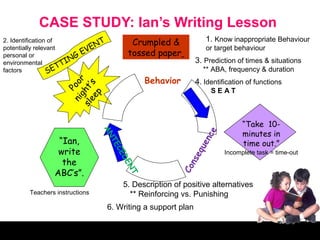
    how to use the components to develop a behavioral plan
    to support plan for the child.

• Identify & understand the factors that can set the events/
  antecedents of a challenging behavior

• Tips on Behavioral Management and plan


                                                               2
When will you say behaviour is
      inappropriate/ negative?
• If a child's behaviour keeps interrupting his or her own
  learning, or the learning of other children.
• Leads to injuries in self and others or a destruction to
  properties/environment.

What could be a solution for these??
 Behavioural Management/ Behavioural Plan


                                                             3
Behavioural Plan
• Is a tool used by the teachers to help the
  child learn better ways of behaving.
• Also used for behaviours that the child is
  already doing, or tends to do.
• Examples: reinforcements and discipline


                                               4
BEHAVIOR ASSUMPTIONS
• Behavior serves a function.
  * get something (attention, sensory stimulation, status, rewards,
  power), or escape or avoid something (pain, boredom, anxiety, fear,
  someone not liked).
• The function is valid for the individual
• Behavior is learned and can be UNLEARNED
• Problem behavior should first and foremost be
  viewed as a form of communication.
  * FBA allows you to look beyond the behavior to
  uncover the communicative message.


                                                                        5
Cont. BEHAVIOR
              ASSUMPTIONS
• Problem behavior results from a lack of basic social skills

• Problem behavior may be a source of internal pleasure
  for the individual

• Problem behavior can be something a student does
  when he or she does not know what else to do


                                                                6
Functional behavioural
             assessment
  • For many children with behaviour problems using the
     common strategy of consequences for misbehaviours
     does not seem to work… WHAT TO DO??
• Try to understand the child's behaviours.
• Look at each problem behaviour to figure out
                            WHO
                          WHEN,
                         WHERE,
                   WHY it is occurring


                                                          7
Steps of FBA
• Description of the inappropriate behavior

• Identification of potentially relevant personal or
  environmental factors

• Prediction of times and situations

• Identification of functions

• Description of positive alternatives

• Writing a support plan


                                                       8
CASE STUDY: Ian’s Writing Lesson
                                               Crumpled &              1. Know inappropriate Behaviour
                                   NT
2. Identification of
                                 E
                               EV
potentially relevant                                                   or target behaviour
personal or                G                  tossed paper
environmental         T IN                                          3. Prediction of times & situations
factors           SET                                                 ** ABA, frequency & duration
                                                    Behavior        4. Identification of functions
                        ni oor
                        ee s
                      sl ht’
                                                                         SEAT
                            P

                           p
                          g


                                                                                    “Take 10-
                                                                                    minutes in
                                    AN


                                                                    ce
                   “Ian,


                                                                  en
                                                                                    time out.”
                                        TE


                   write


                                                                qu
                                          CE


                                                                              Incomplete task = time-out


                                                                  e
                    the
                                             DE


                                                               ns
                                                N


                                                            Co
                  ABC’s”.
                                              T


                                            5. Description of positive alternatives
         Teachers instructions                ** Reinforcing vs. Punishing
                                        6. Writing a support plan

           Goal: Practice writing letters
Support Behavioural Plans


                            10
Setting Classroom Rules
• Making rules together @ beginning of the year

• Emphasize the concept of “Its your classroom”

• Encourage what “they should do” rather than should not do

• Go over rules periodically and let the child participate in
  reminding the rules to fellow classmates and be consistent
  with it


                                                                11
Positive Reinforcements
•   You deserve a hand
•   Surprise calendar
•   Monkey business
•   Token System and reward system

• Paper punch motivation
• Positive notes
• Hugs, smiles and praise


                                     12
Positive Discipline
• Silent Walker

• Writing list rules that are always broken.

• Time out-


                                               13
Modeling & Shaping
• Through Modelling, observation, and then
  imitation, children develop new behaviours

• SHAPING
  * Waiting for the appropriate target behaviour
  or something close to that behaviour to occur
  before reinforcing the behaviour
  * used to establish behaviours that are not
  routinely exhibited.


                                                   14
Resolving peer conflicts
• Deal with conflicts with peers through..
  * Let child understand that conflicts will arise
   & it is a natural part of life (share story)


                                                     15
Anger management
• Teaching children to understand feelings
  * Paper plate faces,
    greeting how are you today
  * Help student understand that feelings are
  not right or wrong and they can express their
  feelings without hurting others or losing
  control.


                                                  16
Create a positive Behaviour Modification Plan
• Step1: have an agreement
  * a picture chart is good for young children
  * Reward system-

• Step2: identify 5 behaviours you like to improve

• Step3: Agree with the child on how you will reward
  the behaviour.


                                                       17
Cont. Create a positive Behaviour…..
• Step4: Design simple & straight forward behaviour
  plan

• Step5: Give reward immediately after verbally
  recognizing a good behaviour

• Step6: Be consistent everyday

• Step7: Reward & praise the child’s progress
  throughout the day.

• Reminder: Don’t take away token or star for bad
  behaviour

                                                      18
Tips on Behavioural Management & Plan
• Remember!
   Children behave badly because they get attention
  * In all ages negative attention is always better than
   NOT getting attention at all

• Try to avoid rewarding bad behaviours (put the
  child down & walk away from him/her after
  repeatedly asking her to stop)


                                                           19
Thank you so much


                    20

Behavioral Management

  • 1.
    Behavioural Management Session Bellatrix Ang, MD Special Needs Educator
  • 2.
    SESSION AIM • Understand“Behavioural Assumptions” • What is Functional Behavior Assessment (FBA) and how to use the components to develop a behavioral plan to support plan for the child. • Identify & understand the factors that can set the events/ antecedents of a challenging behavior • Tips on Behavioral Management and plan 2
  • 3.
    When will yousay behaviour is inappropriate/ negative? • If a child's behaviour keeps interrupting his or her own learning, or the learning of other children. • Leads to injuries in self and others or a destruction to properties/environment. What could be a solution for these?? Behavioural Management/ Behavioural Plan 3
  • 4.
    Behavioural Plan • Isa tool used by the teachers to help the child learn better ways of behaving. • Also used for behaviours that the child is already doing, or tends to do. • Examples: reinforcements and discipline 4
  • 5.
    BEHAVIOR ASSUMPTIONS • Behaviorserves a function. * get something (attention, sensory stimulation, status, rewards, power), or escape or avoid something (pain, boredom, anxiety, fear, someone not liked). • The function is valid for the individual • Behavior is learned and can be UNLEARNED • Problem behavior should first and foremost be viewed as a form of communication. * FBA allows you to look beyond the behavior to uncover the communicative message. 5
  • 6.
    Cont. BEHAVIOR ASSUMPTIONS • Problem behavior results from a lack of basic social skills • Problem behavior may be a source of internal pleasure for the individual • Problem behavior can be something a student does when he or she does not know what else to do 6
  • 7.
    Functional behavioural assessment • For many children with behaviour problems using the common strategy of consequences for misbehaviours does not seem to work… WHAT TO DO?? • Try to understand the child's behaviours. • Look at each problem behaviour to figure out WHO WHEN, WHERE, WHY it is occurring 7
  • 8.
    Steps of FBA •Description of the inappropriate behavior • Identification of potentially relevant personal or environmental factors • Prediction of times and situations • Identification of functions • Description of positive alternatives • Writing a support plan 8
  • 9.
    CASE STUDY: Ian’sWriting Lesson Crumpled & 1. Know inappropriate Behaviour NT 2. Identification of E EV potentially relevant or target behaviour personal or G tossed paper environmental T IN 3. Prediction of times & situations factors SET ** ABA, frequency & duration Behavior 4. Identification of functions ni oor ee s sl ht’ SEAT P p g “Take 10- minutes in AN ce “Ian, en time out.” TE write qu CE Incomplete task = time-out e the DE ns N Co ABC’s”. T 5. Description of positive alternatives Teachers instructions ** Reinforcing vs. Punishing 6. Writing a support plan Goal: Practice writing letters
  • 10.
  • 11.
    Setting Classroom Rules •Making rules together @ beginning of the year • Emphasize the concept of “Its your classroom” • Encourage what “they should do” rather than should not do • Go over rules periodically and let the child participate in reminding the rules to fellow classmates and be consistent with it 11
  • 12.
    Positive Reinforcements • You deserve a hand • Surprise calendar • Monkey business • Token System and reward system • Paper punch motivation • Positive notes • Hugs, smiles and praise 12
  • 13.
    Positive Discipline • SilentWalker • Writing list rules that are always broken. • Time out- 13
  • 14.
    Modeling & Shaping •Through Modelling, observation, and then imitation, children develop new behaviours • SHAPING * Waiting for the appropriate target behaviour or something close to that behaviour to occur before reinforcing the behaviour * used to establish behaviours that are not routinely exhibited. 14
  • 15.
    Resolving peer conflicts •Deal with conflicts with peers through.. * Let child understand that conflicts will arise & it is a natural part of life (share story) 15
  • 16.
    Anger management • Teachingchildren to understand feelings * Paper plate faces, greeting how are you today * Help student understand that feelings are not right or wrong and they can express their feelings without hurting others or losing control. 16
  • 17.
    Create a positiveBehaviour Modification Plan • Step1: have an agreement * a picture chart is good for young children * Reward system- • Step2: identify 5 behaviours you like to improve • Step3: Agree with the child on how you will reward the behaviour. 17
  • 18.
    Cont. Create apositive Behaviour….. • Step4: Design simple & straight forward behaviour plan • Step5: Give reward immediately after verbally recognizing a good behaviour • Step6: Be consistent everyday • Step7: Reward & praise the child’s progress throughout the day. • Reminder: Don’t take away token or star for bad behaviour 18
  • 19.
    Tips on BehaviouralManagement & Plan • Remember! Children behave badly because they get attention * In all ages negative attention is always better than NOT getting attention at all • Try to avoid rewarding bad behaviours (put the child down & walk away from him/her after repeatedly asking her to stop) 19
  • 20.
    Thank you somuch 20

Editor's Notes

  • #10 Now take a moment and look this slide over. Ian has been instructed to begin working on his writing lesson. The antecedent is the instruction that teacher gives to Ian (you may sometimes hear this being referred to as the cue or discriminative stimulus) which is “Ian, write the ABC’s”. Ian’s behavior consisted of crumpling and tossing the paper. The consequence to Ian’s behavior was the teacher telling Ian to “Take 10-minutes in time out”. What the teacher was unaware of was the setting event of sleep deprivation that Ian experienced the night before. Having this information about the setting event explains more about why Ian crumpled and tossed the paper. Begin thinking about what the function of the behavior could be, we’ll come back to it in a minute.