Service Oriented Development with Windows Communication Foundation Jason Townsend
Evolution of Service Orientation
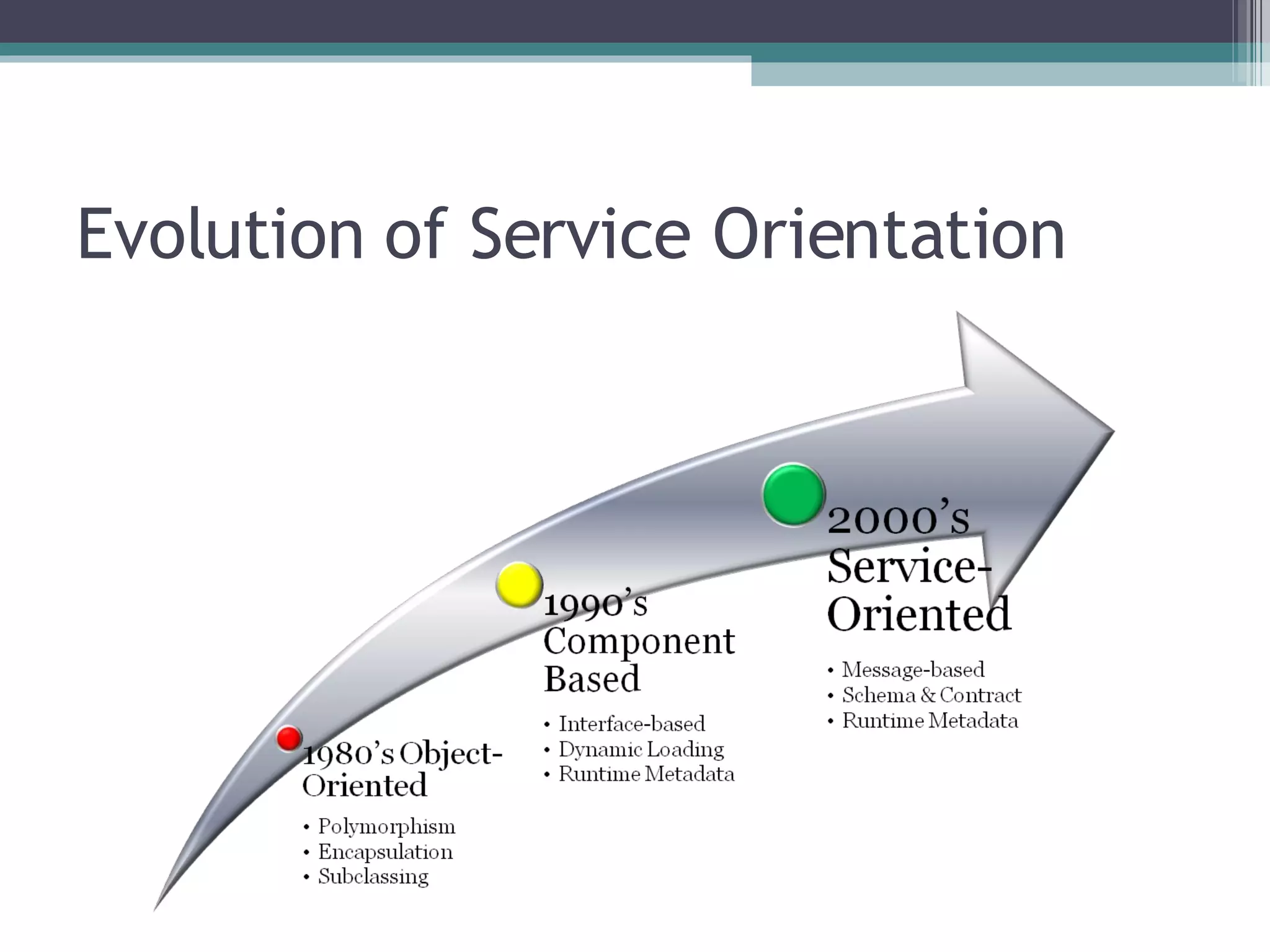
Object-Oriented Polymorphism Lets you treat derived class members just like their parent class' members. Process of using an operator or function in different ways for different set of inputs given. The ability of objects belonging to different types to respond to method calls of the same name, each one according to an appropriate type-specific behavior. Encapsulation Often used interchangeably with information hiding. Reduces software development risk by shifting the code's dependency on an uncertain implementation (design decision) onto a well-defined interface. Subclassing Subclass is a class that inherits some properties from its superclass.
Component-Based Interface-based Insists that Interfaces are to be added to components.  The entire system is thus viewed as Components and the interfaces that helps them to coact. Dynamic Loading Dynamic loading is a mechanism by which a computer program can, at runtime, load a library (or other binary) into memory, retrieve the addresses of functions and variables contained in the library, execute those functions or access those variables, and unload the library from memory. Runtime Metadata Enabled the ability to build systems that dynamically loaded and bound to new functionality at runtime.
Service-Oriented Message-based Communication is made by the sending of messages to recipients.  Forms of messages include function invocation, signals, and data packets. Schema and Contract Use schema to describe the structure of messages Use contract to define acceptable message exchange patterns. Binding via Policy Use policy to define service semantics used for binding.
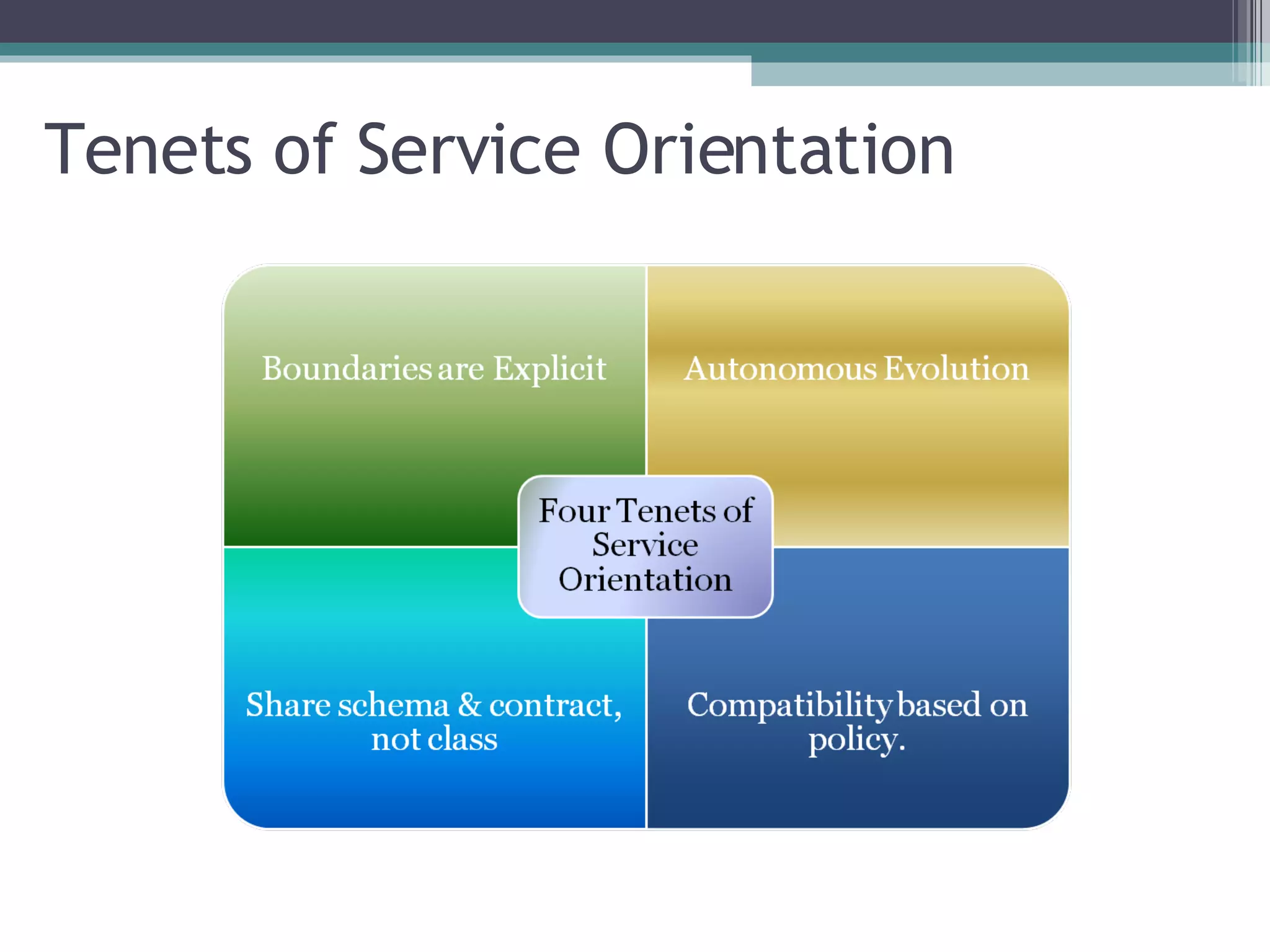
Tenets of Service Orientation
Boundaries are Explicit Based on the underlying concept of encapsulation, this tenet specifies the publishing and consumption of functionality as sets of services that abstract their underlying implementation.  With WCF, the attribute-based programming enables developers to explicitly define external service contracts.  Without explicitly defining these, nothing within the class will be exposed publicly. WCF provides an opt-in model for explicitly defining service boundaries.
Autonomous Evolution Services are Autonomous.  Autonomy We design the system to support the inevitable evolution of the service’s implementation over time.  As we build our services, we need to assume that their internal implementation will evolve (become versioned) over time and that our services as well as the services on which we depend could change location at (almost) any time.
Share Schema & Contract, Not Class Services share schema and contract, not class.  This is how ASMX works. Service publishes a contract (WSDL, XSD) No types are shared between service and its client (by default) Neither service requires knowledge of each others’ internal workings in order to exchange data.
Compatibility Based on Policy Service compatibility is determined based on policy. Services communicate through dynamically negotiated communications channels that support the necessary semantics. Service policy statements created automatically based on configuration, class attributes, and method signatures. Client channels automatically configured via retrieved service policy.
Why Service Orientation? Facilitates loosely coupled standards based integration. Enables independence in deployment, versioning, and management of the client (caller) and the server (called). Promotes reuse of application investments over time.
WCF Design Goals
WS-* Used as a reference to many web service based standards covering topics such as: XML Specifications Messaging Specifications Metadata Exchange Specifications Security Specifications Privacy Reliable Messaging Specifications Resource Specifications Web Services Interoperability organization (WS-I) Specifications Business Process Specifications Transaction Specifications Management Specifications
XML Specifications XML (eXtensible Markup Language)  XML Namespaces  XML Schema  XPath  XQuery  XML Information Set  XInclude  XML Pointer
Messaging Specifications Simple Object Access Protocol (SOAP)  SOAP Message Transmission Optimization Mechanism  WS-Notification  WS-BaseNotification  WS-Topics  WS-BrokeredNotification  WS-Addressing  WS-Transfer  WS-Eventing  WS-Enumeration
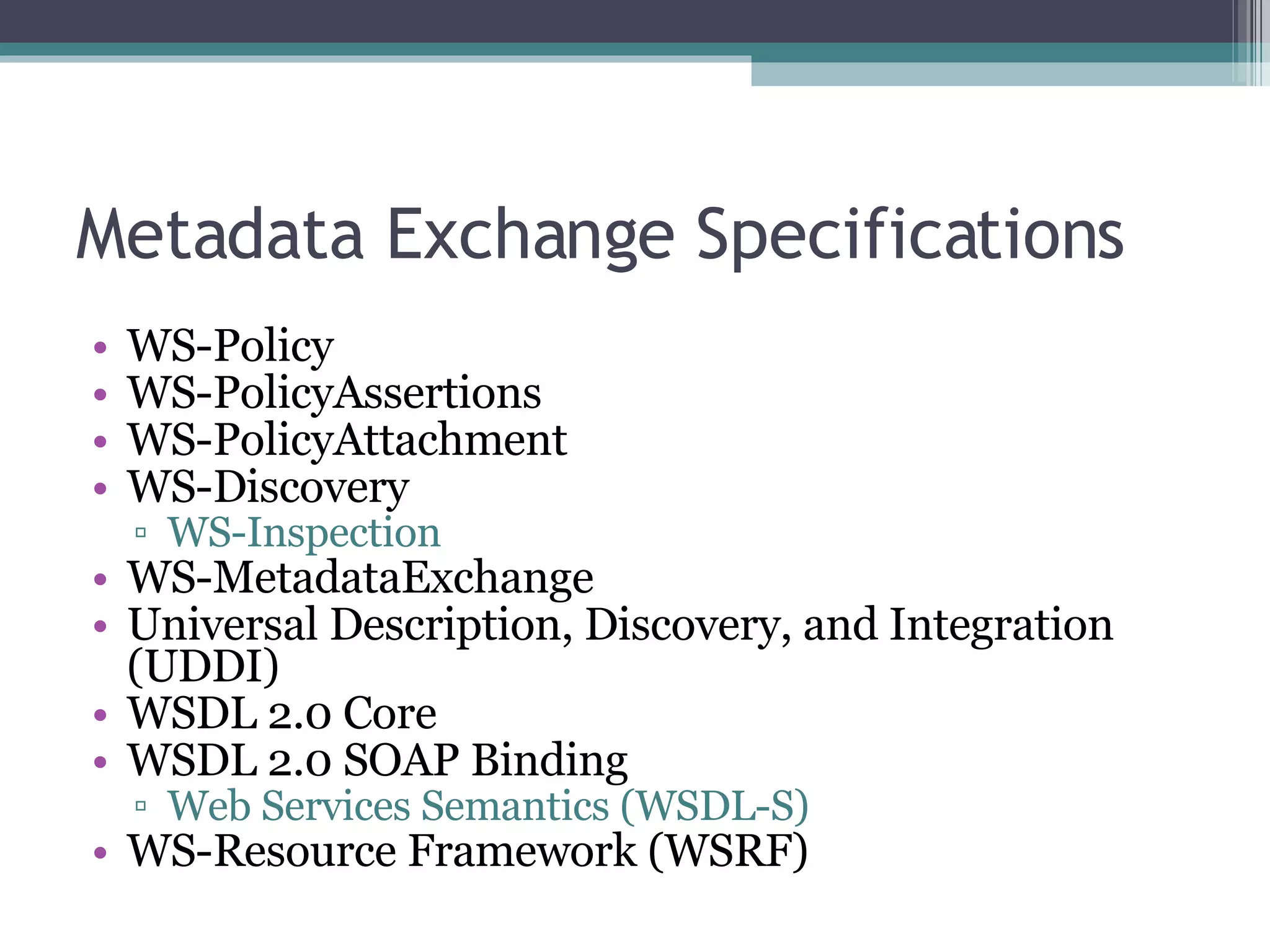
Metadata Exchange Specifications WS-Policy  WS-PolicyAssertions  WS-PolicyAttachment  WS-Discovery  WS-Inspection  WS-MetadataExchange  Universal Description, Discovery, and Integration (UDDI)  WSDL 2.0 Core  WSDL 2.0 SOAP Binding  Web Services Semantics (WSDL-S)  WS-Resource Framework (WSRF)
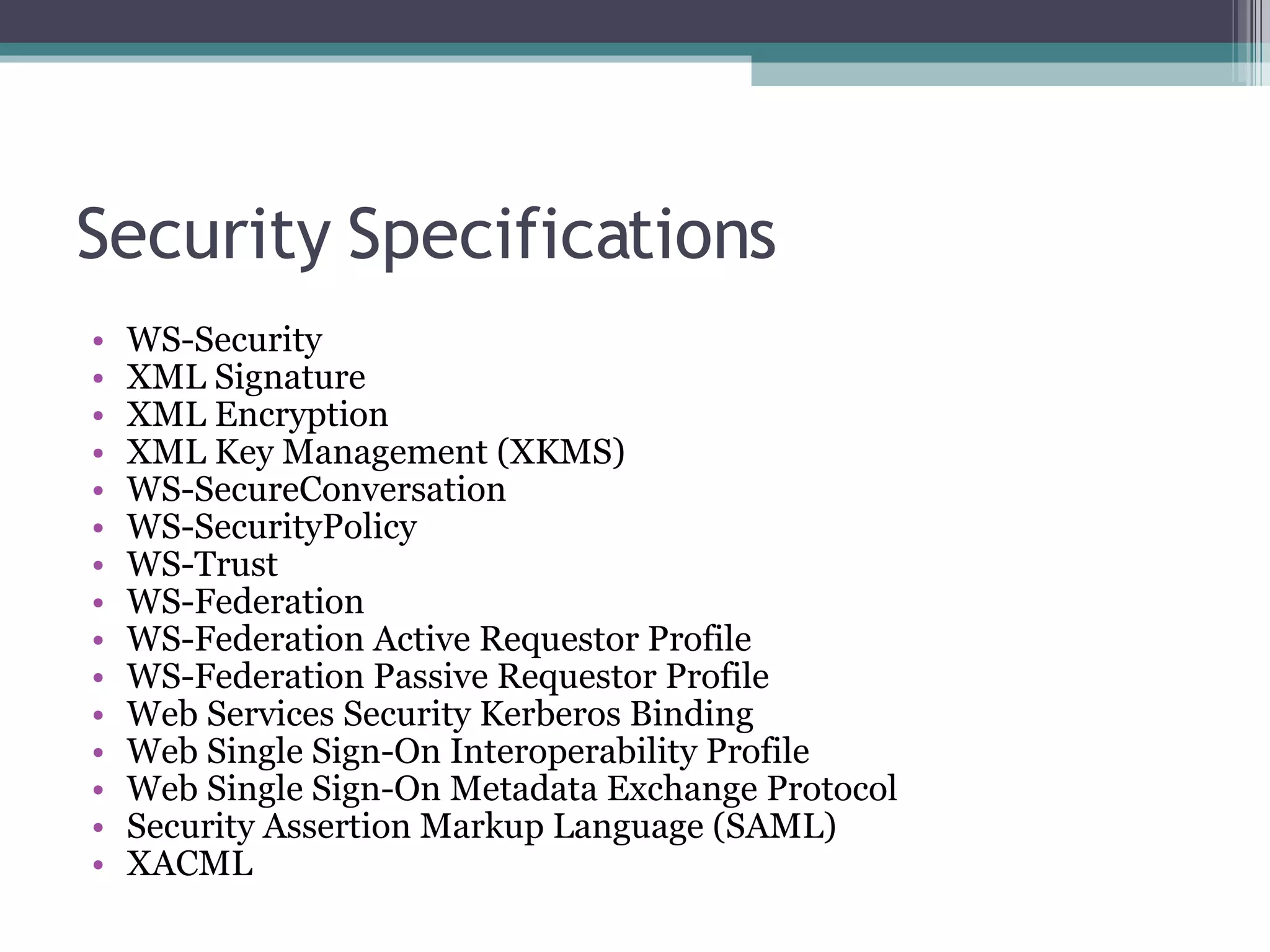
Security Specifications WS-Security  XML Signature  XML Encryption  XML Key Management (XKMS)  WS-SecureConversation  WS-SecurityPolicy  WS-Trust  WS-Federation  WS-Federation Active Requestor Profile  WS-Federation Passive Requestor Profile  Web Services Security Kerberos Binding  Web Single Sign-On Interoperability Profile  Web Single Sign-On Metadata Exchange Protocol  Security Assertion Markup Language (SAML)  XACML
Privacy P3P  Reliable Messaging WS-ReliableMessaging  WS-Reliability  WS-RM Policy Assertion
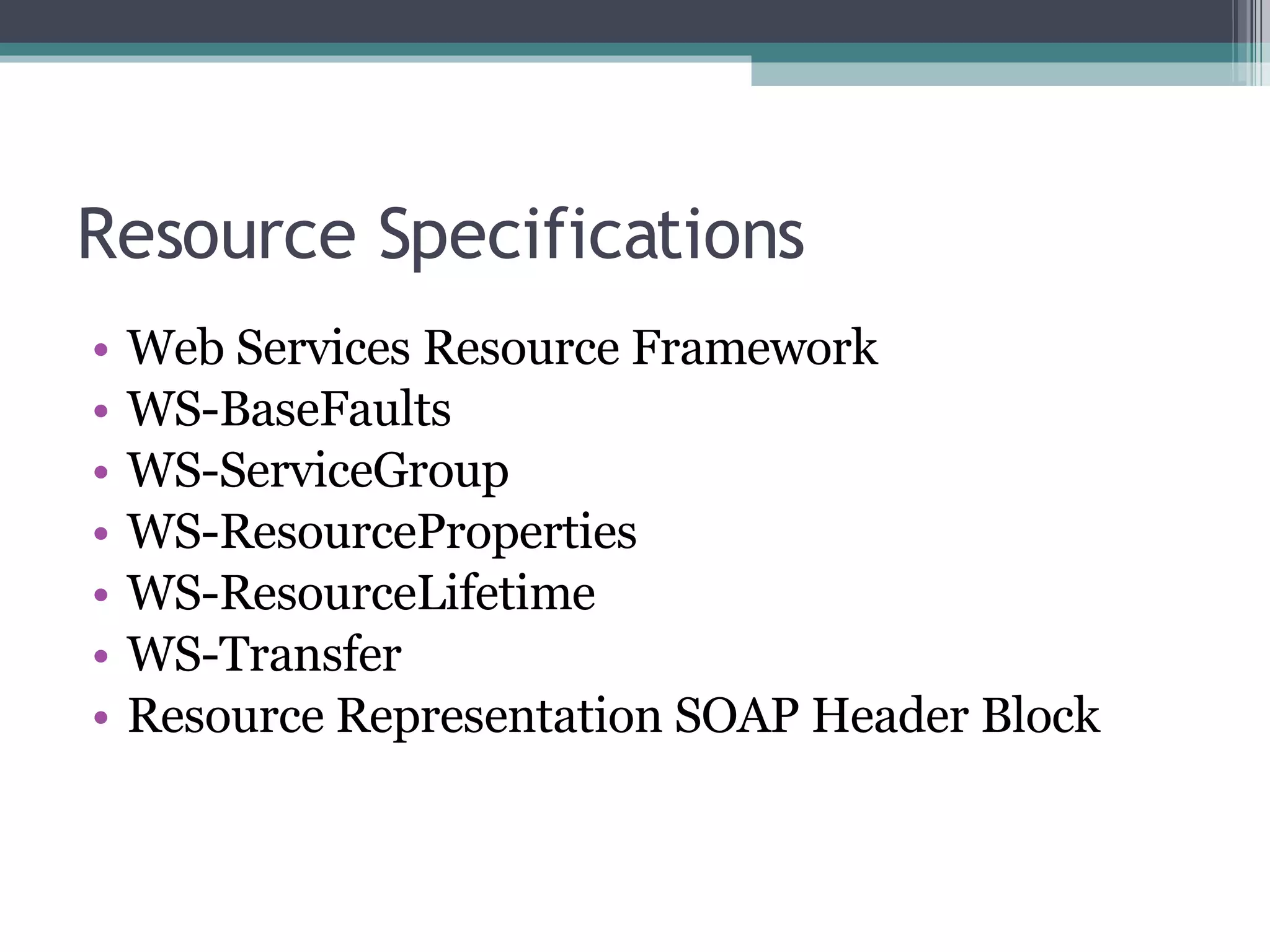
Resource Specifications Web Services Resource Framework  WS-BaseFaults  WS-ServiceGroup  WS-ResourceProperties  WS-ResourceLifetime  WS-Transfer  Resource Representation SOAP Header Block
Web Services Interoperability Organization (WS-I) Specifications WS-I Basic Profile  WS-I Basic Security Profile  Simple Soap Binding Profile
Business Process Specifications WS-BPEL  WS-CDL  Web Services Choreography Interface  WS-Choreography  XML Process Definition Language
Transaction Specifications WS-BusinessActivity  WS-AtomicTransaction  WS-Coordination  WS-CAF  WS-Transaction  WS-Context  WS-CF
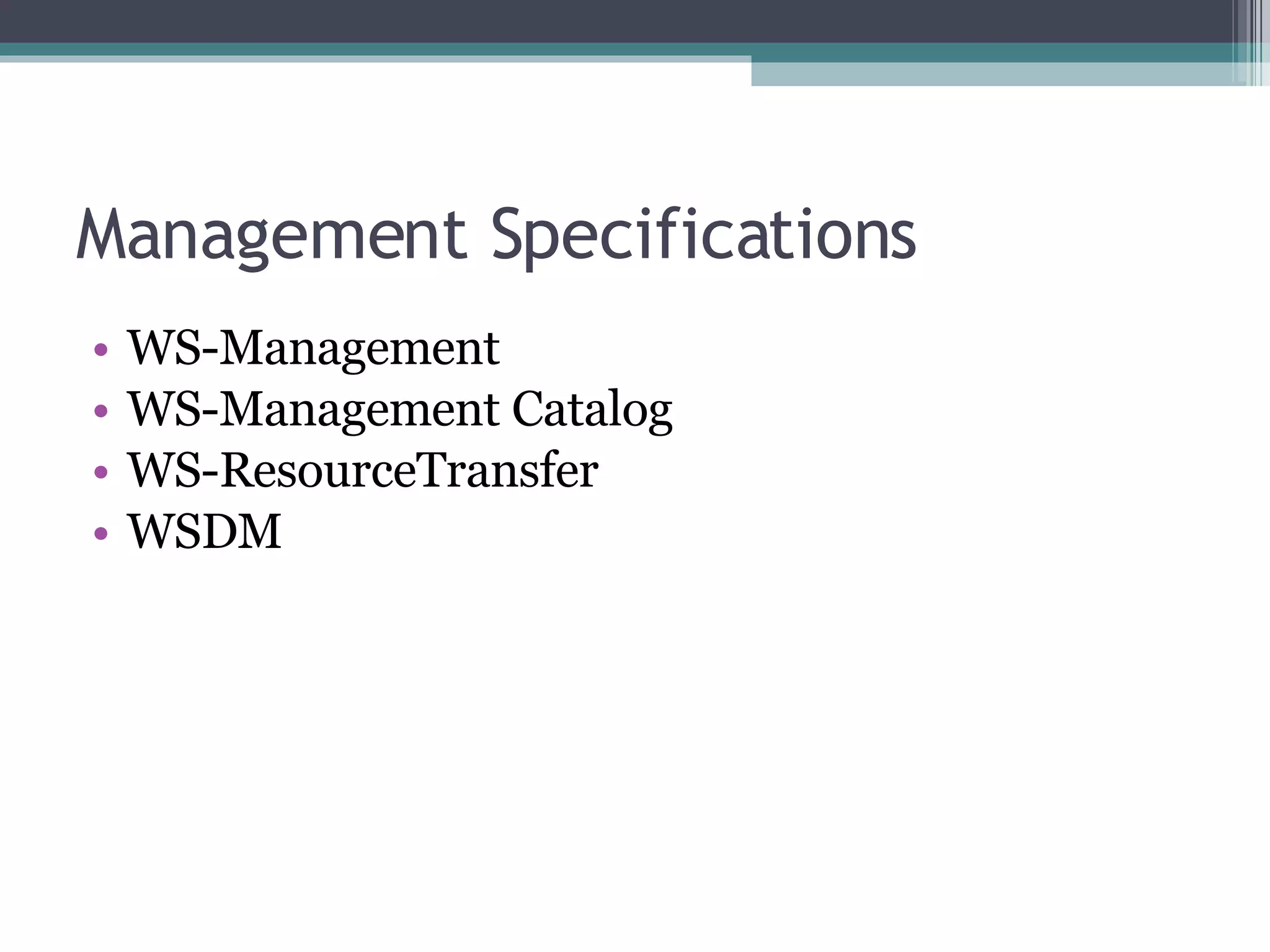
Management Specifications WS-Management  WS-Management Catalog  WS-ResourceTransfer  WSDM
WCF Make WS-* Easy Binding selection abstracts WS-* internals WCF has Oasis Standard Bindings (3.5) Single Object model for Transports Choreographies Message Exchange Patterns (MEPs) Etc…
WCF Offers Features You Need Logging Tracing Instance Control Throttling Rich Configuration Extensibility Hosting Options And More….
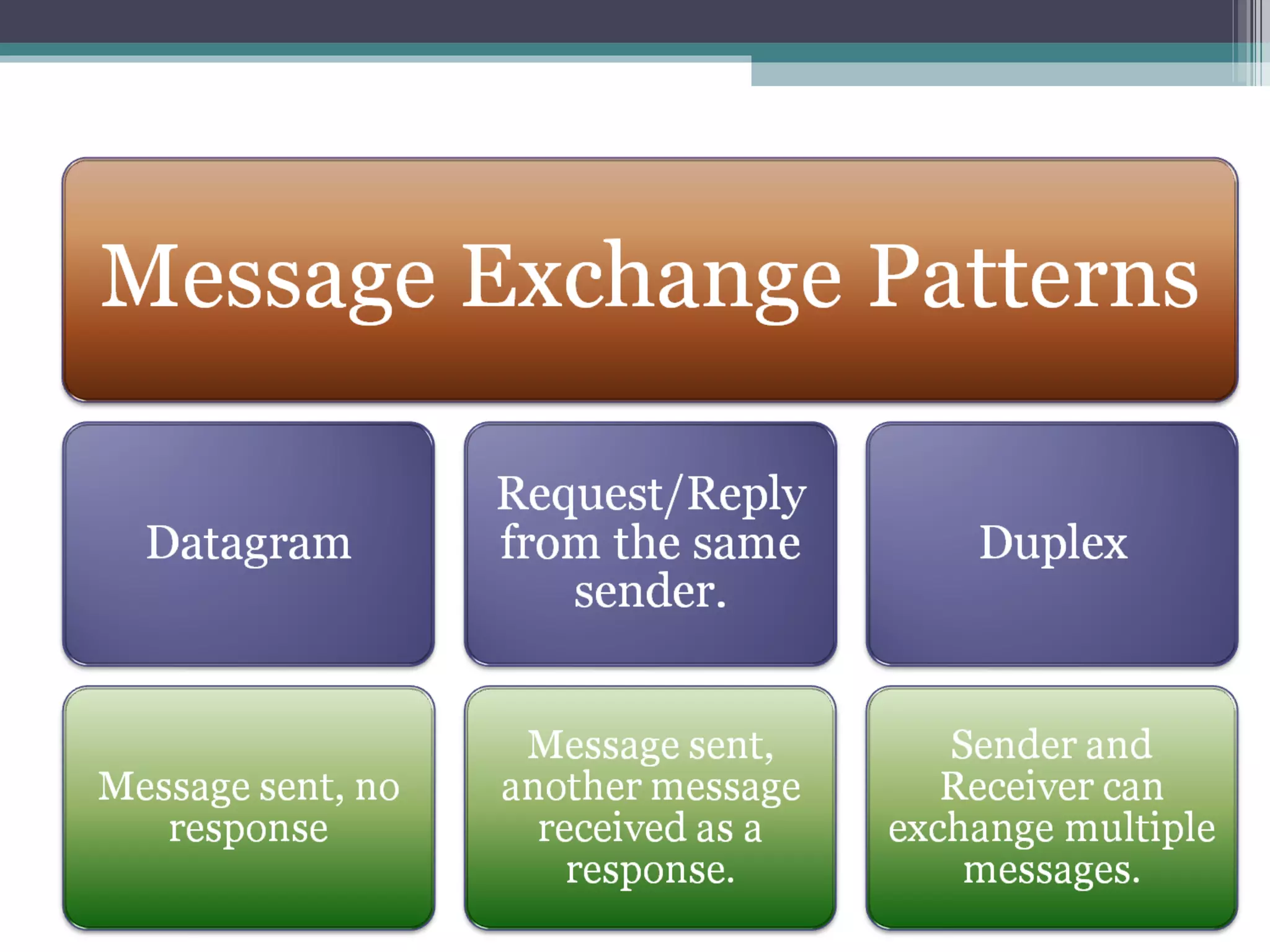
Communicating through Messages Messages travel between communication parties Messages can be grouped into different message exchange patterns (MEPs) MEPs can be implemented synchronously or asynchronously WCF supports different MEPs WCF MEPs implemented by different kinds of channels
 
Channel Shaping Possible mismatch: Physical transport Logical message exchange patterns Channel shapes implemented in transport bindings Express support for Message Exchange Patterns WCF ServiceModel analyzes contract Which channel shapes will be supported? ServiceChannelFactory.BuildChannelFactory and DispatcherBuilder.GetSupportedChannelTypes have the details
Types of Contracts Service Contract Operations Behaviors Communication Shape Data Contract Schema and Versioning Strategy Message Contract Application specific headers and unwrapped body content
Contracts (Request-Reply) Most commonly used MEP It is easy to use and looks natural R/R can be implemented in WCF by several approaches Parameter list DataContract MessageContract Message Mind the “public face” of contracts, i.e. the metadata
Contracts (One-Way) One Way operations smell more feasible when decoupling is goal No return values, rather void Use IsOneWay property of OperationContract OneWay operations can still block Not really fire-and-forget semantics
Contracts (Duplex) Having peer communication parties Blurring the line between client and server Use CallbackContract property of ServiceContract Operations in contracts can be one-way, but need no to be If using non-one-way beware of threading issues
Contracts (Streaming) Buffered communication can be very expensive with large data WCF offers streamed transfer Contract parameters must have certain shape Use Message, IXmlSerializable or System.IO.Stream or derivate as type Use MessageContract Headers will be buffered Body as System.IO.Stream will be streamed Only works with appropriate binding
Bindings (Request-Reply) Almost all out-of-the-box bindings support request-reply MSMQ-based bindings do not For all bindings and MEPs: Beware of default min/max values on binding elements for e.g. message sizes and buffers and timeouts Beware of possible throttles on service behavior
Bindings (One-Way) All bindings support one-way operations Use OneWayBindingElement for custom bindings to shape channel Performs a message-level shape change  Can take a IDuplexSessionChannel or a IRequestChannel and expose it as a IOutputChannel, or conversely it can take a IDuplexSessionChannel or a IReplyChannel and expose it as a IInputChannel
Bindings (Duplex) Duplex out-of-the-box netTcp wsDualHttp netNamedPipe netPeerTcp Manual duplex session-less, e.g. <compositeDuplex /> <oneWay /> <binaryMessageEncoding /> <httpTransport />
Bindings (Streaming) Enable streaming on the baked-in bindings All standard bindings besides MSMQ-based Enable streaming on the transport binding element, e.g. <httpTransport transferMode=„Streamed“ /> Possible transferMode values Buffered Streamed StreamedRequest StreamedResponse Only transport security and no reliable sessions allowed
MSMQ Transport MSMQ is different – always has been Duplex Message Exchange Patern over MSMQ-based binding can be achieved manually: Leverage message headers Access headers through OperationContext in user code Access headers through message inspectors in ServiceModel extensions Use GUID to correlate messages
REST Focus is on the URI HTTP GET  http://dog.com/dogs.id/12 HTTP POST  http://dog.com/updateDog GET is special, other verbs are application specific GET verb always means “View It” PUT/POST/DELETE mean “Do It” but depend on client implementation Content Type is the data model XML JSON Binary Etc... Support built on via WCF extensibility points
WS-* versus REST Which is better? Each has strengths: REST: proliferation of clients, easy to understand Flash Silverlight Javascript Etc… WS-*: rich Messaging Exchange patterns, Topologies, and Choreographies
WCF Security Claims based end-to-end security Secure end-to-end message exchanges Secure access to resources Record resource access requests X509, Username/Password, Kerberos, SAML, and custom credentials Message Security Confidentiality and Integrity Transport or Message Level Access to resources Authentication and Authorization
WCF Reliability and Transactions End-to-End Reliable Messaging In-Order guarantees Exactly once guarantees Transport-Independent Sessions Integration with ASP.NET Sessions in IIS-Hosted compatibility mode Transactions Guaranteed atomic success or failure across services
WCF Instancing, Concurrency, and Sessions Service classes can be instantiated Singleton Per-Call Per-Session Shareable Service code can be either: Single-threaded Re-entrant Multi-threaded
WCF Summary WCF is the future of distributed computing It combines the best of all existing Microsoft distributed computing stacks It uses WS-* standards for interoperability and .NET value-add for performance and integration with existing solutions.
 
Further Resources My Blog http://www.okcodemonkey.com Linkedin http://www.linkedin.com/in/okcodemonkey Bartlesville .NET User Group http://www.bdnug.com Twitter http://twitter.com/okcodemonkey Email [email_address]

Service Oriented Development With Windows Communication Foundation 2003

  • 1.
    Service Oriented Developmentwith Windows Communication Foundation Jason Townsend
  • 2.
  • 3.
    Object-Oriented Polymorphism Letsyou treat derived class members just like their parent class' members. Process of using an operator or function in different ways for different set of inputs given. The ability of objects belonging to different types to respond to method calls of the same name, each one according to an appropriate type-specific behavior. Encapsulation Often used interchangeably with information hiding. Reduces software development risk by shifting the code's dependency on an uncertain implementation (design decision) onto a well-defined interface. Subclassing Subclass is a class that inherits some properties from its superclass.
  • 4.
    Component-Based Interface-based Insiststhat Interfaces are to be added to components. The entire system is thus viewed as Components and the interfaces that helps them to coact. Dynamic Loading Dynamic loading is a mechanism by which a computer program can, at runtime, load a library (or other binary) into memory, retrieve the addresses of functions and variables contained in the library, execute those functions or access those variables, and unload the library from memory. Runtime Metadata Enabled the ability to build systems that dynamically loaded and bound to new functionality at runtime.
  • 5.
    Service-Oriented Message-based Communicationis made by the sending of messages to recipients. Forms of messages include function invocation, signals, and data packets. Schema and Contract Use schema to describe the structure of messages Use contract to define acceptable message exchange patterns. Binding via Policy Use policy to define service semantics used for binding.
  • 6.
    Tenets of ServiceOrientation
  • 7.
    Boundaries are ExplicitBased on the underlying concept of encapsulation, this tenet specifies the publishing and consumption of functionality as sets of services that abstract their underlying implementation. With WCF, the attribute-based programming enables developers to explicitly define external service contracts. Without explicitly defining these, nothing within the class will be exposed publicly. WCF provides an opt-in model for explicitly defining service boundaries.
  • 8.
    Autonomous Evolution Servicesare Autonomous. Autonomy We design the system to support the inevitable evolution of the service’s implementation over time. As we build our services, we need to assume that their internal implementation will evolve (become versioned) over time and that our services as well as the services on which we depend could change location at (almost) any time.
  • 9.
    Share Schema &Contract, Not Class Services share schema and contract, not class. This is how ASMX works. Service publishes a contract (WSDL, XSD) No types are shared between service and its client (by default) Neither service requires knowledge of each others’ internal workings in order to exchange data.
  • 10.
    Compatibility Based onPolicy Service compatibility is determined based on policy. Services communicate through dynamically negotiated communications channels that support the necessary semantics. Service policy statements created automatically based on configuration, class attributes, and method signatures. Client channels automatically configured via retrieved service policy.
  • 11.
    Why Service Orientation?Facilitates loosely coupled standards based integration. Enables independence in deployment, versioning, and management of the client (caller) and the server (called). Promotes reuse of application investments over time.
  • 12.
  • 13.
    WS-* Used asa reference to many web service based standards covering topics such as: XML Specifications Messaging Specifications Metadata Exchange Specifications Security Specifications Privacy Reliable Messaging Specifications Resource Specifications Web Services Interoperability organization (WS-I) Specifications Business Process Specifications Transaction Specifications Management Specifications
  • 14.
    XML Specifications XML(eXtensible Markup Language) XML Namespaces XML Schema XPath XQuery XML Information Set XInclude XML Pointer
  • 15.
    Messaging Specifications SimpleObject Access Protocol (SOAP) SOAP Message Transmission Optimization Mechanism WS-Notification WS-BaseNotification WS-Topics WS-BrokeredNotification WS-Addressing WS-Transfer WS-Eventing WS-Enumeration
  • 16.
    Metadata Exchange SpecificationsWS-Policy WS-PolicyAssertions WS-PolicyAttachment WS-Discovery WS-Inspection WS-MetadataExchange Universal Description, Discovery, and Integration (UDDI) WSDL 2.0 Core WSDL 2.0 SOAP Binding Web Services Semantics (WSDL-S) WS-Resource Framework (WSRF)
  • 17.
    Security Specifications WS-Security XML Signature XML Encryption XML Key Management (XKMS) WS-SecureConversation WS-SecurityPolicy WS-Trust WS-Federation WS-Federation Active Requestor Profile WS-Federation Passive Requestor Profile Web Services Security Kerberos Binding Web Single Sign-On Interoperability Profile Web Single Sign-On Metadata Exchange Protocol Security Assertion Markup Language (SAML) XACML
  • 18.
    Privacy P3P Reliable Messaging WS-ReliableMessaging WS-Reliability WS-RM Policy Assertion
  • 19.
    Resource Specifications WebServices Resource Framework WS-BaseFaults WS-ServiceGroup WS-ResourceProperties WS-ResourceLifetime WS-Transfer Resource Representation SOAP Header Block
  • 20.
    Web Services InteroperabilityOrganization (WS-I) Specifications WS-I Basic Profile WS-I Basic Security Profile Simple Soap Binding Profile
  • 21.
    Business Process SpecificationsWS-BPEL WS-CDL Web Services Choreography Interface WS-Choreography XML Process Definition Language
  • 22.
    Transaction Specifications WS-BusinessActivity WS-AtomicTransaction WS-Coordination WS-CAF WS-Transaction WS-Context WS-CF
  • 23.
    Management Specifications WS-Management WS-Management Catalog WS-ResourceTransfer WSDM
  • 24.
    WCF Make WS-*Easy Binding selection abstracts WS-* internals WCF has Oasis Standard Bindings (3.5) Single Object model for Transports Choreographies Message Exchange Patterns (MEPs) Etc…
  • 25.
    WCF Offers FeaturesYou Need Logging Tracing Instance Control Throttling Rich Configuration Extensibility Hosting Options And More….
  • 26.
    Communicating through MessagesMessages travel between communication parties Messages can be grouped into different message exchange patterns (MEPs) MEPs can be implemented synchronously or asynchronously WCF supports different MEPs WCF MEPs implemented by different kinds of channels
  • 27.
  • 28.
    Channel Shaping Possiblemismatch: Physical transport Logical message exchange patterns Channel shapes implemented in transport bindings Express support for Message Exchange Patterns WCF ServiceModel analyzes contract Which channel shapes will be supported? ServiceChannelFactory.BuildChannelFactory and DispatcherBuilder.GetSupportedChannelTypes have the details
  • 29.
    Types of ContractsService Contract Operations Behaviors Communication Shape Data Contract Schema and Versioning Strategy Message Contract Application specific headers and unwrapped body content
  • 30.
    Contracts (Request-Reply) Mostcommonly used MEP It is easy to use and looks natural R/R can be implemented in WCF by several approaches Parameter list DataContract MessageContract Message Mind the “public face” of contracts, i.e. the metadata
  • 31.
    Contracts (One-Way) OneWay operations smell more feasible when decoupling is goal No return values, rather void Use IsOneWay property of OperationContract OneWay operations can still block Not really fire-and-forget semantics
  • 32.
    Contracts (Duplex) Havingpeer communication parties Blurring the line between client and server Use CallbackContract property of ServiceContract Operations in contracts can be one-way, but need no to be If using non-one-way beware of threading issues
  • 33.
    Contracts (Streaming) Bufferedcommunication can be very expensive with large data WCF offers streamed transfer Contract parameters must have certain shape Use Message, IXmlSerializable or System.IO.Stream or derivate as type Use MessageContract Headers will be buffered Body as System.IO.Stream will be streamed Only works with appropriate binding
  • 34.
    Bindings (Request-Reply) Almostall out-of-the-box bindings support request-reply MSMQ-based bindings do not For all bindings and MEPs: Beware of default min/max values on binding elements for e.g. message sizes and buffers and timeouts Beware of possible throttles on service behavior
  • 35.
    Bindings (One-Way) Allbindings support one-way operations Use OneWayBindingElement for custom bindings to shape channel Performs a message-level shape change Can take a IDuplexSessionChannel or a IRequestChannel and expose it as a IOutputChannel, or conversely it can take a IDuplexSessionChannel or a IReplyChannel and expose it as a IInputChannel
  • 36.
    Bindings (Duplex) Duplexout-of-the-box netTcp wsDualHttp netNamedPipe netPeerTcp Manual duplex session-less, e.g. <compositeDuplex /> <oneWay /> <binaryMessageEncoding /> <httpTransport />
  • 37.
    Bindings (Streaming) Enablestreaming on the baked-in bindings All standard bindings besides MSMQ-based Enable streaming on the transport binding element, e.g. <httpTransport transferMode=„Streamed“ /> Possible transferMode values Buffered Streamed StreamedRequest StreamedResponse Only transport security and no reliable sessions allowed
  • 38.
    MSMQ Transport MSMQis different – always has been Duplex Message Exchange Patern over MSMQ-based binding can be achieved manually: Leverage message headers Access headers through OperationContext in user code Access headers through message inspectors in ServiceModel extensions Use GUID to correlate messages
  • 39.
    REST Focus ison the URI HTTP GET http://dog.com/dogs.id/12 HTTP POST http://dog.com/updateDog GET is special, other verbs are application specific GET verb always means “View It” PUT/POST/DELETE mean “Do It” but depend on client implementation Content Type is the data model XML JSON Binary Etc... Support built on via WCF extensibility points
  • 40.
    WS-* versus RESTWhich is better? Each has strengths: REST: proliferation of clients, easy to understand Flash Silverlight Javascript Etc… WS-*: rich Messaging Exchange patterns, Topologies, and Choreographies
  • 41.
    WCF Security Claimsbased end-to-end security Secure end-to-end message exchanges Secure access to resources Record resource access requests X509, Username/Password, Kerberos, SAML, and custom credentials Message Security Confidentiality and Integrity Transport or Message Level Access to resources Authentication and Authorization
  • 42.
    WCF Reliability andTransactions End-to-End Reliable Messaging In-Order guarantees Exactly once guarantees Transport-Independent Sessions Integration with ASP.NET Sessions in IIS-Hosted compatibility mode Transactions Guaranteed atomic success or failure across services
  • 43.
    WCF Instancing, Concurrency,and Sessions Service classes can be instantiated Singleton Per-Call Per-Session Shareable Service code can be either: Single-threaded Re-entrant Multi-threaded
  • 44.
    WCF Summary WCFis the future of distributed computing It combines the best of all existing Microsoft distributed computing stacks It uses WS-* standards for interoperability and .NET value-add for performance and integration with existing solutions.
  • 45.
  • 46.
    Further Resources MyBlog http://www.okcodemonkey.com Linkedin http://www.linkedin.com/in/okcodemonkey Bartlesville .NET User Group http://www.bdnug.com Twitter http://twitter.com/okcodemonkey Email [email_address]