Changing Teaching And Learning In The Primary School Rosemary Webb
Changing Teaching And Learning In The Primary School Rosemary Webb
Changing Teaching And Learning In The Primary School Rosemary Webb
Changing Teaching And Learning In The Primary School Rosemary Webb
Changing Teaching And Learning In The Primary School Rosemary Webb
1.
Changing Teaching AndLearning In The Primary
School Rosemary Webb download
https://ebookbell.com/product/changing-teaching-and-learning-in-
the-primary-school-rosemary-webb-2322250
Explore and download more ebooks at ebookbell.com
2.
Here are somerecommended products that we believe you will be
interested in. You can click the link to download.
Formative Assessment In United States Classrooms Changing The
Landscape Of Teaching And Learning 1st Ed Cathy Box
https://ebookbell.com/product/formative-assessment-in-united-states-
classrooms-changing-the-landscape-of-teaching-and-learning-1st-ed-
cathy-box-7321148
The Digital Turn In Higher Education International Perspectives On
Learning And Teaching In A Changing World 1st Edition David Kergel Et
Al Eds
https://ebookbell.com/product/the-digital-turn-in-higher-education-
international-perspectives-on-learning-and-teaching-in-a-changing-
world-1st-edition-david-kergel-et-al-eds-6791920
Didactics In A Changing World European Perspectives On Teaching
Learning And The Curriculum Florence Ligozat
https://ebookbell.com/product/didactics-in-a-changing-world-european-
perspectives-on-teaching-learning-and-the-curriculum-florence-
ligozat-49045032
Culturally Sustaining Pedagogies Teaching And Learning For Justice In
A Changing World Django Paris
https://ebookbell.com/product/culturally-sustaining-pedagogies-
teaching-and-learning-for-justice-in-a-changing-world-django-
paris-6851160
3.
Culturally Sustaining PedagogiesTeaching And Learning For Justice In
A Changing World Language And Literacy Series Django Paris H Samy Alim
https://ebookbell.com/product/culturally-sustaining-pedagogies-
teaching-and-learning-for-justice-in-a-changing-world-language-and-
literacy-series-django-paris-h-samy-alim-232793874
English Language Teacher Education In Changing Times Perspectives
Strategies And New Ways Of Teaching And Learning 1st Edition Liz
England
https://ebookbell.com/product/english-language-teacher-education-in-
changing-times-perspectives-strategies-and-new-ways-of-teaching-and-
learning-1st-edition-liz-england-49032126
Asking Better Questions Teaching And Learning For A Changing World 3rd
Edition Juliana Saxton Carole Miller Linda Laidlaw Joanne Omara
https://ebookbell.com/product/asking-better-questions-teaching-and-
learning-for-a-changing-world-3rd-edition-juliana-saxton-carole-
miller-linda-laidlaw-joanne-omara-51644566
Objects To Learn About And Objects For Learning 2 Which Teaching
Practices For Which Issues Volume 11 Jol Bisault
https://ebookbell.com/product/objects-to-learn-about-and-objects-for-
learning-2-which-teaching-practices-for-which-issues-volume-11-jol-
bisault-44785954
Objects To Learn About And Objects For Learning 1 Which Teaching
Practices For Which Issues Joel Bisault
https://ebookbell.com/product/objects-to-learn-about-and-objects-for-
learning-1-which-teaching-practices-for-which-issues-joel-
bisault-49163638
Open University Press
McGraw-HillEducation
McGraw-Hill House
Shoppenhangers Road
Maidenhead
Berkshire
England
SL6 2QL
email: enquiries@openup.co.uk
world wide web: www.openup.co.uk
and Two Penn Plaza, New York, NY 10121–2289, USA
First published 2006
Copyright The Editors and Contributors # — 2006
All rights reserved. Except for the quotation of short passages for the purposes of
criticism and review, no part of this publication may be reproduced, stored in a
retrieval system, or transmitted, in any form, or by any means, electronic,
mechanical, photocopying, recording or otherwise, without the prior permission
of the publisher or a licence from the Copyright Licensing Agency Limited. Details
of such licences (for reprographic reproduction) may be obtained from the
Copyright Licensing Agency Ltd of 90 Tottenham Court Road, London, W1T 4LP.
A catalogue record of this book is available from the British Library
ISBN 10: 0335 219500 (PB) 0335 219519 (HB)
ISBN 13: 978 0 335 219506 (PB) 9780 335 219 513 (HB)
Library of Congress Cataloging-in-Publication Data
CIP data applied for
Typeset by YHT Ltd, London
Printed in Poland by OZ Graf. S.A.
www.polskabook.pl
9.
Contents
Notes on Contributorsvii
Preface xi
Andrew Pollard
Introduction 1
Rosemary Webb
1 Education Policy under New Labour 9
Graham Vulliamy and Rosemary Webb
2 National Policy on Primary Education: Inconsistency and Uncertainty
over the Whole Curriculum 18
Jim Campbell
3 Teachers’ Perspectives on Teaching and Learning in a Performativity
Culture 33
Rosemary Webb
4 From ‘TA’ to Assessment for Learning: The Impact of Assessment
Policy on Teachers’ Assessment Practice 47
Caroline Gipps, Bet McCallum, Eleanore Hargreaves and Alison Pickering
5 Pupils’ Views of the School Experience 60
Cedric Cullingford
6 Learning to Love Learning? – What the Pupils Think 71
Yolande Muschamp and Kate Bullock
7 New Technologies and ‘New Teaching’: a Process of Evolution? 81
Gary Beauchamp
8 Pedagogy at Key Stage Two: Teaching through Pupil-Teacher
Partnership 92
Peter Silcock and Mark Brundrett
10.
9 Promoting InclusiveEducation: from ‘Expertism’ to Sustainable
Inclusive Practices 103
Elias Avramidis
10 Teaching Strategies for Pupils with SEN: Specialist or Inclusive
Pedagogy? 115
Ruth Kershner and Lani Florian
11 Widening the Inclusion Agenda: Policy, Practice and Language
Diversity in the Primary Curriculum 128
Jean Conteh
12 The Butterfly Effect: Teaching Assistants and Workforce Reform
in Primary Schools 139
Hilary Burgess
13 What a Performance! The Impact of Performance Management and
Threshold Assessment on the Work and Lives of Primary Teachers 149
Ian Menter, Pat Mahony and Ian Hextall
14 Leading and Managing Teaching and Learning 161
Linda Hammersley-Fletcher and Rosemary Webb
15 Primary Teacher Professionalism 173
Graham Vulliamy
References 185
Index 215
vi CONTENTS
11.
Notes on Contributors
EliasAvramidis is a Lecturer in Education at the University of York. His
research interests are in the areas of special needs and inclusive education,
educational psychology and quantitative methodology.
Gary Beauchamp taught in primary schools for many years before be-
coming a Lecturer at Swansea University. His research interests are diverse but
currently focus on the role of information and communications technology
in teaching and learning, particularly in the primary school.
Mark Brundrett is Senior Research Consultant in the Centre for Educa-
tional Leadership at the University of Manchester, before which he was a
Professor of Educational Leadership at the University of Hull. He has taught in
all phases of the education system and was a primary school headteacher for 5
years. He has published extensively on primary education and in the area of
educational leadership.
Kate Bullock is a Senior Lecturer at the University of Bath. Her recent re-
search has explored the interface between student learning, educational re-
lationships and school organization.
Hilary Burgess is Director for Postgraduate Studies in the Centre for Re-
search in Education and Educational Technology (CREET) at the Open Uni-
versity. Her research interests are in the areas of primary teaching and
mentoring in primary and secondary schools.
Jim Campbell is Professor of Education at the University of Warwick and
Director of Research at The National Academy for Gifted and Talented Youth.
He has published widely in the fields of primary education, education policy,
teacher effectiveness and gifted education.
Jean Conteh is a Senior Lecturer in primary education at the University of
Manchester. She has many years’ experience of primary teaching and teacher
training in multilingual contexts in Africa, South Asia and the UK. Her re-
search interests are the professional roles and identities of bilingual teachers
in primary schools.
12.
Cedric Cullingford isProfessor of Education at the University of Hud-
dersfield. He is particularly interested in the personal experiences of those
who are learning from a variety of sources, especially the very young, and the
effects of early years on subsequent behaviour.
Lani Florian is a Senior Lecturer in Special and Inclusive Education at the
University of Cambridge. Her research interests focus on models of provision
and teaching strategies for meeting special educational needs in inclusive
schools.
Caroline Gipps is Vice-Chancellor of the University of Wolverhampton.
Previously she was Deputy Vice-Chancellor at Kingston University, and Pro-
fessor of Education and Dean of Research at the University of London In-
stitute of Education. She trained as a psychologist and worked as a primary
school teacher before moving into a career in research. She has published
widely on policy and practice in assessment, and was President of the British
Educational Research Association (BERA) in 1993.
Linda Hammersley-Fletcher is a Senior Lecturer within the Institute for
Education Policy Research at Staffordshire University. Her research specialism
covers all aspects of primary school leadership and management.
Eleanore Hargreaves is a Lecturer in Assessment for Learning at the Lon-
don Institute of Education. Her current research focuses on the formative use
of self-assessment, peer assessment and feedback.
Ian Hextall is a Senior Research Fellow at Roehampton University. He has
worked with Pat Mahony on a number of research projects funded by the
Economic and Social Research Council.
Ruth Kershner is a Lecturer in Education at the University of Cambridge.
Her current research interests are in the fields of teaching pupils with
learning difficulties and the uses of ICT in the primary classroom
environment.
Bet McCallum is a Research Officer at the London Institute of Education.
Her current research interests are in formative assessment in primary schools,
young children’s self-evaluative strategies and the curriculum and assessment
in pre-schools.
Pat Mahony is Professor of Education at Roehampton University. She has
researched extensively on education policy, teachers’ work, and gender.
viii NOTES ON CONTRIBUTORS
13.
Ian Menter isa former primary teacher who is now Professor of Teacher
Education at the University of Glasgow. His research interests are in teacher
education, teacher supply and retention, and primary school teachers’ work.
Yolande Muschamp is a Senior Lecturer at the University of Bath where she
is currently Head of the Department of Education. Her research focuses on the
impact of national policies for primary and middle years education through
qualitative studies of schools and classrooms.
Alison Pickering is a Lecturer at Kingston University, London. She has been
involved in research with Caroline Gipps on the assessment, teaching and
feedback strategies of primary teachers.
Peter Silcock is Visiting Professor of Education at the University of Hert-
fordshire. He was Chair of the Association for the Study of Primary Education
(ASPE) in 2000/3. His main research interests are in primary school teaching
and learning.
Graham Vulliamy is Emeritus Professor of Education at the University of
York. He was President of the British Association for International and
Comparative Education (BAICE) in 2002/3 and has published widely on
comparative education, sociology of education and, in collaboration with
Rosemary Webb, primary school teachers’ work.
Rosemary Webb is a Reader in Education at the University of York. She has
had a varied career in primary education including as a teacher, a professional
officer at the National Curriculum Council, a lecturer and researcher. She was
Chair of the Association for the Study of Primary Education (ASPE from 1994
to 1997) and is currently the convenor of the BERA/ASPE Special Interest
Group on ‘Primary Teachers’ Work’.
NOTES ON CONTRIBUTORS ix
15.
Preface
For practitioners andpolicy makers with an interest in evidence, this book is a
sort of ‘gift’. Within its covers, nice and tidy, are many insightful analyses
about recent policy and practice in primary education. Of even more sig-
nificance are the challenges it poses for the future.
There are many specific messages about ‘what is’ and ‘what might be’ in
relation to topics such as pupil perspectives, classroom relationships, new
technologies and pedagogies, assessment, inclusion, language diversity,
workforce reform, leadership and professionalism. Beyond these, however, I
believe there is a more fundamental and enduring message.
The major underlying implication of this collection is that policy and
practice in primary education should be based on evidence-informed principles
concerning the learning of young children. Provision for curriculum, peda-
gogy, assessment and institutional arrangements should be consistent with
such principles.
Sadly, as the chapters by Vulliamy and Webb and by Campbell demon-
strate, New Labour has, to date, been little more successful at this than were
the Conservative governments that preceded them. Commitments to high
standards and inclusion may be commendable but practical implementation
has been characterized by pressure for narrow performance and by competi-
tion between schools, which itself is differentiating. In the face of such
structural imperatives, occasional attempts to ‘enrich’ the curriculum, affirm
the importance of pupil motivation and ‘enjoyment’ or encourage new
‘networked learning communities’ are undermined. The contradictions are
too stark. Indeed, the irony is that the very pressure to enhance standards
seems at risk of undermining children’s motivation and engagement with
learning per se. The long-term ambition of a nation of lifelong learners is
made harder by educationally naı̈ve pressure for short-term performance.
And yet, as I write this preface, a newspaper headline reads: ‘Exams cut by
third as stress on pupils soars’ (Observer, 26 March 2006) and the Chief Ex-
ecutive of the Qualifications and Curriculum Authority is reported as being
determined to reduce the overall burden on pupils. Earlier in the week, it was
announced that the Secretary of State for Education was to commission a
review of the principles on which teaching and learning should be based to
2020 – and, of course, ‘personalized learning’ is now foregrounded in almost
all policy initiatives.
16.
We do notknow what the future holds. Perhaps, indeed, there will always
be contradictions in the education policies of governments as policy makers
seek to match what is known about education and learning with social ex-
pectations and political expediency. In our contemporary democracies, re-
searchers charged with assembling evidence operate, alongside practitioners,
in the spaces that result from such tensions.
After almost a decade of New Labour it is therefore very appropriate that
researchers should take stock of the strengths, weaknesses and consequences
of recent education policies in respect of primary education, and we are for-
tunate that Rosemary Webb and her colleagues from the British Educational
Research Association (BERA) and the Association for the Study of Primary
Education (ASPE) have stepped up to tackle this task. A similar role was ful-
filled in 1992 when a previous BERA/ASPE task group offered a research-based
critique of the Conservative government’s policies on curriculum and as-
sessment. It was one of many voices and interest groups expressing concerns –
and the curriculum was reviewed soon after.
Today, there is a strong commitment by governments in all parts of the
UK to consider evidence carefully. There are also now major reviews going on
in all four countries. With care, and in partnership with others, it may yet be
possible to overcome contemporary dilemmas and to provide the high
quality, rounded and fulfilling education for all to which so many aspire.
This book helps considerably in understanding contemporary problems
and challenges in primary education – it is important, timely and deserves to
be widely read.
Professor Andrew Pollard
Institute of Education,
University of London.
Director of ESRC’s Teaching and Learning Research Programme (TLRP)
xii PREFACE
17.
Introduction
Rosemary Webb
This bookoffers a research-based critique of New Labour education policy
from 1997 to 2006 and the impact of that policy on primary classroom
practice, pupils’ experiences and primary teachers’ work and professionalism.
Its predominant focus is on teaching and learning at key stage two (KS2)
because the junior years do not enjoy the range and depth of support and
guidance provided by early years and preschool research groups and organi-
zations. The chapters are derived from the work of a special interest group
(SIG) on primary teachers’ work consisting of researchers who are members of
the British Educational Research Association (BERA) and/or the Association
for the Study of Primary Education (ASPE) – the latter is a major UK charitable
organization (with no political affiliation) that is committed to the study of
primary education. Between 2003 and 2005 the SIG met to review published
research on primary school policy and practice and to share the findings of
the ongoing work of SIG members. An important starting point for the SIG’s
work was a collection of papers produced in 1992/3 by a similarly constituted
BERA/ASPE task group – Andrew Pollard (ed.) (1994) Look Before You Leap:
Research Evidence for the Curriculum at Key Stage Two.
Look Before You Leap focused on the fundamental issues arising from the
implementation of the National Curriculum and its associated assessment
procedures at KS2 in order to assist those engaging in national policy review
and formulation. At the time the task group did not anticipate the speed with
which the government would respond to the increasing revelation of the
difficulties caused by the overloaded National Curriculum and its un-
manageable assessment. Consequently, as task group members were putting
together the first drafts of their papers, the newly constituted School Curri-
culum and Assessment Authority (SCAA) – the predecessor of the Qualifica-
tions and Curriculum Authority (QCA) – chaired by Sir Ron Dearing was asked
to conduct a review of the National Curriculum and its assessment (Dearing
1993). The papers, which were sent to inform the SCAA review, raised many
points of both principle and implementation that have subsequently been
debated, addressed or supplanted by new concerns. It is interesting with
hindsight to revisit the two overarching recommendations that the task
group made: ‘the need for a flexible and enabling curriculum framework’ and
18.
‘the development ofgreater trust, respect and partnership between the gov-
ernment and teachers’ (Pollard 1994: 8).
Over the intervening period between the meetings of the original task
group and those of the SIG, the demands of New Labour’s standards agenda
have resulted in an increasingly narrow curriculum emphasizing the basic
skills of literacy and numeracy to the severe detriment of the foundation
subjects. Irresolvable tensions have been created because the government,
while coercing schools to devote maximum time and effort to raising pupil
attainment in high-stakes literacy and numeracy tests in order to meet na-
tional targets, also recognizes the desirability of a broader and richer curri-
culum. This has led to internal contradictions in government policy, such as
announcing in June 2005 that there would be additional earmarked funding
for the music services to support the ‘wider opportunities programme’ that,
among other initiatives, was going to provide instrumental tuition at KS2 and
then in December 2005 reneging on this commitment by putting the monies
directly into schools and enabling headteachers to spend them on other
priorities. Also, primary schools are exhorted to ‘bolt on’ to the curriculum
additional knowledge and skills, such as citizenship and the European di-
mension, and from September 2009 at KS2 they will be expected to teach a
modern foreign language.
The problems of rescuing the current curriculum from these contra-
dictory reductionist/expansionist pressures and the realization that a very
different curriculum from the past might be needed to prepare children for
the future have led some to urge a return to first principles (Richards 1998).
Given the massive personal and professional investment that teachers have
made to implement government curriculum reform, and given what has been
learned from this process and its potential to be built upon, this does not
seem to be a practical option. However, the introduction of the Primary
National Strategy and the ways in which teachers have chosen to interpret it
heralds a more flexible approach to the National Curriculum enabling schools
to adapt it to meet the needs of their pupils and local circumstances. This
could be the short-term solution from which longer term more fundamental
questions could be generated and addressed. However, if creativity, experi-
mentation and innovation by teachers are to be encouraged there will need to
be a fundamental change in the educational climate. For this to occur the
government needs to reduce the stranglehold of accountability and dispense
with the testing regime responsible for the current all-pervasive and stifling
culture of performativity.
The domination of the performativity culture in teaching and learning
and its negative effects on teachers and pupils is emphasized by research into
diverse aspects of primary schooling and therefore necessarily emerges as a
major theme in this book. When New Labour came to power in 1997 there
were high expectations of a new positive relationship being forged between
2 CHANGING TEACHING AND LEARNING IN THE PRIMARY SCHOOL
19.
the government andteachers. However, these expectations were short-lived,
as the White Paper Excellence in Schools (DfEE 1997b) issued just after the new
government took office revealed the highly centralist intentions of its edu-
cation policy. Teachers gained the impression that the government regarded
them as part of the problem rather than the solution, a perception that in-
tensified with the introduction of each new accountability measure. Lack of
trust, or even it seemed interest, in their professional judgement endangered
morale and threatened teacher recruitment and retention.
Although this book reflects the climate of negativity engendered by
government reforms, through teachers’ voices we also identify some benefits
for classroom practice. For example, the introduction of the Literacy and
Numeracy Strategies brought widely acknowledged improvements in teach-
ing methods and classroom organization, illustrating that in this respect
teachers’ perspectives are strongly at variance with the critiques by academics
of the government’s centralized prescription of teaching methods. Also, the
teacher assessment component of national assessment prepared teachers for
Assessment for Learning and the emphasis on personalized learning – both
initiatives in the Primary National Strategy that receive general support. The
investment by the government in resources, especially in information and
communication technology (ICT), has also been welcomed by schools. It is a
testament to teachers’ commitment to strive for improvements in teaching
and learning and higher standards for their pupils that through the im-
plementation of the strategies they changed not only their policies and
practices but also in many instances their attitudes and values.
Teacher voices are central to the chapters in this book and so are those of
pupils. John Holt’s (1982) How Children Fail revealed the adverse effects on
pupil motivation and learning of what he perceived as the routinized and
boring nature of much of their school experience. Since his seminal work
there has been a slow but steady growth in research into pupils’ views on all
aspects of education. In relation to our understanding of children and their
primary schools, the research of Pollard and his colleagues has made a major
contribution, which includes portraying pupils’ perspectives on the formal
and hidden curriculum (Pollard et al. 1997), pupil ‘life-stories’ through pri-
mary schooling (Pollard and Filer 1999) and the impact of recent education
policy on pupils’ perceptions of teachers, teaching and learning (Pollard et al.
2000). This body of research demonstrates unequivocally the importance and
value of listening to pupils’ views and the moral and practical imperatives for
taking these into account in policy making at all levels and in planning
classroom practice.
Research in this book by Cullingford alerts us to the continuity of pupils’
experiences with those exposed by Holt, irrespective of the party in govern-
ment and the particular curriculum specifications being implemented. The
findings by Muschamp and Bullock suggest that the current imposition of
INTRODUCTION 3
20.
curriculum content onpupils irrespective of their interests and preferred
approaches to learning is resulting in reduced pupil motivation and oppor-
tunities to become independent learners. It is ironic that in such a market-
driven educational system, and one that claims to be evidence based, pupils
as the consumers have no say in the nature of the National Curriculum and
little choice at school level in what or how they study.
In their chapters SIG members have reviewed and synthesized some key
findings and analyses of recent and ongoing research. In doing so they pre-
sent evidence that is very critical of some aspects of New Labour’s reforms and
evidence supportive of other aspects. The aim is above all to be informative
but also to be constructive, as is detailed in the brief descriptions below of the
chapter contents. Hence, for example: Silcock and Brundrett develop the
concept of partnership teaching whereby pupils could have much greater
input into the content of, and approaches to, teaching the curriculum; Ker-
shner and Florian find a wealth of knowledge about pupils with special
educational needs that could usefully be more widely drawn upon to support
and personalize the learning of all pupils; and Beauchamp explores the po-
tential contribution of ICT to the further development of primary pedagogy.
The primary readership for this book is envisaged as threefold. First,
teachers and students in initial teacher training who require a substantial
overview of where we are in primary education as regards teaching and
learning, why we are there, and where we will go next. Second, members of
the educational research community who are seeking information on, and
ideas for, research projects on teaching and learning, whether they are car-
rying out research in institutions of higher education or are teacher re-
searchers in primary schools. Third, policy makers at all levels who seek
evidence on any of the areas addressed by the book in order to make informed
judgements on ways forward.
What does each chapter tell us about changing teaching
and learning in the primary school?
To set the context for the chapters that follow, our collection opens with a
review of ‘Education policy under New Labour’ focusing particularly on those
reforms that have directly affected teaching and learning at KS2. Vulliamy
and Webb show that, although there are continuities between New Labour
policy and that of the last Conservative government, the different rationale
underpining the former is one of social justice and social inclusion. However,
the contradictions between the rhetoric and the reality of these policies as
experienced by teachers and pupils and the limitations and benefits for
schools of their implementation are portrayed in the chapters that follow.
In ‘National policy on primary education: inconsistency and uncertainty
4 CHANGING TEACHING AND LEARNING IN THE PRIMARY SCHOOL
21.
over the wholecurriculum’ Campbell goes back to the findings of the HMI
survey Primary Education in England (DES 1978). Through taking a historical
perspective, he demonstrates that the period between the Great Debate,
started by Prime Minister James Callaghan’s speech at Ruskin College in 1976,
to the present has one defining characteristic: the ‘colonization’ by the gov-
ernment of the primary school curriculum. He argues that this ‘colonization’
process can be viewed as falling into three overlapping phases. The first phase
from 1976 to about 1986 was characterized by gentle professional persuasion
from HMI. The second phase from 1987 to 1997 was a period in which central
government sought to impose standards and accountability by statute. A third
phase starting around 1992/3 and probably incomplete is characterized by the
imposition of a performance culture on primary schools. Campbell’s analysis of
government policy throughout these phases reveals that curriculum policy
has been inconsistent, contradictory, overcentralized, and focused on short-
term change at the expense of sustainable improvement. This, he argues,
might have been avoided if New Labour policy makers had gone back to the
1978 primary survey for evidence-based principles on which to develop the
whole curriculum.
‘Teachers’ perspectives on teaching and learning in a performativity
culture’ takes us from the policy-making arena into primary schools to hear
teachers’ voices on the impact of the government’s standards agenda on
them, their pupils, and the curriculum. Webb draws on the database of an
ongoing qualitative research project in 50 schools to report on teachers’ ex-
periences of the implementation of the National Literacy and Numeracy
Strategies and their responses to the Primary National Strategy. She finds that
teachers were generally very positive about changes in teaching methods
directly resulting from the strategies, such as the increase in whole-class
teaching and making learning objectives explicit, particularly because of the
perceived benefits of these for pupil learning. However, the chapter also
documents the continued escalation in the negative effects of targets, tests
and league tables on teaching and learning. This leads her to conclude that,
for teachers to have the confidence to experiment and so take forward further
developments in teaching methods, they need to be freed from the shackles
of performance measures.
Moving from the adverse effects of the government’s regime of national
testing to positive aspects of its legacy, Gipps and her colleagues focus on key
trends and issues in the development of teacher assessment (TA) in primary
schools. ‘From ‘‘TA’’ to ‘‘assessment for learning’’ ’ reviews the growing body of
evidence on teachers’ classroom assessment practices from the introduction of
National Curriculum assessment to the more recent Assessment for Learning
initiative. In so doing it identifies how teacher perspectives on assessment
practices and how the nature of these practices have changed over time, par-
ticularly in relation to the role of strategies for providing feedback for pupils,
INTRODUCTION 5
22.
which are fundamentalto Assessment for Learning. While Gipps et al. fear that
government support for the latter could give rise to yet more central prescrip-
tion and provoke teacher resistance, they are confident that given proper
support and respect teachers will adopt Assessment for Learning practice.
In ‘Pupils’ views of the school experience’ Cullingford exposes the real
meaning of school for many children and identifies the centrality of inter-
actions and relationships with teachers and peers in defining the nature of
school experiences. Pupils’ views of the curriculum and the difference be-
tween what they are taught and what they would like to study are explored,
and their assessment of what they think they really learn examined. He
concludes by considering what teaching and learning in schools and class-
rooms would be like if policy makers and teachers listened to pupils.
Muschamp and Bullock in ‘Learning to love learning?’ draw on an in-
terview-based study of year 6 pupils, as they complete KS2 and move through
to year 7, to provide an analysis of what children understand about the
learning process and how they conceptualize it. Their findings echo Cul-
lingford’s discussion in the previous chapter in relation to children’s per-
ceptions of the dominance of teacher control and expectations. They point
out that current initiatives in teaching and learning challenge teachers to
reflect on their practice and devise more creative ways to engage children in
the learning process. However, their research reveals a stark contrast between
the rhetoric of such initiatives and pupils’ perceptions of the responsibility
and ownership that they have for their learning.
Information and communication technology has the potential to moti-
vate children and enable them to take control of their own learning. However,
as argued in ‘New technologies and ‘‘new teaching’’’, before ICT can bring
about a transformation in teaching and learning teachers need to incorporate it
into their pedagogy. Beauchamp considers the ways in which features of ICT,
such as interactive whiteboards, could effect radical changes in teachers’
practice leading to a ‘new pedagogy’. He compares these possibilities with re-
search evidence on the reality of the impact of ICT on the teaching of primary
teachers and finds that they are using the new technologies both within the
framework of their existing pedagogy and in the development of new teaching
strategies according to subject demands and pupil needs. He concludes that
this could lead to a diversity of ‘new pedagogies’ across the curriculum.
Silcock and Brundrett also explore the possibility of primary teachers
developing a new pedagogy. They draw on research evidence to explain,
justify and exemplify co-constructive pedagogy whereby pupils and teachers
co-determine classroom practice through negotiation and interaction. They
view such partnership teaching as a particularly appropriate means of rea-
lizing the dual and, as illustrated in the preceding chapters, often conflicting
aims for KS2 pupils that they should be prepared well for formally set tasks
and tests and yet find their lessons enjoyable and personally rewarding. This
6 CHANGING TEACHING AND LEARNING IN THE PRIMARY SCHOOL
23.
chapter concludes byproviding illustrations as to how schools might put the
principles of partnership teaching into practice.
Avramidis addresses the issue of ‘Promoting inclusive education’ and
argues that, despite the government’s explicit commitment to providing a
more equitable education system, the progress towards inclusion is slower
than many would wish and is fraught with difficulties. He analyses the effects
of the two main barriers to promoting inclusion most commonly represented
in the literature – the competitive performativity culture and teachers’ in-
adequate preparation for working with pupils with special educational needs.
He concludes that inclusion is a socially complex process requiring a re-
formulation of national policy and changes to initial teacher training. He also
advocates continuing professional development within schools that are
working together as ‘communities of knowledge’ to enable teachers to meet
the needs of all learners within inclusive frameworks.
Developing an inclusive pedagogy applying to all learners is also a
priority for Kershner and Florian who, in ‘Teaching strategies for pupils with
SEN’, explore what such a pedagogy might look like. They demonstrate that
research on SEN has provided a wealth of knowledge about teaching pupils
with learning difficulties on which teachers can draw to help all children to
engage in active learning and to make progress in relation to the curriculum.
The Primary National Strategy and initiatives such as those related to perso-
nalized learning, are viewed as supportive for their contribution to ways of
understanding and knowing pupils. However, most importantly, and echoing
a key message of this book, we are advised to seek and act upon pupils’
perspectives and preferences on how they can be helped with their learning.
In ‘Widening the inclusion agenda’ Conteh explores issues of inclusion
for a diverse group of learners who are not always recognized within defini-
tions of the term – those with English as an additional language (EAL). She
revisits the controversies that have affected the achievement of these learners
and explores ways in which research is offering insights into significant ways
forward that genuinely play to their strengths and enhance their opportu-
nities for success. Two developments that she finds particularly helpful are
the ‘funds of knowledge’ approach to characterizing and shaping home-
school links and the ‘many pathways’ model, which helps to widen our un-
derstanding about literacy learning.
As a result of the government’s workforce remodelling agenda, teaching
assistants are playing an increasingly central role in supporting teaching and
learning. In ‘The butterfly effect’ Burgess raises some key questions posed by
this agenda relating to the potential effect of the deployment of teaching
assistants on educational standards, teachers’ workload and pupil learning.
She finds that research provides insights into how pupils perceive teaching
assistants and the advantages and disadvantages of their enhanced role for
teachers. The greater use of teaching assistants clearly has the potential to
INTRODUCTION 7
24.
assist curriculum enrichmentand provide additional opportunities for pupil
learning but in order for this to happen Burgess suggests that there are con-
siderable constraints to be overcome.
‘What a performance!’ presents some findings from an ESRC-funded
study that analysed the impact of a particular element of the performance
management regime – namely threshold assessment. The primary school
project data revealed widespread cynicism about the overall approach to the
threshold and few teachers believed that it had resulted in a positive impact
on their own teaching. In addition, there were some very negative emotional
impacts on individuals and groups of teachers. Feelings about the process
were largely determined by how it was dealt with by headteachers who ap-
peared influenced by management priorities and whole school responsi-
bilities rather than by the ‘objective’ assessment of individual performance.
Menter, Mahony and Hextall acknowledge that aspects of the standards
agenda have brought gains but at great cost to primary teachers’ professional
identity and personal investment in their work.
In ‘Leading and managing teaching and learning’ Hammersley-Fletcher
and Webb examine the rhetoric and the reality of ‘distributed leadership’ and
the realization of primary schools as ‘professional learning communities’.
They find that the established hierarchical management and leadership
structures, combined with the dominance of instructional leadership by
headteachers as a result of the performativity culture, render distributed
leadership unrealistic in many schools and promote a narrow standards-dri-
ven view of professional learning. However, research shows that, despite these
constraints, heads who prioritize the transformatory possibilities of their role
can develop their schools as professional learning communities that foster
both innovation and critical reflection on government policy.
‘Primary teacher professionalism’ concludes the book by bringing the
teacher’s voice into the debate about the impact of New Labour’s reforms on
primary teacher professionalism. Vulliamy argues that an analysis of primary
teacher perspectives on this issue, as revealed in a number of recent research
projects, does not unequivocally support either the government’s conception
of the ‘new professionalism’ or the widespread critique of it by academics. He
explores why, on the one hand, the changes brought about by the National
Literacy and Numeracy Strategies were viewed as enhancing teachers’ pro-
fessionalism whereas, on the other hand, the government’s standards agenda
and its associated regime of testing and target setting, performance man-
agement and inspection was viewed as diminishing their professionalism. He
concludes that, in response to government intervention, notions of primary
teacher professionalism are undergoing review and reconstruction by primary
teachers. Such notions are influenced by past and present ideology, policy
and practice, and display multiple and situational dimensions.
8 CHANGING TEACHING AND LEARNING IN THE PRIMARY SCHOOL
25.
1 Education Policyunder
New Labour
Graham Vulliamy and Rosemary Webb
The New Labour government came to power in Britain with its Prime Min-
ister, Tony Blair, famously touting the slogan ‘education, education, educa-
tion’. For some, including progressive educationalists and Old Labour
supporters whose primary concern was an amelioration of the traditional
inequalities in access to education for the disadvantaged, such a policy
commitment to education heralded the possibility of a clean break from the
prior emphases of a Conservative government that had attempted to change
the face of education with its 1988 Education Reform Act (ERA). They were to
be disappointed. Instead, the New Labour government, as we shall see, con-
tinued and even intensified the policy directions of its predecessor with its
further slogan ‘standards, not structures’ eschewing the need for any reform
of the market-oriented system of schooling created by the ERA policies of
open enrolment and local management of schools. However, what did change
was the rationale for education policy development under New Labour and
this was accompanied by significantly increased government investment
devoted to state education.
In this chapter we outline some of the main education policy develop-
ments introduced by New Labour in order to provide a context for the dis-
cussion/reporting of research findings to be found in subsequent chapters.
The focus here is on England with a reminder, firstly, that Scotland and
Northern Ireland have historically always had very different policies and,
secondly, that English and Welsh policy – initially framed together with the
ERA – have increasingly diverged following moves to Welsh devolution in
1997.
The New Labour vision for education
New Labour’s approach to change is encapsulated in the ‘high challenge, high
support’ vision described by Michael Barber (Barber 2001: 19l), who directed
the DfES’s Standards and Effectiveness Unit before moving on to be head of
the Prime Minister’s Delivery Unit. This vision is fuelled by a belief that public
26.
services need tobe reformed radically in the context of the new low-tax
economies associated with global economic pressures. The government be-
lieves that, without such reforms, the continued use of such services by the
public will be threatened and a consequent flight to private education will
result in a further intensification of social and economic inequalities in access
to schooling. The starting point for these reforms was a belief that ‘the edu-
cation system will never be world class unless virtually all children learn to
read, write and calculate to high standards before they leave primary school’
and that ‘at the time of the 1997 election the national data showed how far
we were from achieving this goal’ (Barber 2001: 23).
The ‘high challenge’ component of the ‘high challenge, high support’
vision was used to justify high levels of government prescription in areas that
had previously been viewed as lying at the heart of teachers’ professional
autonomy. Thus, for example, prior to the 1988 Education Reform Act,
schools and teachers had not been subject to any prescription concerning
curricula or pedagogy, and teaching methods, in particular, were viewed as
the product of professional judgement (McCulloch et al. 2000). The Education
Reform Act introduced, for the first time in English schools, government
prescription over curriculum content, but it was made explicit that: ‘The
Education Reform Act does not prescribe how pupils should be taught. It is
the birthright of the teaching profession, and must always remain so, to de-
cide on the best and most appropriate means of imparting education to pu-
pils’ (NCC 1990: 7). This position changed markedly with the New Labour
government’s implementation of the National Literacy and Numeracy Stra-
tegies in 1998 and 1999 respectively. The strategies introduced daily literacy
and numeracy hours into primary schools and, crucially, specified class or-
ganization and teaching methods. The justification for this was that ‘the time
has long gone when isolated unaccountable professionals made curriculum
and pedagogical decisions alone without reference to the outside world’ (DfEE
1998c: 14). Implementing the strategies, which Earl et al. (2003: 11) have
described as the ‘most ambitious large-scale educational reform initiative in
the world’, involved a new approach to educational change in which the
more traditional concerns of policy makers to attempt to keep teachers on
board during the process of change were shelved:
Winning hearts and minds is not the best first step in any process of
urgent change . . . Sometimes it is necessary to mandate the change,
implement it well, consciously challenge the prevailing culture and
have the courage to sustain it until beliefs shift. The driving force at
this critical juncture is leadership . . . it is the vocation of leaders to
take people where they have never been before and to show them a
new world from which they do not want to return.
(Quoted in Mahony et al. 2004c: 452)
10 CHANGING TEACHING AND LEARNING IN THE PRIMARY SCHOOL
27.
The ‘high challenge’ethos can also be seen in the manner in which the
New Labour government, just two weeks after gaining office in May 1997, set
ambitious literacy and numeracy targets to be achieved by 2002. These targets
set the tone for an intensification of the performativity culture underlying the
standards agenda discussed in the next section.
The ‘high-support’ component of the ‘high challenge, high support’ vi-
sion is illustrated by the increase in UK education spending from 4.7 per cent
of GDP in 1997 to 5.3 per cent by 2003/4 with an expectation of 5.6 per cent
by 2007/8 (Stewart 2005). Extra resources were targeted at buildings and
equipment (£10 billion in the 3 years between 2001/2 and 2003/4) and tea-
chers’ salaries in an explicit attempt to remedy the prior Conservative gov-
ernment’s underresourcing of education (Mansell et al. 2005). In addition to a
general raising of resource levels for education, two characteristically New
Labour emphases emerged in funding. The first was a policy commitment to
reduce child poverty and to prioritize resources for disadvantaged areas to
combat social exclusion, with initiatives such as Excellence in Cities, Education
Action Zones and Sure Start (Chitty 2004). The second was a massive invest-
ment in ICT for schools to help reinforce both the government’s economic
policy of creating a high technology and high wage economy that can
compete in global markets and the anticipated need for more flexible lifelong
learning opportunities in a rapidly changing globalized world. Thus, for ex-
ample, in 1998 the government launched the National Grid for Learning
(NGfL), which provided a network of information and learning materials and
funding for schools through the Standards Fund and its associated Virtual
Teachers Centre (Selwyn and Fitz 2001).
In the remainder of this chapter, given the focus of the book, we will
concentrate on those New Labour policy initiatives that have had the most
impact on teaching and learning at key stage two (KS2) and these will be
discussed under three broad themes: the standards agenda, the inclusion
agenda, and workforce remodelling. It should be noted that this excludes
both some primary school initiatives such as the commitment to reduce class
sizes in key stage one (KS1) (Blatchford 2003), which have had minimal im-
pact on KS2, and some of New Labour’s most controversial educational po-
licies such as the extension of market forces, choice and private investment
within the secondary school sector with, for example, specialist schools and
city academies (Harris and Ranson 2005).
The standards agenda
New Labour’s standards agenda is the policy focus that best illustrates the
continuities with the previous Conservative government’s policy on educa-
tion. The latter, as argued by Ball (1990), had its ideological underpinnings in
EDUCATION POLICY UNDER NEW LABOUR 11
28.
different and sometimesconflicting aspects of ‘new right’ ideology. On the
one hand, moves towards the local management of schools and open enrol-
ment reflected a neoliberal ideology and, on the other, the implementation of
a national curriculum and associated assessment tests reflected a neo-
conservative ideology. The transition to New Labour maintained the basic
thrust of these changes (Whitty 2002), whilst intensifying the emphasis on
raising standards, fuelled by worries that English primary school pupils were
falling behind in the global competition for basic skills (Reynolds and Farrell
1996).
The neoliberal component of the strategy to raise standards was based on
a belief that the encouragement of market forces and competition, together
with the provision of information to parents on the relative performance of
schools, would ensure that pressure from parental choice would drive up
standards. Those schools that did not provide what parents wanted would –
like failing businesses in the competitive world of industry – need to be
closed. This requires a strong emphasis upon the measurement of school
performance and the widespread publicizing of such measurement – an in-
tensification of a culture of ‘performativity’, defined by Ball (2003: 216) as ‘a
technology, a culture and a mode of regulation that employs judgements,
comparisons and displays as means of incentive, control, attrition and change
– based on rewards and sanctions (both material and symbolic)’. In terms of
specific policies since 1997, this has meant the continuation of national SATs
testing at KS1 and KS2 and a more pronounced emphasis upon league table
comparisons of schools’ results. This, in turn, has led to the intensification
both within LEAs and schools of a target-setting culture whereby expectations
of raised performance levels in individual pupils’ test scores are built into the
planning process with managerial initiatives directed specifically at achieving
these.
If league table results are one means by which parents can compare
schools, another is the publication of the results of Ofsted inspections. The
latter have been viewed by New Labour as a key component of its standards
agenda in two ways: firstly, by focusing inspections specifically on the extent
to which schools are achieving acceptable levels of test performance results
for their children and, secondly, through a policy of ‘naming and shaming’
schools whose pupils badly underform in such tests and developing action
plans for such schools to promote improvement. Underlying both the Ofsted
inspection strategy and the wider performativity discourse is an assumption
that school ‘failure’ is a problem that is internal to the school – caused by poor
teaching or poor management – and that can therefore be solved by internal
school improvements; in extreme cases this could mean forcibly closing a
school and reopening it with new staff, including so-called superheads, under
the New Labour government’s fresh-start programme. Justification for such
an approach was taken from school effectiveness research findings, which
12 CHANGING TEACHING AND LEARNING IN THE PRIMARY SCHOOL
29.
were taken tohighlight the existence of different performance levels in
schools of apparently similar levels of disadvantage. However, as argued
elsewhere (Vulliamy 2000), the school effectiveness research tradition not
only fails adequately to address the questions of ‘effectiveness for whom?’ and
‘effectiveness at what?’ but also exaggerates the extent to which individual
schools can challenge deep-seated structural economic and social
inequalities.
A continuation of the previous government’s neoconservative ideology
can be seen in New Labour’s maintenance of centralized government pre-
scription of curriculum and assessment and its extension to central pre-
scription of teaching methods in the literacy and numeracy strategies,
accompanied by reforms in teacher training designed to promote the new
teaching styles associated with the strategies. However, whilst both the gov-
ernment and Ofsted claimed that the strategies had significantly improved
standards in literacy and numeracy – claims that were subject to widespread
criticism from researchers (Tymms 2004; Richards 2005) – there was in-
creasing evidence from research that the performativity agenda was privile-
ging the ‘effective’ at the expense of the ‘affective’ (McNess et al. 2003). A
survey by Galton et al. (2002) for the NUT demonstrated the manner in which
literacy and numeracy were squeezing other subjects and activities out of the
curriculum, especially in relation to art, music and drama.
Brehony (2005) traces the manner in which such policy concerns at
distortion in the primary curriculum, together with a perceived need to re-
store some initiative to primary teachers whose confidence had been severely
dented by the imposition of the strategies, culminated in the development of
a new Primary National Strategy (PNS) with the government’s publication of
Excellence and Enjoyment: a Strategy for Primary Schools (DfES 2003b). He sug-
gests that pressure for a new policy direction was coming from a broad coa-
lition that were against the emphasis on testing and qualifications, which was
perceived as detrimental to the development of the creativity and innovation
required of a globalized knowledge-based economy. Hence the PNS calls for
schools ‘to take control of their curriculum, and to be innovative’ (DfES
2003b: 16). Such a knowledge-based economy was also viewed by those with
influence on government policy, such as the Specialist Schools Trust, as re-
quiring individualized learning linked to ICT and assessment (see Clarke
2003). The PNS thus declares that ‘learning must be focused on individual
pupils’ needs and abilities’ and that ‘assessment for learning is a powerful tool
for making sure that learning fits individual needs’ (DfES 2003b: 39). Tea-
chers’ improved use of assessment is to be achieved through the provision of
data including the information provided through the ‘autumn package’ (now
updated by the Pupil Achievement Tracker) sent to schools. As Harris and
Ranson (2005) argue, such an approach to ‘personalized learning’ – fitting
particular teaching and learning strategies to individual pupils’ diagnosed
EDUCATION POLICY UNDER NEW LABOUR 13
30.
needs – subsequentlybecame a key plank in the government’s Five Year
Strategy for Children and Learners (DfES 2004a) and its vision for customization
and corporatization of secondary schooling.
The promotion of innovation and creativity in Excellence and Enjoyment
sits uneasily with the reiteration within it of the familiar messages of the
standards agenda: ‘testing, targets and tables are here to stay’ (DfES 2003b:
20). In the foreword Charles Clarke, the then Secretary of State for Education,
claims that ‘enjoyment’ derived from ‘excellent teaching’ is ‘the birthright of
every child’. However, for him ‘excellent teaching’ means the achievement of
high standards in literacy and numeracy that ‘gives children the life chances
they deserve’. Thus the intention of the PNS is to enrich the curriculum but
not at the expense of the standards agenda. The focus on literacy and nu-
meracy should remain and gains should be built on by ‘developing the
Strategies still further, and not losing sight of important fundamentals like
the value of discrete literacy and mathematics teaching through the literacy
hour and daily mathematics lesson’ (DfES 2003b: 27).
The inclusion agenda
Where the New Labour government’s standards agenda can be seen as a
continuation of the previous Conservative government’s policy, a sharp break
with the latter can be seen in New Labour’s policy commitment to social
justice and inclusion. On coming to power in 1997 it set up a Social Exclusion
Unit (SEU 1997) with a broad remit to tackle the high levels of poverty and
deprivation inherited from the previous government and to implement po-
licies in schools to counter truancy and exclusions (SEU 1998). Tackling social
exclusion became a major policy goal of the government and in this context
pupil exclusions from school – which had risen alarmingly in the first half of
the 1990s – were viewed as a problem because of their perceived link with a
section of society alienated from the mainstream by poverty, unemployment
and criminality (Vulliamy and Webb 2000). Resources were targeted at dis-
advantaged areas, often in the form of short-term projects, and there was an
emphasis upon ‘joined-up’ solutions to such problems involving cooperation
between relevant agencies, such as education, social services, health and the
police (Webb and Vulliamy 2001). Such an approach was to lead later to the
concept of ‘extended schools’ and the Every Child Matters agenda, whereby
schools could act as the focal point for interagency work, including the
provision on site of childcare facilities and other community-based initiatives
(DfES 2004b).
As Gewirtz et al. (2005) argue, one of the main assumptions underlying
the targeting of extra educational resources into disadvantaged areas was that
educational attainment could be improved by greater parental and
14 CHANGING TEACHING AND LEARNING IN THE PRIMARY SCHOOL
31.
community involvement inschools. Their research on the Education Action
Zone (EAZ) programme illustrates the manner in which such zones – usually
encompassing two or three secondary schools together with their feeder
primary schools – were encouraged to innovate with schemes such as family
learning classes, home-school liaison workers and training for parents to work
in schools as classroom assistants. Such initiatives have since become wide-
spread in primary schools in inner-city and disadvantaged areas.
If combating exclusion is one aspect of the government’s inclusion
agenda, another is an increasing commitment to the education of children
with special educational needs in mainstream schools. Declaring a ‘tough-
minded determination to show that children with SEN are capable of ex-
cellence’ (DfEE 1997a: foreword), some special schools have been closed and
extra resources have been provided to support the integration of SEN pupils in
mainstream schools both in terms of infrastructure, such as the provision of
ramps for wheelchairs, and the provision of support personnel for individual
pupils. However, as argued elsewhere (Vulliamy and Webb 2000), there is a
fundamental conflict between this aspect of the government’s inclusion
agenda and the government’s standards agenda. If a school’s ‘success’ is
measured only by SATs results, then there is a disincentive for schools to
accept SEN pupils and an incentive for more privileged parents to choose
schools with few ‘problem’ children in them. More generally, the New Labour
government’s attempts to promote social justice and to reduce the gap in
achievement levels between the advantaged and the disadvantaged are vi-
tiated by a continuing emphasis on a performativity discourse with its ‘twin
pillars of accountability (inspection, test scores, league tables) and standards
(target setting, monitoring, raising achievement plans)’ (Harris and Ranson
2005: 573).
Workforce remodelling
Tony Blair, addressing a teacher union conference in 1999 declared that the
government’s objective was to ‘restore teaching to its rightful place as one of
Britain’s foremost professions . . . recognising the need for a stepchange in the
reputation, rewards and image of teaching, raising it to the status of other
professions such as medicine and law’ (Blair 1999). The mechanism for doing
this was laid out in the policy document Teachers Meeting the Challenge of
Change (DfEE 1998c) and a subsequent paper, Professionalism and Trust: the
Future of Teachers and Teaching (DfES 2001b) with proposals to ‘modernize’ the
profession and embrace a ‘new professionalism’. The context for this mod-
ernization process was that by the late 1990s there were increasing govern-
ment concerns about teacher retention and recruitment and that the current
pay scales meant that teachers could only earn higher salaries by promotion
EDUCATION POLICY UNDER NEW LABOUR 15
32.
away from classroomteaching to managerial posts within schools. Conse-
quently the government wanted to move away from the traditional pay
structure whereby extra payment was given to teachers for taking on extra
responsibilities towards a pay structure in which teachers who were regarded
as especially competent could be awarded a higher salary. This led in 1998 to
the establishment of the new post of advanced skills teacher for teachers who
were thought to be particularly good at their job and who were willing to
advise and support other teachers in the same or a different school (Wragg et
al. 2004). More recently, all schools were required to review and rethink their
staffing structures by the end of 2005 in order to replace existing management
allowances with teaching and learning responsibility (TLR) payments to be
implemented by the end of 2008. Furthermore, in September 2006 the gov-
ernment will also introduce the ‘excellent teacher’ scheme for classteachers,
the job description for which has yet to be written.
In 2003 there was a National Agreement on Raising Standards and Tackling
Workload signed by most public sector unions, employers and the govern-
ment. This agreement can be viewed as another element in the government’s
wider ‘school workforce remodelling’ agenda, which was intended to initiate
a fundamental reorganization of the management of schools and the re-
muneration of teachers in England. The agenda contained proposals for a
major expansion of classroom support assistants, the allocation of 10 per cent
of teachers’ time for preparation, planning and pupil assessment (PPA time),
redesigned patterns of progression through the career structure and the in-
troduction of a ‘fast-track’ to allow speedy progress through the restructured
levels of the teaching force (Menter et al. 2004).
Key elements of this modernizing agenda were the adoption of a new
performance management system within schools and the introduction of
performance-related pay. As noted by Mahony and Hextall (2000), the im-
portation of such principles from the private sector of industry and business
formed part of a ‘new public management’ strategy, which has been widely
adopted internationally as a response to global pressures that reinforce
competition and the need for low-tax economies. The first stage of the gov-
ernment’s new incentive pay scheme – called threshold assessment – was that
experienced teachers had to apply formally and in writing if they wanted to
progress beyond the normal salary scale and proceed through this threshold
to an upper pay spine, earning an additional £2000 per annum. The second
stage was the introduction of a performance management system within
schools whereby individual teachers were assessed annually and targets set for
improvement. Decisions had to be made concerning which teachers should
progress even further up the higher pay scale. Wragg et al. (2004: vii) point
out that ‘this was the first time such a widespread incentive pay scheme had
been initiated in UK schools, so it was both controversial and contested’.
16 CHANGING TEACHING AND LEARNING IN THE PRIMARY SCHOOL
33.
Conclusion
The New Labourgovernment’s reforms discussed in this chapter are symp-
tomatic of wider educational reforms being promoted by international
agencies such as the World Bank, the IMF and the OECD as the most ap-
propriate response to the pressures of economic globalization. As Ball (2003:
215–16) puts it, such reforms are ‘embedded in three interrelated policy tech-
nologies; the market, managerialism and performativity’, which when em-
ployed together ‘offer a politically attractive alternative to the state-centred,
public welfare tradition of educational provision’ by ‘aligning public sector
organizations with the methods, culture and ethical system of the private
sector’. However, whereas globalization provides the backdrop to such re-
forms, a process of glocalization (Robertson 1995) results in such reforms
being mediated and adapted in different ways in different national cultures.
This can be seen in comparative studies of such primary school reforms in
England with those in other countries such as Finland (Webb et al. forth-
coming), Scotland (Menter et al. 2004) and New Zealand (Vulliamy et al.
2004).
The New Labour government has, following Giddens (1998), character-
ized its approach as ‘The Third Way’ alternative to the prior Conservative
government’s ‘New Right’ approach. However, Power and Whitty’s (1999:
541) early assessment of New Labour reforms characterizes their ‘middle way’
as being ‘skewed heavily to the new right’. Such a viewpoint is shared by most
academics who have subsequently commented on the reforms. Thus, al-
though the increased investment accorded to education has been generally
welcomed, as Thrupp and Tomlinson (2005: 551) put it: ‘The contradictions
between a rhetoric of social justice and social inclusion, and the realities of
divisiveness and injustice within a society pursuing market policies sustained
by competition and ‘‘choice’’ reserved for privileged choosers, have become
increasingly obvious.’
The New Labour government’s modernizing agenda has been widely
criticized for its overprescription in terms of curriculum and pedagogy (for
example, Davies and Edwards 2001), for the deleterious consequences of its
emphasis on performativity (for example, Fielding 2001) and for the manner
in which its prescriptive accountability measures accompanying a new dis-
course of ‘professionalism’ undermine the autonomy and confidence of tea-
chers (for example, Mahony and Hextall 2000). For those commenting
specifically on the primary phase of schooling (Woods et al. 2001; Brehony
2005), such reforms are generally viewed as undermining the child-centred
ethos that has been seen as central to the culture of English primary schooling
since the publication of the Plowden Report (Central Advisory Council for
Education 1967).
EDUCATION POLICY UNDER NEW LABOUR 17
34.
2 National Policyon Primary
Education: Inconsistency and
Uncertainty over the Whole
Curriculum
Jim Campbell
Introduction: the problematic nature of policy analysis
Analysing education policy is not straightforward. Education policy can be
thought of, following Furlong and White’s classification (cited in Edwards
2003), as having three interrelated aspects, namely, policy formation, policy
implementation and policy evaluation. Irrespective of its relation to research,
education policy is a problematic concept in all three respects. Policy for-
mation is often developed behind closed doors of the civil service, with
compromise and personal ambition sometimes combining with luck so that
policy intentions are often opaque. Some harsh judgements, dismissing the
rational decision-making character of policy formation exist. Shipman (1984)
argued that horse trading was the appropriate metaphor for policy formation
and Briault (cited in Kogan 1975) talked of a triangle of tension between the
national, local, and individual school, levels. Ponting (1986), in an insider’s
account of policy making in the civil service, claimed that policy making had
to be constructed as emerging ad hoc through a series of compromises be-
tween departments headed by powerful ministers with their own ambitions.
For outsiders to these processes, understanding the nature and purpose of a
policy becomes much more difficult than is sometimes recognized.
Moreover policy implementation is often driven by a political timetable,
usually shorter than the time needed for robust trial and evaluation. What
passes for policy implementation thereby becomes a de facto pilot for future
policy formation by experience. For example, the policy established in the
Education Reform Act 1988 that there was to be a common curriculum in 10
subjects up to the age of 16 for all pupils, was amended some 12 years later to
allow students to opt out of some subjects, such as modern foreign languages,
and to add statutory provision for citizenship education for all students. What
the drivers for these changes were remains unclear, but they might be
35.
thought to includethe shortage of modern language teachers and the ex-
perienced difficulty of forcing students with little ability and interest in lan-
guages to study them beyond the age of fourteen. The introduction of
citizenship might be interpreted as driven largely by concerns in the Home
Office, about lack of civic awareness, including alienation from politics, and
excess of anti-social behaviour in public spaces, amongst young people. It
becomes difficult to discern when what was thought of as policy im-
plementation has ended its trial period and has become established.
If formation and implementation are so uncertain, evaluation runs the
risk of becoming either misdirected or at best fuzzy in focus. Thus any analysis
of policy has to be constructed fairly tentatively. However, despite the un-
certainty, the task is necessary if researchers and policy makers are to learn
from experience. Perhaps the Freedom of Information Act will deliver greater
transparency in the future and thus make life easier for policy analysts, but we
should not hold our breath.
The colonization of the curriculum
My intention in this review is to go further back beyond 1994 and the Look
Before You Leap collection of papers (Pollard 1994), because I think that the
period has to be understood from a longer perspective, and especially in re-
lation to the empirical and normative aspects of the survey by HM In-
spectorate (DES 1978); Primary Education in England. Nonetheless I shall also
attempt to bring a sharp focus on the policy formation and implementation
particularly in respect of the last decade.
Although most historical ‘periods’ are largely artificial constructs, the
time between the Great Debate, started by Prime Minister James Callaghan’s
speech at Ruskin College in 1976, and the publication of national tests results
for 11-year-olds in 2004 has one defining characteristic: the colonization by
the government of the primary school curriculum, its aims, nature, assess-
ment and modes of delivery. By colonization, I mean, metaphorically, the
‘settlement in a hostile or newly conquered country’ (Shorter Oxford English
Dictionary) so as to control and administer it according to purposes set by the
colonizing authority. The purposes of non-metaphorical colonization tend to
be criticized as exploitative of the colonized, but colonization of the primary
school curriculum may be justified on the moral grounds of increasing ac-
countability to parents and raising standards of pupil attainment.
In 1976, the metaphor of the curriculum as a secret garden, although
already being over-used, had some resonance with reality. In 1983, it was still
possible to produce case studies of primary classrooms where teachers in-
novated in their curriculum simply because it took their fancy or it followed a
recently acquired interest (Campbell 1985: 13–14). But, by 1998, the DfEE
NATIONAL POLICY ON PRIMARY EDUCATION 19
36.
confirmed that noprimary school had been allowed to experiment with its
curriculum since 1989 (Campbell 1998: 99).
It is easy to exaggerate the extent of real change. In the 1970s, curricular
autonomy was not much in evidence in primary mathematics, where a na-
tional survey by HMI found overdependency on commercial schemes and low
levels of innovation in primary science (DES 1978). The impact of govern-
ment intervention might likewise be overstated. Pollard et al. (1994) found a
range of responses to government reforms among their sample of primary
schoolteachers, including ‘compliance,’ but they also reported, as the ma-
jority response, ‘incorporation’ – appearing to change, but incorporating
changes into existing practices and thereby lessening the impact. Amongst a
minority, they reported ‘resistance’ – simply not implementing the reforms.
More recently, Richards found small primary schools ‘domesticating’ the
highly prescriptive national curriculum (Richards 1999: 91).
Thus, understanding the post-1976 period has not been helped by the
tendency to romanticize the value of primary teachers’ autonomy or to de-
monize state intervention. It is however, possible to construct the coloniza-
tion process as falling into three phases, although there are overlaps, not
clean breaks, between them.
Three phases
The first phase was from 1976 to about 1986, during which time Her Majesty’s
Inspectorate (HMI) built a professional acknowledgement about problems in
primary education, and a consensus about the need for a national curriculum
framework that could provide for commonality of curricular experience but
left decision making about content, pedagogy and curriculum organization at
the school level. It was a phase characterized by gentle professional persuasion
from HMI, which successfully moved the system toward common priorities
and broad frameworks. (See Campbell 1989 for a fuller discussion of the role
of HMI in this period.)
The second phase was from 1987 to 1997, during which time detailed
statutory prescription of the curriculum was imposed on every school from
the central government, which established a discrete set of mechanisms
regulating curriculum content and published measures of school performance
for parents and other consumers in order to lever up standards. It appeared to
undermine teacher judgement about the detail of the curriculum and was
strongly contested. (See Tomlinson 1993 for a fuller analysis of the process.) It
was a phase characterized by the attempt to impose standards and account-
ability by statute. Although the accountability measures were effectively se-
cured, improvement in standards proved elusive.
The third phase started about 1992/3 but came into full force after the
20 CHANGING TEACHING AND LEARNING IN THE PRIMARY SCHOOL
37.
election of theNew Labour government in 1997, when an assault on the
professional culture and orthodoxies in primary education was launched in
the face of continuing evidence that the national curriculum, testing and
inspection were failing to raise standards. The phase, probably as yet in-
complete, is characterized by the imposition of a performance culture on pri-
mary schools, a concentration on raising standards in literacy and numeracy
through an officially sponsored pedagogy. The early part of this phase was
driven by the domination of HMCI Chris Woodhead in matters of primary
curriculum policy.
1976–1986: gentle persuasion
At the time of the Great Debate, Bennett’s ground-breaking and controversial
study of teaching styles (Bennett 1976) triggered a moral panic about primary
pedagogy. Bennett’s findings – teaching styles that he called ‘informal’ were
less effective than others at enabling children to learn the basics – mirrored the
widely publicized concerns of the Black Papers that preceded Bennett’s study.
In retrospect, however, a more pervasive, less melodramatically received in-
fluence was embodied in an empirical survey of classroom practice, Primary
Education in England, conducted by HMI (DES 1978). There has been no dispute
that the 1172 classrooms of 7-, 9-, and 11-year-olds constituted a representative
sample nationally. Some of the findings were potentially dynamite. In a series
of tables presented as annexes, HMI reported that more able pupils were con-
sistently, across all ages and all subjects, set work poorly matched to their
abilities and that there were low expectations of pupil performance by teachers,
especially in inner cities. The curriculum was not generally planned to in-
corporate progression, and was narrowly focused on the basics of mathematics
and English, with poor or patchy provision in most other subjects.
The findings of Primary Education in England could have been used pub-
licly to attack primary teachers for incompetence and the failure to provide an
entitlement curriculum. That this did not happen may lie in the fact that HMI
had incorporated a normative reform agenda into the survey’s empirical base
and set about implementing it by gently persuading the profession, the civil
service and ministers that there were real problems in primary education that
needed to be addressed. This agenda included: the need to broaden the pri-
mary curriculum from its concentration on English and Mathematics, to raise
standards of cognitive attainment, especially for the able pupils, to match
work set to pupils’ different capacities, and to create more continuity and
progression in the curriculum. The seeds of the national curriculum, with its
four linked concepts of ‘standards’, ‘breadth and balance’, ‘differentiation’
and the ‘entitlement curriculum’ were sown in the survey, and came to fruit
in a series of HMI-influenced policy documents, between 1978 to 1986, most
NATIONAL POLICY ON PRIMARY EDUCATION 21
38.
notably the DESnational framework proposal, The School Curriculum (DES
1981), the HMI series, The School Curriculum 5–16 (DES 1985c) and the Third
Report of the Education Select Committee (House of Commons 1986). The
latter report proposed a national framework for the primary school curricu-
lum, giving as a principal justification the notion that children were entitled
to a specified curriculum. Through these documents, not all of them formally
written by HMI, gentle persuasion delivered a professional consensus about
the broad objectives for the curriculum.
The official government position on primary education came in the
forcefully articulated 1985 White Paper, Better Schools (DES 1985a), where the
arguments advanced by Sir Keith Joseph to the 1984 North of England
Conference for the establishment of a ‘broad agreement about the objectives
and the content of the school curriculum’ were codified. In paragraph 31, the
White Paper linked curriculum reform to accountability quite directly. Clarity
about curricular objectives would enable schools’ performance to be ‘more
fairly judged against agreed expectations’, and was, ‘a prerequisite for mon-
itoring progress over time in the achievement of higher standards of
performance.’
On primary practice, the White Paper was critical:
There are rarely effective mechanisms for ensuring that declared
curricular policies are reflected in the day-to-day work of most tea-
chers and pupils.
Many teachers’ judgements of pupils’ potential and of their
learning needs tend to reflect preconceptions about the different
categories of pupils . . . As a result, expectations of pupils are in-
sufficiently demanding at all levels of ability . . . [paras 17–21]
. . . the Government believes that, not least in the light of what is
being achieved in other countries, the standards now generally at-
tained by our pupils are neither as good as they can be, nor as good as
they need to be if young people are to be equipped for the world of
the twenty-first century. [para 9]
Nonetheless, Better Schools did not advocate a prescriptive national cur-
riculum; it proposed agreement about a broad framework only and ruled out
anything more detailed.
It would not be appropriate for either the Secretaries of State or the
LEA to determine the detailed organisation and content of the pro-
gramme of the pupils of any particular school . . . It would not in the
view of the Government be right for the Secretaries of State’s policy
for the range and pattern of the 5–16 curriculum to amount to the
determination of national syllabuses for that period. (paras 35–36)
22 CHANGING TEACHING AND LEARNING IN THE PRIMARY SCHOOL
39.
The political recognitionof substantial problems in the curriculum was
supported by two major research studies into primary practice. Most directly,
the ORACLE project (Galton and Simon 1980; Galton et al. 1980) had de-
monstrated that a ‘class enquiry’ pedagogy, practised by a minority of tea-
chers, with greater proportions of time spent engaging pupils in whole-class
interaction with the teacher, was associated with higher cognitive perfor-
mance by pupils. Bennett et al. (1984) had shown that even the most highly
regarded teachers had difficulty in differentiating effectively in primary
classrooms.
The period ended with the publication of the Second International
Mathematics Study (SIMS), reporting international comparative performance
in school mathematics. This study’s findings were interpreted as showing the
performance of English 13-year-olds to be mediocre compared with our eco-
nomic competitors, some 1 to 2 years behind on average, and, most un-
nervingly, to have declined relative to other countries since the First
International Mathematics Study, (FIMS) some 20 years previously. The de-
tailed analyses of these data are explored in Travers and Westbury (1989) and
reviewed by Reynolds and Farrell (1996, see especially pp. 24–7) but it is the
policy consequences that are most relevant here. The SIMS results appeared to
confirm, in respect of mathematics, all the messages about poor standards
coming, however gently, from HMI since 1978. As Brown (1996: 211) put it:
‘The SIMS league tables undoubtedly hastened the political imposition of the
English national curriculum.’
1987–1996: standards and accountability by statute
The Education Reform Act of 1988, preceded by a consultation paper in 1987,
introduced a statutory and highly detailed curriculum comprising 10 subjects,
statutory assessment and testing at age 7 and 11, and the publication of
results. The Acts that followed provided for statutory inspection of schools
and publication of the inspection report, with the responsibility for the
conduct of inspections being given to a unique non-ministerial government
department, the Office for Standards in Education (Ofsted). There were,
however, important inhibitors, of special salience for primary schools, built
into the 1988 Act, designed to restrict the extent of government penetration
into classroom practice. The state was prohibited from prescribing textbooks,
teaching methods and time allocations for particular subjects. These were all
left to individual schools.
There are many narratives, including from some of those closely involved
in implementing policy (Baker 1993; Black 1993; Graham and Tytler 1993)
attempting to explain how education policy moved as sharply away from the
1985 White Paper position on the curriculum to the detailed prescription that
NATIONAL POLICY ON PRIMARY EDUCATION 23
40.
followed. Although therehave been substantial academic analyses of the
consequences of the reforms, the origins of the dramatic policy volte face are
less clearly established. (Ball’s 1990 work involving first-hand accounts from
policy makers is a rare exception to this syndrome of uncertainty.) There are
anecdotes of Mrs Thatcher’s hairdresser inventing the curriculum whilst
giving her a perm; there is the public record of Sir Keith Joseph’s opposition in
the House of Lords to the excessive detail proposed, on neoliberal and prag-
matic grounds. There is the claim that Kenneth Baker saw a way of leaving a
lasting mark on political history by bringing in massive and far reaching
reforms, which he linked historically in importance to the Balfour and Butler
Acts.
Against these explanations, which rely on personal beliefs and ambitions
of senior politicians, there was, according to Graham, the fact that the civil
service seized the opportunity to intervene directly:
There was also a marked change in the attitudes of civil servants after
the introduction of the 1988 Education Reform Act, which they
rightly saw as their first chance of having real power over state
education. There was a volatile mixture of palpable fear of failing to
deliver what was expected of them and a determination to run the
whole programme. This was the first time ever that the DES had
control of the curriculum and it was the beginning of the demise of
HMI, although that was barely appreciated at the time.
(Graham and Tytler 1993: 13)
Although Graham can not be thought of as disinterested, he makes a
convincing case that a big part of the bureaucratization of the curriculum
arose from the obsessive wish in the civil service to control it and ensure its
effective delivery at the school level. The explanations from personal ambi-
tion and civil service opportunism are not contradictory but mutually re-
inforcing, if it is assumed that Baker’s ambition could be realized most
effectively by harnessing the service to it.
Despite this, the attempt to raise standards in primary schools by statute
was characterized by a profound misunderstanding of everyday practice in
state primary schools. The policy failure arose from an unwillingness at the
centre of government to establish curricular priorities on the one hand or give
attention to pragmatic implementation details on the other. The best illus-
tration of these twin failures concerned policy on the teaching of English,
including literacy. At the level of priorities, even teachers in the most dis-
advantaged areas, who wanted to concentrate almost exclusively on teaching
literacy and numeracy, were required to implement a 10-subject curriculum,
which forced them to reduce the time they had previously spent teaching
children to read (see Campbell and Neill 1994a). At the pragmatic level, there
24 CHANGING TEACHING AND LEARNING IN THE PRIMARY SCHOOL
41.
was palpable ignoranceabout, or neglect of, research on time allocations for
different areas of the curriculum. Guidance to the working parties writing the
syllabuses proposed that about 20 per cent of curriculum time should be spent
on English. This is about 10 per cent less than teachers anywhere in the world
give to teaching the national language (see Meyer et al. 1992), and 10 per cent
less than teachers in this country typically gave to English, according to every
relevant study in the postwar period, including some conducted for the DES,
had shown (see Campbell and Neill 1994a). The ‘reform’ of the primary
curriculum, designed to raise standards of pupil attainment, was pressurizing
infant teachers to spend less, not more, time on teaching literacy, and the
curriculum model underlying the reforms was reinforcing that pressure. The
consequence was immense stress amongst teachers trying conscientiously to
make the reforms work and, 4 years after the reformed primary curriculum
was introduced, official sources acknowledged that it had led to superficiality
in pupil learning and was undeliverable even by the most able teachers (NCC
1993; Ofsted 1993a). A review designed to slim down the statutory curriculum
(Dearing 1993) proposed ‘discretionary time’ equivalent to a day a week, free
of national prescription, but was able to do so only by introducing an un-
convincing set of ‘curricular arithmetic’, pretending that English and
mathematics could take less time than they needed.
All the research showed that primary teachers had welcomed the idea of
the national curriculum, found the idea of a ‘broad and balanced’ curriculum
attractive, and responded positively to the idea of having an agreed syllabus
to guide their planning. Primary teachers devoted increasingly long hours
attempting to make it work and finding that in the end they were unable to
do so. A metaphor of a ‘running commentary’ captured the sense of frustra-
tion and dissatisfaction of most primary teachers at the time:
Well what is frightening now is that we are being blinkered now into
the national curriculum . . . I am noticing it far more now that I never
complete what I hope to achieve. There is always, like, a carry-
forward so that you never get the feeling at the end of a session or
day, ‘Great, I’ve done this that I hoped that we would do’ . . . there is
this running commentary, really, in the background saying that ‘You
haven’t done this, or You haven’t done that’ which I find very an-
noying considering that you work so hard.
(Infant teacher quoted in Campbell and Neill 1994b: 67)
By 1996 the results of the Third International Mathematics and Science Study
(TIMSS) were showing continued relative decline in Mathematics perfor-
mance by English pupils, and some researchers (Campbell 1996; Brooks 1998;
Foxman 1998) were showing that the national curriculum had failed to raise
standards in primary schools some 7 years after its introduction.
NATIONAL POLICY ON PRIMARY EDUCATION 25
42.
There is aslightly different perspective, less focused on the detail of the
curriculum and more on accountability to consumers. It reflects much of the
neoliberal thinking provided to the government as the national curriculum
proposals were out for consultation and is best embodied in an address by the
Permanent Secretary in the DfEE (Bichard 1999). Bichard argued that the
Education Reform Acts of the late 1980s and early 1990s were good examples
of the need ‘to confront vested interests’ – that is, that they were funda-
mentally about breaking the producer dominance in the education service in
order to render it more consumer-led. On Bichard’s criterion, by 1996, the
post-1987 policies, far from being failures, should be judged to have been
outstandingly successful. Curriculum reform was less important an objective,
despite the rhetoric attached to it, than levering in mechanisms for
accountability.
1996 to the present day: imposing the performance
culture on primary schools
There has been a long line of critical analysis focusing on the influence of the
professional culture in primary schools into which any reformed curriculum
has to embed itself. It is ‘cosy, insulated . . . quite cut off from the complexities
of politics’ (White 1982); generalist rather than specialist (Alexander 1984);
nurturant, caring and self-sacrificing (Steedman, undated); it values the af-
fective relationships with pupils (Nias 1989). It is collaborative and collegial,
not competitive, and there is a commitment to differentiated learning, with
individualized and small-group pedagogy (Webb and Vulliamy 1996). There is
little in any of these analyses to suggest that the professional culture values
high cognitive performance and there has been a long trend in the research
evidence that it too unquestioningly embodies low expectations (DES 1978).
The cultural critique has a long history, but it was reinvigorated with the
discussion paper Curriculum Organisation and Classroom Practice in Primary
Schools (Alexander et al. 1992) often referred to, mistakenly, as the ‘Three Wise
Men’ report. Presented explicitly as a paper for discussion, the authors
nevertheless developed an attack on the culture of primary education, con-
centrating on the ineffectivenesss of the pedagogical practices it supported.
The discussion paper generated controversy amongst academics in pri-
mary education, mostly because of its apparent authority. Of the three au-
thors, two – Alexander and Rose, respectively a professor specialising in
primary education and the most senior primary specialist HMI – were leading
experts in the field and the paper had been based on a trawl of most of the
relevant research. For this reason, the attack on primary culture was deeply
resented in the profession (see Richards 1999: 105–8). Much critical comment
(for example, Dadds 1992; Carr 1994) was focused on Alexander, the one
26 CHANGING TEACHING AND LEARNING IN THE PRIMARY SCHOOL
43.
independent academic amongthe wise men, who has since provided a self-
justificatory insider’s account of the writing of the paper (Alexander 1997).
The academic controversy was unfortunate in that the concentration on
one paper diverted attention away from the more sustained cultural attack,
which was to intensify from 1996 onwards. The attack was based on three
assumptions about primary education:
* it was continuing to under-perform in literacy and numeracy;
* too much time was spent by pupils on creative activities lacking
intellectual challenge; and
* the problem was culturally systemic, and embodied in teaching
methods insufficiently focused on direct instruction.
These assumptions could be justified by referring to some of the basic texts on
primary education (for example, Alexander 1997) but they became associated
with Chris Woodhead, the third wise man, now HMCI, who had recognized
that the weakness of the statute-based reforms was that they had been merely
technical – changing components of the curriculum, altering the nature of tests
– but had treated the professional culture as unproblematic. By 1998, he made
explicit his view that the problem lay holistically in the professional culture.
The lesson of the last ten years is as bleak as it is clear. The govern-
ment of the day can reform each and every element in the educa-
tional enterprise, but if these reforms do not challenge the
orthodoxies which have dominated classroom life in too many
schools for the past forty years, then they will do nothing to raise
standards.
(Woodhead 1998: 1)
The status of the attack on primary education was raised in 1996 through
a series of public statements about the poor performance of primary schools
from a powerful Trinity – HMCI Woodhead, soon-to-be Prime Minister Blair,
and Prince Charles. Prince Charles, on the day his divorce settlement was
made public, when he might reasonably be expected to have other things on
his mind, announced that there was, ‘dishearteningly widespread evidence of
underperformance in schools, particularly in the primary sector’ (Guardian,
12 July 1996). And Blair, as Labour leader, at what one might once have
thought of as the other end of the social spectrum from royalty, promised ‘a
radical improvement in primary school standards. We do not share the view
that primary school standards are adequate. They aren’t. Fifty percent of
children are failing to reach appropriate levels in numeracy and literacy tests
at age eleven. That is unacceptable’ (Labour Party 1996: 1). HMCI Wood-
head’s Annual Report (Ofsted 1996: 8) noted ‘. . . overall standards need to be
NATIONAL POLICY ON PRIMARY EDUCATION 27
44.
raised in abouthalf of primary schools’. Which was the Father and which the
Son in this Trinity was unclear, but Woodhead, who the previous year had
claimed that 15,000 teachers were incompetent, was the moving, though
probably not the Holy, Spirit in it.
The election of the Labour government brought in a continuation, and
an intensification, of the focus on literacy and numeracy, established under
the Conservatives in 1996. Early in 1998, Secretary of State David Blunkett
relaxed the statutory requirement to cover all the non-core foundation sub-
jects in full, extended the National Literacy and Numeracy projects into
‘strategies’ for daily literacy and numeracy hours in all schools, and required
schools to set targets for improvement in the percentage of 11-year-old pupils
reaching Level Four in national tests in English and Mathematics by 2002.
The significant point about these strategies was that they specified teaching
methods and time allocations; they were accompanied by weekly and termly
plans for the topics to be covered, and associated teaching methods, includ-
ing the amounts of time to be devoted to whole-class interactions, individual
or group work and a final plenary session. Since governing bodies of primary
schools were expected, but not required, to introduce these lessons, the
prohibition on prescribing teaching methods or time allocations in the 1988
Act was not actually broken in the letter but was clearly against the spirit, of
the law. The overriding purpose had been made clear by Barber (1996: 33),
anticipating, or influencing, Woodhead:
Let us imagine that an incoming government chooses to give top
priority to raising standards of literacy . . . What in practice does it
mean to give something priority? Statute would have little or nothing to
do with it. The central challenge would be to change teachers’ behaviour in
classrooms. [my emphasis]
The speed of implementation was very fast, and largely uncontested. The
literacy and numeracy hours, in any case, were widely welcomed by most
primary teachers (Ofsted 1999b) – see also Chapters 3 and 15. In three short
years the professional culture appeared to have been transformed: significant
increases in the amount of direct instruction in lessons planned with clearly
delimited and achievable objectives defined nationally; reduced amounts of
time on creative activities; almost uniform teaching methods, and the ac-
ceptance of performance targets for literacy and numeracy that would have
been thought unrealizable 10 years previously. The target setting in particular
challenged complacency in middle-class schools and social determinism in
the inner cities, because targets for improvement and the percentages of
pupils expected to reach Level Four, were benchmarked, admittedly crudely,
against the performance in schools with similar intakes.
Criticism of the apparent destruction of the ‘broad-and-balanced’
28 CHANGING TEACHING AND LEARNING IN THE PRIMARY SCHOOL
45.
curriculum was scathinglydismissed by Woodhead (1998), and the Secretary
of State made it clear that whatever the outcomes of the review by QCA, the
emphasis on mathematics and English would remain in place in primary
schools beyond 2000. He could find support in HMCI’s Annual Report for
1998 (Ofsted 1999a), in which significant improvements in the quality of
teaching and in standards of pupil attainment were drawn to his attention.
When the Green Paper, Teachers: Meeting the Challenge of Change (DfEE 1998c),
was published, laying out provision for performance-related pay, fast tracking,
and holding back salary increments for the poor performers, a system for
reinforcing the performance culture in primary schools became available (see
Chapter 13). By September 1999, the state was effectively controlling, by de-
fining, four previously contested areas; curriculum priorities, teaching meth-
ods, curriculum time allocation, and national targets for pupil performance.
Discussion
I have constructed the period under review as a three-phased policy devel-
opment on the primary curriculum. It is doubtful whether policy makers have
such rational long-term planning periods but in retrospect that is what seems
to have happened. It is early to be sure about the outcomes of the third phase
but the transformation of the professional culture embodied in the literacy
hour suggests that successful colonization of the curriculum is taking place. If
it succeeds in raising teacher expectations and pupils’ attainment in literacy
and numeracy permanently it will have been justified.
The policy frame also seemed to be changing yet again in 2003/4, prob-
ably in response to the perception that the resistance in the professional
culture had been effectively undermined. The new relationship with schools
(NRS) and the new Primary Strategy promised greater autonomy to the
schools and to some extent the possibility of tailoring their curriculum more
distinctively to reflect the needs and character of their pupils. There has been
a powerful, if somewhat intemperately expressed, criticism of lack of peda-
gogical principle in the Primary Strategy by one of the erstwhile three wise
men (Alexander 2004), but that may be to misunderstand the policy driver,
which seems to be more about creating a sense of reduced bureaucracy and
government control at the school level amongst schools judged to be effective
in the curriculum than it is about fundamental principles. A particular irony
in the Strategy is the rediscovery of the needs of gifted and talented pupils,
given their identification in 1978 referred to earlier and the expectation that
the curriculum will need to become even more clearly differentiated (so as to
embody ‘personalized’ learning) for this group in particular.
From the perspective of the whole curriculum, however, the Primary
Strategy is simply another change of direction, with renewed emphasis being
NATIONAL POLICY ON PRIMARY EDUCATION 29
46.
placed on thoseaspects of it neglected in the Blunkett-led drive to con-
centrate on literacy and numeracy, namely, creativity, the arts, history and
geography and physical education, the latter also influenced by moral panic
about obesity. This emphasis fairly reflects the evidence from the Toronto-
based evaluation of the national literacy and numeracy strategies (Earl et al.
2003) in which it was concluded that rises in literacy and numeracy standards
were probably robust but had been bought at the expense of delivering the
broad and balanced curriculum. Another casualty of the raised standards
according to Earl and her colleagues was a loss of a sense of ownership of
curriculum change amongst the teachers and this might lead to lack of sus-
tainability of effect and loss of capacity in the profession. This was because a
policy imperative leading to high dependency and another stressing the need
for increased capacity building were pulling in mutually contradictory
directions.
It is fair to assume that this evidence from Earl et al. (2003) could also be
adduced in support of the NRS and increased school-level autonomy in some
areas of curriculum. As with gifted and talented pupils, we have been there
before, in the 1978 Primary Education in England (DES 1978) where it was
argued that higher standards in literacy and numeracy were associated with a
broad curriculum rather than a narrow concentration on teaching literacy
and numeracy (the implication was that the higher standards were caused by
the broad curriculum). The 1978 survey had at least the force of a re-
presentative group, whereas its modern version, the Ofsted report on The
Curriculum in Successful Primary Schools (Ofsted 2002a) made the same claim,
that high standards in the basics of literacy and numeracy could be achieved
without losing the broad and balanced curriculum, but backed it up by only
10 case-study schools, which must have been unrepresentative if Earl and her
colleagues were right.
There remain four substantial uncertainties, however. First, the measures
of improved standards in primary schools are almost entirely controlled by
the government and exclusively concentrated on the core subjects. There is
no independent agency systematically evaluating the impact of the new
curriculum as a whole. As Richards (1998: 141) pointed out, the assertion in
the 1997 White Paper that we have, ‘sound, consistent national measures of
pupil achievement’ is debatable. Most of the measures depend on the relia-
bility of national testing and Ofsted inspection data, which has been con-
tested. A more independent agency for the monitoring of standards over time
is called for if confidence in apparent improvement is to be secured. More-
over, although test reliability has been improved since standardization in
1996, test validity has yet to be demonstrated. We do not know whether
raised performance in the national curriculum tests will actually deliver raised
literacy and numeracy performance in real life or in international
comparisons.
30 CHANGING TEACHING AND LEARNING IN THE PRIMARY SCHOOL
47.
Second, the extentof curriculum colonization remains problematic,
especially given the frequent changes of strategic and tactical approaches to
the issue of how much of the curriculum should be laid down in statute.
Richards (1999) argued that a ‘neoelementary’ curriculum, with a core of
English, mathematics, religious education, science (supported by ICT)
squeezing out other subjects, might be the outcome of the Labour reforms.
Although the QCA review (QCA/DfEE 1999) argued for most of the curricu-
lum to be specified nationally, the QCA has been marginalized in the post-
1996 developments so far. An equally convincing trajectory is that the
neoelementary core should become the limit of state control, with autonomy
for primary schools in the rest of the curriculum. On this assumption, even if
the expected time allocations of the literacy and numeracy hours remain in
force, the state-prescribed core would account for roughly 14 hours out of
approximately 24, freeing up the equivalent of two days a week for school-
based decisions. Such a development would, at a stroke, be in line with
neoliberal ideology (for example, Letwin 1988), with the 1997 White Paper’s
slogan ‘intervention in inverse proportion to success’, and with the priorities
espoused by both Woodhead and the Primary Strategy (unlikely bed fellows
though they appear to be). It would also hand back a restricted but significant
amount of discretion to practitioners. As happens in real colonies, curriculum
colonization would have brought some freedoms as well as dependency.
Third, since 1997 policy for raising standards has focused powerfully on
pedagogical change or, more precisely, taking Alexander’s (2004) critique into
account, on teaching methods; on training primary teachers to alter their
teaching methods towards more whole-class interaction. At the level of the
individual classroom such a change may significantly affect pupil progress, but
the international studies of school effectiveness show, at the national level,
relatively small contributions from teaching methods to variance in pupil
attainment, which tends to be largely influenced by factors outside the control
of the school. Reynolds and Farrell’s (1996) review puts the school con-
tribution between 8 per cent and 14 per cent, depending on the systemic
variation between schools. We are operating with an inexact science and
should not dismiss any potential basis for raising standards, and certainly not
dismiss methods of improving pupil progress, but on the basis of the evidence
available, the almost exclusive focus on teaching methods, however com-
monsensical, may not deliver the extent of change in pupil attainment re-
quired nationally. Most interestingly, the followup study to the ORACLE
project by Galton et al. (1999), showed that although there had been increases
in amounts of whole-class teaching in 1996 compared to 1976, there had
been associated increases in ‘easy riding’ (that is, slowing down of work rate)
by pupils, reminding us that curriculum reform always has unintended con-
sequences. (Easy riders tend to be high achievers.) We need an explanation for
the plateau effect in literacy and numeracy standards across the last 2 years at
NATIONAL POLICY ON PRIMARY EDUCATION 31
48.
age 11, andit may be that part of the explanation lies in the concentration on
improving teaching methods at the expense of more broadly based school
self-evaluation (MacBeath 1999). The former can deliver short-term change
but not build the capacity for sustainable improvement claimed for the latter.
Finally, any ambitions for the whole curriculum, whether held at the
school, local authority or national level, can only be realized if there is a
clarity and consensus over policy over a sustained period. The post-1988
period has been driven by unusually strong directional swerves – from the
broad and balanced curriculum of the 1988 Act, through Dearing’s (1993)
review, through the Blunkett relaxations of statutory force on the foundation
subjects in 1998 and the national initiatives in literacy and numeracy, to the
new Curriculum of 2000 (with its mysterious association with a Values
Forum), to the 2003 Primary Strategy, with its rediscovery of creativity, school
distinctiveness and gifted pupils. Even allowing for the uncertainties involved
in policy analysis, alluded to at the beginning of this chapter, you have to say
of whole curriculum policy over this decade: ‘Policy? What policy?’
The irony is that there might have been such consistency over a sustained
period if current policy makers had gone back to 1978 for the establishment
of some evidence-based principles for the whole curriculum.
32 CHANGING TEACHING AND LEARNING IN THE PRIMARY SCHOOL
49.
3 Teachers’ Perspectiveson
Teaching and Learning in a
Performativity Culture
Rosemary Webb
Introduction
Chapter 1 documented the key components of New Labour’s education pol-
icy, and explained the nature of, and the rationale for, the standards agenda
and how that has reinforced a culture of performativity. This chapter reports
teachers’ views on the impact of this agenda on teaching and learning with a
specific focus on the effect of the regime of targets, tests and league tables, the
National Literacy and Numeracy Strategies (NLS and NNS – for details of these
see Chapter 2) and the Primary National Strategy (PNS). It draws on an on-
going four-year (2003–2006) Association of Teachers and Lecturers (ATL)
project involving revisiting a national sample of 50 schools throughout
England that were researched a decade earlier (Webb and Vulliamy 1996). In
its first phase this project comprised 188 tape-recorded in-depth interviews
with primary teachers in these schools, supplemented by classroom ob-
servations of 51 lessons (Webb and Vulliamy 2006).
The project data show that the government’s overriding concern to im-
prove pupils’ performance in literacy and numeracy continues unabated with
its adverse effects on the primary curriculum, the school experience of chil-
dren particularly those in Y6 and creativity in teaching. According to our
interviews and observations the NLS and the NNS have brought about con-
siderable changes in teaching methods, not only in literacy and numeracy but
also across the curriculum. These may be further developed through the PNS,
which was welcomed by teachers for freeing up the curriculum and thus
supporting initiatives in curriculum development and alternative learning
styles.
50.
The impact oftargets, tests and league tables
National targets in literacy and numeracy have become crucial to the gov-
ernment’s standards agenda. In the Five Year Strategy for Children and Learners
(DfES 2004a: 43) the government predicts that by 2008 ‘we will have reached
and sustained our literacy and numeracy targets of 85 per cent of children
reaching the expected level at the age of eleven; and the proportion of schools
in which fewer than 65 per cent of children reach this level reduced by 40 per
cent’. Headteachers in the 50 schools described the unremitting pressure on
them exerted by these targets and how in turn they put pressure on teachers
to improve pupil attainment in their classes, particularly in schools with
lower than average test results, and teachers passed this pressure on to pupils.
In response to complaints by headteachers about the adverse effects on
schools and the curriculum of the unrealistic targets set for them by LEAs, in
2003 ministers told schools that they could set their own KS2 targets, which
LEAs were supposed to take into account when setting their own targets.
However, the headteachers in our sample complained that they were still
being pressurized into setting targets to fit in with LEA predictions. This
perspective was supported by 2005 figures from the DfES revealing that more
than one in four authorities in England had set targets for English that were
between 5 and 13 percentage points higher than their schools believed pos-
sible (Ward 2004).
For teachers ‘testing has gone far too far’ resulting in primary schools
being ‘over tested, scrutinized and squeezed’ with ‘no allowance for your
professional judgement’. As expressed by one teacher: ‘I mean in Year 6, I do
feel a great pressure – this ‘‘I cannot afford to miss a day of English or maths
before the SATs are coming up’’. You have to be very focused’. Osborn et al.
(2000) and Galton et al. (2002) concluded that the standards agenda focused
teachers’ attention on curriculum coverage in literacy, numeracy and science
to the detriment of the rest of the primary curriculum, especially art, music
and PE and our research showed this situation remained unchanged. Pre-
paration for the tests that completely distorted the curriculum in Y6 was an
established necessity in all 50 schools. Before the tests in the Spring term year
6 children were unlikely to engage in activities, such as residential fieldtrips or
class productions, which might disrupt their work on the core curriculum.
Schools provided booster classes, made use of standardized tests and QCA
optional tests for years 3, 4 and 5 and offered other school-specific initiatives
to support children’s test preparation, such as homework programmes and
the after-school SATs clubs.
Pressure for schools to meet their targets and demonstrate improved
pupil attainment in the national tests was viewed as having a considerable
negative impact on the school experience of children. Year 6 teachers
34 CHANGING TEACHING AND LEARNING IN THE PRIMARY SCHOOL
51.
explained that theconcentration on tests was against their ‘better judgement’
but deemed necessary to reduce the stress involved for the children by
thorough preparation and to enable them to do as well as possible for their
own benefit and that of the school. Teachers tried to achieve a balance be-
tween getting pupils to realize the importance of doing their best but without
making them over anxious. Pollard et al. (2000: 238) after interviewing 103
children across nine schools about their experience of taking the tests con-
cluded that while the children’s comments reflected both the reassurances of
teachers and parents and the pressures of their expectations ‘overall, the
children seemed only too aware that whilst ‘‘trying’’ was worthy, ‘‘achieving’’
was actually the required outcome’. This perception was reflected in the ac-
counts of the teachers that we interviewed of the responses of individual
pupils to their test results:
I whispered in each child’s ear the results – outside the classroom so
nobody else could hear – and when I came back in the classroom one
lad, who had actually achieved a level four, which was what I ex-
pected him to achieve – he was crying. Nobody else had said any-
thing to him but he just felt that level four wasn’t good enough . . .
For him, that level 4 was a good result and, although I’d said so to
him, his own self image couldn’t let him see that. So, for children like
that, and for children who do, plod on, and who still can’t achieve a
level 4, I do feel very sorry.
(Teacher, June 2004)
Some confident, competitive, high-attaining children were regarded as find-
ing the challenge of tests exhilarating but for many others, particularly lower
achievers, the tests were demotivating, stressful and alienating. Also teachers
in the 50 schools often commented on the inequitable nature and demoti-
vating effect of SATs that rewarded ability often largely irrespective of effort.
Whereas classteachers held an overwhelmingly negative view of SATs and
would like to see them abolished, only eight headteachers were completely
against them. This was because most headteachers acknowledged that,
whatever their concerns about the effects of SATs, these had played a crucial
role in driving up pupil attainment in literacy and numeracy. However, they
were highly critical of league tables and of the technical problems associated
with the value-added version of these tables – criticisms that are substantiated
by Easen and Bolden (2005) and Goldstein (2001). The tables were also per-
ceived as being profoundly demotivating for teachers in situations where,
firstly, a good performance at KS1 resulted in even the highest performance at
KS2 meaning that a better than average value added score was not possible
and, secondly, the achievements and progress of children with special edu-
cational needs were not recognized.
TEACHERS’ PERSPECTIVES ON TEACHING 35
52.
Schools were collectingand analysing increasing amounts of assessment
data, particularly performance data, aided by the development of school
management information and communications technology in order to make
comparisons between: the school’s results and those of other schools in the
locality and nationwide; current and past cohorts of pupils; test results and
TA or other assessment data; and pupils’ results with their own previous re-
sults. Many of the 50 schools used QCA’s optional SATs as the basis for such
analyses – often administering them at the same time as the Y6 tests in order
to instil quiet throughout the school, accustom all KS2 children to test con-
ditions and emphasize to parents the importance of their child’s attendance
during ‘test week’. While the focus of the analysis of performance data was
the attainment and progress of individuals and groups of pupils and strengths
and weaknesses in the coverage of literacy and numeracy, issues were ne-
cessarily raised about differences between teachers in the quality of teaching.
Thus increasingly teachers were expected to set attainment targets for in-
dividual pupils and their performance was judged according to their ability to
enable pupils to meet these attainment targets (see also Chapter 13).
The National Literacy and Numeracy Strategies
In our qualitative research project the use of a relatively large interview
sample enables us to present, where appropriate, a broader quantitative pic-
ture of our interview responses to act as a context for the more nuanced
qualitative analysis of key themes. Each of the 188 interviews was scrutinized
for evaluative comments made about either the NLS or the NNS or both in
terms of a threefold classification of ‘strongly like’, ‘strongly dislike’ and an
intermediary category of ‘mixed responses’ where interviewees could not be
firmly placed in either of the other two extremes. Twenty-three of the 119
interviewees who made such evaluative comments on both strategies strongly
liked each of them – for example:
I think that the National Numeracy Strategy and the National Lit-
eracy Strategy have been really, really big steps forward. I think that
they have been excellent and I like the structure of them [Literacy
and Numeracy Hours] and I think that is great for kids who do not
benefit from just being given tasks and asked to finish them in their
own time.
(KS2 Co-ordinator, June 2003)
However, as can be seen from a comparison of Tables 3.1 and 3.2, the
NNS was viewed very much more favourably than the NLS.
36 CHANGING TEACHING AND LEARNING IN THE PRIMARY SCHOOL
53.
Another indication ofthis differential response is that 7 of the 17 interviewees
coded as ‘strongly’ disliking the NLS were coded as ‘strongly’ liking the NNS.
In Earl et al.’s (2003) research into the early stages of the implementation of
the strategies it was found that headteachers viewed them more favourably
than other teachers. However, data from our sample suggests that at a much
later stage, when the strategies had more firmly bedded in, the responses of
headteachers and teachers were very similar. Finally, although other re-
searchers have sometimes found that there are differences in teachers’ re-
sponses to the 1990s reforms between those who had entered teaching before
and after the implementation of the Education Reform Act 1988 (Osborn et al.
2000; Day 2002), there is only a very small tendency towards this in our
sample.
Although not mandatory, the implementation of the strategies was for-
cefully recommended (DfEE 1997c). Teachers in the 50 schools, irrespective of
their opinions on the advantages and disadvantages of the strategies, were
highly critical of the government for imposing them ‘in a such a way that
‘‘You don’t have to do it, it is an option, but woe betide anybody who
doesn’t!’’ ’ The strategies were viewed as another expression of the govern-
ment’s lack of trust in the teaching profession and a public declaration that
teachers lacked the required expertise, which further lowered morale and
reduced teacher self-confidence. The pressure for compliance exerted on
schools through Ofsted inspections and the LEAs was also greatly resented.
The minority of schools that decided against implementing the strategies as
specified and chose to modify the literacy and/or numeracy hour from the
outset found themselves ‘doing battle’, ‘fighting their corner’ and ‘defending
the barricades against all the onslaught’ from LEA strategy consultants and
advisers. As argued by Jeffrey (2002: 541) ‘the performativity discourse
changed teacher-inspector relations from one of partnership to one of sub-
jugation’. Consequently, the majority of teachers interviewed described how
they ‘toed the line’ even if they had misgivings about what they were doing
and, if they did deviate from recommended practice, they did not publicize
the fact to colleagues.
Table 3.1 Teachers’ responses to the National Literacy Strategy (N = 124)
Strongly like Mixed responses Strongly dislike
19% 68% 14%
Table 3.2 Teachers’ responses to the National Numeracy Strategy (N = 119)
Strongly like Mixed responses Strongly dislike
52% 45% 3%
TEACHERS’ PERSPECTIVES ON TEACHING 37
54.
All the 50schools in our sample were adapting the strategies to some
extent on the basis of their experience in order not only to tailor them to the
needs of the children but also to take into account the strengths and lim-
itations of the teaching staff, to abandon aspects considered unnecessary or
unsuccessful and to bring back valued practices ‘squeezed out’ by the strate-
gies. This process was facilitated by the perception that such adaptations were
now acceptable, even expected of them (see, for example, Ofsted 2002a),
although the majority of schools weary of change opted to proceed slowly.
Not surprisingly given the criticisms of the NLS this was subject to much more
adaptation than the NNS. Adaptation took a variety of forms ranging from
‘modifications in small ways by different staff as they need to’ to major
changes in whole school policy, such as no longer teaching a daily dedicated
literacy hour and incorporating aspects of the NLS across the curriculum (for
details, see Webb and Vulliamy 2006). The perceived freedom to make
changes engendered a sense of ‘being back in control’ that was crucial to the
restoration of teacher confidence.
Benefits and limitations of the strategies
The main downside of overprescription in the strategies was that it negated
spontaneity and meant that if, by choice or circumstances, a lesson did not
occur ‘you fell behind a day with everything knocked out’, which was a source
of anxiety. Teachers welcomed the increased flexibility: ‘Just to be able to relax
a little bit, to say ‘‘I didn’t meet that objective but tomorrow I will’’ – things
like that.’ However, for many teachers a positive side of the prescription of the
strategies was knowledge of exactly what ought to be covered in order to teach
the basics thoroughly, especially for teachers lacking confidence in either
literacy or numeracy who admitted that previously sometimes they struggled
to come up with varied worthwhile activities. The majority of headteachers
valued the strategies for encouraging continuity and consistency of teaching
across the school so ‘harmonizing what is going on in a much more clear
transparent way’. Several referred to how they had used the strategies to
monitor and support weaker members of staff to improve the quality of their
teaching and to exert pressure for improvement where teachers were reluctant
to change. However, a small minority of headteachers complained that such
staff used the strategies as ‘a crutch’ and delivered literacy and numeracy
lessons ‘unthinkingly without taking into account the needs of the children’.
Headteachers also reported that ‘teachers don’t change into other years now
because they have got their resources all lined up’, which made it difficult to
spread expertise and good practice around the school and prevent weaker
teachers being permanently located in years 3 and 4.
The strategies were generally viewed as very positive in that they ensured
that children across England had access to the same content in literacy and
38 CHANGING TEACHING AND LEARNING IN THE PRIMARY SCHOOL
a false position,too weak to insist upon our own terms, and our best
plan is to march as fast as we can to Bebahan. Unfortunately there
are not only crags to cross, but the Kurdistan river has to be forded.
April 19.—A disagreeable twenty-four hours has passed, and we
have scaled the crags, and escaped from the Jazûn people, who, it
seems, had some evil design. But there is still the Kurdistan river
between us and Bebahan.
We managed to set out from Jazûn soon after two o’clock in the
afternoon, getting at once off the plain on to broken ground, which
became more and more broken till at seven o’clock, when we halted,
we were involved in a confused mass of hills apparently tossed
together at random. We had crossed several small streams in deep
ravines, and one narrow ledge of rock at the head of a ravine, which
would have been unpleasant in the dark. Saw three or four gazelles,
luckily not perceived by the greyhounds, for we cannot stop for
sport. Sand-grouse, beebirds, plovers, and doves abounded. By
seven o’clock we had done about ten miles and ascended over 600
feet, and Wilfrid proposed to halt for some hours. I was pleased,
not liking passes and steeps in the dark, and we still had the pass
itself before us, but Abdallah Khan, the Kaïd’s nephew, remonstrated
and protested danger. Wilfrid, however, gave a peremptory order to
unload the camels and we sat down to drink tea and make a frugal
meal, and proposed afterwards to make aliek for the camels, as they
have had a tiring march and cannot feed now in the night. Before
we had done eating Hajji Mohammed came to announce that forty
Jazûnis were following to attack and plunder us. Shafi, he said, had
found this out, and told him, and he added that the welled Abdallah
Khan had also been told of the plot and warned by the villagers not
to stay with us. He called the youth, who confirmed the tale, as did
all the others, the four men on foot who had come all the way with
Abdallah. It seems probable that an attack really was contemplated,
for Shafi could gain nothing by inventing such a story. But, as
Wilfrid suggested, it may have been only a way of “expressing the
polite feelings of the inhabitants of Jazûn.” He however agreed that
57.
we ought tobe on the watch and start as soon as possible—at this
moment it was really impossible. Guns and revolvers were placed
ready and sentinels posted, and Abdallah earnestly assured us he
would stand by us. I think he would, he had been a much better
guide than his uncle and was besides always ready to help and to
wait for the camels at difficult places. After all this agitation, nothing
happened except one or two false alarms, and I don’t think I ever
slept a sweeter sleep than between nine and two o’clock this night—
no mosquitoes and no flies.
It took us more than an hour to load in the dark, and we were not
off till past three o’clock; at first feeling our way in single file, led by
Abdallah, along a very broken and steep road. For part of the way
we had a little assistance from a red crescent moon. At a quarter to
six, we had gained the highest point of the ridge, between 1600 and
1700 feet above the sea, making about 900 feet ascent from Jazûn.
Here there was at last an open view, down towards the Kurdistan
river, with the palm village of Kaïkus plainly visible, and other palm
villages beyond the river, and still further something vague, said to
be Bebahan.
A gradual descent brought us on to a strip of plain, swarming with
cuckoos, beebirds, doves, francolins, and sandgrouse, and dotted
with canora trees, singly or in clumps, here and there fields of corn.
The sight of a mound commanding air, if air there should be,
decided us to halt, and here we now are, waiting for the decline of
day to set out again and ford the river. This plain by the river is
hardly more than three hundred feet below the top of the pass we
came over this morning.
Sunday, April 20.—Bebahan has been reached at last. Our final
march, though not a long one, took us till towards midnight to
accomplish, for we had the Kurdistan river to cross. This was the
deepest of any we had forded, and there was a long delay in
choosing a safe place; and then the water was up to our saddle
bows, and running almost like a mill race. But the camels are now
58.
so used towater in every form from mud to torrents, that all
marched bravely through, a portion only of the luggage getting wet.
Unfitted though the country has been in many ways for camels, we
may nevertheless congratulate ourselves with the thought that with
no other beasts of burden could we have got our luggage across the
rivers at all. Loaded mules must have been swept away.
The Kurdistan forms the boundary on this side of the cultivated plain
of Bebahan. Beyond it, we found ourselves travelling entirely
between cornfields, and along a broad highway towards the capital
of Khusistan. When two hours from the town we sent on Hajji
Mohammed to announce us to the governor, but the governor was
already asleep, and it was with some difficulty that we were
admitted by the guard within the gate; nor was it possible in the
utter darkness of the night to choose our ground within for
camping. In the first open place we stopped, and as we were, lay
down and slept (we care little now, how or where it is we lie, the
ground is always soft as a feather-bed). Then, with the first light,
we went on through the town and stopped again in front of the
Seraï. Here I have been writing my journal and sketching the
picturesque old palace, with its tottering minarets covered with
storks’ nests. “The Shahzade is still sleeping,” say the sentries, “and
will not be awakened.”
CHAPTER VI.
“Last scene of all . . . . . .
A mere oblivion.”—Shakespeare.
A last rush through the sun—We arrive at Dilam on the Persian
Gulf—Politics of the Gulf—A journey “in extremis”—Bushire—The
End.
The rest of our journey was little better than a feverish dream of
heat and flies. After a day spent at Bebahan, where we were
hospitably entertained by the Shahzade, Ahtesham ed-Daulah, a
59.
Persian nobleman ofreal good breeding, we recommenced our
weary march, thinking only now to get down to Bushire alive.
The kind invitations of our host could not detain us, nor the polite
attentions of his wives, nor the amiable visits of merchants,
calendars, and other idle persons, who thronged our lodgings from
dawn to dusk. The truth is Bebahan was like a furnace, and we felt
that it was more than our strength would stand, to prolong our
sufferings over another week. The lowlands of Persia, bordering on
the Persian Gulf, are one of the most oven-like regions of the world,
and though Bebahan lies nearly 1400 feet above the sea, it shares
the climate of the Gulf. We had now, besides, nothing further to
fear in the way of robbers or marauders, and prepared ourselves for
a last desperate rush through the sun to Bushire. The distance was
hardly more than a hundred and twenty miles, but between Bebahan
and Dilam there lay a region of hills, worse, according to report,
than any we had yet passed, and absolutely impassable for camels.
Still we had good reason to feel confident in the climbing powers of
our beasts, and could not think of leaving them behind. Accordingly
the next day we started, our courage well screwed to the sticking
point of endurance, and under escort of three of the Shahzade’s
horsemen.
We set off at six in the afternoon, making the best of what daylight
yet remained to get well started on our road. The difficulties are
almost always greater close to the town, and once fairly on the
beaten track, our camels would have no temptation to wander.
From Bebahan to Dilam there are two considerable lines of ridges or
hills—steps, as it were, and extremely precipitous ones, down to the
sea coast. At first it was easy going for the camels, but presently,
about an hour after dark, we found ourselves in broken ground,
where, after stumbling on till half-past nine, we were brought to a
dead halt by finding ourselves at the brink of a deep gulf, in which
the road seemed to disappear. This made it necessary we should
wait till daylight, and we lay down with our camels on the road, and
slept soundly till the first streak of dawn at half-past four. Then we
60.
discovered we hadleft the road, though only a few yards, and that
the fissure before us was a sufficient reason for the halt we had
made. The chief formation of these hills is not rock but clay, which
being entirely without vegetation except in favoured spots, is
furrowed into ravines and fissures by the action of the rain, making
the district impassable except along the beaten track. We had risen
some hundred feet from Bebahan, and so had nearly reached the
summit of the first pass, where to our joy we saw something far
away which we knew by instinct must be the sea. This raised our
spirits, and we began our descent at once.
The path was very precipitous, and looking down from the edge it
looked impossible that a camel should get down the thousand feet of
zigzag which one could see plainly to the bottom. In some places
rocks jutted out of the soil, making awkward narrow passes, and in
others there were drops of three feet and more. Our horses of
course made no difficulty, but watching the camels was nervous
work, knowing as we did how little could be done to help them. Still
we did what we could, going in front and calling them “Hao-hao,”
according to Bedouin fashion, which they understand so well. They
know us now and trust in us, and so came bravely on. Even the
Mecca delúl and the Safra, the young and giddy ones, have learned
sobriety. Three hours exactly it took to get down, and without
accident. Another hour brought us to Zeytun, a pretty village on the
river Zorah, with palm gardens and a good patch of cultivated land.
At the river we stopped, exhausted already by the sun and overcome
by the sight of the cool running water. Here we lay frizzling till the
afternoon.
At four we crossed the river, as broad but a little less deep than the
Kurdistan (both have gravelly bottoms), and resumed our march. A
last cup of the ice-cold water was indulged in, but it could not slake
my thirst, which nothing now can cure, though as a rule we drink
nothing till the evening. Our march was a repetition of last night’s, a
long stumble half asleep along a break-neck road ending as before in
an “impasse,” and the rest of the night spent on the ground. We are
61.
plagued now, especiallyin these night halts, where we cannot see to
choose a bed, with the horrible little spiked grass. Every bit of
clothing we have is full of these points. These and the flies make it
impossible to sleep by day, and we are both very weary, Wilfrid
almost a skeleton.
April 23.—At a quarter past three, we again went on, by the light of
a false dawn, the Scorpion, still in front of us. We know exactly now
the rising of these stars in the south-eastern sky. The ascent this
time was longer and more gradual, and the descent shorter than the
former one, but quite as difficult. This second ridge is considerably
lower than the first, and at the foot of it our path followed a sort of
valley in which we found a few pools of water. Then suddenly the
gorge opened and we found ourselves at eight o’clock in the plain,
with a village near us, and about eight miles away Dilam and the
sea, simmering like melted lead to the horizon.
Eight miles, it sounds an easy march; but the heat, which now on
the sea coast is more insufferable than ever, stopped us half way,
and again we rigged up our tent on the plain, and lay under it till
evening. Then we rode into Dilam. Our first question was for
Captain Cameron, whose road should here have joined our own; but
no Frank or stranger of any kind had passed that way. [227]
Dilam, like most maritime villages on the north-eastern shore of the
Persian Gulf, is inhabited by people of Arab race, who have carried
on a mixed trade of commerce and piracy there from time
immemorial. Of the two, the piracy seems to have been the more
profitable trade, for since its suppression by the English or rather
Indian navy, the villages have languished. The Arab idea of piracy
by sea, is exactly the same as that of ghazús by land. Any stranger
not in alliance with the tribe, or under its protection, is held to be an
enemy, and his goods to be lawful prize. The greater part, however,
of the armed expeditions, formerly made in the Gulf were directed
by one tribe or village against another tribe or village, and were
called in Arabic ghazús no less than if they had been made by land.
62.
The British Government,however, naturally found these ideas
antiquated and the practice inconvenient, and in the interests of its
commerce undertook, thirty or forty years ago, to keep the police of
the Gulf. It compelled the Sheykhs of the various towns and villages
to enter into what is called the Truce of the Gulf, and piracy has
disappeared. Expeditions henceforth, if made at all, were to be
made by land, and armed vessels, if met by an English cruiser, were
confiscated. This sealed the fate of the coast villages, for the
commerce of the Gulf alone being insufficient to support them, their
inhabitants took up new quarters further inland, and from sailors
became cultivators of the soil. The sea-port villages, where ports
there are, still live on but poorly, and where there are no ports, the
coast is abandoned. Dilam possesses no regular port, except for
small boats, but the anchorage is good, and I believe the roadstead
is considered one of the best in the Gulf. It has been talked of as
the terminus of an Indo-Mediterranean railway.
Dilam now is a poor place of perhaps two hundred houses, but there
are a few well-to-do people in it who presently came out to pay us
their respects. The English name is well known on the coast, and
there was no danger now of any lack of courtesy. We were besieged
at once with hospitable offers of entertainment for man and beast,
but as usual preferred our camp outside the town. This we placed
on a strip of sand dunes fronting the sea, and dividing it from the
level plain which runs inland ten miles to the foot of the hills. This
strip was scattered over with thorn bushes, in one of which a pair of
cormorants were sitting. Our visitors remonstrated with us on
choosing such a spot, assuring us that it was full of poisonous
snakes, but this no doubt was nonsense. Among the rest came a
wild-looking man with a gun, who told us he was a Beluch, and sent
by the governor of Dilam as a guard, to protect us during the night.
He had been in Turkish service, and was now in the Persian. This
was our first meeting with anything Indian. We liked the man. In
the evening, when it was dark and all were gone, Wilfrid gave
himself the luxury of bathing in salt water.
63.
We had nowdone what few if any Europeans had done before,—
come all the way by land from the Mediterranean to the Persian
Gulf: our journey had been over two thousand miles.
April 24.—There was now a great debate whether we should go on
still by land for the other hundred miles which remained to us before
we could reach Bushire, or whether, selling our camels here at
Dilam, we should hire a sefineh, or native boat, to convey us with
our things by sea. Wilfrid was much taken with this last idea,
thinking that the arrangement would save us from another week’s
toil in the overwhelming heat; but to me the sight of the rickety
boats in which we should have had to trust ourselves and our horses
to the mercy of the winds and waves, was sufficient to make me
rejoice that the negotiation about a sea journey failed. Then it was
decided to march on as before. There seemed something sad, too,
in abandoning our camels here, and taking to the ships of the sea
where they could not follow us; and though we knew our parting
from them was anyhow at hand, it was a respite to take them on.
We had got, from our long care of them, to take great pride in their
condition, and they were now fat and free from mange, a triumph of
management which only those who have travelled far and loved
their camels will understand.
On the afternoon of the 24th, having spent just twenty-four hours at
Dilam, we struck our tents, and began our last march.
The country bordering the Persian Gulf is here a dead flat, little, if
anything, raised above the level of the sea. It is very barren, and
impregnated for the most part with saltpetre, while here and there
broad tidal creeks intersect it, wherever a stream runs into it from
the hills. These formed the only obstacle to our march, and we
travelled more easily now by night, for there began to be a moon.
I hurry over these last days, indeed the heat and the march
absorbed all our faculties and thought. Our plan was to start about
three o’clock in the afternoon, when usually a light breeze sprang up
from the south-east, and travel on till the moon set, or till some
64.
creek barred passagefor the night; then sleep upon the ground till
dawn, and on again till eight. By that hour the sun had become a
fierce and importunate thing, beating as if with a weight upon our
heads; and, choosing a place where there was some show of
pasture, we unloaded and turned out our beasts to graze, and then
rigged up the tent and lay gasping under it in the breathless air,
supporting life with tea. Hajji Mohammed now was only capable of
tea-making. In all things else he had become idiotic, sitting half
back on his beast, or in the tent, ejaculating: “Allah kerim,” God is
generous. Our tempers all were severely tried, and we could do
little now to help each other. Ghada and Rahim, Arab and Persian,
were at daggers drawn. The horses’ backs for the first time were
getting sore, and the dogs were run nearly off the soles of their
feet. Shiekha and Sayad in a course in which they killed a gazelle
were injured, the former having cut her feet badly on the glazed
edges of some dry cracked mud she had galloped over. Lastly, and
this was a terrible grief, one of the camels being badly loaded had
slipped its pack, and in the fall Rasham had been crushed. The
falcon’s leg was broken, and for the last three days of our journey, it
seemed impossible he should live, clinging as he was obliged to do
by one leg to the saddle. It was all like a night-mare, with no
redeeming feature but that we knew now the end was close at hand.
On the 25th we reached Gunawa, on the 26th Bender Rik and on the
27th, Rohalla, where we crossed the river, and then marching on
without halting through the night, we forded a shallow arm of the
sea, and found ourselves the next morning about dawn upon the
edge of the Khor, or salt lake of Bushire. As the sun rose Bushire
itself was before us, and our long march was at an end.
It was now necessary to abandon our nomadic life, and shipping all
our goods in a “baggara,” and leaving the unloaded camels to be
driven round at low tide to the neck of the Bushire peninsula, we put
ourselves and our dogs and bird on board, and with a fresh breeze
ran in two hours to the custom-house landing. There, taken for
Arabs, we had long to wait, but in the end procuring porters, walked
65.
in procession throughthe streets to the Residency. When we arrived
at the door of the Residency, the well-dressed Sepoys in their smart
European uniforms, barred us the door with their muskets. They
refused to believe that such vagabonds, blackened with the sun, and
grimed with long sleeping on the ground, were English gentlefolks or
honest people of any sort.
66.
APPENDIX.
NOTES ON THEPHYSICAL GEOGRAPHY OF
NORTHERN ARABIA.
Arabia between latitude 34° and latitude 29°, may be described in
general terms as a plain of sand-stone grit, or gravel, unbroken by
any considerable range of hills, or by any continuous watercourse, if
we except the Wady Hauran, which traverses it in the extreme north
and in rainy seasons forms a succession of pools from the Harra,
east of Jebel Hauran, to the Euphrates. This stony plain is known to
the Bedouins as the Hamád or “Plain” par excellence; and though for
67.
the most partdestitute of perennial pasture, or of water above
ground, there are certain districts in it better provided which form
their winter quarters. Such are the above mentioned Wady Hauran,
the resort of the Bisshr Ánazeh, and the Wady-er-Rothy, of the Daffir,
and Shammar. A few wells would seem to exist on the line of certain
ancient routes, traversing the Hamád from various points on the
Euphrates, and these form centres of attraction to the tribes. But
their immediate neighbourhood is invariably barren, having been
pitilessly browsed down for centuries. Routes of this sort connect
Kâf with Shedadi, Meskakeh with Suk-esh-Shiókh, and Jôf with
Maan. But the best frequented of them and that best supplied with
water is the great Haj road from Meshhed Ali to Jebel Shammar,
called the road of Zobeydeh. On this wells and reservoirs were
constructed in the 9th century, by the widow of Harun-el-Rashid,
and kháns, for the convenience of pilgrims, the ruins of which still
exist.
The Hamád, starting from the level of the Euphrates, rises rapidly for
a few miles through a district much intersected by ravines, to an
upper plateau, which thenceforward has a fairly regular slope
upwards towards the west and south of 8 to 10 feet per mile. The
drainage of the plain would not, however, seem to be continuous
towards the river; but to terminate in certain sandy hollows, known
by the name Buttn Jôf or Bekka, all signifying belly or receptacle,
which may in former times have been lakes or small inland seas.
These do not now at any time of the year hold water above ground,
but at the depth of a few feet below the surface it may be found in
wells. Such are the Buttn on the Haj road, in which the Wady-er-
Rothy terminates, the oases of Taibetism and Jobba in the south,
and I believe that of Teyma in the west; but the most remarkable of
them all is without comparison the so-called Wady and Jôf of Sirhan.
The Wady Sirhan bisects northern Arabia in a line parallel with the
Euphrates and with the coast lines of the Peninsula, that is to say,
nearly from N.W. to S.E. Immediately east and north of it the
Hamád reaches its highest level, 2,500 feet above the sea; and the
68.
cliffs bounding iton this side are rather abrupt, corresponding, as I
am inclined to think, with the general formation of the plain. This
consists of a series of shelves set one above the other, with their
edges opposed to the general slope; a formation very evident on the
Haj road, where the traveller from Nejd, though in reality descending
at a general rate of more than eight feet to the mile, is tempted to
fancy himself on an ascending road, owing to the frequent Akabas or
steep cliffs he has to climb. I am inclined, therefore, to believe that
the Wady Sirhan and the Jôf receive their drainage principally from
the west, and that there is a second great watershed to the plain in
the volcanic region, which, according to Guarmani, continues the
Hauran ridge southwards to Tabuk. East of the Wady Sirhan I was
struck by the absence of large tributary wadys such as one would
expect if the area drained was a wide one. The Wady Sirhan,
however, in the days when it was an inland sea, must have received
contributions from all sides. It lies as a trough between two
watersheds in the plain, and may have been supplied from Jebel Aja
in the south, as it is still supplied from Jebel Hauran in the north. Its
general level below that of the adjacent plain eastwards, is about
500 feet, and the plain may rise again still higher to the west.
Be this as it may, one thing is clear, namely, that the Wady was and
is the great central receptacle of the plain, and corresponds pretty
closely with its neighbour, the still existing Dead Sea, while the
Wady-er-Rajel entering it from the north, holds towards it the
position of the Jordan. Water in the Wady Sirhan is found at a
nearly uniform level of 1850 feet; and this rule applies to that part of
it which is known as the Jôf as well as to the rest. The abundance
of water obtainable from its wells along a line extending 300 miles
from the frontier of Syria, to within 200 of the frontier of Nejd,
points out Wady Sirhan as the natural high road of Northern Arabia,
and such it must from the earliest times have been. It is probable
that in the days when Arabia was more populous than now, villages
existed in it at intervals from Ezrak to Jôf. At present, the wells of
these only remain, if we except the twin oases of Kâf and Ithery, still
preserved in life by the salt lakes which supply them with an article
69.
of trade. Theseare but poor places, and their population can hardly
exceed two hundred souls.
Jôf and Meskakeh are still flourishing towns, but I have reason to
think their population has been over estimated by Mr. Palgrave. I
cannot put the total number of houses in Jôf at more than 500, nor
in Meskakeh at more than 600, while 100 houses are an ample
allowance for Kara and the other hamlets of the Jôf oasis. This
would give us a census of hardly 8,000 souls, whereas Mr. Palgrave
puts it at 40,000. I do not, however, pretend to accuracy on this
point.
With regard to the geology of the Hamád and the adjacent districts
north of the Nefûd, I believe that sandstone is throughout the
principal element. In the extreme north, indeed, limestone takes its
place or conglomerate; but, with the exception of a single district
about 100 miles south of Meshhed Ali on the Haj road, I do not think
our route crossed any true calcareous rock. The cliffs which form
the eastern boundary of the Wady Sirhan are, I think, all of
sandstone, south at any rate of Jebel Mizmeh, as are certainly the
hills of Jôf and Meskakeh, the rocks of Aalem and Jobba, and all the
outlying peaks and ridges north-west of Haïl. These have been
described as basaltic or of dark granite, the mistake arising from
their colour which, though very varied, is in many instances black.
The particular form of sandstone in which iron occurs, seems indeed
to acquire a dark weathering with exposure, and unless closely
examined, has a volcanic look. I do not, however, believe that south
of latitude 31° the volcanic stones of the Haura are really met with;
unless indeed it be west of the Wady Sirhan. Jebel Mizmeh, the
highest point east of it, is alone perhaps basaltic. The whole of the
Jôf district reminded me geologically of the sandstone formation of
Sinaï, both in the excentric outline of its rocks, which are often
mushroom shaped, and in their colour, where purple, violet, dark
red, orange, white and even blue and green are found, the harder
rock assuming generally an upper weathering of black. I can state
positively that nothing basaltic occurs on the road between Jôf and
70.
Jebel Aja. OfJebel Mizmeh I am less certain, as I did not actually
touch the stone, but, if volcanic it be, it is the extreme limit of the
Harra southwards. The tells of Kâf I certainly took to be of basalt
when I passed them. But I did not then consider how easily I might
be mistaken. On the whole I am inclined to place latitude 31° as the
boundary of the volcanic district east of the Wady.
The bed of the Wady Sirhan is principally of sand, though in some
places there is a clayey deposit sufficient to form subbkhas, or salt
lakes, notably at Kâf and Ithery. About three days’ journey E.S.E. of
Ithery, I heard of quicksands, but did not myself cross any ground
holding water. The sand of the Wady Sirhan, like that of all the
hollows both of the Hamád and of northern Nejd, is nearly white,
and has little to distinguish it from the ordinary sand of the sea
shore, or of the Isthmus of Suez. It is far less fertile than the red
sand of the Nefûd, and is more easily affected by the wind. The
ghada is found growing wherever the sand is pure, and I noticed it
as far north as Kâf. In some parts of the Wady which appear to hold
water in rainy seasons, there is much saltpetre on the surface, and
there the vegetation is rank, but of little value as pasture. In the
pure white sand, little else but the ghada grows. Wady Sirhan is the
summer quarters of the Sherarat.
The Harra is a high region of black volcanic boulders too well known
to need description. It begins as far north as the latitude of
Damascus, and stretches from the foot of the Hauran hills eastward
for some fifty miles, when it gives place to the Hamád. Southwards
it extends to Kâf, and forms the water shed of the plain east of the
Wady Sirhan. According to Guarmani, it is found again west of the
Wady, as far south as Tebuk. The eastern watershed of the Harra
would seem with the Jebel Hauran to feed the Wady-er-Rajel, a bed
sometimes containing running water, and on its opposite slope the
Wady Hauran which reaches the Euphrates. The Harra is more
plentifully supplied with water than the Hamád, and has a reputation
of fertility wherever the soil is uncovered by the boulders.
71.
The Nefûd.—A littlenorth of latitude 29′, the Hamád, which has to
this point been a bare plain of gravel broken only by occasional
hollows, the beds of ancient seas, suddenly becomes heaped over
with high ridges of pure red sand. The transition from the smooth
hard plain to the broken dunes of the Nefûd is very startling. The
sand rises abruptly from the plain without any transition whatever;
and it is easy to see that the plain is not really changed but only
hidden from the eye by a super-incumbent mass. Its edge is so well
defined that it is hardly an exaggeration to say that with one foot a
man may stand upon the Hamád, and with the other on the Nefûd;
nor is there much irregularity in its outline. The limit of the sand for
several hundred miles runs almost evenly from east to west, and it is
only at these extremities that it becomes broken and irregular. Such,
at least, I believe to be the case; and if, as seems probable, the
whole drift of sand has been shaped by prevailing easterly winds,
the phenomenon is less strange than might be thought.
The great Nefûd of Northern Arabia extends from the wells of Lina in
the east to Teyma in the west, and from the edge of the Jôf basin in
the north to the foot of Jebel Aja in the south. In its greatest
breadth it is 150 miles, and in its greatest length 400 miles, but the
whole of this is not continuous sand. The extreme eastern portion
(and perhaps also the extreme western) is but a series of long strips,
from half a mile to five miles in breadth, running parallel to each
other, and separated by intervening strips of solid plain. Nor is the
sand everywhere of equal depth; the intermittent Nefûds are
comparatively shallow, and would seem to bear a certain proportion
in depth to the breadth of the strips. Thus the highest sand ridge
crossed by the Haj road is barely eighty feet, while others are but
fifty and twenty feet. The continuous Nefûd on the other hand,
between Jôf and Haïl, has a depth of at least two hundred feet. The
intermittent ridges may possibly suggest an explanation of the
original formation of the mass. It would seem as if the wind acting
upon the sand drove it at first into lines, and that, as these grew
broader and deeper, they at last filled up the intervening space, and
formed themselves into a continuous mass at their lee end. If this
72.
be the case,the intermittent ridges show the direction in which the
solid mass of sand is advancing, the direction, that is, contrary to
that of the wind. I leave this deduction, however, to more
competent persons than myself to draw, contenting myself with
recording the fact.
The red sand of the Nefûd is of a different texture from the ordinary
white sand of the desert, and seems to obey mechanical laws of its
own. It is coarser in texture and far less volatile, and I am inclined
to think that the ordinary light winds which vary sandy surfaces
elsewhere leave it very little affected. A strong wind alone,
amounting to a gale, could raise it high in the air. It is remarkable
that whereas the light white sand is generally found in low hollows,
or on the lee side of hills, the red sand of the Nefûd has been
heaped up into a lofty mass high above the highest part of the
plain. The Hamád where the Nefûd begins is 2,200 feet above the
sea. No traveller can see this desert of red sand for the first time
without acknowledging its individuality. It is as little like the ordinary
sand dunes of the desert, as a glacier is like an ordinary snow field
in the Alps. It seems, like the glacier, to have a law of being peculiar
to itself, a law of increase, of motion, almost of life. One is struck
with these in traversing it, and one seems to recognise an organism.
The most remarkable phenomenon of the Nefûd are the long lines of
horse-hoof shaped hollows, called fuljes, with which its surface is
pitted; these are only observable where the sand has attained a
depth of from 80 to 100 feet, and are consequently seldom found in
the intermittent portion of the Nefûd; while it is remarkable that in
the very centre of all, where it might be supposed the sand was
deepest, the fuljes are less deep than towards the northern and
southern edges, while the lines in which they run become more
73.
regular. Indeed, forsome miles on either side of Aalem, which
marks the centre of the Nefûd, there are no large fuljes; but their
strings are so regular as to form, with the intervening spaces, a kind
of shallow ridge and furrow running nearly east and west, and not
altogether unlike, on a gigantic scale, those ridges in which
meadows are sometimes laid down in England. From the top of
Aalem this formation was very distinct.
The fuljes themselves are singularly uniform in shape, though
varying in size. They represent very closely horse tracks on an
enormous scale, that is to say a half-circle, deep at the curved end
or toe, and shelving up to the level of the plain at the square end or
heel. The sides of the former are as precipitous as it is in the nature
of sand to be, and they terminate abruptly where they meet the
floor of the fulj. This floor, sloping downwards towards the toe at an
angle of about 70°, and scored with water-courses converging to a
centre, roughly represents the frog, so that in plan the whole hollow
would appear as in the woodcut A; while in section it would appear
as in woodcut B. It is necessary, therefore, in entering a fulj on
horseback, or with camels, to approach it from the east; but on foot
one can slip down the sand at any point. I noticed that just west of
the deep fuljes there is generally a high mound of sand, which adds
considerably to their apparent depth and to the delusion of their
being artificial in their origin, as though the sand scooped out has
been thrown up by a digger.
74.
The size anddepth of the fuljes varies greatly; some are, as it were,
rudimentary only, while others attain a depth of 200 feet and more.
The deepest of those I measured proved to be 280 feet, including
the sand hill, which may have been 60 feet above the general level
of the plain; its width seemed about a quarter of a mile. At the
bottom of these deep fuljes, solid ground is reached, and there is
generally a stony deposit there, such as I have often noticed in
sandy places where water has stood. This bare space is seldom
more than a few paces in diameter. I heard of, but did not see, one
which contained a well. The wells of Shagik do not stand in a fulj,
but in a valley clear of sand, and those of Jobba in a broad circular
basin 400 feet below the level of the Nefûd. The fuljes, I have said,
run in strings irregularly from east to west, corresponding in this
with their individual direction. [244] They are most regularly placed
in the neighbourhood of the rocks of Aalem, but their size there is
less than either north or south of it. The shape of the fuljes seems
unaffected by the solid ground beneath, for at the rocks of Ghota
there is a large fulj pierced by the rocks, but which otherwise retains
its semi-circular form.
The physical features of the Nefûd, whether they be ridges or
mounds or fuljes, appear to be permanent in their character. The
red sand of which they are composed is less volatile than the
common sand of the desert and, except on the summits of the
mounds and ridges, seems little affected by the wind. It is
everywhere, except in such positions, sprinkled over with brushwood
ghada trees and tufts of grass. The sides of the fuljes especially are
well clothed, and this could hardly be the case if they were liable to
change with a change of wind. In the Nefûd between Jobba and
Igneh I noticed well defined sheep tracks ascending the steep slopes
of the fuljes spirally, and these I was assured were by no means
75.
recent. Moreover, thelevelled track made according to tradition by
Abu Zeyd is still discernible in places where cuttings were originally
made. Sticks and stones left in the Nefûd by travellers, the bones of
camels and even their droppings, remain for years uncovered, and
those who cross do so by the knowledge of landmarks constantly the
same. I am inclined to think, then, that the Nefûds represent a state
of comparative repose in Nature. Either the prevailing winds which
heaped them up formerly are less violent now than then, or the
fuljes are due to exceptional causes which have not occurred for
many years. That wind in some form, and at some time, has been
their cause I do not doubt, but the exact method of its action I will
not affect to determine. Mr. Blandford, an authority on these
subjects, suggests that the fuljes are spaces still unfilled with sand;
and if this be so, the strings of fuljes may in reality mark the site of
such bare strips as one finds in the intermittent Nefûds. It is
conceivable that as the spaces between the sand ridges grew
narrower, the wind blocked between them acquired such a rotatory
motion as to have thrown bridges of sand across, and so, little by
little, filled up all spaces but these. But to me no theory that has
been suggested is quite satisfactory. What cause is it that keeps the
floors of the deeper fuljes bare; floors so narrow that it would seem
a single gale should obliterate them, or even the gradual slipping of
the sand slopes above them? There must be some continuous cause
to keep these bare. Yet where is the cause now in action sufficient
to have heaped up such walls or dug out such pits?
Another strange phenomenon is that of such places as Jobba.
There, in the middle of the Nefûd, without apparent reason, the
sand is pushed high back on all sides from a low central plain of bare
ground three or four miles across. North, south, east, and west the
sand rises round it in mountains 400 and 500 feet high, but the plain
itself is bare as a threshing-floor. It would seem as if this red sand
could not rest in a hollow place, and that the fact of Jobba’s low
level alone kept it free. Jobba, if cleared of sand all round, would, I
have no doubt, present the same feature as Jôf or Taibetism. It
would appear as a basin sunk in the plain, an ancient receptacle of
76.
the drainage fromMount Aja. Has it only in recent times been
surrounded thus with sand? There is a tradition still extant there of
running water.
Jebel Shammar.—A little north of latitude 29°, the Nefûd ceases as
suddenly as it began. The stony plain reappears unchanged
geologically, but more broken by the proximity of a lofty range of
hills, the Jebel Aja. Between these, however, and the sand, there is
an interval of at least five miles where the soil is of sandstone,
mostly red, the material out of which the Nefûd sand was made, but
mixed with a still coarser sand washed down from the granite
range. This rises rapidly to the foot of the hills. There, with little
preliminary warning, we come upon unmistakeable red granite
cropping in huge rounded masses out of the plain, and rising to a
height of 1000 and 1500 feet. The shape of these rocks is very
fantastic, boulder being set on boulder in enormous pinnacles; and I
noticed that many of them were pierced with those round holes one
finds in granite. The texture of the rock is coarse, and precisely
similar to that of Jebel Musa in the Sinaï peninsula, as is the scanty
vegetation with which the wadys are clothed. There are the same
thorny acacia, and the wild palm, and the caper plant as there, and I
heard of the same animals inhabiting the hills.
The Jebel Aja range has a main direction of E. by N. and W. by S.
Of this I am convinced by the observations I was able to take when
approaching it from the N.W. The weather was clear and I was able
to see its peaks running for many miles in the direction mentioned.
With regard to its length I should put it, by the accounts I heard, at
something like 100 miles, and its average breadth may possibly be
10 or 15. In this I differ from the German geographers, who give
Jebel Aja a direction of N.E. by S.W., on the authority I believe of
Wallin. But as they also place Haïl on the southern slope of the hills,
a gross error, I do not consider the discrepancy as of any
importance.
Of Jebel Selman, I can only speak according to the distant view I
had of it. But I should be much surprised to learn that any portion
77.
of it passedwest of the latitude of Haïl. That portion of it visible
from Haïl certainly lies to the S.E., and at an apparent distance of 30
miles, with no indication of its being continued westwards. It is by
all accounts of the same rock (red granite) as Jebel Aja.
Between Jebel Selman and the Nefûd lie several isolated hills rising
from broken ground. All these are of the sandstone formation of the
Hamád, and have no geological connection with Aja or Selman.
Such are Jebels Jildiyeh, Yatubb, and Jilfeh, Jildiyeh the tallest
having a height of perhaps 3800 feet above the sea, or 300 above
Haïl.
Haïl lies due east of the extreme eastern buttress of Jebel Aja, and
not south of it as has been supposed. Both it and Kefar, as indeed
all the towns and villages of the district, lie in a single broad wady,
draining the south-eastern rocks of Aja, and sweeping round them
northwards to the Nefûd. The height of Haïl is 3,500 feet above the
sea, and the plain rises southwards behind it, almost imperceptibly.
The small isolated hills close to the town, belong, I think,
geologically to the granite range. The main drainage of the plain
south of Haïl would seem to be received by the Wady Hannasy,
whose course is north, so that the highest part of the plain is
probably between Aja and Selman, and may be as much as 4,000
feet above the sea. This, I take it, is the highest plateau of Arabia—
as Aja is its highest mountain, 5000 to 5600 feet,—an all sufficient
reason for including Jebel Shammar in the term Nejd or Highland.
I feel that I am taking a very serious liberty with geographers in
placing Haïl 60 miles farther south than where it is found in our
modern maps. I consider, however, that until its position has been
scientifically determined, I am justified in doing this by the fact, that
my dead reckoning gave it this position, not only according to the
out journey, but by the return one, measured from Meshhed Ali. I
am so much in the habit of measuring distances by a rough
computation of pace and time, that I doubt if I am much out in the
present instance. On this, however, I forbear to dogmatise.
78.
I had hopedto conclude this sketch with a list of plants found in the
Nefûd. But our small collection has proved to be so pulverised by its
journey, that Sir Joseph Hooker, who kindly undertook to look over
it, has been able to identify hardly half-a-dozen specimens.
Of wild animals, I have ascertained the existence of the ostrich, the
leopard, the wolf, the fox, the hyæna, the hare, the jerboa, the
white antelope, and the gazelle in the Nefûd; and of the ibex and
the marmot in Jebel Aja. Of these it may be remarked that the
ostrich is the most valuable and perhaps the most rare; I had not
the luck to see a single wild specimen, though once a fresh egg was
brought me. Neither did I see, except in confinement, the white
antelope (Oryx beatrix), which is the most important quadruped of
the Nefûd. This antelope frequents every part of the red sand
desert, and I found its track quite one hundred miles from any
spring, so that the Arabs may be pardoned for affirming that it never
drinks. The hare too is found and plentifully throughout; but the
gazelle haunts only the outskirts within reach of the hills or of wells
where the Arabs are accustomed to water their flocks. The same
may be said of the wolf, the fox, and the hyæna, which seem fairly
abundant. The tracks of these grew frequent as we approached
Jebel Aja, and it may be assumed that it is there they have their
lairs, making use of the Nefûd as a hunting ground. The Jebel Aja, a
granite range not less than 5,500 feet above the sea, furnishes the
water required by these animals, not indeed in streams, for none
such are found in the range, but in springs and natural tanks where
rain water is stored. These seem by all accounts to be fairly
numerous; and if so, the ancient tradition of a wild horse having also
been found in the Nefûd, may not be so improbable as at first sight
it seems. There is certainly pasture and good pasture for the horse
in every part of it. The sheep of the Nefûd requires water but once
in a month, and the Nefûd horse may have required no more.
Of reptiles the Nefûd boasts by all accounts the horned viper and the
cobra, besides the harmless grey snake called Suliman, which is
common everywhere. There are also immense numbers of lizards.
79.
Birds are lessnumerous, but I noticed the frilled bustard Houbara,
and one or two hawks and buzzards. A large black buzzard was
especially plentiful. The Bedouins of Nejd train the Lanner falcon,
the only noble hawk they possess, to take hares and bustards. In
the Nefûd, most of the common desert birds are found, the desert
lark, the wheatear, and a kind of wren which inhabits the ghada and
yerta bushes.
Of insects I noticed the dragon-fly, several beetles, the common
house-fly, and ants, whose nests, made of some glutinous substance
mixed with sand, may be seen under these bushes. I was also
interested at finding, sunning itself on the rocks of Aalem, a
specimen of the painted lady butterfly, so well known for its
adventurous flights. This insect could not well have been bred at
any nearer point than Syria or the Euphrates, respectively 400 and
300 miles distant. Fleas do not exist beyond the Nefûd, and our
dogs became free of them as soon as we reached Haïl. Locusts
were incredibly numerous everywhere, and formed the chief article
of food for man, beast, and bird. They are of two colours, red and
green, the latter being I believe the male, while the former is the
female. They both are excellent eating, but the red locust is
preferred.
Sand-storms are probably less common in the Nefûd than in deserts
where the sand is white, for reasons already named; nor do the
Bedouins seem much to dread them. They are only dangerous
where they last long enough to delay travellers far from home
beyond the time calculated on for their supplies. No tales are told of
caravans overwhelmed or even single persons. Those who perish in
the Nefûd perish of thirst. I made particular inquiries as to the
simoom or poisonous wind mentioned by Mr. Palgrave, but could
gain no information respecting it.
In the Jebel Aja an ibex is found, specimens of which I saw at Haïl,
and a mountain gazelle, and I heard of a leopard, probably the same
as that found in Sinaï. The only animal there, which may be new, is
one described to me as the Webber, an animal of the size of the
80.
hare, which climbsthe wild palms and eats the dates. It is
described as sitting on its legs and whistling, and from the
description I judged it to be a marmot or a coney (hierax). But Lord
Lilford, whom I spoke to on the subject, assures me it is in all
probability the Lophiomys Imhausii.
W. S. B.
HISTORICAL SKETCH OF THE RISE AND
DECLINE OF WAHHABISM IN ARABIA.
Compiled principally from Materials supplied by Lt.-Colonel E. C. Ross,
H.M.’s Resident at Bushire.
At the beginning of last century, Nejd, and Arabia generally, with the
exception of Oman, Yemen, and Hejaz, was divided into a number of
independent districts or townships, each ruled by a tribal chief on
the principle already explained of self-government under Bedouin
protection. Religion, except in its primitive Arabian form, was almost
forgotten by the townspeople, and little if any connection was kept
up between them and the rest of the Mahometan world.
In 1691, however, Mohammed Ibn Abd-el-Wahhab, founder of the
Wahhabi sect, was born at Eiyanah in Aared, his father being of the
Ibn Temim tribe, the same which till lately held power in Jebel
81.
Shammar. In hisyouth he went to Bussorah, and perhaps to
Damascus, to study religious law, and after making the pilgrimage to
Mecca and Medina returned to his native country, and soon after
married in the village of Horeylama near Deriyeh. There and at
Eyaneh he began his preaching, and about the year 1742 succeeded
in converting Mohammed Ibn Saoud, Emir of Deriyeh, the principal
town of Aared.
The chief features of his teaching were:—
1st. The re-establishment of Mahometan beliefs as taught by the
Koran, and the rejection of those other beliefs accepted by the Sunis
on tradition.
2nd. A denial of all spiritual authority to the Ottoman or any other
Caliph, and of all special respect due to sherifs, saints, dervishes, or
other persons.
3rd. The restoration of discipline in the matter of prayer, fasting,
and pilgrimage.
4th. A strict prohibition of wine, tobacco, games of chance, magic,
silk and gold in dress, and of tombstones for the dead.
Ibn Abd-el-Wahhab lived to an advanced age at Deriyeh, and died in
1787.
Mohammed Ibn Saoud, the first Wahhabi Emir, belonged to the
Mesalikh tribe of Ánazeh, itself an offshoot of the Welled Ali of
western Nejd (deriving, according to the account of the Ibn Saouds
themselves, from the Beni Bekr Wail, through Maane Ibn Rabiia, king
of Nejd, Hasa and Oman in the 15th century). He embraced the
tenets of Abd-el-Wahhab, as has been said, in the year 1742, and
was followed in his conversion by many of the inhabitants of Deriyeh
and the neighbouring districts, who at last so swelled the number of
Ibn Saoud’s adherents, that he became the head of the reformed
religion, and according to the Wahhabi pretensions the head of all
Islam. Guided by the counsels of Ibn Abd-el-Wahhab, and carried
82.
forward on thewave of the new teaching, he gradually established
his authority over all Aared and eventually over the greater part of
Nejd. His hardest contests there were with the people of Riad, who,
under their Sheykh, Mohammed Ibn Daus, long held out, and with
the Ibn Ghureyr (Areyr or Aruk), Sheykhs of the Beni Khaled. These
latter, who owned the districts of Hasa and Katif, though forced to
tribute, have always been hostile to the Ibn Saouds, and are so at
the present day. Another opponent, bitterly hostile to the new
religion, was the Emir’s brother, Theniyan, whose descendants still
belong to the anti-Wahhabi faction in Aared. Mohammed Ibn Saoud
died in 1765 and was succeeded by his son Abdel Aziz.
Abd-el-Aziz Ibn Saoud, a man of energy and ambition, completed
the subjugation of Nejd and Hasa, and carried the Wahhabi arms as
far northwards as Bussorah, and even it would seem to
Mesopotamia and the Sinjar Hills. These latter raids so greatly
alarmed the government of the Sultan, that in 1798 a Turkish
expeditionary force was sent by land from Bagdad into Hasa, under
the command of one Ali Pasha, secretary to Suliman Pasha the
Turkish Valy. It consisted of 4000 or 5000 regular infantry, with
artillery, and a large contingent of Bedouin Arabs collected from the
Montefik, Daffir, and other tribes hostile to the Wahhabi power.
These marched down the coast and took possession of the greater
part of Hasa, but having failed to reduce Hofhuf, a fortified town,
were returning northwards when their retreat was intercepted by
Saoud, the Emir’s son, who took up a position under the walls of
Taj. A battle was then imminent, but it was averted by the
mediation of the Arab Sheykhs, and Ali Pasha was allowed to
continue his retreat to Bussorah, while Saoud retook possession of
Hasa and punished those who had submitted to the Turks. This
affair contributed much to the extension and renown of the Wahhabi
power; and offers of submission came in from all sides. The Emir,
nevertheless, thought it prudent to endeavour to conciliate the
Turkish Valy, and despatched horses and other valuable presents to
Bagdad.
83.
The Wahhabi Statewas now become a regular Government, with a
centralised administration, a system of tax instead of tribute, and a
standing army which marched under the command of Saoud Ibn
Saoud, the Emir’s eldest son. The Emir, Abd-el-Aziz himself, appears
to have been a man of peace, simple in his dress and habits, and
extremely devout. Saoud, however, was a warrior, and it was
through him that the Wahhabis pushed their fortunes. There seems,
nevertheless, to have been always a strong party of opposition in the
desert, where the Bedouins clung to the traditions of their
independence and chafed under the religious discipline imposed on
them. Kasim and Jebel Shammar, both of them centres of Bedouin
life, never accepted the Wahhabi tenets with any enthusiasm, and
the people of Hasa, an industrious race standing in close commercial
relations with Persia, accepted the rule of the Ibn Saouds only on
compulsion. Southern Nejd alone seems to have been fanatically
Wahhabi, but their fanaticism was their strength and long carried all
before it.
In 1799, Saoud made his first pilgrimage to Mecca, at the head of
4000 armed followers, and in the following year he repeated the act
of piety. Passage through Nejd, however, seems to have been
forbidden to the Shiah pilgrims whom the Wahhabis regarded as
infidels, and a violent feeling was roused against the Wahhabis in
Persia and in the Pashalik of Bagdad, where most of the inhabitants
are Shiahs. It ended in the assassination of the Emir Abd-el-Aziz by
a Persian seyyid from Kerbela, in 1800, at the age of 82 years.
(Colonel Ross gives 1803 as the date of this event, but, according to
members of the Ibn Saoud family themselves, it happened three
years earlier; a date which accords better with other events.)
In 1801, a first expedition was despatched against Oman under
Selim-el-Hark, one of Saoud’s lieutenants; and in the same year
Saoud himself, to avenge his father’s murder, marched northwards
with 20,000 men to the Euphrates, and on the 20th of April sacked
Kerbela, whence, having put all the male inhabitants to the sword
and razed the tomb of Husseyn, he retired the same afternoon with
84.
an immense booty.The success of this attack, made in the name of
a reformed Islam upon the stronghold of the Shiah heretics and
within the nominal dominions of the Sultan, spread consternation
throughout the Mussulman world.
In 1802 the island of Bahreyn was reduced to tribute, and the
Wahhabi power extended down the Eastern coast as far as Batinah
on the Sea of Oman, and several of the Oman tribes embraced the
Wahhabi faith, and became tributary to Ibn Saoud.
In 1803, a quarrel having occurred between the Wahhabi Emir and
Ghalib the Sherif of Mecca, Saoud marched into Hejaz with a large
army, reduced Taif, and on the 1st of May entered Mecca, where he
deposed the Sherif and appointed a Governor of his own. He did
not, however, appear there as an enemy but as a pilgrim, and his
troops were restrained from plunder, the only act of violence
permitted being the destruction of the large tombs in the city, so
that, as they themselves said, “there did not remain an idol in all
that pure city.” Then they abolished the taxes and customs;
destroyed all instruments for the use of tobacco and the dwellings of
those who sold hashish or who lived in open wickedness. Saoud
returned to Nejd, having received the submission of all Central
Arabia, including the holy city of Medina. This may be considered as
the zenith of the Wahhabi power. Law and order prevailed under a
central government, and the Emir on his return to Deriyeh issued a
proclamation promising strict protection of life, property, and
commerce throughout his dominions. This fortunate state of things
continued for several years.
In 1807 Saoud once more marched to the Euphrates and laid siege
to Meshhed Ali, but failed to capture that walled town and was
forced to retreat.
In 1809 he collected an army of 30,000 men with the intention of
attacking Bagdad, but disturbances having broken out in Nejd he
abandoned his intention and marched instead with his army on
85.
pilgrimage to Mecca,whence he returned home by Medina, now
annexed to his empire.
In Oman the Wahhabi arms continued to gain ground, and their
name seems first to have become known in India in connexion with
piratical raids committed on the Indian Sea. This led to an
expedition undertaken in 1809 by the English against Ras-el-
Kheymah on the Persian Gulf. But in spite of this, the Wahhabis
advanced next year to Mattrah, a few miles only from Muscat, and to
Bahreyn, which was occupied by them and received a Wahhabi
governor.
In 1810 Saoud invaded Irak, and in 1811 his son Abdallah arrived
close to Bagdad on a plundering raid, while another Wahhabi army,
under Abu Nocta, a slave of the Emir’s, invaded Syria and held
Damascus to ransom. In Syria, indeed, for some years tribute had
been paid by the desert towns of the Hauran and the districts east of
Jordan to Nejd; and it seemed probable that the new Arabian Empire
would extend itself to the Mediterranean, and Abd-el-Wahhabi’s
reformation to all the Arab race. A coalition of the Northern
Bedouins, however, under Eddrehi Ibn Shaalan, Sheykh of the Roala,
saved Damascus from Abu Nocta, and after sustaining a defeat from
them on the Orontes the Wahhabi army returned to Nejd.
The danger, however, to orthodox Islam was now recognized, and in
the same year, 1811, the Ottoman Sultan, urged by his Suni subjects
to recover the holy places of Arabia to orthodox keeping, resolved on
serious measures against Nejd. Matters had been brought to a crisis
the year before by an act of fanaticism on the part of Saoud which
had roused the indignation of all sects in Islam against him. On the
occasion of a fourth pilgrimage which he had then made, he had
caused the tomb of the prophet to be opened at Medina and the rich
jewels and precious relics it contained to be sold or distributed
among his soldiers, an act of sacrilege which it was impossible to
tolerate. The Sultan was reminded that one of the claims on which
his ancestors of the House of Ottoman rested their tenure to the
Caliphate was that they possessed the Holy Places, and he was
86.
called upon toassert his protectorate of Mecca and Medina by
force. It is probable, indeed, that only the great interests at stake in
Europe during the previous years of the century had delayed
vigorous action. The invasion of Egypt by Napoleon, and the
disorganisation of the Turkish Empire resulting from it, had
contributed not a little to the Wahhabi successes. Now, however,
Egypt was under the rule of Mehemet Ali, and to his vigorous hands
the Sultan entrusted the duty of punishing the Ibn Saouds. The
absence of the Emir’s armies in the north gave a favourable
opportunity to the Egyptian arms, a force of 8000 men was
despatched to Hejaz, and Mecca was occupied by Tusun Pasha
without resistance. On advancing inland, however, beyond Taif,
Tusun was met by Abdullah Ibn Saoud, and defeated in the desert
with the loss of half his army; nor was he able to do more than hold
his own in Mecca until relieved from Egypt.
In 1813, Mehemet Ali, impatient of his son’s failure, went in person
to Arabia, and seized Ghalib the Sherif, whom he suspected of
Wahhabism, at Mecca and sent him prisoner to Cairo. Tusun was
again entrusted with the command of an expedition destined for
Nejd, but was again met and defeated beyond Taif in the spring of
1814.
In April 1814, while preparations were being pressed for a renewal
of the campaign, Saoud Ibn Saoud the Wahhabi Emir, died, and
Abdallah, his son and recognized successor, was acknowledged
without opposition, chief of the Wahhabis.
In January 1815, Mehemet Ali inflicted a first serious defeat on the
Wahhabi army, and Tusun having occupied Medina advanced into
Kasim, in northern Nejd, where he took possession of Ras, at that
time capital of the district.
Negotiations were opened from that point with the Emir Abdallah
who had retired with his army to Aneyzeh; and these resulted to the
astonishment of every one (for Abdallah still had a powerful army) in
the Emir’s submission.
87.
It is probablethat in thus yielding, Abdallah felt his position in Nejd
insecure. The Bedouins though subdued had never accepted the
Wahhabi rule but on compulsion, and many of them were openly
siding with the Turks, while his late defeat had destroyed much of
his soldier’s prestige. Be that as it may, the Emir agreed to the
following stringent terms at Aneyzeh.
1st. He acknowledged as suzerain the Sultan of Turkey.
2nd. He agreed to give hostages for future conduct, and even, if
required, to present himself in person at Constantinople.
3rd. He would deliver over Deriyeh, his capital, to a governor
appointed by the Sultan; and
4th. He would restore the jewels plundered from Medina on the
occasion of his father’s visit in 1810.
On these conditions peace was concluded between the Emir and
Tusun, and Abdallah gave the hostages required. He did not,
however, give over Deriyeh, but proceeded on the contrary to
prepare it for a siege. Neither did Mehemet Ali, when he learned
that Abdallah refused to come to Egypt in person, nullify the peace.
Tusun was recalled, and Ibrahim, his second son, appointed
commander of the army in Arabia in his stead.
In September 1816 Ibrahim Pasha left Egypt at the head of a
considerable force and proceeded to the scene of action.
The first encounter seems to have taken place at Ma’ Wiyah, where
Abdallah ibn Saoud attacked the Egyptian army and suffered a signal
defeat. On this occasion Ibrahim Pasha put to death all prisoners
taken. The pasha then advanced with 4000 infantry and 1200
cavalry, besides contingents of the friendly Arab tribes, Beni-Kháled,
Muteyr, ’Oteybah, Harb, and Suhool against Ras, which was held by
a Wahhabi garrison. Before this town Ibrahim Pasha suffered a
serious check, and after besieging it for three and a half months,
and losing 3000 men, he was obliged to agree to an armistice and
88.
abandon the siege.The Egyptian general, however, masking Ras,
continued to advance eastwards on ’Aneyzah and the Emir retired
south to Bereydah. After six days’ bombardments, the forts of
’Aneyzah surrendered, and the entire district of Kasim then
submitted to the Egyptian commander. Abdallah retired on Shakrah,
a town in the district of Woshem, and Ibrahim Pasha took Bereydah,
where he halted two months for reinforcements. During this time
the pasha succeeded in detaching from the Wahhabi cause many of
those Bedouins who still remained faithful to Ibn Saoud. Among the
first to join the Egyptians had been Feysul-el-Dawish, Sheikh of the
Muteyr, who, animated by an ancient feud with the Ibn Saouds, was
readily persuaded by Ibrahim with the promise of being installed
Governor of Nejd, a promise which the pasha had no intention of
fulfilling.
Having received at Bereydah a reinforcement of 800 men, and two
guns, as well as supplies of provisions and ammunition, Ibrahim
Pasha was able to continue his advance on Shakrah at the head of
4500 Turkish, Albanian, and Moorish troops in addition to Arab
contingents. About 10,000 camels accompanied the force, and the
infantry soldiers were usually mounted two and two on camels. The
Emir Abdallah meantime retired on his capital, wasting the country
before the enemy, and sending the surplus cattle and flocks to
Hasa. This was in the latter part of December, 1817. In the
following month the Turkish army appeared before Shakrah, which
was regularly approached under the direction of a French engineer,
M. Vaissière, and capitulated on the 22nd of January, 1818. The
lives of the garrison were spared, but they were deprived of their
arms, and had to engage not to serve again under the Wahhabi
Emir. Some time after, when Deriyeh had fallen, Ibrahim Pasha
caused the fortifications of Shakrah to be demolished.
Abdallah ibn Saoud had now retreated to Deriyeh and before
following him up to the capital Ibrahim Pasha judged it advisable to
turn aside from the direct route to take the town of Dhoramah. At
that place he encountered a spirited resistance, several of his men
89.
Welcome to ourwebsite – the perfect destination for book lovers and
knowledge seekers. We believe that every book holds a new world,
offering opportunities for learning, discovery, and personal growth.
That’s why we are dedicated to bringing you a diverse collection of
books, ranging from classic literature and specialized publications to
self-development guides and children's books.
More than just a book-buying platform, we strive to be a bridge
connecting you with timeless cultural and intellectual values. With an
elegant, user-friendly interface and a smart search system, you can
quickly find the books that best suit your interests. Additionally,
our special promotions and home delivery services help you save time
and fully enjoy the joy of reading.
Join us on a journey of knowledge exploration, passion nurturing, and
personal growth every day!
ebookbell.com
















![notably the DES national framework proposal, The School Curriculum (DES
1981), the HMI series, The School Curriculum 5–16 (DES 1985c) and the Third
Report of the Education Select Committee (House of Commons 1986). The
latter report proposed a national framework for the primary school curricu-
lum, giving as a principal justification the notion that children were entitled
to a specified curriculum. Through these documents, not all of them formally
written by HMI, gentle persuasion delivered a professional consensus about
the broad objectives for the curriculum.
The official government position on primary education came in the
forcefully articulated 1985 White Paper, Better Schools (DES 1985a), where the
arguments advanced by Sir Keith Joseph to the 1984 North of England
Conference for the establishment of a ‘broad agreement about the objectives
and the content of the school curriculum’ were codified. In paragraph 31, the
White Paper linked curriculum reform to accountability quite directly. Clarity
about curricular objectives would enable schools’ performance to be ‘more
fairly judged against agreed expectations’, and was, ‘a prerequisite for mon-
itoring progress over time in the achievement of higher standards of
performance.’
On primary practice, the White Paper was critical:
There are rarely effective mechanisms for ensuring that declared
curricular policies are reflected in the day-to-day work of most tea-
chers and pupils.
Many teachers’ judgements of pupils’ potential and of their
learning needs tend to reflect preconceptions about the different
categories of pupils . . . As a result, expectations of pupils are in-
sufficiently demanding at all levels of ability . . . [paras 17–21]
. . . the Government believes that, not least in the light of what is
being achieved in other countries, the standards now generally at-
tained by our pupils are neither as good as they can be, nor as good as
they need to be if young people are to be equipped for the world of
the twenty-first century. [para 9]
Nonetheless, Better Schools did not advocate a prescriptive national cur-
riculum; it proposed agreement about a broad framework only and ruled out
anything more detailed.
It would not be appropriate for either the Secretaries of State or the
LEA to determine the detailed organisation and content of the pro-
gramme of the pupils of any particular school . . . It would not in the
view of the Government be right for the Secretaries of State’s policy
for the range and pattern of the 5–16 curriculum to amount to the
determination of national syllabuses for that period. (paras 35–36)
22 CHANGING TEACHING AND LEARNING IN THE PRIMARY SCHOOL](https://image.slidesharecdn.com/1161125-250528221034-e13aca19/75/Changing-Teaching-And-Learning-In-The-Primary-School-Rosemary-Webb-38-2048.jpg)

![raised in about half of primary schools’. Which was the Father and which the
Son in this Trinity was unclear, but Woodhead, who the previous year had
claimed that 15,000 teachers were incompetent, was the moving, though
probably not the Holy, Spirit in it.
The election of the Labour government brought in a continuation, and
an intensification, of the focus on literacy and numeracy, established under
the Conservatives in 1996. Early in 1998, Secretary of State David Blunkett
relaxed the statutory requirement to cover all the non-core foundation sub-
jects in full, extended the National Literacy and Numeracy projects into
‘strategies’ for daily literacy and numeracy hours in all schools, and required
schools to set targets for improvement in the percentage of 11-year-old pupils
reaching Level Four in national tests in English and Mathematics by 2002.
The significant point about these strategies was that they specified teaching
methods and time allocations; they were accompanied by weekly and termly
plans for the topics to be covered, and associated teaching methods, includ-
ing the amounts of time to be devoted to whole-class interactions, individual
or group work and a final plenary session. Since governing bodies of primary
schools were expected, but not required, to introduce these lessons, the
prohibition on prescribing teaching methods or time allocations in the 1988
Act was not actually broken in the letter but was clearly against the spirit, of
the law. The overriding purpose had been made clear by Barber (1996: 33),
anticipating, or influencing, Woodhead:
Let us imagine that an incoming government chooses to give top
priority to raising standards of literacy . . . What in practice does it
mean to give something priority? Statute would have little or nothing to
do with it. The central challenge would be to change teachers’ behaviour in
classrooms. [my emphasis]
The speed of implementation was very fast, and largely uncontested. The
literacy and numeracy hours, in any case, were widely welcomed by most
primary teachers (Ofsted 1999b) – see also Chapters 3 and 15. In three short
years the professional culture appeared to have been transformed: significant
increases in the amount of direct instruction in lessons planned with clearly
delimited and achievable objectives defined nationally; reduced amounts of
time on creative activities; almost uniform teaching methods, and the ac-
ceptance of performance targets for literacy and numeracy that would have
been thought unrealizable 10 years previously. The target setting in particular
challenged complacency in middle-class schools and social determinism in
the inner cities, because targets for improvement and the percentages of
pupils expected to reach Level Four, were benchmarked, admittedly crudely,
against the performance in schools with similar intakes.
Criticism of the apparent destruction of the ‘broad-and-balanced’
28 CHANGING TEACHING AND LEARNING IN THE PRIMARY SCHOOL](https://image.slidesharecdn.com/1161125-250528221034-e13aca19/75/Changing-Teaching-And-Learning-In-The-Primary-School-Rosemary-Webb-44-2048.jpg)


![Schools were collecting and analysing increasing amounts of assessment
data, particularly performance data, aided by the development of school
management information and communications technology in order to make
comparisons between: the school’s results and those of other schools in the
locality and nationwide; current and past cohorts of pupils; test results and
TA or other assessment data; and pupils’ results with their own previous re-
sults. Many of the 50 schools used QCA’s optional SATs as the basis for such
analyses – often administering them at the same time as the Y6 tests in order
to instil quiet throughout the school, accustom all KS2 children to test con-
ditions and emphasize to parents the importance of their child’s attendance
during ‘test week’. While the focus of the analysis of performance data was
the attainment and progress of individuals and groups of pupils and strengths
and weaknesses in the coverage of literacy and numeracy, issues were ne-
cessarily raised about differences between teachers in the quality of teaching.
Thus increasingly teachers were expected to set attainment targets for in-
dividual pupils and their performance was judged according to their ability to
enable pupils to meet these attainment targets (see also Chapter 13).
The National Literacy and Numeracy Strategies
In our qualitative research project the use of a relatively large interview
sample enables us to present, where appropriate, a broader quantitative pic-
ture of our interview responses to act as a context for the more nuanced
qualitative analysis of key themes. Each of the 188 interviews was scrutinized
for evaluative comments made about either the NLS or the NNS or both in
terms of a threefold classification of ‘strongly like’, ‘strongly dislike’ and an
intermediary category of ‘mixed responses’ where interviewees could not be
firmly placed in either of the other two extremes. Twenty-three of the 119
interviewees who made such evaluative comments on both strategies strongly
liked each of them – for example:
I think that the National Numeracy Strategy and the National Lit-
eracy Strategy have been really, really big steps forward. I think that
they have been excellent and I like the structure of them [Literacy
and Numeracy Hours] and I think that is great for kids who do not
benefit from just being given tasks and asked to finish them in their
own time.
(KS2 Co-ordinator, June 2003)
However, as can be seen from a comparison of Tables 3.1 and 3.2, the
NNS was viewed very much more favourably than the NLS.
36 CHANGING TEACHING AND LEARNING IN THE PRIMARY SCHOOL](https://image.slidesharecdn.com/1161125-250528221034-e13aca19/75/Changing-Teaching-And-Learning-In-The-Primary-School-Rosemary-Webb-52-2048.jpg)
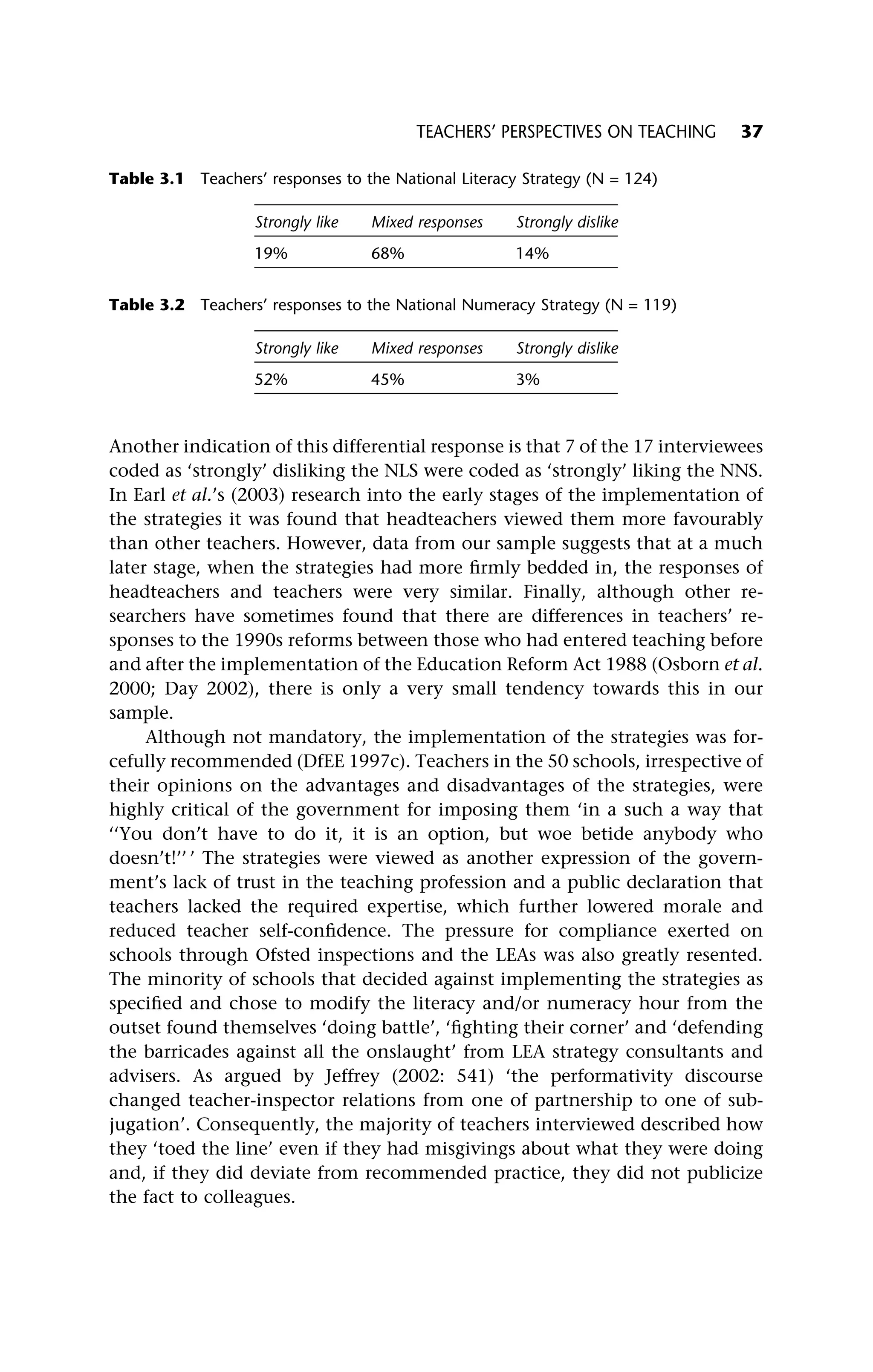


![plagued now, especially in these night halts, where we cannot see to
choose a bed, with the horrible little spiked grass. Every bit of
clothing we have is full of these points. These and the flies make it
impossible to sleep by day, and we are both very weary, Wilfrid
almost a skeleton.
April 23.—At a quarter past three, we again went on, by the light of
a false dawn, the Scorpion, still in front of us. We know exactly now
the rising of these stars in the south-eastern sky. The ascent this
time was longer and more gradual, and the descent shorter than the
former one, but quite as difficult. This second ridge is considerably
lower than the first, and at the foot of it our path followed a sort of
valley in which we found a few pools of water. Then suddenly the
gorge opened and we found ourselves at eight o’clock in the plain,
with a village near us, and about eight miles away Dilam and the
sea, simmering like melted lead to the horizon.
Eight miles, it sounds an easy march; but the heat, which now on
the sea coast is more insufferable than ever, stopped us half way,
and again we rigged up our tent on the plain, and lay under it till
evening. Then we rode into Dilam. Our first question was for
Captain Cameron, whose road should here have joined our own; but
no Frank or stranger of any kind had passed that way. [227]
Dilam, like most maritime villages on the north-eastern shore of the
Persian Gulf, is inhabited by people of Arab race, who have carried
on a mixed trade of commerce and piracy there from time
immemorial. Of the two, the piracy seems to have been the more
profitable trade, for since its suppression by the English or rather
Indian navy, the villages have languished. The Arab idea of piracy
by sea, is exactly the same as that of ghazús by land. Any stranger
not in alliance with the tribe, or under its protection, is held to be an
enemy, and his goods to be lawful prize. The greater part, however,
of the armed expeditions, formerly made in the Gulf were directed
by one tribe or village against another tribe or village, and were
called in Arabic ghazús no less than if they had been made by land.](https://image.slidesharecdn.com/1161125-250528221034-e13aca19/75/Changing-Teaching-And-Learning-In-The-Primary-School-Rosemary-Webb-61-2048.jpg)




![The size and depth of the fuljes varies greatly; some are, as it were,
rudimentary only, while others attain a depth of 200 feet and more.
The deepest of those I measured proved to be 280 feet, including
the sand hill, which may have been 60 feet above the general level
of the plain; its width seemed about a quarter of a mile. At the
bottom of these deep fuljes, solid ground is reached, and there is
generally a stony deposit there, such as I have often noticed in
sandy places where water has stood. This bare space is seldom
more than a few paces in diameter. I heard of, but did not see, one
which contained a well. The wells of Shagik do not stand in a fulj,
but in a valley clear of sand, and those of Jobba in a broad circular
basin 400 feet below the level of the Nefûd. The fuljes, I have said,
run in strings irregularly from east to west, corresponding in this
with their individual direction. [244] They are most regularly placed
in the neighbourhood of the rocks of Aalem, but their size there is
less than either north or south of it. The shape of the fuljes seems
unaffected by the solid ground beneath, for at the rocks of Ghota
there is a large fulj pierced by the rocks, but which otherwise retains
its semi-circular form.
The physical features of the Nefûd, whether they be ridges or
mounds or fuljes, appear to be permanent in their character. The
red sand of which they are composed is less volatile than the
common sand of the desert and, except on the summits of the
mounds and ridges, seems little affected by the wind. It is
everywhere, except in such positions, sprinkled over with brushwood
ghada trees and tufts of grass. The sides of the fuljes especially are
well clothed, and this could hardly be the case if they were liable to
change with a change of wind. In the Nefûd between Jobba and
Igneh I noticed well defined sheep tracks ascending the steep slopes
of the fuljes spirally, and these I was assured were by no means](https://image.slidesharecdn.com/1161125-250528221034-e13aca19/75/Changing-Teaching-And-Learning-In-The-Primary-School-Rosemary-Webb-74-2048.jpg)