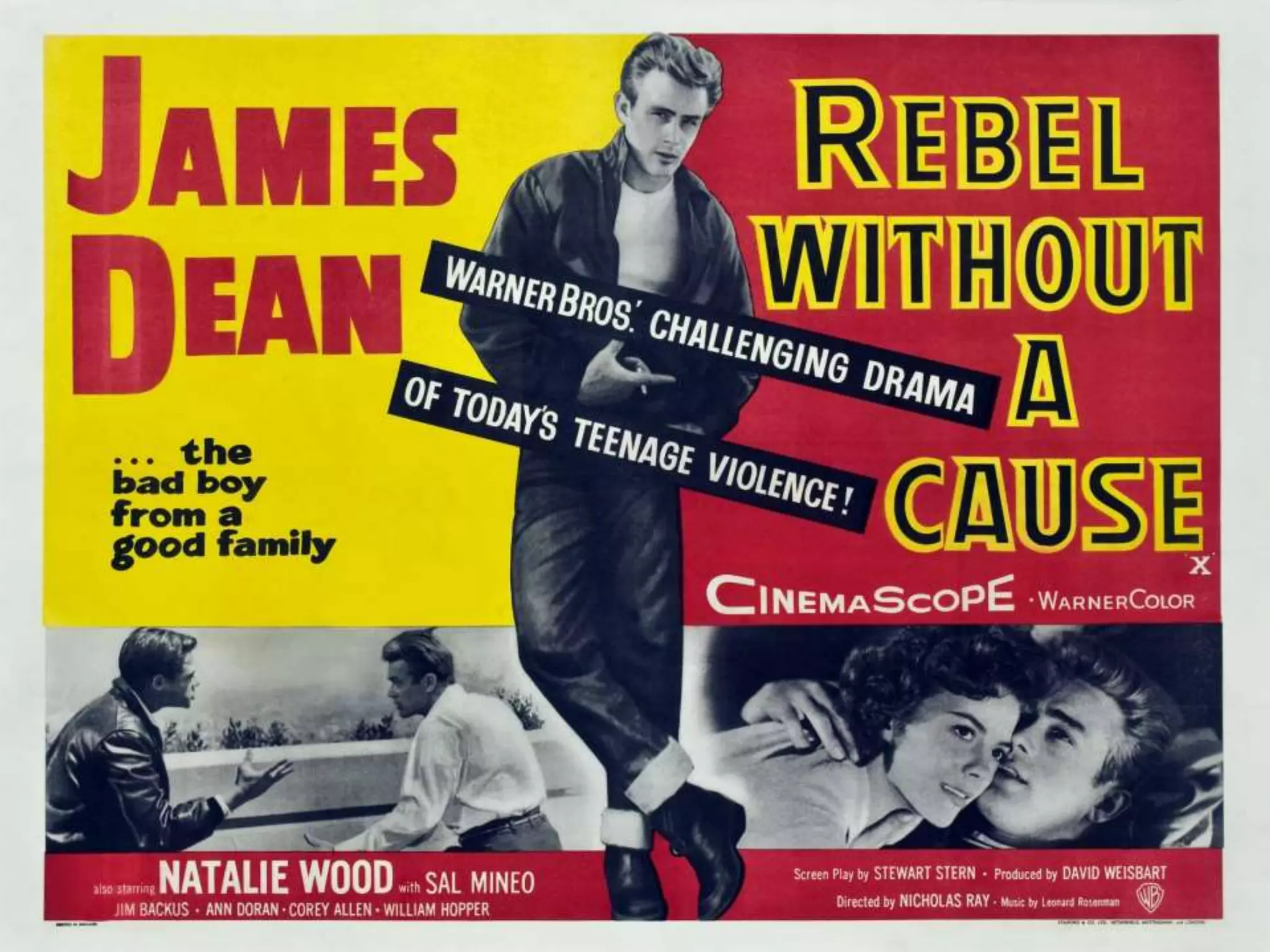
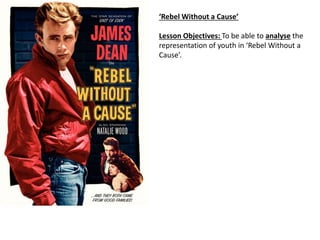
‘Rebel Without a Cause’
Lesson Objectives: To be able to analyse the
representation of youth in ‘Rebel Without a
Cause’.
‘Rebel Without a Cause’
Lesson Objectives: To be able to analyse the
representation of youth in ‘Rebel Without a
Cause’.
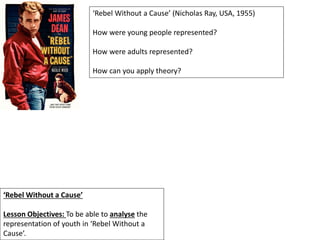
‘Rebel Without a Cause’ (Nicholas Ray, USA, 1955)
How were young people represented?
How were adults represented?
How can you apply theory?
‘Rebel Without a Cause’
Lesson Objectives: To be able to analyse the
representation of youth in ‘Rebel Without a
Cause’.
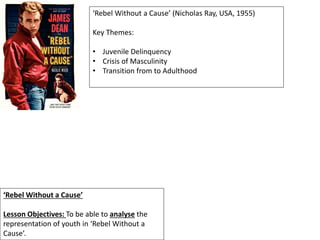
‘Rebel Without a Cause’ (Nicholas Ray, USA, 1955)
Key Themes:
• Juvenile Delinquency
• Crisis of Masculinity
• Transition from to Adulthood
‘Rebel Without a Cause’
Lesson Objectives: To be able to analyse the
representation of youth in ‘Rebel Without a
Cause’.
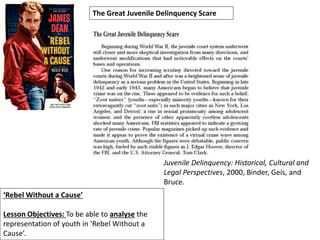
The Great Juvenile Delinquency Scare
Juvenile Delinquency: Historical, Cultural and
Legal Perspectives, 2000, Binder, Geis, and
Bruce.
‘Rebel Without a Cause’
Lesson Objectives: To be able to analyse the
representation of youth in ‘Rebel Without a
Cause’.
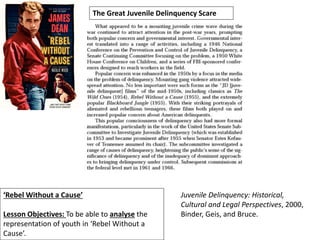
The Great Juvenile Delinquency Scare
Juvenile Delinquency: Historical,
Cultural and Legal Perspectives, 2000,
Binder, Geis, and Bruce.
‘Rebel Without a Cause’
Lesson Objectives: To be able to analyse the
representation of youth in ‘Rebel Without a
Cause’.
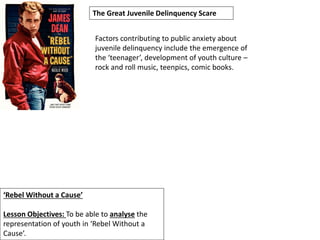
The Great Juvenile Delinquency Scare
Factors contributing to public anxiety about
juvenile delinquency include the emergence of
the ‘teenager’, development of youth culture –
rock and roll music, teenpics, comic books.
‘Rebel Without a Cause’
Lesson Objectives: To be able to analyse the
representation of youth in ‘Rebel Without a
Cause’.
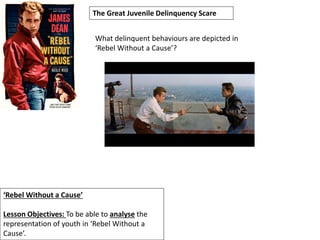
The Great Juvenile Delinquency Scare
What delinquent behaviours are depicted in
‘Rebel Without a Cause’?
‘Rebel Without a Cause’
Lesson Objectives: To be able to analyse the
representation of youth in ‘Rebel Without a
Cause’.
The Great Juvenile Delinquency Scare
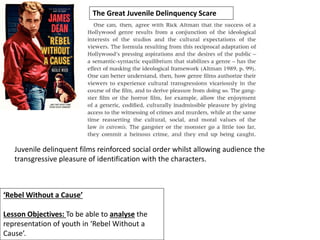
Juvenile delinquent films reinforced social order whilst allowing audience the
transgressive pleasure of identification with the characters.
‘Rebel Without a Cause’
Lesson Objectives: To be able to analyse the
representation of youth in ‘Rebel Without a
Cause’.
Crisis of Masculinity
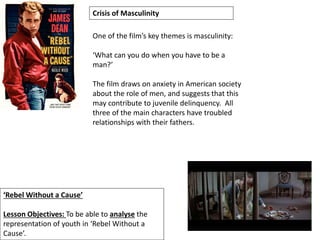
One of the film’s key themes is masculinity:
‘What can you do when you have to be a
man?’
The film draws on anxiety in American society
about the role of men, and suggests that this
may contribute to juvenile delinquency. All
three of the main characters have troubled
relationships with their fathers.
‘Rebel Without a Cause’
Lesson Objectives: To be able to analyse the
representation of youth in ‘Rebel Without a
Cause’.
Crisis of Masculinity
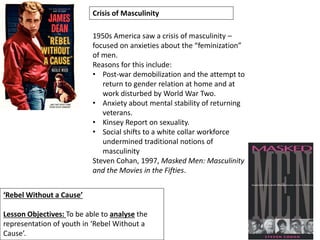
1950s America saw a crisis of masculinity –
focused on anxieties about the “feminization”
of men.
Reasons for this include:
• Post-war demobilization and the attempt to
return to gender relation at home and at
work disturbed by World War Two.
• Anxiety about mental stability of returning
veterans.
• Kinsey Report on sexuality.
• Social shifts to a white collar workforce
undermined traditional notions of
masculinity
Steven Cohan, 1997, Masked Men: Masculinity
and the Movies in the Fifties.
‘Rebel Without a Cause’
Lesson Objectives: To be able to analyse the
representation of youth in ‘Rebel Without a
Cause’.
Crisis of Masculinity
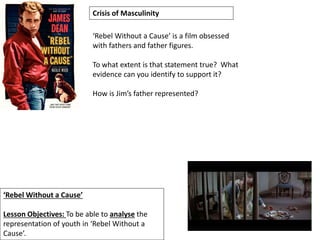
‘Rebel Without a Cause’ is a film obsessed
with fathers and father figures.
To what extent is that statement true? What
evidence can you identify to support it?
How is Jim’s father represented?
‘Rebel Without a Cause’
Lesson Objectives: To be able to analyse the
representation of youth in ‘Rebel Without a
Cause’.
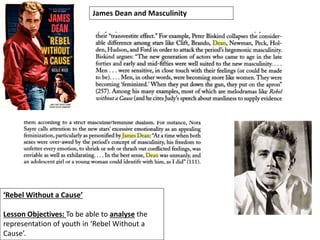
James Dean and Masculinity
‘Rebel Without a Cause’
Lesson Objectives: To be able to analyse the
representation of youth in ‘Rebel Without a
Cause’.
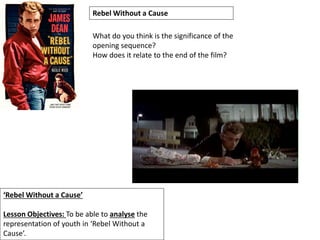
Rebel Without a Cause
What do you think is the significance of the
opening sequence?
How does it relate to the end of the film?
‘Rebel Without a Cause’
Lesson Objectives: To be able to analyse the
representation of youth in ‘Rebel Without a
Cause’.
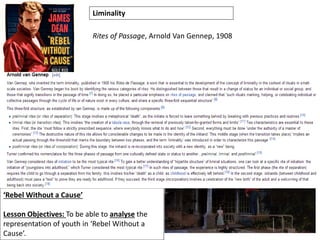
Liminality
Rites of Passage, Arnold Van Gennep, 1908
‘Rebel Without a Cause’
Lesson Objectives: To be able to analyse the
representation of youth in ‘Rebel Without a
Cause’.
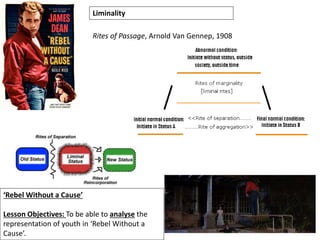
Liminality
Rites of Passage, Arnold Van Gennep, 1908
‘Rebel Without a Cause’
Lesson Objectives: To be able to analyse the
representation of youth in ‘Rebel Without a
Cause’.
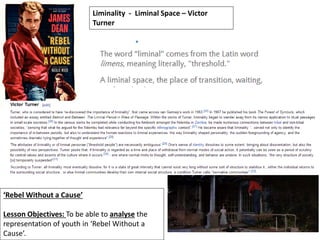
Liminality - Liminal Space – Victor
Turner
‘Rebel Without a Cause’
Lesson Objectives: To be able to analyse the
representation of youth in ‘Rebel Without a
Cause’.
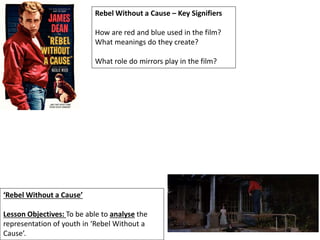
Rebel Without a Cause – Key Signifiers
How are red and blue used in the film?
What meanings do they create?
What role do mirrors play in the film?
‘Rebel Without a Cause’
Lesson Objectives: To be able to analyse the
representation of youth in ‘Rebel Without a
Cause’.
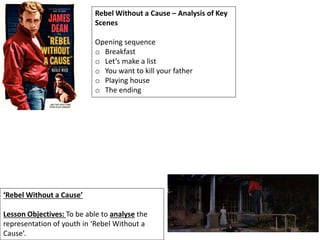
Rebel Without a Cause – Analysis of Key
Scenes
Opening sequence
o Breakfast
o Let’s make a list
o You want to kill your father
o Playing house
o The ending
‘Rebel Without a Cause’
Lesson Objectives: To be able to analyse the
representation of youth in ‘Rebel Without a
Cause’.
How are young people represented in
‘Rebel Without a Cause’?
‘Rebel Without a Cause’
Lesson Objectives: To be able to analyse the
representation of youth in ‘Rebel Without a
Cause’.
How are young people represented in
‘Rebel Without a Cause’?
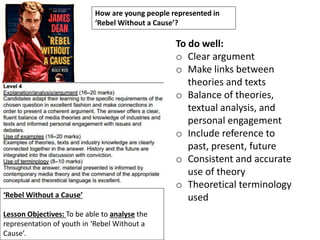
To do well:
o Clear argument
o Make links between
theories and texts
o Balance of theories,
textual analysis, and
personal engagement
o Include reference to
past, present, future
o Consistent and accurate
use of theory
o Theoretical terminology
used
‘Rebel Without a Cause’
Lesson Objectives: To be able to analyse the
representation of youth in ‘Rebel Without a
Cause’.
How are young people represented in
‘Rebel Without a Cause’?
What theorists might you apply in your essay?
‘Rebel Without a Cause’
Lesson Objectives: To be able to analyse the
representation of youth in ‘Rebel Without a
Cause’.
How are young people represented in
‘Rebel Without a Cause’?
What might your argument be?
‘Rebel Without a Cause’
Lesson Objectives: To be able to analyse the
representation of youth in ‘Rebel Without a
Cause’.
How are young people represented in
‘Rebel Without a Cause’?
Structure:
Introduction
Youth and Delinquency
Crisis of Masculinity
Reinforcing hegemony
Conclusion
‘Rebel Without a Cause’
Lesson Objectives: To be able to analyse the
representation of youth in ‘Rebel Without a
Cause’.
How are young people represented in
‘Rebel Without a Cause’?
Introduction
o Start with a quote.
o Outline focus.
o Identify argument.
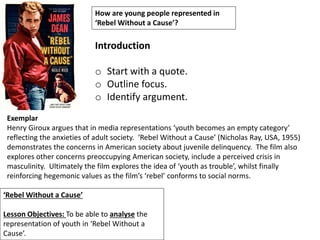
Exemplar
Henry Giroux argues that in media representations ‘youth becomes an empty category’
reflecting the anxieties of adult society. ‘Rebel Without a Cause’ (Nicholas Ray, USA, 1955)
demonstrates the concerns in American society about juvenile delinquency. The film also
explores other concerns preoccupying American society, include a perceived crisis in
masculinity. Ultimately the film explores the idea of ‘youth as trouble’, whilst finally
reinforcing hegemonic values as the film’s ‘rebel’ conforms to social norms.
‘Rebel Without a Cause’
Lesson Objectives: To be able to analyse the
representation of youth in ‘Rebel Without a
Cause’.
How are young people represented in
‘Rebel Without a Cause’?
Youth and Delinquency
o Youth as trouble/demonization of
young people
o Juvenile delinquency 1950s
o JD movies – ‘The Wild One’,
‘Blackboard Jungle’
o Linked to post-war emergence of the
‘teenager’ and youth culture
o How is juvenile delinquency
represented in the film?
‘Rebel Without a Cause’
Lesson Objectives: To be able to analyse the
representation of youth in ‘Rebel Without a
Cause’.
How are young people represented in
‘Rebel Without a Cause’?
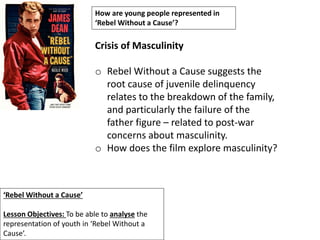
Crisis of Masculinity
o Rebel Without a Cause suggests the
root cause of juvenile delinquency
relates to the breakdown of the family,
and particularly the failure of the
father figure – related to post-war
concerns about masculinity.
o How does the film explore masculinity?
‘Rebel Without a Cause’
Lesson Objectives: To be able to analyse the
representation of youth in ‘Rebel Without a
Cause’.
How are young people represented in
‘Rebel Without a Cause’?
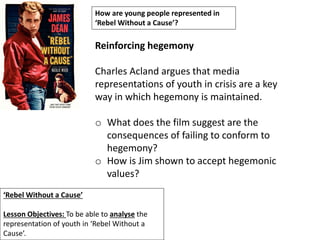
Reinforcing hegemony
Charles Acland argues that media
representations of youth in crisis are a key
way in which hegemony is maintained.
o What does the film suggest are the
consequences of failing to conform to
hegemony?
o How is Jim shown to accept hegemonic
values?
‘Rebel Without a Cause’
Lesson Objectives: To be able to analyse the
representation of youth in ‘Rebel Without a
Cause’.
How are young people represented in
‘Rebel Without a Cause’?
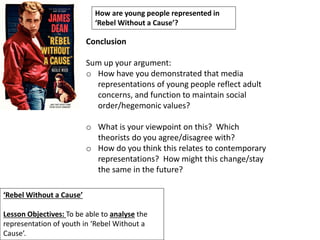
Conclusion
Sum up your argument:
o How have you demonstrated that media
representations of young people reflect adult
concerns, and function to maintain social
order/hegemonic values?
o What is your viewpoint on this? Which
theorists do you agree/disagree with?
o How do you think this relates to contemporary
representations? How might this change/stay
the same in the future?
‘Rebel Without a Cause’
Lesson Objectives: To be able to analyse the
representation of youth in ‘Rebel Without a
Cause’.
Media and Collective Identity Blogs
Research into the following areas:
o Juvenile crime in the 1950s
o 1950s cinema – Juvenile Delinquent
films
o 1950s Crisis of Masculinity
o Liminal Space
o Analyse the representation of
teenagers in the trailer for a JD movie
from the 1950s.
o Find and evaluate a critical/academic
reading of ‘Rebel Without a Cause’.
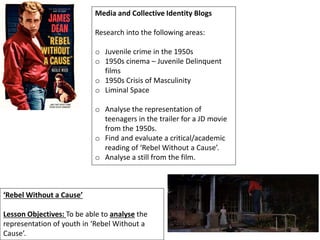
o Analyse a still from the film.

Rebel without a cause

  • 2.
    ‘Rebel Without aCause’ Lesson Objectives: To be able to analyse the representation of youth in ‘Rebel Without a Cause’.
  • 3.
    ‘Rebel Without aCause’ Lesson Objectives: To be able to analyse the representation of youth in ‘Rebel Without a Cause’. ‘Rebel Without a Cause’ (Nicholas Ray, USA, 1955) How were young people represented? How were adults represented? How can you apply theory?
  • 4.
    ‘Rebel Without aCause’ Lesson Objectives: To be able to analyse the representation of youth in ‘Rebel Without a Cause’. ‘Rebel Without a Cause’ (Nicholas Ray, USA, 1955) Key Themes: • Juvenile Delinquency • Crisis of Masculinity • Transition from to Adulthood
  • 5.
    ‘Rebel Without aCause’ Lesson Objectives: To be able to analyse the representation of youth in ‘Rebel Without a Cause’. The Great Juvenile Delinquency Scare Juvenile Delinquency: Historical, Cultural and Legal Perspectives, 2000, Binder, Geis, and Bruce.
  • 6.
    ‘Rebel Without aCause’ Lesson Objectives: To be able to analyse the representation of youth in ‘Rebel Without a Cause’. The Great Juvenile Delinquency Scare Juvenile Delinquency: Historical, Cultural and Legal Perspectives, 2000, Binder, Geis, and Bruce.
  • 7.
    ‘Rebel Without aCause’ Lesson Objectives: To be able to analyse the representation of youth in ‘Rebel Without a Cause’. The Great Juvenile Delinquency Scare Factors contributing to public anxiety about juvenile delinquency include the emergence of the ‘teenager’, development of youth culture – rock and roll music, teenpics, comic books.
  • 8.
    ‘Rebel Without aCause’ Lesson Objectives: To be able to analyse the representation of youth in ‘Rebel Without a Cause’. The Great Juvenile Delinquency Scare What delinquent behaviours are depicted in ‘Rebel Without a Cause’?
  • 9.
    ‘Rebel Without aCause’ Lesson Objectives: To be able to analyse the representation of youth in ‘Rebel Without a Cause’. The Great Juvenile Delinquency Scare Juvenile delinquent films reinforced social order whilst allowing audience the transgressive pleasure of identification with the characters.
  • 10.
    ‘Rebel Without aCause’ Lesson Objectives: To be able to analyse the representation of youth in ‘Rebel Without a Cause’. Crisis of Masculinity One of the film’s key themes is masculinity: ‘What can you do when you have to be a man?’ The film draws on anxiety in American society about the role of men, and suggests that this may contribute to juvenile delinquency. All three of the main characters have troubled relationships with their fathers.
  • 11.
    ‘Rebel Without aCause’ Lesson Objectives: To be able to analyse the representation of youth in ‘Rebel Without a Cause’. Crisis of Masculinity 1950s America saw a crisis of masculinity – focused on anxieties about the “feminization” of men. Reasons for this include: • Post-war demobilization and the attempt to return to gender relation at home and at work disturbed by World War Two. • Anxiety about mental stability of returning veterans. • Kinsey Report on sexuality. • Social shifts to a white collar workforce undermined traditional notions of masculinity Steven Cohan, 1997, Masked Men: Masculinity and the Movies in the Fifties.
  • 12.
    ‘Rebel Without aCause’ Lesson Objectives: To be able to analyse the representation of youth in ‘Rebel Without a Cause’. Crisis of Masculinity ‘Rebel Without a Cause’ is a film obsessed with fathers and father figures. To what extent is that statement true? What evidence can you identify to support it? How is Jim’s father represented?
  • 13.
    ‘Rebel Without aCause’ Lesson Objectives: To be able to analyse the representation of youth in ‘Rebel Without a Cause’. James Dean and Masculinity
  • 14.
    ‘Rebel Without aCause’ Lesson Objectives: To be able to analyse the representation of youth in ‘Rebel Without a Cause’. Rebel Without a Cause What do you think is the significance of the opening sequence? How does it relate to the end of the film?
  • 15.
    ‘Rebel Without aCause’ Lesson Objectives: To be able to analyse the representation of youth in ‘Rebel Without a Cause’. Liminality Rites of Passage, Arnold Van Gennep, 1908
  • 16.
    ‘Rebel Without aCause’ Lesson Objectives: To be able to analyse the representation of youth in ‘Rebel Without a Cause’. Liminality Rites of Passage, Arnold Van Gennep, 1908
  • 17.
    ‘Rebel Without aCause’ Lesson Objectives: To be able to analyse the representation of youth in ‘Rebel Without a Cause’. Liminality - Liminal Space – Victor Turner
  • 18.
    ‘Rebel Without aCause’ Lesson Objectives: To be able to analyse the representation of youth in ‘Rebel Without a Cause’. Rebel Without a Cause – Key Signifiers How are red and blue used in the film? What meanings do they create? What role do mirrors play in the film?
  • 19.
    ‘Rebel Without aCause’ Lesson Objectives: To be able to analyse the representation of youth in ‘Rebel Without a Cause’. Rebel Without a Cause – Analysis of Key Scenes Opening sequence o Breakfast o Let’s make a list o You want to kill your father o Playing house o The ending
  • 20.
    ‘Rebel Without aCause’ Lesson Objectives: To be able to analyse the representation of youth in ‘Rebel Without a Cause’. How are young people represented in ‘Rebel Without a Cause’?
  • 21.
    ‘Rebel Without aCause’ Lesson Objectives: To be able to analyse the representation of youth in ‘Rebel Without a Cause’. How are young people represented in ‘Rebel Without a Cause’? To do well: o Clear argument o Make links between theories and texts o Balance of theories, textual analysis, and personal engagement o Include reference to past, present, future o Consistent and accurate use of theory o Theoretical terminology used
  • 22.
    ‘Rebel Without aCause’ Lesson Objectives: To be able to analyse the representation of youth in ‘Rebel Without a Cause’. How are young people represented in ‘Rebel Without a Cause’? What theorists might you apply in your essay?
  • 23.
    ‘Rebel Without aCause’ Lesson Objectives: To be able to analyse the representation of youth in ‘Rebel Without a Cause’. How are young people represented in ‘Rebel Without a Cause’? What might your argument be?
  • 24.
    ‘Rebel Without aCause’ Lesson Objectives: To be able to analyse the representation of youth in ‘Rebel Without a Cause’. How are young people represented in ‘Rebel Without a Cause’? Structure: Introduction Youth and Delinquency Crisis of Masculinity Reinforcing hegemony Conclusion
  • 25.
    ‘Rebel Without aCause’ Lesson Objectives: To be able to analyse the representation of youth in ‘Rebel Without a Cause’. How are young people represented in ‘Rebel Without a Cause’? Introduction o Start with a quote. o Outline focus. o Identify argument. Exemplar Henry Giroux argues that in media representations ‘youth becomes an empty category’ reflecting the anxieties of adult society. ‘Rebel Without a Cause’ (Nicholas Ray, USA, 1955) demonstrates the concerns in American society about juvenile delinquency. The film also explores other concerns preoccupying American society, include a perceived crisis in masculinity. Ultimately the film explores the idea of ‘youth as trouble’, whilst finally reinforcing hegemonic values as the film’s ‘rebel’ conforms to social norms.
  • 26.
    ‘Rebel Without aCause’ Lesson Objectives: To be able to analyse the representation of youth in ‘Rebel Without a Cause’. How are young people represented in ‘Rebel Without a Cause’? Youth and Delinquency o Youth as trouble/demonization of young people o Juvenile delinquency 1950s o JD movies – ‘The Wild One’, ‘Blackboard Jungle’ o Linked to post-war emergence of the ‘teenager’ and youth culture o How is juvenile delinquency represented in the film?
  • 27.
    ‘Rebel Without aCause’ Lesson Objectives: To be able to analyse the representation of youth in ‘Rebel Without a Cause’. How are young people represented in ‘Rebel Without a Cause’? Crisis of Masculinity o Rebel Without a Cause suggests the root cause of juvenile delinquency relates to the breakdown of the family, and particularly the failure of the father figure – related to post-war concerns about masculinity. o How does the film explore masculinity?
  • 28.
    ‘Rebel Without aCause’ Lesson Objectives: To be able to analyse the representation of youth in ‘Rebel Without a Cause’. How are young people represented in ‘Rebel Without a Cause’? Reinforcing hegemony Charles Acland argues that media representations of youth in crisis are a key way in which hegemony is maintained. o What does the film suggest are the consequences of failing to conform to hegemony? o How is Jim shown to accept hegemonic values?
  • 29.
    ‘Rebel Without aCause’ Lesson Objectives: To be able to analyse the representation of youth in ‘Rebel Without a Cause’. How are young people represented in ‘Rebel Without a Cause’? Conclusion Sum up your argument: o How have you demonstrated that media representations of young people reflect adult concerns, and function to maintain social order/hegemonic values? o What is your viewpoint on this? Which theorists do you agree/disagree with? o How do you think this relates to contemporary representations? How might this change/stay the same in the future?
  • 30.
    ‘Rebel Without aCause’ Lesson Objectives: To be able to analyse the representation of youth in ‘Rebel Without a Cause’. Media and Collective Identity Blogs Research into the following areas: o Juvenile crime in the 1950s o 1950s cinema – Juvenile Delinquent films o 1950s Crisis of Masculinity o Liminal Space o Analyse the representation of teenagers in the trailer for a JD movie from the 1950s. o Find and evaluate a critical/academic reading of ‘Rebel Without a Cause’. o Analyse a still from the film.