BCT Section 1.2 Terms
                   Data Communications, Networks
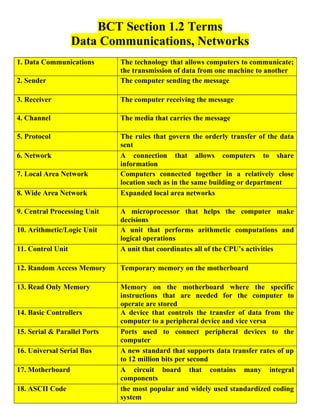
1. Data Communications        The technology that allows computers to communicate;
                              the transmission of data from one machine to another
2. Sender                     The computer sending the message

3. Receiver                   The computer receiving the message

4. Channel                    The media that carries the message

5. Protocol                   The rules that govern the orderly transfer of the data
                              sent
6. Network                    A connection that allows computers to share
                              information
7. Local Area Network         Computers connected together in a relatively close
                              location such as in the same building or department
8. Wide Area Network          Expanded local area networks

9. Central Processing Unit    A microprocessor that helps the computer make
                              decisions
10. Arithmetic/Logic Unit     A unit that performs arithmetic computations and
                              logical operations
11. Control Unit              A unit that coordinates all of the CPU’s activities

12. Random Access Memory      Temporary memory on the motherboard

13. Read Only Memory          Memory on the motherboard where the specific
                              instructions that are needed for the computer to
                              operate are stored
14. Basic Controllers         A device that controls the transfer of data from the
                              computer to a peripheral device and vice versa
15. Serial & Parallel Ports   Ports used to connect peripheral devices to the
                              computer
16. Universal Serial Bus      A new standard that supports data transfer rates of up
                              to 12 million bits per second
17. Motherboard               A circuit board that contains many integral
                              components
18. ASCII Code                the most popular and widely used standardized coding
                              system
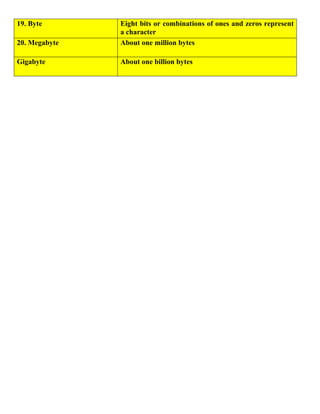
19. Byte       Eight bits or combinations of ones and zeros represent
               a character
20. Megabyte   About one million bytes

Gigabyte       About one billion bytes

Bct Section 1 2 Ternms

  • 1.
    BCT Section 1.2Terms Data Communications, Networks 1. Data Communications The technology that allows computers to communicate; the transmission of data from one machine to another 2. Sender The computer sending the message 3. Receiver The computer receiving the message 4. Channel The media that carries the message 5. Protocol The rules that govern the orderly transfer of the data sent 6. Network A connection that allows computers to share information 7. Local Area Network Computers connected together in a relatively close location such as in the same building or department 8. Wide Area Network Expanded local area networks 9. Central Processing Unit A microprocessor that helps the computer make decisions 10. Arithmetic/Logic Unit A unit that performs arithmetic computations and logical operations 11. Control Unit A unit that coordinates all of the CPU’s activities 12. Random Access Memory Temporary memory on the motherboard 13. Read Only Memory Memory on the motherboard where the specific instructions that are needed for the computer to operate are stored 14. Basic Controllers A device that controls the transfer of data from the computer to a peripheral device and vice versa 15. Serial & Parallel Ports Ports used to connect peripheral devices to the computer 16. Universal Serial Bus A new standard that supports data transfer rates of up to 12 million bits per second 17. Motherboard A circuit board that contains many integral components 18. ASCII Code the most popular and widely used standardized coding system
  • 2.
    19. Byte Eight bits or combinations of ones and zeros represent a character 20. Megabyte About one million bytes Gigabyte About one billion bytes