Adequacy and Sustainability of Contributory and
Non-Contributory Pensions: An ILO View
April 4, 2013
Krzysztof Hagemejer
International Labour Office
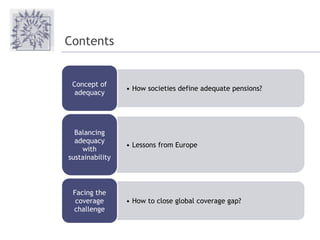
Contents
• How societies define adequate pensions?
Concept of
adequacy
• Lessons from Europe
Balancing
adequacy
with
sustainability
• How to close global coverage gap?
Facing the
coverage
challenge
Adequacy of pensions
• How societies define adequate pensions?
Concept of
adequacy
Questions to be asked and answered to
determine what pension provisions are
adequate
What is
retirement?
What society
should
guarantee?
Social contract:
What pension system
country should have?
Changing perceptions what is adequate may
lead to changes in explicit and implicit
social contracts
• Happens only when person is not able to work
anymore?
• Is a well deserved period of rest after working
life?
Definition and
timing of
retirement
• Guarantee aims only at alleviating poverty for
those unable to support themselves?
• Guarantees every resident a minimum income at
old-age?
• Guarantees also certain proportion of pre-
retirement income (replacement rates)?
Level of
societal
guarantees
• People should save for themselves
• Those unable to contribute/save should be
supported
• Younger should support old generation
Degree of
solidarity
Changing social contracts determine changes
in financial and institutional solutions
Social contract behind
pensions
What is retirement?
What is guaranteed by
the society?
How much solidarity and
redistribution towards
the poorer?
Financial and
institutional
alternatives
Mandatory versus
voluntary
Defined benefit versus
defined contribution
PAYG versus advanced
funding
Public versus private
provision
Defining pension adequacy
● Adequacy and sustainability are joint and
interlinked objectives of social policy
● Adequacy is defined nationally as part of the
broader implicit or explicit social contract which
sets the design of the pension system
● National social contracts cross the borders:
● there are standards accepted internationally (like ILO
Convention no 102 or Recommendation no 202)
● European Union Open Method of Coordination: Adequate
old-age pension systems should prevent poverty in the old
age but also provide income replacement after retirement
preventing sharp decline in living standards
Lessons from Europe
• Focus on sustainability but what about
adequacy?
Recent
reforms of
European
pensions to
face
demographic
challenge
In many European countries already introduced pension reforms
may successfully counterbalance financial impact of
demographic change (Projected change of public pension expenditure due
to different factors in GDP percentage points between 2010 and 2060)
-30 -25 -20 -15 -10 -5 0 5 10 15 20 25 30
LV
PL
EE
IT
DK
PT
FR
SE
EL
BG
UK
EU27
EA17
AT
DE
CZ
HU
FI
LT
NL
ES
RO
IE
NO
SK
MT
BE
SI
CY
LU
Demographic dependency Benefit reductions Other changes
In some countries public pension expenditure are
even projected to decrease and average projected
increase in most countries is far from dramatic
-5 0 5 10 15 20
Latvia
Poland
Estonia
Italy
Denmark
Portugal
France
Sweden
Greece
Bulgaria
UK
EU27
Austria
Germany
CzechRepublic
Hungary
Finland
Lithuania
Spain
Netherlands
Romania
Ireland
Norway
Slovakia
Malta
Belgium
Slovenia
Cyprus
Luxembourg
Percentage points
Resulting change
Benefit reduced
Other reforms
However in many countries reforms will significantly
affect future benefit levels...
Replacement rate in public pension schemes 2010 and 2060
Italy
Luxembourg
Spain
Greece
France
Malta
Portugal
Finland
Slovakia
Bulgaria
Poland
Norway
Latvia
EU27
Austria
Cyprus
Romania
Germany
Hungary
Lithuania
Ireland
Estonia
15
20
25
30
35
40
45
50
55
60
65
70
75
80
15 20 25 30 35 40 45 50 55 60 65 70 75 80
Replacementrateatretirementin2060
Replacement rate at retirement in 2010
Czech Republic
Even 40% replacement rate however does not
prevent poverty for those with low earnings
0
10
20
30
40
50
60
70
80
90
100
Bulgaria
CzechRepublic
Estonia
Slovakia
Luxembourg
Latvia
Spain
Lithuania
Hungary
Slovenia
Malta
Portugal
France
Romania
Croatia
UnitedKingdom
Netherlands
Belgium
Poland
Greece
Ireland
40%ofminimumwageaspercentageofrelativepovertyline
C102 benchmarks
40% of minimum wage as percentageof relativepoverty line, 2010
(poverty line thresholds at 40% and 60% of median income) 40% median income poverty threshold
60% median income poverty threshold
Nearly all EU member countries ratified:
● either ILO Convention no 102 (C.102) on
minimum standards in social security or
● European Code of Social Security (ECSS) of
the Council of Europe,
● and some ratified in addition also ILO
Convention no 128 on Invalidity, Old-age
and Survivors benefits (C.128).
Future replacement rates from contributory
pensions will be significantly reduced
● Reforms implemented or being implemented across
Europe are significantly reducing replacement rates
provided through the contributory, earnings related
parts of the national pension systems
● Replacement rates after 30 years in many countries
will be lower than 40 per cent required by
international standards
● Many of those with shorter or broken careers and low
incomes will not be eligible to pensions from
contributory parts of the pension system high enough
to prevent them from falling into poverty in the old-
age
Protection of those with broken careers and
lower life-time incomes weakened by reforms
● Many new reformed pension schemes are not just
translating differentiation of earnings at the labour market
into differentiation of pensions: these differences may
actually be amplified
● Reforms often removed from benefit formulas redistributive
components aimed to protect against poverty those with
lower earnings and shorter careers
● For a time being this changes has not yet been everywhere
adequately compensated by increased role of various non-
contributory provisions like basic minimum pensions or
subsidies to contributions of those caring for children or sick
and elderly, unemployed, persons with disabilities etc.
How to prevent from poverty those with lower
incomes and those having no possibility to have
long unbroken careers?
● Either one should preserve or restore in one way or
another the redistributive defined benefit formulas in
first pillars, or
● Secure that in the overall pension system there are
much stronger than before non-contributory income
guarantees (like basic state pension, universal or
means-tested) as well as contribution subsidies
compensating adequately some non-contributory
periods
● To secure sustainability, conditions have to be created
to effectively extend duration of working lives and
delay retirements
Automatic mechanisms will not replace good
policy making in social dialogue
● Many reforms introduce various automatic mechanisms to
ensure long-run financial sustainability of pensions
● There are no similar mechanisms to guarantee adequacy...
● ...other than good policy making through well informed
social dialogue based on agreed adequacy targets,
balancing shorter and longer term needs as well as benefit
adequacy with financial sustainability
Closing the coverage gap
• How to close global coverage gap?
Facing the
coverage
challenge
Demographic ageing will worsen
the global coverage gap
1. Now already 61% of the worlds’ elderly live in less
developed regions with lowest pension coverage
2. This percentage will increase to 83% in 2100
3. More than half of these not covered elderly are – and
will be - in Asia
4. now has only 5% of older than 65 live in Africa, it will
be more than 20% in 2100
5. There is more women than men among those not
covered
6. Now 35% of older than 65 live in Europe and North
America, in 2100 it will be only 15%
Greatest challenge in the ageing
world: coverage gap
• Only minority of the world’s working population
contributes to any pension scheme (30%)
• Only small minority of the world’s older persons receives
any pension (20% in low-income countries)
Provide at least basic income security to uncovered
majority of the elderly is a priority
Recommendation no 202 (2012) concerning national
floors of social protection
Role of non-contributory pensions in closing
coverage gaps
1. Low-income countries with very low coverage (i.e. Africa and Asia):
non-contributory pension the only way to provide at least basic
income security for majority of the elderly. Attractive option to be
selected as one of the first step to gradually build comprehensive
social security system
2. Countries with significant coverage gap mainly concerning poor self-
employed (like Chile etc.): the way not only to close effectively
coverage gap but also to strengthen minimum guarantees within the
whole pension system
3. Countries with coverage high now but which introduced reforms
aiming at having “actuarially fair” pensions: as the coverage in
terms of number of people entitled to reasonably adequate
pensions will be falling, the role of non-contributory pensions will
be growing in all respects: filling the emerging coverage gap,
guaranteeing minimum incomes and taking over redistributional
functions eliminated from contributory part of the system
Policy choices and parameters:
1. Entitlement conditions: universal pension for everybody over
certain age more equitable, simpler and cheaper
administratively then solutions with additional entitlement
criteria or “tests”
2. Age: should be coordinated with age in the contributory
programmes, in the longer run can be easily linked to life
expectancy or demographic structure, in some low income
countries however may be chosen at a higher level for cost
considerations and then gradually reduced.
3. Benefit level: chosen depending on the structure and
provisions of the overall pension system in the country and
minimum income guarantee levels targeted by social policy
4. Affordable everywhere if policy space available
Adequate and sustainable pensions part of
wider national social protection floors:
access to a set of
goods and services
constituting
essential health
care including
maternity care
basic income
security for
children
basic income
security for
persons in active
age unable to earn
sufficient income
basic income
security for
persons in old
age
The social protection floors should comprise at least the following
basic social security guarantees
national definition of minimum levels
Guarantees should be provided to at least all residents and children, as defined
in national laws and regulations, subject to Members’ existing international
obligations

Pensions Core Course 2013: Adequacy and Sustainability of Contributory and Non-contributory Pensions - An ILO View

  • 1.
    Adequacy and Sustainabilityof Contributory and Non-Contributory Pensions: An ILO View April 4, 2013 Krzysztof Hagemejer International Labour Office
  • 2.
    Contents • How societiesdefine adequate pensions? Concept of adequacy • Lessons from Europe Balancing adequacy with sustainability • How to close global coverage gap? Facing the coverage challenge
  • 3.
    Adequacy of pensions •How societies define adequate pensions? Concept of adequacy
  • 4.
    Questions to beasked and answered to determine what pension provisions are adequate What is retirement? What society should guarantee? Social contract: What pension system country should have?
  • 5.
    Changing perceptions whatis adequate may lead to changes in explicit and implicit social contracts • Happens only when person is not able to work anymore? • Is a well deserved period of rest after working life? Definition and timing of retirement • Guarantee aims only at alleviating poverty for those unable to support themselves? • Guarantees every resident a minimum income at old-age? • Guarantees also certain proportion of pre- retirement income (replacement rates)? Level of societal guarantees • People should save for themselves • Those unable to contribute/save should be supported • Younger should support old generation Degree of solidarity
  • 6.
    Changing social contractsdetermine changes in financial and institutional solutions Social contract behind pensions What is retirement? What is guaranteed by the society? How much solidarity and redistribution towards the poorer? Financial and institutional alternatives Mandatory versus voluntary Defined benefit versus defined contribution PAYG versus advanced funding Public versus private provision
  • 7.
    Defining pension adequacy ●Adequacy and sustainability are joint and interlinked objectives of social policy ● Adequacy is defined nationally as part of the broader implicit or explicit social contract which sets the design of the pension system ● National social contracts cross the borders: ● there are standards accepted internationally (like ILO Convention no 102 or Recommendation no 202) ● European Union Open Method of Coordination: Adequate old-age pension systems should prevent poverty in the old age but also provide income replacement after retirement preventing sharp decline in living standards
  • 8.
    Lessons from Europe •Focus on sustainability but what about adequacy? Recent reforms of European pensions to face demographic challenge
  • 9.
    In many Europeancountries already introduced pension reforms may successfully counterbalance financial impact of demographic change (Projected change of public pension expenditure due to different factors in GDP percentage points between 2010 and 2060) -30 -25 -20 -15 -10 -5 0 5 10 15 20 25 30 LV PL EE IT DK PT FR SE EL BG UK EU27 EA17 AT DE CZ HU FI LT NL ES RO IE NO SK MT BE SI CY LU Demographic dependency Benefit reductions Other changes
  • 10.
    In some countriespublic pension expenditure are even projected to decrease and average projected increase in most countries is far from dramatic -5 0 5 10 15 20 Latvia Poland Estonia Italy Denmark Portugal France Sweden Greece Bulgaria UK EU27 Austria Germany CzechRepublic Hungary Finland Lithuania Spain Netherlands Romania Ireland Norway Slovakia Malta Belgium Slovenia Cyprus Luxembourg Percentage points Resulting change Benefit reduced Other reforms
  • 11.
    However in manycountries reforms will significantly affect future benefit levels... Replacement rate in public pension schemes 2010 and 2060 Italy Luxembourg Spain Greece France Malta Portugal Finland Slovakia Bulgaria Poland Norway Latvia EU27 Austria Cyprus Romania Germany Hungary Lithuania Ireland Estonia 15 20 25 30 35 40 45 50 55 60 65 70 75 80 15 20 25 30 35 40 45 50 55 60 65 70 75 80 Replacementrateatretirementin2060 Replacement rate at retirement in 2010 Czech Republic
  • 12.
    Even 40% replacementrate however does not prevent poverty for those with low earnings 0 10 20 30 40 50 60 70 80 90 100 Bulgaria CzechRepublic Estonia Slovakia Luxembourg Latvia Spain Lithuania Hungary Slovenia Malta Portugal France Romania Croatia UnitedKingdom Netherlands Belgium Poland Greece Ireland 40%ofminimumwageaspercentageofrelativepovertyline C102 benchmarks 40% of minimum wage as percentageof relativepoverty line, 2010 (poverty line thresholds at 40% and 60% of median income) 40% median income poverty threshold 60% median income poverty threshold
  • 13.
    Nearly all EUmember countries ratified: ● either ILO Convention no 102 (C.102) on minimum standards in social security or ● European Code of Social Security (ECSS) of the Council of Europe, ● and some ratified in addition also ILO Convention no 128 on Invalidity, Old-age and Survivors benefits (C.128).
  • 14.
    Future replacement ratesfrom contributory pensions will be significantly reduced ● Reforms implemented or being implemented across Europe are significantly reducing replacement rates provided through the contributory, earnings related parts of the national pension systems ● Replacement rates after 30 years in many countries will be lower than 40 per cent required by international standards ● Many of those with shorter or broken careers and low incomes will not be eligible to pensions from contributory parts of the pension system high enough to prevent them from falling into poverty in the old- age
  • 15.
    Protection of thosewith broken careers and lower life-time incomes weakened by reforms ● Many new reformed pension schemes are not just translating differentiation of earnings at the labour market into differentiation of pensions: these differences may actually be amplified ● Reforms often removed from benefit formulas redistributive components aimed to protect against poverty those with lower earnings and shorter careers ● For a time being this changes has not yet been everywhere adequately compensated by increased role of various non- contributory provisions like basic minimum pensions or subsidies to contributions of those caring for children or sick and elderly, unemployed, persons with disabilities etc.
  • 16.
    How to preventfrom poverty those with lower incomes and those having no possibility to have long unbroken careers? ● Either one should preserve or restore in one way or another the redistributive defined benefit formulas in first pillars, or ● Secure that in the overall pension system there are much stronger than before non-contributory income guarantees (like basic state pension, universal or means-tested) as well as contribution subsidies compensating adequately some non-contributory periods ● To secure sustainability, conditions have to be created to effectively extend duration of working lives and delay retirements
  • 17.
    Automatic mechanisms willnot replace good policy making in social dialogue ● Many reforms introduce various automatic mechanisms to ensure long-run financial sustainability of pensions ● There are no similar mechanisms to guarantee adequacy... ● ...other than good policy making through well informed social dialogue based on agreed adequacy targets, balancing shorter and longer term needs as well as benefit adequacy with financial sustainability
  • 18.
    Closing the coveragegap • How to close global coverage gap? Facing the coverage challenge
  • 19.
    Demographic ageing willworsen the global coverage gap 1. Now already 61% of the worlds’ elderly live in less developed regions with lowest pension coverage 2. This percentage will increase to 83% in 2100 3. More than half of these not covered elderly are – and will be - in Asia 4. now has only 5% of older than 65 live in Africa, it will be more than 20% in 2100 5. There is more women than men among those not covered 6. Now 35% of older than 65 live in Europe and North America, in 2100 it will be only 15%
  • 20.
    Greatest challenge inthe ageing world: coverage gap • Only minority of the world’s working population contributes to any pension scheme (30%) • Only small minority of the world’s older persons receives any pension (20% in low-income countries) Provide at least basic income security to uncovered majority of the elderly is a priority Recommendation no 202 (2012) concerning national floors of social protection
  • 21.
    Role of non-contributorypensions in closing coverage gaps 1. Low-income countries with very low coverage (i.e. Africa and Asia): non-contributory pension the only way to provide at least basic income security for majority of the elderly. Attractive option to be selected as one of the first step to gradually build comprehensive social security system 2. Countries with significant coverage gap mainly concerning poor self- employed (like Chile etc.): the way not only to close effectively coverage gap but also to strengthen minimum guarantees within the whole pension system 3. Countries with coverage high now but which introduced reforms aiming at having “actuarially fair” pensions: as the coverage in terms of number of people entitled to reasonably adequate pensions will be falling, the role of non-contributory pensions will be growing in all respects: filling the emerging coverage gap, guaranteeing minimum incomes and taking over redistributional functions eliminated from contributory part of the system
  • 22.
    Policy choices andparameters: 1. Entitlement conditions: universal pension for everybody over certain age more equitable, simpler and cheaper administratively then solutions with additional entitlement criteria or “tests” 2. Age: should be coordinated with age in the contributory programmes, in the longer run can be easily linked to life expectancy or demographic structure, in some low income countries however may be chosen at a higher level for cost considerations and then gradually reduced. 3. Benefit level: chosen depending on the structure and provisions of the overall pension system in the country and minimum income guarantee levels targeted by social policy 4. Affordable everywhere if policy space available
  • 23.
    Adequate and sustainablepensions part of wider national social protection floors: access to a set of goods and services constituting essential health care including maternity care basic income security for children basic income security for persons in active age unable to earn sufficient income basic income security for persons in old age The social protection floors should comprise at least the following basic social security guarantees national definition of minimum levels Guarantees should be provided to at least all residents and children, as defined in national laws and regulations, subject to Members’ existing international obligations