Caridy Patino
Principal Frontend at Yahoo! Search
YUI Evangelist
Mojito Ambassador

caridy@yahoo-inc.com
@caridy
Expanding Yahoo! Axis
  across 3 screens
Axis
(codename SearchX)
From day one:

                       ?


 iPhone/iPad/Desktop
Build mobile products on top of
platforms designed primarily for
        mobile products
Yahoo! Cocktails is set to become the de facto
infrastructure for mobile applications at Yahoo!
Yahoo! Cocktails Umbrella
Mojito JavaScript
                Application
                Framework


http://github.com/yahoo/mojito
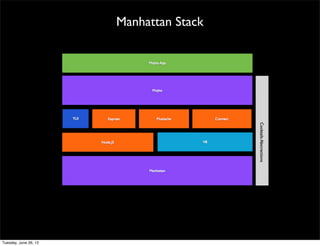
Manhattan
Hosting infrastructure for
Node.js applications.
Manhattan Stack
Mojito Shaker
                     Shaker is a static asset rollup
                     manager for Mojito applications.


http://github.com/yahoo/mojito-shaker
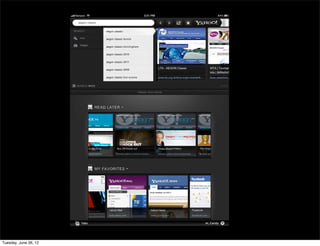
Axis
the making
"write once, deploy everywhere"
Can you imagine a car that works exceptionally

well under any condition?
"write once, deploy everywhere"

"divide & conquer"
Analyze each piece individually
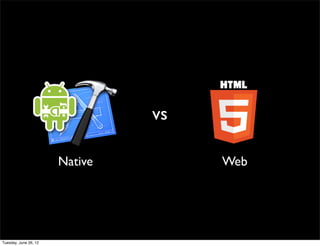
vs

Native        Web
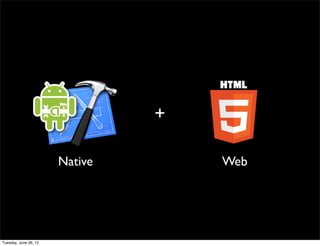
+

Native       Web
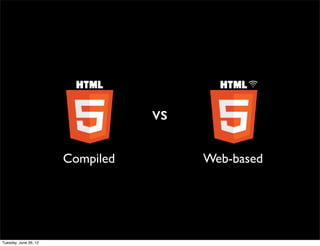
vs

Compiled        Web-based
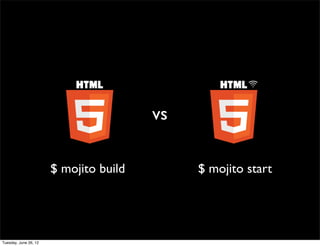
vs

$ mojito build        $ mojito start
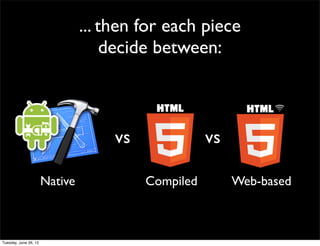
... then for each piece
              decide between:


              vs              vs

Native             Compiled        Web-based
Where to put the shared logic?
REUSE
REDUCE
RECYCLE
REPLACE
How to connect those pieces together?

               “Y.CL”
Pros and Cons
Reduce fragmentation
No need to issue an app update
Some webviews might need to be
refreshed when restoring the app
Easy to ramp-up for web developers
Ideal for experiment-driven development


http://www.bluefountainmedia.com/blog/how-to-be-successful-using-ab-and-multivariate-testing/
It is all about control
Network failures need to be controlled
Initialization needs to be controlled


http://blog.mobtest.com/2012/05/heres-why-the-facebook-ios-app-is-so-bad-uiwebviews-and-no-nitro/
A WebView loading remote content
   is not first class citizen in iOS
Loading over the network is still easier and
 safer than stepping into the gray area of
       auto-upgrading HTML5 apps
Optimization vs Adaptation
         Analogy
Optimization in Mojito
Performance as a product feature
Optimization in Mojito is about
 customizing the way your product
behaves per runtime and per request.
It is about producing the right HTML, JS
  and CSS per runtime and per request.
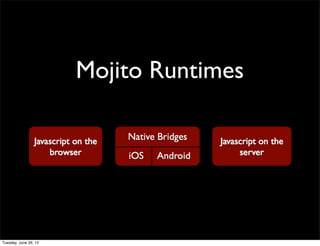
Mojito Runtimes
Mojito Context
- Locale (en-US. pt-BR)
- Environment (staging, qa, prod)
- Device type (iphone, ipad)
- Runtime (Server, Client)

- Network (AT&T, verizon)
- CPU (low, medium, high)
- Foo / Bar / Baz (???)
Optimize per context
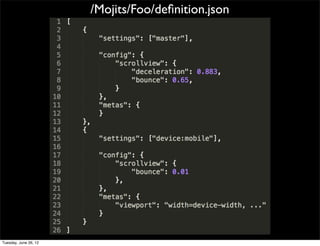
/Mojits/Foo/definition.json
What to do in an event of a
traffic surge?
/Mojits/Bar/definition.json
Control your dimensions in Mojito
/dimensions.json
Adaptation in Mojito
Adaptability as a product feature
Adaptation in Mojito is about
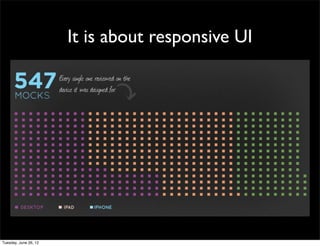
customizing the UI per screen size,
per connection speed, per feature
          detection, etc.
It is about responsive UI
In Mojito,YUI covers a
lot in terms of adaptation:

 - YUI().use(‘cache-offline’)
 - Y.on(‘click’)
 - Y.on(‘orientationchange’)
 - Y.CL.on(‘query’)
 - Y.Foo
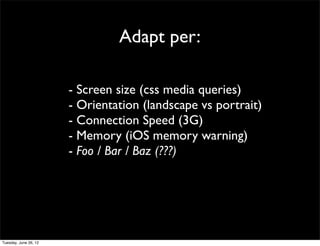
Adapt per:

- Screen size (css media queries)
- Orientation (landscape vs portrait)
- Connection Speed (3G)
- Memory (iOS memory warning)
- Foo / Bar / Baz (???)
Let’s recap
Axis runs on Yahoo! Cocktails
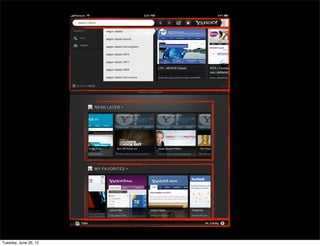
Axis is some sort of hybrid application
composed of independent small native
           and HTML5 apps
HTML5 parts were written on
Yahoo! Mojito, an open source
    application framework
  on top of YUI and Node.js
Axis leverages Mojito context to
optimize and adapt those HTML5 parts
Axis leverages Y.CL as the main
infrastructure to connect different parts
Thank you!
   @caridy

BayJax: Expanding Yahoo! Axis across 3 screens