#yuiconf
#modown
@caridy
http://www.flickr.com/photos/diverkeith/379540273/
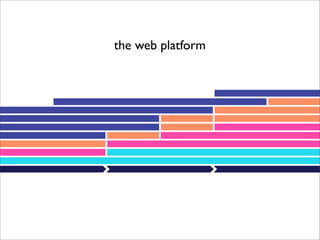
the web platform
“modown”
motivations
web applications becoming
single-page applications
YAF success
mojito constraints
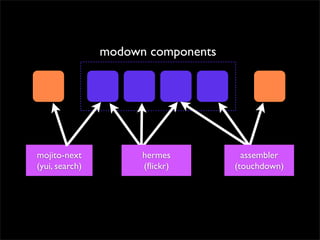
modown components

mojito-next
(yui, search)

hermes
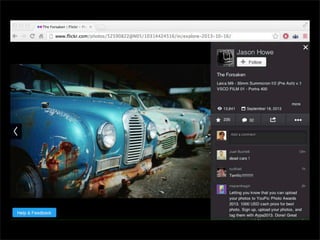
(flickr)

assembler
(touchdown)
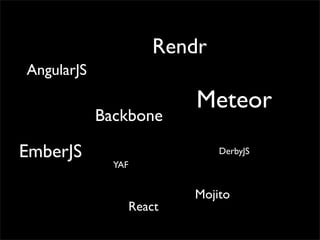
Rendr
AngularJS

Backbone
EmberJS

Meteor
DerbyJS

YAF

React

Mojito
single-page applications
users can switch between
different states in no time
... and doing so without breaking
any of the core features of the web
(history, url, openness, seo)
back to our roots
building blocks rather
than prescriptions
libraries over frameworks
development on the open
goals
building blocks for
SPA written in nodejs
extending express
rendering initial state on the server,
then let the browser takes over
today
13 modules in NPM
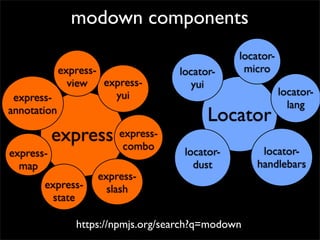
modown components
expressview expressyui
expressannotation

expressmap

express expresscombo

expressstate

expressslash

locatoryui

locatormicro

Locator
locatordust

https://npmjs.org/search?q=modown

locatorlang

locatorhandlebars
2 major customers in production
(flickr and media)
all major changes in YAF
are already in place

https://github.com/yui/yui3/blob/master/src/app/HISTORY.md
no docs, only component level
docs and examples in github
examples
express-yui
for yui core modules
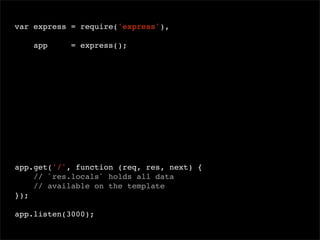
var express = require('express'),
app

= express();


app.get('/', function (req, res, next) {
// `res.locals` holds all data
// available on the template
});
app.listen(3000);
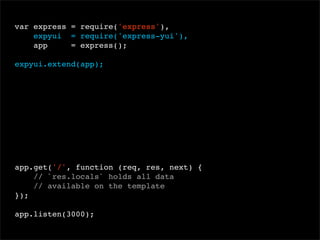
var express = require('express'),
expyui = require('express-yui'),
app
= express();
 
expyui.extend(app);

app.get('/', function (req, res, next) {
// `res.locals` holds all data
// available on the template
});
app.listen(3000);
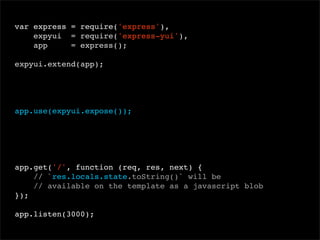
var express = require('express'),
expyui = require('express-yui'),
app
= express();
 
expyui.extend(app);

app.use(expyui.expose());

app.get('/', function (req, res, next) {
// `res.locals.state.toString()` will be
// available on the template as a javascript blob
});
app.listen(3000);
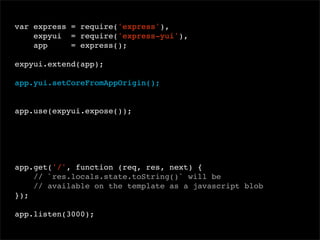
var express = require('express'),
expyui = require('express-yui'),
app
= express();
 
expyui.extend(app);
app.yui.setCoreFromAppOrigin();

app.use(expyui.expose());

app.get('/', function (req, res, next) {
// `res.locals.state.toString()` will be
// available on the template as a javascript blob
});
app.listen(3000);
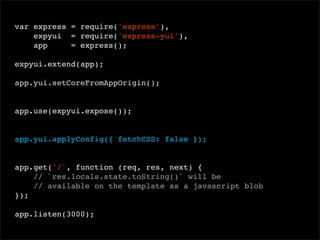
var express = require('express'),
expyui = require('express-yui'),
app
= express();
 
expyui.extend(app);
app.yui.setCoreFromAppOrigin();

app.use(expyui.expose());

app.yui.applyConfig({ fetchCSS: false });

app.get('/', function (req, res, next) {
// `res.locals.state.toString()` will be
// available on the template as a javascript blob
});
app.listen(3000);
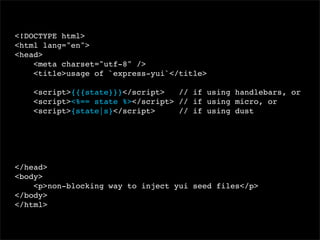
<!DOCTYPE html>
<html lang="en">
<head>
<meta charset="utf-8" />
<title>usage of `express-yui`</title>
<script>{{{state}}}</script>
// if using handlebars, or
<script><%== state %></script> // if using micro, or
<script>{state|s}</script>
// if using dust

</head>
<body>
<p>non-blocking way to inject yui seed files</p>
</body>
</html>
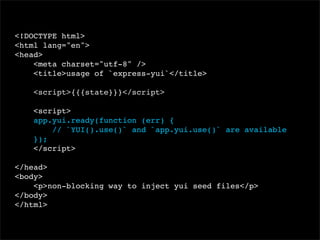
<!DOCTYPE html>
<html lang="en">
<head>
<meta charset="utf-8" />
<title>usage of `express-yui`</title>
<script>{{{state}}}</script>
<script>
app.yui.ready(function (err) {
// `YUI().use()` and `app.yui.use()` are available
});
</script>
</head>
<body>
<p>non-blocking way to inject yui seed files</p>
</body>
</html>
express-yui
for custom yui modules
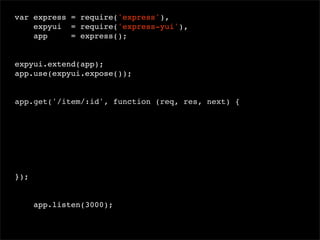
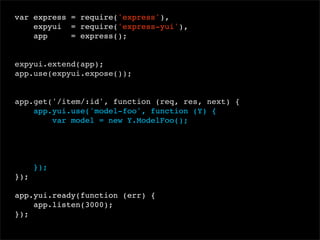
var express = require('express'),
expyui = require('express-yui'),
app
= express();
 
expyui.extend(app);
app.use(expyui.expose());

app.get('/item/:id', function (req, res, next) {

});

app.listen(3000);
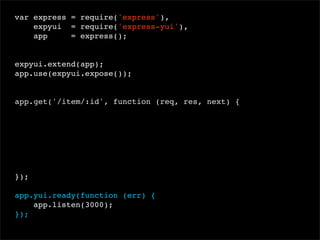
var express = require('express'),
expyui = require('express-yui'),
app
= express();
 
expyui.extend(app);
app.use(expyui.expose());

app.get('/item/:id', function (req, res, next) {

});
app.yui.ready(function (err) {
app.listen(3000);
});
var express = require('express'),
expyui = require('express-yui'),
app
= express();
 
expyui.extend(app);
app.use(expyui.expose());

app.get('/item/:id', function (req, res, next) {
app.yui.use('model-foo', function (Y) {
var model = new Y.ModelFoo();

});
});
app.yui.ready(function (err) {
app.listen(3000);
});
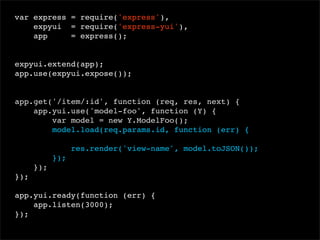
var express = require('express'),
expyui = require('express-yui'),
app
= express();
 
expyui.extend(app);
app.use(expyui.expose());

app.get('/item/:id', function (req, res, next) {
app.yui.use('model-foo', function (Y) {
var model = new Y.ModelFoo();
model.load(req.params.id, function (err) {
res.render('view-name', model.toJSON());
});
});
});
app.yui.ready(function (err) {
app.listen(3000);
});
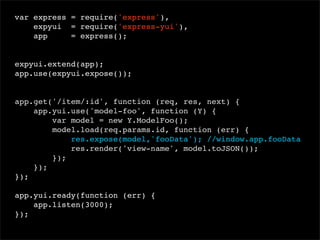
var express = require('express'),
expyui = require('express-yui'),
app
= express();
 
expyui.extend(app);
app.use(expyui.expose());

app.get('/item/:id', function (req, res, next) {
app.yui.use('model-foo', function (Y) {
var model = new Y.ModelFoo();
model.load(req.params.id, function (err) {
res.expose(model,'fooData'); //window.app.fooData
res.render('view-name', model.toJSON());
});
});
});
app.yui.ready(function (err) {
app.listen(3000);
});
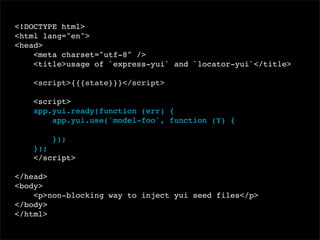
<!DOCTYPE html>
<html lang="en">
<head>
<meta charset="utf-8" />
<title>usage of `express-yui` and `locator-yui`</title>
<script>{{{state}}}</script>
<script>
app.yui.ready(function (err) {
app.yui.use('model-foo', function (Y) {
});
});
</script>
</head>
<body>
<p>non-blocking way to inject yui seed files</p>
</body>
</html>
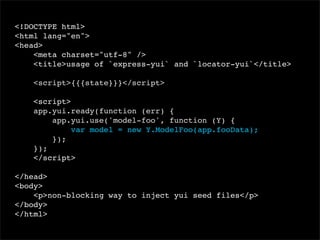
<!DOCTYPE html>
<html lang="en">
<head>
<meta charset="utf-8" />
<title>usage of `express-yui` and `locator-yui`</title>
<script>{{{state}}}</script>
<script>
app.yui.ready(function (err) {
app.yui.use('model-foo', function (Y) {
var model = new Y.ModelFoo(app.fooData);
});
});
</script>
</head>
<body>
<p>non-blocking way to inject yui seed files</p>
</body>
</html>
filesystem abstraction
with locator
locator gives semantic meaning
to files on the filesystem
filesystem analysis to understand
the capabilities of the app
on the making...
Intl
composition
ES6 modules
UI data bindings
modownization of YUI
some final notes
modown is not a framework
modown is not a product
modown is just a principle
Thanks
@caridy

YUIConf2013: Introducing The "Modown" Project