BAUMRIND’S
CAREGIVING
STYLE
DIANA BLUMBERG BAUMRIND
(August 23, 1927 – September 13, 2018)
She was a clinical and developmental
psychologist known for her research on parenting
styles. After being awarded her
doctorate she served as a staff
psychologist at Cowell Memorial
Hospital in Berkeley. She was
also director of two U. S. Public
Health Service projects and a
consultant on a California state
project. From 1958-1960 she
also had a private practice in
Berkeley.
1.Authoritative Parenting:
A. Authoritative parents are both highly responsive
and highly demanding. They set clear rules and
expectations for their children's behavior but also
provide warmth, support, and responsiveness to
their children's needs.
B. They encourage independence while maintaining
appropriate boundaries and guidance.
Authoritative parents are nurturing and
supportive while also fostering autonomy and
self-discipline in their children.
C. This parenting style is associated with positive
outcomes for children, including higher self-
esteem, better social skills, and higher academic
achievement.
2. Authoritarian Parenting:
A. Authoritarian parents are highly demanding
but low in responsiveness. They have strict
rules and high expectations for their
children's behavior but provide little
warmth or emotional support.
B. Authoritarian parents often rely on
punishment and control to enforce
obedience and may prioritize discipline over
nurturing relationships with their children.
C. Children raised by authoritarian parents may
struggle with low self-esteem, anxiety, and
difficulty in social relationships.
3. Permissive Parenting:
A.Permissive parents are highly responsive but
low in demandingness. They are warm and
affectionate towards their children but have
few rules or expectations for their behavior.
B.Permissive parents may avoid conflict and
confrontation, allowing their children
considerable freedom and autonomy in
decision-making.
C.Children raised by permissive parents may
lack self-discipline and struggle with
boundaries, which can lead to behavioral
problems and academic underachievement.
4. Uninvolved/Neglectful Parenting:
A.Uninvolved parents are low in both responsiveness
and demandingness. They provide little emotional
support, guidance, or supervision to their children.
B. Uninvolved parents may be emotionally detached,
preoccupied with their own concerns, or unable to
meet their children's needs due to various factors
such as substance abuse, mental illness, or extreme
work schedules.
C. Children raised by uninvolved parents may
experience neglect, lack of emotional support, and
inadequate supervision, which can lead to a range
of negative outcomes including poor academic
performance, low self-esteem, and behavioral
problems.
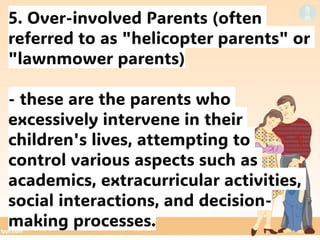
5. Over-involved Parents (often
referred to as "helicopter parents" or
"lawnmower parents)
- these are the parents who
excessively intervene in their
children's lives, attempting to
control various aspects such as
academics, extracurricular activities,
social interactions, and decision-
making processes.
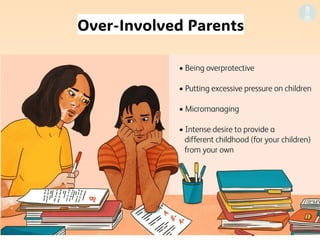
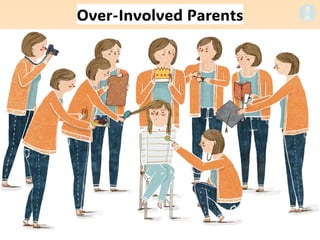
Over-Involved Parents
Over-involved parents, often referred to as "helicopter parents" or "lawnmower
parents," are parents who excessively intervene in their children's lives, attempting
to control various aspects such as academics, extracurricular activities, social
interactions, and decision-making processes.
Scenario example:
Imagine a high school student, Alex, who has a mother named Lisa, who is
overly involved in his academic life. Lisa closely monitors Alex's grades, constantly
checks his homework, and communicates with his teachers to ensure he is meeting
her expectations. Whenever Alex faces a challenge or setback, Lisa immediately
steps in to solve the problem for him, often without giving him the chance to try to
resolve it himself. She also pressures Alex to enroll in advanced classes and
participate in numerous extracurricular activities, believing that this will enhance his
college prospects.
As a result of Lisa's over-involvement, Alex feels suffocated and lacks
autonomy in his own life. He becomes reliant on his parent to navigate his academic
and personal challenges, which hinders his ability to develop important life skills
such as problem-solving, resilience, and independence. Additionally, Alex may
experience increased stress and anxiety due to the pressure placed on him by his
parent's high expectations.
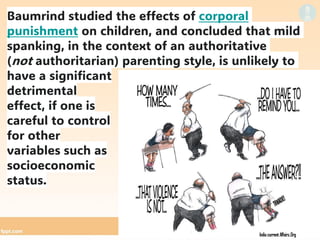
Baumrind studied the effects of corporal
punishment on children, and concluded that mild
spanking, in the context of an authoritative
(not authoritarian) parenting style, is unlikely to
have a significant
detrimental
effect, if one is
careful to control
for other
variables such as
socioeconomic
status.
She observed that previous studies demonstrating a correlation between
corporal punishment and bad outcomes failed to control for variables such
as socioeconomic status. Low-income families are more likely to employ
corporal punishment compared with affluent families. Children from low-
income neighborhoods are more likely to commit violent crimes compared
with children from affluent neighborhoods. But Baumrind believed that
when appropriate controls are made for family income and other
independent variables, mild corporal punishment per se does not increase
the likelihood of bad outcomes.
This assertion
has in turn attracted
criticism and
counterpoints from
other researchers in the
same publication,
for example:
Whether harmful or not,
there is still no consistent
evidence of beneficial
effects.

Baumrind's Caregiving/Parenting Style.pdf

  • 1.
  • 2.
    DIANA BLUMBERG BAUMRIND (August23, 1927 – September 13, 2018) She was a clinical and developmental psychologist known for her research on parenting styles. After being awarded her doctorate she served as a staff psychologist at Cowell Memorial Hospital in Berkeley. She was also director of two U. S. Public Health Service projects and a consultant on a California state project. From 1958-1960 she also had a private practice in Berkeley.
  • 4.
    1.Authoritative Parenting: A. Authoritativeparents are both highly responsive and highly demanding. They set clear rules and expectations for their children's behavior but also provide warmth, support, and responsiveness to their children's needs. B. They encourage independence while maintaining appropriate boundaries and guidance. Authoritative parents are nurturing and supportive while also fostering autonomy and self-discipline in their children. C. This parenting style is associated with positive outcomes for children, including higher self- esteem, better social skills, and higher academic achievement.
  • 5.
    2. Authoritarian Parenting: A.Authoritarian parents are highly demanding but low in responsiveness. They have strict rules and high expectations for their children's behavior but provide little warmth or emotional support. B. Authoritarian parents often rely on punishment and control to enforce obedience and may prioritize discipline over nurturing relationships with their children. C. Children raised by authoritarian parents may struggle with low self-esteem, anxiety, and difficulty in social relationships.
  • 6.
    3. Permissive Parenting: A.Permissiveparents are highly responsive but low in demandingness. They are warm and affectionate towards their children but have few rules or expectations for their behavior. B.Permissive parents may avoid conflict and confrontation, allowing their children considerable freedom and autonomy in decision-making. C.Children raised by permissive parents may lack self-discipline and struggle with boundaries, which can lead to behavioral problems and academic underachievement.
  • 7.
    4. Uninvolved/Neglectful Parenting: A.Uninvolvedparents are low in both responsiveness and demandingness. They provide little emotional support, guidance, or supervision to their children. B. Uninvolved parents may be emotionally detached, preoccupied with their own concerns, or unable to meet their children's needs due to various factors such as substance abuse, mental illness, or extreme work schedules. C. Children raised by uninvolved parents may experience neglect, lack of emotional support, and inadequate supervision, which can lead to a range of negative outcomes including poor academic performance, low self-esteem, and behavioral problems.
  • 9.
    5. Over-involved Parents(often referred to as "helicopter parents" or "lawnmower parents) - these are the parents who excessively intervene in their children's lives, attempting to control various aspects such as academics, extracurricular activities, social interactions, and decision- making processes.
  • 10.
  • 11.
  • 12.
    Over-involved parents, oftenreferred to as "helicopter parents" or "lawnmower parents," are parents who excessively intervene in their children's lives, attempting to control various aspects such as academics, extracurricular activities, social interactions, and decision-making processes. Scenario example: Imagine a high school student, Alex, who has a mother named Lisa, who is overly involved in his academic life. Lisa closely monitors Alex's grades, constantly checks his homework, and communicates with his teachers to ensure he is meeting her expectations. Whenever Alex faces a challenge or setback, Lisa immediately steps in to solve the problem for him, often without giving him the chance to try to resolve it himself. She also pressures Alex to enroll in advanced classes and participate in numerous extracurricular activities, believing that this will enhance his college prospects. As a result of Lisa's over-involvement, Alex feels suffocated and lacks autonomy in his own life. He becomes reliant on his parent to navigate his academic and personal challenges, which hinders his ability to develop important life skills such as problem-solving, resilience, and independence. Additionally, Alex may experience increased stress and anxiety due to the pressure placed on him by his parent's high expectations.
  • 13.
    Baumrind studied theeffects of corporal punishment on children, and concluded that mild spanking, in the context of an authoritative (not authoritarian) parenting style, is unlikely to have a significant detrimental effect, if one is careful to control for other variables such as socioeconomic status.
  • 14.
    She observed thatprevious studies demonstrating a correlation between corporal punishment and bad outcomes failed to control for variables such as socioeconomic status. Low-income families are more likely to employ corporal punishment compared with affluent families. Children from low- income neighborhoods are more likely to commit violent crimes compared with children from affluent neighborhoods. But Baumrind believed that when appropriate controls are made for family income and other independent variables, mild corporal punishment per se does not increase the likelihood of bad outcomes. This assertion has in turn attracted criticism and counterpoints from other researchers in the same publication, for example: Whether harmful or not, there is still no consistent evidence of beneficial effects.