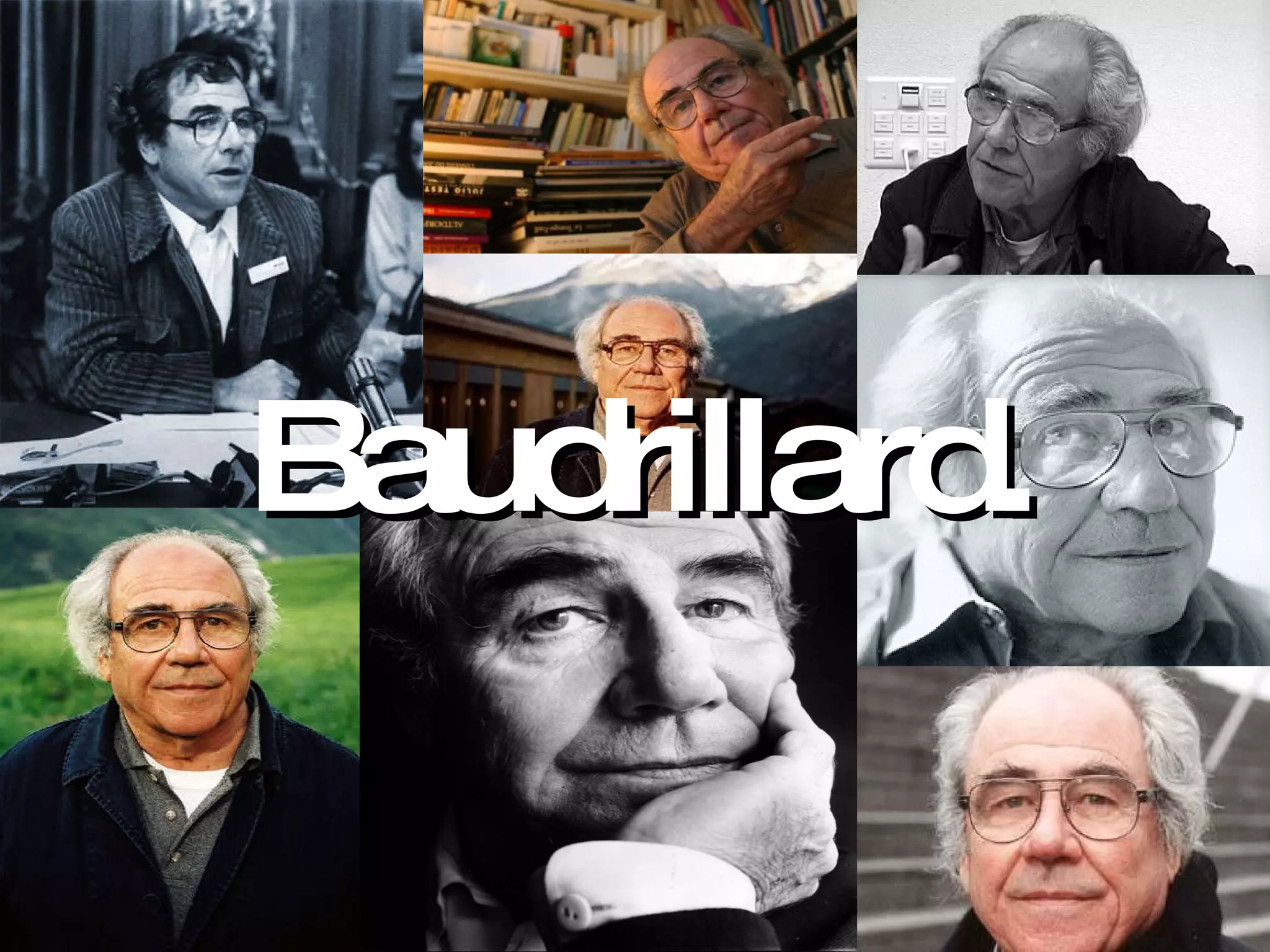
Baudrillard.
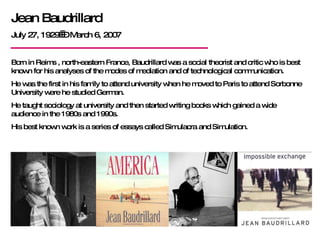
Jean Baudrillard July 27, 1929  – March 6, 2007 Born in Reims , north-eastern France, Baudrillard was a social theorist and critic who is best known for his analyses of the modes of mediation and of technological communication.  He was the first in his family to attend university when he moved to Paris to attend Sorbonne University were he studied German. He taught sociology at university and then started writing books which gained a wide audience in the 1980s and 1990s. His best known work is a series of essays called Simulacra and Simulation.
Simulacra and Simulation In this series of essays, Baudrillard examines the power of representations in the pre-modern, modern and post-modern worlds and discusses the interaction between reality, symbols and society. It is most known for its discussion of images, signs, and how they relate to the present day. Baudrillard claims that modern society has replaced all reality and meaning with symbols and signs, and that the human experience is of a simulation of reality rather than reality itself. According to Baudrillard, in the pre-modern world, audiences were rarely confronted with representations of the real because technology was simply not available therefore, there could be no confusion between virtual and actual. In the modern world, industrialisation and mass production allowed  an endless series of representations,  but it was still more likely  people could distinguish between the simulation and the real. In the post-modern world, audiences are saturated in representations,  that these now precede perceptions of the actually. For example,  many victims of the 9/11 described their trauma of the collapse  ‘like a film’, a comment which show one considers a simulation  of the real (a film)as the reference point for something actual.
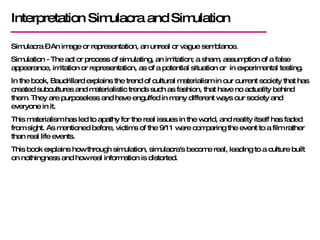
Interpretation Simulacra and Simulation Simulacra – An image or representation, an unreal or vague semblance. Simulation - The act or process of simulating, an imitation; a sham, assumption of a false appearance, imitation or representation, as of a potential situation or  in experimental testing.  In the book, Baudrillard explains the trend of cultural materialism in our current society that has created subcultures and materialistic trends such as fashion, that have no actuality behind them. They are purposeless and have engulfed in many different ways our society and everyone in it.  This materialism has led to apathy for the real issues in the world, and reality itself has faded from sight. As mentioned before, victims of the 9/11 were comparing the event to a film rather than real life events.  This book explains how through simulation, simulacra's become real, leading to a culture built on nothingness and how real information is distorted.
Bibliography Major Theoretical Works by Baudrillard (1996c [1968]),  The System of Objects . London: Verso.  (1998 [1970]),  The Consumer Society . Paris: Gallimard.  (1975 [1973]),  The Mirror of Production . St. Louis: Telos Press.  (1981 [1973]),  For a Critique of the Political Economy of the Sign . St. Louis: Telos Press.  (1983a),  Simulations . New York: Semiotext(e).  (1983b),  In the Shadow of the Silent Majorities . New York: Semiotext(e).  (1983c), "The Ecstacy of Communication," in  The Anti-Aesthetic , ed. Hal Foster. Washington: Bay Press.  (1988),  America . London: Verso.  (1990a),  Cool Memories . London: Verso.  (1990b),  Fatal Strategies . New York: Semiotext(e).  (1993a),  Symbolic Exchange and Death . London: Sage.  (1993b),  The Transparency of Evil . London: Verso.  (1994a),  Simulacra and Simulation . Ann Arbor: The University of Michigan Press.  (1994b),  The Illusion of the End . Oxford: Polity Press.  (1995),  The Gulf War Never Happened . Oxford: Polity Press.  (1996a),  Cool Memories II . Oxford: Polity Press.  (1996b),  The Perfect Crime . London and New York: Verso Books.  (1997),  Fragments: Cool Memories III, 1990-1995 . London and New York: Verso Books.  (2000),  The Vital Illusion . New York: Columbia University Press.  (2001),  Impossible Exchange  (2001). London: Verso.  (2002a),  The Spirit of Terrorism: And Requiem for the Twin Towers . London: Verso.  (2002b),  Screened Out . London: Verso.

Baudrillard

  • 1.
  • 2.
    Jean Baudrillard July27, 1929  – March 6, 2007 Born in Reims , north-eastern France, Baudrillard was a social theorist and critic who is best known for his analyses of the modes of mediation and of technological communication. He was the first in his family to attend university when he moved to Paris to attend Sorbonne University were he studied German. He taught sociology at university and then started writing books which gained a wide audience in the 1980s and 1990s. His best known work is a series of essays called Simulacra and Simulation.
  • 3.
    Simulacra and SimulationIn this series of essays, Baudrillard examines the power of representations in the pre-modern, modern and post-modern worlds and discusses the interaction between reality, symbols and society. It is most known for its discussion of images, signs, and how they relate to the present day. Baudrillard claims that modern society has replaced all reality and meaning with symbols and signs, and that the human experience is of a simulation of reality rather than reality itself. According to Baudrillard, in the pre-modern world, audiences were rarely confronted with representations of the real because technology was simply not available therefore, there could be no confusion between virtual and actual. In the modern world, industrialisation and mass production allowed an endless series of representations, but it was still more likely people could distinguish between the simulation and the real. In the post-modern world, audiences are saturated in representations, that these now precede perceptions of the actually. For example, many victims of the 9/11 described their trauma of the collapse ‘like a film’, a comment which show one considers a simulation of the real (a film)as the reference point for something actual.
  • 4.
    Interpretation Simulacra andSimulation Simulacra – An image or representation, an unreal or vague semblance. Simulation - The act or process of simulating, an imitation; a sham, assumption of a false appearance, imitation or representation, as of a potential situation or in experimental testing. In the book, Baudrillard explains the trend of cultural materialism in our current society that has created subcultures and materialistic trends such as fashion, that have no actuality behind them. They are purposeless and have engulfed in many different ways our society and everyone in it. This materialism has led to apathy for the real issues in the world, and reality itself has faded from sight. As mentioned before, victims of the 9/11 were comparing the event to a film rather than real life events. This book explains how through simulation, simulacra's become real, leading to a culture built on nothingness and how real information is distorted.
  • 5.
    Bibliography Major TheoreticalWorks by Baudrillard (1996c [1968]), The System of Objects . London: Verso. (1998 [1970]), The Consumer Society . Paris: Gallimard. (1975 [1973]), The Mirror of Production . St. Louis: Telos Press. (1981 [1973]), For a Critique of the Political Economy of the Sign . St. Louis: Telos Press. (1983a), Simulations . New York: Semiotext(e). (1983b), In the Shadow of the Silent Majorities . New York: Semiotext(e). (1983c), "The Ecstacy of Communication," in The Anti-Aesthetic , ed. Hal Foster. Washington: Bay Press. (1988), America . London: Verso. (1990a), Cool Memories . London: Verso. (1990b), Fatal Strategies . New York: Semiotext(e). (1993a), Symbolic Exchange and Death . London: Sage. (1993b), The Transparency of Evil . London: Verso. (1994a), Simulacra and Simulation . Ann Arbor: The University of Michigan Press. (1994b), The Illusion of the End . Oxford: Polity Press. (1995), The Gulf War Never Happened . Oxford: Polity Press. (1996a), Cool Memories II . Oxford: Polity Press. (1996b), The Perfect Crime . London and New York: Verso Books. (1997), Fragments: Cool Memories III, 1990-1995 . London and New York: Verso Books. (2000), The Vital Illusion . New York: Columbia University Press. (2001), Impossible Exchange (2001). London: Verso. (2002a), The Spirit of Terrorism: And Requiem for the Twin Towers . London: Verso. (2002b), Screened Out . London: Verso.