battery supercapacitor EV bldc motorpresentation.pptx
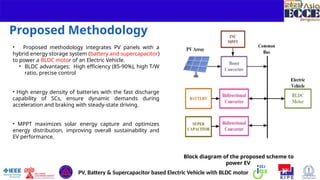
Proposed methodology integrates PV panels with a hybrid energy storage system (battery and supercapacitor) to power a BLDC motor of an Electric Vehicle
battery supercapacitor EV bldc motorpresentation.pptx
1.
PV, Battery &Supercapacitor based Electric
Vehicle with BLDC motor
2.
2
Outline
PV, Battery &Supercapacitor based Electric Vehicle with BLDC motor
• Introduction
• Challenges and issues associated
• Literature Review
• Methodology
• Control technique
• Simulation setup
• Simulation results
• Discussion
• Conclusions
3.
3
Introduction
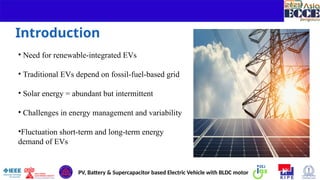
• Need forrenewable-integrated EVs
• Traditional EVs depend on fossil-fuel-based grid
• Solar energy = abundant but intermittent
• Challenges in energy management and variability
•Fluctuation short-term and long-term energy
demand of EVs
PV, Battery & Supercapacitor based Electric Vehicle with BLDC motor
4.
4
Literature review andchallenges
• Past studies focus on hybrid systems (Battery+SC+PV):
• Azizi et al. proposed an energy management strategy that optimally integrates Battery Storage Systems (BSS) and
supercapacitors to enhance urban EV performance. Simulation results show significant reductions in energy consumption
compared to traditional methods [1].
• However, The focus on urban conditions limits generalizability to other environments like highways or rural areas.
• Additionally, complex control algorithms may increase computational demands, affecting real-time performance.
• Kim et al. proposed a motor driver design for HEVs is evaluated via simulations, demonstrating improved torque control
and energy efficiency [2].
• Despite the benefits, reliance on simulations may not fully account for real-world dynamics thermal management is
not addressed, which is crucial for long-term reliability.
• Common issues:
• Heavy simulation reliance,
• Lack of real-world validations
• Complexity in implementation
• Cost & integration concerns
PV, Battery & Supercapacitor based Electric Vehicle with BLDC motor
Azizi, I., & Radjeai, H. (2018). A new strategy for battery and supercapacitor energy management for an urban electric vehicle. Electrical Engineering, 100(2), 667-676.
Kim, S. C., Sangam, N., Pagidipala, S., & Salkuti, S. R. (2022). Design and analysis of BLDC motor driver for hybrid electric vehicles. In Next Generation Smart Grids: Modeling, Control and Optimization (pp. 297-311). Singapore: Springer
Nature Singapore.
5.
5
Proposed Methodology
• Proposedmethodology integrates PV panels with a
hybrid energy storage system (battery and supercapacitor)
to power a BLDC motor of an Electric Vehicle.
• BLDC advantages: High efficiency (85-90%), high T/W
ratio, precise control
• High energy density of batteries with the fast discharge
capability of SCs, ensure dynamic demands during
acceleration and braking with steady-state driving.
• MPPT maximizes solar energy capture and optimizes
energy distribution, improving overall sustainability and
EV performance.
Block diagram of the proposed scheme to
power EV
PV, Battery & Supercapacitor based Electric Vehicle with BLDC motor
6.
6
PV with MPPTControl
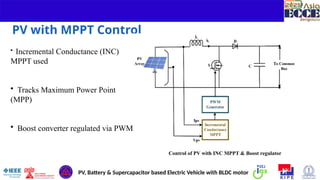
• Incremental Conductance (INC)
MPPT used
• Tracks Maximum Power Point
(MPP)
• Boost converter regulated via PWM
Control of PV with INC MPPT & Boost regulator
PV, Battery & Supercapacitor based Electric Vehicle with BLDC motor
7.
7
Battery and Supercapacitorcontrol
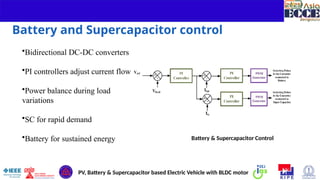
•Bidirectional DC-DC converters
•PI controllers adjust current flow
•Power balance during load
variations
•SC for rapid demand
•Battery for sustained energy Battery & Supercapacitor Control
PV, Battery & Supercapacitor based Electric Vehicle with BLDC motor
8.
8
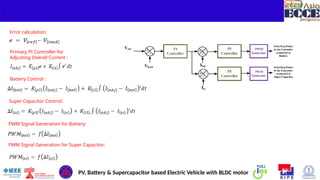
Error calculation:
Primary PIController for
Adjusting Overall Current :
Battery Control :
Super Capacitor Control:
PWM Signal Generation for Battery:
PWM Signal Generation for Super Capacitor:
PV, Battery & Supercapacitor based Electric Vehicle with BLDC motor
9.
9
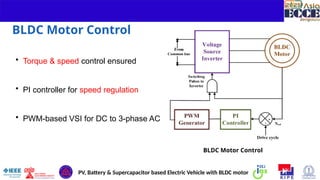
BLDC Motor Control
•Torque & speed control ensured
• PI controller for speed regulation
• PWM-based VSI for DC to 3-phase AC
BLDC Motor Control
PV, Battery & Supercapacitor based Electric Vehicle with BLDC motor
10.
10
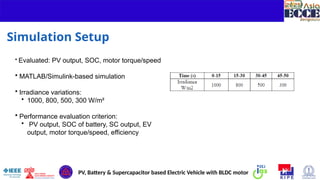
Simulation Setup
• Evaluated:PV output, SOC, motor torque/speed
• MATLAB/Simulink-based simulation
• Irradiance variations:
• 1000, 800, 500, 300 W/m²
• Performance evaluation criterion:
• PV output, SOC of battery, SC output, EV
output, motor torque/speed, efficiency
PV, Battery & Supercapacitor based Electric Vehicle with BLDC motor
11.
11
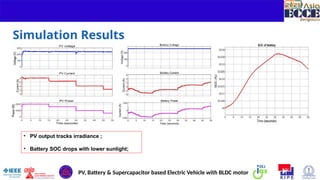
Simulation Results
• PVoutput tracks irradiance ;
• Battery SOC drops with lower sunlight;
PV, Battery & Supercapacitor based Electric Vehicle with BLDC motor
12.
12
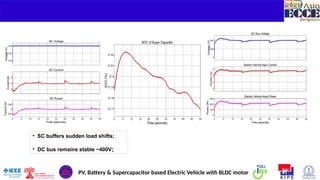
• SC bufferssudden load shifts;
• DC bus remains stable ~400V;
PV, Battery & Supercapacitor based Electric Vehicle with BLDC motor
13.
13
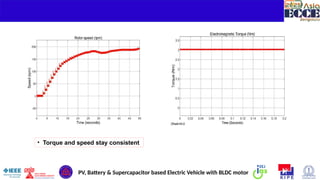
• Torque andspeed stay consistent
PV, Battery & Supercapacitor based Electric Vehicle with BLDC motor
14.
14
Conclusion
The study concludesthat the hybrid PV, battery, and supercapacitor system, coupled with efficient control strategies,
provides a sustainable and reliable energy solution for EVs, optimizing motor performance while adapting to the
variability of renewable energy sources.
PV, Battery & Supercapacitor based Electric Vehicle with BLDC motor
•Efficient energy management with minimal grid dependence
•Real-time adaptation to solar input
•SC improves transient performance and accommodates vehicle’s fluctuating demand
• Stable operation with varying irradiance
• Effective MPPT and control strategies
• Battery life extension via reduced deep discharges


![4
Literature review and challenges
• Past studies focus on hybrid systems (Battery+SC+PV):
• Azizi et al. proposed an energy management strategy that optimally integrates Battery Storage Systems (BSS) and
supercapacitors to enhance urban EV performance. Simulation results show significant reductions in energy consumption
compared to traditional methods [1].
• However, The focus on urban conditions limits generalizability to other environments like highways or rural areas.
• Additionally, complex control algorithms may increase computational demands, affecting real-time performance.
• Kim et al. proposed a motor driver design for HEVs is evaluated via simulations, demonstrating improved torque control
and energy efficiency [2].
• Despite the benefits, reliance on simulations may not fully account for real-world dynamics thermal management is
not addressed, which is crucial for long-term reliability.
• Common issues:
• Heavy simulation reliance,
• Lack of real-world validations
• Complexity in implementation
• Cost & integration concerns
PV, Battery & Supercapacitor based Electric Vehicle with BLDC motor
Azizi, I., & Radjeai, H. (2018). A new strategy for battery and supercapacitor energy management for an urban electric vehicle. Electrical Engineering, 100(2), 667-676.
Kim, S. C., Sangam, N., Pagidipala, S., & Salkuti, S. R. (2022). Design and analysis of BLDC motor driver for hybrid electric vehicles. In Next Generation Smart Grids: Modeling, Control and Optimization (pp. 297-311). Singapore: Springer
Nature Singapore.](https://image.slidesharecdn.com/batterysupercapacitorev-251126104906-2bed15ca/85/battery-supercapacitor-EV-bldc-motorpresentation-pptx-4-320.jpg)