SUBMITTED TO:-ER.AMANJOT SINGH
SUBMITTED BY:- NANDNI
ROLL NO. :-1730762
CLASS:- CIVIL(4TH)SEM
BATCHING PLANT
ACONCRETEPLANTISALSOKNOWNASBETCHINGPLANT.ITISA
DEVICEWHICHCOMBINESVARIOUSINGRIDIENTSTO FORM
CONCRETE.
SOME OIF THESEINPUTS INCLUDE:-
1. SAND
2. Water
3. Aggregate(rocks , gravel)
4. Fly ash
5. Admixtures
6. Cement
AGGRIGATES
Aggregates forms the
skeleton matrix 60-75%
by volume.
25-40% Paste
1-2% Voids.
Cement-sand
Mortar
Aggregate
Aggregate shall be inert and strong.
CEMENT
4
– Most commonly used cement is called Portland Cement
discovered in 1824 in England, when it mixed with water,
it gets hardens, hence become hydraulic cement .
Basic raw materials used in the manufacture of
cement are calcium carbonate found in lime Stone
or chalk, and silica, alumina and iron- oxide found in
clay or shale.
ADMIXTURES
Chemical Admixture:- Used for specific
Property/performance enhancement.
Mineral Admixture:- Used for improvement of
long term strength and durability performance.
Using above admixtures together, high Strength and
high performance concrete Materials can be designed.
2
General Outline
Concrete Production.
 Production
 Batching
 Mixing.
PRODUCTION PROCESS
Mixing
Compaction
Transport Placing
Curing
QUALITY CONTROLIS
MOST IMPORTANT
CONCRETE
BATCHING
What is CONCRETE?
– Ordinarily concrete
is made by mixing an
inorganic material
known as cement
with water together
with natural sand or
stone dusts and
natural stones which
may be uncrushed or
crushed.
Cement
Sand/
FineAggregate
Stone /
CoarseAgg.
CONCRETE&COMPOSITES
 Normal strength Concrete.
 High strength/performance concrete.
 Ultra high strength concrete.
 Fiber Reinforced Concrete.
 Densified with small particle (DSP).
 Macro Defect Free (MDF) Matrix.
 Reactive Powder Concrete (RPC).
 Polymer Concrete (PC).
 Polymer cement concrete.
PERFORMANCE OF CONCRETE
1. Normal strength concrete:  60MPa.
2. High strength concrete: 60  f C 120MPa.
3. Ultra High strength concrete:  120MPa.
4. Performance at fresh state:- Self Compacting
5. Long term durability performance.
 Concrete is a versatile construction material.
DESIGNATIONOFNORMAL STRENGTH
CONCRETE
-Concrete is designated through 28 day
Standard cube compressive strength.
- In Indian Standard Code of practice
(IS456) a concrete is designated by its
characteristic cube compressive strength
at 28 days, the cube being cast, cured and
tested in a standard manner.
Concrete is designated as M25 has a 28 day
Characteristic standard cube strength of 25 Mpa.
ADVANTAGES AND
DISADVANTAGES OF CONCRETE
Lower life cycle cost.
Mould – ability.
Robustness.
Can be designed for desired property
Low tensile strength.
Lower ductility (brittle).
Concrete is most popular construction
material.
BATCHING
– Batching is the process of
measurement of specified quantities
of cement, aggregates, water and
admixture, i.e., ingredients of concrete
in correct proportion.
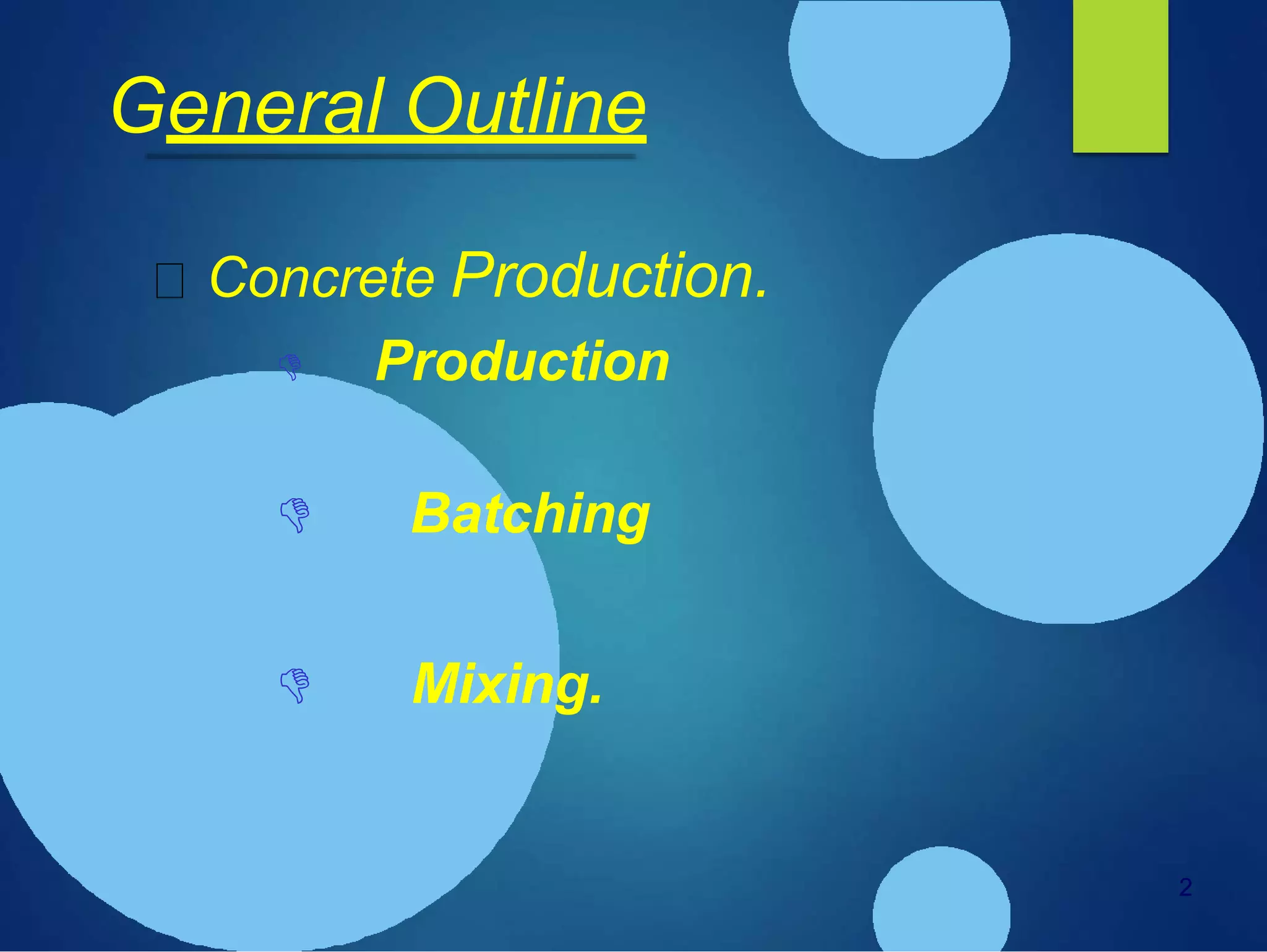
Batching plant:- ACONCRETEPLANTIS
ALSOKNOWNASBETCHINGPLANT.ITISADEVICE
WHICH COMBINESVARIOUSINGRIDIENTSTOFORM
CONCRETE.
TYPESOFBATCHINGPLANT
READYMIX PLANT.
CENTERALMIX PLANT.
Ready mix plant (RMC):-
1.Aready mix plant combines all ingredients except for water at the
concrete plant. This mixture is then discharge into aready mix truck.
2. water is then added to the mix in the truck .And mix during
transport to the job site.
Central mixplant
1. Itcombines all the ingredients +water at a
location.
2. The final product is transported to the job site.
3. CMP is different from RMC asit gives much more
consistent product, since all the ingredient mixing
is done at the central location and is computer
assisted to ensure the uniformity of product.
BATCHING PLANT
components
Components of a Batching Plant
-A) Aggregate bins for various types of
aggregates.
-B) Feeding mechanisms such as
scrappers, conveyors or hoists etc. to
transfer aggregate to scales (balances).
- C) Balance and measuring system.
BATCHING PLANT
components
Components of a Batching Plant
-D) Cement silos and a conveyor screw or
bucket conveyor .
-E) The storage tank for water and water
measuring system .
-F) Dispenser for chemical (liquid)
admixture.
BATCHINGPROCESS
– Batching by mass (weights) as
reproducibility of loose volume is
inadequate and is not economical .
– Control and storage of materials
Aggregate bins for storing aggregate. Silos
for storing cement and cementitious
materials
BATCHING process
– Plant Type can be cyclic or continuous.
– Plant Type can be automatic or manual.
– Accuracy.
Recommendation of IS 456 is 2% for the
quantity of cement measured and 3% for
the quantity of aggregate, water and
admixture being measured.
BATCHING PLANT
Scrapper
Fly ash silo
Cement Silos
Aggregate bins
BATCHING PLANT
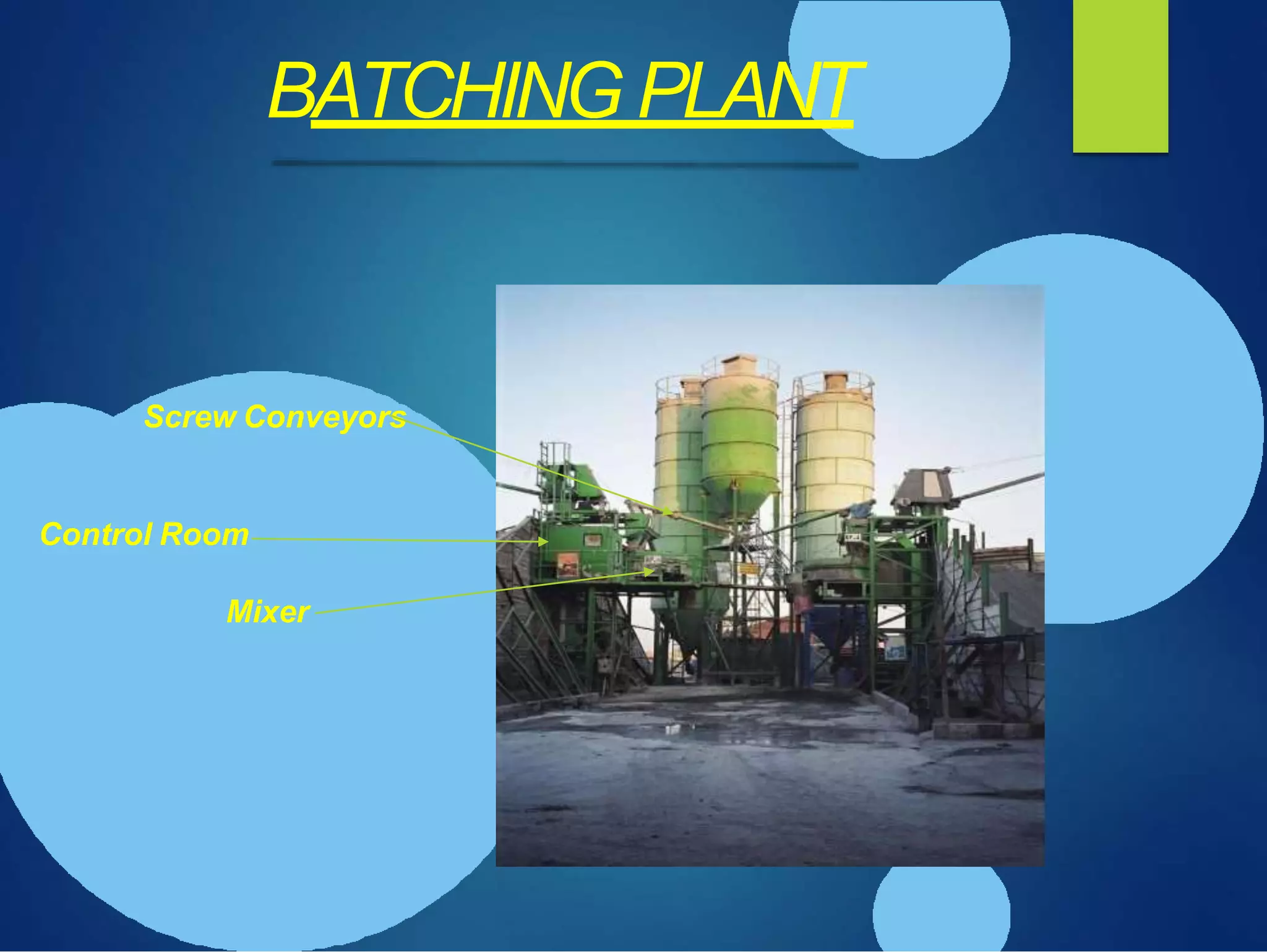
Screw Conveyors
Control Room
Mixer
MIXING
– Thorough mixing is essential for production of
uniform quality concrete.
– Equipment and method should be capable of
effectively mixing concrete material containing
largest specified aggregate to produce uniform
mixtures of the lowest slump practical for the
work.
MIXING
– cyclic or batch mixers, and continuous
mixers.
– gravity mixers or mixers with forced
movements.
– Counter-flow mixer or open–pan
mixers
MIXING
– uniformity tests on samples of fresh concrete collected
from the mixer at different stages of its discharge from a
given batch.
– Mixing Time: 1minute is required for 0.75 m3 capacity
mixer and 0.25 minute is required for each additional0.75
m3 capacity.
Mixers
The centre of the concrete batching plant is known as
mixer.
There are three type ofmixer:-
1.Tilting drum mixer.
2.Pan mixer.
3.Twinshaft mixer.
Tilting drum mixer:- They are fast and efficient , but
can be maintenance- intensive since they include several moving
parts that are subjected to a heavy load.
Panmixer:- pan mixer are generally lower capacity mixers .They
are used at precast concrete plant.
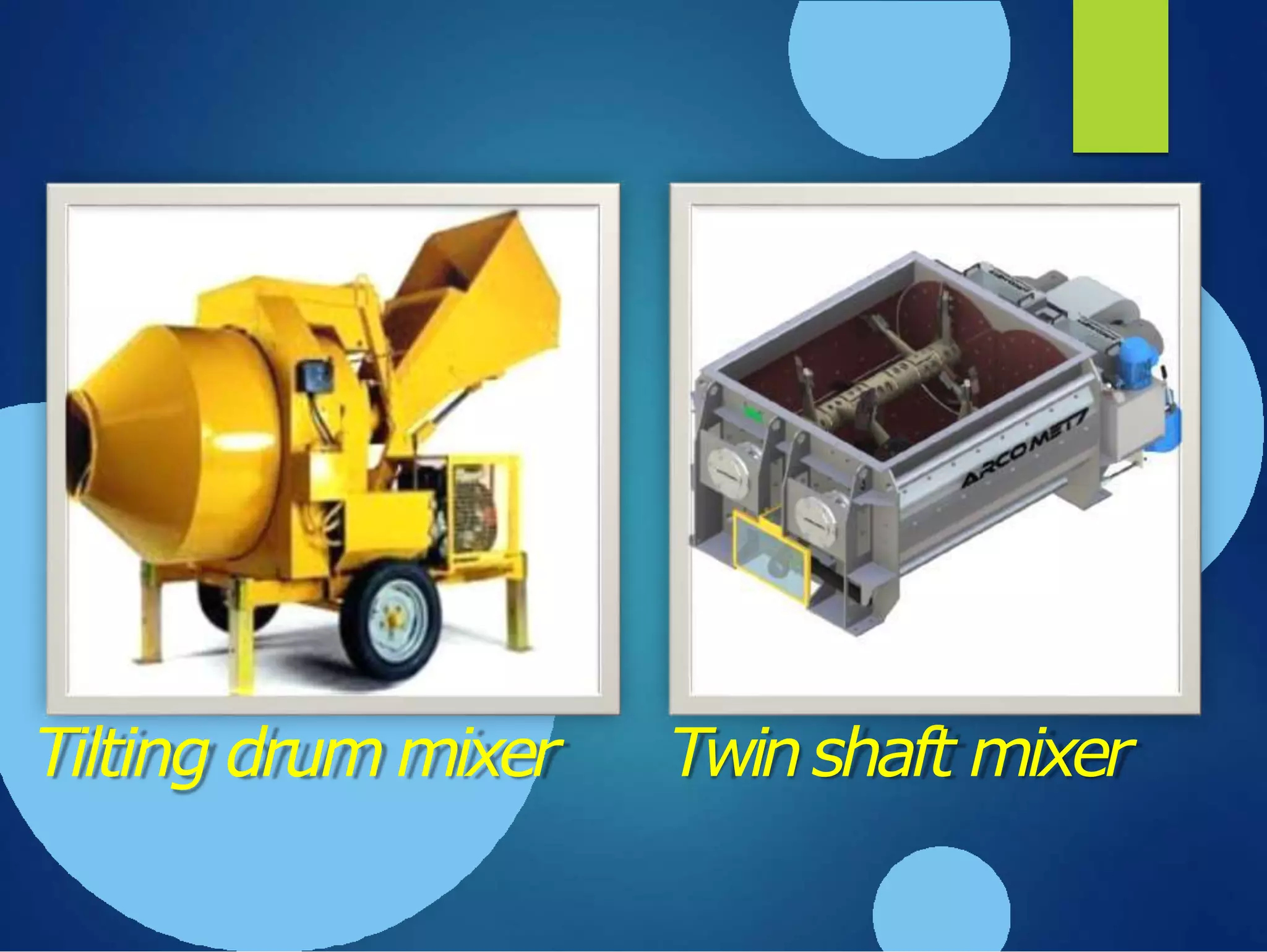
Twin shaft mixer:-
1.it can ensure an even mixture of concrete and large output with high
quality.
2.it consist amixer ,with counter rotating shafts, delivers fast mixing
action and rapid discharge.
Tilting drum mixer Twinshaft mixer
PAN MIXER
.
PAN MIXER
MIXING TIME
–increasing mixing time may result in more uniform
distribution of hydration product resulting in higher
compressive strength
–prolonging the mixing processtoo long may not
increase the strength proportionally and may result in
a decreasein some cases.
–over grinding of the material and in some cases
may increase the proportion of fines. Quite often
excessivemixing leads to segregation in caseof
leaner concretes.
SUMMARY
Concrete production process.
Batching process and its importance in producing
quality concrete.
Mixing process for producing uniform quality
concrete.
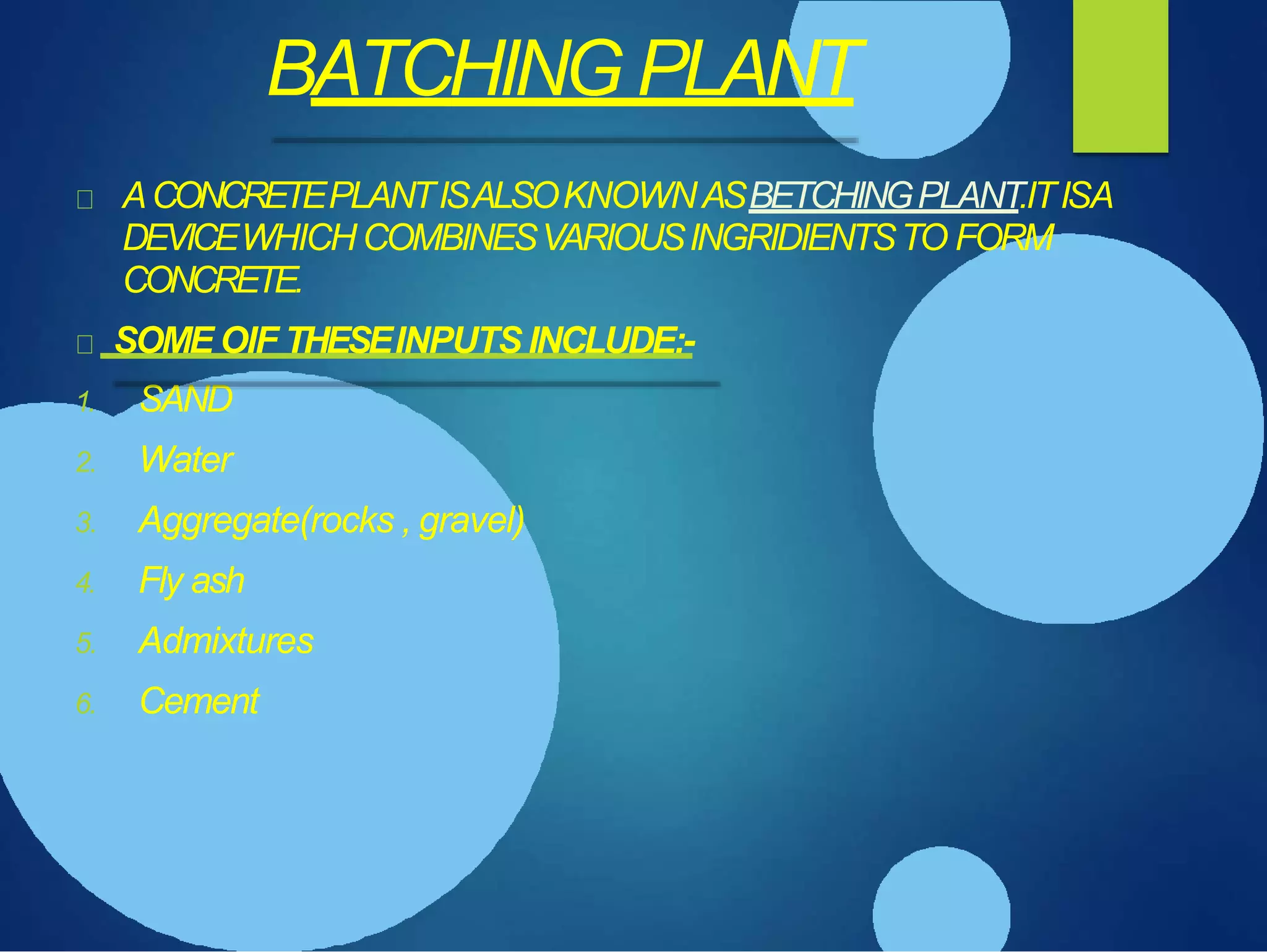
“Hot mix” plant
Asphaltic concrete is amixture of asphalt ,
coarse aggregates ,fine aggregates & filler
material .After mixing we are heating them up
to final product called “Hot Mix”.
There are two types of hot mixplant:
Batch type plant
Drum(continuous)typeplant
Batch mix plant
Asphalt Batch mixplants: These plants produce hot mix
asphalt in a series of batches.
1.Cold aggregate four - bin feeder.
2.Cold conveyor.
3.Aggregate dryer.
4.Mixing chamber.
5.Asphalt tank.
6.Mineral filler unit.
7.Load out conveyor.
8.Centralized control panel.
Drum type plant
Drum mix asphalt plant:- These plants produce hot mix asphalt in a
continuous process. These are usually drum mix plants and counter flow
plants.
Usually drum type plant is smaller than asphalt batch plant.
Itrequire less space, less energy ,less energy and less efforts to run.
The components are also less in the drum asphalt plant which make
them easyto transport.
THANK YOU
FOR HEARING

Batching Plant and Mixer

  • 1.
    SUBMITTED TO:-ER.AMANJOT SINGH SUBMITTEDBY:- NANDNI ROLL NO. :-1730762 CLASS:- CIVIL(4TH)SEM
  • 2.
    BATCHING PLANT ACONCRETEPLANTISALSOKNOWNASBETCHINGPLANT.ITISA DEVICEWHICHCOMBINESVARIOUSINGRIDIENTSTO FORM CONCRETE. SOMEOIF THESEINPUTS INCLUDE:- 1. SAND 2. Water 3. Aggregate(rocks , gravel) 4. Fly ash 5. Admixtures 6. Cement
  • 3.
    AGGRIGATES Aggregates forms the skeletonmatrix 60-75% by volume. 25-40% Paste 1-2% Voids. Cement-sand Mortar Aggregate Aggregate shall be inert and strong.
  • 4.
    CEMENT 4 – Most commonlyused cement is called Portland Cement discovered in 1824 in England, when it mixed with water, it gets hardens, hence become hydraulic cement . Basic raw materials used in the manufacture of cement are calcium carbonate found in lime Stone or chalk, and silica, alumina and iron- oxide found in clay or shale.
  • 5.
    ADMIXTURES Chemical Admixture:- Usedfor specific Property/performance enhancement. Mineral Admixture:- Used for improvement of long term strength and durability performance. Using above admixtures together, high Strength and high performance concrete Materials can be designed.
  • 6.
    2 General Outline Concrete Production. Production  Batching  Mixing.
  • 7.
  • 8.
    What is CONCRETE? –Ordinarily concrete is made by mixing an inorganic material known as cement with water together with natural sand or stone dusts and natural stones which may be uncrushed or crushed. Cement Sand/ FineAggregate Stone / CoarseAgg.
  • 9.
    CONCRETE&COMPOSITES  Normal strengthConcrete.  High strength/performance concrete.  Ultra high strength concrete.  Fiber Reinforced Concrete.  Densified with small particle (DSP).  Macro Defect Free (MDF) Matrix.  Reactive Powder Concrete (RPC).  Polymer Concrete (PC).  Polymer cement concrete.
  • 10.
    PERFORMANCE OF CONCRETE 1.Normal strength concrete:  60MPa. 2. High strength concrete: 60  f C 120MPa. 3. Ultra High strength concrete:  120MPa. 4. Performance at fresh state:- Self Compacting 5. Long term durability performance.  Concrete is a versatile construction material.
  • 11.
    DESIGNATIONOFNORMAL STRENGTH CONCRETE -Concrete isdesignated through 28 day Standard cube compressive strength. - In Indian Standard Code of practice (IS456) a concrete is designated by its characteristic cube compressive strength at 28 days, the cube being cast, cured and tested in a standard manner. Concrete is designated as M25 has a 28 day Characteristic standard cube strength of 25 Mpa.
  • 12.
    ADVANTAGES AND DISADVANTAGES OFCONCRETE Lower life cycle cost. Mould – ability. Robustness. Can be designed for desired property Low tensile strength. Lower ductility (brittle). Concrete is most popular construction material.
  • 13.
    BATCHING – Batching isthe process of measurement of specified quantities of cement, aggregates, water and admixture, i.e., ingredients of concrete in correct proportion. Batching plant:- ACONCRETEPLANTIS ALSOKNOWNASBETCHINGPLANT.ITISADEVICE WHICH COMBINESVARIOUSINGRIDIENTSTOFORM CONCRETE.
  • 14.
    TYPESOFBATCHINGPLANT READYMIX PLANT. CENTERALMIX PLANT. Readymix plant (RMC):- 1.Aready mix plant combines all ingredients except for water at the concrete plant. This mixture is then discharge into aready mix truck. 2. water is then added to the mix in the truck .And mix during transport to the job site.
  • 15.
    Central mixplant 1. Itcombinesall the ingredients +water at a location. 2. The final product is transported to the job site. 3. CMP is different from RMC asit gives much more consistent product, since all the ingredient mixing is done at the central location and is computer assisted to ensure the uniformity of product.
  • 16.
    BATCHING PLANT components Components ofa Batching Plant -A) Aggregate bins for various types of aggregates. -B) Feeding mechanisms such as scrappers, conveyors or hoists etc. to transfer aggregate to scales (balances). - C) Balance and measuring system.
  • 17.
    BATCHING PLANT components Components ofa Batching Plant -D) Cement silos and a conveyor screw or bucket conveyor . -E) The storage tank for water and water measuring system . -F) Dispenser for chemical (liquid) admixture.
  • 18.
    BATCHINGPROCESS – Batching bymass (weights) as reproducibility of loose volume is inadequate and is not economical . – Control and storage of materials Aggregate bins for storing aggregate. Silos for storing cement and cementitious materials
  • 19.
    BATCHING process – PlantType can be cyclic or continuous. – Plant Type can be automatic or manual. – Accuracy. Recommendation of IS 456 is 2% for the quantity of cement measured and 3% for the quantity of aggregate, water and admixture being measured.
  • 20.
    BATCHING PLANT Scrapper Fly ashsilo Cement Silos Aggregate bins
  • 21.
  • 22.
    MIXING – Thorough mixingis essential for production of uniform quality concrete. – Equipment and method should be capable of effectively mixing concrete material containing largest specified aggregate to produce uniform mixtures of the lowest slump practical for the work.
  • 23.
    MIXING – cyclic orbatch mixers, and continuous mixers. – gravity mixers or mixers with forced movements. – Counter-flow mixer or open–pan mixers
  • 24.
    MIXING – uniformity testson samples of fresh concrete collected from the mixer at different stages of its discharge from a given batch. – Mixing Time: 1minute is required for 0.75 m3 capacity mixer and 0.25 minute is required for each additional0.75 m3 capacity.
  • 25.
    Mixers The centre ofthe concrete batching plant is known as mixer. There are three type ofmixer:- 1.Tilting drum mixer. 2.Pan mixer. 3.Twinshaft mixer.
  • 26.
    Tilting drum mixer:-They are fast and efficient , but can be maintenance- intensive since they include several moving parts that are subjected to a heavy load. Panmixer:- pan mixer are generally lower capacity mixers .They are used at precast concrete plant. Twin shaft mixer:- 1.it can ensure an even mixture of concrete and large output with high quality. 2.it consist amixer ,with counter rotating shafts, delivers fast mixing action and rapid discharge.
  • 27.
    Tilting drum mixerTwinshaft mixer
  • 28.
  • 29.
  • 30.
    MIXING TIME –increasing mixingtime may result in more uniform distribution of hydration product resulting in higher compressive strength –prolonging the mixing processtoo long may not increase the strength proportionally and may result in a decreasein some cases. –over grinding of the material and in some cases may increase the proportion of fines. Quite often excessivemixing leads to segregation in caseof leaner concretes.
  • 31.
    SUMMARY Concrete production process. Batchingprocess and its importance in producing quality concrete. Mixing process for producing uniform quality concrete.
  • 32.
    “Hot mix” plant Asphalticconcrete is amixture of asphalt , coarse aggregates ,fine aggregates & filler material .After mixing we are heating them up to final product called “Hot Mix”. There are two types of hot mixplant: Batch type plant Drum(continuous)typeplant
  • 33.
    Batch mix plant AsphaltBatch mixplants: These plants produce hot mix asphalt in a series of batches. 1.Cold aggregate four - bin feeder. 2.Cold conveyor. 3.Aggregate dryer. 4.Mixing chamber. 5.Asphalt tank. 6.Mineral filler unit. 7.Load out conveyor. 8.Centralized control panel.
  • 34.
    Drum type plant Drummix asphalt plant:- These plants produce hot mix asphalt in a continuous process. These are usually drum mix plants and counter flow plants. Usually drum type plant is smaller than asphalt batch plant. Itrequire less space, less energy ,less energy and less efforts to run. The components are also less in the drum asphalt plant which make them easyto transport.
  • 35.