HURRICANE
                             INFORMATION
                             SERIES

Hurricanes & Trees
                Basic Tree Care After a Storm
The first impulse of the homeowner after a       should be cut back to the trunk or a main
major storm is to hurry up and clean up the      limb.
mess. Making hasty decisions may result in       FOLLOW THE PRUNING GUIDELINES.
removing trees that could have been saved.       Because of its
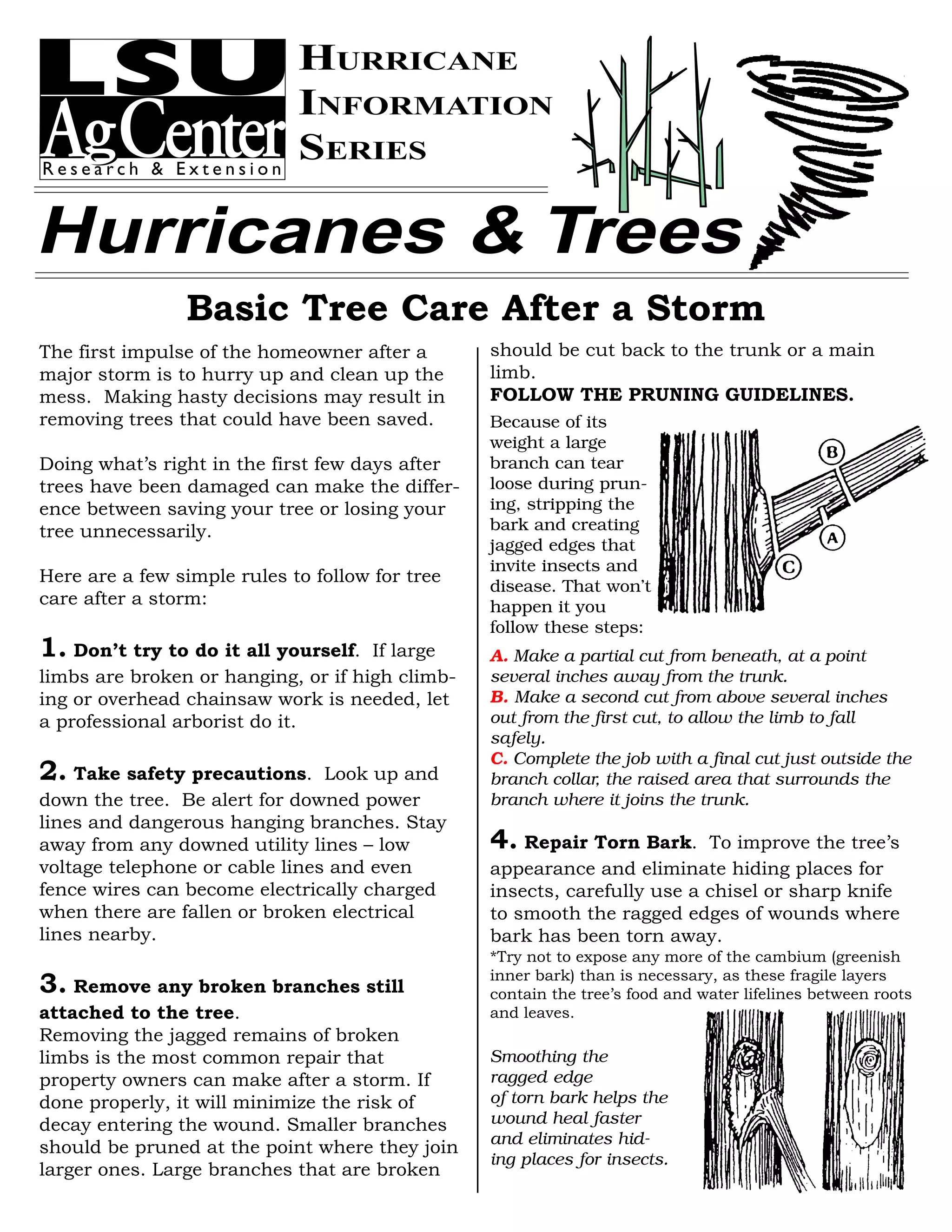
                                                 weight a large
Doing what’s right in the first few days after   branch can tear
trees have been damaged can make the differ-     loose during prun-
ence between saving your tree or losing your     ing, stripping the
tree unnecessarily.                              bark and creating
                                                 jagged edges that
                                                 invite insects and
Here are a few simple rules to follow for tree
                                                 disease. That won’t
care after a storm:                              happen it you
                                                 follow these steps:
1. Don’t try to do it all yourself.  If large    A. Make a partial cut from beneath, at a point
limbs are broken or hanging, or if high climb-   several inches away from the trunk.
ing or overhead chainsaw work is needed, let     B. Make a second cut from above several inches
a professional arborist do it.                   out from the first cut, to allow the limb to fall
                                                 safely.
                                                 C. Complete the job with a final cut just outside the
2. Take safety precautions.     Look up and      branch collar, the raised area that surrounds the
down the tree. Be alert for downed power         branch where it joins the trunk.
lines and dangerous hanging branches. Stay
away from any downed utility lines – low         4. Repair Torn Bark.     To improve the tree’s
voltage telephone or cable lines and even        appearance and eliminate hiding places for
fence wires can become electrically charged      insects, carefully use a chisel or sharp knife
when there are fallen or broken electrical       to smooth the ragged edges of wounds where
lines nearby.                                    bark has been torn away.
                                                 *Try not to expose any more of the cambium (greenish
                                                 inner bark) than is necessary, as these fragile layers
3. Remove any broken branches still              contain the tree’s food and water lifelines between roots
attached to the tree.                            and leaves.
Removing the jagged remains of broken
limbs is the most common repair that             Smoothing the
property owners can make after a storm. If       ragged edge
done properly, it will minimize the risk of      of torn bark helps the
decay entering the wound. Smaller branches       wound heal faster
                                                 and eliminates hid-
should be pruned at the point where they join
                                                 ing places for insects.
larger ones. Large branches that are broken
Hurricanes & Trees                                                    Basic Tree Care After a Storm


5. Resist the urge to overprune.
Don’t worry if the tree’s appearance isn’t
perfect. With branches gone, your trees may
look unbalanced or naked. You’ll be sur-
prised at how fast they will heal, grow new
foliage and return to their natural beauty.

6. Don’t top your trees.
So-called “tree experts” may urge you to cut
back all of the branches, on the mistaken
assumption that reducing the length of
branches will help avoid breakage in future
storms. This practice is called “Topping” and
it is one of the worst things you can do to
your tree. Stubs will tend to grow back a lot of
weakly– attached branches that are even
more likely to break when a storm strikes.
Topping the tree will reduce the amount
of foliage, on which the tree depends for the
food and nourishment needed for re-growth.
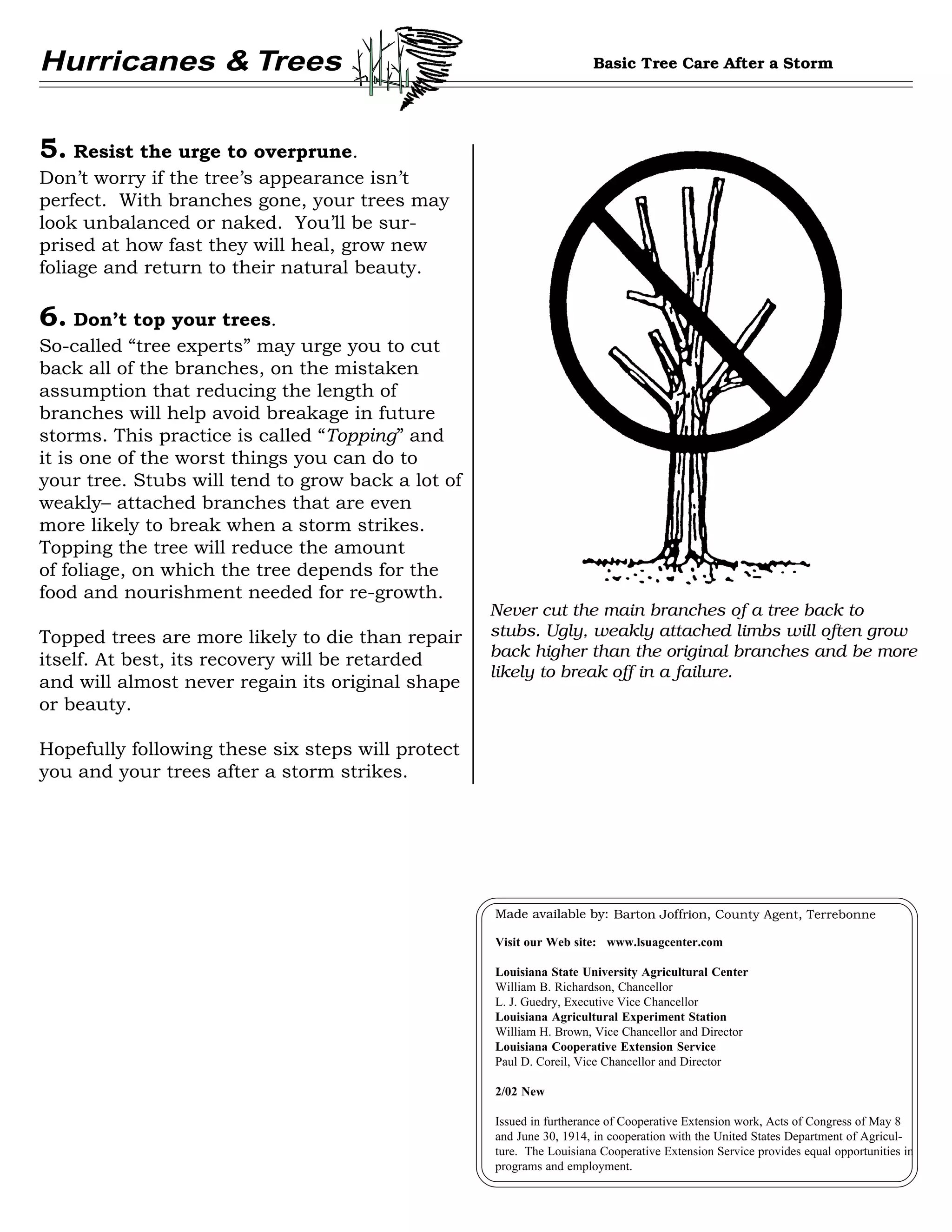
                                                   Never cut the main branches of a tree back to
Topped trees are more likely to die than repair    stubs. Ugly, weakly attached limbs will often grow
                                                   back higher than the original branches and be more
itself. At best, its recovery will be retarded
                                                   likely to break off in a failure.
and will almost never regain its original shape
or beauty.

Hopefully following these six steps will protect
you and your trees after a storm strikes.


                                                   Made available by: Barton Joffrion, County Agent, Terrebonne

                                                   Visit our Web site: www.lsuagcenter.com

                                                   Louisiana State University Agricultural Center
                                                   William B. Richardson, Chancellor
                                                   L. J. Guedry, Executive Vice Chancellor
                                                   Louisiana Agricultural Experiment Station
                                                   William H. Brown, Vice Chancellor and Director
                                                   Louisiana Cooperative Extension Service
                                                   Paul D. Coreil, Vice Chancellor and Director

                                                   2/02 New

                                                   Issued in furtherance of Cooperative Extension work, Acts of Congress of May 8
                                                   and June 30, 1914, in cooperation with the United States Department of Agricul-
                                                   ture. The Louisiana Cooperative Extension Service provides equal opportunities in
                                                   programs and employment.

Basictreecare

  • 1.
    HURRICANE INFORMATION SERIES Hurricanes & Trees Basic Tree Care After a Storm The first impulse of the homeowner after a should be cut back to the trunk or a main major storm is to hurry up and clean up the limb. mess. Making hasty decisions may result in FOLLOW THE PRUNING GUIDELINES. removing trees that could have been saved. Because of its weight a large Doing what’s right in the first few days after branch can tear trees have been damaged can make the differ- loose during prun- ence between saving your tree or losing your ing, stripping the tree unnecessarily. bark and creating jagged edges that invite insects and Here are a few simple rules to follow for tree disease. That won’t care after a storm: happen it you follow these steps: 1. Don’t try to do it all yourself. If large A. Make a partial cut from beneath, at a point limbs are broken or hanging, or if high climb- several inches away from the trunk. ing or overhead chainsaw work is needed, let B. Make a second cut from above several inches a professional arborist do it. out from the first cut, to allow the limb to fall safely. C. Complete the job with a final cut just outside the 2. Take safety precautions. Look up and branch collar, the raised area that surrounds the down the tree. Be alert for downed power branch where it joins the trunk. lines and dangerous hanging branches. Stay away from any downed utility lines – low 4. Repair Torn Bark. To improve the tree’s voltage telephone or cable lines and even appearance and eliminate hiding places for fence wires can become electrically charged insects, carefully use a chisel or sharp knife when there are fallen or broken electrical to smooth the ragged edges of wounds where lines nearby. bark has been torn away. *Try not to expose any more of the cambium (greenish inner bark) than is necessary, as these fragile layers 3. Remove any broken branches still contain the tree’s food and water lifelines between roots attached to the tree. and leaves. Removing the jagged remains of broken limbs is the most common repair that Smoothing the property owners can make after a storm. If ragged edge done properly, it will minimize the risk of of torn bark helps the decay entering the wound. Smaller branches wound heal faster and eliminates hid- should be pruned at the point where they join ing places for insects. larger ones. Large branches that are broken
  • 2.
    Hurricanes & Trees Basic Tree Care After a Storm 5. Resist the urge to overprune. Don’t worry if the tree’s appearance isn’t perfect. With branches gone, your trees may look unbalanced or naked. You’ll be sur- prised at how fast they will heal, grow new foliage and return to their natural beauty. 6. Don’t top your trees. So-called “tree experts” may urge you to cut back all of the branches, on the mistaken assumption that reducing the length of branches will help avoid breakage in future storms. This practice is called “Topping” and it is one of the worst things you can do to your tree. Stubs will tend to grow back a lot of weakly– attached branches that are even more likely to break when a storm strikes. Topping the tree will reduce the amount of foliage, on which the tree depends for the food and nourishment needed for re-growth. Never cut the main branches of a tree back to Topped trees are more likely to die than repair stubs. Ugly, weakly attached limbs will often grow back higher than the original branches and be more itself. At best, its recovery will be retarded likely to break off in a failure. and will almost never regain its original shape or beauty. Hopefully following these six steps will protect you and your trees after a storm strikes. Made available by: Barton Joffrion, County Agent, Terrebonne Visit our Web site: www.lsuagcenter.com Louisiana State University Agricultural Center William B. Richardson, Chancellor L. J. Guedry, Executive Vice Chancellor Louisiana Agricultural Experiment Station William H. Brown, Vice Chancellor and Director Louisiana Cooperative Extension Service Paul D. Coreil, Vice Chancellor and Director 2/02 New Issued in furtherance of Cooperative Extension work, Acts of Congress of May 8 and June 30, 1914, in cooperation with the United States Department of Agricul- ture. The Louisiana Cooperative Extension Service provides equal opportunities in programs and employment.