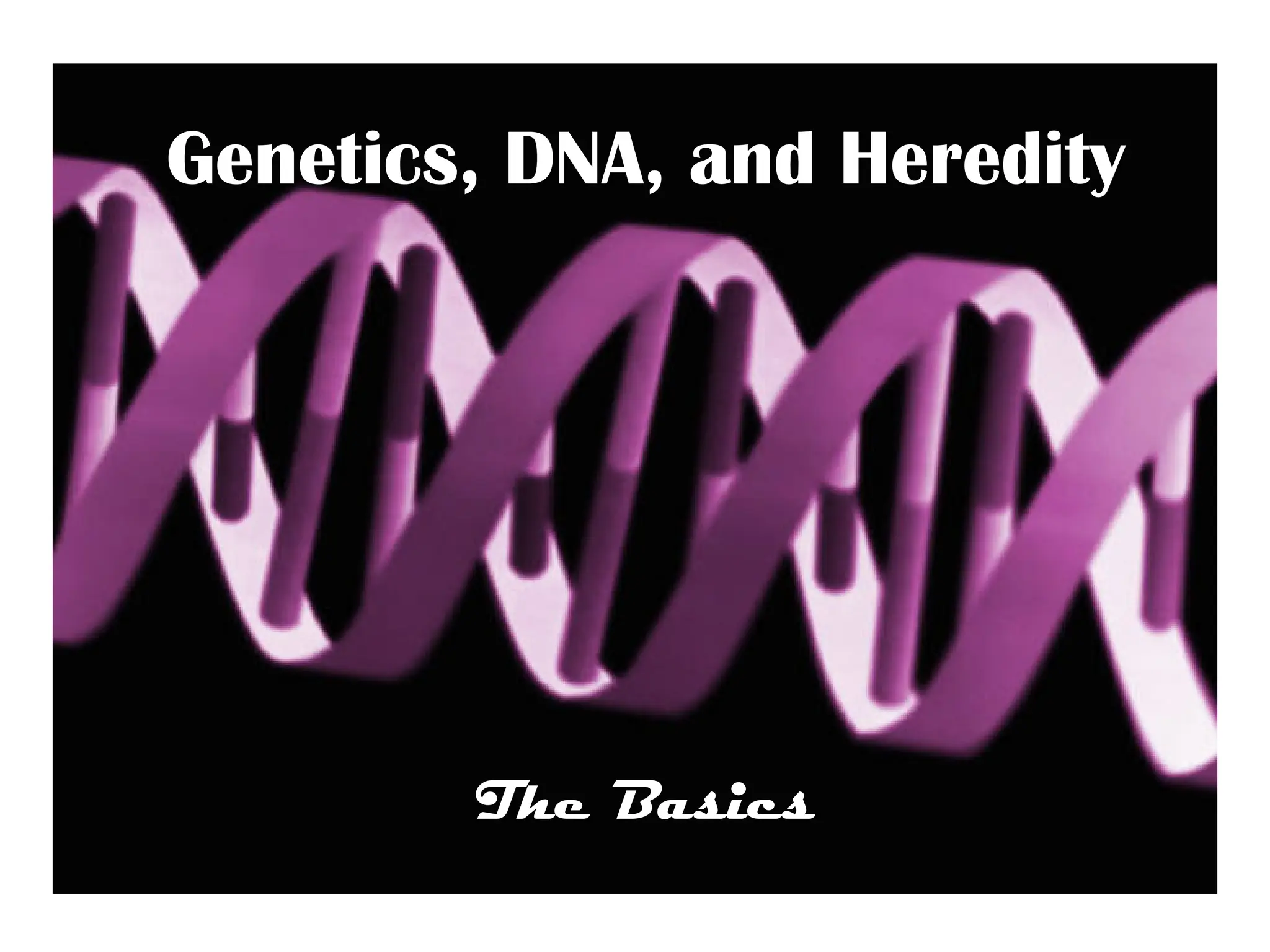
Genetics, DNA, and Heredity
The Basics
What is DNA?
It's a history book - a narrative of the journey of our
species through time.
It's a shop manual, with an incredibly detailed blueprint
for building every human cell.
And it's a transformative textbook of medicine, with
insights that will give health care providers immense
new powers to treat, prevent and cure disease."
- Francis Collins
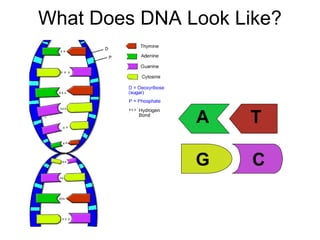
What Does DNA Look Like?
A T
G C
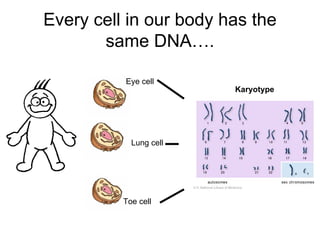
Every cell in our body has the
same DNA….
Eye cell
Lung cell
Toe cell
Karyotype
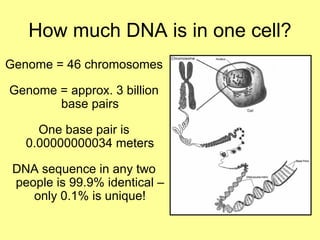
How much DNA is in one cell?
Genome = 46 chromosomes
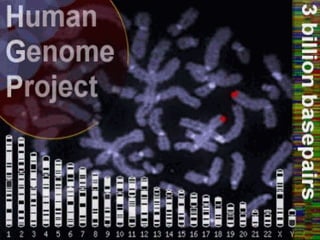
Genome = approx. 3 billion
base pairs
One base pair is
0.00000000034 meters
DNA sequence in any two
people is 99.9% identical –
only 0.1% is unique!
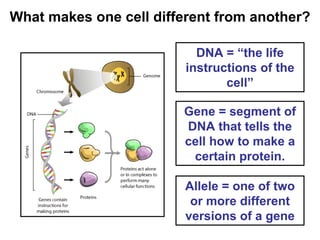
What makes one cell different from another?
DNA = “the life
instructions of the
cell”
Gene = segment of
DNA that tells the
cell how to make a
certain protein.
Allele = one of two
or more different
versions of a gene
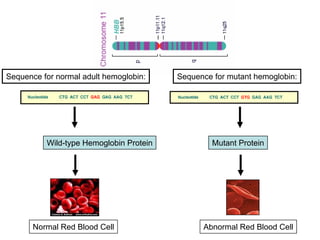
Sequence for normal adult hemoglobin: Sequence for mutant hemoglobin:
Wild-type Hemoglobin Protein Mutant Protein
Normal Red Blood Cell Abnormal Red Blood Cell
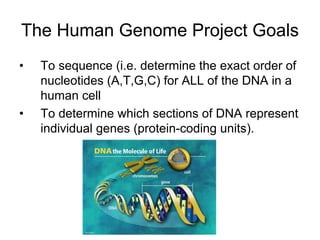
The Human Genome Project Goals
• To sequence (i.e. determine the exact order of
nucleotides (A,T,G,C) for ALL of the DNA in a
human cell
• To determine which sections of DNA represent
individual genes (protein-coding units).
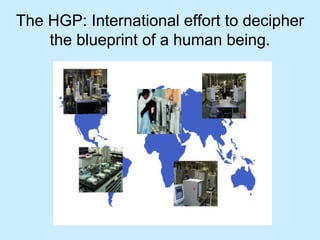
The HGP: International effort to decipher
the blueprint of a human being.
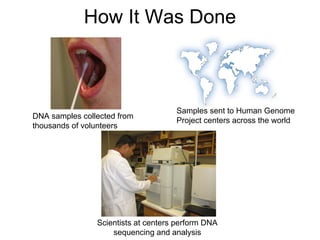
How It Was Done
DNA samples collected from
thousands of volunteers
Samples sent to Human Genome
Project centers across the world
Scientists at centers perform DNA
sequencing and analysis
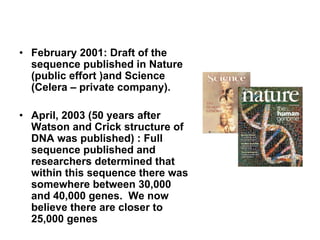
• February 2001: Draft of the
sequence published in Nature
(public effort )and Science
(Celera – private company).
• April, 2003 (50 years after
Watson and Crick structure of
DNA was published) : Full
sequence published and
researchers determined that
within this sequence there was
somewhere between 30,000
and 40,000 genes. We now
believe there are closer to
25,000 genes
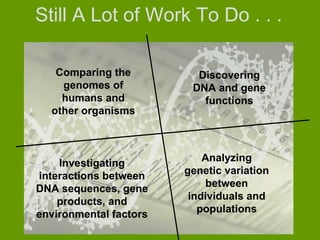
Still A Lot of Work To Do . . .
Analyzing
genetic variation
between
individuals and
populations
Discovering
DNA and gene
functions
Investigating
interactions between
DNA sequences, gene
products, and
environmental factors
Comparing the
genomes of
humans and
other organisms
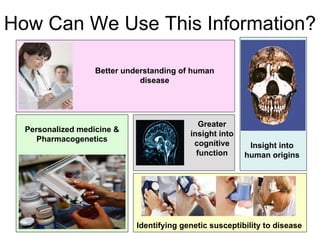
How Can We Use This Information?
Better understanding of human
disease
Insight into
human origins
Personalized medicine &
Pharmacogenetics
Identifying genetic susceptibility to disease
Greater
insight into
cognitive
function
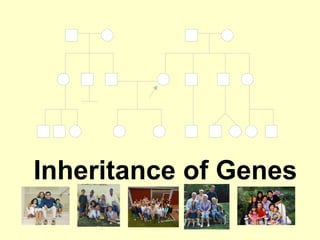
Inheritance of Genes
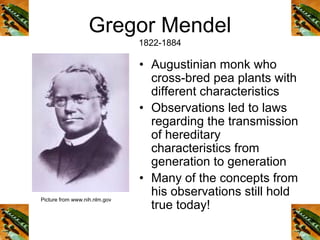
Gregor Mendel
1822-1884
• Augustinian monk who
cross-bred pea plants with
different characteristics
• Observations led to laws
regarding the transmission
of hereditary
characteristics from
generation to generation
• Many of the concepts from
his observations still hold
true today!
Picture from www.nih.nlm.gov
Mendel’s
Laws:
1. Principle of Segregation: Two members of a
gene pair segregate from each other in the
formation of gametes; half the gametes carry
one allele, and the other half carry the other
allele
What it means: each gene has two copies
(alleles) and a parent will give only one copy to
a child. The other parent will give another
copy, and thus the child will receive two copies
(alleles) – one from each parent. Each child
will literally be half-mom and half-dad!
Mendel’s
Laws:
2. Principle of Independent Assortment:
Genes for different traits assort
independently of one another in gamete
production
What it means: different genes are
inherited separately. For example, the
gene which codes for eye color is inherited
separately from the gene which codes for
nose shape.
Mendelian Concepts
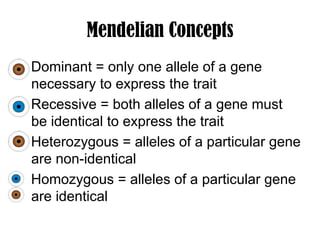
Dominant = only one allele of a gene
necessary to express the trait
Recessive = both alleles of a gene must
be identical to express the trait
Heterozygous = alleles of a particular gene
are non-identical
Homozygous = alleles of a particular gene
are identical
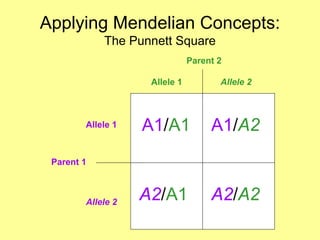
Applying Mendelian Concepts:
The Punnett Square
Parent 1
Allele 1
Allele 2
Allele 1 Allele 2
Parent 2
A1/A1 A1/A2
A2/A1 A2/A2
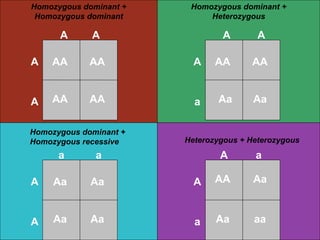
A
A
A A
AA AA
AA AA
A
a
A A
AA AA
Aa Aa
A
A
a a
Aa Aa
Aa Aa
A
A
a
a
AA Aa
Aa aa
Homozygous dominant +
Homozygous dominant
Homozygous dominant +
Heterozygous
Homozygous dominant +
Homozygous recessive Heterozygous + Heterozygous
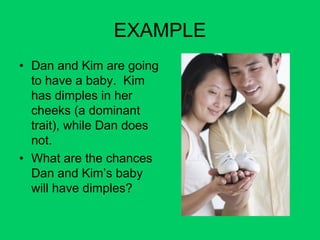
EXAMPLE
• Dan and Kim are going
to have a baby. Kim
has dimples in her
cheeks (a dominant
trait), while Dan does
not.
• What are the chances
Dan and Kim’s baby
will have dimples?
We know Dan and Kim’s
phenotypes (no dimples/dimples),
but what are their genotypes?
• Dan has the recessive trait (no dimples)
– He must have two recessive alleles
– Dan’s genotype can be represented as ‘dd’
• Kim has the dominant trait (dimples)
– But Kim could be homozygous dominant OR
heterozygous dominant
– Kim’s genotype can be either ‘DD’ or ‘Dd’
– Which one is it?
More information
• What if you knew something about Kim’s
parents?
• How could that help?
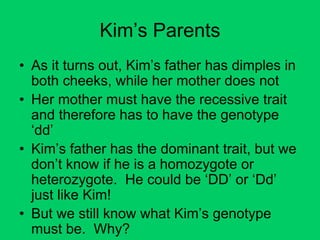
Kim’s Parents
• As it turns out, Kim’s father has dimples in
both cheeks, while her mother does not
• Her mother must have the recessive trait
and therefore has to have the genotype
‘dd’
• Kim’s father has the dominant trait, but we
don’t know if he is a homozygote or
heterozygote. He could be ‘DD’ or ‘Dd’
just like Kim!
• But we still know what Kim’s genotype
must be. Why?
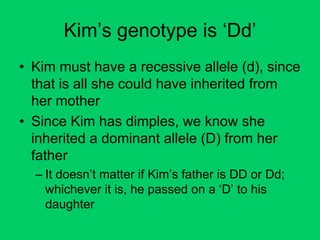
Kim’s genotype is ‘Dd’
• Kim must have a recessive allele (d), since
that is all she could have inherited from
her mother
• Since Kim has dimples, we know she
inherited a dominant allele (D) from her
father
– It doesn’t matter if Kim’s father is DD or Dd;
whichever it is, he passed on a ‘D’ to his
daughter
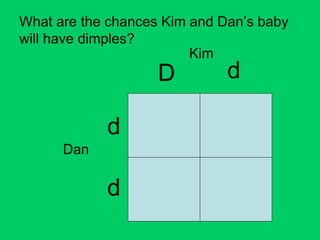
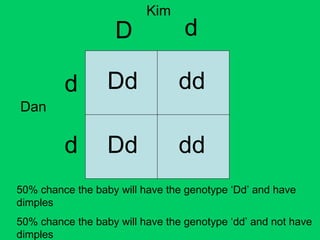
What are the chances Kim and Dan’s baby
will have dimples?
Dan
d
d
D d
Kim
Dan
d
d
D d
Kim
Dd dd
Dd dd
50% chance the baby will have the genotype ‘Dd’ and have
dimples
50% chance the baby will have the genotype ‘dd’ and not have
dimples
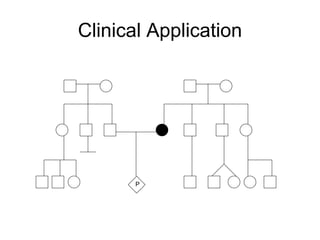
Clinical Application
P
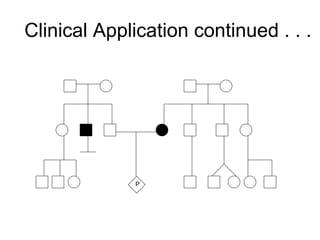
Clinical Application continued . . .
P
Other things may change us, but we start and
end with family
-Anthony Brandt
If you look deeply into the palm of your hand,
you will see your parents and all generations of
your ancestors. All of them are alive in this
moment. Each is present in your body. You are
the continuation of each of these people.
-Thich Nhat Hanh
Questions?
Adapted from a Presentation Created by the University
of North Carolina DNA Day Program
• Sponsors
– NC Glaxo Smith Kline Foundation
– National Human Genome Research Institute
– Sigma XI Scientific Research Society
• Collaborative Partners
– North Carolina Department of Public Instruction
– Destiny Traveling Science Learning Program
– North Carolina Association for Biomedical Research
– National Human Genome Research Institute
– American Society for Human Genetics
• North Carolina Educators
– Amy Bradley, Hibriten High School; Cindy Byron, School of Inquiry and Life
Sciences at Asheville (SILSA); Anita Crowley, Lee County High School;
MaryAnne Gore, West Brunswick High School; Terry Howerton, The School of
Biotechnology at Atkins; Michael Kendall, East Bladen High School; Crystal
McDowell; Letitia Myles, E.E. Smith High School; Elizabeth Pressley, Bartlett
Yancey High School; Steven Ross, Harnett Central High School; Murphey
Wellman, North Iredell High School; Anita Willington, East Bladen High School;
Linda Woody, Reidsville High School

basicspresentation.pdf

  • 1.
    Genetics, DNA, andHeredity The Basics
  • 3.
    What is DNA? It'sa history book - a narrative of the journey of our species through time. It's a shop manual, with an incredibly detailed blueprint for building every human cell. And it's a transformative textbook of medicine, with insights that will give health care providers immense new powers to treat, prevent and cure disease." - Francis Collins
  • 4.
    What Does DNALook Like? A T G C
  • 5.
    Every cell inour body has the same DNA…. Eye cell Lung cell Toe cell Karyotype
  • 6.
    How much DNAis in one cell? Genome = 46 chromosomes Genome = approx. 3 billion base pairs One base pair is 0.00000000034 meters DNA sequence in any two people is 99.9% identical – only 0.1% is unique!
  • 7.
    What makes onecell different from another? DNA = “the life instructions of the cell” Gene = segment of DNA that tells the cell how to make a certain protein. Allele = one of two or more different versions of a gene
  • 8.
    Sequence for normaladult hemoglobin: Sequence for mutant hemoglobin: Wild-type Hemoglobin Protein Mutant Protein Normal Red Blood Cell Abnormal Red Blood Cell
  • 9.
    The Human GenomeProject Goals • To sequence (i.e. determine the exact order of nucleotides (A,T,G,C) for ALL of the DNA in a human cell • To determine which sections of DNA represent individual genes (protein-coding units).
  • 10.
    The HGP: Internationaleffort to decipher the blueprint of a human being.
  • 11.
    How It WasDone DNA samples collected from thousands of volunteers Samples sent to Human Genome Project centers across the world Scientists at centers perform DNA sequencing and analysis
  • 13.
    • February 2001:Draft of the sequence published in Nature (public effort )and Science (Celera – private company). • April, 2003 (50 years after Watson and Crick structure of DNA was published) : Full sequence published and researchers determined that within this sequence there was somewhere between 30,000 and 40,000 genes. We now believe there are closer to 25,000 genes
  • 14.
    Still A Lotof Work To Do . . . Analyzing genetic variation between individuals and populations Discovering DNA and gene functions Investigating interactions between DNA sequences, gene products, and environmental factors Comparing the genomes of humans and other organisms
  • 15.
    How Can WeUse This Information? Better understanding of human disease Insight into human origins Personalized medicine & Pharmacogenetics Identifying genetic susceptibility to disease Greater insight into cognitive function
  • 16.
  • 17.
    Gregor Mendel 1822-1884 • Augustinianmonk who cross-bred pea plants with different characteristics • Observations led to laws regarding the transmission of hereditary characteristics from generation to generation • Many of the concepts from his observations still hold true today! Picture from www.nih.nlm.gov
  • 18.
    Mendel’s Laws: 1. Principle ofSegregation: Two members of a gene pair segregate from each other in the formation of gametes; half the gametes carry one allele, and the other half carry the other allele What it means: each gene has two copies (alleles) and a parent will give only one copy to a child. The other parent will give another copy, and thus the child will receive two copies (alleles) – one from each parent. Each child will literally be half-mom and half-dad!
  • 19.
    Mendel’s Laws: 2. Principle ofIndependent Assortment: Genes for different traits assort independently of one another in gamete production What it means: different genes are inherited separately. For example, the gene which codes for eye color is inherited separately from the gene which codes for nose shape.
  • 20.
    Mendelian Concepts Dominant =only one allele of a gene necessary to express the trait Recessive = both alleles of a gene must be identical to express the trait Heterozygous = alleles of a particular gene are non-identical Homozygous = alleles of a particular gene are identical
  • 21.
    Applying Mendelian Concepts: ThePunnett Square Parent 1 Allele 1 Allele 2 Allele 1 Allele 2 Parent 2 A1/A1 A1/A2 A2/A1 A2/A2
  • 22.
    A A A A AA AA AAAA A a A A AA AA Aa Aa A A a a Aa Aa Aa Aa A A a a AA Aa Aa aa Homozygous dominant + Homozygous dominant Homozygous dominant + Heterozygous Homozygous dominant + Homozygous recessive Heterozygous + Heterozygous
  • 23.
    EXAMPLE • Dan andKim are going to have a baby. Kim has dimples in her cheeks (a dominant trait), while Dan does not. • What are the chances Dan and Kim’s baby will have dimples?
  • 24.
    We know Danand Kim’s phenotypes (no dimples/dimples), but what are their genotypes? • Dan has the recessive trait (no dimples) – He must have two recessive alleles – Dan’s genotype can be represented as ‘dd’ • Kim has the dominant trait (dimples) – But Kim could be homozygous dominant OR heterozygous dominant – Kim’s genotype can be either ‘DD’ or ‘Dd’ – Which one is it?
  • 25.
    More information • Whatif you knew something about Kim’s parents? • How could that help?
  • 26.
    Kim’s Parents • Asit turns out, Kim’s father has dimples in both cheeks, while her mother does not • Her mother must have the recessive trait and therefore has to have the genotype ‘dd’ • Kim’s father has the dominant trait, but we don’t know if he is a homozygote or heterozygote. He could be ‘DD’ or ‘Dd’ just like Kim! • But we still know what Kim’s genotype must be. Why?
  • 27.
    Kim’s genotype is‘Dd’ • Kim must have a recessive allele (d), since that is all she could have inherited from her mother • Since Kim has dimples, we know she inherited a dominant allele (D) from her father – It doesn’t matter if Kim’s father is DD or Dd; whichever it is, he passed on a ‘D’ to his daughter
  • 28.
    What are thechances Kim and Dan’s baby will have dimples? Dan d d D d Kim
  • 29.
    Dan d d D d Kim Dd dd Dddd 50% chance the baby will have the genotype ‘Dd’ and have dimples 50% chance the baby will have the genotype ‘dd’ and not have dimples
  • 30.
  • 31.
  • 32.
    Other things maychange us, but we start and end with family -Anthony Brandt If you look deeply into the palm of your hand, you will see your parents and all generations of your ancestors. All of them are alive in this moment. Each is present in your body. You are the continuation of each of these people. -Thich Nhat Hanh
  • 33.
  • 34.
    Adapted from aPresentation Created by the University of North Carolina DNA Day Program • Sponsors – NC Glaxo Smith Kline Foundation – National Human Genome Research Institute – Sigma XI Scientific Research Society • Collaborative Partners – North Carolina Department of Public Instruction – Destiny Traveling Science Learning Program – North Carolina Association for Biomedical Research – National Human Genome Research Institute – American Society for Human Genetics • North Carolina Educators – Amy Bradley, Hibriten High School; Cindy Byron, School of Inquiry and Life Sciences at Asheville (SILSA); Anita Crowley, Lee County High School; MaryAnne Gore, West Brunswick High School; Terry Howerton, The School of Biotechnology at Atkins; Michael Kendall, East Bladen High School; Crystal McDowell; Letitia Myles, E.E. Smith High School; Elizabeth Pressley, Bartlett Yancey High School; Steven Ross, Harnett Central High School; Murphey Wellman, North Iredell High School; Anita Willington, East Bladen High School; Linda Woody, Reidsville High School