CRYPTOGRAPHY
- Drishya T P
CONTENTS
• Cryptography
• Encryption and Decryption
• Types of Cryptography
• Applications of Cryptography
Definition
Cryptography:
• Cryptography is a technique of securing
communication by converting plain text
(readable text) into cipher text (unreadable
format). It involves various algorithms and
protocols to ensure data confidentiality, integrity,
authentication, and non-repudiation.
Encryption:
• It is the process of converting normal message
(plaintext) into meaningless message (Cipher text).
• Encryption is the process which take place at
sender’s end.
Decryption
• It is the process of converting meaningless message
(Cipher text) into its original form (Plaintext).
• Decryption is the process which take place at
receiver’s end.
Types of Cryptography
• Symmetric Key Cryptography
• Asymmetric Key Cryptography
• Hash Functions
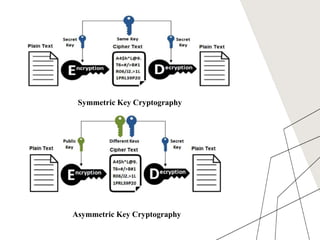
Symmetric Key Cryptography
• It is an encryption system where the sender and
receiver of a message use a single common key
to encrypt and decrypt messages.
• The most popular symmetric key cryptography
systems are Data Encryption Systems (DES) and
Advanced Encryption Systems (AES).
Asymmetric Key Cryptography
• In Asymmetric Key Cryptography, a pair of keys is used to
encrypt and decrypt information. A receiver’s public key is
used for encryption and a receiver’s private key is used for
decryption.
• Public keys and Private keys are different. Even if the
public key is known by everyone the intended receiver can
only decode it because he alone knows his private key.
• The most popular asymmetric key cryptography algorithm
is the RSA algorithm.
Hash Functions
• There is no usage of any key in this algorithm.
• A hash value with a fixed length is calculated as per the
plain text which makes it impossible for the contents of
plain text to be recovered.
Symmetric Key Cryptography
Asymmetric Key Cryptography
Applications of Cryptography
• Computer passwords: Cryptography is widely utilized in
computer security, particularly when creating and
maintaining passwords.
• Secure web browsing: Online browsing security is provided
by the use of cryptography, which shields users from
eavesdropping and man-in-the-middle assaults.
• Electronic signatures: Electronic signatures serve as the
digital equivalent of a handwritten signature and are used to
sign documents.
• Authentication: Cryptography is used for authentication in
many different situations, such as when accessing a bank
account, logging into a computer, or using a secure network.
• End-to-end Internet Encryption: End-to-end encryption is
used to protect two-way communications like video
conversations, instant messages, and email.
Thank You

CRYPTOGRAPHY and its applications .pptx

  • 1.
  • 2.
    CONTENTS • Cryptography • Encryptionand Decryption • Types of Cryptography • Applications of Cryptography
  • 3.
    Definition Cryptography: • Cryptography isa technique of securing communication by converting plain text (readable text) into cipher text (unreadable format). It involves various algorithms and protocols to ensure data confidentiality, integrity, authentication, and non-repudiation.
  • 4.
    Encryption: • It isthe process of converting normal message (plaintext) into meaningless message (Cipher text). • Encryption is the process which take place at sender’s end. Decryption • It is the process of converting meaningless message (Cipher text) into its original form (Plaintext). • Decryption is the process which take place at receiver’s end.
  • 5.
    Types of Cryptography •Symmetric Key Cryptography • Asymmetric Key Cryptography • Hash Functions Symmetric Key Cryptography • It is an encryption system where the sender and receiver of a message use a single common key to encrypt and decrypt messages. • The most popular symmetric key cryptography systems are Data Encryption Systems (DES) and Advanced Encryption Systems (AES).
  • 6.
    Asymmetric Key Cryptography •In Asymmetric Key Cryptography, a pair of keys is used to encrypt and decrypt information. A receiver’s public key is used for encryption and a receiver’s private key is used for decryption. • Public keys and Private keys are different. Even if the public key is known by everyone the intended receiver can only decode it because he alone knows his private key. • The most popular asymmetric key cryptography algorithm is the RSA algorithm. Hash Functions • There is no usage of any key in this algorithm. • A hash value with a fixed length is calculated as per the plain text which makes it impossible for the contents of plain text to be recovered.
  • 7.
  • 8.
    Applications of Cryptography •Computer passwords: Cryptography is widely utilized in computer security, particularly when creating and maintaining passwords. • Secure web browsing: Online browsing security is provided by the use of cryptography, which shields users from eavesdropping and man-in-the-middle assaults. • Electronic signatures: Electronic signatures serve as the digital equivalent of a handwritten signature and are used to sign documents. • Authentication: Cryptography is used for authentication in many different situations, such as when accessing a bank account, logging into a computer, or using a secure network. • End-to-end Internet Encryption: End-to-end encryption is used to protect two-way communications like video conversations, instant messages, and email.
  • 9.