BACKEND DEVELOPMENT WITH
RESTFUL APIS & EXPRESS.JS
Workshop 2
REST APIS AND REQUESTS
WHAT IS BACKEND PROGRAMMING
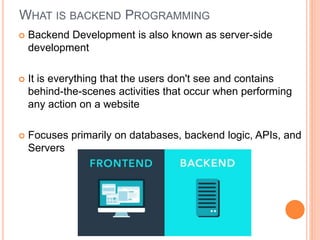
 Backend Development is also known as server-side
development
 It is everything that the users don't see and contains
behind-the-scenes activities that occur when performing
any action on a website
 Focuses primarily on databases, backend logic, APIs, and
Servers
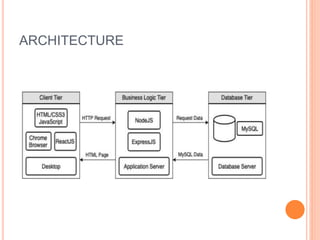
ARCHITECTURE
HTTP REQUESTS
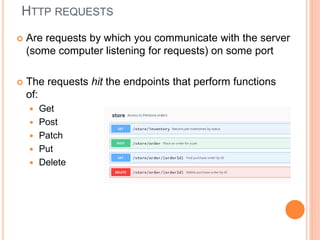
 Are requests by which you communicate with the server
(some computer listening for requests) on some port
 The requests hit the endpoints that perform functions
of:
 Get
 Post
 Patch
 Put
 Delete
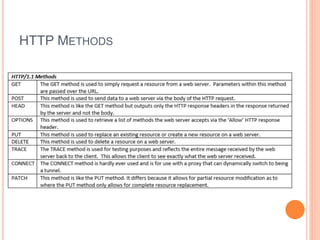
HTTP METHODS
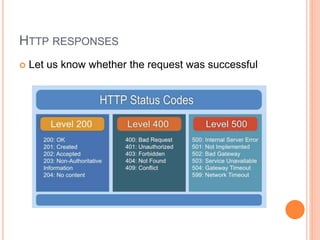
HTTP RESPONSES
 Let us know whether the request was successful
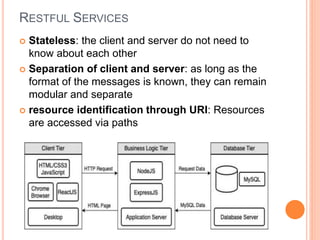
RESTFUL SERVICES
 Stateless: the client and server do not need to
know about each other
 Separation of client and server: as long as the
format of the messages is known, they can remain
modular and separate
 resource identification through URI: Resources
are accessed via paths
JAVASCRIPT
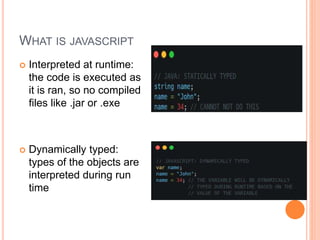
WHAT IS JAVASCRIPT
 Interpreted at runtime:
the code is executed as
it is ran, so no compiled
files like .jar or .exe
 Dynamically typed:
types of the objects are
interpreted during run
time
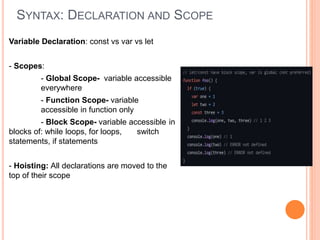
SYNTAX: DECLARATION AND SCOPE
Variable Declaration: const vs var vs let
- Scopes:
- Global Scope- variable accessible
everywhere
- Function Scope- variable
accessible in function only
- Block Scope- variable accessible in
blocks of: while loops, for loops, switch
statements, if statements
- Hoisting: All declarations are moved to the
top of their scope
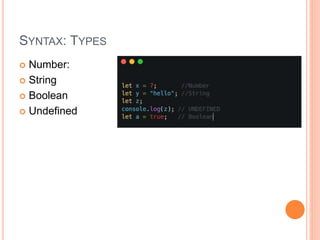
SYNTAX: TYPES
 Number:
 String
 Boolean
 Undefined
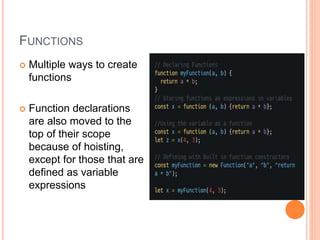
FUNCTIONS
 Multiple ways to create
functions
 Function declarations
are also moved to the
top of their scope
because of hoisting,
except for those that are
defined as variable
expressions
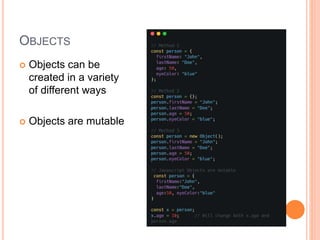
OBJECTS
 Objects can be
created in a variety
of different ways
 Objects are mutable
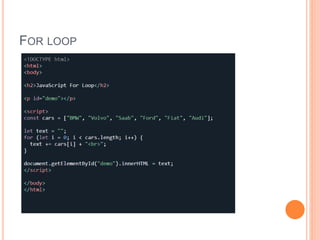
FOR LOOP
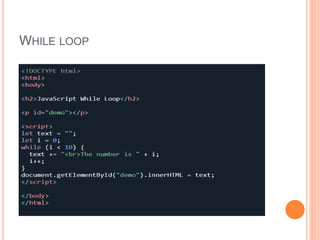
WHILE LOOP
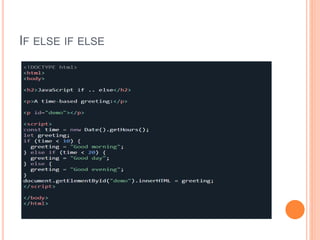
IF ELSE IF ELSE
NODE AND EXPRESS.JS
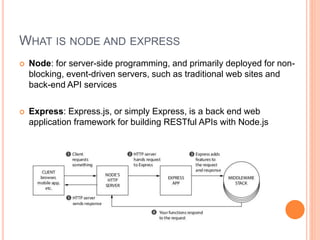
WHAT IS NODE AND EXPRESS
 Node: for server-side programming, and primarily deployed for non-
blocking, event-driven servers, such as traditional web sites and
back-end API services
 Express: Express.js, or simply Express, is a back end web
application framework for building RESTful APIs with Node.js
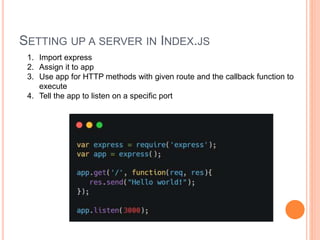
SETTING UP A SERVER IN INDEX.JS
1. Import express
2. Assign it to app
3. Use app for HTTP methods with given route and the callback function to
execute
4. Tell the app to listen on a specific port
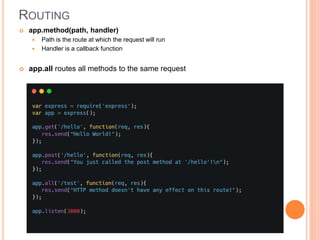
ROUTING
 app.method(path, handler)
 Path is the route at which the request will run
 Handler is a callback function
 app.all routes all methods to the same request
SEPARATING ROUTING FILES
 app.use function call
on route '/things'
 attaches the things
router with this route
 The '/' route in things.js
is actually a subroute
of '/things'
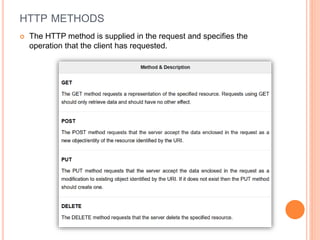
HTTP METHODS
 The HTTP method is supplied in the request and specifies the
operation that the client has requested.
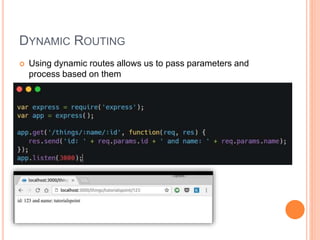
DYNAMIC ROUTING
 Using dynamic routes allows us to pass parameters and
process based on them
MIDDLEWARE
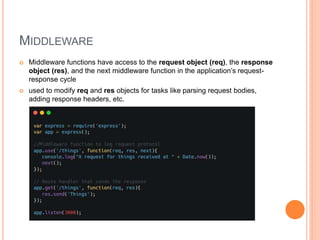
 Middleware functions have access to the request object (req), the response
object (res), and the next middleware function in the application’s request-
response cycle
 used to modify req and res objects for tasks like parsing request bodies,
adding response headers, etc.
DEMO TIME!

Express

  • 1.
    BACKEND DEVELOPMENT WITH RESTFULAPIS & EXPRESS.JS Workshop 2
  • 2.
    REST APIS ANDREQUESTS
  • 3.
    WHAT IS BACKENDPROGRAMMING  Backend Development is also known as server-side development  It is everything that the users don't see and contains behind-the-scenes activities that occur when performing any action on a website  Focuses primarily on databases, backend logic, APIs, and Servers
  • 4.
  • 5.
    HTTP REQUESTS  Arerequests by which you communicate with the server (some computer listening for requests) on some port  The requests hit the endpoints that perform functions of:  Get  Post  Patch  Put  Delete
  • 6.
  • 7.
    HTTP RESPONSES  Letus know whether the request was successful
  • 8.
    RESTFUL SERVICES  Stateless:the client and server do not need to know about each other  Separation of client and server: as long as the format of the messages is known, they can remain modular and separate  resource identification through URI: Resources are accessed via paths
  • 9.
  • 10.
    WHAT IS JAVASCRIPT Interpreted at runtime: the code is executed as it is ran, so no compiled files like .jar or .exe  Dynamically typed: types of the objects are interpreted during run time
  • 11.
    SYNTAX: DECLARATION ANDSCOPE Variable Declaration: const vs var vs let - Scopes: - Global Scope- variable accessible everywhere - Function Scope- variable accessible in function only - Block Scope- variable accessible in blocks of: while loops, for loops, switch statements, if statements - Hoisting: All declarations are moved to the top of their scope
  • 12.
    SYNTAX: TYPES  Number: String  Boolean  Undefined
  • 13.
    FUNCTIONS  Multiple waysto create functions  Function declarations are also moved to the top of their scope because of hoisting, except for those that are defined as variable expressions
  • 14.
    OBJECTS  Objects canbe created in a variety of different ways  Objects are mutable
  • 15.
  • 16.
  • 17.
  • 18.
  • 19.
    WHAT IS NODEAND EXPRESS  Node: for server-side programming, and primarily deployed for non- blocking, event-driven servers, such as traditional web sites and back-end API services  Express: Express.js, or simply Express, is a back end web application framework for building RESTful APIs with Node.js
  • 20.
    SETTING UP ASERVER IN INDEX.JS 1. Import express 2. Assign it to app 3. Use app for HTTP methods with given route and the callback function to execute 4. Tell the app to listen on a specific port
  • 21.
    ROUTING  app.method(path, handler) Path is the route at which the request will run  Handler is a callback function  app.all routes all methods to the same request
  • 22.
    SEPARATING ROUTING FILES app.use function call on route '/things'  attaches the things router with this route  The '/' route in things.js is actually a subroute of '/things'
  • 23.
    HTTP METHODS  TheHTTP method is supplied in the request and specifies the operation that the client has requested.
  • 24.
    DYNAMIC ROUTING  Usingdynamic routes allows us to pass parameters and process based on them
  • 25.
    MIDDLEWARE  Middleware functionshave access to the request object (req), the response object (res), and the next middleware function in the application’s request- response cycle  used to modify req and res objects for tasks like parsing request bodies, adding response headers, etc.
  • 26.

Editor's Notes

  • #11 No intermediate files compiled like jar or exe to detect semantics or syntax errors, instead code instructions are run and executed at the same time Static Typing: Variables have types, Values have types, and variable types cannot change Dynamic Typing: Variables don’t have types, Values have types and variables change type dynamically during run time
  • #12 Source: https://www.freecodecamp.org/news/var-let-and-const-whats-the-difference https://www.w3schools.com/js/js_let.asp Scopes: Determines where specific variables are available Var: globally scoped, ie: declared inside a function or a block, will still be available outside of that function or block, can be re-declared Let: variables declared with let cannot be re-declared, variables defined with let must be declared before use, let has block scope, can be re-assigned Const: cannot be Redeclared, cannot be Reassigned, have Block Scope
  • #15 Source: https://www.w3schools.com/js/js_objects.asp
  • #16 https://www.w3schools.com/js/tryit.asp?filename=tryjs_loop_for_om1
  • #17 https://www.w3schools.com/js/tryit.asp?filename=tryjs_dowhile
  • #18 https://www.w3schools.com/js/tryit.asp?filename=tryjs_loop_for_om1
  • #20 Installation: https://www.tutorialspoint.com/expressjs/expressjs_environment.htm
  • #21 - Import Express: we have access to it through express variable - We use it to create a express application and assign it to var - app.get(route, callback) : tells what to do when a get request at the given route is called The request object(req) represents the HTTP request and has properties for the request query string, parameters, body, HTTP headers, etc. Similarly, the response object represents the HTTP response that the Express app sends when it receives an HTTP request. res.send() takes an object as input and it sends this to the requesting client app.listen(port, [host], [backlog], [callback]]) binds and listens for connections on the specified host and port. Port is the only required parameter here.
  • #22 When we send a request, it’s being sent to our computer, which is local host, and the port that’s listening for requests in port 3000
  • #23 https://www.tutorialspoint.com/expressjs/expressjs_routing.htm