Basic
Computer
Course
Presented byBiitTechnology
What is a
Computer?
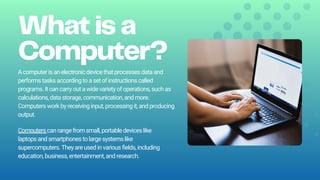
Acomputerisanelectronicdevicethatprocessesdataand
performstasksaccordingtoasetofinstructionscalled
programs.Itcancarryoutawidevarietyofoperations,suchas
calculations,datastorage,communication,andmore.
Computersworkbyreceivinginput,processingit,andproducing
output.
Computerscanrangefromsmall,portabledeviceslike
laptopsandsmartphonestolargesystemslike
supercomputers.Theyareusedinvariousfields,including
education,business,entertainment,andresearch.
History of
Computers
Key Figures in Computer History
CharlesBabbage: Known as the "father of the computer,"
he conceptualized the first automatic mechanical
computer, the Analytical Engine.
AlanTuring: Known for the Turing Machine, a theoretical
model for computation, and his work on breaking the
German Enigma code during World War II.
JohnvonNeumann: His architecture (the Von Neumann
architecture) laid the foundation for most modern
computers.
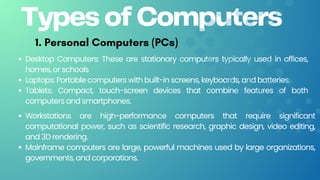
Types of Computers
Desktop Computers: These are stationary computers typically used in offices,
homes, or schools
Laptops: Portable computers with built-in screens, keyboards, and batteries.
Tablets: Compact, touch-screen devices that combine features of both
computers and smartphones.
Workstations are high-performance computers that require significant
computational power, such as scientific research, graphic design, video editing,
and 3D rendering.
Mainframe computers are large, powerful machines used by large organizations,
governments, and corporations.
1. Personal Computers (PCs)
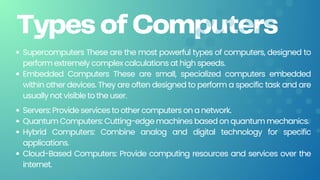
Types of Computers
Supercomputers These are the most powerful types of computers, designed to
perform extremely complex calculations at high speeds.
Embedded Computers These are small, specialized computers embedded
within other devices. They are often designed to perform a specific task and are
usually not visible to the user.
Servers: Provide services to other computers on a network.
Quantum Computers: Cutting-edge machines based on quantum mechanics.
Hybrid Computers: Combine analog and digital technology for specific
applications.
Cloud-Based Computers: Provide computing resources and services over the
internet.
Hardware
Components
Computer hardware refers to the physical components that make up a
computer system. These components work together to perform various tasks
and operations. Here's an overview of the main hardware components.
Hardware Components
CPU
Motherboard
RAM
Storage Devices
Power Supply Unit
GPU
Input Devices
Output Devices
Expansion Cards
Cooling Systems
Ports and Connectors
Network Components
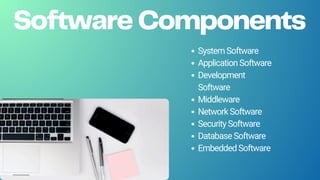
Software Components
SystemSoftware
ApplicationSoftware
Development
Software
Middleware
NetworkSoftware
SecuritySoftware
DatabaseSoftware
EmbeddedSoftware
How
Computers
Work
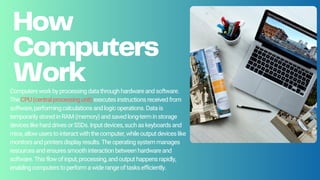
Computersworkbyprocessingdatathroughhardwareandsoftware.
TheCPU(centralprocessingunit)executesinstructionsreceivedfrom
software,performingcalculationsandlogicoperations.Datais
temporarilystoredinRAM(memory)andsavedlong-terminstorage
deviceslikeharddrivesorSSDs.Inputdevices,suchaskeyboardsand
mice,allowuserstointeractwiththecomputer,whileoutputdeviceslike
monitorsandprintersdisplayresults.Theoperatingsystemmanages
resourcesandensuressmoothinteractionbetweenhardwareand
software.Thisflowofinput,processing,andoutputhappensrapidly,
enablingcomputerstoperformawiderangeoftasksefficiently.
Binary Code
Binarycodeisthefundamentallanguagecomputersuseto
processandstoredata.Itconsistsofonlytwodigits,0and1,
knownasbits.Thesebitsrepresentelectricalstates,where0
typicallymeans"off"and1means"on."Bycombiningthesebits
insequences,computerscanencodenumbers,text,images,and
othertypesofdata.Binarycodeisthecoreofcomputer
operations,allowingcomplexprocessesandcomputationsto
occurathighspeeds.
Computer
Networks
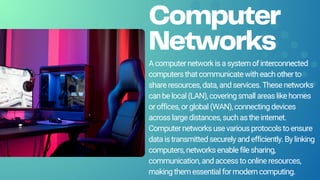
Acomputernetworkisasystemofinterconnected
computersthatcommunicatewitheachotherto
shareresources,data,andservices.Thesenetworks
canbelocal(LAN),coveringsmallareaslikehomes
oroffices,orglobal(WAN),connectingdevices
acrosslargedistances,suchastheinternet.
Computernetworksusevariousprotocolstoensure
dataistransmittedsecurelyandefficiently.Bylinking
computers,networksenablefilesharing,
communication,andaccesstoonlineresources,
makingthemessentialformoderncomputing.
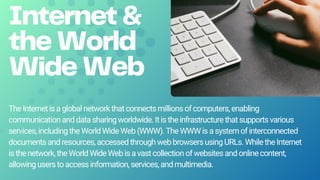
Internet &
the World
Wide Web
TheInternetisaglobalnetworkthatconnectsmillionsofcomputers,enabling
communicationanddatasharingworldwide.Itistheinfrastructurethatsupportsvarious
services,includingtheWorldWideWeb(WWW).TheWWWisasystemofinterconnected
documentsandresources,accessedthroughwebbrowsersusingURLs.WhiletheInternet
isthenetwork,theWorldWideWebisavastcollectionofwebsitesandonlinecontent,
allowinguserstoaccessinformation,services,andmultimedia.
Cloud
Computing
Cloudcomputingisthedeliveryofcomputingservicessuchasstorage,processing,andsoftware
overtheInternet.Insteadofrelyingonlocalserversorpersonaldevices,usersaccessresources
hostedonremoteservers,managedbycloudserviceproviders.Thistechnologyallowsforon-
demandaccesstodataandapplications,offeringflexibility,scalability,andcost-efficiency.Popular
cloudservicesincludeGoogleDrive,AmazonWebServices(AWS),andMicrosoftAzure,enabling
userstostorefiles,runapplications,andcollaboratefromanywhere.
Cybersecurity
Cybersecurityisthepracticeofprotectingcomputers,networks,anddigitaldatafromunauthorizedaccess,
attacks,ordamage.Itinvolvesimplementingvariousmeasuressuchasfirewalls,encryption,andantivirus
softwaretosafeguardinformation.Withincreasingcyberthreatslikehacking,phishing,andmalware,
cybersecurityensurestheconfidentiality,integrity,andavailabilityofdata.Individuals,businesses,and
governmentsneedtomaintainsecuresystemsandpreventpotentialdatabreaches,financialloss,andother
securityrisksinthedigitalworld.
Ethical
Considerations
Ethicalconsiderationsintechnologyinvolveensuringthatpracticesrelatedtothe
development,use,andimpactoftechnologyaremorallyresponsible.Thisincludes
protectingprivacy,ensuringfairness,preventingharm,andmaintainingtransparency.Issues
likedataprivacy,AIbias,andcybersecurityarekeyareaswhereethicaldecisionsmustbe
made.Developersandorganizationsmustconsiderthesocietal,legal,andenvironmental
consequencesoftheirtechnologies,ensuringtheybenefitusersandcommunitieswhile
minimizingpotentialnegativeeffectsandpromotingfairnessandaccountability.
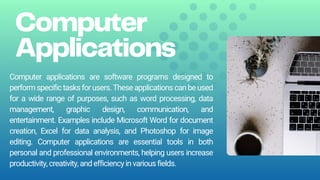
Computer
Applications
Computer applications are software programs designed to
performspecifictasksforusers.Theseapplicationscanbeused
for a wide range of purposes, such as word processing, data
management, graphic design, communication, and
entertainment. Examples include Microsoft Word for document
creation, Excel for data analysis, and Photoshop for image
editing. Computer applications are essential tools in both
personal and professional environments, helping users increase
productivity,creativity,andefficiencyinvariousfields.
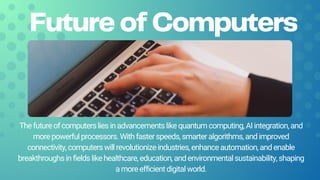
Future of Computers
Thefutureofcomputersliesinadvancementslikequantumcomputing,AIintegration,and
morepowerfulprocessors.Withfasterspeeds,smarteralgorithms,andimproved
connectivity,computerswillrevolutionizeindustries,enhanceautomation,andenable
breakthroughsinfieldslikehealthcare,education,andenvironmentalsustainability,shaping
amoreefficientdigitalworld.
Computer
Careers
Computercareersofferdiverseopportunities,from
softwaredevelopmentandcybersecuritytodata
scienceandAIengineering.Astechnologyevolves,
thedemandforskilledprofessionalsgrows.These
rolesprovidehighearningpotential,jobstability,and
thechancetoinnovateinindustrieslikehealthcare,
finance,andentertainment.
Computer
Ethics
Computerethicsinvolvestheresponsibleuseof
technology,focusingonissueslikeprivacy,data
security,intellectualproperty,anddigitalrights.It
ensuresthatindividualsandorganizationsrespect
legalguidelinesandmoralprincipleswhileusing
computers,fosteringafair,safe,andequitabledigital
environmentforallusers.
Conclusion
Inconclusion,astrongconclusionsummarizeskeypoints,reinforcesthemainmessage,andprovides
closure.Itleavesalastingimpression,guidingtheaudiencetoreflectonthetopic'ssignificance.Whether
inessays,presentations,ordiscussions,awell-craftedconclusiontieseverythingtogetherand
emphasizesthefinalthought.
Thank
You
www.biitnewdelhi.com
info@biitnewdelhi.com
+91-9318356685

Basic to Advanced Computer training Course