Problem Solving Negotiation


David Landis
Definition


A negotiation is a trade
     - “I’ll do Y, if you’ll do X.”
Two Strategy Options

• Seeking Advantage
• Seeking Joint Gain
Advantage Seeking

• Good short term results
• Hard to exploit
• Relatively easy to do
Advantage Seeking

• Hard on relationships
• Misses joint gain
• Breeds reciprocity
Joint Gain Seeking

• Expands the pie
• Benefits grow over time
• Builds relationships
Joint Gain Seeking

• Risks exploitation
• Takes more time and preparation
• Requires skill to be effective
Taming the Advantage Seeker

• Align your incentives
• Cooperation on terms is reciprocal, not
  individual
• Lift the horizon
• Develop “walk away” alternative
Being Trustworthy

• Say what you mean, mean what you say
• Does not require full disclosure
• Worth its weight in gold
Trusting

• Operate independent of trust
• Reciprocal consequences
3 Characteristics of Negotiation

• Recurring Dynamics

• Tension

• Asymmetrical information
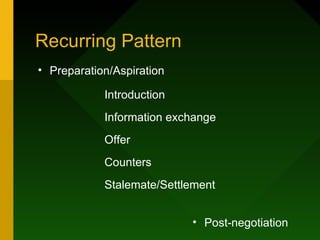
Recurring Pattern
• Preparation/Aspiration

            Introduction
            Information exchange
            Offer
            Counters
            Stalemate/Settlement


                           • Post-negotiation
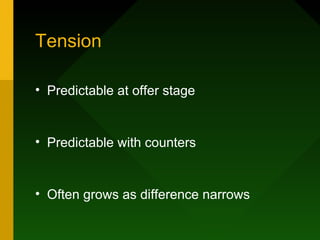
Tension

• Predictable at offer stage


• Predictable with counters


• Often grows as difference narrows
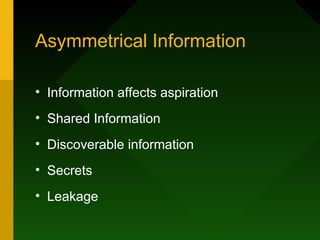
Asymmetrical Information

• Information affects aspiration
• Shared Information
• Discoverable information
• Secrets
• Leakage
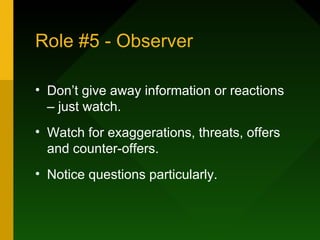
Role #5 - Observer

• Don’t give away information or reactions
  – just watch.
• Watch for exaggerations, threats, offers
  and counter-offers.
• Notice questions particularly.
Role #1


Your mother says, “Go to the store. Bring
 me an orange. You come home without
 an orange and you’ll be in trouble.”
Role #2


Your mother says, “Go to the store. Bring
 me an orange. You come home without
 an orange and you’ll be in trouble.”
Role #3

Your mother says, “Go to the store and
 bring me an orange. Family is coming
 over tomorrow, I’m going to peel the
 orange and cut up the pulp for a fruit
 salad. Bring me an orange or you’ll be in
 trouble.”
Role #4

Your mother says, “Go to the store, bring
 me an orange. Family is coming over
 tomorrow. I’m going to peel the orange
 and grate the peel to flavor some orange
 bread I’m making. Bring me an orange
 or you’re in trouble.”
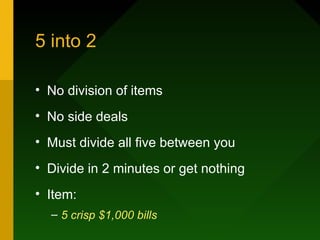
5 into 2

• No division of items
• No side deals
• Must divide all five between you
• Divide in 2 minutes or get nothing
• Item:
  – 5 crisp $1,000 bills
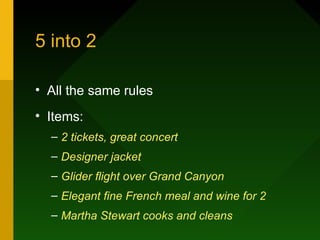
5 into 2

• All the same rules
• Items:
  – 2 tickets, great concert
  – Designer jacket
  – Glider flight over Grand Canyon
  – Elegant fine French meal and wine for 2
  – Martha Stewart cooks and cleans
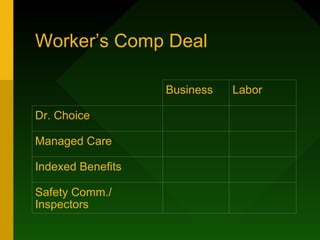
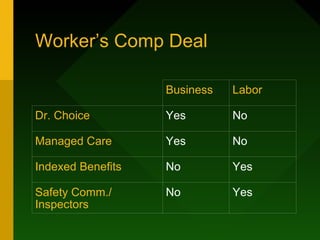
Worker’s Comp Deal

                   Business   Labor

Dr. Choice

Managed Care

Indexed Benefits

Safety Comm./
Inspectors
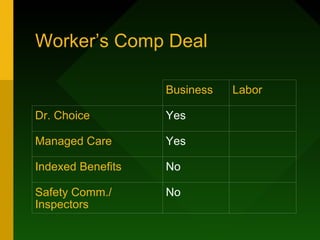
Worker’s Comp Deal

                   Business   Labor

Dr. Choice         Yes

Managed Care       Yes

Indexed Benefits   No

Safety Comm./      No
Inspectors
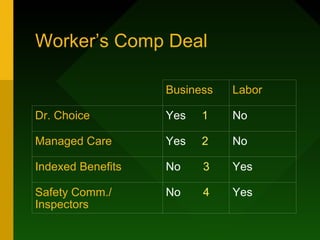
Worker’s Comp Deal

                   Business   Labor

Dr. Choice         Yes        No

Managed Care       Yes        No

Indexed Benefits   No         Yes

Safety Comm./      No         Yes
Inspectors
Worker’s Comp Deal

                   Business   Labor

Dr. Choice         Yes   1    No

Managed Care       Yes   2    No

Indexed Benefits   No    3    Yes

Safety Comm./      No    4    Yes
Inspectors
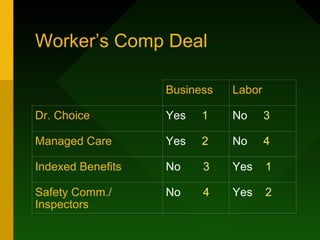
Worker’s Comp Deal

                   Business   Labor

Dr. Choice         Yes   1    No      3

Managed Care       Yes   2    No      4

Indexed Benefits   No    3    Yes     1

Safety Comm./      No    4    Yes     2
Inspectors
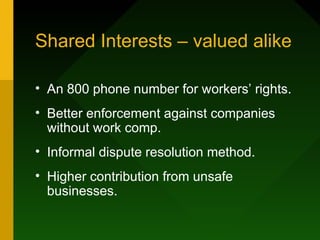
Shared Interests – valued alike

• An 800 phone number for workers’ rights.
• Better enforcement against companies
  without work comp.
• Informal dispute resolution method.
• Higher contribution from unsafe
  businesses.
Tools for Mutual Gain

• Interests before positions
• Priorities traded across differences
• Fair process norms
• Objective criteria
• Trust through authentic communication
Conflicting Interests

• Definition:
  – Valued alike, in opposition (money is the
    most common

• Strategy
  – Use objective criteria to insure fair results
Complementary Interests

• Definition:
  – Elements valued differently
  – Need at least two to link

• Strategy
  – discover, link, maximize
Shared Interests

• Definition:
  – Valued alike, good for both

• Strategy
  – Discover, maximize
  – No need to link
Focus on Interests before Positions

 • Interests = underlying motivations
    – The answer to “why?”

 • Positions = “yes or no” options
    – The answer to “how much?”

 • Focusing on interests induces problem solving
   because they are flexible and create
   satisfaction.
Invent Options for Mutual Gain

• Brainstorm method of advancing parties’
  interests
• Invent first, then decide
• Link differences, priorities
• Maximize shared interests
Use Objective Criteria

• Learn marketplace
• Frame dispute as a joint search for fair
  standards
• Adjust standards for unique circumstances
• Open with an offer you can justify
Separate People from the Problem

Be unconditionally cooperative on process
  – Good listening
  – Fair characterizations
  – Symbolic gestures
Separate Problem from the People

Be firm on fair outcomes
  – Trade cooperation
  – Reason, be open to reason
  – Results need a fair, reasonable basis
Advantage Seeking comes
from…

• High aspiration

• Stingy asymmetrical concessions

• Insistent counteroffers

• Information manipulation & leveraging
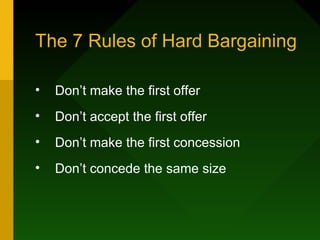
The 7 Rules of Hard Bargaining

•   Don’t make the first offer
•   Don’t accept the first offer
•   Don’t make the first concession
•   Don’t concede the same size
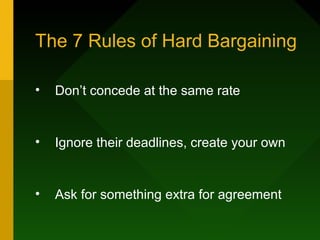
The 7 Rules of Hard Bargaining

•   Don’t concede at the same rate


•   Ignore their deadlines, create your own


•   Ask for something extra for agreement
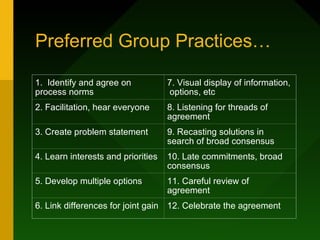
Preferred Group Practices…

1. Identify and agree on            7. Visual display of information,
process norms                       options, etc
2. Facilitation, hear everyone      8. Listening for threads of
                                    agreement
3. Create problem statement         9. Recasting solutions in
                                    search of broad consensus
4. Learn interests and priorities   10. Late commitments, broad
                                    consensus
5. Develop multiple options         11. Careful review of
                                    agreement
6. Link differences for joint gain 12. Celebrate the agreement
Problem Solving Negotiation

   “Good luck and good negotiating,


            Dave Landis
       dlandis@lincoln.ne.gov

Basic psn 2012

  • 1.
  • 2.
    Definition A negotiation isa trade - “I’ll do Y, if you’ll do X.”
  • 3.
    Two Strategy Options •Seeking Advantage • Seeking Joint Gain
  • 4.
    Advantage Seeking • Goodshort term results • Hard to exploit • Relatively easy to do
  • 5.
    Advantage Seeking • Hardon relationships • Misses joint gain • Breeds reciprocity
  • 6.
    Joint Gain Seeking •Expands the pie • Benefits grow over time • Builds relationships
  • 7.
    Joint Gain Seeking •Risks exploitation • Takes more time and preparation • Requires skill to be effective
  • 8.
    Taming the AdvantageSeeker • Align your incentives • Cooperation on terms is reciprocal, not individual • Lift the horizon • Develop “walk away” alternative
  • 9.
    Being Trustworthy • Saywhat you mean, mean what you say • Does not require full disclosure • Worth its weight in gold
  • 10.
    Trusting • Operate independentof trust • Reciprocal consequences
  • 11.
    3 Characteristics ofNegotiation • Recurring Dynamics • Tension • Asymmetrical information
  • 12.
    Recurring Pattern • Preparation/Aspiration Introduction Information exchange Offer Counters Stalemate/Settlement • Post-negotiation
  • 13.
    Tension • Predictable atoffer stage • Predictable with counters • Often grows as difference narrows
  • 14.
    Asymmetrical Information • Informationaffects aspiration • Shared Information • Discoverable information • Secrets • Leakage
  • 16.
    Role #5 -Observer • Don’t give away information or reactions – just watch. • Watch for exaggerations, threats, offers and counter-offers. • Notice questions particularly.
  • 18.
    Role #1 Your mothersays, “Go to the store. Bring me an orange. You come home without an orange and you’ll be in trouble.”
  • 20.
    Role #2 Your mothersays, “Go to the store. Bring me an orange. You come home without an orange and you’ll be in trouble.”
  • 22.
    Role #3 Your mothersays, “Go to the store and bring me an orange. Family is coming over tomorrow, I’m going to peel the orange and cut up the pulp for a fruit salad. Bring me an orange or you’ll be in trouble.”
  • 24.
    Role #4 Your mothersays, “Go to the store, bring me an orange. Family is coming over tomorrow. I’m going to peel the orange and grate the peel to flavor some orange bread I’m making. Bring me an orange or you’re in trouble.”
  • 26.
    5 into 2 •No division of items • No side deals • Must divide all five between you • Divide in 2 minutes or get nothing • Item: – 5 crisp $1,000 bills
  • 27.
    5 into 2 •All the same rules • Items: – 2 tickets, great concert – Designer jacket – Glider flight over Grand Canyon – Elegant fine French meal and wine for 2 – Martha Stewart cooks and cleans
  • 28.
    Worker’s Comp Deal Business Labor Dr. Choice Managed Care Indexed Benefits Safety Comm./ Inspectors
  • 29.
    Worker’s Comp Deal Business Labor Dr. Choice Yes Managed Care Yes Indexed Benefits No Safety Comm./ No Inspectors
  • 30.
    Worker’s Comp Deal Business Labor Dr. Choice Yes No Managed Care Yes No Indexed Benefits No Yes Safety Comm./ No Yes Inspectors
  • 31.
    Worker’s Comp Deal Business Labor Dr. Choice Yes 1 No Managed Care Yes 2 No Indexed Benefits No 3 Yes Safety Comm./ No 4 Yes Inspectors
  • 32.
    Worker’s Comp Deal Business Labor Dr. Choice Yes 1 No 3 Managed Care Yes 2 No 4 Indexed Benefits No 3 Yes 1 Safety Comm./ No 4 Yes 2 Inspectors
  • 33.
    Shared Interests –valued alike • An 800 phone number for workers’ rights. • Better enforcement against companies without work comp. • Informal dispute resolution method. • Higher contribution from unsafe businesses.
  • 34.
    Tools for MutualGain • Interests before positions • Priorities traded across differences • Fair process norms • Objective criteria • Trust through authentic communication
  • 35.
    Conflicting Interests • Definition: – Valued alike, in opposition (money is the most common • Strategy – Use objective criteria to insure fair results
  • 36.
    Complementary Interests • Definition: – Elements valued differently – Need at least two to link • Strategy – discover, link, maximize
  • 37.
    Shared Interests • Definition: – Valued alike, good for both • Strategy – Discover, maximize – No need to link
  • 38.
    Focus on Interestsbefore Positions • Interests = underlying motivations – The answer to “why?” • Positions = “yes or no” options – The answer to “how much?” • Focusing on interests induces problem solving because they are flexible and create satisfaction.
  • 39.
    Invent Options forMutual Gain • Brainstorm method of advancing parties’ interests • Invent first, then decide • Link differences, priorities • Maximize shared interests
  • 40.
    Use Objective Criteria •Learn marketplace • Frame dispute as a joint search for fair standards • Adjust standards for unique circumstances • Open with an offer you can justify
  • 41.
    Separate People fromthe Problem Be unconditionally cooperative on process – Good listening – Fair characterizations – Symbolic gestures
  • 42.
    Separate Problem fromthe People Be firm on fair outcomes – Trade cooperation – Reason, be open to reason – Results need a fair, reasonable basis
  • 43.
    Advantage Seeking comes from… •High aspiration • Stingy asymmetrical concessions • Insistent counteroffers • Information manipulation & leveraging
  • 44.
    The 7 Rulesof Hard Bargaining • Don’t make the first offer • Don’t accept the first offer • Don’t make the first concession • Don’t concede the same size
  • 45.
    The 7 Rulesof Hard Bargaining • Don’t concede at the same rate • Ignore their deadlines, create your own • Ask for something extra for agreement
  • 46.
    Preferred Group Practices… 1.Identify and agree on 7. Visual display of information, process norms options, etc 2. Facilitation, hear everyone 8. Listening for threads of agreement 3. Create problem statement 9. Recasting solutions in search of broad consensus 4. Learn interests and priorities 10. Late commitments, broad consensus 5. Develop multiple options 11. Careful review of agreement 6. Link differences for joint gain 12. Celebrate the agreement
  • 47.
    Problem Solving Negotiation “Good luck and good negotiating, Dave Landis dlandis@lincoln.ne.gov