Basic Principle Committee
Interim Report (1950)
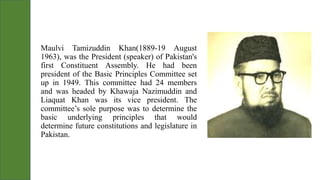
Maulvi Tamizuddin Khan(1889-19 August
1963), was the President (speaker) of Pakistan's
first Constituent Assembly. He had been
president of the Basic Principles Committee set
up in 1949. This committee had 24 members
and was headed by Khawaja Nazimuddin and
Liaquat Khan was its vice president. The
committee’s sole purpose was to determine the
basic underlying principles that would
determine future constitutions and legislature in
Pakistan.
There were three sub committees set-up under the Basic Principles
Committee:
• Sub-committee on federal and provincial constitution and distribution
of powers
• Sub-committee on franchise
• Sub-committee for judiciary
First proposal (1950)
The salient features of this report were as following:
1. The state of Pakistan was to be a federation.
2. The Central Legislature was to be bicameral. It would consist of a House of
Unit (Upper House) with 100 members and a House of People (Lower House)
with 400 members.
3. The Upper House was to be elected by provincial legislature. While the Lower House was to
be elected by the people on the basis of adult franchise.
4. The tenure of both the Houses was to be five years.
5. Objectives Resolution should be made part of the constitution.
6. The decisions regarding budget or monetary bills were to be decided in
joint sessions of the two houses.
7. The Head of state was to be elected by a joint session of the two houses
for a term of five years and would work on the advice of the Prime
Minister.
8. Federal legislature had the authority to remove the head of state.
9. Each province was to have its own legislature; elected on the basis of
adult franchise for a term of five years.
10. Head of the provincial legislature was to be elected by the head of state
for a term of five years and he was to work on the advice of Chief
Minister.
11.In case of a dispute, the Supreme Court had the authority to interpret the
constitution.
12. The procedure to amend the constitution was very rigid.
13. Head of the state was given added powers like the authority to abrogate the
constitution.
14. A Board of Ulama would be appointed by the head of state and provincial
governors to examine the process of lawmaking and to ensure that laws were in
accordance with the Quran and Sunnah.
15. Urdu was to be the state language
Reaction:
• As a consequence popularity of the First Constituent Assembly was badly
maligned. Resultantly Liaquat Ali Khan was forced to postpone his considerations
on account of severe criticism on the part of East Pakistan.
• In particular, the report was highly criticized by Sris Chandra Chattopadhyay who
observed that East Pakistan, being more populous than West Pakistan, would be
under-represented if both were given an equal number of seats in the upper house.
• On 4 October 1950, in an editorial published in the Nawa-i-Waqt, the report was
called a "charter of people's slavery".
• Bengali critics also voiced concern over making Urdu the national language while
thoroughly neglecting the Bengali language from the constitutional arena. There
was also criticism of the proposals for a strong center with vast powers on
financial matters.
Second Proposal(1952)
Second proposal was presented with some amendments. But this time
again after the first proposal, this report was not well received. Then, In
October 1953 formula named “ MUHAMMAD ALI BOGRA
FORMULA” was applied to solve this issue.

Basic Principle Committee Interim Report (1950).pptx

  • 1.
  • 2.
    Maulvi Tamizuddin Khan(1889-19August 1963), was the President (speaker) of Pakistan's first Constituent Assembly. He had been president of the Basic Principles Committee set up in 1949. This committee had 24 members and was headed by Khawaja Nazimuddin and Liaquat Khan was its vice president. The committee’s sole purpose was to determine the basic underlying principles that would determine future constitutions and legislature in Pakistan.
  • 3.
    There were threesub committees set-up under the Basic Principles Committee: • Sub-committee on federal and provincial constitution and distribution of powers • Sub-committee on franchise • Sub-committee for judiciary
  • 4.
    First proposal (1950) Thesalient features of this report were as following: 1. The state of Pakistan was to be a federation. 2. The Central Legislature was to be bicameral. It would consist of a House of Unit (Upper House) with 100 members and a House of People (Lower House) with 400 members. 3. The Upper House was to be elected by provincial legislature. While the Lower House was to be elected by the people on the basis of adult franchise. 4. The tenure of both the Houses was to be five years. 5. Objectives Resolution should be made part of the constitution.
  • 5.
    6. The decisionsregarding budget or monetary bills were to be decided in joint sessions of the two houses. 7. The Head of state was to be elected by a joint session of the two houses for a term of five years and would work on the advice of the Prime Minister. 8. Federal legislature had the authority to remove the head of state. 9. Each province was to have its own legislature; elected on the basis of adult franchise for a term of five years. 10. Head of the provincial legislature was to be elected by the head of state for a term of five years and he was to work on the advice of Chief Minister.
  • 6.
    11.In case ofa dispute, the Supreme Court had the authority to interpret the constitution. 12. The procedure to amend the constitution was very rigid. 13. Head of the state was given added powers like the authority to abrogate the constitution. 14. A Board of Ulama would be appointed by the head of state and provincial governors to examine the process of lawmaking and to ensure that laws were in accordance with the Quran and Sunnah. 15. Urdu was to be the state language
  • 7.
    Reaction: • As aconsequence popularity of the First Constituent Assembly was badly maligned. Resultantly Liaquat Ali Khan was forced to postpone his considerations on account of severe criticism on the part of East Pakistan. • In particular, the report was highly criticized by Sris Chandra Chattopadhyay who observed that East Pakistan, being more populous than West Pakistan, would be under-represented if both were given an equal number of seats in the upper house. • On 4 October 1950, in an editorial published in the Nawa-i-Waqt, the report was called a "charter of people's slavery". • Bengali critics also voiced concern over making Urdu the national language while thoroughly neglecting the Bengali language from the constitutional arena. There was also criticism of the proposals for a strong center with vast powers on financial matters.
  • 8.
    Second Proposal(1952) Second proposalwas presented with some amendments. But this time again after the first proposal, this report was not well received. Then, In October 1953 formula named “ MUHAMMAD ALI BOGRA FORMULA” was applied to solve this issue.