Basic of Cloud Computing
Name: Prashant kumar
Roll No: 41A
USN No: ENG23MCA088
Batch: 1 semester & 1year
University: Dayananada Sagar
University
Course: MCA
Session: 2023 - 2025
Basic of Cloud Computing
Presented by -
Prashant Kumar
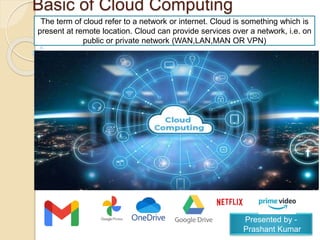
The term of cloud refer to a network or internet. Cloud is something which is
present at remote location. Cloud can provide services over a network, i.e. on
public or private network (WAN,LAN,MAN OR VPN)
Basic of Cloud Computing
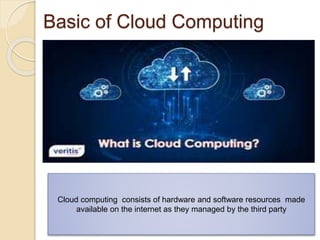
Cloud computing consists of hardware and software resources made
available on the internet as they managed by the third party
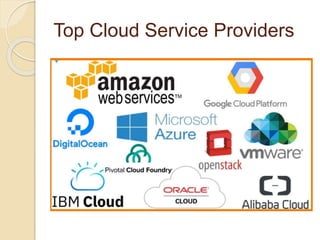
Top Cloud Service Providers
Basic of Cloud Computing
 Cloud computing is the delivery of the
computing services:
 Servers
 Storage
 Database
 Networking
 Software
 Analytics
 Intelligence
 Etc
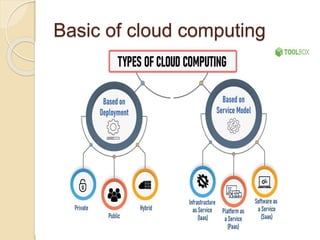
Basic of cloud computing
Types of Cloud Computing
 Infrastructure as a Service (IaaS)-
 It is also known as cloud Infrastructure
Services.
 Used by system administrator &
networkarchitec.
 it responsible for managing application data,
middleware, O.S, and runtime environments.
Example: Amazon Web Services(AWS),EC2,GOOGLE
 It provides the underlying O.S, security , networking
and services for developing the application.
 It provides access to fundamental resources such as
physical machines , virtual machines , virtual storage,
etc.
 Flexibility and Control
Types of Cloud Computing
Platform as a Service (PaaS)-
 It is also known as cloud platform services.
 It provides a platform and environment .
 Pass allow to developer to build applications and
services over the internet.
 No control over the infrastructures .
 We interact with user interface
 O.S will be provided by the vendor.
It similar to Saas ,but the difference is that PaaS
Provides a platform for software creation ,but using
SaaS we can access software over the internet without
the need of any platform.
Example: Window Azure,force.com,etc
Simplifying the Development
Enhancing Efficiency and Productivity
Types of Cloud Computing
Software as a service (SaaS)-
 It is also known as cloud application services.
 Example: Gmail, dropbox , etc.
 Generally used by end user
 SaaS application run directly through the web broswer
means do not required installation and download
these applications.
 It is available on demand , pay as per requirement.
 Reduced the cost of h/w and s/w maintainance.
 It is way of delivery services and application over the
internet.
 Maintainance of software and hardware ,done by the
vendor.
Cloud Deployment Models
Public Deployment Model: It comes with
offering a pay-as-you-go principle for
scalability and accessibility of cloud
resources for numerous users. it ensures
cost-effectiveness by providing enterprise-
needed services. Like – Gmail,etc
Private Deployment Model: It provides
an enhancement in protection and
customization by cloud resource utilization
as per particular specified requirements. It
is perfect for companies which looking for
security and compliance needs.
Cloud Deployment Models
 Hybrid Deployment Model - It comes
up with a combination of elements of
both private and public clouds providing
seamless data and application
processing in between environments. It
offers flexibility in optimizing resources
such as sensitive data in private clouds
and important scalable applications in
the public cloud.
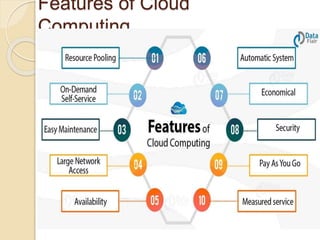
Features of Cloud
Computing
Thank
you…..

Basic of Cloud Computing.pptx cloud basic

  • 2.
    Basic of CloudComputing Name: Prashant kumar Roll No: 41A USN No: ENG23MCA088 Batch: 1 semester & 1year University: Dayananada Sagar University Course: MCA Session: 2023 - 2025
  • 3.
    Basic of CloudComputing Presented by - Prashant Kumar The term of cloud refer to a network or internet. Cloud is something which is present at remote location. Cloud can provide services over a network, i.e. on public or private network (WAN,LAN,MAN OR VPN)
  • 4.
    Basic of CloudComputing Cloud computing consists of hardware and software resources made available on the internet as they managed by the third party
  • 5.
  • 7.
    Basic of CloudComputing  Cloud computing is the delivery of the computing services:  Servers  Storage  Database  Networking  Software  Analytics  Intelligence  Etc
  • 8.
    Basic of cloudcomputing
  • 9.
    Types of CloudComputing  Infrastructure as a Service (IaaS)-  It is also known as cloud Infrastructure Services.  Used by system administrator & networkarchitec.  it responsible for managing application data, middleware, O.S, and runtime environments. Example: Amazon Web Services(AWS),EC2,GOOGLE  It provides the underlying O.S, security , networking and services for developing the application.  It provides access to fundamental resources such as physical machines , virtual machines , virtual storage, etc.  Flexibility and Control
  • 10.
    Types of CloudComputing Platform as a Service (PaaS)-  It is also known as cloud platform services.  It provides a platform and environment .  Pass allow to developer to build applications and services over the internet.  No control over the infrastructures .  We interact with user interface  O.S will be provided by the vendor. It similar to Saas ,but the difference is that PaaS Provides a platform for software creation ,but using SaaS we can access software over the internet without the need of any platform. Example: Window Azure,force.com,etc Simplifying the Development Enhancing Efficiency and Productivity
  • 11.
    Types of CloudComputing Software as a service (SaaS)-  It is also known as cloud application services.  Example: Gmail, dropbox , etc.  Generally used by end user  SaaS application run directly through the web broswer means do not required installation and download these applications.  It is available on demand , pay as per requirement.  Reduced the cost of h/w and s/w maintainance.  It is way of delivery services and application over the internet.  Maintainance of software and hardware ,done by the vendor.
  • 12.
    Cloud Deployment Models PublicDeployment Model: It comes with offering a pay-as-you-go principle for scalability and accessibility of cloud resources for numerous users. it ensures cost-effectiveness by providing enterprise- needed services. Like – Gmail,etc Private Deployment Model: It provides an enhancement in protection and customization by cloud resource utilization as per particular specified requirements. It is perfect for companies which looking for security and compliance needs.
  • 13.
    Cloud Deployment Models Hybrid Deployment Model - It comes up with a combination of elements of both private and public clouds providing seamless data and application processing in between environments. It offers flexibility in optimizing resources such as sensitive data in private clouds and important scalable applications in the public cloud.
  • 14.
  • 15.