What is Marketing?


… the process to of
identifying, stimulating
and satisfying customer
genuine wants and
needs. ..
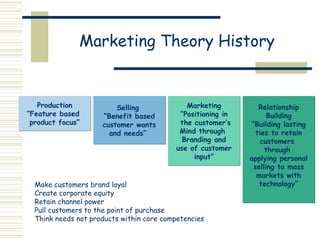
Marketing Theory History


   Production            Selling             Marketing          Relationship
“Feature based       “Benefit based        “Positioning in         Building
 product focus”      customer wants        the customer’s    “Building lasting
                       and needs”          Mind through        ties to retain
                                            Branding and         customers
                                          use of customer         through
                                               input”        applying personal
                                                              selling to mass
                                                               markets with
  Make customers brand loyal                                    technology”
  Create corporate equity
  Retain channel power
  Pull customers to the point of purchase
  Think needs not products within core competencies
Basic Marketing Frameworks

   Marketing environment
   Communications process
   Message effectiveness model
   Customer qualification pyramid
   Stages of buying
   Product diffusion/adoption
   Competitive positioning
   MC* strategic development
                            *Marketing Communications
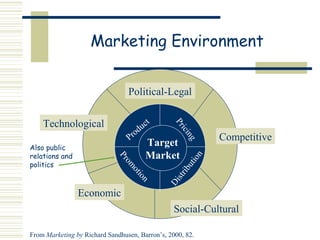
Marketing Environment


                                 Political-Legal


    Technological                         c   t


                                                   Pr
                                       du


                                                      ici
                                   o
                                 Pr                            Competitive


                                                          ng
Also public
                                         Target
relations and                            Market


                                                           n
                             Pr


                                                        io
politics
                                o


                                                      ut
                                m


                                                    ib
                                 ot


                                                    str
                                   io
                                     n


                                                  Di

                Economic
                                                   Social-Cultural

From Marketing by Richard Sandhusen, Barron’s, 2000, 82.
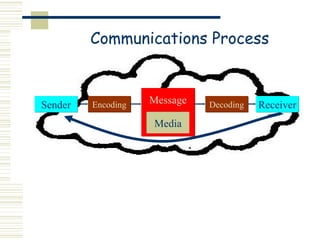
Communications Process


Sender   Encoding   Message   Decoding   Receiver
                    Media
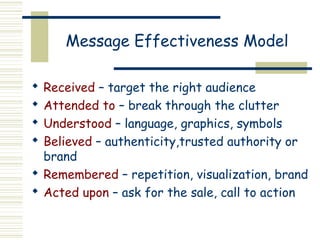
Message Effectiveness Model

 Received – target the right audience
 Attended to – break through the clutter
 Understood – language, graphics, symbols
 Believed – authenticity,trusted authority or
  brand
 Remembered – repetition, visualization, brand
 Acted upon – ask for the sale, call to action
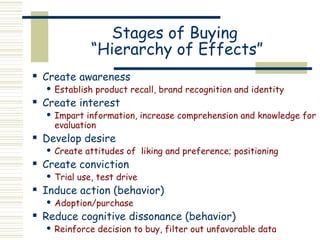
Stages of Buying
                 “Hierarchy of Effects”
   Create awareness
       Establish product recall, brand recognition and identity
   Create interest
       Impart information, increase comprehension and knowledge for
        evaluation
   Develop desire
       Create attitudes of liking and preference; positioning
   Create conviction
       Trial use, test drive
   Induce action (behavior)
       Adoption/purchase
   Reduce cognitive dissonance (behavior)
       Reinforce decision to buy, filter out unfavorable data
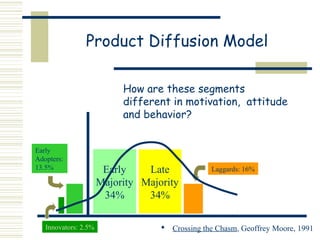
Product Diffusion Model

                           How are these segments
                           different in motivation, attitude
                           and behavior?


Early
Adopters:
13.5%                  Early    Late            Laggards: 16%
                      Majority Majority
                       34%      34%

   Innovators: 2.5%                 Crossing the Chasm, Geoffrey Moore, 1991
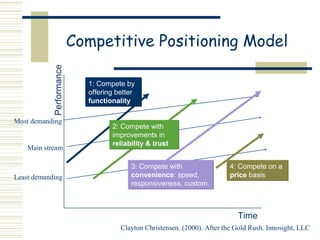
Competitive Positioning Model
            Performance

                            1: Compete by
                            offering better
                            functionality

Most demanding
                                   2: Compete with
                                   improvements in
                                   reliability & trust
    Main stream

                                         3: Compete with                  4: Compete on a
Least demanding                          convenience: speed,              price basis
                                         responsiveness, custom.


                                                                             Time
                                      Clayton Christensen. (2000). After the Gold Rush. Innosight, LLC
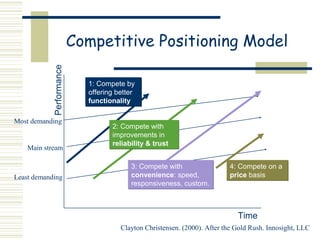
Competitive Positioning Model
            Performance

                            1: Compete by
                            offering better
                            functionality

Most demanding
                                   2: Compete with
                                   improvements in
                                   reliability & trust
    Main stream

                                         3: Compete with                  4: Compete on a
Least demanding                          convenience: speed,              price basis
                                         responsiveness, custom.


                                                                             Time
                                      Clayton Christensen. (2000). After the Gold Rush. Innosight, LLC

Basic marketing models

  • 1.
    What is Marketing? …the process to of identifying, stimulating and satisfying customer genuine wants and needs. ..
  • 2.
    Marketing Theory History Production Selling Marketing Relationship “Feature based “Benefit based “Positioning in Building product focus” customer wants the customer’s “Building lasting and needs” Mind through ties to retain Branding and customers use of customer through input” applying personal selling to mass markets with Make customers brand loyal technology” Create corporate equity Retain channel power Pull customers to the point of purchase Think needs not products within core competencies
  • 3.
    Basic Marketing Frameworks  Marketing environment  Communications process  Message effectiveness model  Customer qualification pyramid  Stages of buying  Product diffusion/adoption  Competitive positioning  MC* strategic development *Marketing Communications
  • 4.
    Marketing Environment Political-Legal Technological c t Pr du ici o Pr Competitive ng Also public Target relations and Market n Pr io politics o ut m ib ot str io n Di Economic Social-Cultural From Marketing by Richard Sandhusen, Barron’s, 2000, 82.
  • 5.
    Communications Process Sender Encoding Message Decoding Receiver Media
  • 6.
    Message Effectiveness Model Received – target the right audience  Attended to – break through the clutter  Understood – language, graphics, symbols  Believed – authenticity,trusted authority or brand  Remembered – repetition, visualization, brand  Acted upon – ask for the sale, call to action
  • 7.
    Stages of Buying “Hierarchy of Effects”  Create awareness  Establish product recall, brand recognition and identity  Create interest  Impart information, increase comprehension and knowledge for evaluation  Develop desire  Create attitudes of liking and preference; positioning  Create conviction  Trial use, test drive  Induce action (behavior)  Adoption/purchase  Reduce cognitive dissonance (behavior)  Reinforce decision to buy, filter out unfavorable data
  • 8.
    Product Diffusion Model How are these segments different in motivation, attitude and behavior? Early Adopters: 13.5% Early Late Laggards: 16% Majority Majority 34% 34% Innovators: 2.5%  Crossing the Chasm, Geoffrey Moore, 1991
  • 9.
    Competitive Positioning Model Performance 1: Compete by offering better functionality Most demanding 2: Compete with improvements in reliability & trust Main stream 3: Compete with 4: Compete on a Least demanding convenience: speed, price basis responsiveness, custom. Time Clayton Christensen. (2000). After the Gold Rush. Innosight, LLC
  • 10.
    Competitive Positioning Model Performance 1: Compete by offering better functionality Most demanding 2: Compete with improvements in reliability & trust Main stream 3: Compete with 4: Compete on a Least demanding convenience: speed, price basis responsiveness, custom. Time Clayton Christensen. (2000). After the Gold Rush. Innosight, LLC