


Creating a
  Creating a
  Powerful
  Powerful
Marketing Plan
Marketing Plan


                 1
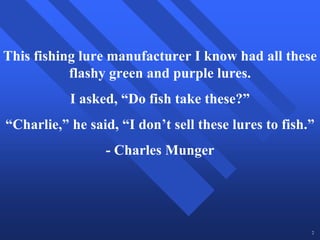
This fishing lure manufacturer I know had all these
           flashy green and purple lures.
           I asked, “Do fish take these?”
“Charlie,” he said, “I don’t sell these lures to fish.”
                 - Charles Munger


                                                      2
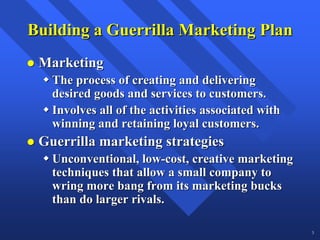
Building a Guerrilla Marketing Plan
 Marketing
   The process of creating and delivering
   desired goods and services to customers.
   Involves all of the activities associated with
   winning and retaining loyal customers.
 Guerrilla marketing strategies
   Unconventional, low-cost, creative marketing
   techniques that allow a small company to
   wring more bang from its marketing bucks
   than do larger rivals.

                                                    3
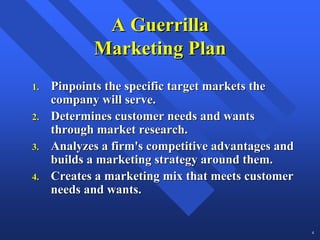
A Guerrilla
            Marketing Plan
1.   Pinpoints the specific target markets the
     company will serve.
2.   Determines customer needs and wants
     through market research.
3.   Analyzes a firm's competitive advantages and
     builds a marketing strategy around them.
4.   Creates a marketing mix that meets customer
     needs and wants.


                                                    4
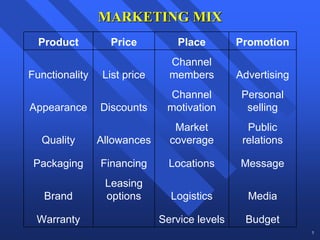
MARKETING MIX
  Product         Price           Place        Promotion
                                Channel
Functionality    List price     members        Advertising
                               Channel          Personal
Appearance      Discounts      motivation        selling
                                 Market          Public
  Quality       Allowances      coverage        relations

 Packaging      Financing       Locations      Message
                 Leasing
   Brand         options        Logistics        Media

 Warranty                     Service levels    Budget
                                                             5
Pinpointing the Target Market
One objective of market research
is to pinpoint the company's target
market, the specific group of
customers at whom the company
aims its products or services.
Without a clear image of its target
market, a small company tries to
reach almost everyone and ends up
appealing to almost no one!


                                      6
Market Research
Market research is the vehicle for gathering the
information that serves as the foundation for
the marketing plan.
Never assume that a market exists for your
company’s product or service; prove it!
Market research does not have to be time
consuming, complex, or expensive to be useful.


                                                   7
Market Research
                    (continued)


How to Conduct Market Research:
 Define the objective.
 Collect the data.
   Individualized (one-to-one) marketing


                                           8
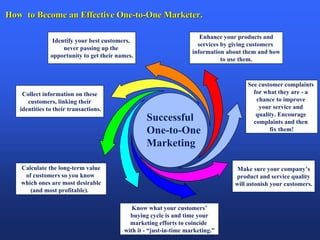
How to Become an Effective One-to-One Marketer.

                                                                       Enhance your products and
                Identify your best customers,
                                                                      services by giving customers
                    never passing up the
                                                                    information about them and how
               opportunity to get their names.
                                                                               to use them.


                                                                                      See customer complaints
    Collect information on these                                                        for what they are - a
      customers, linking their                                                           chance to improve
   identities to their transactions.                                                      your service and
                                                                                         quality. Encourage
                                                  Successful                            complaints and then
                                                  One-to-One                                  fix them!

                                                  Marketing

   Calculate the long-term value                                                   Make sure your company’s
    of customers so you know                                                      product and service quality
   which ones are most desirable                                                  will astonish your customers.
      (and most profitable).

                                             Know what your customers’
                                            buying cycle is and time your
                                            marketing efforts to coincide
                                          with it - “just-in-time marketing.”
Market Research
                    (continued)


How to Conduct Market Research:
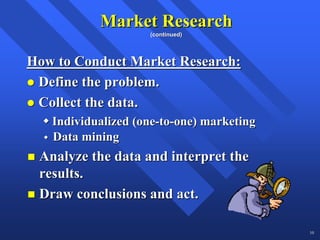
 Define the problem.
 Collect the data.
   Individualized (one-to-one) marketing
   Data mining
 Analyze the data and interpret the
 results.
 Draw conclusions and act.

                                           10
DATAMINING

Data mining is a process in which computer
software that uses statistical analysis, database
technology, and artificial intelligence finds
hidden patterns, trends, and connections in
data so that business owners can make better
marketing decisions and predictions about
customers’ behavior.


                                                    11
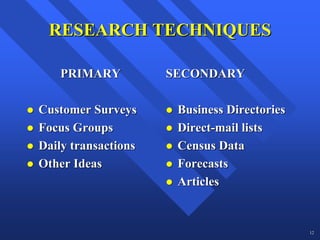
RESEARCH TECHNIQUES

   PRIMARY           SECONDARY

Customer Surveys      Business Directories
Focus Groups          Direct-mail lists
Daily transactions    Census Data
Other Ideas           Forecasts
                      Articles


                                             12
Relationship Marketing
    (Customer Relationship Management)
Involves developing and maintaining long-term
relationships with customers so that they will
keep coming back to make repeat purchases.
Small companies have an advantage over their
larger rivals at relationship marketing.
Requires a company to make customer service
an all-encompassing part of its culture.
Customers are part of all major issues the
company faces.


                                                 13
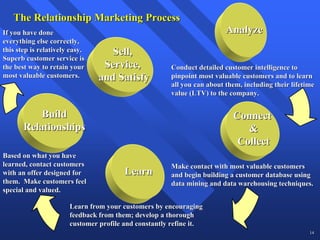
The Relationship Marketing Process
If you have done                                                         Analyze
everything else correctly,
this step is relatively easy.      Sell,
Superb customer service is
the best way to retain your      Service,              Conduct detailed customer intelligence to
most valuable customers.        and Satisfy            pinpoint most valuable customers and to learn
                                                       all you can about them, including their lifetime
                                                       value (LTV) to the company.


           Build                                                           Connect
       Relationships                                                          &
                                                                            Collect
Based on what you have
learned, contact customers                             Make contact with most valuable customers
with an offer designed for              Learn          and begin building a customer database using
them. Make customers feel                              data mining and data warehousing techniques.
special and valued.

                       Learn from your customers by encouraging
                       feedback from them; develop a thorough
                       customer profile and constantly refine it.
                                                                                                     14
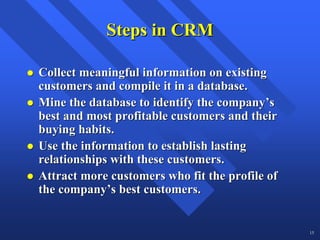
Steps in CRM

Collect meaningful information on existing
customers and compile it in a database.
Mine the database to identify the company’s
best and most profitable customers and their
buying habits.
Use the information to establish lasting
relationships with these customers.
Attract more customers who fit the profile of
the company’s best customers.


                                                15
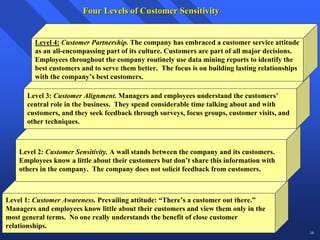
Four Levels of Customer Sensitivity


         Level 4: Customer Partnership. The company has embraced a customer service attitude
         as an all-encompassing part of its culture. Customers are part of all major decisions.
         Employees throughout the company routinely use data mining reports to identify the
         best customers and to serve them better. The focus is on building lasting relationships
         with the company’s best customers.

      Level 3: Customer Alignment. Managers and employees understand the customers’
      central role in the business. They spend considerable time talking about and with
      customers, and they seek feedback through surveys, focus groups, customer visits, and
      other techniques.


    Level 2: Customer Sensitivity. A wall stands between the company and its customers.
    Employees know a little about their customers but don’t share this information with
    others in the company. The company does not solicit feedback from customers.


Level 1: Customer Awareness. Prevailing attitude: “There’s a customer out there.”
Managers and employees know little about their customers and view them only in the
most general terms. No one really understands the benefit of close customer
relationships.
                                                                                                   16
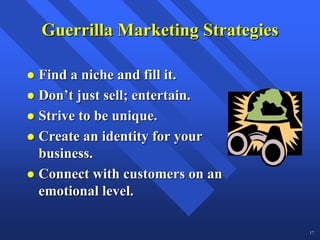
Guerrilla Marketing Strategies

Find a niche and fill it.
Don’t just sell; entertain.
Strive to be unique.
Create an identity for your
business.
Connect with customers on an
emotional level.

                                 17
Guerrilla Marketing Strategies
               (continued)


 Focus on the customer.
 Devotion to quality.
 Attention to convenience.
 Concentration on
 innovation.
 Dedication to service and
 customer satisfaction.
 Emphasis on speed.

                                 18
Focus on the Customer
67% of customers who stop patronizing a
business do so because an indifferent employee
treated them poorly.
96% of dissatisfied customers never complain
about rude or discourteous service, but...
    91% will not buy from that business again.
   100% will tell their “horror stories” to at
    least nine other people.
   13% of those unhappy customers will tell
    their stories to at least 20 other people.

                                                 19
Focus on the Customer
                     (continued)


Treating customers indifferently or poorly costs the
average company from 15% to 30% of gross sales!
Replacing lost customers is expensive; it costs five
times as much to attract a new customer as it does
to sell to an existing one!
About 70% of a company’s sales come from
existing customers.
Because 20% of a typical company’s customers
account for about 80% of its sales, no business can
afford to alienate its best and most profitable
customers and survive!

                                                       20
Focus on the Customer
                  (continued)


Companies that are successful at retaining
their customers constantly ask themselves
(and their customers) four questions:
   1. What are we doing right?
   2. How can we do that even better?
   3. What have we done wrong?
   4. What can we do in the future?


                                             21
Devotion to Quality
Quality-more than just a slogan on the
company bulletin board.
World-class companies treat quality as a
strategic objective, an integral part of the
company culture.
This is the philosophy of Total Quality
Management (TQM).
  Quality in the product or service itself.
  Quality in every aspect of the business and its
  relationship with the customer.
  Continuous improvement in quality.


                                                    22
How Do Customer Define Quality
        in a Product?
Reliability (average time between breakdowns)
Durability (how long an item lasts)
Ease of use
                                      Quality
Known or trusted brand name
Low price


                                                23
How Do Customer Define Quality
        in a Service?
Tangibles (equipment, facilities,
people)
Reliability (doing what you say you
will do)                              Quality
Responsiveness (promptness in
helping customers)
Assurance and empathy (conveying
a caring attitude)

                                                24
Attention to Convenience

Is your business conveniently located near
customers?
Are your business hours suitable to your
customers?
Would customers appreciate pickup and
delivery services?
Do you make it easy for customers to buy
on credit or with credit cards?

                                             25
Attention to Convenience
                   (continued)


Are your employees trained to handle
business transactions quickly, efficiently,
and politely?
Does your company offer “extras” that
would make customers’ visits easier?
Can you adapt existing products to make
them more convenient for customers?
Does your company handle telephone calls
quickly and efficiently?
                                              26
Concentration on Innovation
Innovation
  The key to future success.
  One of the greatest strengths of
  entrepreneurs. It shows up in the new
  products, techniques, and unusual
  approaches they introduce.
Entrepreneurs often create new products
and services by focusing their efforts on
one area and by using their size and
flexibility to their advantage.


                                            27
Dedication to Service
      Goal: to achieve customer astonishment!

Listen to customers.
Define “superior service.”
Set standards and measure
performance.
Examine your company’s service
cycle.
Hire the right employees.
Train employees to deliver superior
service.
                                                28
Dedication to Service
                  (continued)

     Goal: to achieve customer astonishment!

Empower employees to offer superior
service.
Use technology to provide improved
service.
Reward superior service.
Get top managers’ support.
View customer service as an
investment, not an expense.


                                               29
Emphasis on Speed
Use principles of time compression
management (TCM):
  Speed new products to market.
  Shorten customer response time in manufacturing
  and delivery.
  Reduce the administrative time required to fill an
  order.
Study: Most businesses waste 85 to 99% of the
time required to produce products or services!


                                                       30
Emphasis on Speed
                (continued)


Re-engineer the process rather than try
to do the same thing - only faster.
Create cross-functional teams of workers
and empower them to attack and solve
problems.
Set aggressive goals for production and
stick to the schedule.


                                           31
Emphasis on Speed
                 (continued)


Rethink the supply chain.
Instill speed in the company culture.
Use technology to find shortcuts
wherever possible.
Put the Internet to work for you.


                                        32
Benefits of Marketing on the
        World Wide Web
Even the smallest companies can
market their products and services
around the globe.
SBA study: 67% of small businesses
that established Web sites said their
sites brought in new customers.
The Web can be the “Great
Equalizer” in a small company’s
marketing program.


                                        33
Benefits of Marketing on the
       World Wide Web
                     (continued)


Only 24% of small companies with
Web sites actually generate revenues
from online sales.
Web customers are demographically
attractive: They are young,
educated, and wealthy.
  Average household income = $52,300
  39% have college degrees


                                       34
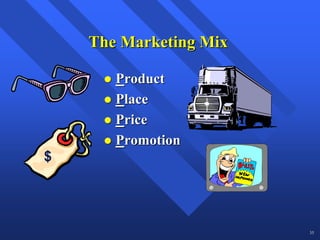
The Marketing Mix

       Product
       Place
       Price
       Promotion
$


                        35
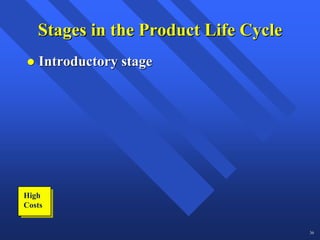
Stages in the Product Life Cycle
   Introductory stage


High
Costs


                                      36
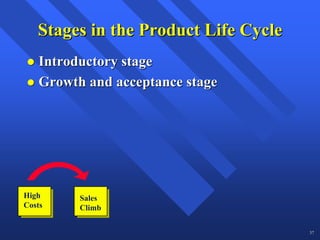
Stages in the Product Life Cycle
   Introductory stage
   Growth and acceptance stage


High     High
         Sales
Costs    Costs
         Climb

                                      37
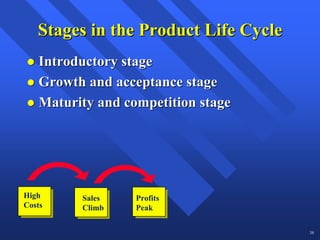
Stages in the Product Life Cycle
   Introductory stage
   Growth and acceptance stage
   Maturity and competition stage


High     Sales    Profits
Costs    Climb    Peak

                                      38
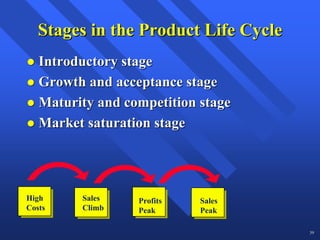
Stages in the Product Life Cycle
   Introductory stage
   Growth and acceptance stage
   Maturity and competition stage
   Market saturation stage


High
High     Sales    Profits    Sales
                   Profits    Sales
Costs
Costs    Climb    Peak       Peak
                   Peak       Peak

                                      39
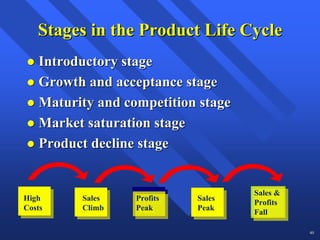
Stages in the Product Life Cycle
   Introductory stage
   Growth and acceptance stage
   Maturity and competition stage
   Market saturation stage
   Product decline stage


                                     Sales &
                                      Sales &
High     Sales    Profits
                   Profits   Sales
                                     Profits
                                      Profits
Costs    Climb    Peak
                   Peak      Peak
                                     Fall
                                      Fall

                                                40
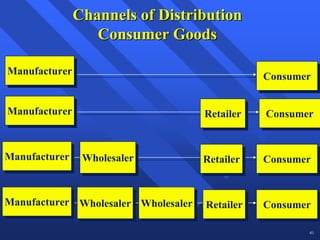
Channels of Distribution
               Consumer Goods

Manufacturer
Manufacturer                                  Consumer
                                              Consumer


Manufacturer
Manufacturer                       Retailer   Consumer
                                   Retailer   Consumer


Manufacturer Wholesaler
Manufacturer Wholesaler            Retailer   Consumer
                                   Retailer   Consumer


Manufacturer Wholesaler Wholesaler Retailer
Manufacturer Wholesaler Wholesaler Retailer   Consumer
                                              Consumer

                                                     41
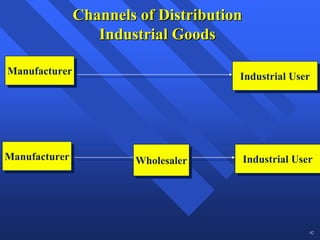
Channels of Distribution
                  Industrial Goods

Manufacturer
Manufacturer                          Industrial User
                                       Industrial User


Manufacturer
Manufacturer           Wholesaler         Industrial User
                       Wholesaler          Industrial User


                                                        42

7 marketing plan

  • 1.
    Creating a Creating a Powerful Powerful Marketing Plan Marketing Plan 1
  • 2.
    This fishing luremanufacturer I know had all these flashy green and purple lures. I asked, “Do fish take these?” “Charlie,” he said, “I don’t sell these lures to fish.” - Charles Munger 2
  • 3.
    Building a GuerrillaMarketing Plan Marketing The process of creating and delivering desired goods and services to customers. Involves all of the activities associated with winning and retaining loyal customers. Guerrilla marketing strategies Unconventional, low-cost, creative marketing techniques that allow a small company to wring more bang from its marketing bucks than do larger rivals. 3
  • 4.
    A Guerrilla Marketing Plan 1. Pinpoints the specific target markets the company will serve. 2. Determines customer needs and wants through market research. 3. Analyzes a firm's competitive advantages and builds a marketing strategy around them. 4. Creates a marketing mix that meets customer needs and wants. 4
  • 5.
    MARKETING MIX Product Price Place Promotion Channel Functionality List price members Advertising Channel Personal Appearance Discounts motivation selling Market Public Quality Allowances coverage relations Packaging Financing Locations Message Leasing Brand options Logistics Media Warranty Service levels Budget 5
  • 6.
    Pinpointing the TargetMarket One objective of market research is to pinpoint the company's target market, the specific group of customers at whom the company aims its products or services. Without a clear image of its target market, a small company tries to reach almost everyone and ends up appealing to almost no one! 6
  • 7.
    Market Research Market researchis the vehicle for gathering the information that serves as the foundation for the marketing plan. Never assume that a market exists for your company’s product or service; prove it! Market research does not have to be time consuming, complex, or expensive to be useful. 7
  • 8.
    Market Research (continued) How to Conduct Market Research: Define the objective. Collect the data. Individualized (one-to-one) marketing 8
  • 9.
    How to Becomean Effective One-to-One Marketer. Enhance your products and Identify your best customers, services by giving customers never passing up the information about them and how opportunity to get their names. to use them. See customer complaints Collect information on these for what they are - a customers, linking their chance to improve identities to their transactions. your service and quality. Encourage Successful complaints and then One-to-One fix them! Marketing Calculate the long-term value Make sure your company’s of customers so you know product and service quality which ones are most desirable will astonish your customers. (and most profitable). Know what your customers’ buying cycle is and time your marketing efforts to coincide with it - “just-in-time marketing.”
  • 10.
    Market Research (continued) How to Conduct Market Research: Define the problem. Collect the data. Individualized (one-to-one) marketing Data mining Analyze the data and interpret the results. Draw conclusions and act. 10
  • 11.
    DATAMINING Data mining isa process in which computer software that uses statistical analysis, database technology, and artificial intelligence finds hidden patterns, trends, and connections in data so that business owners can make better marketing decisions and predictions about customers’ behavior. 11
  • 12.
    RESEARCH TECHNIQUES PRIMARY SECONDARY Customer Surveys Business Directories Focus Groups Direct-mail lists Daily transactions Census Data Other Ideas Forecasts Articles 12
  • 13.
    Relationship Marketing (Customer Relationship Management) Involves developing and maintaining long-term relationships with customers so that they will keep coming back to make repeat purchases. Small companies have an advantage over their larger rivals at relationship marketing. Requires a company to make customer service an all-encompassing part of its culture. Customers are part of all major issues the company faces. 13
  • 14.
    The Relationship MarketingProcess If you have done Analyze everything else correctly, this step is relatively easy. Sell, Superb customer service is the best way to retain your Service, Conduct detailed customer intelligence to most valuable customers. and Satisfy pinpoint most valuable customers and to learn all you can about them, including their lifetime value (LTV) to the company. Build Connect Relationships & Collect Based on what you have learned, contact customers Make contact with most valuable customers with an offer designed for Learn and begin building a customer database using them. Make customers feel data mining and data warehousing techniques. special and valued. Learn from your customers by encouraging feedback from them; develop a thorough customer profile and constantly refine it. 14
  • 15.
    Steps in CRM Collectmeaningful information on existing customers and compile it in a database. Mine the database to identify the company’s best and most profitable customers and their buying habits. Use the information to establish lasting relationships with these customers. Attract more customers who fit the profile of the company’s best customers. 15
  • 16.
    Four Levels ofCustomer Sensitivity Level 4: Customer Partnership. The company has embraced a customer service attitude as an all-encompassing part of its culture. Customers are part of all major decisions. Employees throughout the company routinely use data mining reports to identify the best customers and to serve them better. The focus is on building lasting relationships with the company’s best customers. Level 3: Customer Alignment. Managers and employees understand the customers’ central role in the business. They spend considerable time talking about and with customers, and they seek feedback through surveys, focus groups, customer visits, and other techniques. Level 2: Customer Sensitivity. A wall stands between the company and its customers. Employees know a little about their customers but don’t share this information with others in the company. The company does not solicit feedback from customers. Level 1: Customer Awareness. Prevailing attitude: “There’s a customer out there.” Managers and employees know little about their customers and view them only in the most general terms. No one really understands the benefit of close customer relationships. 16
  • 17.
    Guerrilla Marketing Strategies Finda niche and fill it. Don’t just sell; entertain. Strive to be unique. Create an identity for your business. Connect with customers on an emotional level. 17
  • 18.
    Guerrilla Marketing Strategies (continued) Focus on the customer. Devotion to quality. Attention to convenience. Concentration on innovation. Dedication to service and customer satisfaction. Emphasis on speed. 18
  • 19.
    Focus on theCustomer 67% of customers who stop patronizing a business do so because an indifferent employee treated them poorly. 96% of dissatisfied customers never complain about rude or discourteous service, but... 91% will not buy from that business again. 100% will tell their “horror stories” to at least nine other people. 13% of those unhappy customers will tell their stories to at least 20 other people. 19
  • 20.
    Focus on theCustomer (continued) Treating customers indifferently or poorly costs the average company from 15% to 30% of gross sales! Replacing lost customers is expensive; it costs five times as much to attract a new customer as it does to sell to an existing one! About 70% of a company’s sales come from existing customers. Because 20% of a typical company’s customers account for about 80% of its sales, no business can afford to alienate its best and most profitable customers and survive! 20
  • 21.
    Focus on theCustomer (continued) Companies that are successful at retaining their customers constantly ask themselves (and their customers) four questions: 1. What are we doing right? 2. How can we do that even better? 3. What have we done wrong? 4. What can we do in the future? 21
  • 22.
    Devotion to Quality Quality-morethan just a slogan on the company bulletin board. World-class companies treat quality as a strategic objective, an integral part of the company culture. This is the philosophy of Total Quality Management (TQM). Quality in the product or service itself. Quality in every aspect of the business and its relationship with the customer. Continuous improvement in quality. 22
  • 23.
    How Do CustomerDefine Quality in a Product? Reliability (average time between breakdowns) Durability (how long an item lasts) Ease of use Quality Known or trusted brand name Low price 23
  • 24.
    How Do CustomerDefine Quality in a Service? Tangibles (equipment, facilities, people) Reliability (doing what you say you will do) Quality Responsiveness (promptness in helping customers) Assurance and empathy (conveying a caring attitude) 24
  • 25.
    Attention to Convenience Isyour business conveniently located near customers? Are your business hours suitable to your customers? Would customers appreciate pickup and delivery services? Do you make it easy for customers to buy on credit or with credit cards? 25
  • 26.
    Attention to Convenience (continued) Are your employees trained to handle business transactions quickly, efficiently, and politely? Does your company offer “extras” that would make customers’ visits easier? Can you adapt existing products to make them more convenient for customers? Does your company handle telephone calls quickly and efficiently? 26
  • 27.
    Concentration on Innovation Innovation The key to future success. One of the greatest strengths of entrepreneurs. It shows up in the new products, techniques, and unusual approaches they introduce. Entrepreneurs often create new products and services by focusing their efforts on one area and by using their size and flexibility to their advantage. 27
  • 28.
    Dedication to Service Goal: to achieve customer astonishment! Listen to customers. Define “superior service.” Set standards and measure performance. Examine your company’s service cycle. Hire the right employees. Train employees to deliver superior service. 28
  • 29.
    Dedication to Service (continued) Goal: to achieve customer astonishment! Empower employees to offer superior service. Use technology to provide improved service. Reward superior service. Get top managers’ support. View customer service as an investment, not an expense. 29
  • 30.
    Emphasis on Speed Useprinciples of time compression management (TCM): Speed new products to market. Shorten customer response time in manufacturing and delivery. Reduce the administrative time required to fill an order. Study: Most businesses waste 85 to 99% of the time required to produce products or services! 30
  • 31.
    Emphasis on Speed (continued) Re-engineer the process rather than try to do the same thing - only faster. Create cross-functional teams of workers and empower them to attack and solve problems. Set aggressive goals for production and stick to the schedule. 31
  • 32.
    Emphasis on Speed (continued) Rethink the supply chain. Instill speed in the company culture. Use technology to find shortcuts wherever possible. Put the Internet to work for you. 32
  • 33.
    Benefits of Marketingon the World Wide Web Even the smallest companies can market their products and services around the globe. SBA study: 67% of small businesses that established Web sites said their sites brought in new customers. The Web can be the “Great Equalizer” in a small company’s marketing program. 33
  • 34.
    Benefits of Marketingon the World Wide Web (continued) Only 24% of small companies with Web sites actually generate revenues from online sales. Web customers are demographically attractive: They are young, educated, and wealthy. Average household income = $52,300 39% have college degrees 34
  • 35.
    The Marketing Mix Product Place Price Promotion $ 35
  • 36.
    Stages in theProduct Life Cycle Introductory stage High Costs 36
  • 37.
    Stages in theProduct Life Cycle Introductory stage Growth and acceptance stage High High Sales Costs Costs Climb 37
  • 38.
    Stages in theProduct Life Cycle Introductory stage Growth and acceptance stage Maturity and competition stage High Sales Profits Costs Climb Peak 38
  • 39.
    Stages in theProduct Life Cycle Introductory stage Growth and acceptance stage Maturity and competition stage Market saturation stage High High Sales Profits Sales Profits Sales Costs Costs Climb Peak Peak Peak Peak 39
  • 40.
    Stages in theProduct Life Cycle Introductory stage Growth and acceptance stage Maturity and competition stage Market saturation stage Product decline stage Sales & Sales & High Sales Profits Profits Sales Profits Profits Costs Climb Peak Peak Peak Fall Fall 40
  • 41.
    Channels of Distribution Consumer Goods Manufacturer Manufacturer Consumer Consumer Manufacturer Manufacturer Retailer Consumer Retailer Consumer Manufacturer Wholesaler Manufacturer Wholesaler Retailer Consumer Retailer Consumer Manufacturer Wholesaler Wholesaler Retailer Manufacturer Wholesaler Wholesaler Retailer Consumer Consumer 41
  • 42.
    Channels of Distribution Industrial Goods Manufacturer Manufacturer Industrial User Industrial User Manufacturer Manufacturer Wholesaler Industrial User Wholesaler Industrial User 42