Basic Life Support
Dr.Gowtham Krishna J.
OBJECTIVES
• Introduction
• Chains of survival
• Adult BLS
• Child BLS
• Choking
• Rescue breathing
INTRODUCTION
• BLS is the foundation for saving a life after
cardiac arrest.
• Proper competency of BLS enables us to
– Recognize cardiac arrest
– Activate the emergency response system early
– Respond quickly and confidently
Chain of survival
Recognising the threat
IHCA most often represents
- progression of physiologic instability
100/
Adult BLS
 Scene safety and assessment
 Agitated attenders
 Ward environment
 Transport of patient to ICU
 Assessment
Check the response by taping at shoulder
Shout for help, if no response(Code Blue/RRT)
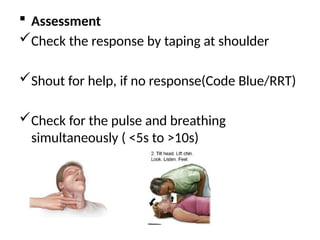
Check for the pulse and breathing
simultaneously ( <5s to >10s)
Adult BLS
• No pulse no breathing
 Code Blue
 Start CPR
Building blocks of CPR
Adult BLS
High quality CPR( 30:2)
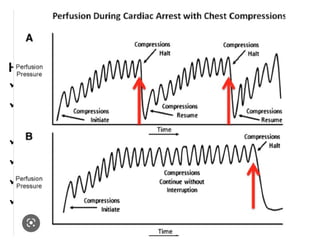
Compressions At the rate of 100- 120 /min
Allow the chest to get recoil for refilling of the
heart
Minimize the interruptions less than 10 secs
Depth of At least 5cm or 2.5 inches
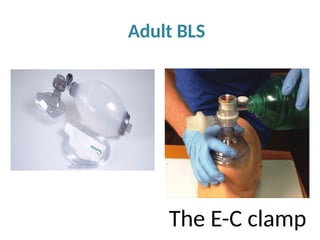
Effective ventilation 1 breath over 1 secs
Avoid excessive ventilation
Adult BLS
• Hand placement
Adult BLS
The E-C clamp
AED
 Turn on the AED
 Follow the AED Prompts
 Attach the Pads ,then plug can be connected (CPR to continue)
 Right side below the clavicle and left side nipple or mid axillary line
 Plug in to AED
 AED: Analysis of the rhythm
 Clear for analysis
Charging
Start compression while charging
Shock Advised press the shock button now
(flash light)
Clear the patient and deliver shock
Resume CPR if needed
Immediately start CPR after delivering shock
Adult BLS
Adult BLS
Special consideration applying for AED Pads
Hairy chest ( shave or use AED pads to stick out
hair if extra pads available )
Implanted pacemaker / defibrillator (should not
apply directly to that , can use just below that )
Medication Patches ( quickly remove and wipe )
Submerged with water ( pull the victim out,
quick dry)
Adult BLS
Adult BLS
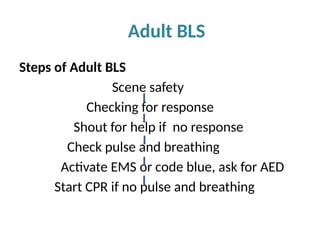
Steps of Adult BLS
Scene safety
Checking for response
Shout for help if no response
Check pulse and breathing
Activate EMS or code blue, ask for AED
Start CPR if no pulse and breathing
Adult BLS
Difference between single and multi rescuers
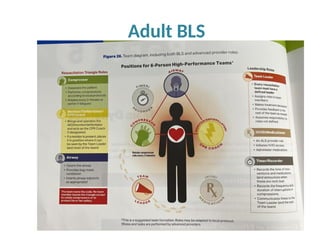
In case 2 or more rescuer –follow team
dynamics.
Every 2 mins ( 5 cycles of CPR) the rescuers
has to be switch over
Others remain same for both single and multi
rescuers like rate, ratio & depth
CHILD (1 yr to puberty )BLS
Scene safety
Checking for response
Shout for help if no response
Check pulse and breathing( carotid or femoral )
Activate EMS or code blue, ask for AED
Start CPR if no pulse and breathing
CHILD BLS
Witnessed VS Un-witnessed arrest
Start CPR immediately in case of un-witnessed
arrest, continue for 2 minutes, then activate EMS
Activate EMS and get help then start CPR
Hand placement
Centre of the chest , between the nipples, you
can use one hand or two hand technique for
compressions.
CHILD BLS
• High quality CPR( 30:2) & (15:2)
Compressions At the rate of 100- 120 /min
Allow the chest to get recoil for refilling of the heart
Minimize the interruptions less than 10 secs
Depth of about 5cm or 2.5 inches
Effective ventilation 1 breath over 1 secs
Avoid excessive ventilation to increases the cardiac
output
CHILD BLS
Difference between single and multi rescuers
In case 2 or more rescuer –follow team
dynamics
Every 2 mins ( 5 cycles of CPR) the rescuers
has to be switch over
Ratio will be 30:2 if single rescuer, 15:2 if case
of two or multi rescuer.
CHILD BLS
AED for child
 All the steps remains same as like an adult
 If child pads available, apply as like adult (right side
below the clavicle, left side below the nipple )
 Adult pad for children more 10 kg
 If using adult pad for the children, apply one at
anteriorly between the nipple another one at
posteriorly between scapula.
 Do not use child pad for the adult but can use the
adult pad for children.
RESCUE BREATHING
There is a pulse but breathing, abnormal
breathing or agonal gasping.
Start rescue breathing
 Adult : 1 breath for every 6 secs – 10/min
 Child & infant: 1 breath for every 2-3 secs- 20-
30/min
Check for pulse,every 2 minutes, if no pulse
activate EMS/ code blue and start CPR.
RESCUE BREATHING
Patient with Advanced Airway :
1 breath for every 6 secs, should not interrupt
the compressions, compression will be 100-
120 /min.
Patient on advanced airway- Clinical decision
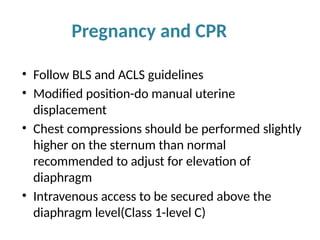
• Follow BLS and ACLS guidelines
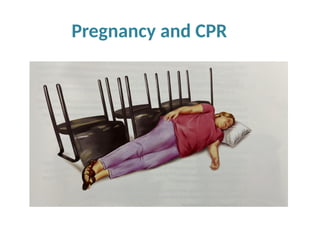
• Modified position-do manual uterine
displacement
• Chest compressions should be performed slightly
higher on the sternum than normal
recommended to adjust for elevation of
diaphragm
• Intravenous access to be secured above the
diaphragm level(Class 1-level C)
Pregnancy and CPR
Pregnancy and CPR
20 wk-prob for resc
/L lat-avoid cpr/
24-25 wk- fetus can survive
No ROSC -5 min-c/s(peri-
mor)
Pregnancy and CPR
• If no ROSC by 4 mins perform emergency
caesarean section
• Aim for delivery within 5 min of onset of
resuscitation
• Continue resuscitative efforts during and after
caesarean
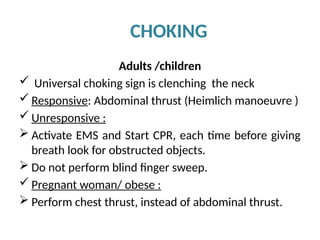
CHOKING
Adults /children
 Universal choking sign is clenching the neck
 Responsive: Abdominal thrust (Heimlich manoeuvre )
 Unresponsive :
 Activate EMS and Start CPR, each time before giving
breath look for obstructed objects.
 Do not perform blind finger sweep.
 Pregnant woman/ obese :
 Perform chest thrust, instead of abdominal thrust.
CHOKING
Adults /children
Code Blue structure
MEWS score
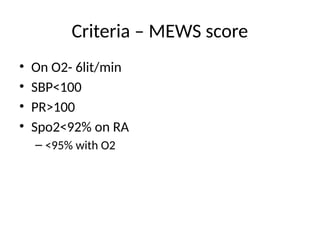
Criteria – MEWS score
• On O2- 6lit/min
• SBP<100
• PR>100
• Spo2<92% on RA
– <95% with O2
Basic life support- a beginners tutorial

Basic life support- a beginners tutorial

  • 1.
  • 2.
    OBJECTIVES • Introduction • Chainsof survival • Adult BLS • Child BLS • Choking • Rescue breathing
  • 3.
    INTRODUCTION • BLS isthe foundation for saving a life after cardiac arrest. • Proper competency of BLS enables us to – Recognize cardiac arrest – Activate the emergency response system early – Respond quickly and confidently
  • 4.
  • 6.
    Recognising the threat IHCAmost often represents - progression of physiologic instability 100/
  • 7.
    Adult BLS  Scenesafety and assessment  Agitated attenders  Ward environment  Transport of patient to ICU
  • 8.
     Assessment Check theresponse by taping at shoulder Shout for help, if no response(Code Blue/RRT) Check for the pulse and breathing simultaneously ( <5s to >10s)
  • 9.
    Adult BLS • Nopulse no breathing  Code Blue  Start CPR
  • 10.
  • 11.
    Adult BLS High qualityCPR( 30:2) Compressions At the rate of 100- 120 /min Allow the chest to get recoil for refilling of the heart Minimize the interruptions less than 10 secs Depth of At least 5cm or 2.5 inches Effective ventilation 1 breath over 1 secs Avoid excessive ventilation
  • 12.
  • 13.
  • 14.
    AED  Turn onthe AED  Follow the AED Prompts  Attach the Pads ,then plug can be connected (CPR to continue)  Right side below the clavicle and left side nipple or mid axillary line  Plug in to AED  AED: Analysis of the rhythm  Clear for analysis
  • 15.
    Charging Start compression whilecharging Shock Advised press the shock button now (flash light) Clear the patient and deliver shock Resume CPR if needed Immediately start CPR after delivering shock
  • 16.
  • 17.
    Adult BLS Special considerationapplying for AED Pads Hairy chest ( shave or use AED pads to stick out hair if extra pads available ) Implanted pacemaker / defibrillator (should not apply directly to that , can use just below that ) Medication Patches ( quickly remove and wipe ) Submerged with water ( pull the victim out, quick dry)
  • 18.
  • 19.
    Adult BLS Steps ofAdult BLS Scene safety Checking for response Shout for help if no response Check pulse and breathing Activate EMS or code blue, ask for AED Start CPR if no pulse and breathing
  • 20.
    Adult BLS Difference betweensingle and multi rescuers In case 2 or more rescuer –follow team dynamics. Every 2 mins ( 5 cycles of CPR) the rescuers has to be switch over Others remain same for both single and multi rescuers like rate, ratio & depth
  • 21.
    CHILD (1 yrto puberty )BLS Scene safety Checking for response Shout for help if no response Check pulse and breathing( carotid or femoral ) Activate EMS or code blue, ask for AED Start CPR if no pulse and breathing
  • 22.
    CHILD BLS Witnessed VSUn-witnessed arrest Start CPR immediately in case of un-witnessed arrest, continue for 2 minutes, then activate EMS Activate EMS and get help then start CPR Hand placement Centre of the chest , between the nipples, you can use one hand or two hand technique for compressions.
  • 23.
    CHILD BLS • Highquality CPR( 30:2) & (15:2) Compressions At the rate of 100- 120 /min Allow the chest to get recoil for refilling of the heart Minimize the interruptions less than 10 secs Depth of about 5cm or 2.5 inches Effective ventilation 1 breath over 1 secs Avoid excessive ventilation to increases the cardiac output
  • 24.
    CHILD BLS Difference betweensingle and multi rescuers In case 2 or more rescuer –follow team dynamics Every 2 mins ( 5 cycles of CPR) the rescuers has to be switch over Ratio will be 30:2 if single rescuer, 15:2 if case of two or multi rescuer.
  • 25.
    CHILD BLS AED forchild  All the steps remains same as like an adult  If child pads available, apply as like adult (right side below the clavicle, left side below the nipple )  Adult pad for children more 10 kg  If using adult pad for the children, apply one at anteriorly between the nipple another one at posteriorly between scapula.  Do not use child pad for the adult but can use the adult pad for children.
  • 26.
    RESCUE BREATHING There isa pulse but breathing, abnormal breathing or agonal gasping. Start rescue breathing  Adult : 1 breath for every 6 secs – 10/min  Child & infant: 1 breath for every 2-3 secs- 20- 30/min Check for pulse,every 2 minutes, if no pulse activate EMS/ code blue and start CPR.
  • 27.
    RESCUE BREATHING Patient withAdvanced Airway : 1 breath for every 6 secs, should not interrupt the compressions, compression will be 100- 120 /min. Patient on advanced airway- Clinical decision
  • 28.
    • Follow BLSand ACLS guidelines • Modified position-do manual uterine displacement • Chest compressions should be performed slightly higher on the sternum than normal recommended to adjust for elevation of diaphragm • Intravenous access to be secured above the diaphragm level(Class 1-level C) Pregnancy and CPR
  • 29.
  • 30.
    20 wk-prob forresc /L lat-avoid cpr/ 24-25 wk- fetus can survive No ROSC -5 min-c/s(peri- mor)
  • 31.
    Pregnancy and CPR •If no ROSC by 4 mins perform emergency caesarean section • Aim for delivery within 5 min of onset of resuscitation • Continue resuscitative efforts during and after caesarean
  • 32.
    CHOKING Adults /children  Universalchoking sign is clenching the neck  Responsive: Abdominal thrust (Heimlich manoeuvre )  Unresponsive :  Activate EMS and Start CPR, each time before giving breath look for obstructed objects.  Do not perform blind finger sweep.  Pregnant woman/ obese :  Perform chest thrust, instead of abdominal thrust.
  • 33.
  • 34.
  • 35.
  • 37.
    Criteria – MEWSscore • On O2- 6lit/min • SBP<100 • PR>100 • Spo2<92% on RA – <95% with O2