Organize. Collaborate. Discover. www.mendeley.com
1
Basic Introduction to Mendeley Reference
Manager
By
Mr. S. B. Kalbhare
Assistant Professor
M. Pharmacy (Pharmaceutics)
YSPM’s Yashoda Technical Campus, Faculty of B. Pharmacy,
Wadhe, Satara
In-house Student Training Programme
2021-22
Class: B. Pharm 3rd year Date: 14th January. 2022
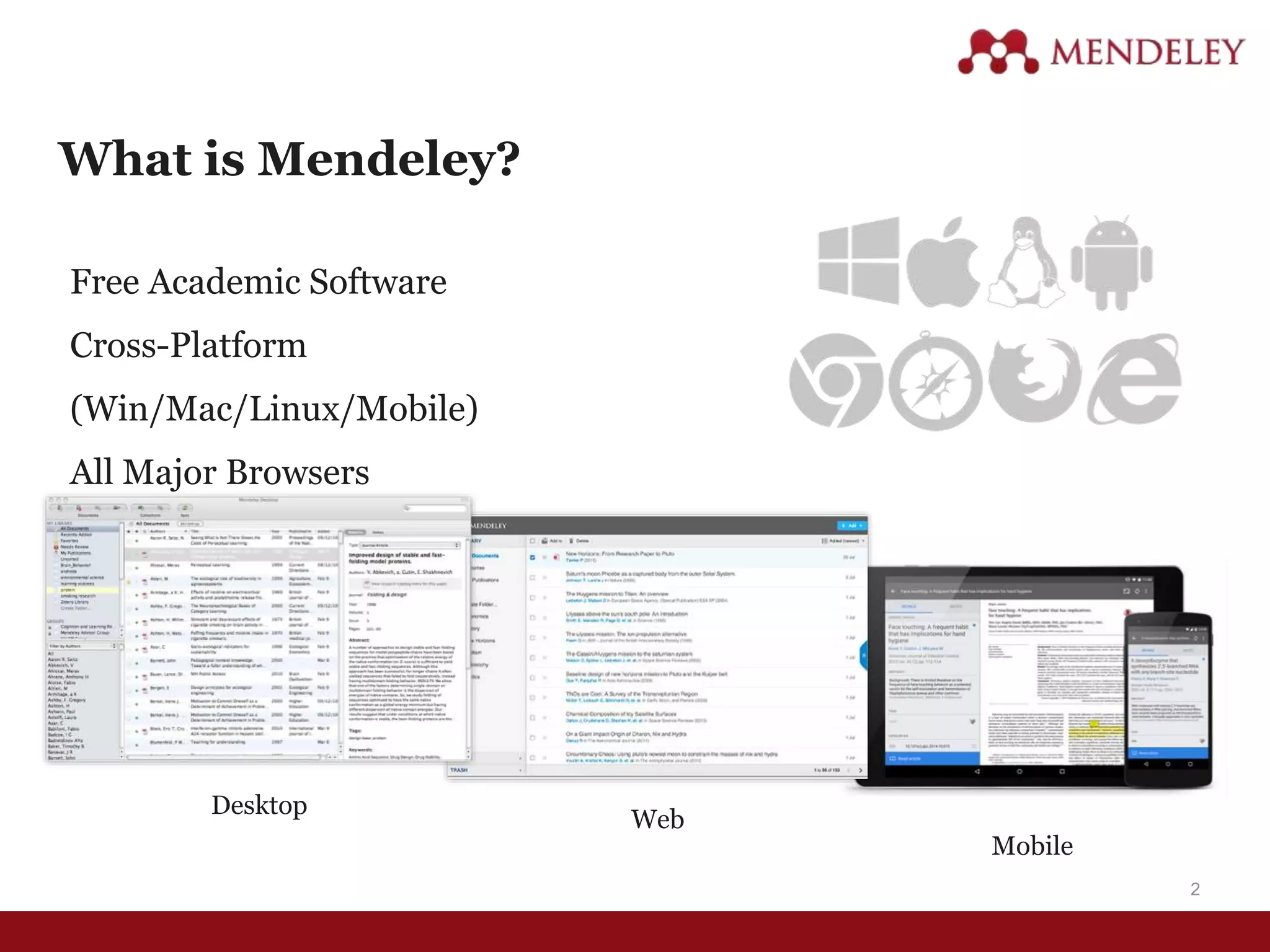
Desktop
Web
Mobile
Free Academic Software
Cross-Platform
(Win/Mac/Linux/Mobile)
All Major Browsers
What is Mendeley?
2
3
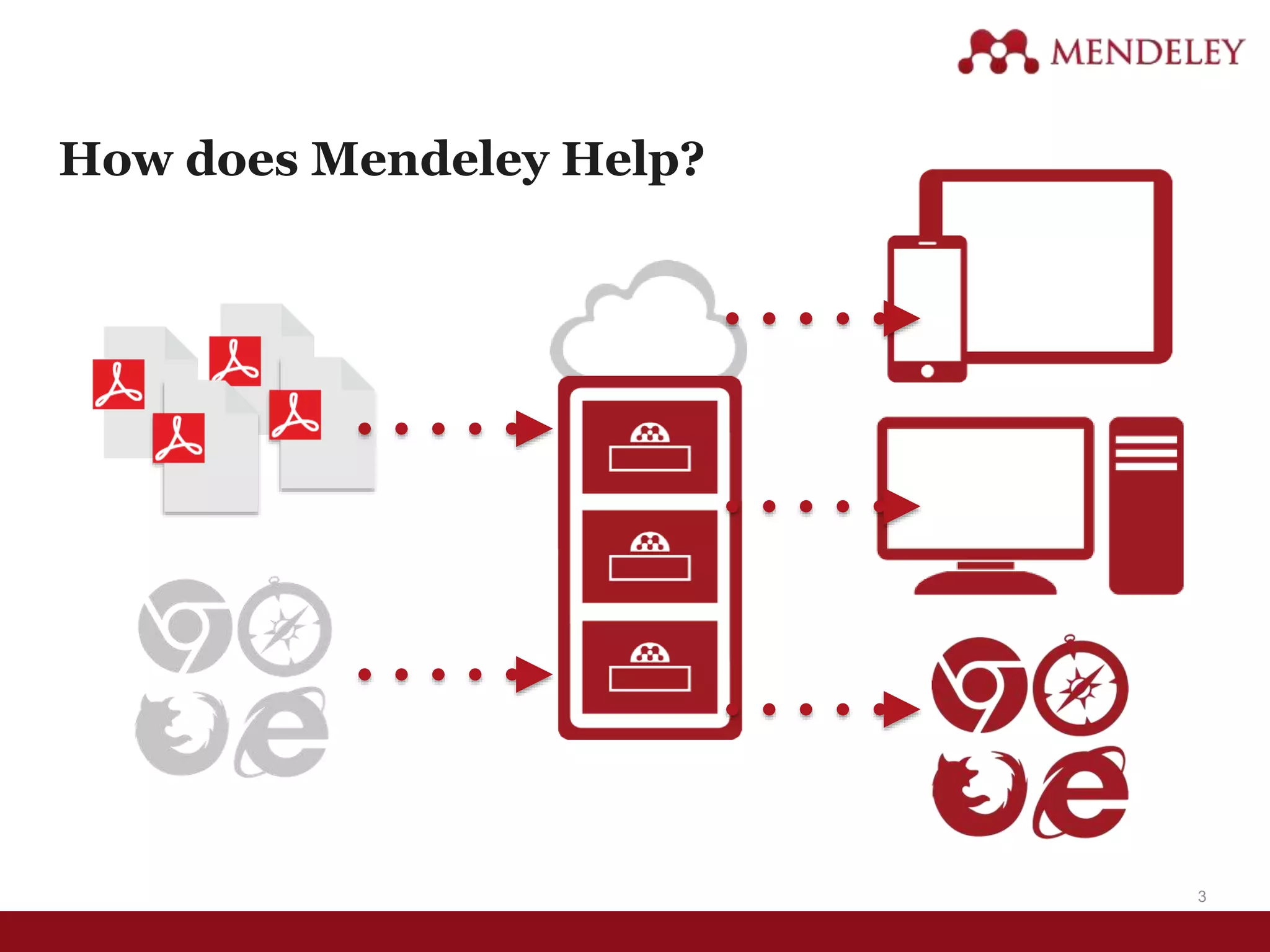
How does Mendeley Help?
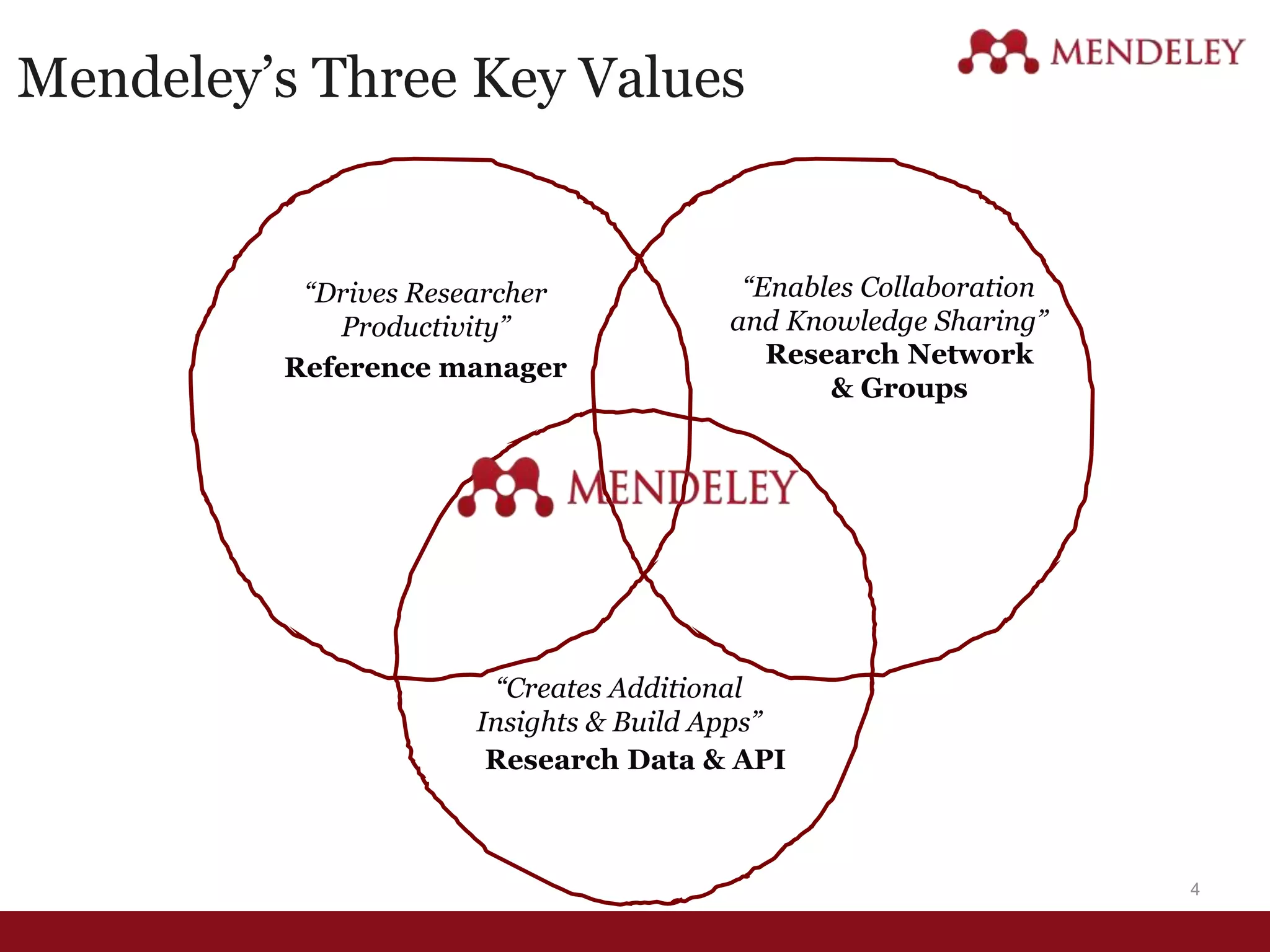
Mendeley’s Three Key Values
Reference manager
“Drives Researcher
Productivity”
Research Data & API
“Creates Additional
Insights & Build Apps”
Research Network
& Groups
“Enables Collaboration
and Knowledge Sharing”
4
5
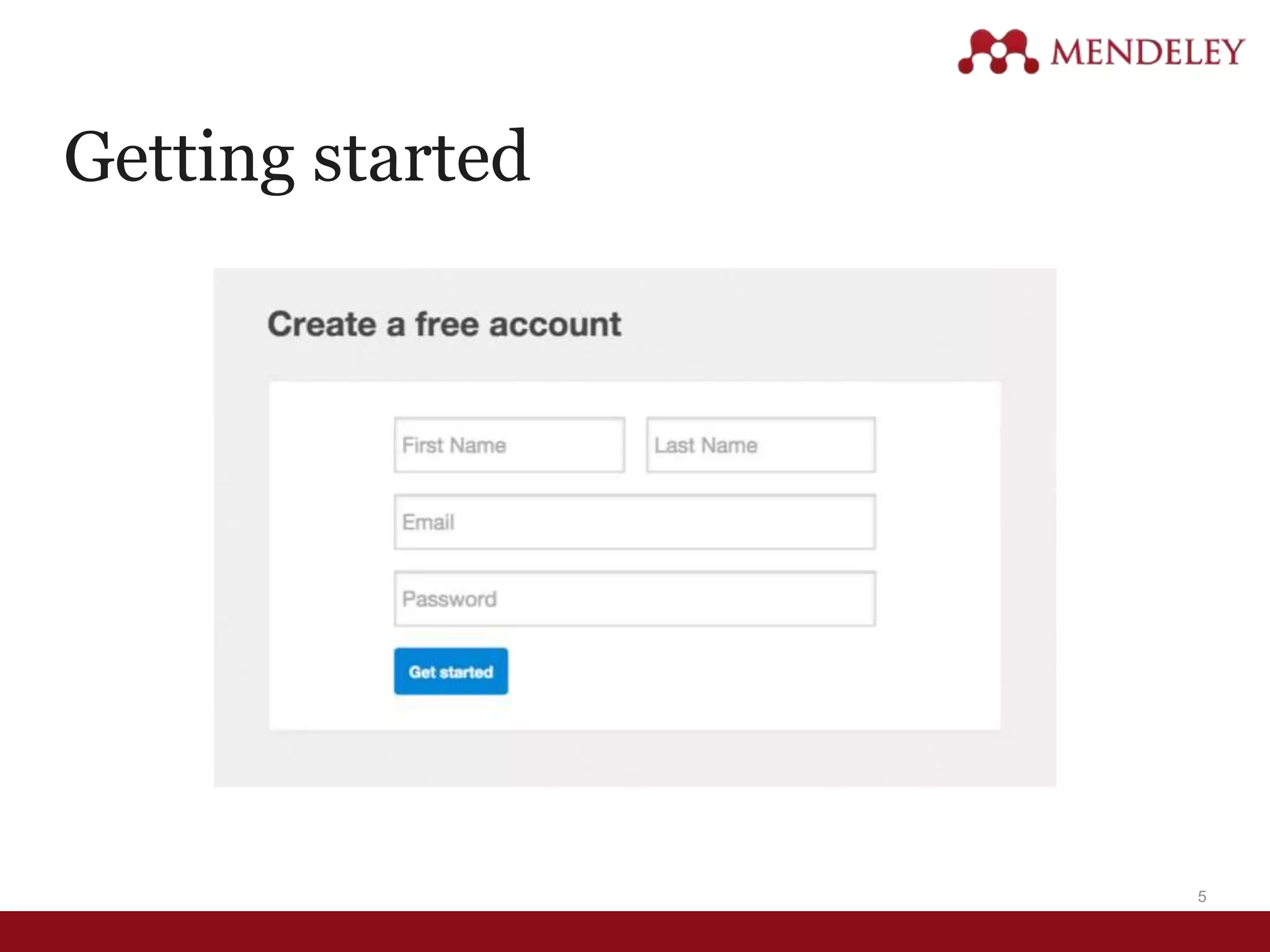
Getting started
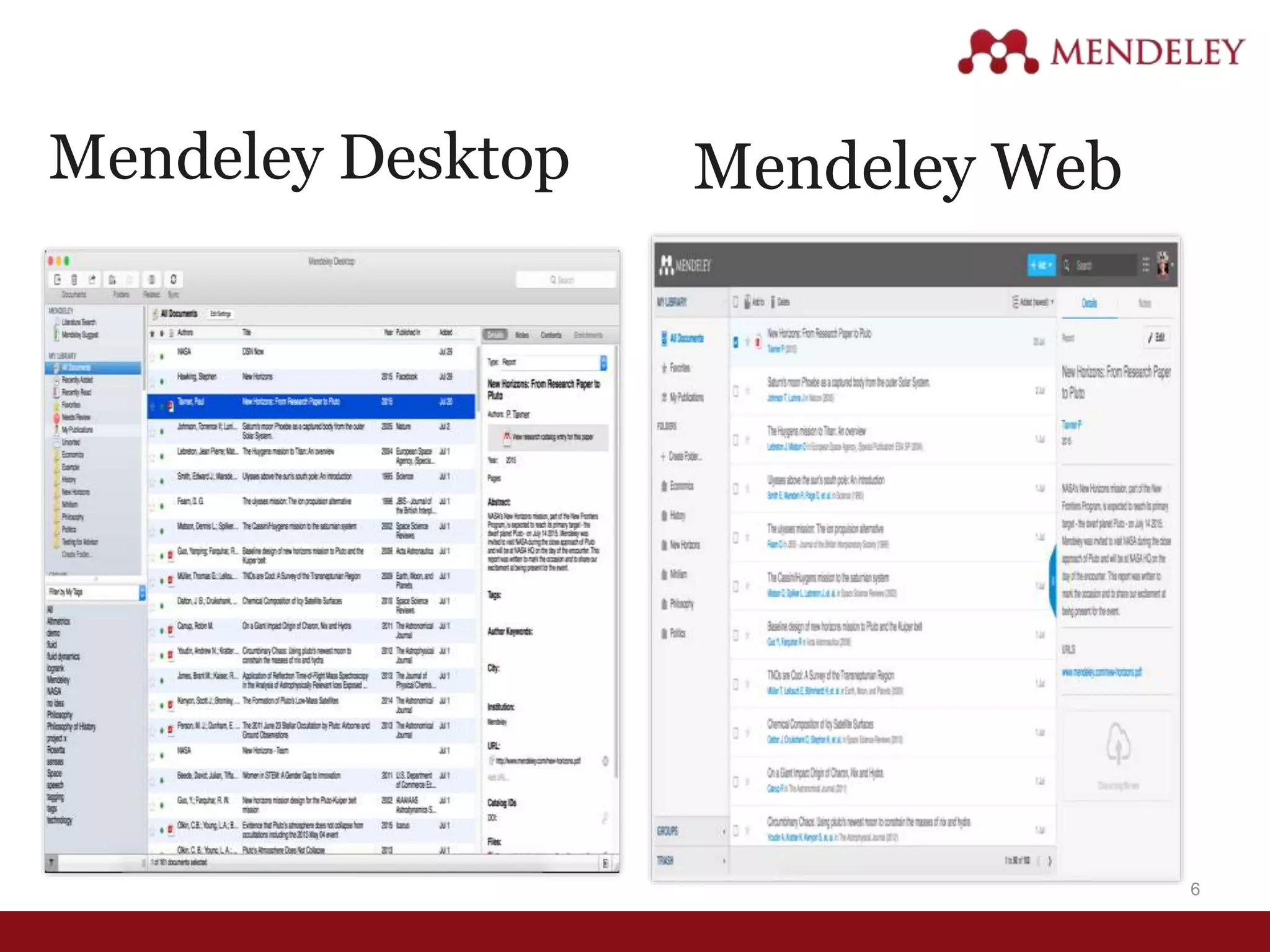
Mendeley Desktop Mendeley Web
6
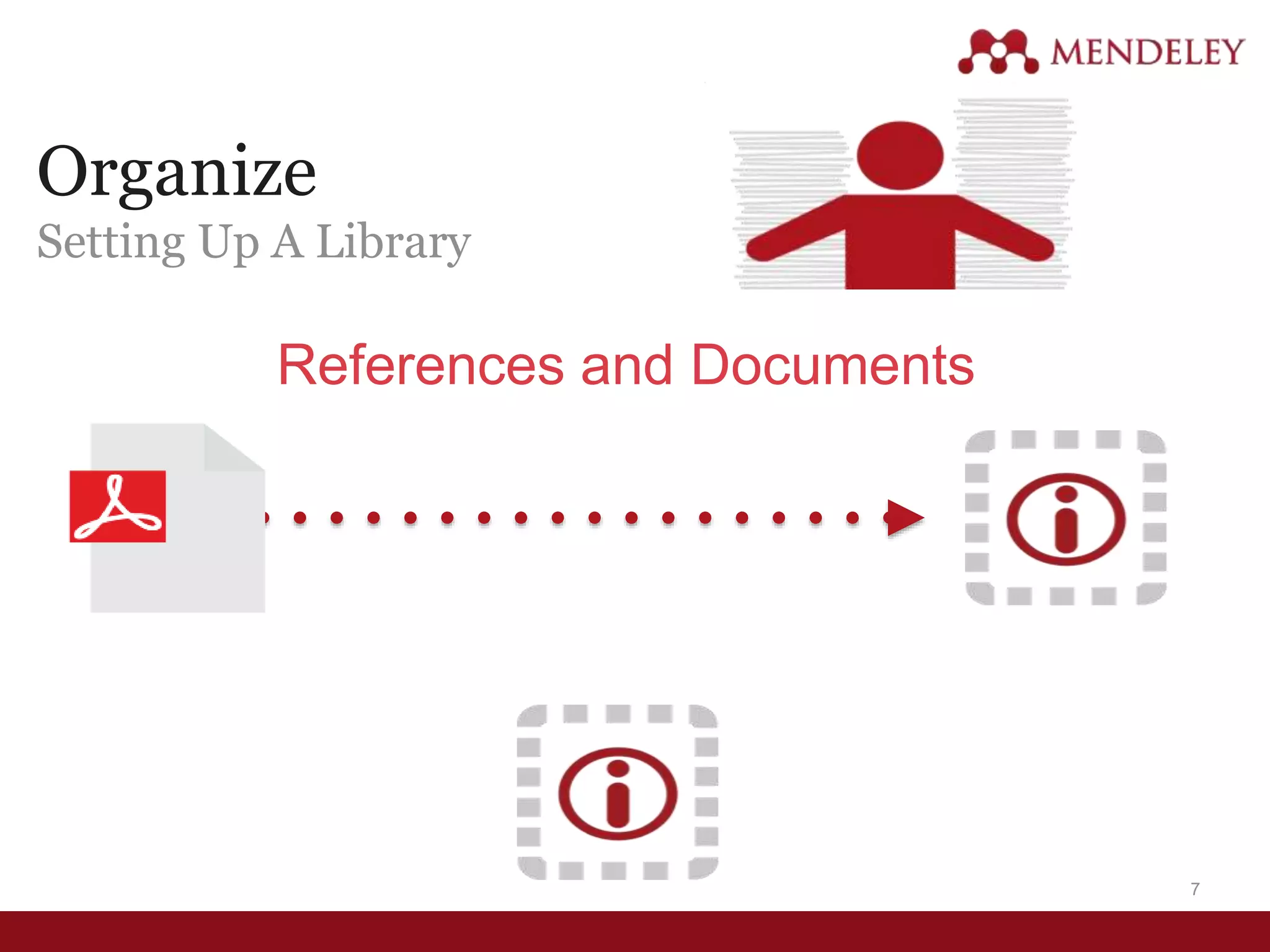
Organize
Setting Up A Library
References and Documents
7
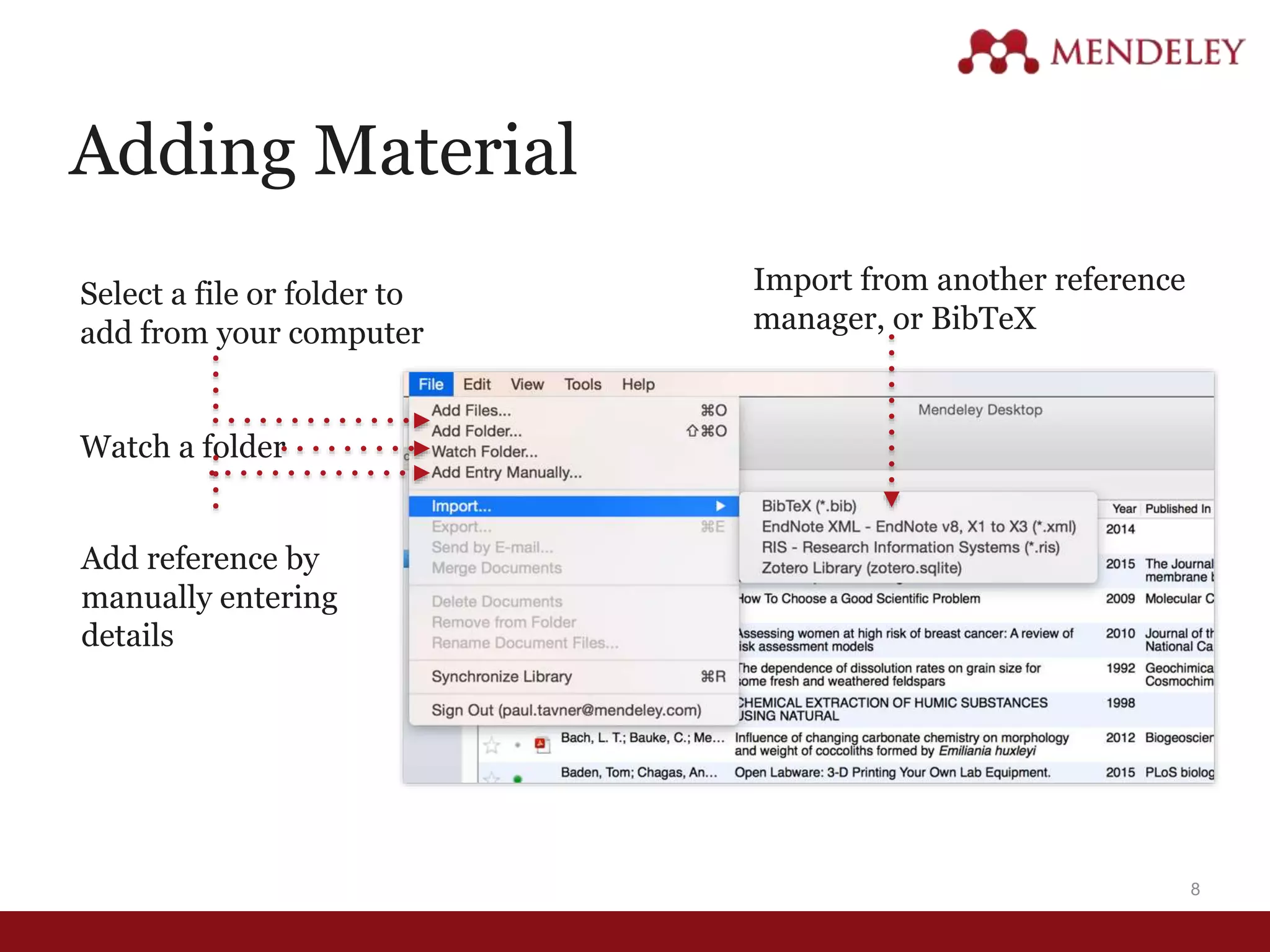
Adding Material
Select a file or folder to
add from your computer
Watch a folder
Add reference by
manually entering
details
Import from another reference
manager, or BibTeX
8
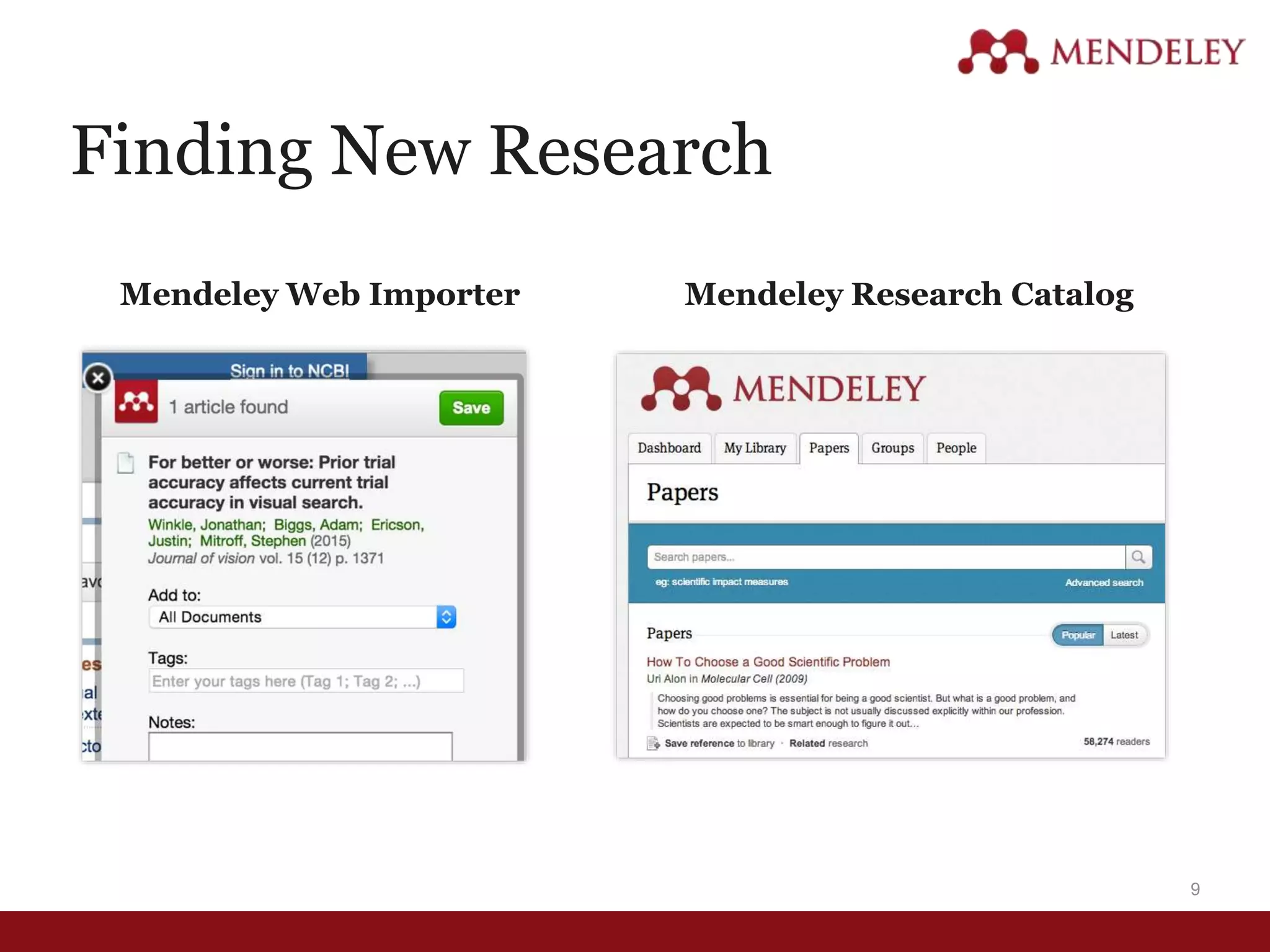
Finding New Research
Mendeley Web Importer Mendeley Research Catalog
9
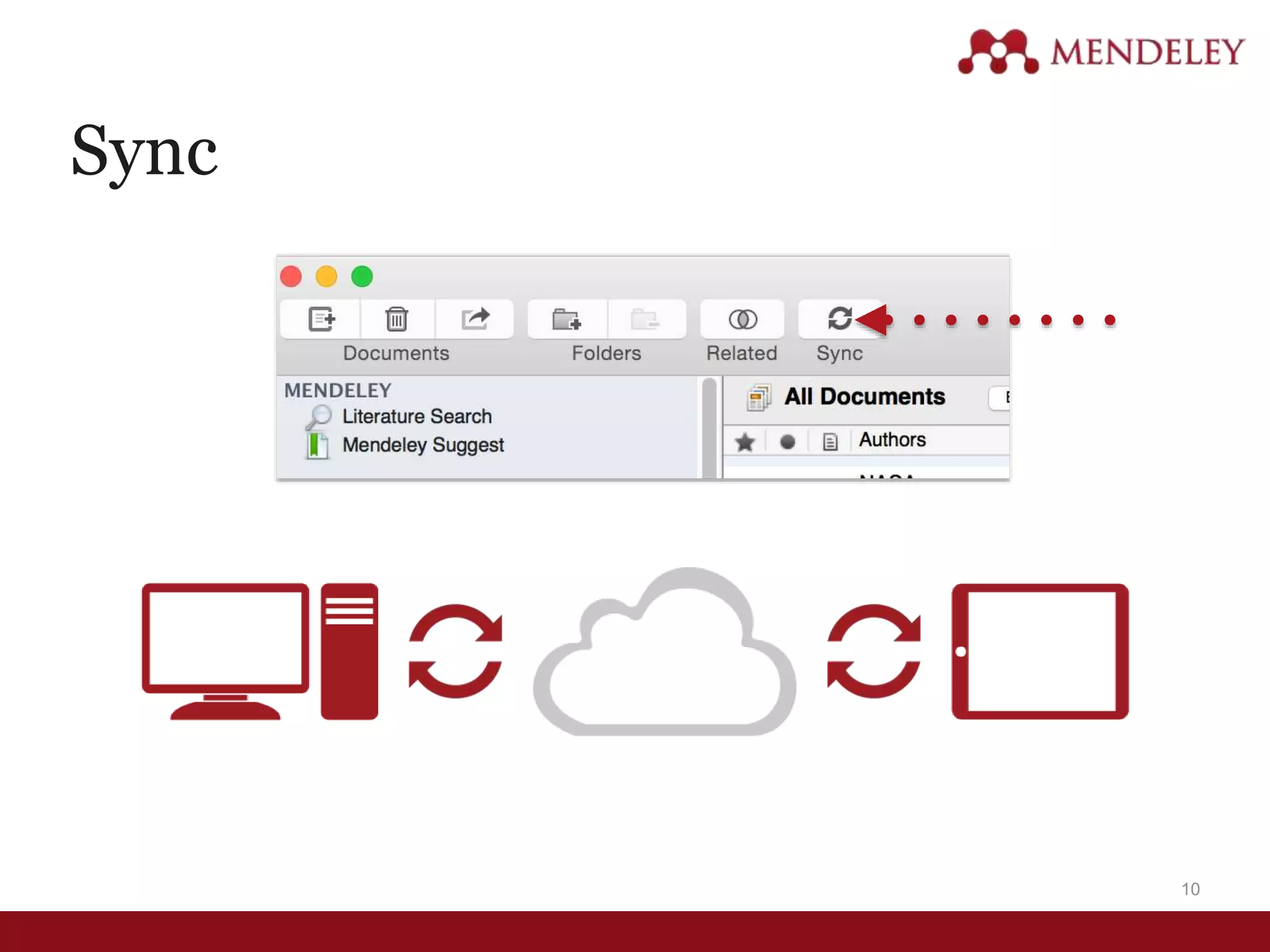
Sync
10
Organize
Managing Your Library
11
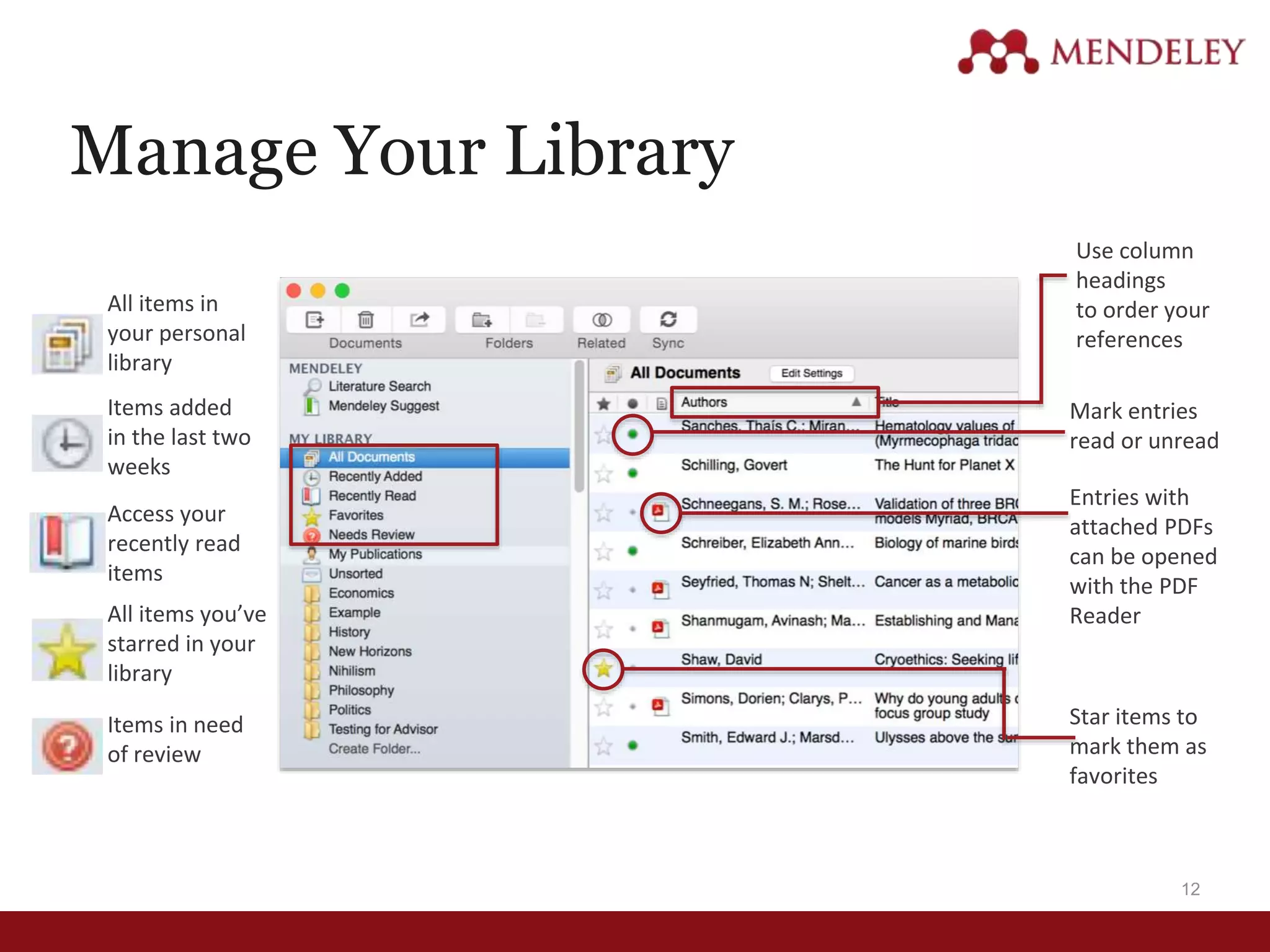
Manage Your Library
Use column
headings
to order your
references
Mark entries
read or unread
Entries with
attached PDFs
can be opened
with the PDF
Reader
Star items to
mark them as
favorites
All items in
your personal
library
Items added
in the last two
weeks
Access your
recently read
items
All items you’ve
starred in your
library
Items in need
of review
12
13
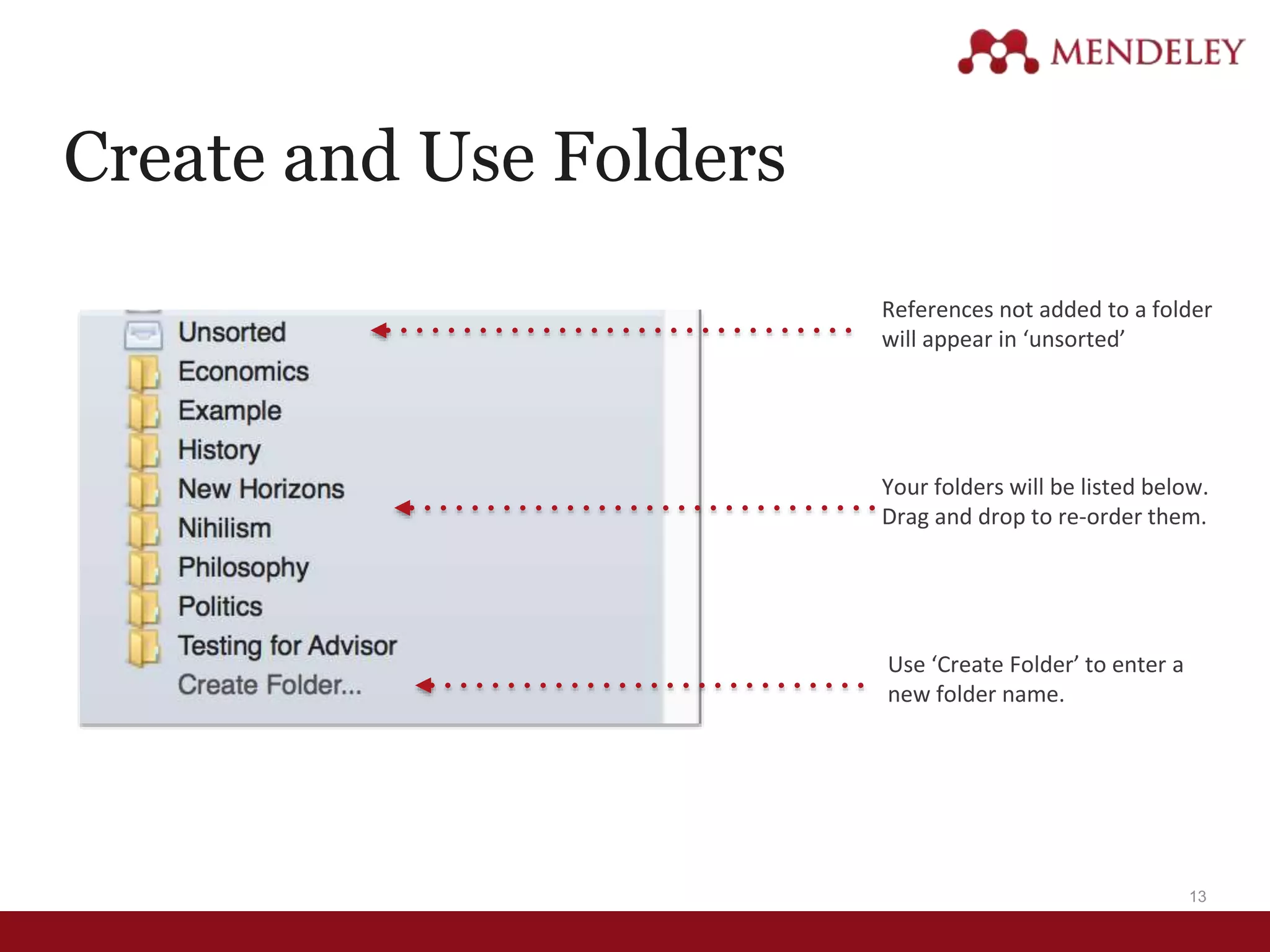
Create and Use Folders
References not added to a folder
will appear in ‘unsorted’
Your folders will be listed below.
Drag and drop to re-order them.
Use ‘Create Folder’ to enter a
new folder name.
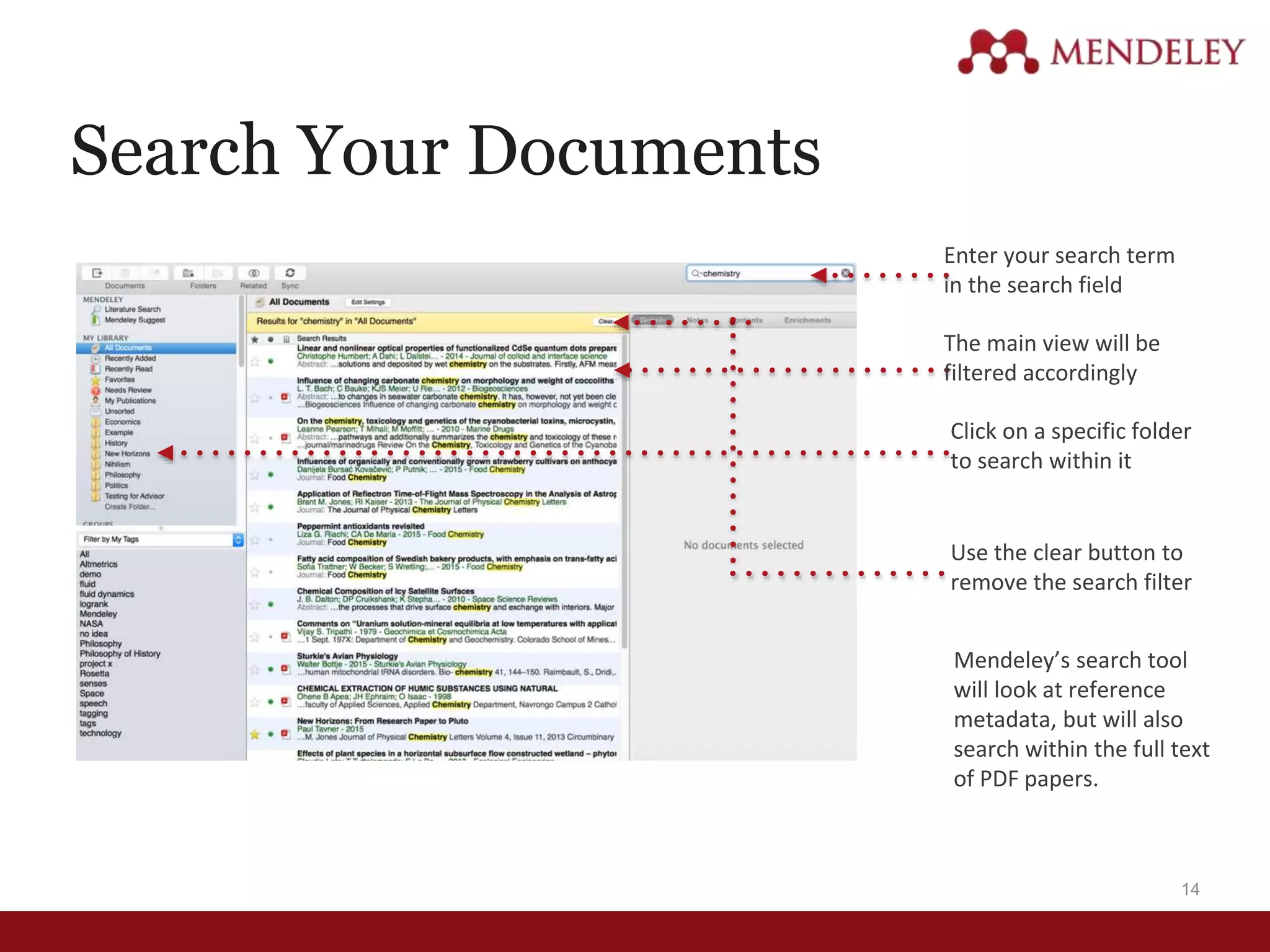
Search Your Documents
Enter your search term
in the search field
The main view will be
filtered accordingly
Click on a specific folder
to search within it
Use the clear button to
remove the search filter
Mendeley’s search tool
will look at reference
metadata, but will also
search within the full text
of PDF papers.
14
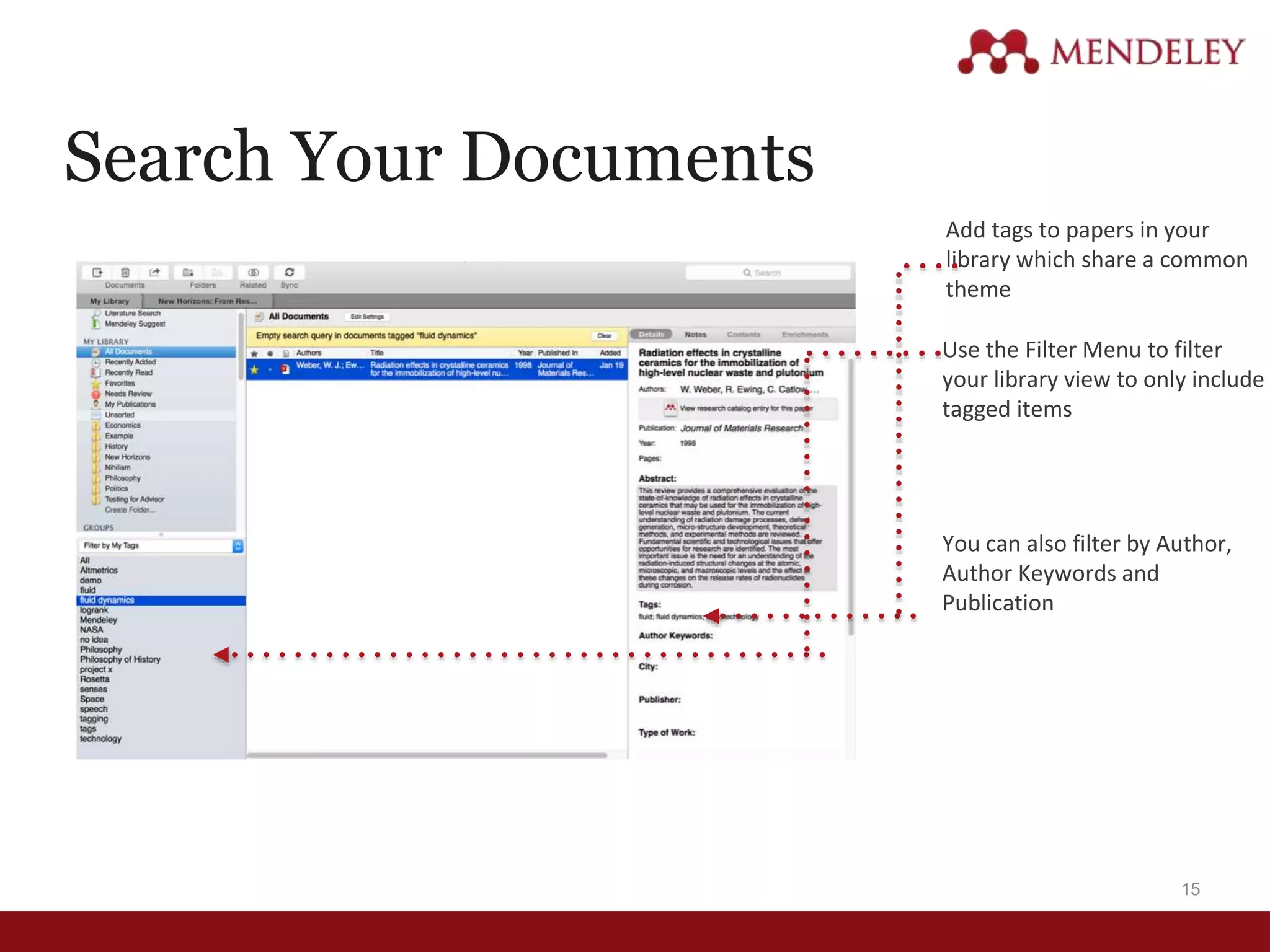
Search Your Documents
Add tags to papers in your
library which share a common
theme
Use the Filter Menu to filter
your library view to only include
tagged items
You can also filter by Author,
Author Keywords and
Publication
15
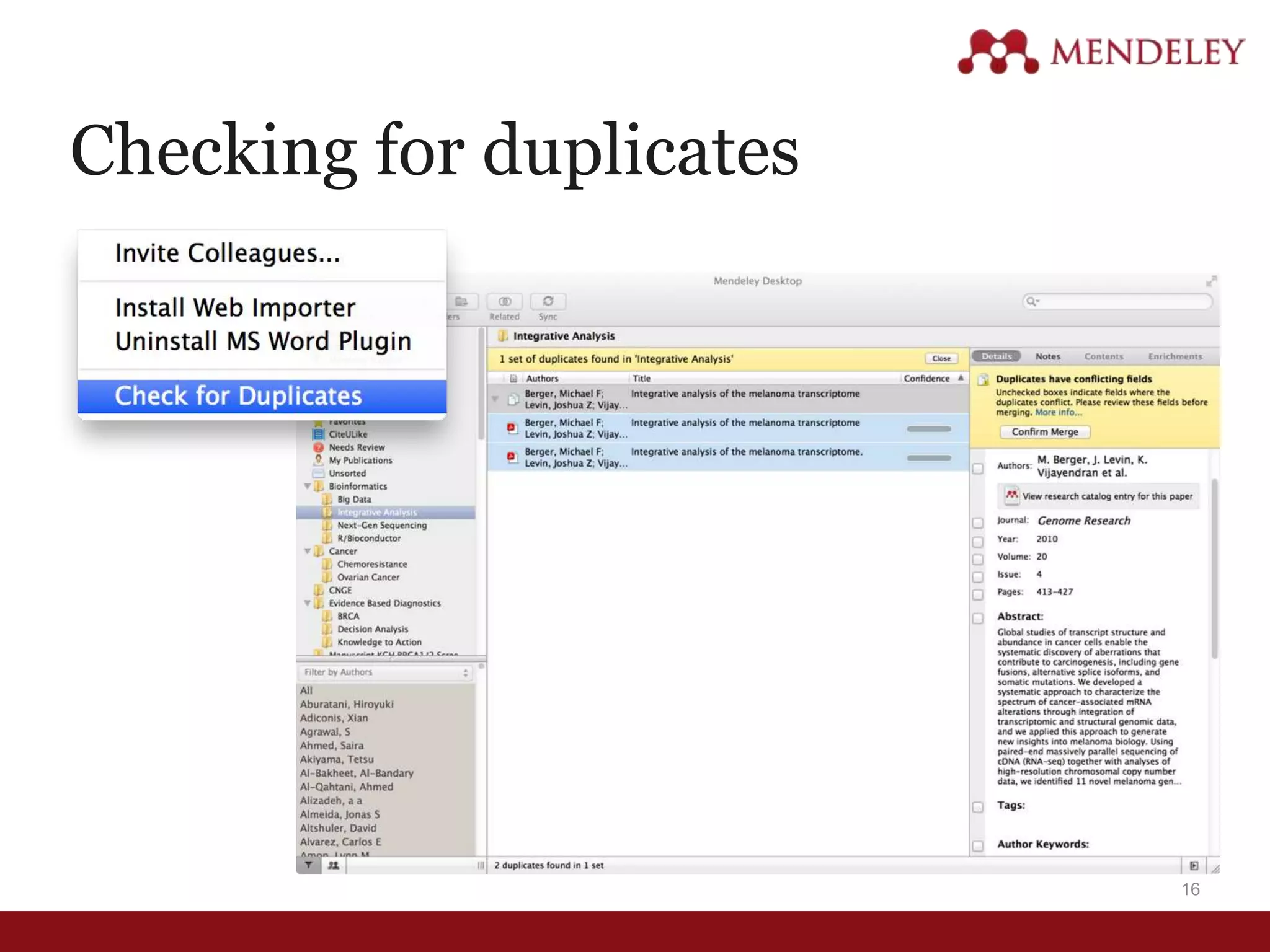
Checking for duplicates
16
Cite
Using the Mendeley Citation Plug-In
17
Install the Citation Plug-in
18
Generate In-Text Citations in Word
19
Merging Citations
20
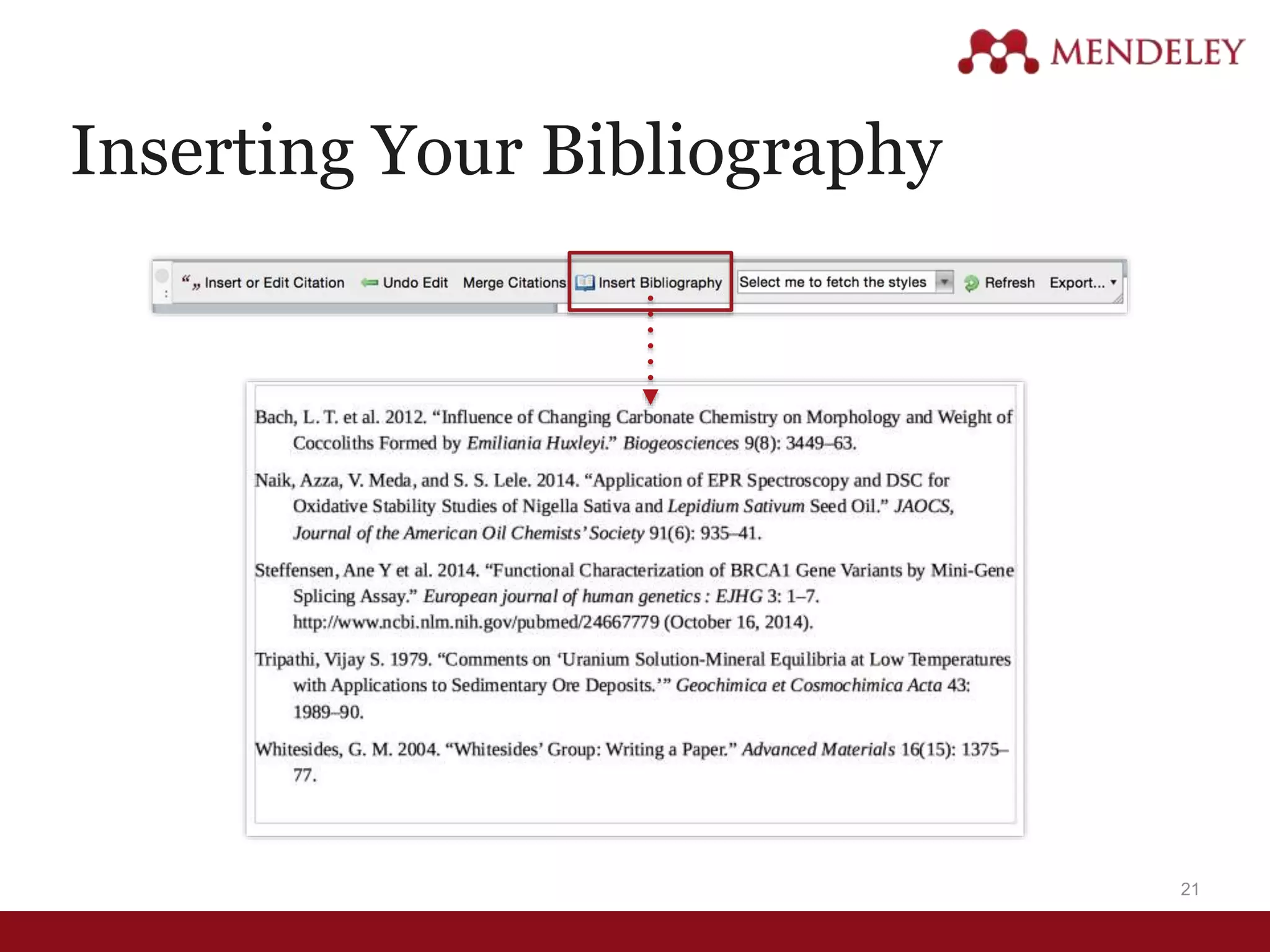
Inserting Your Bibliography
21
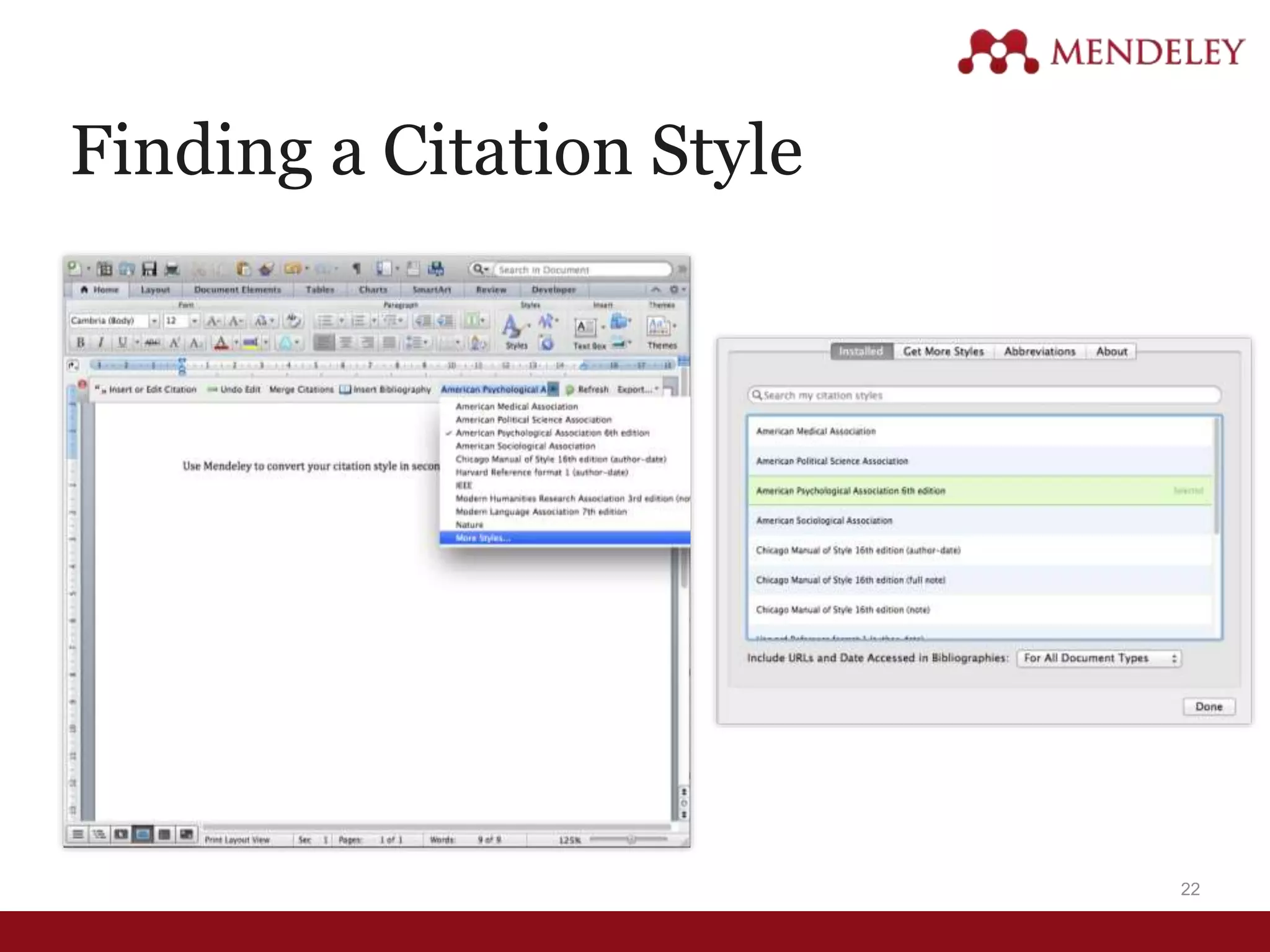
Finding a Citation Style
22
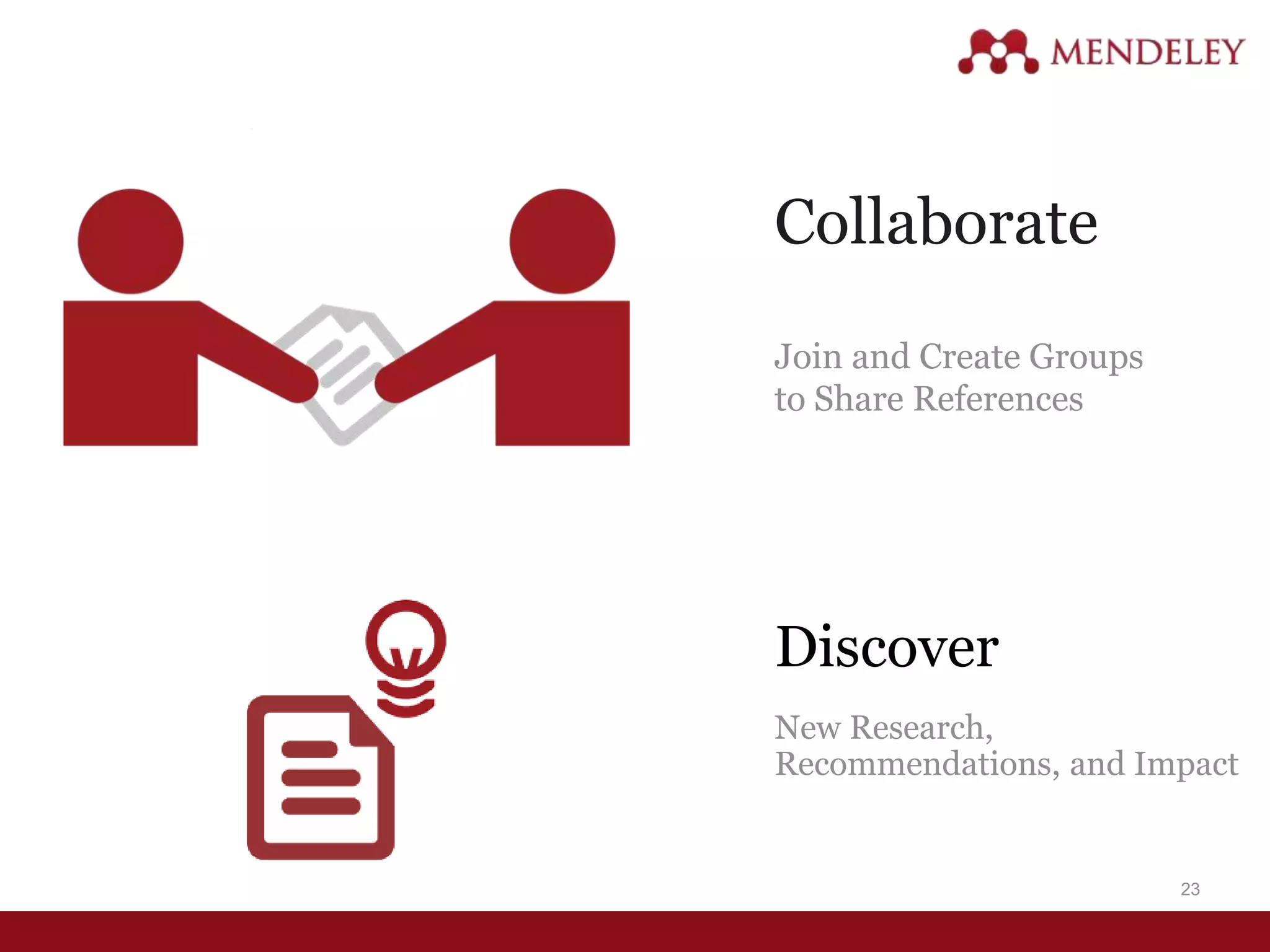
Collaborate
Join and Create Groups
to Share References
Discover
New Research,
Recommendations, and Impact
23
24
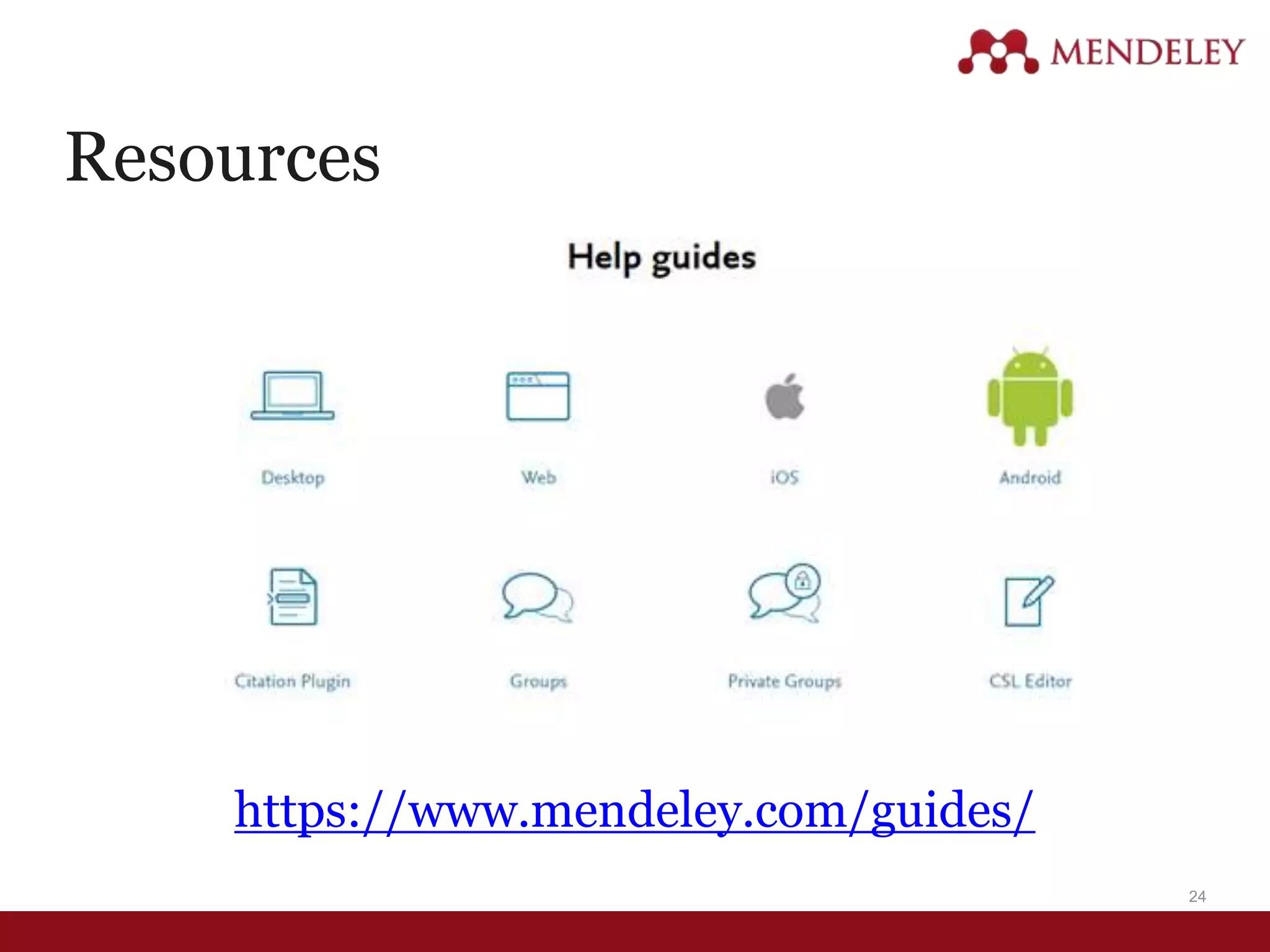
Resources
https://www.mendeley.com/guides/
Organize. Collaborate. Discover. www.mendeley.com
25
Thank You

Basic Introduction to Mendeley Reference Manager

Editor's Notes

  • #2 Hello and welcome to this Mendeley Workshop. My name is [NAME] and I’m [TITLE, i.e. Mendeley Advisor, Head Librarian at U of …, Professor of….]. Today I’m going to give you an introduction to Mendeley, to help you get started. Hopefully you have already downloaded Mendeley and taken a look, but if not, that’s okay too. I’ll walk you through this from the beginning. Mendeley is designed to help you to achieve three main goals: Organizing your references, by allowing you to create a personal library of materials and structuring it as you see fit. It can help you keep track of different papers you’re reading - by adding notes and highlights, and by remembering where you had reached. Collaborating with others. Mendeley allows you to come together with other users to share references and to exchange ideas. You can also use private groups to share full-text papers and to collaboratively annotate. You can use this functionality to work with people you see every day, or use Mendeley’s social features to find people with similar interests from around the world. Discover. In addition to helping you discover new people to work with, Mendeley can also help you to find new research being published in your field - and to recommend new reading based on the contents of your personal library.
  • #3 Mendeley is free software which is available across a number of different platforms. You can run Mendeley on your computer or laptop, your phone or tablet, and also access it from any modern browser. You can either download the appropriate app for your particular device, or use your web browser to log onto the web version. Mendeley’s Desktop application offers the most complete experience - allowing you to organize, collaborate and discover, as well as use the citation plugin to cite as you write in Microsoft. The other versions - Web and Mobile - offer you the ability to access your references on the go, as well as making notes and annotations.
  • #4 Mendeley acts as a repository for your reference information. You add papers to your library by importing PDF files stored on your computer, or by retrieving them from other locations - like online catalogs such as ScienceDirect, Scopus, Pubmed or PLOS. You can also create entries for items that you don’t have access to as PDFs by manually entering details. Materials you add to your library are then stored in the cloud, for you to retrieve wherever you need them. It might be that you want to read a paper on the way home on the train, or you need to write a paper on your main computer. Mendeley allows you to retrieve the same resources with the same enhancements and annotations wherever you need them.
  • #5 Reference manager *Mendeley is often the reference manager of choice for researchers. *About 4 million researchers have downloaded the ‘free’ Mendeley on their own and use it to support their studies as well as co-author papers with other researchers. Often, these researchers have tried other tools (such as RefWorks, EndNote) that are purchased by the institutions and discovered that Mendeley’s user interface is more intuitive, its mobile ability supports the on-the-go lifestyle, and its ability to automatically extra metadata from PDFs greatly saves time and minimizes errors. *close to 60 major research institutions have decided to offer Mendeley institutionally for their researchers. Research Network and Groups *form small groups and fully share private research work with collaborators and supports joint writing process *join or form larger research interest groups to share knowledge and identify world-wide trends from the global network *form groups to support material sharing and distribution in classroom or a research lab Research Data and API *able to see more detailed readership insights from your researchers on their published work – gives you additional information on research impact. *detail key journals/ articles being actively ‘used’ by your researchers *’centralized’ view of all research output as self-submitted by researchers. Not just published work. *Extensive and flexible APIs allow further data extraction for the institution as well as extraction to build additional application
  • #6 The first thing you’ll need to do is to create an account via mendeley.com. This is completely free to do and only takes a few seconds. You’ll need a Mendeley account to log into the different versions of the software. Once you’ve created your account you’ll be prompted to download the appropriate version of Mendeley Desktop for your current machine. You don’t have to do this right away, but it’s a good idea to have the desktop application installed on your main working computer.
  • #7 So how do you use Mendeley? Mendeley is free academic software that is available on all major platforms and in all popular browsers. That means you can use Mendeley on your MacBook, on your PC, or in Linux. Mendeley offers you a desktop library so you can work online, a web library for when you’re not at your own computer, and an iOS/Android version, so you can work on the go. Mendeley Desktop This is how Mendeley Desktop looks on a Mac. The Windows version may have a few cosmetic differences, but the functionality is exactly the same. This presentation uses Mac screenshots throughout - but don’t let that put you off if you use a Windows PC. Mendeley Desktop offers the complete Mendeley experience. It allows you to build, maintain and order your personal library. It also allows you to access reading and writing functions. When you first open Mendeley Desktop, you’ll need to log into your Mendeley account. This ensures that any changes you make are being made to your own account and will be carried across when you log into different devices. Mendeley Desktop follows a three column structure. The left-hand panel allows you to navigate through different filtering options for your library. When you click on different folders or groups listed in this column, different lists of papers will be returned in the main panel. In this screenshot we have ‘All Documents’ selected, which means the main panel is listing all of our references. The middle panel allows you to select individual references. Clicking on a reference listed here will display this document’s details in the right-hand panel. You can also select multiple papers to undertake bulk actions, such as mass deletions or additions to folders. The right panel shows the details of your selected reference. You can also use this panel to modify the details by clicking into the individual fields. You should carefully check and correct the details displayed in this panel as ensuring accuracy here will ensure that your citations are totally correct. Mendeley Web is the version of Mendeley accessible via your web browser. You’ll need to be logged into your Mendeley account in order to access it. The layout is similar to what we’ve just seen for Mendeley Desktop - although it has been optimized for use in a browser. The same three-column structure persists.
  • #8 How can Mendeley help you to bring organization to your references?. There is a distinction between references and documents. In this context when we say ‘document’ we’re referring to an actual file - usually a PDF version of a research paper. A document will contain lots of information - many papers are many pages in length and contain thousands of words. They also contain the details necessary to ‘reference’ the paper. Usually this is just key information about the paper, such as the author name(s), title, publisher and so on. Mendeley deals in both documents and references. It will take a document - in the form of a PDF paper - and attempt to extract the reference information in order to produce a reference. It does this by looking at the contents of the paper, or by examining the ‘metadata’ - or detailed information which publishers include in files when creating them. You can then check and modify this reference data to ensure that Mendeley has produced the correct details. Ensuring you have correct reference details is very important. It’s also important to realise that you can have a reference without providing a document. If you know the details of a publication (such as the author, title etc.) you can still add it to your library and cite it - even if you don’t have access to a PDF version. This can be useful if you’re citing a book that you use in hard copy, for example.
  • #9 Mendeley also offers a number of other options for adding material to your library. You can find these by opening the File menu. You can choose to add individual files, or the contents of an entire folder by browsing to the relevant location on your computer. You can opt to ‘watch’ a folder - which will mean that Mendeley monitors that location for any new items being dropped into the folder. If it finds a new document, that document will be automatically added to your Mendeley library. You can also easily import a library from other reference managers, so if you’ve tried out EndNote, Reworks or another solution and found them not to your liking, you can carry across your library to Mendeley easily. You also have the option to create a reference manually - which will allow you to complete a number of fields by hand.
  • #10 Mendeley makes it easy for you to continue building your library. The Web Importer is a bookmarklet that you can add to your web browser. When you click on this item in your browser’s favorites, the Web Importer will attempt to detect references on the page you’re viewing and ask if you want to add them to your library. You can also use it to add web pages to your library. I’ll show you the Web Importer in more detail shortly. Mendeley also operates a Research Catalog - the largest crowd-sourced collections of Papers available online. You can search the online catalog to identify references you want in your library, and add them with just a few clicks. Certain online catalogs, such as ScienceDirect - pictured here - allow you to export references directly to Mendeley. Look out for the Export button on pages like this. Other catalogs will allow you to export in file formats such as RIS, which can then be added to Mendeley using the File menu.
  • #11 Syncing is a core concept in Mendeley. Whenever you make changes in Mendeley, you’ll need to sync in order to push those changes up into cloud storage. Syncing will also pull down any changes made on other devices. It’s a good idea to sync regularly to ensure that your documents and annotations are saved in the cloud. You can sync at any time by using the sync button. Mendeley will also sync automatically each time you open it.
  • #12 How can you can order and structure your library?
  • #13 Mendeley Desktop’s interface should be fairly intuitive if you’re familiar with programs like iTunes, or even Gmail. The left-hand panel offers a number of different options to help filter your document list to exactly what you need to find. The default position when opening Mendeley Desktop is ‘All Documents,’ which will list all items in your library. You can use the column headings (such as Author Names, Year, etc.) to order your documents by that value - this can be useful for finding works by a specific author, for example. When you add materials to your library, they will initially be marked as unread - indicated by a large green dot in the second column. You can toggle this off and on by clicking it. Alternatively, a document will be marked as read once you’ve spent a certain amount of time reading it in the Mendeley PDF reader. You can ‘star’ documents to mark them as favorites. They can then be easily retrieved via the left-hand panel. You can also use the left-hand panel to access items you’ve recently added, or items you’ve recently read.
  • #14 Folders allow you to quickly file your references under different topic headings. You can drag and drop references from your library onto the folder name in the left panel to add that reference to a folder. You can also create folders within existing folders.
  • #15 Mendeley offers a powerful search tool to help you to locate items in your library. Just enter your search term in the field which appears in the top right corner and Mendeley will filter your current view to show references which contain that term. It will also search within the full text of PDF papers which appear in your library. The search is context specific, so if you’re not getting the results you expect make sure that you have the appropriate folder selected in the left-hand panel. If in doubt, select ‘All Documents’. Use the ‘clear’ button which appears on the yellow toolbar to remove the search filter.
  • #16 You can also use tags to help locate a reference or references within your library. You can add multiple tags to your references using the document detail panel when you have the reference selected. Then use the Filter by My Tags menu which appears in the bottom left corner to quickly pull up materials that you’ve tagged. The list of available tags will only display tags used in your current folder view - so, again, make sure you are viewing the appropriate folder or All Documents before attempting to filter.
  • #17 You may find that after collecting a library of references that you have accumulated some duplicate entries - where two copies of the same reference have been added to your library. Mendeley can clean these up for you. Use ‘Check for Duplicates’ - found in the Tools menu. Mendeley will identify any duplicate entries and offer to merge these into a single, combined entry. You will be prompted to check over the details of the combined version before the merger is completed - allowing you to take details from each of the entries you’re merging.
  • #18 One of the most popular features of Mendeley is its ability to improve the citing process. Mendeley makes it a lot easier to insert properly formatted citations throughout a paper you’re writing - and will automatically generate a bibliography for you. It also allows you to restyle your manuscript’s citations with just a few clicks - making it ideal for resubmissions to different journals or publishers.
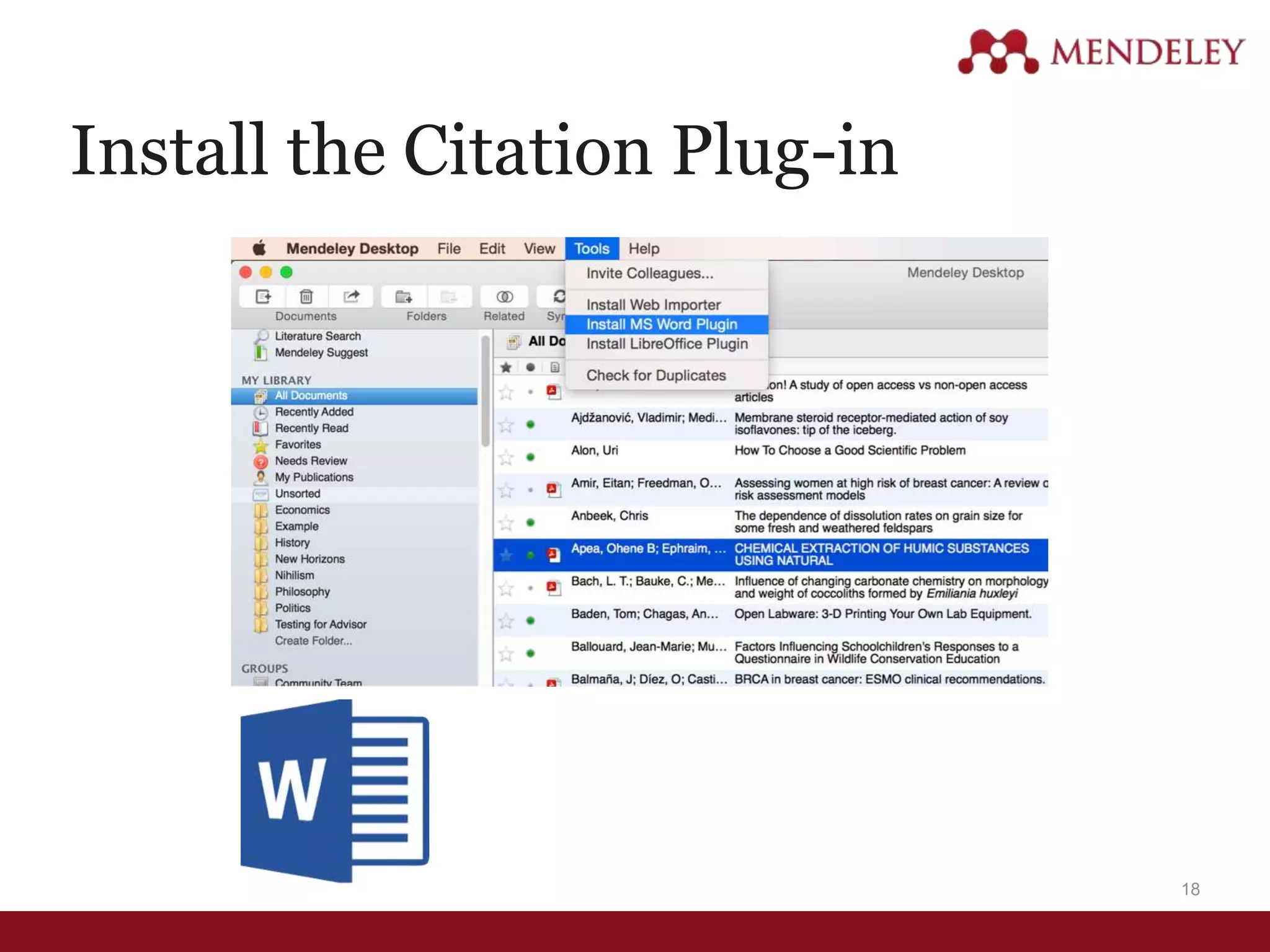
  • #19 You’ll first need to install the citation plugin. This can be done via the Tools menu within Mendeley Desktop. The citation plugin supports Microsoft Word. You will see the prompt to install the MS Word plugin. Once installed, the citation plugin will appear within your word processor. Its appearance will vary slightly depending on your operating system, but you will see the same buttons and options in both.
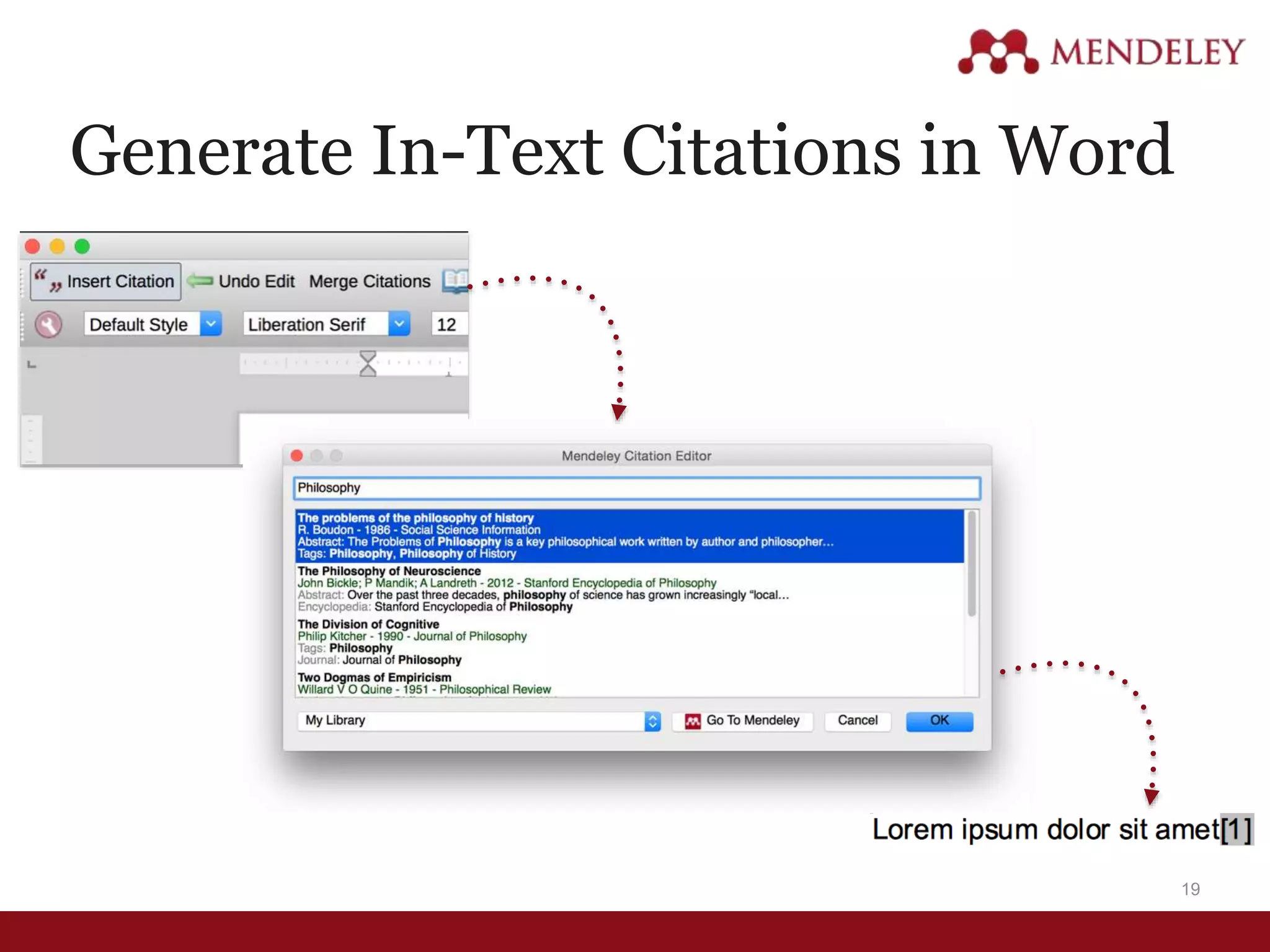
  • #20 Inserting a citation is achieved by first positioning your cursor in the appropriate location and pressing the ‘Insert Citation’ button which appears on the Mendeley toolbar. You also need to be running Mendeley Desktop, and will be prompted to start it if it is not currently running. Pressing the button will open the Mendeley search tool. This box allows you to enter a term - such as an author name - before returning search results from your library. Locate the reference you want to cite, click to select it and press the Ok button. You will see that the citation is added. Its appearance will vary depending on which citation style you currently have active. If you’re looking for a particular citation and can’t remember its details you can also opt to switch to Mendeley desktop to locate it - using search or filtering by tags, for example. Just press the ‘Go to Mendeley’ button to switch over to that interface. Once you’ve located the appropriate reference, click to highlight it and press the ‘Cite’ button which temporarily appears on the Mendeley Desktop toolbar. If you want to cancel the citing process and return to your manuscript press the cancel button. Note that your manuscript is considered locked while this process is active. You need to cancel the citation to return to the document, or insert a citation before you can switch back to your word processor.
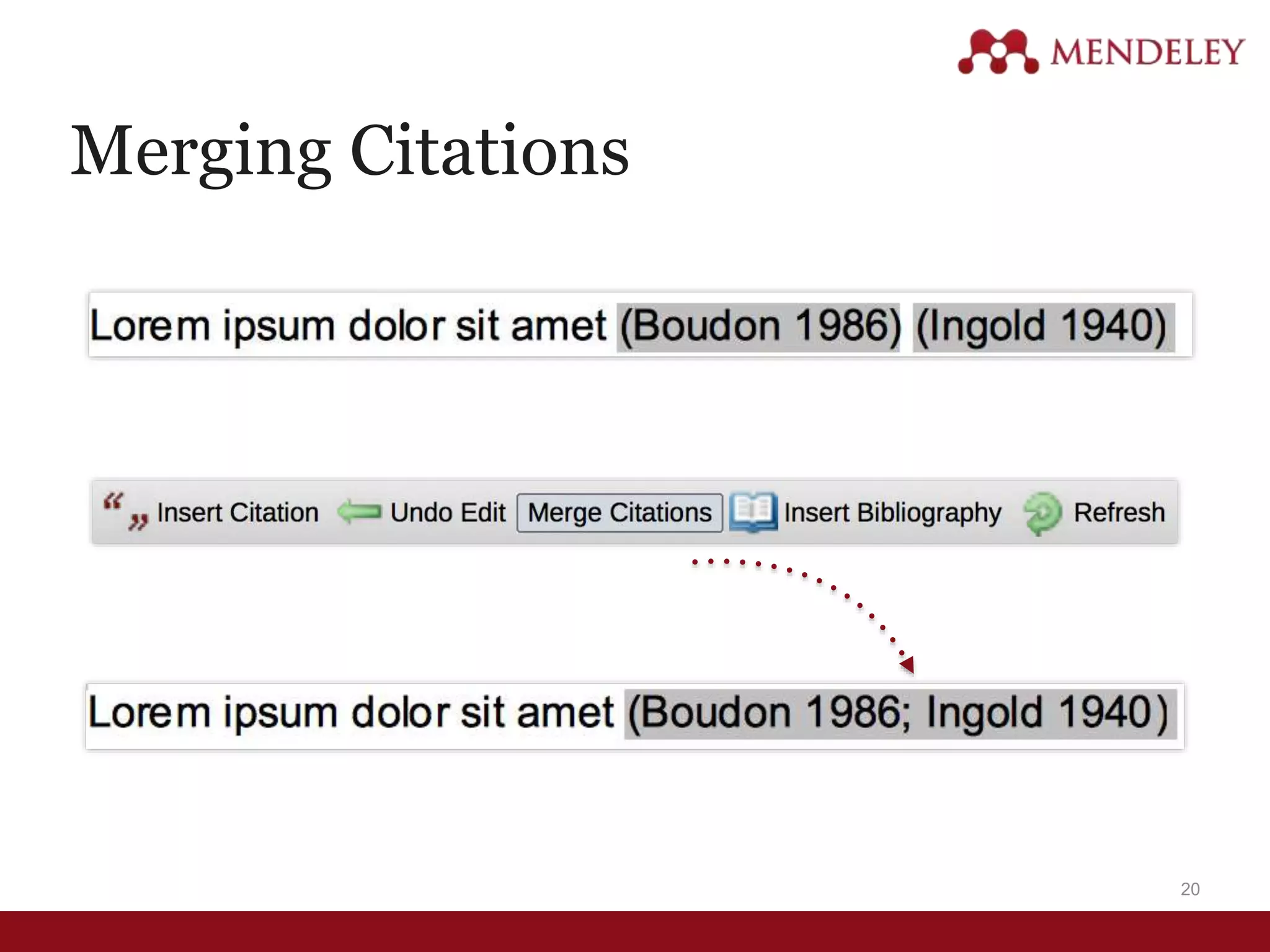
  • #21 Many publishers require adjacent citations to be combined into a single, properly-styled format. Mendeley can handle this for you. Just insert two separate citations, highlight them both in the word processor and press ‘Merge Citations’ to combine them.
  • #22 Once you have added all your citations you’ll need to generate a bibliography. Ensure your cursor is positioned where you want your bibliography to appear and press the ‘Insert Bibliography’ button - it just takes one click! Mendeley will now look through your manuscript, pick out all the citations you’ve added and order them into a list. The exact ordering and appearance of your bibliography will depend on the citation style.
  • #23 Citation Styles are sets of styling instructions which control how your citations and bibliography appear. Different publishers and institutions require different formatting for citations when you wish to submit a paper. Using Mendeley, you can choose the appropriate citation style for your manuscript - and also switch between different styles with just a few clicks. Mendeley will restyle all the citations in your manuscript automatically. To change citation styles, open the styles dropdown menu which appears on the Mendeley toolbar. If you don’t see the style you need, you can click ‘More Styles’ to be taken to the Styles tool within Mendeley Desktop. This will also allow you to download and install new styles in seconds. Mendeley allows you to use over 1,600 different citation styles - but comes pre-installed with some of the most commonly used, such as APA, Harvard and IEEE. If you still can’t find the right style or you’d like to customize an existing style, you may want to try the Mendeley CSL Editor, which allows you to customize citation styles. Saved styles are added to the Mendeley database, and will appear in your drop-down menu in Word. You can also share created styles with other Mendeley users. The editor can be found at http://csl.mendeley.com
  • #24 Collaborate: Create groups within Mendeley to share reference materials and work together with others. Discover: Mendeley analyzes users’ activity to recommend new reading materials and to suggest potential contacts. More details is available about these on the Mendeley Website.
  • #25 Mendeley’s Resource Center has detailed guides to each of the different versions, as well as feature guides that cover specific components. It’s a good idea to use these guides to familiarize yourself with the different aspects of Mendeley. There are also a number of video guides available.