ECG INTERPRETATION:
the
basics
Mohammed ayed
Critical Care Education
Staff Development Unit
Overview
•
Conduction Pathways
•
Systematic Interpretation
•
Common abnormalities in Critical Care
–
Supraventricular arrhythmias
–
Ventricular arrhythmias
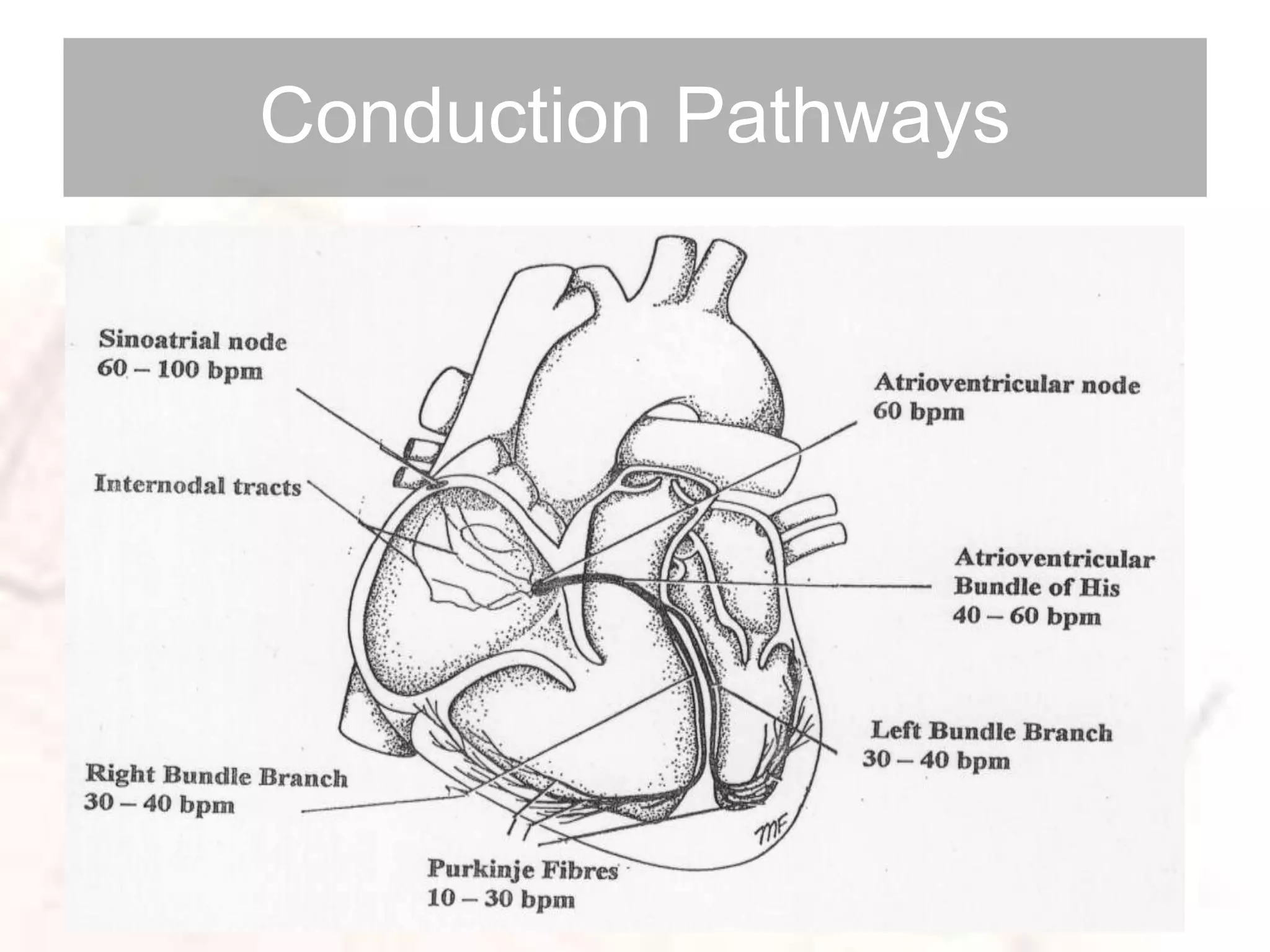
Conduction Pathways
ECG INTERPRETATION:
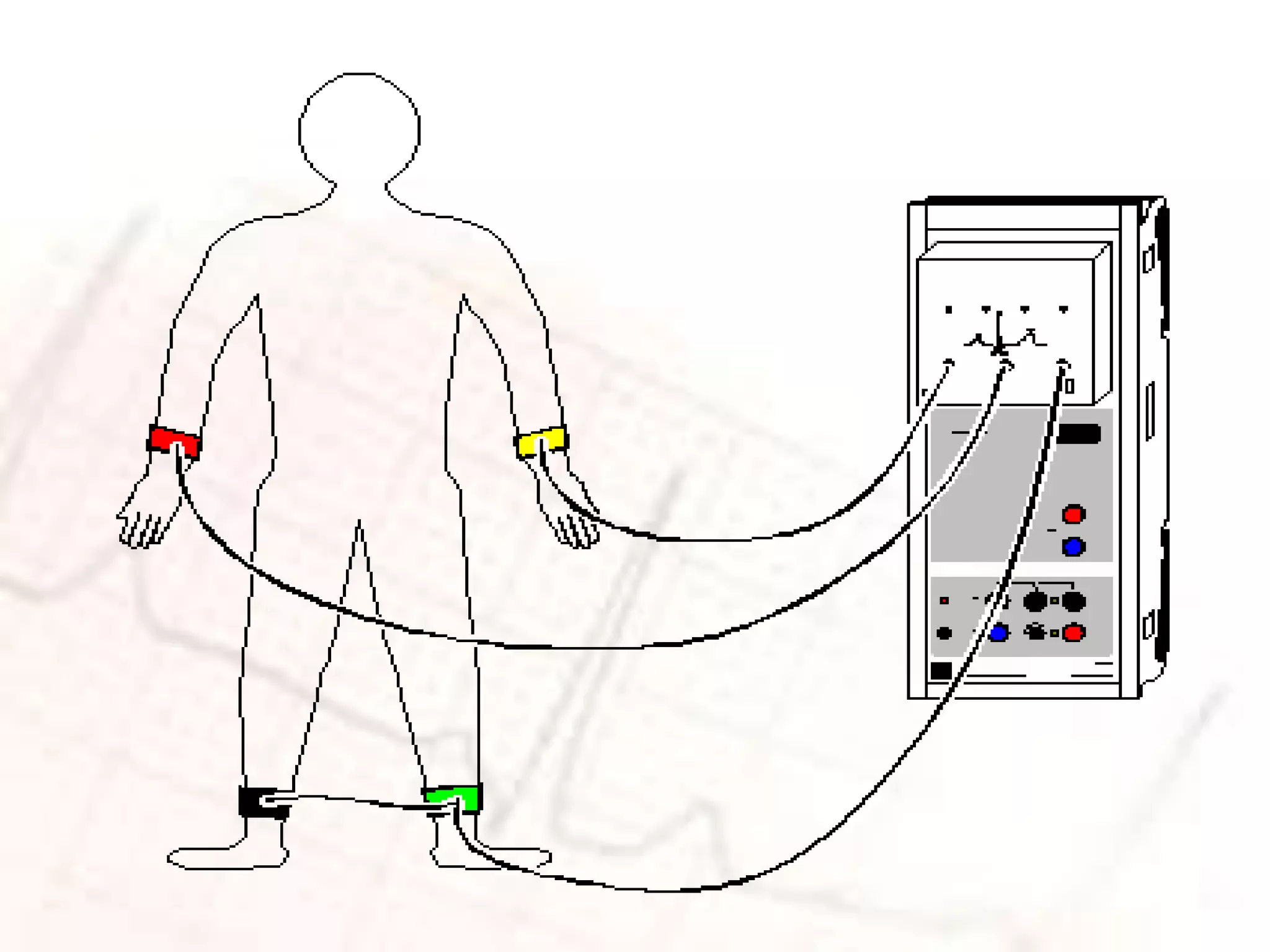
12 Lead
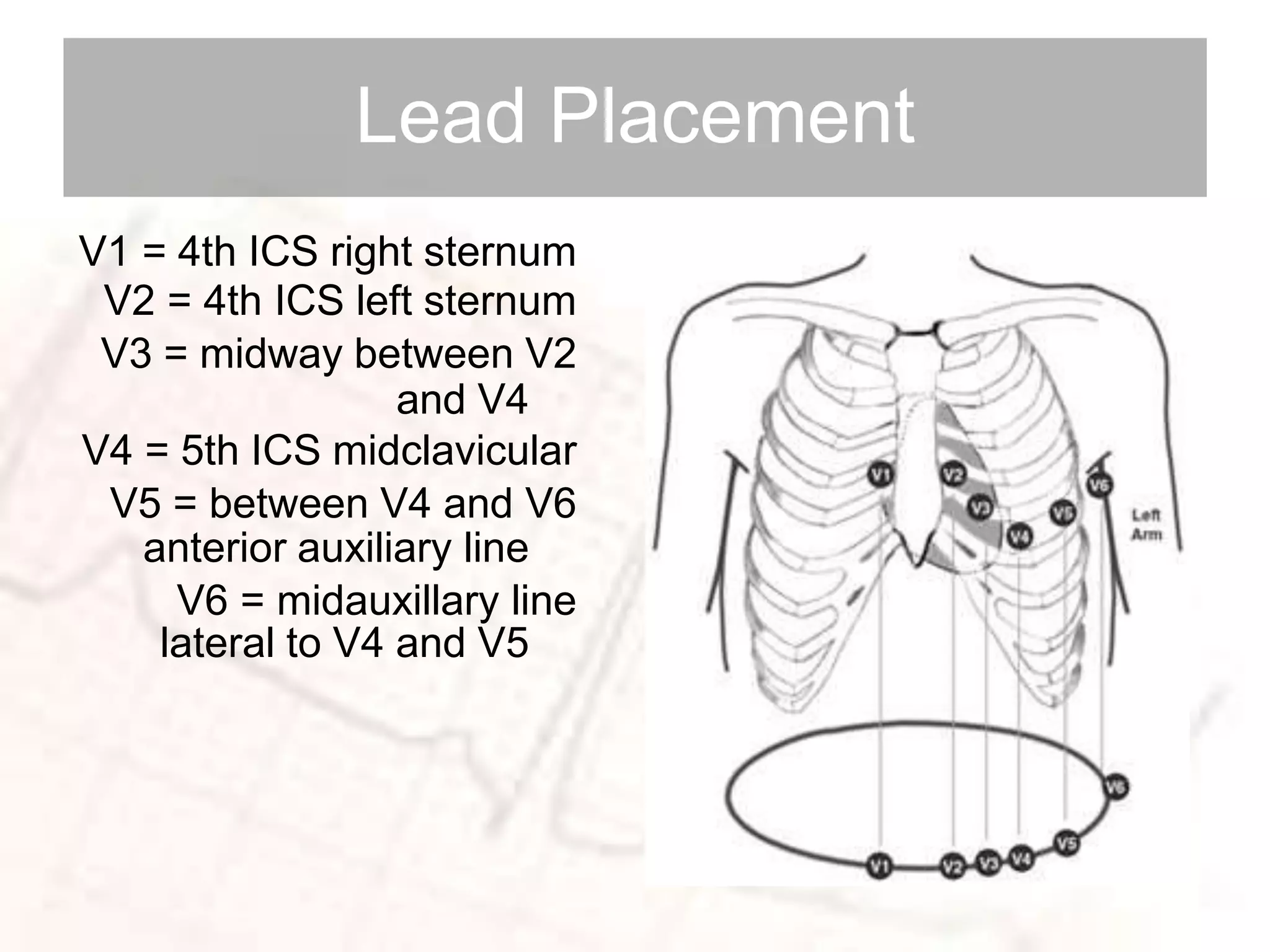
Lead Placement
V1 = 4th ICS right sternum
V2 = 4th ICS left sternum
V3 = midway between V2
and V4
V4 = 5th ICS midclavicular
V5 = between V4 and V6
anterior auxiliary line
V6 = midauxillary line
lateral to V4 and V5
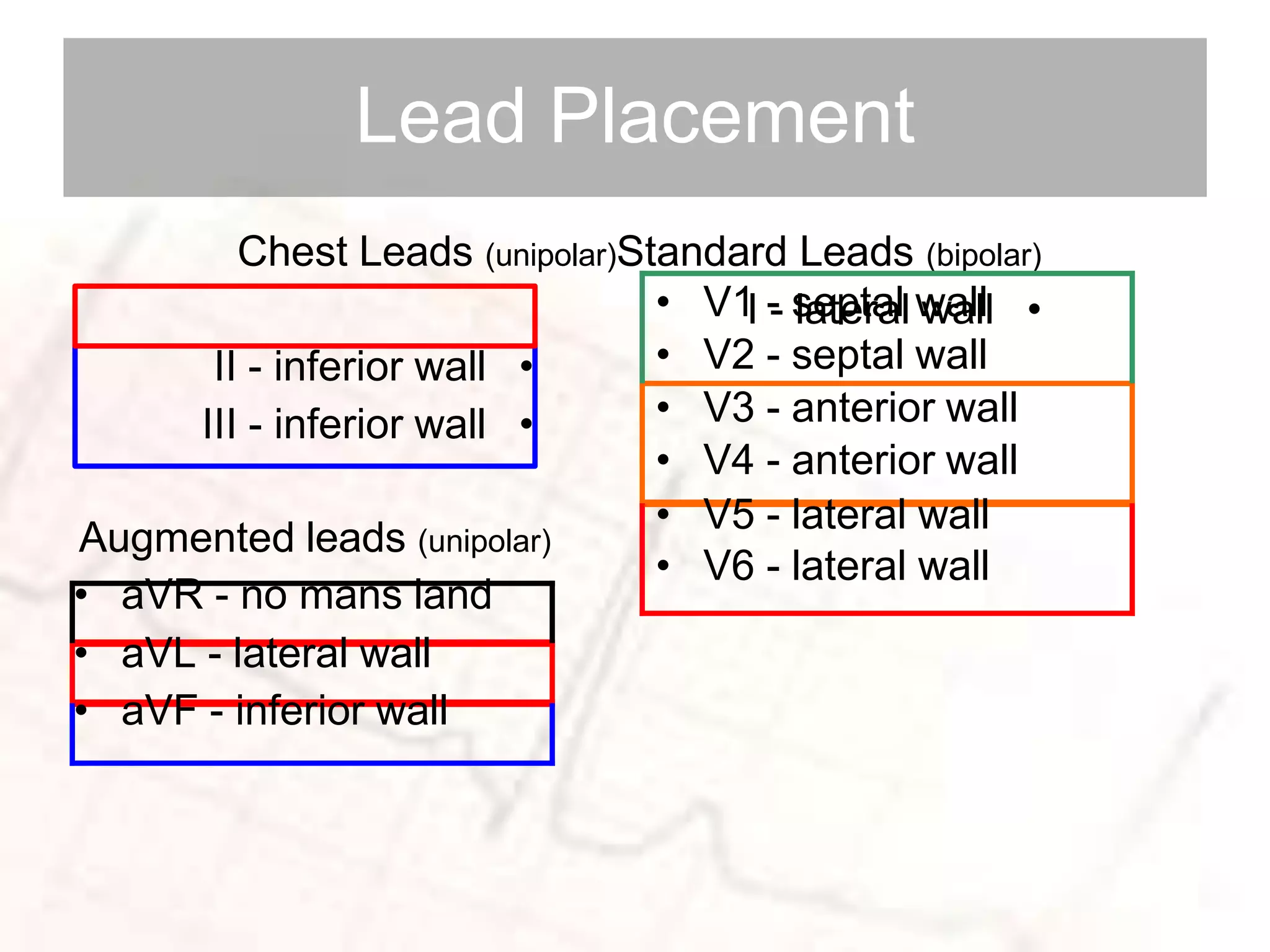
Lead Placement
•
II - inferior wall
•
III - inferior wall
Augmented leads (unipolar)
• aVR - no mans land
• aVL - lateral wall
• aVF - inferior wall
Standard Leads (bipolar)
Chest Leads (unipolar)
•
I - lateral wall
• V1 - septal wall
• V2 - septal wall
• V3 - anterior wall
• V4 - anterior wall
• V5 - lateral wall
• V6 - lateral wall
Lead Placement
No-mans land, inferior, lateral, anterior, septal,
P wave =
atrial depolarisation.
PR Interval =
impulse from atria
to ventricles.
QRS complex = ventricular
depolarisation.
ST segment = isoelectric - part
of repolarisation.
T wave = usually same direction
as QRS - ventricular
repolarisation.
QT Interval = This interval
spans the onset of
depolarisation to the
completion of repolarization
of the ventricles.
Conduction Pathways
Interpretation
VOLTAGE AND TIME CALIBRATION OF THE
ELECTROCARDIOGRAM
•
Rhythm = Regular or irregular. Map P-P and R-R
intervals
.
•
Rate = Number of P
’
s (atrial) R
’
s (ventricular)
per minute
)
6
second [
30
squares] X
10
=
(etar etunim
.
P rate:
8
x
10
=
80
R rate:
8
x
10
=
80
Interpretation
3. P wave =
present, 1 per QRS, shape, duration, voltage.
4. P-R interval = length (0.12 - 0.2 sec = <1 big square), isoelectric.
Interpretation
5. QRS = duration (0.06 - 0.10 ), voltage, q or Q waves
6. ST Segment =
shape, isoelectric with PR segment
Interpretation
7. T wave = shape, direction
8. QT interval = length (R-R/2 or QTc <0.40 sec)
Interpretation
MAJOR CARDIAC
ARRHYTHMIAS
SINUS RHYTHMS ATRIAL
RHYTHMS
VETRICULAR
RHYTHMS
ATRIO-
VENTRICULAR
(AV) RHYTHMS
SINUS BRADY PREMATURE
ATRIAL
CONTRACTION
(PAC)
PREMATURE
VENTRICULAR
CONTRACTION
(PVC)
1ST DEGREEAV
BLOCK
SINUS
TACHICARDIA
ATRIAL
FLUTTER
VENTRICULAR
TACHICARDIA
2ND DEGREE AV
BLOCK TYPE I
SINUS
ARRYTHMIA
ATRIAL
FIBRILATION
VENTRICULAR
FIBRILATION
2ND DEGREE AV
BLOCK TYPE II
SINUS ARREST ASYSTOLE 3RD DEGREE AV
BLOCK
SINUS
RHYTHMS
CHARACTERISTICS
-less than 60bpm
-regular PP and RR
-PR 0.12-.20
QRS0.10
WHAT TO DO?
-watch the patient for s/s of bradycardia
-If symptomatic; iv access, o2, transcuteneus pacing
MEDICATION
Atropine 0.5mg ivp
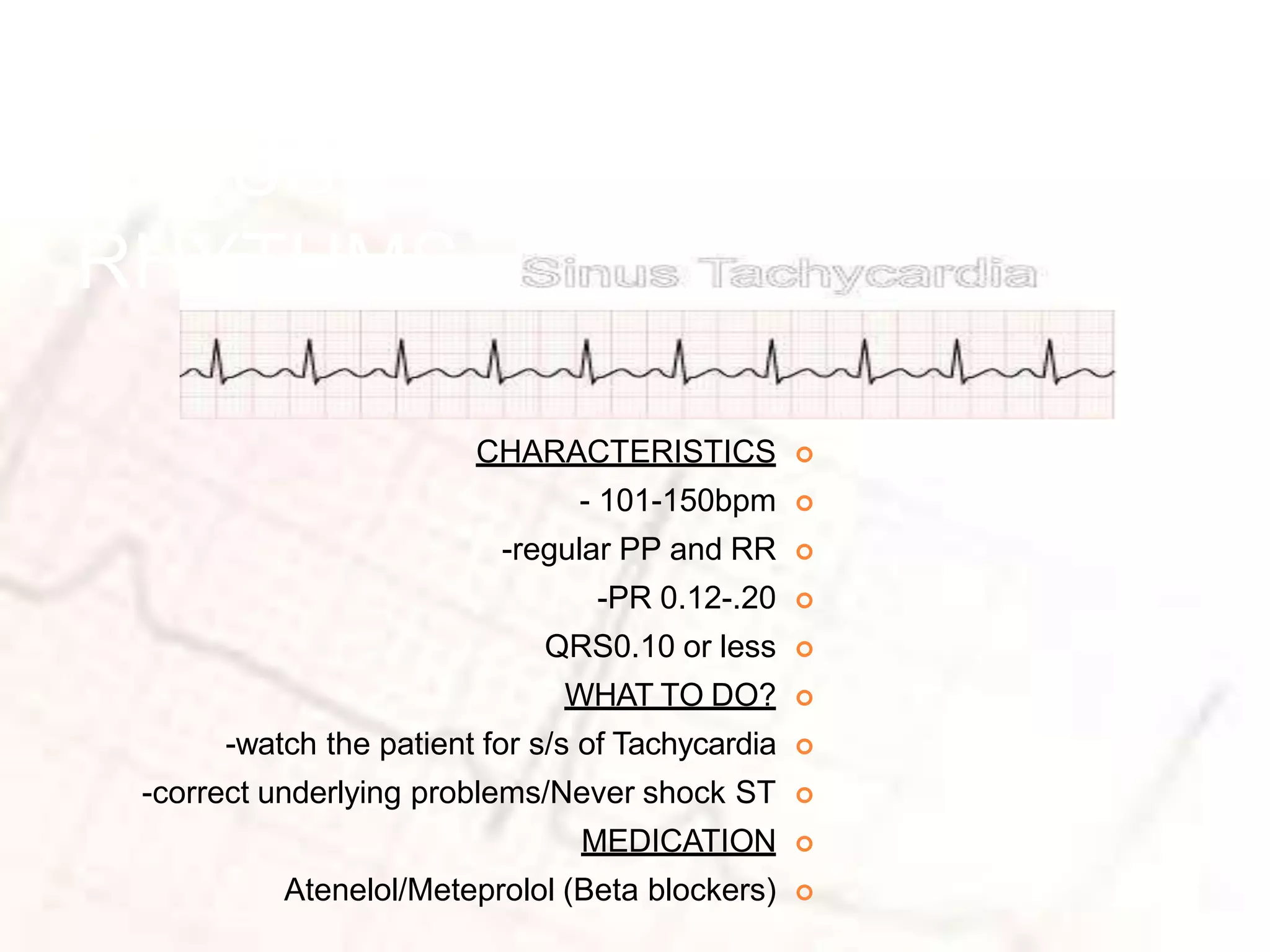
SINUS
RHYTHMS

CHARACTERISTICS

- 101-150bpm

-regular PP and RR

-PR 0.12-.20

QRS0.10 or less

WHAT TO DO?

-watch the patient for s/s of Tachycardia

-correct underlying problems/Never shock ST

MEDICATION

Atenelol/Meteprolol (Beta blockers)
SINUS RHYTHMS
SINUS RHYTHMS
SINUSARREST
Abnormalities:
Supraventricular arrhythmias
•
Atrial Fibrillation
•
Atrial Flutter
•
Supraventricular Tachycardia (SVT)
•
Premature Ventricular Complexes (PACs)
Abnormalities:
Ventricular arrhythmias
Abnormalities:
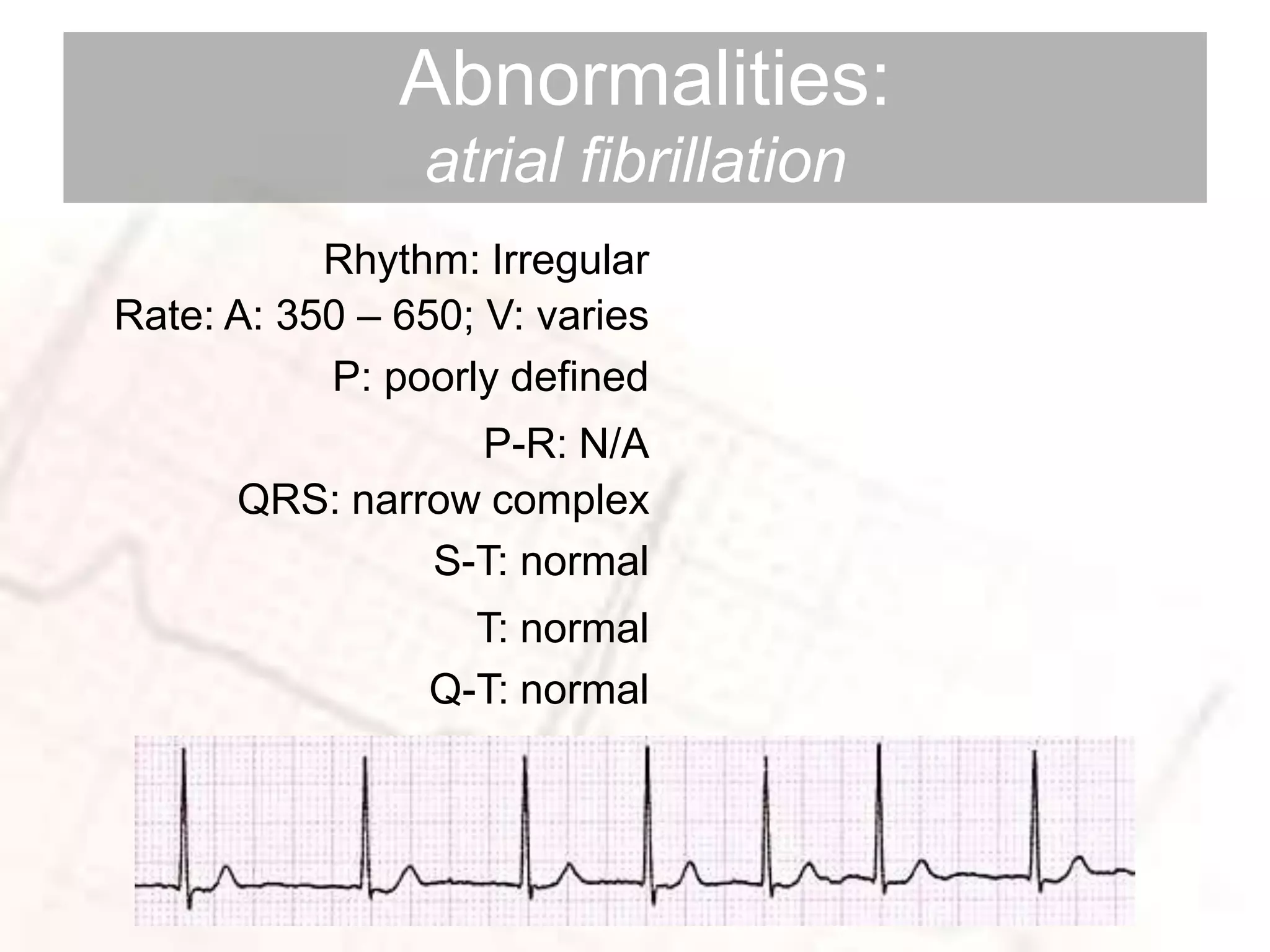
atrial fibrillation
Rhythm: Irregular
Rate: A: 350 – 650; V: varies
P: poorly defined
P-R: N/A
QRS: narrow complex
S-T: normal
T: normal
Q-T: normal
Abnormalities:
atrial flutter
Rhythm: Regular / Irregular
Rate: A: 220 – 430; V: <300 (2:1, 3:1 or sometimes 4:1)
P: Saw toothed appearance
P-R: N/A
QRS: narrow complex
S-T: normal
T: normal
Q-T: normal
Abnormalities:
supraventricular tachycardia (SVT)
Rhythm: Regular
Rate: >100
P: not visible
P-R: not defined
QRS: narrow complex
S-T: depression (sometimes)
T: normal
Q-T: prolonged (sometimes)
Abnormalities:
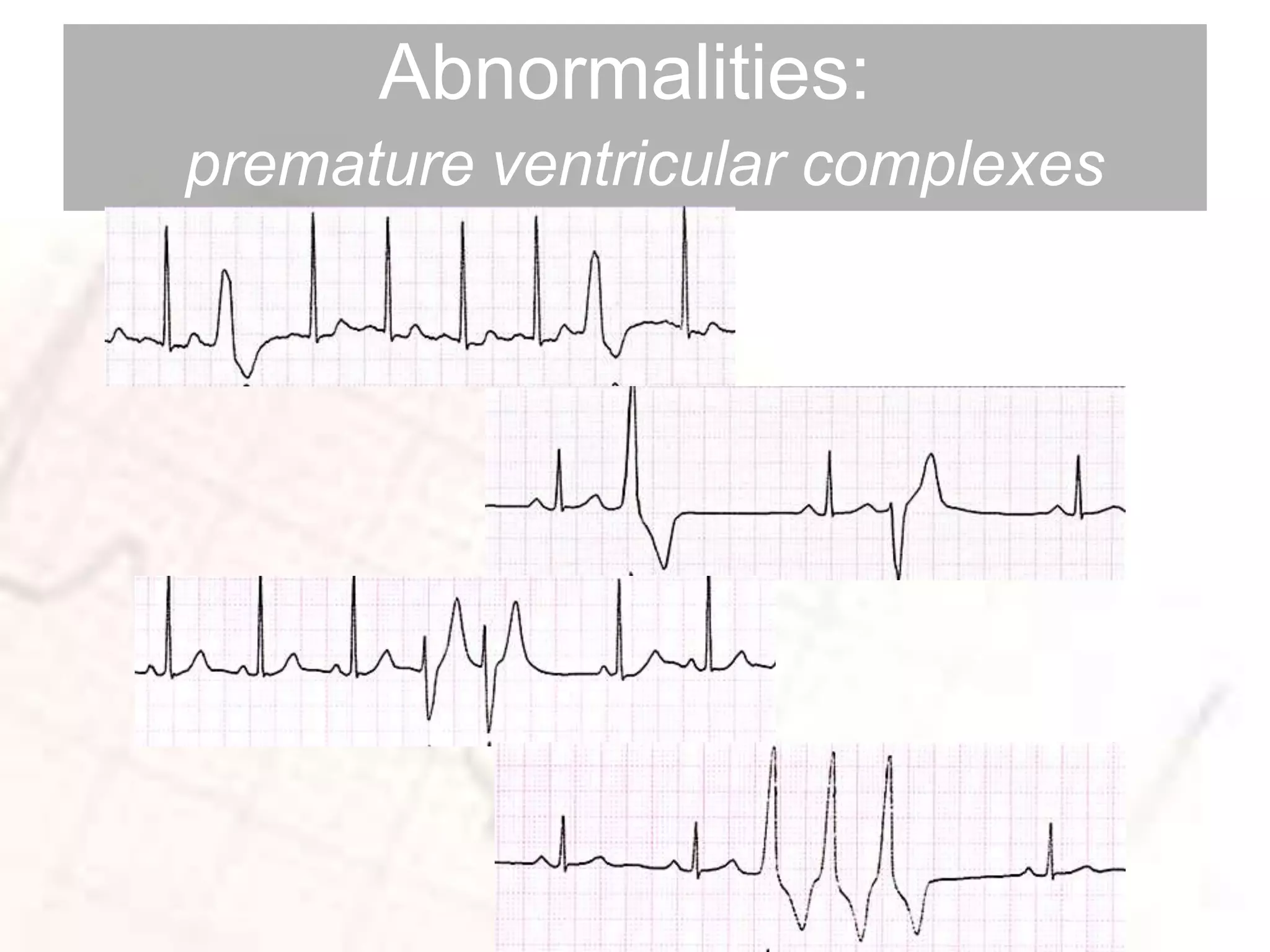
premature ventricular complexes
Abnormalities:
heart block
•
•
SA block (exit block)
•
1st degree AV block
•
2nd degree AV block
–
Wenckeback (type I)
–
Mobitz (type II)
3rd degree AV block
Abnormalities:
heart block – SA block
Abnormalities:
heart block – 1st degree AV
Abnormalities:
heart block – 2nd degree AV
Wenkeback
Mobitz
Abnormalities:
heart block – 3rd degree AV
Abnormalities:
life threatening arrhythmias
•
Ventricular Tachycardia
•
Ventricular Fibrillation
•
Asystole
Abnormalities:
life threatening arrhythmias - VT
Abnormalities:
life threatening arrhythmias - VF
Abnormalities:
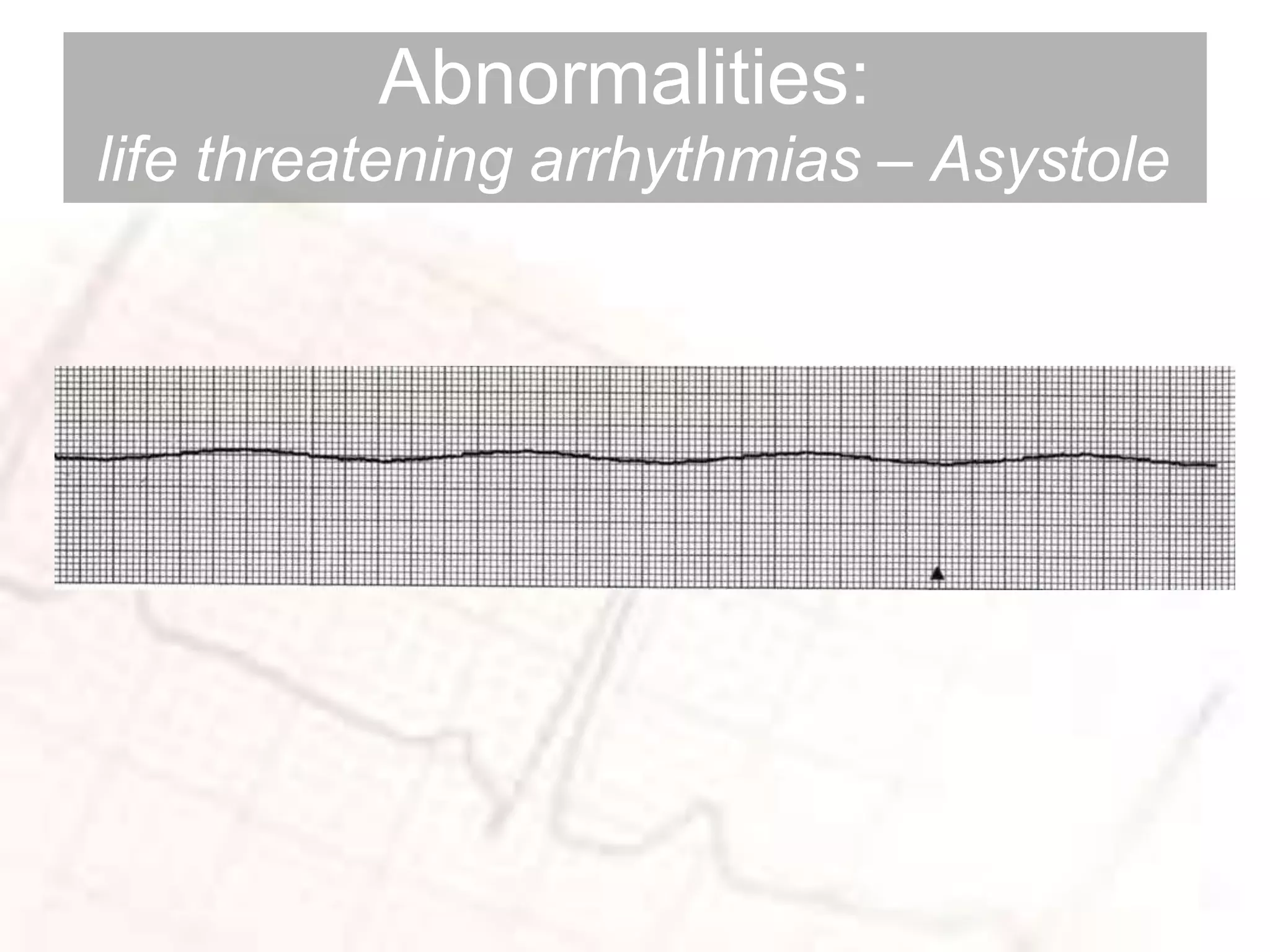
life threatening arrhythmias – Asystole
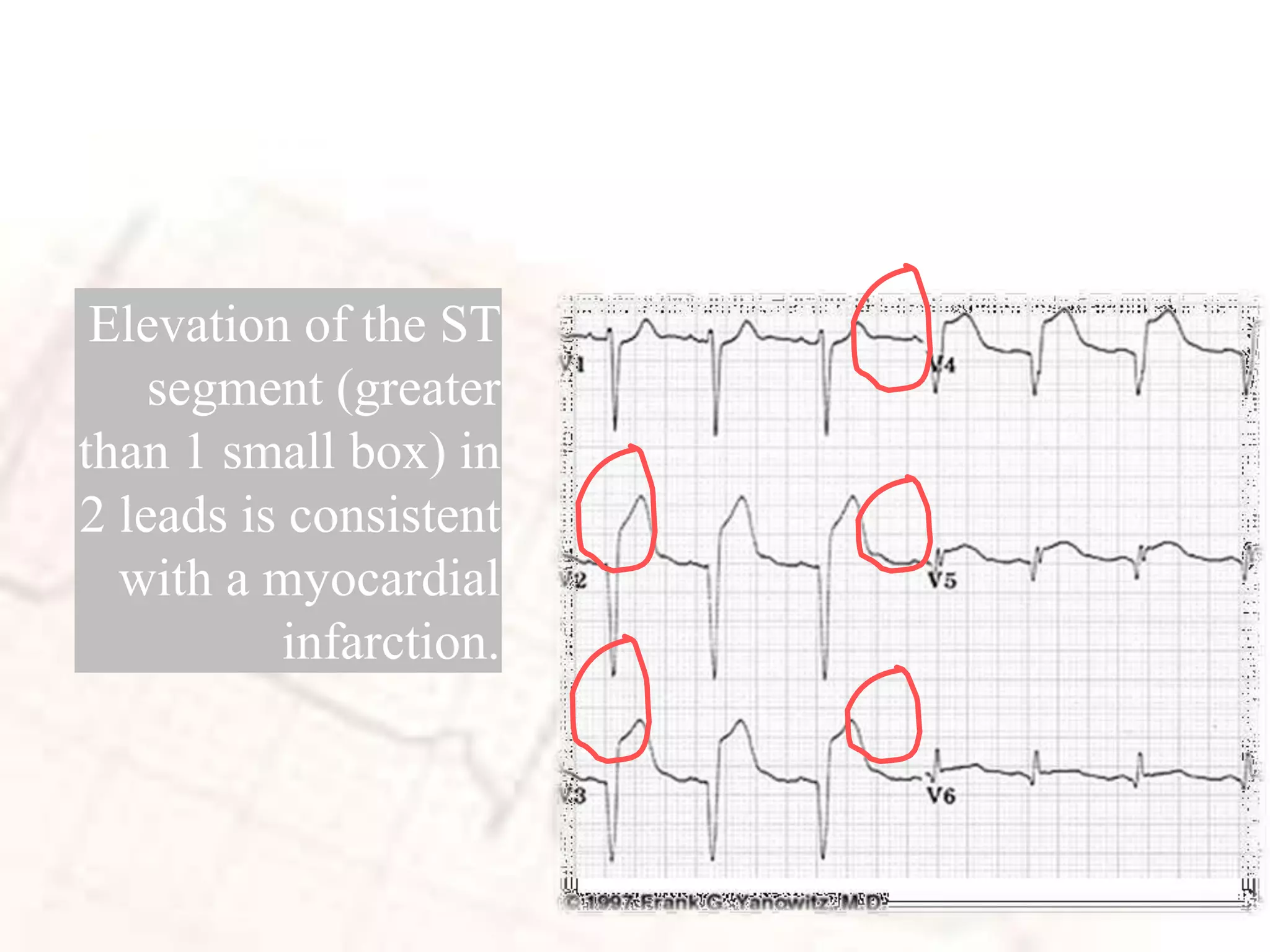
MI -- ST Elevation
One way to
diagnose an
acute MI is to
look for
elevation of the
ST segment.
ST Elevation (cont)
Elevation of the ST
segment (greater
than 1 small box) in
2 leads is consistent
with a myocardial
infarction.
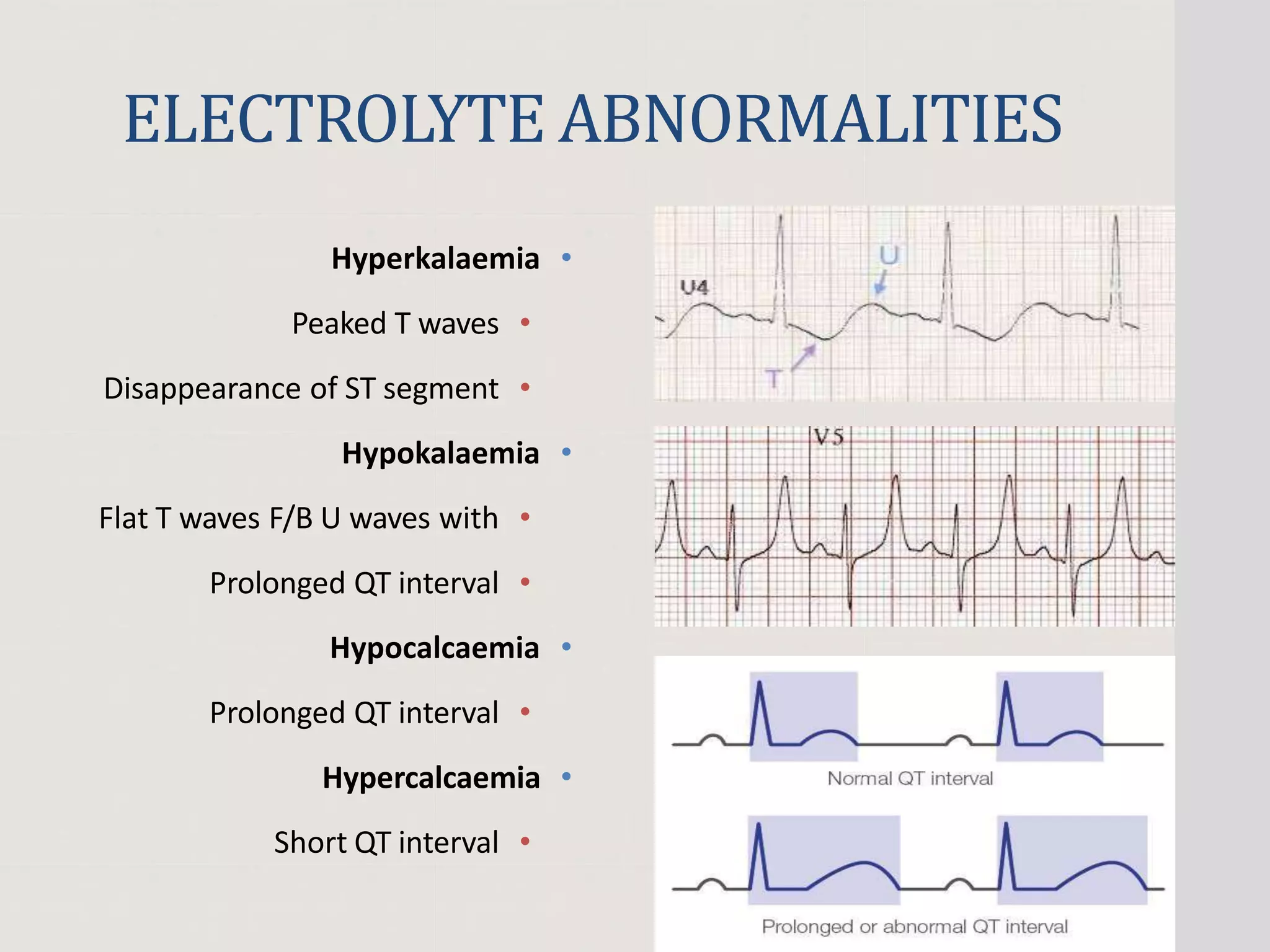
ELECTROLYTE ABNORMALITIES
•
Hyperkalaemia
•
Peaked T waves
•
Disappearance of ST segment
•
Hypokalaemia
•
Flat T waves F/B U waves with
•
Prolonged QT interval
•
Hypocalcaemia
•
Prolonged QT interval
•
Hypercalcaemia
•
Short QT interval
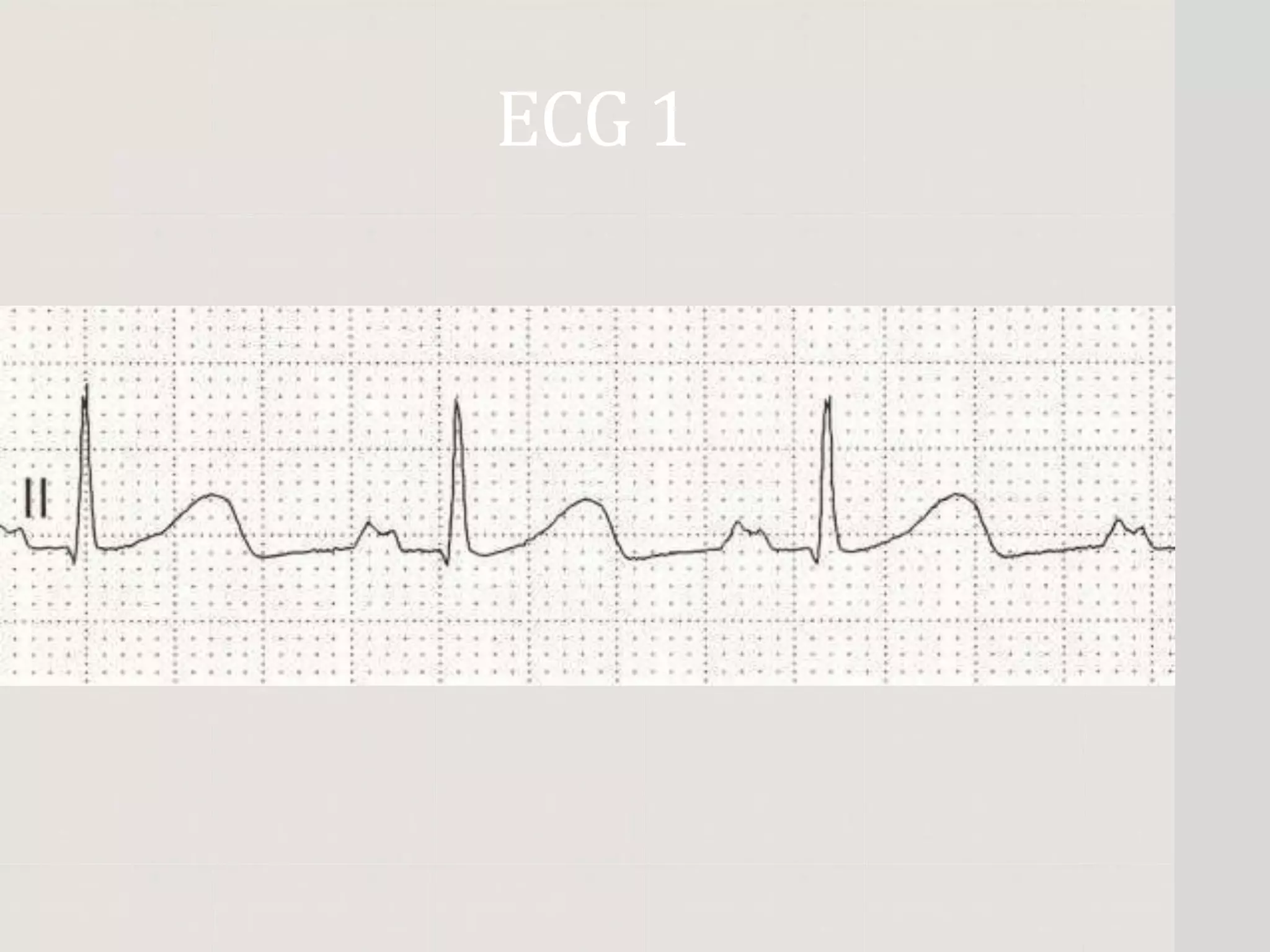
ECG 1
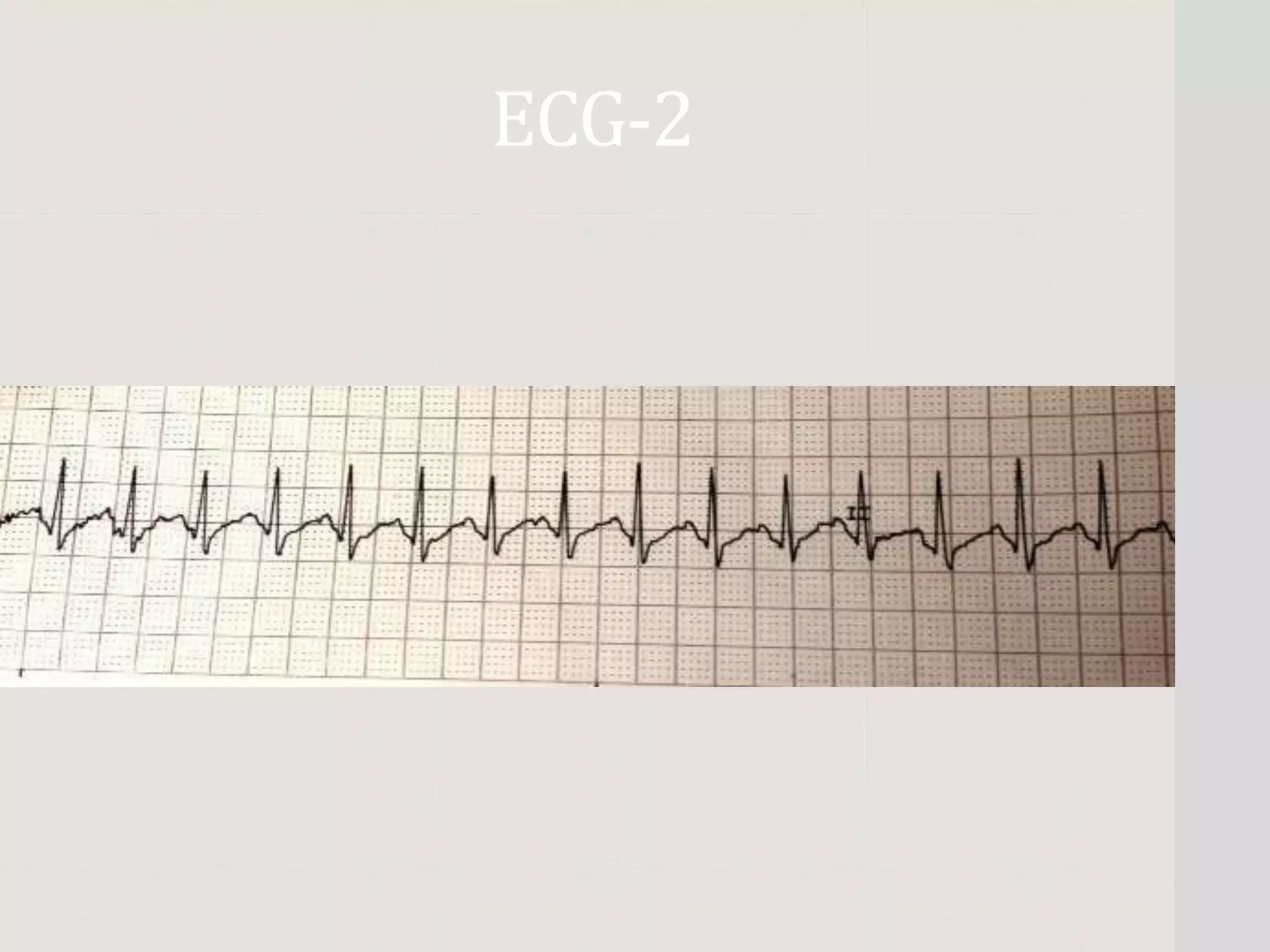
ECG-2
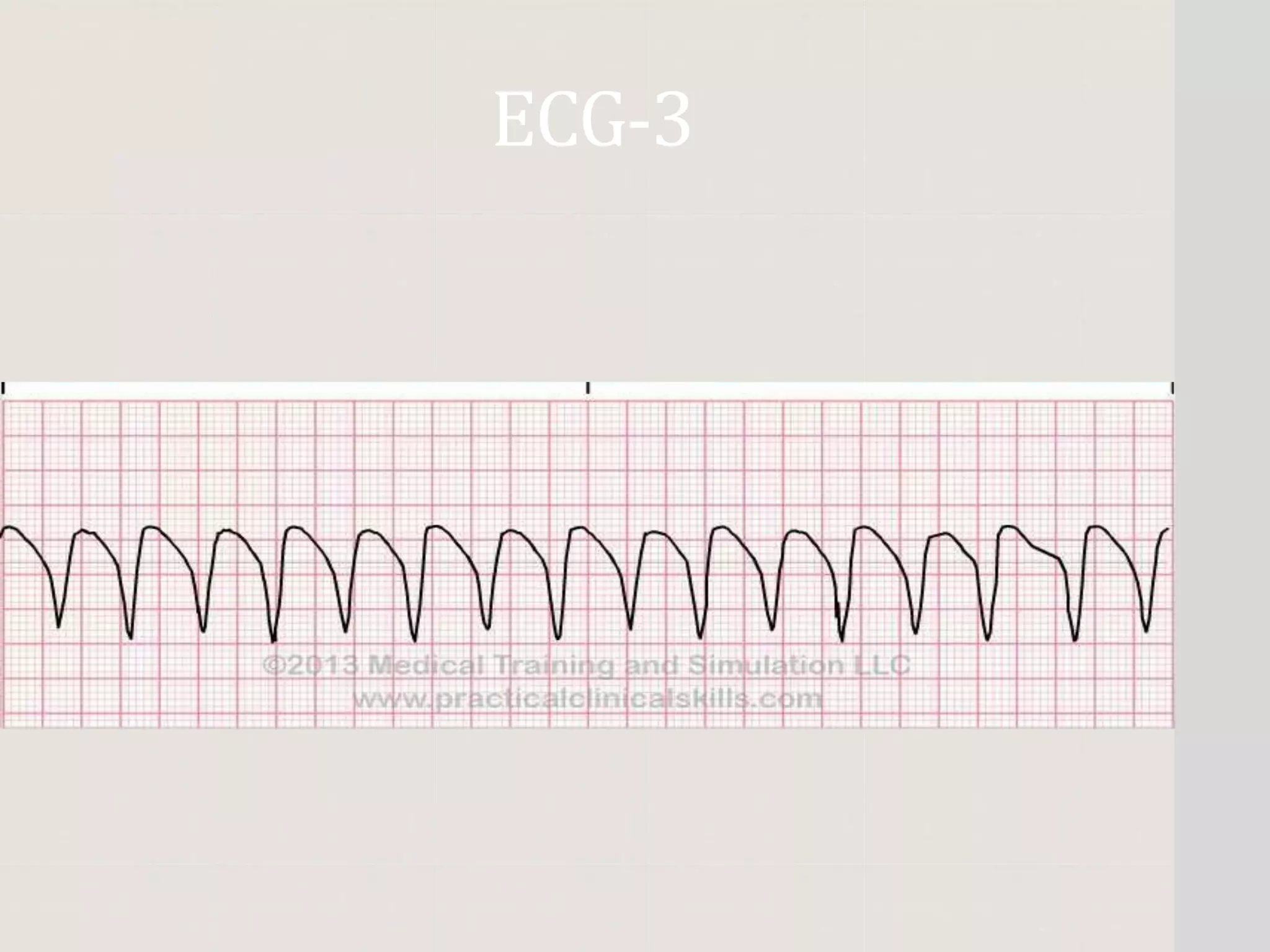
ECG-3
ECG-6
ECG-7
ECG-8
Examples
Examples
Thank you
THANK
YOU

basic ECG SAMPLE WAY

Editor's Notes

  • #23 Nursing Management Control of ventricular rate - Prevention of embolism with anticoagulation therapy Obtain 12 lead ECG- chaotic rhythm with no P waves. Measure vitals- if unstable may need cardioversion. Hook patient to cardiac monitor. Administer drugs as prescribed. Administer anticoagulant.
  • #24 What is the management of atrial flutter?  administer an antiarrhythmic drug; (2) initiate DC cardioversion; Obtain 12 lead ECG- Measure vitals- if unstable may need cardioversion. Hook patient to cardiac monitor. Administer anticoagulant.
  • #25 Nursing Management Obtain an order for oxygen per nasal cannula adjusted to oxygen saturation. Monitor ECG for rate, rhythm, and conduction. Assess vital signs and ECG and report abnormal changes to the clinician. Cardioversion.
  • #26 Therapeutic Management Nursing Interventions.  Determine underlying rhythm . Determine frequency of PVCs. Bigeminy. Trigeminy. Determine/treat the cause. Caffeine intake. Electrolyte imbalance. Hypoxia. Medications. ... . Continue to monitor. Symptomatic/Frequent. Medications. Antiarrhythmics. Beta blockers.
  • #29 Nursing Management Monitor vital signs. Place the patient on a cardiac monitor. Obtain an ECG. Assess oxygenation. Check labs to ensure electrolytes are within normal limits. Place the patient at bed rest. Listen to the heart for murmurs. Monitor for fluid retention.
  • #30  Nursing Management Monitor vital signs. Place the patient on a cardiac monitor. Obtain an ECG. Assess oxygenation. Check labs to ensure electrolytes are within normal limits. Place the patient at bed rest. Listen to the heart for murmurs. Monitor for fluid retention.   initiating pacing as soon as this rhythm is identified.
  • #31  Nursing Management Monitor vital signs. Place the patient on a cardiac monitor. Obtain an ECG. Assess oxygenation. Check labs to ensure electrolytes are within normal limits. Place the patient at bed rest. Listen to the heart for murmurs. Monitor for fluid retention.   initiating pacing as soon as this rhythm is identified.
  • #33 assess the patient first and see if there is a pulse present. mmediate cardiopulmonary resuscitation (CPR) and defibrillation
  • #34 Treatment includes: CPR (cardiopulmonary resuscitation). The first response to V-fib may be CPR. ... Defibrillation. This is an electrical shock that is delivered to your chest wall to restore normal rhythm. ... Medicines. ... Implantable cardioverter defibrillator (ICD). ... Catheter ablation. ... Left cardiac sympathetic denervation