WHAt is ecg
An electrocardiogram
(ECG ) is a quick test to
check the heartbeat. It
records the electrical
signals in the heart. Test
results can help diagnose
heart attacks and
irregular heartbeats,
called arrhythmias.
Non –invasive , quick and
painless
3.
An ECGis done to check the heartbeat. It shows how fast or how slow
the heart is beating. ECG test results can help your care team diagnose:
Irregular heartbeats, called arrhythmias.
A previous heart attack.
The cause of chest pain. For example, it may show signs of blocked
or narrowed heart arteries.
An ECG also may be done to learn how well a pacemaker and heart
disease treatments are working.
You may need an ECG if you have:
Chest pain.
Dizziness or confusion.
Pounding, skipping or fluttering heartbeat.
Fast pulse.
Shortness of breath.
Weakness or fatigue.
Reduced ability to exercise.
Why’s is done
The Electrical
conduction system
Pwave :- atrial depolarization
QRS complex :- ventricular
depolarization
T wave :- ventricular
repolarization
Where is atrial depolarization?
In QRS complex
8.
Proper 12-Lead ECG
Placement
ELECTRODEPLACEMENT
V1 4th Intercostal space to the right of the sternum
V2 4th Intercostal space to the left of the sternum
V3 Midway between V2 and V4
V4 5th Intercostal space at the midclavicular line
V5 Anterior axillary line at the same level as V4
V6 Midaxillary line at the same level as V4 and V5
RL Anywhere above the right ankle and below the torso
RA Anywhere between the right shoulder and the wrist
LL Anywhere above the left ankle and below the torso
LA Anywhere between the left shoulder and the wrist
10.
How toread and interpret electrocardiograms (ECG) is an important
skill to have.
The main components of an EKG wave include the following:
P wave
PR segment
QRS complex
ST segment
T wave
U wave
TP segment
There are also intervals that will be discussed:
PR interval
QT interval
ECG WAVEFORMS
13.
The Prototypical ECG
Tracing
The P wave corresponds to electrical
impulse traveling through the atria.
This is synonymous with atrial
depolarization and usually corresponds
with atrial contraction.
The QRS complex corresponds to the
depolarization of the left and right
ventricles.
It generally corresponds to the contraction
of the ventricles.
The T wave corresponds to a repolarization
of the ventricles.
15.
PR interval
• Isthe time from the beginning of the P
wave to the first ventricular deflection.
(QRS complex)
• Represents the activity from the
beginning of atrial depolarization to the
beginning of ventricular depolarization.
• Normal PR interval (adult): 0.12-0.20s
16.
QRS complex
• Representsthe ventricular Depolarization or
electrical activity in the ventricles.
• Location: Follow the PR interval
• Measured from the beginning of Q wave to the
end of S wave
• Amplitude: Alters, depends on the position in
the 12 lead ECG.
• Duration:0.06-0.10s
17.
ST Segment
• Representsa plateau between the end of
ventricular depolarization (QRS complex) and the
beginning of ventricular repolarization
• Normal ST segment is in line with the isoelectric line
• ST segment depression of 1-2 mm or more below the
baseline may indicate MYOCARDIAL ISCHAEMIA
• ST segment elevation 1-2 mm or more above the
baseline may indicate MYOCARDIAL INJURY
18.
T Wave
• Representsthe repolarization of the
ventricles.
• Location:Follow the S wave
• Polarity:- Same as preceding QRS
• Configuration:Typically rounded and
slightly asymmetrical (first upward part
ascending more slowly than the second
downward part)
19.
QT Interval
• Representsventricular depolarization
and ventricular repolarization
• Location:Extends from the beginning of
the QRS complex to the end of the T
wave.
• Duration:Between 0.36-0.44 sec (9-11)
small squares
Regular withnormal P, Q-R-S
T deflections and intervals.
Rate = 60-100 at rest.
Sinus Rhythm
23.
Rate lessthan 60 per minute in an adult
Sinus Bradycardia
24.
Rate greaterthan 100 per minute in an adult. Note
that the p waves are still present.
Sinus Tachycardia
25.
Prolonged PRinterval > 0.20 seconds due to a delay
in transmission from the atria to the ventricles.
First Degree Heart
Block
26.
A 2nddegree AV block is usually classified as
Mobitz Type I (Wenckebach) or Mobitz Type II.
A Mobitz Type I heart block is characterized by
progressive lengthening of the PR interval until a
QRS complex is dropped.
2nd Degree heart block
28.
Symptoms Second- andthird-
degree heart block
The second type of second-degree heart block — Mobitz 2 — is more serious and can lead
to:
chest pain
shortness of breath
fainting
nausea
excessive fatigue
heart palpitations
Third-degree heart block stops the electrical signal altogether. This makes the heartbeat
irregular and unreliable, which can lead to serious health problems. Symptoms can include:
fainting
chest pain
shortness of breath
extreme tiredness
The symptoms of third-degree heart block can be life threatening and people should seek
emergency medical help.
29.
3rd Degree heartblock
A 3rd degree heart block (sometimes called a
complete heart block)
A rhythm in which there is no relationship between
the P and QRS waves.
The P to P intervals are regular but have no
relationship to the QRS complexes on the ECG.
31.
Supraventricular tachycardia
(SVT)
Extremelyfast atrial rhythm with narrow QRS complexes when the impulse
originates above the bundle branches (above the ventricles).
The main symptom of supraventricular tachycardia (SVT) is a very fast heartbeat
that may last for a few minutes to a few days. The heart beats 100 or more times a
minute. Usually during SVT, the heart beats 150 to 220 times a minute. The fast
heartbeat may come and go suddenly.
Symptoms of supraventricular tachycardia may include:
Pounding or fluttering feelings in the chest, called palpitations.
A pounding sensation in the neck.
Chest pain.
Fainting or almost fainting.
Lightheadedness or dizziness.
Shortness of breath.
Sweating.
Weakness or extreme tiredness.
33.
Atrial Fibrillation
Verycommon arrhythmia.
This rhythm is characterized by no visible P waves
and an irregularly irregular QRS complex.
34.
Supraventricular arrhythmiathat is characterized by
a “saw-toothed” flutter appearance on the ECG that
represents multiple P waves for each QRS complex.
Atrial flutter
35.
Premature Ventricular
Contractions
Atrialrhythm is regular
Ventricular rhythm is irregular
QRS complex premature, usually followed by a
complete compensatory pause
QRS complex is also wide and distorted, usually
>0.14 second.
Premature QRS complexes occurring singly, in pairs,
or three
37.
Characterized bybizarre widened QRS complexes,
no P waves and usually a Rate over 100 per minute.
May quickly degenerate to Ventricular fibrillation
and death. VT may be responsive to electrical
defibrillation.
Ventricular tachycardia
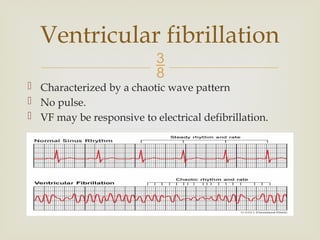
38.
Characterized bya chaotic wave pattern
No pulse.
VF may be responsive to electrical defibrillation.
Ventricular fibrillation
39.
Asystole
Commonly knownas a “flat line”
No electrical activity seen on the cardiac monitor.
Not responsive to electrical defibrillation.
40.
CONCLUSION
ECG resultscan help
diagnose an unusually
fast heart rate, called
tachycardia, or an
unusually slow heart
rate, called bradycardia.
Heart rhythm. The heart's
rhythm is the time
between each heartbeat.
It's also the signal pattern
between each beat.