Basic Carpentry Hand
Tools: Hammers
By Ryan Saucier
Hammers
• Various types
• Used to drive nails, pull nails and adjust
boards or move objects.
• Never strike one hammer head against
another. The force could break both
hammers and cause an eye injury.
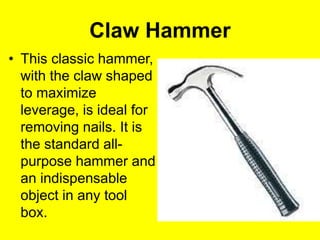
Claw Hammer
• This classic hammer,
with the claw shaped
to maximize
leverage, is ideal for
removing nails. It is
the standard all-
purpose hammer and
an indispensable
object in any tool
box.
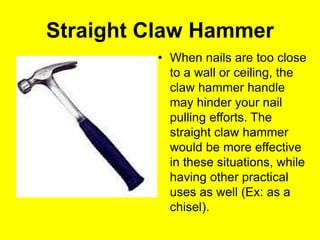
Straight Claw Hammer
• When nails are too close
to a wall or ceiling, the
claw hammer handle
may hinder your nail
pulling efforts. The
straight claw hammer
would be more effective
in these situations, while
having other practical
uses as well (Ex: as a
chisel).
Drywall Hammer
• With its rounded and
slightly grooved
hammering surface, the
drywall hammer allows
you to sink gypsum nails
without damaging or
denting the board and
helps improve the hold of
the joint compound. Its
distinctive flat claw also
allows you to remove
nails easily without
damaging the board.
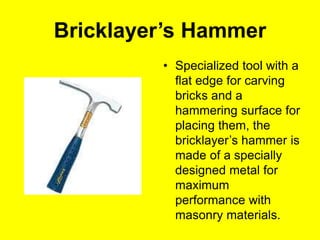
Bricklayer’s Hammer
• Specialized tool with a
flat edge for carving
bricks and a
hammering surface for
placing them, the
bricklayer’s hammer is
made of a specially
designed metal for
maximum
performance with
masonry materials.
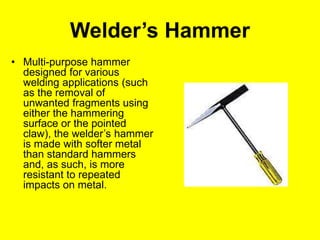
Welder’s Hammer
• Multi-purpose hammer
designed for various
welding applications (such
as the removal of
unwanted fragments using
either the hammering
surface or the pointed
claw), the welder’s hammer
is made with softer metal
than standard hammers
and, as such, is more
resistant to repeated
impacts on metal.
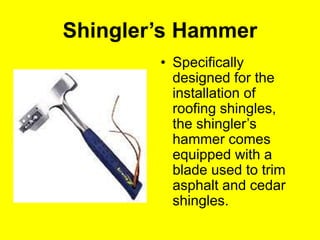
Shingler’s Hammer
• Specifically
designed for the
installation of
roofing shingles,
the shingler’s
hammer comes
equipped with a
blade used to trim
asphalt and cedar
shingles.
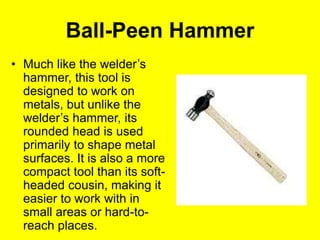
Ball-Peen Hammer
• Much like the welder’s
hammer, this tool is
designed to work on
metals, but unlike the
welder’s hammer, its
rounded head is used
primarily to shape metal
surfaces. It is also a more
compact tool than its soft-
headed cousin, making it
easier to work with in
small areas or hard-to-
reach places.
Mallet
• Rubber headed hammer
used in applications
where you need to strike
a surface without causing
damage; when installing
floor boards or hubcaps
for instance. Typically
made of black rubber,
mallet heads are also
available in white rubber,
which helps prevent
surface marks.
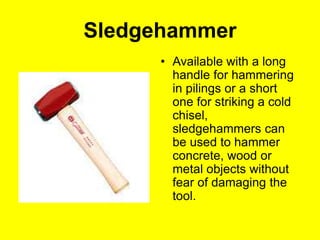
Sledgehammer
• Available with a long
handle for hammering
in pilings or a short
one for striking a cold
chisel,
sledgehammers can
be used to hammer
concrete, wood or
metal objects without
fear of damaging the
tool.
Types of Hammer Handles
• Hammers are typically built with metal, wood or
fiberglass handles.
• There is no one type of handle that is better than the
rest; it’s all about how the handle feels in your hand, thus
the importance of trying the tool out.
• This being said, a wood handle is ideal for working in
areas in close proximity with sources of extreme heat
(Ex: in some factories) as the wood will not conduct heat.
• Note that wood handled hammers are usually less
expensive and provide another interesting advantage -
the handle can be replaced.
• However, some users find that hammers made with
metal and fiberglass handles offer better control when
hammering.
Types of Hammer Handles
• Metal handles come in two types: flat and tubular. Here
too, it is mostly a question of preference.
• Some users prefer the flat handle for its versatility (it can
be used to straighten bent nails for example), whereas
tubular handles are less likely to mark or damage
surfaces if the user “misses the mark”.
• Keep in mind that tubular handles are less durable when
it comes to pulling difficult nails…The truth is, when a
hammer handle breaks, regardless of type or material, it
is usually because the tool was “forced” while being
applied as a nail puller or pry bar, which it isn’t.
Types of Hammer Handles
• Over the last few years, manufacturers
began offering hammers with anti-vibration
handles. These tools can, depending on
the model, reduce the amount of vibration
felt by the user from three to eight times
when compared to a regular hammer. A
significant advantage for everyday users!
Types of Hammer Heads
• The hammer head is comprised of a hammering
surface and a claw. The claw may be straight or
curved and can be used to straighten or pull
nails.
• In general terms, forged steel heads provide
better quality than molded heads, which have a
tendency to become damaged with use.
Types of Hammer Heads
• Some hammers have a “textured” striking
surface to avoid slippage but keep in mind that
these models tend to damage the hammering
surface and cause more serious injuries when
fingers get hit.
• This type of head is not to be confused with the
drywall hammer, which is slightly rounded and
finely textured to minimize the risk of damage to
the drywall board and to create small relief on
the board in order to improve the hold of the joint
compound.
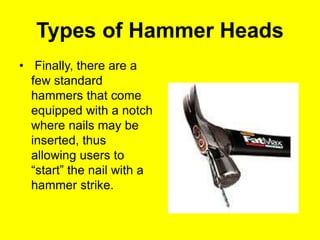
Types of Hammer Heads
• Finally, there are a
few standard
hammers that come
equipped with a notch
where nails may be
inserted, thus
allowing users to
“start” the nail with a
hammer strike.
Various Hammer Weights
• Regardless of handle material, standard hammers are
offered in 8, 13, 16, 20 and 22-ounce models: a 16-oz.
hammer with wood handle will weigh the same as a 16-
oz. hammer with a fibreglass handle.
• Though 8-oz. hammers can be useful for small jobs, 16-
oz. versions, with their optimal weight to handling ratio,
are the ultimate all-purpose models.
• 20 and 22-oz. hammers are usually intended for use by
profesionnals, in carpentry or demolition applications for
example.
• The 13-oz. hammer, designed for finishing applications
such as the installation of baseboards and mouldings, is
gradually disappearing and is being replaced by
compressed air hammers.
Hammer Maintenance
• It is recommended that hammers be stored in a dry location
and that they be wiped down if wet.
• To avoid injury, never leave any tool within reach of a child.
• Use added caution when using a tool in proximity to electrical
installations.
• Always wear safety glasses.
• Grip the hammer firmly and strike using the entire arm and not
only the wrist.
• Never use a hammer with a damaged handle or head.
• Always look behind you before starting the required swing to
make your strike.
In Closing…
• Use a 16-oz. hammer for your various carpentry
and household jobs as it provides the best
weight-handling ratio.
• Try different handles before purchasing your
hammer; evaluate tool balance, grip comfort,
and then choose the model that feels best in
your hand.
• If you keep in mind that your household hammer
is not a nail puller and is not designed for
working metal, it will no doubt provide you with
many years of carefree service.

Basic Carpentry Hand Tools- Hammers and safety

  • 1.
    Basic Carpentry Hand Tools:Hammers By Ryan Saucier
  • 2.
    Hammers • Various types •Used to drive nails, pull nails and adjust boards or move objects. • Never strike one hammer head against another. The force could break both hammers and cause an eye injury.
  • 4.
    Claw Hammer • Thisclassic hammer, with the claw shaped to maximize leverage, is ideal for removing nails. It is the standard all- purpose hammer and an indispensable object in any tool box.
  • 5.
    Straight Claw Hammer •When nails are too close to a wall or ceiling, the claw hammer handle may hinder your nail pulling efforts. The straight claw hammer would be more effective in these situations, while having other practical uses as well (Ex: as a chisel).
  • 6.
    Drywall Hammer • Withits rounded and slightly grooved hammering surface, the drywall hammer allows you to sink gypsum nails without damaging or denting the board and helps improve the hold of the joint compound. Its distinctive flat claw also allows you to remove nails easily without damaging the board.
  • 7.
    Bricklayer’s Hammer • Specializedtool with a flat edge for carving bricks and a hammering surface for placing them, the bricklayer’s hammer is made of a specially designed metal for maximum performance with masonry materials.
  • 8.
    Welder’s Hammer • Multi-purposehammer designed for various welding applications (such as the removal of unwanted fragments using either the hammering surface or the pointed claw), the welder’s hammer is made with softer metal than standard hammers and, as such, is more resistant to repeated impacts on metal.
  • 9.
    Shingler’s Hammer • Specifically designedfor the installation of roofing shingles, the shingler’s hammer comes equipped with a blade used to trim asphalt and cedar shingles.
  • 10.
    Ball-Peen Hammer • Muchlike the welder’s hammer, this tool is designed to work on metals, but unlike the welder’s hammer, its rounded head is used primarily to shape metal surfaces. It is also a more compact tool than its soft- headed cousin, making it easier to work with in small areas or hard-to- reach places.
  • 11.
    Mallet • Rubber headedhammer used in applications where you need to strike a surface without causing damage; when installing floor boards or hubcaps for instance. Typically made of black rubber, mallet heads are also available in white rubber, which helps prevent surface marks.
  • 12.
    Sledgehammer • Available witha long handle for hammering in pilings or a short one for striking a cold chisel, sledgehammers can be used to hammer concrete, wood or metal objects without fear of damaging the tool.
  • 13.
    Types of HammerHandles • Hammers are typically built with metal, wood or fiberglass handles. • There is no one type of handle that is better than the rest; it’s all about how the handle feels in your hand, thus the importance of trying the tool out. • This being said, a wood handle is ideal for working in areas in close proximity with sources of extreme heat (Ex: in some factories) as the wood will not conduct heat. • Note that wood handled hammers are usually less expensive and provide another interesting advantage - the handle can be replaced. • However, some users find that hammers made with metal and fiberglass handles offer better control when hammering.
  • 14.
    Types of HammerHandles • Metal handles come in two types: flat and tubular. Here too, it is mostly a question of preference. • Some users prefer the flat handle for its versatility (it can be used to straighten bent nails for example), whereas tubular handles are less likely to mark or damage surfaces if the user “misses the mark”. • Keep in mind that tubular handles are less durable when it comes to pulling difficult nails…The truth is, when a hammer handle breaks, regardless of type or material, it is usually because the tool was “forced” while being applied as a nail puller or pry bar, which it isn’t.
  • 15.
    Types of HammerHandles • Over the last few years, manufacturers began offering hammers with anti-vibration handles. These tools can, depending on the model, reduce the amount of vibration felt by the user from three to eight times when compared to a regular hammer. A significant advantage for everyday users!
  • 16.
    Types of HammerHeads • The hammer head is comprised of a hammering surface and a claw. The claw may be straight or curved and can be used to straighten or pull nails. • In general terms, forged steel heads provide better quality than molded heads, which have a tendency to become damaged with use.
  • 17.
    Types of HammerHeads • Some hammers have a “textured” striking surface to avoid slippage but keep in mind that these models tend to damage the hammering surface and cause more serious injuries when fingers get hit. • This type of head is not to be confused with the drywall hammer, which is slightly rounded and finely textured to minimize the risk of damage to the drywall board and to create small relief on the board in order to improve the hold of the joint compound.
  • 18.
    Types of HammerHeads • Finally, there are a few standard hammers that come equipped with a notch where nails may be inserted, thus allowing users to “start” the nail with a hammer strike.
  • 19.
    Various Hammer Weights •Regardless of handle material, standard hammers are offered in 8, 13, 16, 20 and 22-ounce models: a 16-oz. hammer with wood handle will weigh the same as a 16- oz. hammer with a fibreglass handle. • Though 8-oz. hammers can be useful for small jobs, 16- oz. versions, with their optimal weight to handling ratio, are the ultimate all-purpose models. • 20 and 22-oz. hammers are usually intended for use by profesionnals, in carpentry or demolition applications for example. • The 13-oz. hammer, designed for finishing applications such as the installation of baseboards and mouldings, is gradually disappearing and is being replaced by compressed air hammers.
  • 20.
    Hammer Maintenance • Itis recommended that hammers be stored in a dry location and that they be wiped down if wet. • To avoid injury, never leave any tool within reach of a child. • Use added caution when using a tool in proximity to electrical installations. • Always wear safety glasses. • Grip the hammer firmly and strike using the entire arm and not only the wrist. • Never use a hammer with a damaged handle or head. • Always look behind you before starting the required swing to make your strike.
  • 21.
    In Closing… • Usea 16-oz. hammer for your various carpentry and household jobs as it provides the best weight-handling ratio. • Try different handles before purchasing your hammer; evaluate tool balance, grip comfort, and then choose the model that feels best in your hand. • If you keep in mind that your household hammer is not a nail puller and is not designed for working metal, it will no doubt provide you with many years of carefree service.