Barriers to Effective
Communication
Mark Darwin V. Garcia
Communication Process
• The process of communication
has multiple barriers. The
intended communique will
often be disturbed and
distorted leading to a
condition of misunderstanding
and failure of communication.
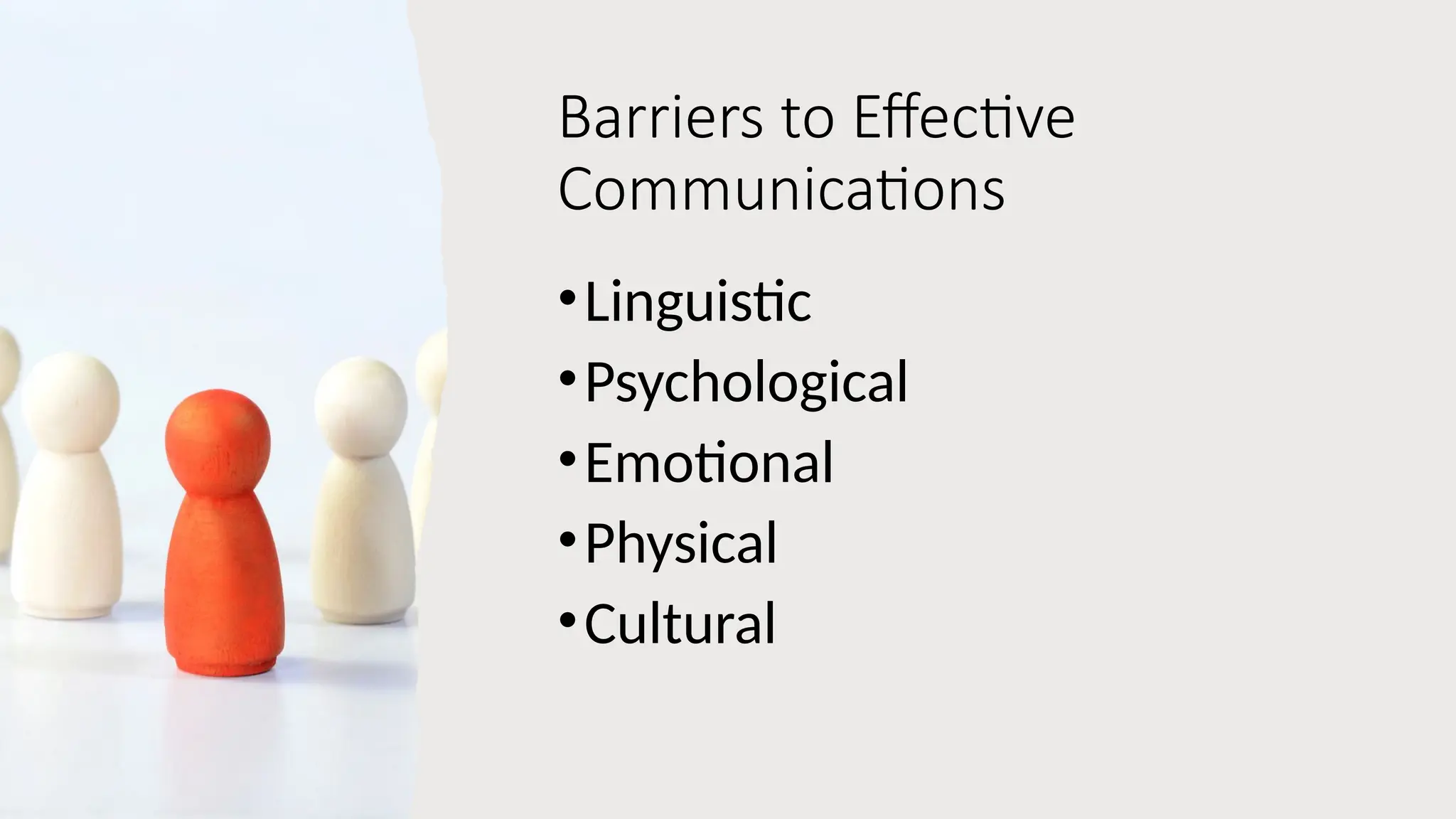
Barriers to Effective
Communications
•Linguistic
•Psychological
•Emotional
•Physical
•Cultural
Linguistic Barrier
•The language barrier is one of the main
barriers that limit effective
communication. Language is the most
commonly employed tool of
communication. The fact that each major
region has its own language is one of the
Barriers to effective communication.
Sometimes even a thick dialect may
render the communication ineffective.
Psychological barrier
•There are various mental and
psychological issues that may be
barriers to effective
communication. Some people have
stage fear, speech disorders,
phobia, depression etc. All of these
conditions are very difficult to
manage sometimes and will most
certainly limit the ease of
communication
Emotional Barrier
•The emotional (EQ) of a person
determines the ease and comfort
with which they can communicate.
A person who is emotionally
mature will be able to
communicate effectively. On the
other hand, people who let their
emotions take over will face
certain difficulties.
Physical Barrier
•They are the most obvious barriers to
effective communication. These barriers
are mostly easily removable in principle at
least. They include barriers like noise,
closed doors, faulty equipment used for
communication, closed cabins, etc.
Sometimes, in a large office, the physical
separation between various employees
combined with faulty equipment may
result in severe barriers to effective
communication.
Cultural barrier
•As the world is getting more and
more globalized, any large office
may have people from several
parts of the world. Different
cultures have a different meaning
for several basic values of society.
Dressing, Religions or lack of them,
food, drinks, pets, and the general
behaviour will change drastically
from one culture to another.
Overcoming
Communication Barriers
• Eliminating differences in perception
• Use of Simple Language
• Reduction and elimination of noise
levels
• Active Listening
• Avoid Information Overload
• Emotional State
In conclusion
• Effective communication can be hindered by various barriers that
impede the smooth flow of information and understanding. These
barriers can be linguistic, psychological, emotional, physical,
attitude-related, perception-based, physiological, technological, or
socio-religious in nature. Each barrier poses unique challenges and
can impact communication in different ways
• By recognizing and understanding these barriers, individuals can
develop strategies to overcome them and enhance their
communication skills. It is essential to actively listen, practice
empathy, adapt to different communication styles, and utilize
appropriate technology to foster effective communication. By
addressing and overcoming these barriers, we can create a more
inclusive and collaborative environment, promoting meaningful and
successful communication in various personal and professional
settings.
Thank you
References
• https://www.toppr.com/guides/business-correspondence-and-reporti
ng/communication/barriers-in-communication/
• https://managementstudyguide.com/overcoming-communication-bar
riers.htm

Barriers to Effective Communication.pptx

  • 1.
  • 2.
  • 3.
    • The processof communication has multiple barriers. The intended communique will often be disturbed and distorted leading to a condition of misunderstanding and failure of communication.
  • 4.
  • 5.
    Linguistic Barrier •The languagebarrier is one of the main barriers that limit effective communication. Language is the most commonly employed tool of communication. The fact that each major region has its own language is one of the Barriers to effective communication. Sometimes even a thick dialect may render the communication ineffective.
  • 6.
    Psychological barrier •There arevarious mental and psychological issues that may be barriers to effective communication. Some people have stage fear, speech disorders, phobia, depression etc. All of these conditions are very difficult to manage sometimes and will most certainly limit the ease of communication
  • 7.
    Emotional Barrier •The emotional(EQ) of a person determines the ease and comfort with which they can communicate. A person who is emotionally mature will be able to communicate effectively. On the other hand, people who let their emotions take over will face certain difficulties.
  • 8.
    Physical Barrier •They arethe most obvious barriers to effective communication. These barriers are mostly easily removable in principle at least. They include barriers like noise, closed doors, faulty equipment used for communication, closed cabins, etc. Sometimes, in a large office, the physical separation between various employees combined with faulty equipment may result in severe barriers to effective communication.
  • 9.
    Cultural barrier •As theworld is getting more and more globalized, any large office may have people from several parts of the world. Different cultures have a different meaning for several basic values of society. Dressing, Religions or lack of them, food, drinks, pets, and the general behaviour will change drastically from one culture to another.
  • 10.
  • 11.
    • Eliminating differencesin perception • Use of Simple Language • Reduction and elimination of noise levels • Active Listening • Avoid Information Overload • Emotional State
  • 12.
    In conclusion • Effectivecommunication can be hindered by various barriers that impede the smooth flow of information and understanding. These barriers can be linguistic, psychological, emotional, physical, attitude-related, perception-based, physiological, technological, or socio-religious in nature. Each barrier poses unique challenges and can impact communication in different ways
  • 13.
    • By recognizingand understanding these barriers, individuals can develop strategies to overcome them and enhance their communication skills. It is essential to actively listen, practice empathy, adapt to different communication styles, and utilize appropriate technology to foster effective communication. By addressing and overcoming these barriers, we can create a more inclusive and collaborative environment, promoting meaningful and successful communication in various personal and professional settings.
  • 14.
  • 15.