The Edinburgh-Stanford Link Michael Clouser 03/03/2007 BarCamp Scotland
What is the Link? A research collaboration between Edinburgh and Stanford Universities into speech and language technology, and related disciplines. Each research project is jointly carried out on both sides of the Atlantic. Funded by Scottish Enterprise, the Link works with companies and organisations to make its research applicable to business. One way it does this is by creating state-of-the-art prototypes with commercial potential. The commercialisation process favours Scottish companies for one year, after which time, technologies can be marketed around the world.
About Me Associate w/ Edinburgh Stanford Link Courses delivered online and off; working on building online course now Linking companies with MSc students Ph.D. Student at UoE – Entrepreneurship and Innovation (expected 2008) -Earned MBA and BS from Cornell University in Ithaca, New York (1999 and 1990 respectively) Worked in Silicon Valley 5 years before coming to Edinburgh in 2004 Former Venture Capitalist for Dot Edu Ventures Entrepreneur:  Software, Internet, and Competitive Intelligence / Market Research firms First real job:  Pastry Chef; next Hotelier
What’s special ?  The Link is using economic development money to invest in university research…this makes it unique in the UK  (ITIs contract out research) Need to create  measurable  economic benefits from the research We’re working with Stanford University, one of the most entrepreneurial universities in the world  Stanford is at the heart of Silicon Valley…because it helped create it  The Link’s also experimental…can this kind of investment really benefit business & help grow the economy?  It may provide some of the pieces… but we don’t expect to complete the jigsaw
Commercial Strategy Invest  only  in projects with commercial viability Not technology for technologies’ sake Use industrial collaboration partners to offer guidance and direction Otherwise how do we know what industry wants? Utilise all Gov’t initiatives to help SMEs access IP  (Score & Seekit etc) No “build it and they will come mentality” – mechanisms needed Use students and staff on consulting contracts with companies  (primarily to adapt/implement University IP) Specialists to help with demos/prototypes
Approach – what can we do for you? Work with you to identify problems and future trends in your sector. Place researchers into companies to offer insight and world-class expertise in the development of key technologies. Identify new funding sources that companies can use to acquire novel IP and know-how. Facilitate access to Silicon Valley and the US market.  We have some examples of applications we think might be useful… But there are probably others we haven’t thought of..
Student projects:   Little or no cost to suggest a topic for a 3 month student project – benefits both the student and the company.  Collaboration:   On existing research projects – companies can help direct existing research at no cost, and may wish to negotiate a licence when the research is completed.  Consulting:   When we already have something you want - we can help develop it and integrate into your company, with staff training if required.  Contract research:   If you want us to develop something just for you – we can negotiate terms and conditions covering things like intellectual property rights.  We can also help  identify and access   new government and Scottish Enterprise initiatives that can be used help fund all of the above. Mechanisms for working together
Technologies and applications
Speech recognition Turning spoken language into text From, extremely accurate dictation by systems trained for one voice… …  to systems working in specific domains with many speakers Speech synthesis Turning text into speech By breaking human language into parts, we can rebuild sounds to create ‘natural’ synthesised voices Artificial voices now being used in a wide variety of applications Spoken dialogue systems Trying to create a ‘natural’ dialogue with a computer Does the clever bit in the middle….  Enables ‘intelligent’ responses to unexpected events Technologies
Examples  cont.. Information extraction Teaching computers to automatically recognise entities in unstructured data Can then identify relationships between entities and data sets Eventually leads to intelligent retrieval  Text summarisation Attempts to interpret the meaning of phrases and paragraphs Ultimate aim is to take a document and accurately summarise the content Already great results with legal documents  Question & answering systems C ombines NLP with intelligent databases, where data is stored by meaning Enables the building of natural question and answer (Q&A) systems that require little or no training to use  Translation Advanced translation software can now assess context in the same way a human translator can, although considerably faster Can also remember previous ‘model’ translations and implement immediately
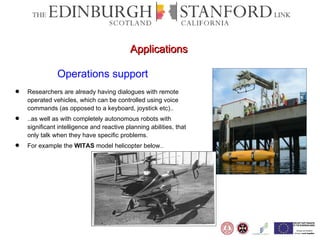
Operations support Researchers are already having dialogues with remote operated vehicles, which can be controlled using voice commands (as opposed to a keyboard, joystick etc).. ..as well as with completely autonomous robots with significant intelligence and reactive planning abilities, that only talk when they have specific problems. For example the  WITAS  model helicopter below.. Applications
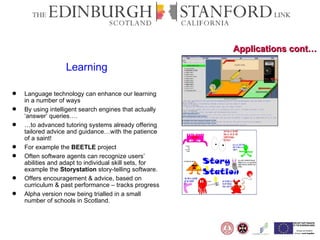
Applications cont… Learning Language technology can enhance our learning in a number of ways By using intelligent search engines that actually ‘answer’ queries…. … to advanced tutoring systems already offering tailored advice and guidance…with the patience of a saint!  For example the  BEETLE  project Often software agents can recognize users’ abilities and adapt to individual skill sets, for example the  Storystation  story-telling software. Offers encouragement & advice, based on curriculum & past performance – tracks progress Alpha version now being trialled in a small number of schools in Scotland.
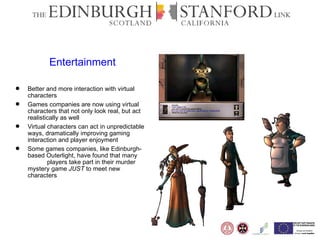
Entertainment Better and more interaction with virtual characters Games companies are now using virtual characters that not only look real, but act realistically as well Virtual characters can act in unpredictable ways, dramatically improving gaming interaction and player enjoyment  Some games companies, like Edinburgh-based Outerlight, have found that many  players take part in their murder mystery game  JUST  to meet new characters
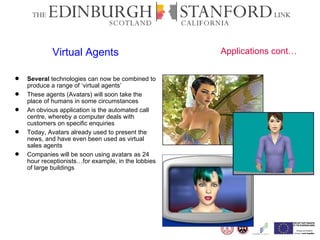
Virtual Agents Several  technologies can now be combined to produce a range of ‘virtual agents’ These agents (Avatars) will soon take the place of humans in some circumstances An obvious application is the automated call centre, whereby a computer deals with customers on specific enquiries  Today, Avatars already used to present the news, and have even been used as virtual sales agents  Companies will be soon using avatars as 24 hour receptionists…for example, in the lobbies of large buildings  Applications cont…
Current Partners   Formal Industry Launch Event held on the 10 th  October 2003  Company sizes: 3 - 3000 staff Company sales: pre-sale - $900m revenues Includes:  developers of synthetic voices, operators of remotely operated & autonomous vehicles, database developers, business intelligence companies, knowledge management organisations and e-learning providers
Some current Partners
Link success to date… Working with over 40 companies on collaborations, student projects, consulting etc  Signed over 10 licensing deals with Scottish companies Recently attracted US company to establish R&D base in Edinburgh Introduced Scottish companies to Silicon Valley contacts, e.g. AffectiveMedia to Toyota research centre. Created hi-tech entrepreneurship courses, with over a dozen start-ups to date!
And finally… Three Separately funded courses…that still count towards grades Three courses to date – Informatics Entrepreneurship (2 courses of 10- weeks each) The Digital Marketplace (10 week course) – both four hours per week, plus four optional sessions Guest Speakers from Silicon Valley, as well as entrepreneurs & VCs from Scotland Also host Master Classes for directors of partner companies Students teams present their business plans to a panel of active venture capitalists Several Companies have already been incorporated Online entrepreneurship courses for companies and researchers now being developed. Launching in October 2007 See:   www.tech-entrepreneur.org
For further details, please visit:  www.eslink.org and  www.tech-entrepreneur.org
Contact Michael Clouser [email_address] 0131.650.4436

BarCamp Scotland Edinburgh-Stanford Link Overview

  • 1.
    The Edinburgh-Stanford LinkMichael Clouser 03/03/2007 BarCamp Scotland
  • 2.
    What is theLink? A research collaboration between Edinburgh and Stanford Universities into speech and language technology, and related disciplines. Each research project is jointly carried out on both sides of the Atlantic. Funded by Scottish Enterprise, the Link works with companies and organisations to make its research applicable to business. One way it does this is by creating state-of-the-art prototypes with commercial potential. The commercialisation process favours Scottish companies for one year, after which time, technologies can be marketed around the world.
  • 3.
    About Me Associatew/ Edinburgh Stanford Link Courses delivered online and off; working on building online course now Linking companies with MSc students Ph.D. Student at UoE – Entrepreneurship and Innovation (expected 2008) -Earned MBA and BS from Cornell University in Ithaca, New York (1999 and 1990 respectively) Worked in Silicon Valley 5 years before coming to Edinburgh in 2004 Former Venture Capitalist for Dot Edu Ventures Entrepreneur: Software, Internet, and Competitive Intelligence / Market Research firms First real job: Pastry Chef; next Hotelier
  • 4.
    What’s special ? The Link is using economic development money to invest in university research…this makes it unique in the UK (ITIs contract out research) Need to create measurable economic benefits from the research We’re working with Stanford University, one of the most entrepreneurial universities in the world Stanford is at the heart of Silicon Valley…because it helped create it The Link’s also experimental…can this kind of investment really benefit business & help grow the economy? It may provide some of the pieces… but we don’t expect to complete the jigsaw
  • 5.
    Commercial Strategy Invest only in projects with commercial viability Not technology for technologies’ sake Use industrial collaboration partners to offer guidance and direction Otherwise how do we know what industry wants? Utilise all Gov’t initiatives to help SMEs access IP (Score & Seekit etc) No “build it and they will come mentality” – mechanisms needed Use students and staff on consulting contracts with companies (primarily to adapt/implement University IP) Specialists to help with demos/prototypes
  • 6.
    Approach – whatcan we do for you? Work with you to identify problems and future trends in your sector. Place researchers into companies to offer insight and world-class expertise in the development of key technologies. Identify new funding sources that companies can use to acquire novel IP and know-how. Facilitate access to Silicon Valley and the US market. We have some examples of applications we think might be useful… But there are probably others we haven’t thought of..
  • 7.
    Student projects: Little or no cost to suggest a topic for a 3 month student project – benefits both the student and the company. Collaboration: On existing research projects – companies can help direct existing research at no cost, and may wish to negotiate a licence when the research is completed. Consulting: When we already have something you want - we can help develop it and integrate into your company, with staff training if required. Contract research: If you want us to develop something just for you – we can negotiate terms and conditions covering things like intellectual property rights. We can also help identify and access new government and Scottish Enterprise initiatives that can be used help fund all of the above. Mechanisms for working together
  • 8.
  • 9.
    Speech recognition Turningspoken language into text From, extremely accurate dictation by systems trained for one voice… … to systems working in specific domains with many speakers Speech synthesis Turning text into speech By breaking human language into parts, we can rebuild sounds to create ‘natural’ synthesised voices Artificial voices now being used in a wide variety of applications Spoken dialogue systems Trying to create a ‘natural’ dialogue with a computer Does the clever bit in the middle…. Enables ‘intelligent’ responses to unexpected events Technologies
  • 10.
    Examples cont..Information extraction Teaching computers to automatically recognise entities in unstructured data Can then identify relationships between entities and data sets Eventually leads to intelligent retrieval Text summarisation Attempts to interpret the meaning of phrases and paragraphs Ultimate aim is to take a document and accurately summarise the content Already great results with legal documents Question & answering systems C ombines NLP with intelligent databases, where data is stored by meaning Enables the building of natural question and answer (Q&A) systems that require little or no training to use Translation Advanced translation software can now assess context in the same way a human translator can, although considerably faster Can also remember previous ‘model’ translations and implement immediately
  • 11.
    Operations support Researchersare already having dialogues with remote operated vehicles, which can be controlled using voice commands (as opposed to a keyboard, joystick etc).. ..as well as with completely autonomous robots with significant intelligence and reactive planning abilities, that only talk when they have specific problems. For example the WITAS model helicopter below.. Applications
  • 12.
    Applications cont… LearningLanguage technology can enhance our learning in a number of ways By using intelligent search engines that actually ‘answer’ queries…. … to advanced tutoring systems already offering tailored advice and guidance…with the patience of a saint! For example the BEETLE project Often software agents can recognize users’ abilities and adapt to individual skill sets, for example the Storystation story-telling software. Offers encouragement & advice, based on curriculum & past performance – tracks progress Alpha version now being trialled in a small number of schools in Scotland.
  • 13.
    Entertainment Better andmore interaction with virtual characters Games companies are now using virtual characters that not only look real, but act realistically as well Virtual characters can act in unpredictable ways, dramatically improving gaming interaction and player enjoyment Some games companies, like Edinburgh-based Outerlight, have found that many players take part in their murder mystery game JUST to meet new characters
  • 14.
    Virtual Agents Several technologies can now be combined to produce a range of ‘virtual agents’ These agents (Avatars) will soon take the place of humans in some circumstances An obvious application is the automated call centre, whereby a computer deals with customers on specific enquiries Today, Avatars already used to present the news, and have even been used as virtual sales agents Companies will be soon using avatars as 24 hour receptionists…for example, in the lobbies of large buildings Applications cont…
  • 15.
    Current Partners Formal Industry Launch Event held on the 10 th October 2003 Company sizes: 3 - 3000 staff Company sales: pre-sale - $900m revenues Includes: developers of synthetic voices, operators of remotely operated & autonomous vehicles, database developers, business intelligence companies, knowledge management organisations and e-learning providers
  • 16.
  • 17.
    Link success todate… Working with over 40 companies on collaborations, student projects, consulting etc Signed over 10 licensing deals with Scottish companies Recently attracted US company to establish R&D base in Edinburgh Introduced Scottish companies to Silicon Valley contacts, e.g. AffectiveMedia to Toyota research centre. Created hi-tech entrepreneurship courses, with over a dozen start-ups to date!
  • 18.
    And finally… ThreeSeparately funded courses…that still count towards grades Three courses to date – Informatics Entrepreneurship (2 courses of 10- weeks each) The Digital Marketplace (10 week course) – both four hours per week, plus four optional sessions Guest Speakers from Silicon Valley, as well as entrepreneurs & VCs from Scotland Also host Master Classes for directors of partner companies Students teams present their business plans to a panel of active venture capitalists Several Companies have already been incorporated Online entrepreneurship courses for companies and researchers now being developed. Launching in October 2007 See: www.tech-entrepreneur.org
  • 19.
    For further details,please visit: www.eslink.org and www.tech-entrepreneur.org
  • 20.
    Contact Michael Clouser[email_address] 0131.650.4436