Sai Paravastu
Principal, BAR360
Open Data Platform
Why open source has
taken precedence in
making a common
data platform for
enterprises ?
DAMA Sydney Chapter
11th August 2015
Sai Paravastu
Principal
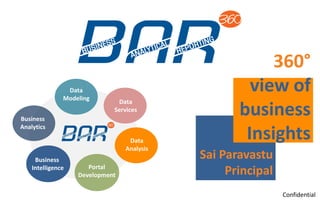
360°
view of
business
Insights
Data
Modeling
Business
Analytics
Portal
Development
Data
Services
Business
Intelligence
Data
Analysis
Confidential
BAR360 is an Australian DATA services business since 2005. We understand the information management
needs of Australian businesses and cater tailored business DATA solutions by integrating and improving their
data capabilities. BIRT is well open source Business Intelligence engine and we deliver development services,
integration, maintenance and training offerings tailored to business needs in the Australia and New Zealand
region. We also work with major BIRT OEM vendors like IBM, Micro focus, Schneider-Electric to name a few.
We have started our practice in Hadoop and NoSQL for data ingestion and processing in the world of BIG
Data
Our Value Proposition
We Provide Data Cleansing, Quality, Loading, Processing and Reporting services
We source and manage DATA solutions focused on achieving ROI.
We bring reliability and trustworthiness through simplicity in our engagements with clients.
We develop, training and support in implementations.
We evangelize in open source technologies.
We source local IT resources in projects and stand by our team.
Who is BAR360
Confidential
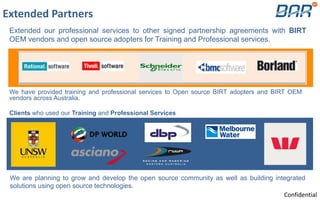
Extended Partners
We have provided training and professional services to Open source BIRT adopters and BIRT OEM
vendors across Australia.
Clients who used our Training and Professional Services
We are planning to grow and develop the open source community as well as building integrated
solutions using open source technologies.
Extended our professional services to other signed partnership agreements with BIRT
OEM vendors and open source adopters for Training and Professional services.
Confidential
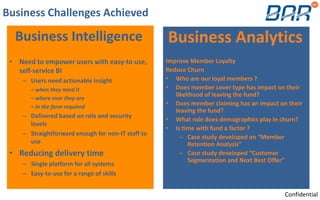
Business Challenges Achieved
Business Intelligence
• Need to empower users with easy-to use,
self-service BI
– Users need actionable insight
– when they need it
– where ever they are
– in the form required
– Delivered based on role and security
levels
– Straightforward enough for non-IT staff to
use
• Reducing delivery time
– Single platform for all systems
– Easy-to-use for a range of skills
Business Analytics
Improve Member Loyalty
Reduce Churn
• Who are our loyal members ?
• Does member cover type has impact on their
likelihood of leaving the fund?
• Does member claiming has an impact on their
leaving the fund?
• What role does demographics play in churn?
• Is time with fund a factor ?
– Case study developed on “Member
Retention Analysis”
– Case study developed “Customer
Segmentation and Next Best Offer”
Confidential
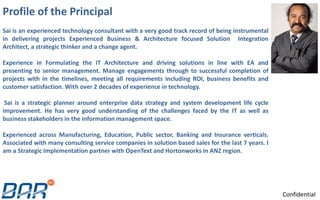
Profile of the Principal
Confidential
Sai is an experienced technology consultant with a very good track record of being instrumental
in delivering projects Experienced Business & Architecture focused Solution Integration
Architect, a strategic thinker and a change agent.
Experience in Formulating the IT Architecture and driving solutions in line with EA and
presenting to senior management. Manage engagements through to successful completion of
projects with in the timelines, meeting all requirements including ROI, business benefits and
customer satisfaction. With over 2 decades of experience in technology.
Sai is a strategic planner around enterprise data strategy and system development life cycle
improvement. He has very good understanding of the challenges faced by the IT as well as
business stakeholders in the information management space.
Experienced across Manufacturing, Education, Public sector, Banking and Insurance verticals.
Associated with many consulting service companies in solution based sales for the last 7 years. I
am a Strategic Implementation partner with OpenText and Hortonworks in ANZ region.
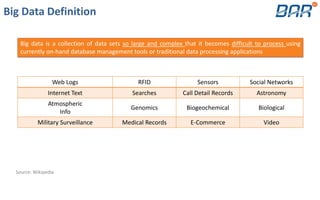
Big Data Definition
Big data is a collection of data sets so large and complex that it becomes difficult to process using
currently on-hand database management tools or traditional data processing applications
Source: Wikipedia
Web Logs RFID Sensors Social Networks
Internet Text Searches Call Detail Records Astronomy
Atmospheric
Info
Genomics Biogeochemical Biological
Military Surveillance Medical Records E-Commerce Video
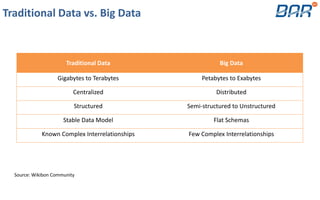
Traditional Data vs. Big Data
Traditional Data Big Data
Gigabytes to Terabytes Petabytes to Exabytes
Centralized Distributed
Structured Semi-structured to Unstructured
Stable Data Model Flat Schemas
Known Complex Interrelationships Few Complex Interrelationships
Source: Wikibon Community
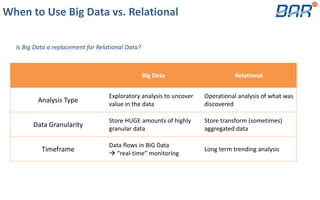
When to Use Big Data vs. Relational
Big Data Relational
Analysis Type
Exploratory analysis to uncover
value in the data
Operational analysis of what was
discovered
Data Granularity
Store HUGE amounts of highly
granular data
Store transform (sometimes)
aggregated data
Timeframe
Data flows in BIG Data
 “real-time” monitoring
Long term trending analysis
Is Big Data a replacement for Relational Data?
Why BIG Data
In a nutshell, the quest for Big Data is directly
attributable to analytics, which has evolved from being a
business initiative to a business imperative.
Many vendors are talking about Big Data, but we’re not
seeing much more than the ability to store large
volumes of data, leaving the organization to “roll
their own” applications without much help to make
sense of it all. Real value can only emerge from a
consumable analytics platform that saves you from
having to build applications from scratch one that
effectively flattens the time-to-insight curve.
In my opinion BIG Data is truly all about analytics.
Confidential
New Approaches To Big Data Processing & Analytics
Traditional tools and technologies are straining
• New approaches to data processing
– Commodity hardware to scale
– Parallel processing techniques
– Non-relational data storage capabilities
– Unstructured, semi-structured data
• Better analytics
– Advanced visualization
– Data mining
Source: Wikibon Community
Confidential
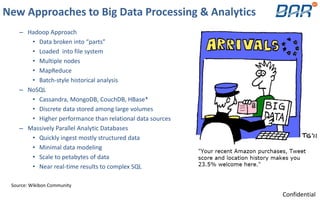
New Approaches to Big Data Processing & Analytics
– Hadoop Approach
• Data broken into “parts”
• Loaded into file system
• Multiple nodes
• MapReduce
• Batch-style historical analysis
– NoSQL
• Cassandra, MongoDB, CouchDB, HBase*
• Discrete data stored among large volumes
• Higher performance than relational data sources
– Massively Parallel Analytic Databases
• Quickly ingest mostly structured data
• Minimal data modeling
• Scale to petabytes of data
• Near real-time results to complex SQL
Source: Wikibon Community
Confidential
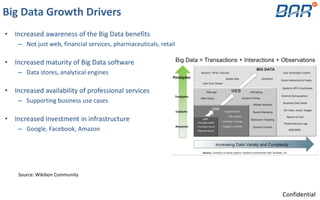
Big Data Growth Drivers
• Increased awareness of the Big Data benefits
– Not just web, financial services, pharmaceuticals, retail
• Increased maturity of Big Data software
– Data stores, analytical engines
• Increased availability of professional services
– Supporting business use cases
• Increased investment in infrastructure
– Google, Facebook, Amazon
Source: Wikibon Community
Confidential
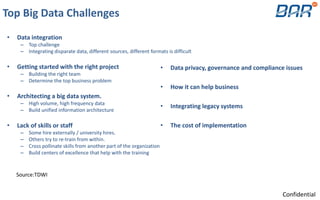
Top Big Data Challenges
• Data integration
– Top challenge
– Integrating disparate data, different sources, different formats is difficult
• Getting started with the right project
– Building the right team
– Determine the top business problem
• Architecting a big data system.
– High volume, high frequency data
– Build unified information architecture
• Lack of skills or staff
– Some hire externally / university hires.
– Others try to re-train from within.
– Cross pollinate skills from another part of the organization
– Build centers of excellence that help with the training
Source:TDWI
• Data privacy, governance and compliance issues
• How it can help business
• Integrating legacy systems
• The cost of implementation
Confidential
Apache Software Foundation – ASF
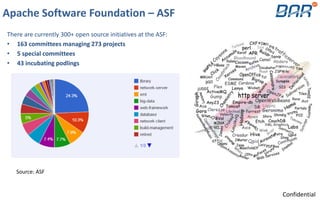
There are currently 300+ open source initiatives at the ASF:
• 163 committees managing 273 projects
• 5 special committees
• 43 incubating podlings
Source: ASF
Confidential
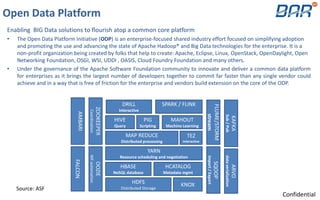
Open Data Platform
Enabling BIG Data solutions to flourish atop a common core platform
• The Open Data Platform Initiative (ODP) is an enterprise-focused shared industry effort focused on simplifying adoption
and promoting the use and advancing the state of Apache Hadoop® and Big Data technologies for the enterprise. It is a
non-profit organization being created by folks that help to create: Apache, Eclipse, Linux, OpenStack, OpenDaylight, Open
Networking Foundation, OSGI, WSI, UDDI , OASIS, Cloud Foundry Foundation and many others.
• Under the governance of the Apache Software Foundation community to innovate and deliver a common data platform
for enterprises as it brings the largest number of developers together to commit far faster than any single vendor could
achieve and in a way that is free of friction for the enterprise and vendors build extension on the core of the ODP.
Source: ASF
HIVE
Query
PIG
Scripting
MAHOUT
Machine Learning
MAP REDUCE
Distributed processing
YARN
Resource scheduling and negotiation
HDFS
Distributed Storage
HCATALOG
Metadata mgmt
HBASE
NoSQL database
SQOOP
Import/Export
FLUME/STORM
stream
KAFKA
Sub/Pub
ZOOKEEPER
Coordination
OOZIE
WFautomation
AMBARI
DRILL
Interactive
SPARK / FLINK
FALCON
KNOX
TEZ
Interactive
ARVO
dataserialization
Confidential
Benefits of ODP
Enabling BIG Data solutions to flourish atop a common core platform
The ODP core is a set of open source Hadoop technologies designed to provide a standardized core that big data solution
providers software and hardware developers can use to deliver compatible solutions rooted in open source that unlock
customer choice.
Source: ODP
How do we benefit:
ASF
- 100% focus on enabling collaboration between developers
- does not recognize corporations
- projects are on completely asynchronous development cycles
ODP
- Enables collaboration between vendors
- Focused on developing a platform , but does not supersede governance
- creates complimentary brand value for integrated platform
- focused on enterprise use case for hadoop
Confidential
ODP Core will initially focus on Apache Hadoop (inclusive of HDFS, YARN, and MapReduce) and Apache Ambari.
Once the ODP members and processes are well established, the scope of the ODP Core may expand to include
other open source projects.
The ODP Core will deliver the following benefits:
• For Apache Hadoop technology vendors, reduced R&D costs that come from a shared qualification effort
• For Big Data application solution providers, reduced R&D costs that come from more predictable and better
qualified releases
• Improved interoperability within the platform and simplified integration with existing systems in support of a
broad set of use cases
• Less friction and confusion for Enterprise customers and vendors
• Ability to redirect resources towards higher value efforts
Benefits of ODP
Source: ODP Confidential
1. Provide a stable base against which Big Data solutions providers can qualify solutions.
2. Support community development and outreach activities that accelerate the rollout of modern data
architectures that leverage Apache Hadoop
3. Contribute to ASF projects in accordance with ASF processes and Intellectual Property guidelines.
4. Accelerate the delivery of Big Data solutions by providing a well-defined core platform to target.
5. Define, integrate, test, and certify a standard "ODP Core" of compatible versions of select Big Data open
source projects.
6. Produce a set of tools and methods that enable members to create and test differentiated offerings based
on the ODP Core.
7. Reinforce the role of the Apache Software Foundation (ASF) in the development and governance of
upstream projects.
8. Help minimize the fragmentation and duplication of effort within the industry
ODP Delivers
The ODP Core will take the guesswork out of the process and accelerate many use cases by running on a
common platform.
Freeing up enterprises and ecosystem vendors to focus on building business driven applications.
Source: ODP Confidential
Thank You Partners
Confidential
BAR360
Sai Paravastu
Principal
+61 402 449 524
sai@bar360.com.au
www.bar360.com.au

BAR360 open data platform presentation at DAMA, Sydney

  • 1.
    Sai Paravastu Principal, BAR360 OpenData Platform Why open source has taken precedence in making a common data platform for enterprises ? DAMA Sydney Chapter 11th August 2015
  • 2.
  • 3.
    BAR360 is anAustralian DATA services business since 2005. We understand the information management needs of Australian businesses and cater tailored business DATA solutions by integrating and improving their data capabilities. BIRT is well open source Business Intelligence engine and we deliver development services, integration, maintenance and training offerings tailored to business needs in the Australia and New Zealand region. We also work with major BIRT OEM vendors like IBM, Micro focus, Schneider-Electric to name a few. We have started our practice in Hadoop and NoSQL for data ingestion and processing in the world of BIG Data Our Value Proposition We Provide Data Cleansing, Quality, Loading, Processing and Reporting services We source and manage DATA solutions focused on achieving ROI. We bring reliability and trustworthiness through simplicity in our engagements with clients. We develop, training and support in implementations. We evangelize in open source technologies. We source local IT resources in projects and stand by our team. Who is BAR360 Confidential
  • 4.
    Extended Partners We haveprovided training and professional services to Open source BIRT adopters and BIRT OEM vendors across Australia. Clients who used our Training and Professional Services We are planning to grow and develop the open source community as well as building integrated solutions using open source technologies. Extended our professional services to other signed partnership agreements with BIRT OEM vendors and open source adopters for Training and Professional services. Confidential
  • 5.
    Business Challenges Achieved BusinessIntelligence • Need to empower users with easy-to use, self-service BI – Users need actionable insight – when they need it – where ever they are – in the form required – Delivered based on role and security levels – Straightforward enough for non-IT staff to use • Reducing delivery time – Single platform for all systems – Easy-to-use for a range of skills Business Analytics Improve Member Loyalty Reduce Churn • Who are our loyal members ? • Does member cover type has impact on their likelihood of leaving the fund? • Does member claiming has an impact on their leaving the fund? • What role does demographics play in churn? • Is time with fund a factor ? – Case study developed on “Member Retention Analysis” – Case study developed “Customer Segmentation and Next Best Offer” Confidential
  • 6.
    Profile of thePrincipal Confidential Sai is an experienced technology consultant with a very good track record of being instrumental in delivering projects Experienced Business & Architecture focused Solution Integration Architect, a strategic thinker and a change agent. Experience in Formulating the IT Architecture and driving solutions in line with EA and presenting to senior management. Manage engagements through to successful completion of projects with in the timelines, meeting all requirements including ROI, business benefits and customer satisfaction. With over 2 decades of experience in technology. Sai is a strategic planner around enterprise data strategy and system development life cycle improvement. He has very good understanding of the challenges faced by the IT as well as business stakeholders in the information management space. Experienced across Manufacturing, Education, Public sector, Banking and Insurance verticals. Associated with many consulting service companies in solution based sales for the last 7 years. I am a Strategic Implementation partner with OpenText and Hortonworks in ANZ region.
  • 7.
    Big Data Definition Bigdata is a collection of data sets so large and complex that it becomes difficult to process using currently on-hand database management tools or traditional data processing applications Source: Wikipedia Web Logs RFID Sensors Social Networks Internet Text Searches Call Detail Records Astronomy Atmospheric Info Genomics Biogeochemical Biological Military Surveillance Medical Records E-Commerce Video
  • 8.
    Traditional Data vs.Big Data Traditional Data Big Data Gigabytes to Terabytes Petabytes to Exabytes Centralized Distributed Structured Semi-structured to Unstructured Stable Data Model Flat Schemas Known Complex Interrelationships Few Complex Interrelationships Source: Wikibon Community
  • 9.
    When to UseBig Data vs. Relational Big Data Relational Analysis Type Exploratory analysis to uncover value in the data Operational analysis of what was discovered Data Granularity Store HUGE amounts of highly granular data Store transform (sometimes) aggregated data Timeframe Data flows in BIG Data  “real-time” monitoring Long term trending analysis Is Big Data a replacement for Relational Data?
  • 10.
    Why BIG Data Ina nutshell, the quest for Big Data is directly attributable to analytics, which has evolved from being a business initiative to a business imperative. Many vendors are talking about Big Data, but we’re not seeing much more than the ability to store large volumes of data, leaving the organization to “roll their own” applications without much help to make sense of it all. Real value can only emerge from a consumable analytics platform that saves you from having to build applications from scratch one that effectively flattens the time-to-insight curve. In my opinion BIG Data is truly all about analytics. Confidential
  • 11.
    New Approaches ToBig Data Processing & Analytics Traditional tools and technologies are straining • New approaches to data processing – Commodity hardware to scale – Parallel processing techniques – Non-relational data storage capabilities – Unstructured, semi-structured data • Better analytics – Advanced visualization – Data mining Source: Wikibon Community Confidential
  • 12.
    New Approaches toBig Data Processing & Analytics – Hadoop Approach • Data broken into “parts” • Loaded into file system • Multiple nodes • MapReduce • Batch-style historical analysis – NoSQL • Cassandra, MongoDB, CouchDB, HBase* • Discrete data stored among large volumes • Higher performance than relational data sources – Massively Parallel Analytic Databases • Quickly ingest mostly structured data • Minimal data modeling • Scale to petabytes of data • Near real-time results to complex SQL Source: Wikibon Community Confidential
  • 13.
    Big Data GrowthDrivers • Increased awareness of the Big Data benefits – Not just web, financial services, pharmaceuticals, retail • Increased maturity of Big Data software – Data stores, analytical engines • Increased availability of professional services – Supporting business use cases • Increased investment in infrastructure – Google, Facebook, Amazon Source: Wikibon Community Confidential
  • 14.
    Top Big DataChallenges • Data integration – Top challenge – Integrating disparate data, different sources, different formats is difficult • Getting started with the right project – Building the right team – Determine the top business problem • Architecting a big data system. – High volume, high frequency data – Build unified information architecture • Lack of skills or staff – Some hire externally / university hires. – Others try to re-train from within. – Cross pollinate skills from another part of the organization – Build centers of excellence that help with the training Source:TDWI • Data privacy, governance and compliance issues • How it can help business • Integrating legacy systems • The cost of implementation Confidential
  • 15.
    Apache Software Foundation– ASF There are currently 300+ open source initiatives at the ASF: • 163 committees managing 273 projects • 5 special committees • 43 incubating podlings Source: ASF Confidential
  • 16.
    Open Data Platform EnablingBIG Data solutions to flourish atop a common core platform • The Open Data Platform Initiative (ODP) is an enterprise-focused shared industry effort focused on simplifying adoption and promoting the use and advancing the state of Apache Hadoop® and Big Data technologies for the enterprise. It is a non-profit organization being created by folks that help to create: Apache, Eclipse, Linux, OpenStack, OpenDaylight, Open Networking Foundation, OSGI, WSI, UDDI , OASIS, Cloud Foundry Foundation and many others. • Under the governance of the Apache Software Foundation community to innovate and deliver a common data platform for enterprises as it brings the largest number of developers together to commit far faster than any single vendor could achieve and in a way that is free of friction for the enterprise and vendors build extension on the core of the ODP. Source: ASF HIVE Query PIG Scripting MAHOUT Machine Learning MAP REDUCE Distributed processing YARN Resource scheduling and negotiation HDFS Distributed Storage HCATALOG Metadata mgmt HBASE NoSQL database SQOOP Import/Export FLUME/STORM stream KAFKA Sub/Pub ZOOKEEPER Coordination OOZIE WFautomation AMBARI DRILL Interactive SPARK / FLINK FALCON KNOX TEZ Interactive ARVO dataserialization Confidential
  • 17.
    Benefits of ODP EnablingBIG Data solutions to flourish atop a common core platform The ODP core is a set of open source Hadoop technologies designed to provide a standardized core that big data solution providers software and hardware developers can use to deliver compatible solutions rooted in open source that unlock customer choice. Source: ODP How do we benefit: ASF - 100% focus on enabling collaboration between developers - does not recognize corporations - projects are on completely asynchronous development cycles ODP - Enables collaboration between vendors - Focused on developing a platform , but does not supersede governance - creates complimentary brand value for integrated platform - focused on enterprise use case for hadoop Confidential
  • 18.
    ODP Core willinitially focus on Apache Hadoop (inclusive of HDFS, YARN, and MapReduce) and Apache Ambari. Once the ODP members and processes are well established, the scope of the ODP Core may expand to include other open source projects. The ODP Core will deliver the following benefits: • For Apache Hadoop technology vendors, reduced R&D costs that come from a shared qualification effort • For Big Data application solution providers, reduced R&D costs that come from more predictable and better qualified releases • Improved interoperability within the platform and simplified integration with existing systems in support of a broad set of use cases • Less friction and confusion for Enterprise customers and vendors • Ability to redirect resources towards higher value efforts Benefits of ODP Source: ODP Confidential
  • 19.
    1. Provide astable base against which Big Data solutions providers can qualify solutions. 2. Support community development and outreach activities that accelerate the rollout of modern data architectures that leverage Apache Hadoop 3. Contribute to ASF projects in accordance with ASF processes and Intellectual Property guidelines. 4. Accelerate the delivery of Big Data solutions by providing a well-defined core platform to target. 5. Define, integrate, test, and certify a standard "ODP Core" of compatible versions of select Big Data open source projects. 6. Produce a set of tools and methods that enable members to create and test differentiated offerings based on the ODP Core. 7. Reinforce the role of the Apache Software Foundation (ASF) in the development and governance of upstream projects. 8. Help minimize the fragmentation and duplication of effort within the industry ODP Delivers The ODP Core will take the guesswork out of the process and accelerate many use cases by running on a common platform. Freeing up enterprises and ecosystem vendors to focus on building business driven applications. Source: ODP Confidential
  • 20.
    Thank You Partners Confidential BAR360 SaiParavastu Principal +61 402 449 524 sai@bar360.com.au www.bar360.com.au