25 They asked him, “Then why are you baptizing, if you are
neither the Christ, nor Elijah, nor the Prophet?” 26 John
answered them, “I baptize with water, but among you
stands one you do not know, 27 even he who comes after
me, the strap of whose sandal I am not worthy to untie.”
28 These things took place in Bethany across the Jordan,

where John was baptizing.
   At this point, we see the narrative of Jesus kick off with John the
    Baptist being questioned on baptism by the Pharisee’s. In the prior
    verse (see John 1:23), John the Baptist had already stated that his
    purpose was to make straight the way of the Lord (see Isaiah 40:2-
    4).
   At this point, he (John the Baptist) had been preaching repentance
    & baptizing (see Matthew 3:11; Mark 1:4, Luke 3:3) people who
    came to him to hear the message.
   To the Pharisee’s, this became an issue of authority (see John 1:25)
    because John was neither the Christ, Elijah, nor some other
    recognized prophet.
   Baptism: What is it?
     It is a symbol representing our literal burial & resurrection w/Christ (see
      Colossians 2:11-12; Romans 6:3)
     Colossians 2:11-12
       ▪   11 In
               him also you were circumcised with a circumcision made without hands, by putting off
           the body of the flesh, by the circumcision of Christ, 12 having been buried with him in baptism,
           in which you were also raised with him through faith in the powerful working of God, who
           raised him from the dead.
     Romans 6:3
       ▪   3 Do you not know that all of us who have been baptized into Christ Jesus were baptized into
           his death?

           How does it (practically) work?
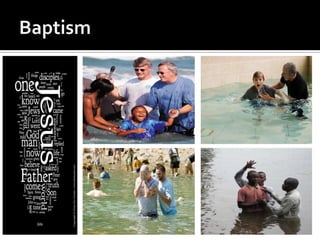
     As we saw in the pictures before, you begin by standing, sitting, or kneeling in
      some water. Another Christian then lowers you under the water and brings
      you back up out of the water.
   Who can be baptized? Anyone making a profession of faith who
    desires can & should be baptized. Examples include
     Tax Collectors (Luke 3:12)
     Samaritans (Acts 8:12)
     Parthians, Medes, Elamites, Mesopotamians, Judeans, Cappadocians,
        Pontifians, Asians, Phrygians, Pamphylians, Egyptians, Lybians, Cyreneans,
        Romans, Jews, non-jews, Cretans & Arabs – in other words…ALL (Acts 2:9-11)
       Those w/disabilities & the religious (Acts 9:18)
       Entire households (Acts 10:47-48)
       Women (Acts 16:14-15)
       Pharisees & Rulers of Synagogues (Acts 18:8)
       ALL nations (Matthew. 28:19)
   If baptism is a product of repentance than why was Jesus baptized?
    (NOTE: We will be discussing this next week)
   Talk about your baptism experience?
   What have you accomplished in the context of missiology
    (missional theology) since your baptism?

Baptism

  • 2.
    25 They askedhim, “Then why are you baptizing, if you are neither the Christ, nor Elijah, nor the Prophet?” 26 John answered them, “I baptize with water, but among you stands one you do not know, 27 even he who comes after me, the strap of whose sandal I am not worthy to untie.” 28 These things took place in Bethany across the Jordan, where John was baptizing.
  • 3.
    At this point, we see the narrative of Jesus kick off with John the Baptist being questioned on baptism by the Pharisee’s. In the prior verse (see John 1:23), John the Baptist had already stated that his purpose was to make straight the way of the Lord (see Isaiah 40:2- 4).  At this point, he (John the Baptist) had been preaching repentance & baptizing (see Matthew 3:11; Mark 1:4, Luke 3:3) people who came to him to hear the message.  To the Pharisee’s, this became an issue of authority (see John 1:25) because John was neither the Christ, Elijah, nor some other recognized prophet.
  • 4.
    Baptism: What is it?  It is a symbol representing our literal burial & resurrection w/Christ (see Colossians 2:11-12; Romans 6:3)  Colossians 2:11-12 ▪ 11 In him also you were circumcised with a circumcision made without hands, by putting off the body of the flesh, by the circumcision of Christ, 12 having been buried with him in baptism, in which you were also raised with him through faith in the powerful working of God, who raised him from the dead.  Romans 6:3 ▪ 3 Do you not know that all of us who have been baptized into Christ Jesus were baptized into his death? How does it (practically) work?  As we saw in the pictures before, you begin by standing, sitting, or kneeling in some water. Another Christian then lowers you under the water and brings you back up out of the water.
  • 6.
    Who can be baptized? Anyone making a profession of faith who desires can & should be baptized. Examples include  Tax Collectors (Luke 3:12)  Samaritans (Acts 8:12)  Parthians, Medes, Elamites, Mesopotamians, Judeans, Cappadocians, Pontifians, Asians, Phrygians, Pamphylians, Egyptians, Lybians, Cyreneans, Romans, Jews, non-jews, Cretans & Arabs – in other words…ALL (Acts 2:9-11)  Those w/disabilities & the religious (Acts 9:18)  Entire households (Acts 10:47-48)  Women (Acts 16:14-15)  Pharisees & Rulers of Synagogues (Acts 18:8)  ALL nations (Matthew. 28:19)
  • 7.
    If baptism is a product of repentance than why was Jesus baptized? (NOTE: We will be discussing this next week)  Talk about your baptism experience?  What have you accomplished in the context of missiology (missional theology) since your baptism?