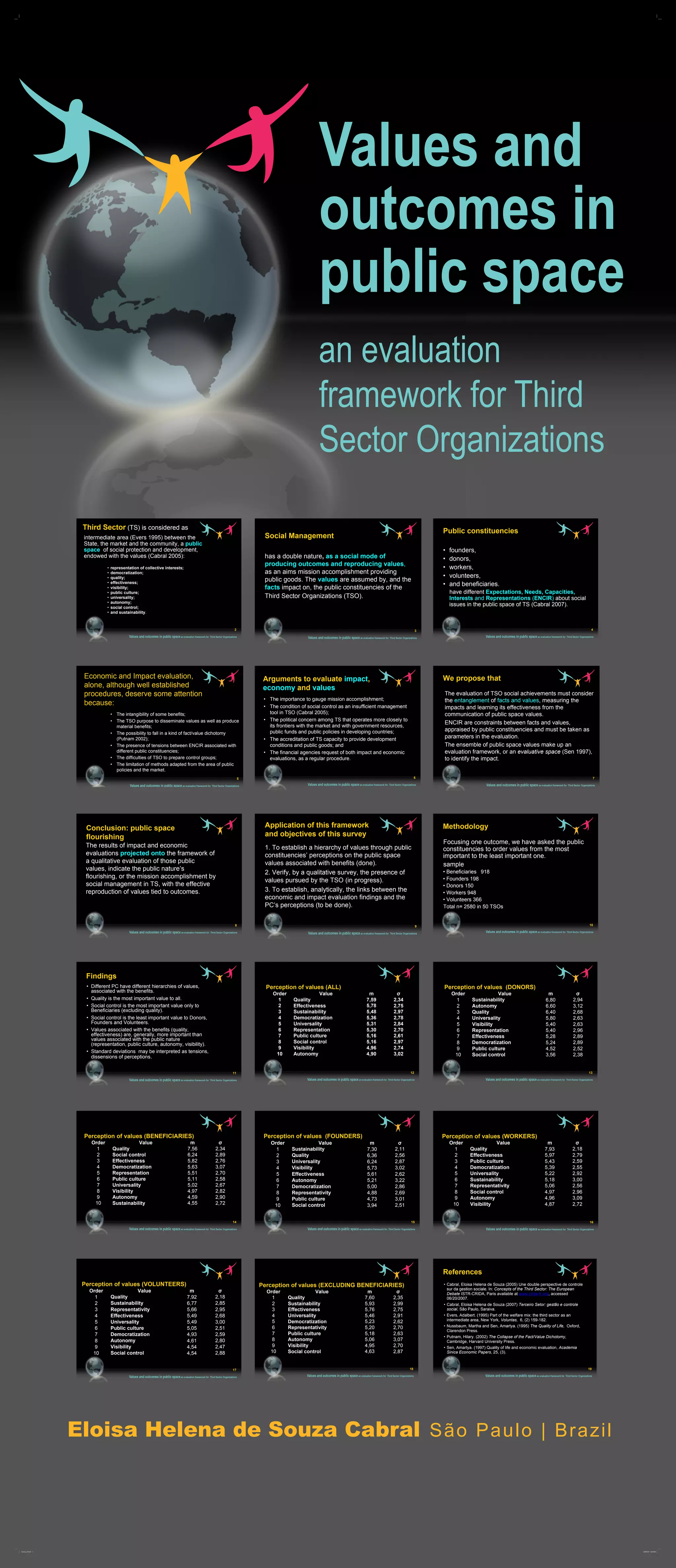
Third Sector organizations operate in the public space between the state, market, and community. They produce both social outcomes and reproduce important values like representation, democratization, quality, effectiveness, and sustainability. These values are important to various public constituencies like founders, donors, workers, volunteers, and beneficiaries, who may have different expectations and interests.
Evaluating Third Sector organizations requires considering both the impacts produced and how effectively values are communicated to constituencies. The values make up an evaluative framework to identify impact. This study aims to establish a hierarchy of values through public perceptions, verify the presence of important values through a qualitative survey, and analyze how economic/impact evaluations link to perceptions of different constituencies.