Analysis of pseudo-medical methods, drugs &
devices using the Patents Libraries
Sergey Soshnikov
MD, Ph.D.
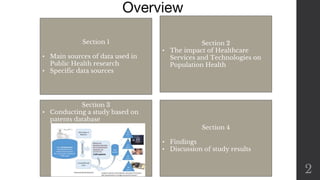
Overview
2
Section 1
• Main sources of data used in
Public Health research
• Specific data sources
Section 2
• The impact of Healthcare
Services and Technologies on
Population Health
Section 4
• Findings
• Discussion of study results
Section 3
• Conducting a study based on
patents database
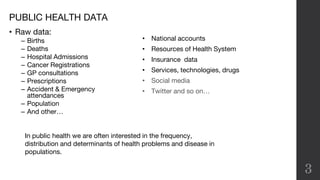
PUBLIC HEALTH DATA
3
• National accounts
• Resources of Health System
• Insurance data
• Services, technologies, drugs
• Social media
• Twitter and so on…
In public health we are often interested in the frequency,
distribution and determinants of health problems and disease in
populations.
• Raw data:
– Births
– Deaths
– Hospital Admissions
– Cancer Registrations
– GP consultations
– Prescriptions
– Accident & Emergency
attendances
– Population
– And other…
Data Catalogs and Repositories
•International Household Survey Network
•Integrated Public Use Microdata Series International (IPUMS-I)
•Integrated Public Use Microdata Series USA (IPUMS-USA)
•Simple Online Data Archive for Population Studies (SodaPop)
•Synapse (formerly Sage Bionetworks Repository)
•HealthData.Gov (USA)
Country Open Data Sites
•United States
Data Archives
•Inter-University Consortium for Political and Social Research (ICPSR)
•Dataverse from IQSS (Institute for Quantitative Social Science at Harvard
University)
Health (Indicator) Databases
•WHO Global Health Observatory
•World Bank Open Data
•European Health for All Database (HFA/DB)
•CDC Wonder (USA)
•Health Indicators Warehouse (USA)
Free Online
Databases
Available for All
4
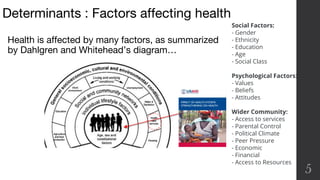
Determinants : Factors affecting health
5
Health is affected by many factors, as summarized
by Dahlgren and Whitehead’s diagram…
Social Factors:
- Gender
- Ethnicity
- Education
- Age
- Social Class
Psychological Factors:
- Values
- Beliefs
- Attitudes
Wider Community:
- Access to services
- Parental Control
- Political Climate
- Peer Pressure
- Economic
- Financial
- Access to Resources
What is Open Source for HTA?
6
• The Cochrane and other Systematic Reviews and Meta-
analyses Libraries
• PubMed with tons of RCT and papers with other types of CT
• RTC registries (unpublished data)
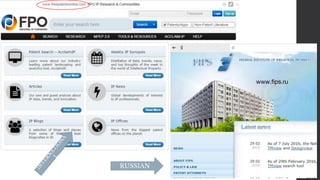
• Patents on medical technologies, drugs and devices
7RUSSIAN
www.fips.ru
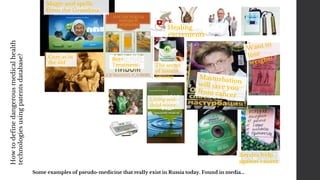
Some examples of pseudo-medicine that really exist in Russia today. Found in media...
Healing
excrements
The secret
of instant
healing
Magic and spells
from the Grandma
Beer
Treatment
Living and
dead water
Berries help
against cancer
Cure as in
the old
Howtodefinedangerousmedicalhealth
technologiesusingpatentsdatabase?
9
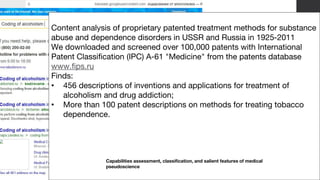
Content analysis of proprietary patented treatment methods for substance
abuse and dependence disorders in USSR and Russia in 1925-2011
We downloaded and screened over 100,000 patents with International
Patent Classification (IPC) A-61 "Medicine" from the patents database
www.fips.ru
Finds:
• 456 descriptions of inventions and applications for treatment of
alcoholism and drug addiction;
• More than 100 patent descriptions on methods for treating tobacco
dependence.
Capabilities assessment, classification, and salient features of medical
pseudoscience
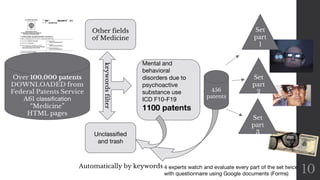
10
Over 100,000 patents
DOWNLOADED from
Federal Patents Service
A61 classification
“Medicine”
HTML pages
keywordsfilter
Other fields
of Medicine
Mental and
behavioral
disorders due to
psychoactive
substance use
ICD F10-F19
1100 patents
Unclassified
and trash
Set
part
1
Set
part
2
Set
part
3
4 experts watch and evaluate every part of the set twice
with questionnaire using Google documents (Forms)
Automatically by keywords
456
patents
11
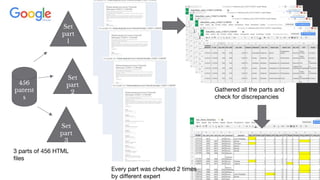
Set
part
1
Set
part
2
Set
part
3
456
patent
s
3 parts of 456 HTML
files
Every part was checked 2 times
by different expert
Gathered all the parts and
check for discrepancies
12
Most patents on drug and alcohol treatment were registered in the period 1991-2007.
The first application was done in 1957.
Years
Numberofdocuments
13
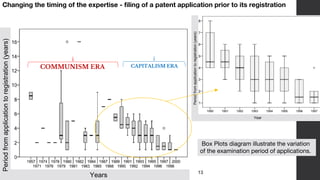
Changing the timing of the expertise - filing of a patent application prior to its registration
COMMUNISM ERA CAPITALISM ERA
Periodfromapplicationtoregistration(years)
Years
Year
Periodfromapplicationtoregistration(years)
Box Plots diagram illustrate the variation
of the examination period of applications.
14
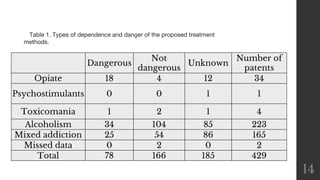
Table 1. Types of dependence and danger of the proposed treatment
methods.
Dangerous
Not
dangerous
Unknown
Number of
patents
Opiate 18 4 12 34
Psychostimulants 0 0 1 1
Toxicomania 1 2 1 4
Alcoholism 34 104 85 223
Mixed addiction 25 54 86 165
Missed data 0 2 0 2
Total 78 166 185 429
15
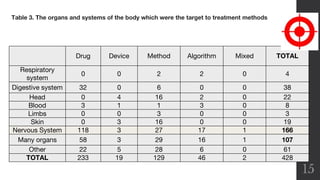
Drug Device Method Algorithm Mixed TOTAL
Respiratory
system
0 0 2 2 0 4
Digestive system 32 0 6 0 0 38
Head 0 4 16 2 0 22
Blood 3 1 1 3 0 8
Limbs 0 0 3 0 0 3
Skin 0 3 16 0 0 19
Nervous System 118 3 27 17 1 166
Many organs 58 3 29 16 1 107
Other 22 5 28 6 0 61
TOTAL 233 19 129 46 2 428
Table 3. The organs and systems of the body which were the target to treatment methods
16
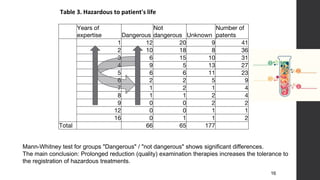
Table 3. Hazardous to patient's life
Years of
expertise Dangerous
Not
dangerous Unknown
Number of
patents
1 12 20 9 41
2 10 18 8 36
3 6 15 10 31
4 9 5 13 27
5 6 6 11 23
6 2 2 5 9
7 1 2 1 4
8 1 1 2 4
9 0 0 2 2
12 0 0 1 1
16 0 1 1 2
Total 66 65 177
Mann-Whitney test for groups "Dangerous" / "not dangerous" shows significant differences.
The main conclusion: Prolonged reduction (quality) examination therapies increases the tolerance to
the registration of hazardous treatments.
17
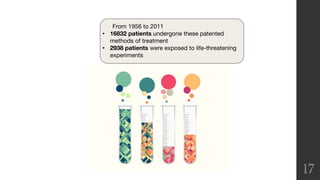
From 1956 to 2011
• 16832 patients undergone these patented
methods of treatment
• 2938 patients were exposed to life-threatening
experiments
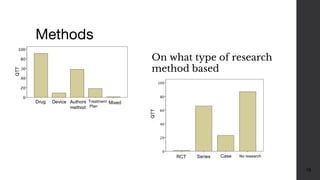
Methods
18
On what type of research
method based
Drug Device Authors
method
Treatment
Plan
Mixed
RCT Series Case No research
QTT
QTT
19
METHOD FOR TREATMENT OF
SUBSTANCE ADDICTION and
alcohol:
"... Used an electrical current with
the parameters that cause the
development of unilateral
convulsive fit"
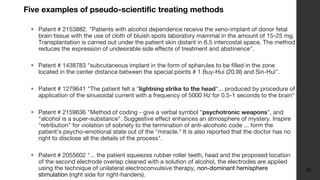
Five examples of pseudo-scientific treating methods
 Patent # 2153882. "Patients with alcohol dependence receive the xeno-implant of donor fetal
brain tissue with the use of cloth of bluish spots laboratory mammal in the amount of 15-25 mg.
Transplantation is carried out under the patient skin distant in 6.5 intercostal space. The method
reduces the expression of undesirable side effects of treatment and abstinence".
 Patent # 1438783 "subcutaneous implant in the form of spherules to be filled in the zone
located in the center distance between the special points # 1 Buy-Hui (20.III) and Sin-Hui".
 Patent # 1279641 "The patient felt a "lightning strike to the head"... produced by procedure of
application of the sinusoidal current with a frequency of 5000 Hz for 0.5-1 seconds to the brain“
 Patent # 2159636 "Method of coding - give a verbal symbol "psychotronic weapons", and
“alcohol is a super-substance". Suggestive effect enhances an atmosphere of mystery. Inspire
"retribution" for violation of sobriety to the termination of anti-alcoholic code ... form the
patient's psycho-emotional state out of the "miracle." It is also reported that the doctor has no
right to disclose all the details of the process".
 Patent # 2055602 "... the patient squeezes rubber roller teeth, head and the proposed location
of the second electrode overlap cleaned with a solution of alcohol, the electrodes are applied
using the technique of unilateral electroconvulsive therapy, non-dominant hemisphere
stimulation (right side for right-handers).
20
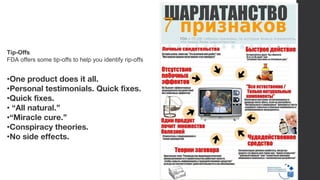
•One product does it all.
•Personal testimonials. Quick fixes.
•Quick fixes.
• “All natural.”
•“Miracle cure.”
•Conspiracy theories.
•No side effects.
Tip-Offs
FDA offers some tip-offs to help you identify rip-offs
Outcomes:
• Publications in main Newspapers and other media changed public opinion.
• TV shows and reports on TV have been noticed by the policymakers.
• The method that has been used for many years in grey zone has been studied.
• Changing regulation in the treatment of substance abuse and dependence in
Russia.
• Now «coding of alcoholism» is banned by the regulating authority.
23
Where does to complain about
the charlatans?
Contents of the quack treatment or questionable medical device or drug through
the system of electronic forms applications for citizens:
1. Rospotrebnadzor. Appeals on the facts of trade substandard goods, including,
Supplements, devices and pseudomedical services
http://rospotrebnadzor.ru/feedback/new.php
2. The Federal Antimonopoly Service (FAS). Accepted treatment of suspicious
advertising services and medical products http://fas.gov.ru/citizens/feedback/
3. The Ministry of Health of Russia. Accepted applications of citizens in any form
http://www.rosminzdrav.ru/reception/appeals/new
4. Rozdravnadzor. Regulator issuing permits for medical devices.
http://roszdravnadzor.ru/people

Analysisofpseudo medicalmethodsdrugsdevicesusingthepatentslibraries1-161013143047

  • 1.
    Analysis of pseudo-medicalmethods, drugs & devices using the Patents Libraries Sergey Soshnikov MD, Ph.D.
  • 2.
    Overview 2 Section 1 • Mainsources of data used in Public Health research • Specific data sources Section 2 • The impact of Healthcare Services and Technologies on Population Health Section 4 • Findings • Discussion of study results Section 3 • Conducting a study based on patents database
  • 3.
    PUBLIC HEALTH DATA 3 •National accounts • Resources of Health System • Insurance data • Services, technologies, drugs • Social media • Twitter and so on… In public health we are often interested in the frequency, distribution and determinants of health problems and disease in populations. • Raw data: – Births – Deaths – Hospital Admissions – Cancer Registrations – GP consultations – Prescriptions – Accident & Emergency attendances – Population – And other…
  • 4.
    Data Catalogs andRepositories •International Household Survey Network •Integrated Public Use Microdata Series International (IPUMS-I) •Integrated Public Use Microdata Series USA (IPUMS-USA) •Simple Online Data Archive for Population Studies (SodaPop) •Synapse (formerly Sage Bionetworks Repository) •HealthData.Gov (USA) Country Open Data Sites •United States Data Archives •Inter-University Consortium for Political and Social Research (ICPSR) •Dataverse from IQSS (Institute for Quantitative Social Science at Harvard University) Health (Indicator) Databases •WHO Global Health Observatory •World Bank Open Data •European Health for All Database (HFA/DB) •CDC Wonder (USA) •Health Indicators Warehouse (USA) Free Online Databases Available for All 4
  • 5.
    Determinants : Factorsaffecting health 5 Health is affected by many factors, as summarized by Dahlgren and Whitehead’s diagram… Social Factors: - Gender - Ethnicity - Education - Age - Social Class Psychological Factors: - Values - Beliefs - Attitudes Wider Community: - Access to services - Parental Control - Political Climate - Peer Pressure - Economic - Financial - Access to Resources
  • 6.
    What is OpenSource for HTA? 6 • The Cochrane and other Systematic Reviews and Meta- analyses Libraries • PubMed with tons of RCT and papers with other types of CT • RTC registries (unpublished data) • Patents on medical technologies, drugs and devices
  • 7.
  • 8.
    Some examples ofpseudo-medicine that really exist in Russia today. Found in media... Healing excrements The secret of instant healing Magic and spells from the Grandma Beer Treatment Living and dead water Berries help against cancer Cure as in the old Howtodefinedangerousmedicalhealth technologiesusingpatentsdatabase?
  • 9.
    9 Content analysis ofproprietary patented treatment methods for substance abuse and dependence disorders in USSR and Russia in 1925-2011 We downloaded and screened over 100,000 patents with International Patent Classification (IPC) A-61 "Medicine" from the patents database www.fips.ru Finds: • 456 descriptions of inventions and applications for treatment of alcoholism and drug addiction; • More than 100 patent descriptions on methods for treating tobacco dependence. Capabilities assessment, classification, and salient features of medical pseudoscience
  • 10.
    10 Over 100,000 patents DOWNLOADEDfrom Federal Patents Service A61 classification “Medicine” HTML pages keywordsfilter Other fields of Medicine Mental and behavioral disorders due to psychoactive substance use ICD F10-F19 1100 patents Unclassified and trash Set part 1 Set part 2 Set part 3 4 experts watch and evaluate every part of the set twice with questionnaire using Google documents (Forms) Automatically by keywords 456 patents
  • 11.
    11 Set part 1 Set part 2 Set part 3 456 patent s 3 parts of456 HTML files Every part was checked 2 times by different expert Gathered all the parts and check for discrepancies
  • 12.
    12 Most patents ondrug and alcohol treatment were registered in the period 1991-2007. The first application was done in 1957. Years Numberofdocuments
  • 13.
    13 Changing the timingof the expertise - filing of a patent application prior to its registration COMMUNISM ERA CAPITALISM ERA Periodfromapplicationtoregistration(years) Years Year Periodfromapplicationtoregistration(years) Box Plots diagram illustrate the variation of the examination period of applications.
  • 14.
    14 Table 1. Typesof dependence and danger of the proposed treatment methods. Dangerous Not dangerous Unknown Number of patents Opiate 18 4 12 34 Psychostimulants 0 0 1 1 Toxicomania 1 2 1 4 Alcoholism 34 104 85 223 Mixed addiction 25 54 86 165 Missed data 0 2 0 2 Total 78 166 185 429
  • 15.
    15 Drug Device MethodAlgorithm Mixed TOTAL Respiratory system 0 0 2 2 0 4 Digestive system 32 0 6 0 0 38 Head 0 4 16 2 0 22 Blood 3 1 1 3 0 8 Limbs 0 0 3 0 0 3 Skin 0 3 16 0 0 19 Nervous System 118 3 27 17 1 166 Many organs 58 3 29 16 1 107 Other 22 5 28 6 0 61 TOTAL 233 19 129 46 2 428 Table 3. The organs and systems of the body which were the target to treatment methods
  • 16.
    16 Table 3. Hazardousto patient's life Years of expertise Dangerous Not dangerous Unknown Number of patents 1 12 20 9 41 2 10 18 8 36 3 6 15 10 31 4 9 5 13 27 5 6 6 11 23 6 2 2 5 9 7 1 2 1 4 8 1 1 2 4 9 0 0 2 2 12 0 0 1 1 16 0 1 1 2 Total 66 65 177 Mann-Whitney test for groups "Dangerous" / "not dangerous" shows significant differences. The main conclusion: Prolonged reduction (quality) examination therapies increases the tolerance to the registration of hazardous treatments.
  • 17.
    17 From 1956 to2011 • 16832 patients undergone these patented methods of treatment • 2938 patients were exposed to life-threatening experiments
  • 18.
    Methods 18 On what typeof research method based Drug Device Authors method Treatment Plan Mixed RCT Series Case No research QTT QTT
  • 19.
    19 METHOD FOR TREATMENTOF SUBSTANCE ADDICTION and alcohol: "... Used an electrical current with the parameters that cause the development of unilateral convulsive fit"
  • 20.
    Five examples ofpseudo-scientific treating methods  Patent # 2153882. "Patients with alcohol dependence receive the xeno-implant of donor fetal brain tissue with the use of cloth of bluish spots laboratory mammal in the amount of 15-25 mg. Transplantation is carried out under the patient skin distant in 6.5 intercostal space. The method reduces the expression of undesirable side effects of treatment and abstinence".  Patent # 1438783 "subcutaneous implant in the form of spherules to be filled in the zone located in the center distance between the special points # 1 Buy-Hui (20.III) and Sin-Hui".  Patent # 1279641 "The patient felt a "lightning strike to the head"... produced by procedure of application of the sinusoidal current with a frequency of 5000 Hz for 0.5-1 seconds to the brain“  Patent # 2159636 "Method of coding - give a verbal symbol "psychotronic weapons", and “alcohol is a super-substance". Suggestive effect enhances an atmosphere of mystery. Inspire "retribution" for violation of sobriety to the termination of anti-alcoholic code ... form the patient's psycho-emotional state out of the "miracle." It is also reported that the doctor has no right to disclose all the details of the process".  Patent # 2055602 "... the patient squeezes rubber roller teeth, head and the proposed location of the second electrode overlap cleaned with a solution of alcohol, the electrodes are applied using the technique of unilateral electroconvulsive therapy, non-dominant hemisphere stimulation (right side for right-handers). 20
  • 22.
    •One product doesit all. •Personal testimonials. Quick fixes. •Quick fixes. • “All natural.” •“Miracle cure.” •Conspiracy theories. •No side effects. Tip-Offs FDA offers some tip-offs to help you identify rip-offs
  • 23.
    Outcomes: • Publications inmain Newspapers and other media changed public opinion. • TV shows and reports on TV have been noticed by the policymakers. • The method that has been used for many years in grey zone has been studied. • Changing regulation in the treatment of substance abuse and dependence in Russia. • Now «coding of alcoholism» is banned by the regulating authority. 23
  • 24.
    Where does tocomplain about the charlatans? Contents of the quack treatment or questionable medical device or drug through the system of electronic forms applications for citizens: 1. Rospotrebnadzor. Appeals on the facts of trade substandard goods, including, Supplements, devices and pseudomedical services http://rospotrebnadzor.ru/feedback/new.php 2. The Federal Antimonopoly Service (FAS). Accepted treatment of suspicious advertising services and medical products http://fas.gov.ru/citizens/feedback/ 3. The Ministry of Health of Russia. Accepted applications of citizens in any form http://www.rosminzdrav.ru/reception/appeals/new 4. Rozdravnadzor. Regulator issuing permits for medical devices. http://roszdravnadzor.ru/people