BAGONG BAYANI FINANCIAL
Overview
BUSINESS PROPOSITION:
Create a comprehensive, Filipino-centric
online money remittance, bill payment,
savings and financial consulting system
that helps Filipino Nationals working
oversees conveniently manage their
hard earned money.
Opportunity:
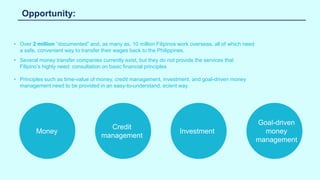
• Over 2 million “documented” and, as many as, 10 million Filipinos work overseas, all of which need
a safe, convenient way to transfer their wages back to the Philippines.
• Several money transfer companies currently exist, but they do not provide the services that
Filipino’s highly need: consultation on basic financial principles
• Principles such as time-value of money, credit management, investment, and goal-driven money
management need to be provided in an easy-to-understand, ecient way.
Money Investment
Goal-driven
money
management
Credit
management
Constraint
Many working class Filipinos have a reputation for being a “hand-to-mouth”,
“live for today” society.
Many working class Filipinos do not have a reputation of being smart
money managers. For the most part, the working class is known
more to be a “hand-to-mouth”, “live for today” society.
Therefore, creating a money management system that overcomes
this constraint will take more than creating an
ecient, easy-to-use delivery system.
Overcoming this Constraint:
• Bagong Bayani Financial will create a program that leans more towards education and consultation rather
than persuasion.
• Incentives (provided both by the Filipino government and Bagong Bayani Financial) such as
increasedsavings rates, tax incentives, points towards goods & services
The Market
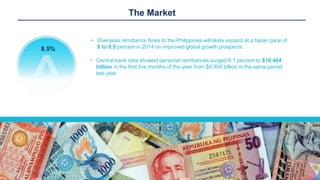
• Overseas remittance flows to the Philippines will likely expand at a faster pace of
8 to 8.5 percent in 2014 on improved global growth prospects.
• Central bank data showed personal remittances surged 6.1 percent to $10.404
billion in the first five months of the year from $9.809 billion in the same period
last year.
8.5%
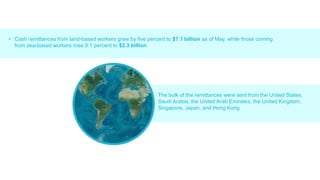
• Cash remittances from land-based workers grew by five percent to $7.1 billion as of May, while those coming
from sea-based workers rose 8.1 percent to $2.3 billion.
The bulk of the remittances were sent from the United States,
Saudi Arabia, the United Arab Emirates, the United Kingdom,
Singapore, Japan, and Hong Kong.
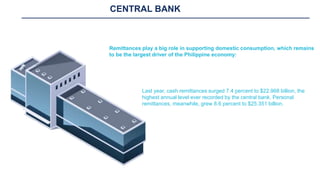
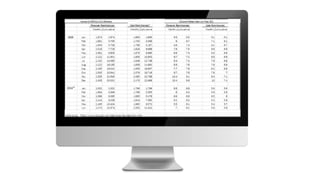
CENTRAL BANK
Remittances play a big role in supporting domestic consumption, which remains
to be the largest driver of the Philippine economy:
Last year, cash remittances surged 7.4 percent to $22.968 billion, the
highest annual level ever recorded by the central bank. Personal
remittances, meanwhile, grew 8.6 percent to $25.351 billion.
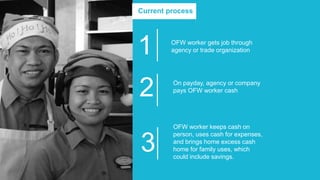
Current process
OFW worker gets job through
agency or trade organization
On payday, agency or company
pays OFW worker cash
OFW worker keeps cash on
person, uses cash for expenses,
and brings home excess cash
home for family uses, which
could include savings.
1
2
3
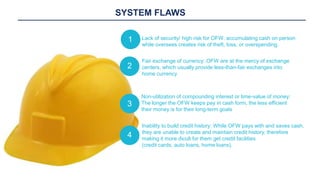
SYSTEM FLAWS
Lack of security/ high risk for OFW: accumulating cash on person
while oversees creates risk of theft, loss, or overspending.
Fair exchange of currency: OFW are at the mercy of exchange
centers, which usually provide less-than-fair exchanges into
home currency
Non-utilization of compounding interest or time-value of money:
The longer the OFW keeps pay in cash form, the less efficient
their money is for their long-term goals
Inability to build credit history: While OFW pays with and saves cash,
they are unable to create and maintain credit history, therefore
making it more dicult for them get credit facilities
(credit cards, auto loans, home loans).
1
2
3
4
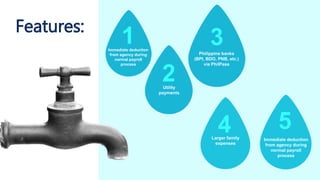
Features:
Immediate deduction
from agency during
normal payroll
process
Utility
payments
Philippine banks
(BPI, BDO, PNB, etc.)
via PhilPass
Immediate deduction
from agency during
normal payroll
process
Larger family
expenses
2
3
4 5
1
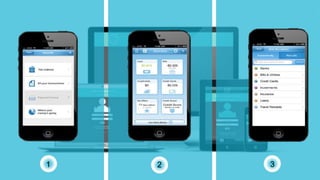
OFW has online access
• Utility payments (ie. Meralco, PLDT, Globe, etc.). Integration to the
remittance company will show current balance due/paid.
• Philippine banks (BPI, BDO, PNB, etc.) via PhilPass
• Larger family expenses (rent payment to landlord’s bank account,
auto loan, etc.)
• Debit cards
• Savings/Investment account /Time Deposit
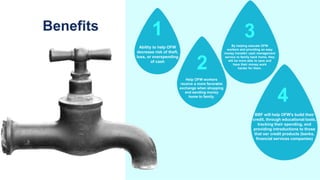
Benefits
Ability to help OFW
decrease risk of theft,
loss, or overspending
of cash
Help OFW workers
receive a more favorable
exchange when shopping
and sending money
home to family.
By helping educate OFW
workers and providing an easy
money transfer/ cash management
service to family back home, they
will be more able to save and
have their money work
harder for them.
BBF will help OFW's build their
credit, through educational tools,
tracking their spending, and
providing introductions to those
that oer credit products (banks,
financial services companies)
1
2
3
4
1 2 3
PROPOSED
WORKFLOW
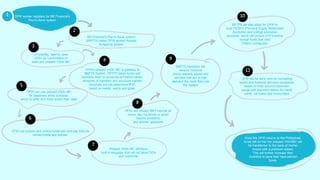
OFW worker registers for BB Financial's
Pay-to-Save system
BB Financial's Pay-to-Save system
(BBPTS) walks OFW worker through
budgeting system
On payday, agency pays
OFW via combination of
cash and prepaid VISA/ MC
OFW's prepaid VISA/ MC is gateway to
BBPTS System. NFPTS takes funds and
transfers them to accounts at Filipino banks.
Amounts of transfers and acccount names/
purposes are pre-determineOFW,
based on needs, wants and goals.
OFW can use prepaid VISA/ MC
for expenses while overseas,
which is safer and more ecient than cash
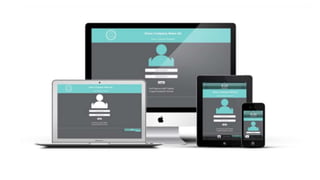
OFW can access and control funds and and pay bills vis
online/mobile app system
Prepaid VISA/ MC will have
built in stopgaps that will not allow OD's
and overlimits
OFW can contact BB Financial 24
hours/ day via phone or email
tosolve problems
and answer questions
BBPTS members will
receive incentive
points towards goods and
services that are in high
demand the more they use
the system
BBTPS will also allow for OFW to
fund PERA's (Personal Equity Retirement
Accounts) and college education
accounts, which will include ETF's and/or
mutual funds that hold
Filipino comapnies
OFW will be send oers by competing
banks and financial services companies
based on their account balances,
usage and payment hitsory for credit
cards, car loans and home loans
Once the OFW returns to the Philippines,
funds left on his/ her prepaid VISA/MC will
be transferred to the bank of his/her
choice with a premium added.
This will further increase their
incentive to save their hard-earned
funds.
1
2
3
5
6
4
8
7
9
10
11
Revenue Sources
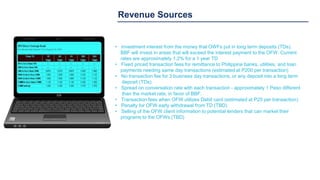
• Investment interest from the money that OWFs put in long term deposits (TDs).
BBF will invest in areas that will exceed the interest payment to the OFW. Current
rates are approximately 1.2% for a 1 year TD
• Fixed priced transaction fees for remittance to Philippine banks, utilities, and loan
payments needing same day transactions (estimated at P200 per transaction)
• No transaction fee for 3 business day transactions, or any deposit into a long term
deposit (TDs).
• Spread on conversation rate with each transaction - approximately 1 Peso different
than the market rate, in favor of BBF.
• Transaction fees when OFW utilizes Debit card (estimated at P25 per transaction)
• Penalty for OFW early withdrawal from TD (TBD)
• Selling of the OFW client information to potential lenders that can market their
programs to the OFWs (TBD)
Investment Requirements
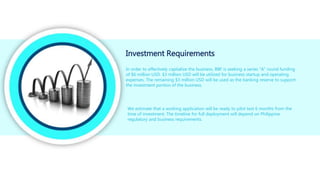
In order to effectively capitalize the business, BBF is seeking a series “A” round funding
of $6 million USD. $3 million USD will be utilized for business startup and operating
expenses. The remaining $3 million USD will be used as the banking reserve to support
the investment portion of the business.
We estimate that a working application will be ready to pilot test 6 months from the
time of investment. The timeline for full deployment will depend on Philippine
regulatory and business requirements.
The Team
Mr. de Vera has been involved in the financial services, banking, and
commercial real estate lending industry for more than 25 years. Joe has
provided investment, private banking, and wealth management
services to small- to mid-sized businesses, medical professionals,
and executives, including financing their commercial real estate
acquisitions and development projects.
Mr. de Vera is currently a Senior Vice President for A10 Capital, a nationwide
private equity real estate finance company. Previously Mr. de Vera served
as Vice President and Regional Marketing Officer for an Idaho-based
community bank, a First Vice President of a Northwestern regional
bank’s wealth management and trust division, and was a
Vice President/ Regional Manager for Washington
Mutual Bank (now Chase).
Joe graduated from the University of California, Los Angeles with a
Bachelor of Arts degree in political science. He is active in youth
sports, non-profit organizations, and school boards.
The Team
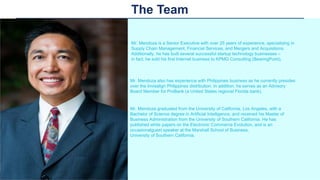
Mr. Mendoza is a Senior Executive with over 25 years of experience, specializing in
Supply Chain Management, Financial Services, and Mergers and Acquisitions.
Additionally, he has built several successful startup technology businesses –
in fact, he sold his first Internet business to KPMG Consulting (BearingPoint).
Mr. Mendoza also has experience with Philippines business as he currently presides
over the Invisalign Philippines distribution. In addition, he serves as an Advisory
Board Member for ProBank (a United States regional Florida bank).
Mr. Mendoza graduated from the University of California, Los Angeles, with a
Bachelor of Science degree in Artificial Intelligence, and received his Master of
Business Administration from the University of Southern California. He has
published white papers on the Electronic Commerce Evolution, and is an
occasionalguest speaker at the Marshall School of Business,
University of Southern California.

Banking presentation

  • 1.
  • 2.
    Overview BUSINESS PROPOSITION: Create acomprehensive, Filipino-centric online money remittance, bill payment, savings and financial consulting system that helps Filipino Nationals working oversees conveniently manage their hard earned money.
  • 3.
    Opportunity: • Over 2million “documented” and, as many as, 10 million Filipinos work overseas, all of which need a safe, convenient way to transfer their wages back to the Philippines. • Several money transfer companies currently exist, but they do not provide the services that Filipino’s highly need: consultation on basic financial principles • Principles such as time-value of money, credit management, investment, and goal-driven money management need to be provided in an easy-to-understand, ecient way. Money Investment Goal-driven money management Credit management
  • 4.
    Constraint Many working classFilipinos have a reputation for being a “hand-to-mouth”, “live for today” society.
  • 5.
    Many working classFilipinos do not have a reputation of being smart money managers. For the most part, the working class is known more to be a “hand-to-mouth”, “live for today” society. Therefore, creating a money management system that overcomes this constraint will take more than creating an ecient, easy-to-use delivery system.
  • 6.
    Overcoming this Constraint: •Bagong Bayani Financial will create a program that leans more towards education and consultation rather than persuasion. • Incentives (provided both by the Filipino government and Bagong Bayani Financial) such as increasedsavings rates, tax incentives, points towards goods & services
  • 7.
    The Market • Overseasremittance flows to the Philippines will likely expand at a faster pace of 8 to 8.5 percent in 2014 on improved global growth prospects. • Central bank data showed personal remittances surged 6.1 percent to $10.404 billion in the first five months of the year from $9.809 billion in the same period last year. 8.5%
  • 8.
    • Cash remittancesfrom land-based workers grew by five percent to $7.1 billion as of May, while those coming from sea-based workers rose 8.1 percent to $2.3 billion. The bulk of the remittances were sent from the United States, Saudi Arabia, the United Arab Emirates, the United Kingdom, Singapore, Japan, and Hong Kong.
  • 9.
    CENTRAL BANK Remittances playa big role in supporting domestic consumption, which remains to be the largest driver of the Philippine economy: Last year, cash remittances surged 7.4 percent to $22.968 billion, the highest annual level ever recorded by the central bank. Personal remittances, meanwhile, grew 8.6 percent to $25.351 billion.
  • 11.
    Current process OFW workergets job through agency or trade organization On payday, agency or company pays OFW worker cash OFW worker keeps cash on person, uses cash for expenses, and brings home excess cash home for family uses, which could include savings. 1 2 3
  • 12.
    SYSTEM FLAWS Lack ofsecurity/ high risk for OFW: accumulating cash on person while oversees creates risk of theft, loss, or overspending. Fair exchange of currency: OFW are at the mercy of exchange centers, which usually provide less-than-fair exchanges into home currency Non-utilization of compounding interest or time-value of money: The longer the OFW keeps pay in cash form, the less efficient their money is for their long-term goals Inability to build credit history: While OFW pays with and saves cash, they are unable to create and maintain credit history, therefore making it more dicult for them get credit facilities (credit cards, auto loans, home loans). 1 2 3 4
  • 13.
    Features: Immediate deduction from agencyduring normal payroll process Utility payments Philippine banks (BPI, BDO, PNB, etc.) via PhilPass Immediate deduction from agency during normal payroll process Larger family expenses 2 3 4 5 1
  • 14.
    OFW has onlineaccess • Utility payments (ie. Meralco, PLDT, Globe, etc.). Integration to the remittance company will show current balance due/paid. • Philippine banks (BPI, BDO, PNB, etc.) via PhilPass • Larger family expenses (rent payment to landlord’s bank account, auto loan, etc.) • Debit cards • Savings/Investment account /Time Deposit
  • 15.
    Benefits Ability to helpOFW decrease risk of theft, loss, or overspending of cash Help OFW workers receive a more favorable exchange when shopping and sending money home to family. By helping educate OFW workers and providing an easy money transfer/ cash management service to family back home, they will be more able to save and have their money work harder for them. BBF will help OFW's build their credit, through educational tools, tracking their spending, and providing introductions to those that oer credit products (banks, financial services companies) 1 2 3 4
  • 17.
  • 18.
  • 19.
    OFW worker registersfor BB Financial's Pay-to-Save system BB Financial's Pay-to-Save system (BBPTS) walks OFW worker through budgeting system On payday, agency pays OFW via combination of cash and prepaid VISA/ MC OFW's prepaid VISA/ MC is gateway to BBPTS System. NFPTS takes funds and transfers them to accounts at Filipino banks. Amounts of transfers and acccount names/ purposes are pre-determineOFW, based on needs, wants and goals. OFW can use prepaid VISA/ MC for expenses while overseas, which is safer and more ecient than cash OFW can access and control funds and and pay bills vis online/mobile app system Prepaid VISA/ MC will have built in stopgaps that will not allow OD's and overlimits OFW can contact BB Financial 24 hours/ day via phone or email tosolve problems and answer questions BBPTS members will receive incentive points towards goods and services that are in high demand the more they use the system BBTPS will also allow for OFW to fund PERA's (Personal Equity Retirement Accounts) and college education accounts, which will include ETF's and/or mutual funds that hold Filipino comapnies OFW will be send oers by competing banks and financial services companies based on their account balances, usage and payment hitsory for credit cards, car loans and home loans Once the OFW returns to the Philippines, funds left on his/ her prepaid VISA/MC will be transferred to the bank of his/her choice with a premium added. This will further increase their incentive to save their hard-earned funds. 1 2 3 5 6 4 8 7 9 10 11
  • 20.
    Revenue Sources • Investmentinterest from the money that OWFs put in long term deposits (TDs). BBF will invest in areas that will exceed the interest payment to the OFW. Current rates are approximately 1.2% for a 1 year TD • Fixed priced transaction fees for remittance to Philippine banks, utilities, and loan payments needing same day transactions (estimated at P200 per transaction) • No transaction fee for 3 business day transactions, or any deposit into a long term deposit (TDs). • Spread on conversation rate with each transaction - approximately 1 Peso different than the market rate, in favor of BBF. • Transaction fees when OFW utilizes Debit card (estimated at P25 per transaction) • Penalty for OFW early withdrawal from TD (TBD) • Selling of the OFW client information to potential lenders that can market their programs to the OFWs (TBD)
  • 21.
    Investment Requirements In orderto effectively capitalize the business, BBF is seeking a series “A” round funding of $6 million USD. $3 million USD will be utilized for business startup and operating expenses. The remaining $3 million USD will be used as the banking reserve to support the investment portion of the business. We estimate that a working application will be ready to pilot test 6 months from the time of investment. The timeline for full deployment will depend on Philippine regulatory and business requirements.
  • 22.
    The Team Mr. deVera has been involved in the financial services, banking, and commercial real estate lending industry for more than 25 years. Joe has provided investment, private banking, and wealth management services to small- to mid-sized businesses, medical professionals, and executives, including financing their commercial real estate acquisitions and development projects. Mr. de Vera is currently a Senior Vice President for A10 Capital, a nationwide private equity real estate finance company. Previously Mr. de Vera served as Vice President and Regional Marketing Officer for an Idaho-based community bank, a First Vice President of a Northwestern regional bank’s wealth management and trust division, and was a Vice President/ Regional Manager for Washington Mutual Bank (now Chase). Joe graduated from the University of California, Los Angeles with a Bachelor of Arts degree in political science. He is active in youth sports, non-profit organizations, and school boards.
  • 23.
    The Team Mr. Mendozais a Senior Executive with over 25 years of experience, specializing in Supply Chain Management, Financial Services, and Mergers and Acquisitions. Additionally, he has built several successful startup technology businesses – in fact, he sold his first Internet business to KPMG Consulting (BearingPoint). Mr. Mendoza also has experience with Philippines business as he currently presides over the Invisalign Philippines distribution. In addition, he serves as an Advisory Board Member for ProBank (a United States regional Florida bank). Mr. Mendoza graduated from the University of California, Los Angeles, with a Bachelor of Science degree in Artificial Intelligence, and received his Master of Business Administration from the University of Southern California. He has published white papers on the Electronic Commerce Evolution, and is an occasionalguest speaker at the Marshall School of Business, University of Southern California.