Critical Thinking: A (Very) Short Intro
? ! ○
@Martins_Vaivars, martins@toneboard.com
01 - Argumentation
02 - Scientific Method
03 - Cognitive Biases
04 - Media Literacy
…
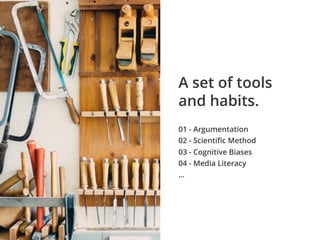
A set of tools
and habits.
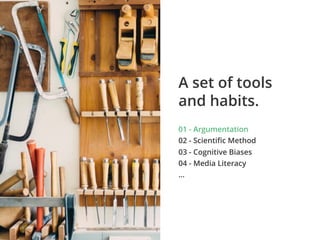
01 - Argumentation
02 - Scientific Method
03 - Cognitive Biases
04 - Media Literacy
…
A set of tools
and habits.
Reason 1
Reason 2
Reason 3
…
__________________________________
Conclusion
What is an
argument?
?
Two simple ways how arguments can
go wrong
Relevance
#
Sufficiency
$
The reasons provided, while
psychologically persuasive, are
logically irrelevant to the
conclusion they are supposed to
support.
Fallacies of
relevance.
#
Pointing out someone’s personal
characteristics in an attempt to
discredit his/her argument.
Personal attack
(ad hominem).
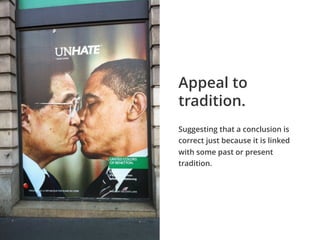
Suggesting that a conclusion is
correct just because it is linked
with some past or present
tradition.
Appeal to
tradition.
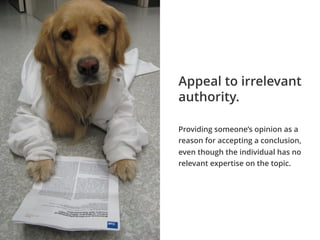
Providing someone’s opinion as a
reason for accepting a conclusion,
even though the individual has no
relevant expertise on the topic.
Appeal to irrelevant
authority.
While the reasons provided are
logically relevant, without
additional support they are
insufficient to warrant the
conclusion.
Fallacies of
sufficiency.
$
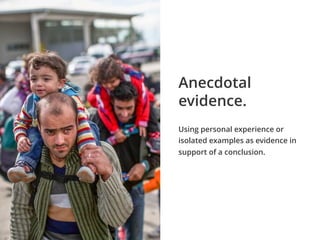
Using personal experience or
isolated examples as evidence in
support of a conclusion.
Anecdotal
evidence.
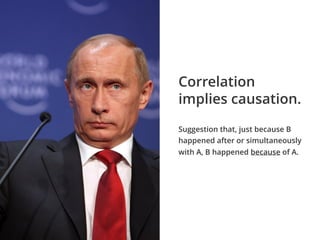
Suggestion that, just because B
happened after or simultaneously
with A, B happened because of A.
Correlation
implies causation.
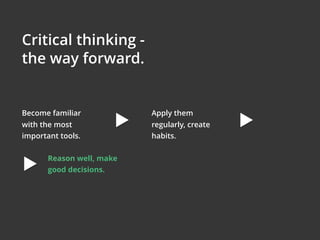
Become familiar
with the most
important tools.
Critical thinking -
the way forward.
Apply them
regularly, create
habits.
Reason well, make
good decisions.
info@quotudoma.lv
FB: QUO tu domā?
@QUOtudoma
Support the
movement.
Critical Thinking: A (Very) Short Intro
? ! ○
@Martins_Vaivars, martins@toneboard.com

Baltic pr awards critical thinking v03

  • 1.
    Critical Thinking: A(Very) Short Intro ? ! ○ @Martins_Vaivars, martins@toneboard.com
  • 2.
    01 - Argumentation 02- Scientific Method 03 - Cognitive Biases 04 - Media Literacy … A set of tools and habits.
  • 3.
    01 - Argumentation 02- Scientific Method 03 - Cognitive Biases 04 - Media Literacy … A set of tools and habits.
  • 4.
    Reason 1 Reason 2 Reason3 … __________________________________ Conclusion What is an argument? ?
  • 5.
    Two simple wayshow arguments can go wrong Relevance # Sufficiency $
  • 6.
    The reasons provided,while psychologically persuasive, are logically irrelevant to the conclusion they are supposed to support. Fallacies of relevance. #
  • 7.
    Pointing out someone’spersonal characteristics in an attempt to discredit his/her argument. Personal attack (ad hominem).
  • 8.
    Suggesting that aconclusion is correct just because it is linked with some past or present tradition. Appeal to tradition.
  • 9.
    Providing someone’s opinionas a reason for accepting a conclusion, even though the individual has no relevant expertise on the topic. Appeal to irrelevant authority.
  • 10.
    While the reasonsprovided are logically relevant, without additional support they are insufficient to warrant the conclusion. Fallacies of sufficiency. $
  • 11.
    Using personal experienceor isolated examples as evidence in support of a conclusion. Anecdotal evidence.
  • 12.
    Suggestion that, justbecause B happened after or simultaneously with A, B happened because of A. Correlation implies causation.
  • 13.
    Become familiar with themost important tools. Critical thinking - the way forward. Apply them regularly, create habits. Reason well, make good decisions.
  • 14.
    info@quotudoma.lv FB: QUO tudomā? @QUOtudoma Support the movement.
  • 15.
    Critical Thinking: A(Very) Short Intro ? ! ○ @Martins_Vaivars, martins@toneboard.com