Genera
lThesis Defense
Let us pray!
Attendance
Chemical Reactions
and Equations
Chemical Reactions
• Is the process by
which a chemical
change takes place.
• A change where a
new substance is
formed.
Chemical Equation
• way of expressing chemical reactions
using numbers, symbols, and formulas.
Two Major Parts:
• Reactants
• Products
Reactant
s
• The starting materials
• These are the
substances that
changes when it is
combined with another
substance in a chemical
reaction.
Products
• The new substance
• The substances that
result of the
chemical reaction
Reactant
Product
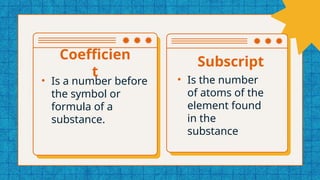
Coefficien
t
• Is a number before
the symbol or
formula of a
substance.
Subscript
• Is the number
of atoms of the
element found
in the
substance
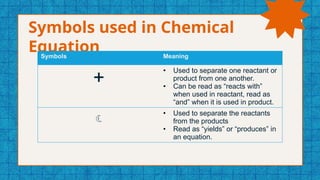
Symbols used in Chemical
Equation
Symbols Meaning
+
• Used to separate one reactant or
product from one another.
• Can be read as “reacts with”
when used in reactant, read as
“and” when it is used in product.

• Used to separate the reactants
from the products
• Read as “yields” or “produces” in
an equation.
Symbols used in Chemical
Equation
Symbols Meaning
(s) • Indicates that the substance is in
solid state..
(l) • Indicates that the substance is in the
liquid state
(aq) • Indicates that the substance is
dissolved in water
• Comes from the term “aqueous”
∆

• Indicates that there is heat applied or
needed to make the reaction proceed
C: 1 C: 1
S: 8 S: 2
4C + S8  4CS2
C + S8  CS2
Xe + 3F2  XeF6
Xe: 1 Xe: 1
F: 2 F: 6
Xe + F2  XeF6
Ag + H2S  Ag2S + H2
Ag: 1 Ag: 2
H: 2 H: 2
S: 1 S: 1
2
2Ag + H2S  Ag2S + H2
2FeO + C  2Fe + CO2
FeO + C  Fe + CO2
Fe: 1 Fe: 1
O: 1 O: 2
C: 1 C: 1
2
2
2
Let’s try!
1.SiO2 + C  SiC + CO
2.KOH + C02  K2CO3 + H2O
3.Na + Cl2  NaCl
4.H3PO4 + KOH  K3PO4 + H2O
5.K + B 2 O 3  K 2 O + B
Let’s try!
Thank you!

balancing equation .pptx

  • 1.
  • 2.
  • 3.
  • 4.
  • 5.
    Chemical Reactions • Isthe process by which a chemical change takes place. • A change where a new substance is formed.
  • 6.
    Chemical Equation • wayof expressing chemical reactions using numbers, symbols, and formulas. Two Major Parts: • Reactants • Products
  • 7.
    Reactant s • The startingmaterials • These are the substances that changes when it is combined with another substance in a chemical reaction. Products • The new substance • The substances that result of the chemical reaction
  • 8.
  • 10.
    Coefficien t • Is anumber before the symbol or formula of a substance. Subscript • Is the number of atoms of the element found in the substance
  • 11.
    Symbols used inChemical Equation Symbols Meaning + • Used to separate one reactant or product from one another. • Can be read as “reacts with” when used in reactant, read as “and” when it is used in product.  • Used to separate the reactants from the products • Read as “yields” or “produces” in an equation.
  • 12.
    Symbols used inChemical Equation Symbols Meaning (s) • Indicates that the substance is in solid state.. (l) • Indicates that the substance is in the liquid state (aq) • Indicates that the substance is dissolved in water • Comes from the term “aqueous” ∆  • Indicates that there is heat applied or needed to make the reaction proceed
  • 14.
    C: 1 C:1 S: 8 S: 2 4C + S8  4CS2 C + S8  CS2
  • 15.
    Xe + 3F2 XeF6 Xe: 1 Xe: 1 F: 2 F: 6 Xe + F2  XeF6
  • 16.
    Ag + H2S Ag2S + H2 Ag: 1 Ag: 2 H: 2 H: 2 S: 1 S: 1 2 2Ag + H2S  Ag2S + H2
  • 17.
    2FeO + C 2Fe + CO2 FeO + C  Fe + CO2 Fe: 1 Fe: 1 O: 1 O: 2 C: 1 C: 1 2 2 2
  • 18.
  • 19.
    1.SiO2 + C SiC + CO 2.KOH + C02  K2CO3 + H2O 3.Na + Cl2  NaCl 4.H3PO4 + KOH  K3PO4 + H2O 5.K + B 2 O 3  K 2 O + B Let’s try!
  • 20.

Editor's Notes

  • #5 The amount of product obtained in the reaction and used to separate the reactant and products
  • #6 What is the purpose of a chemical equation? To balance the equation
  • #8 The reactant is The substance that is consumed or used up in the reaction The product is the substance that is produced as a result of the reaction