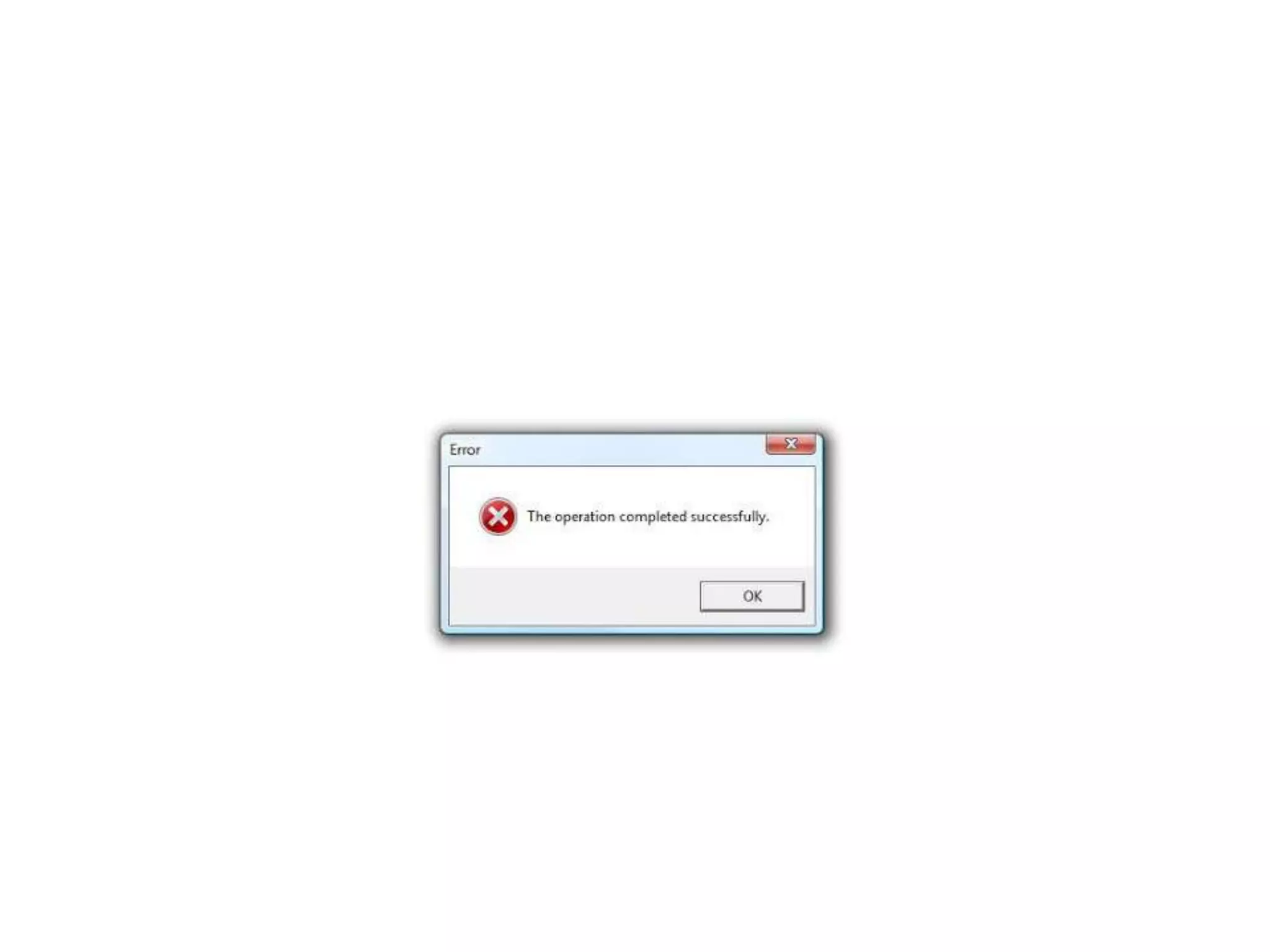
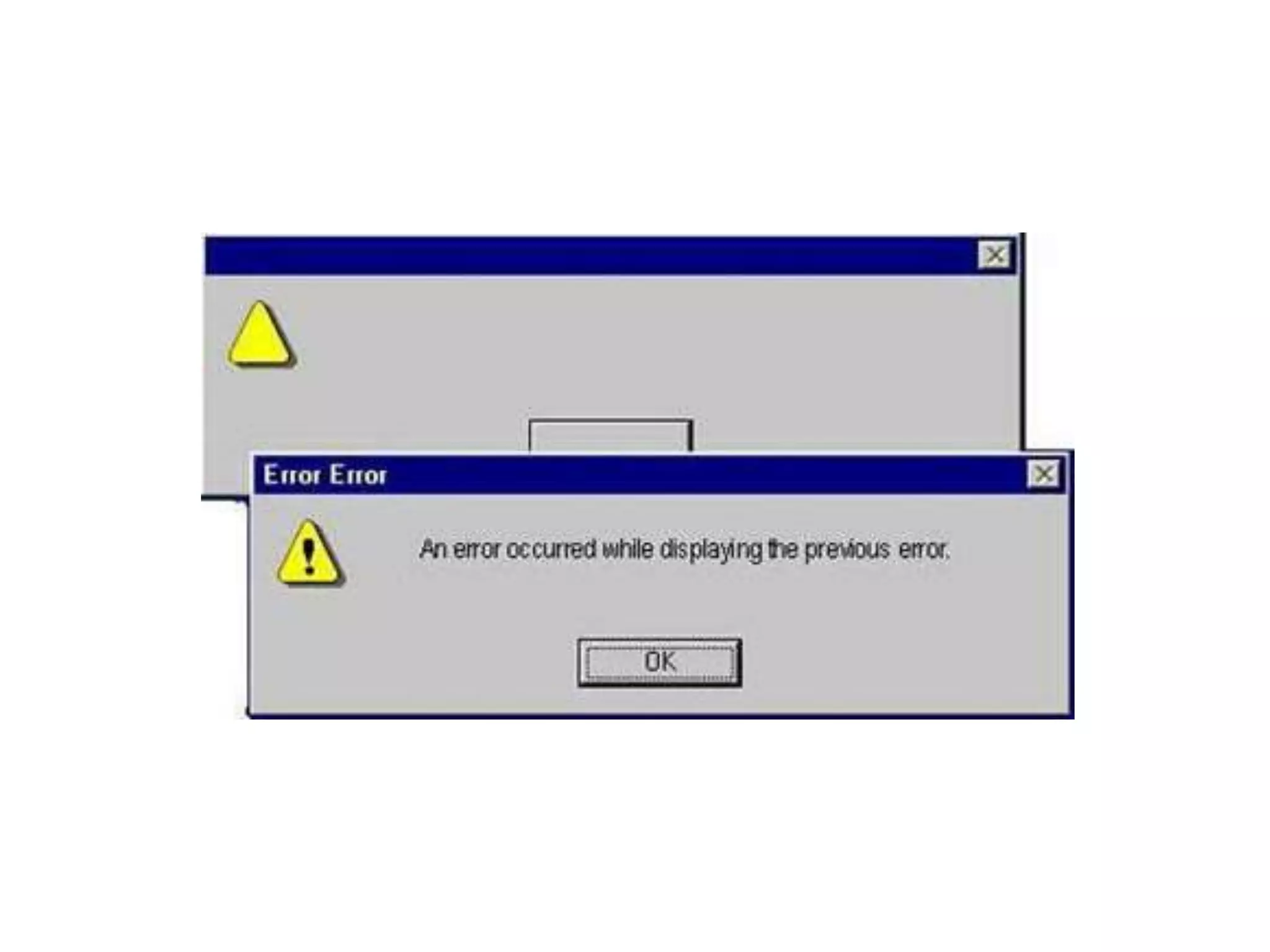
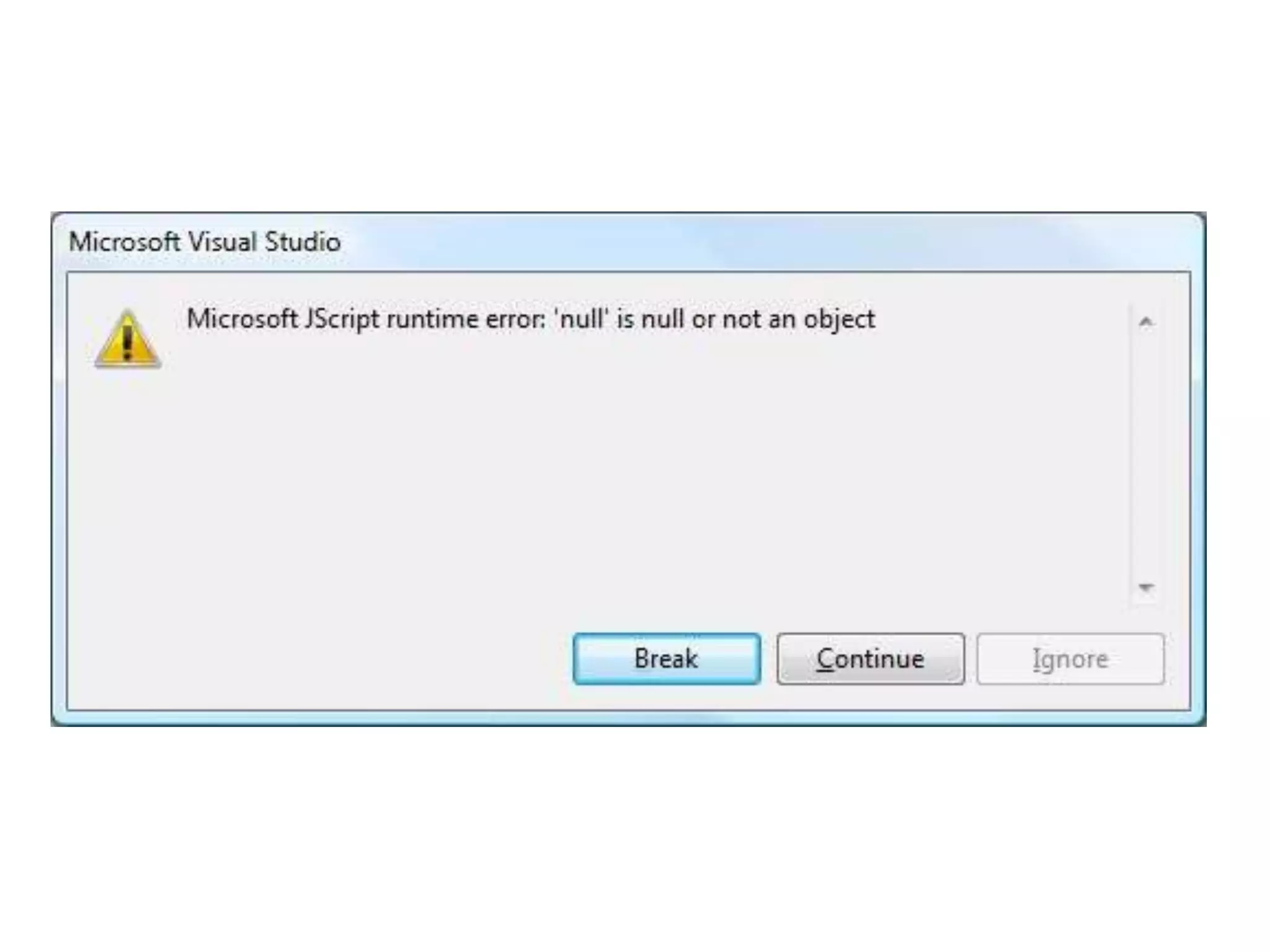
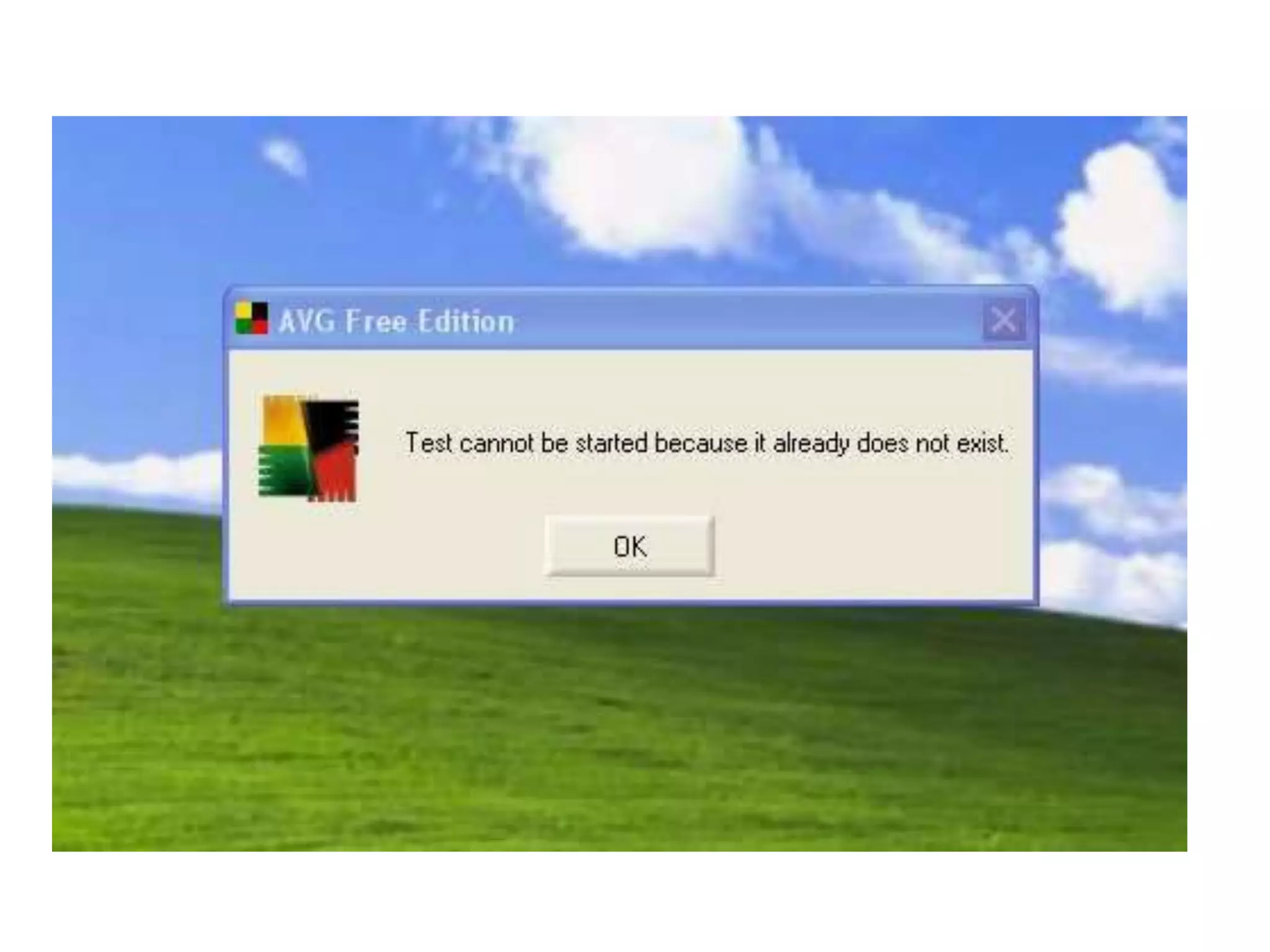
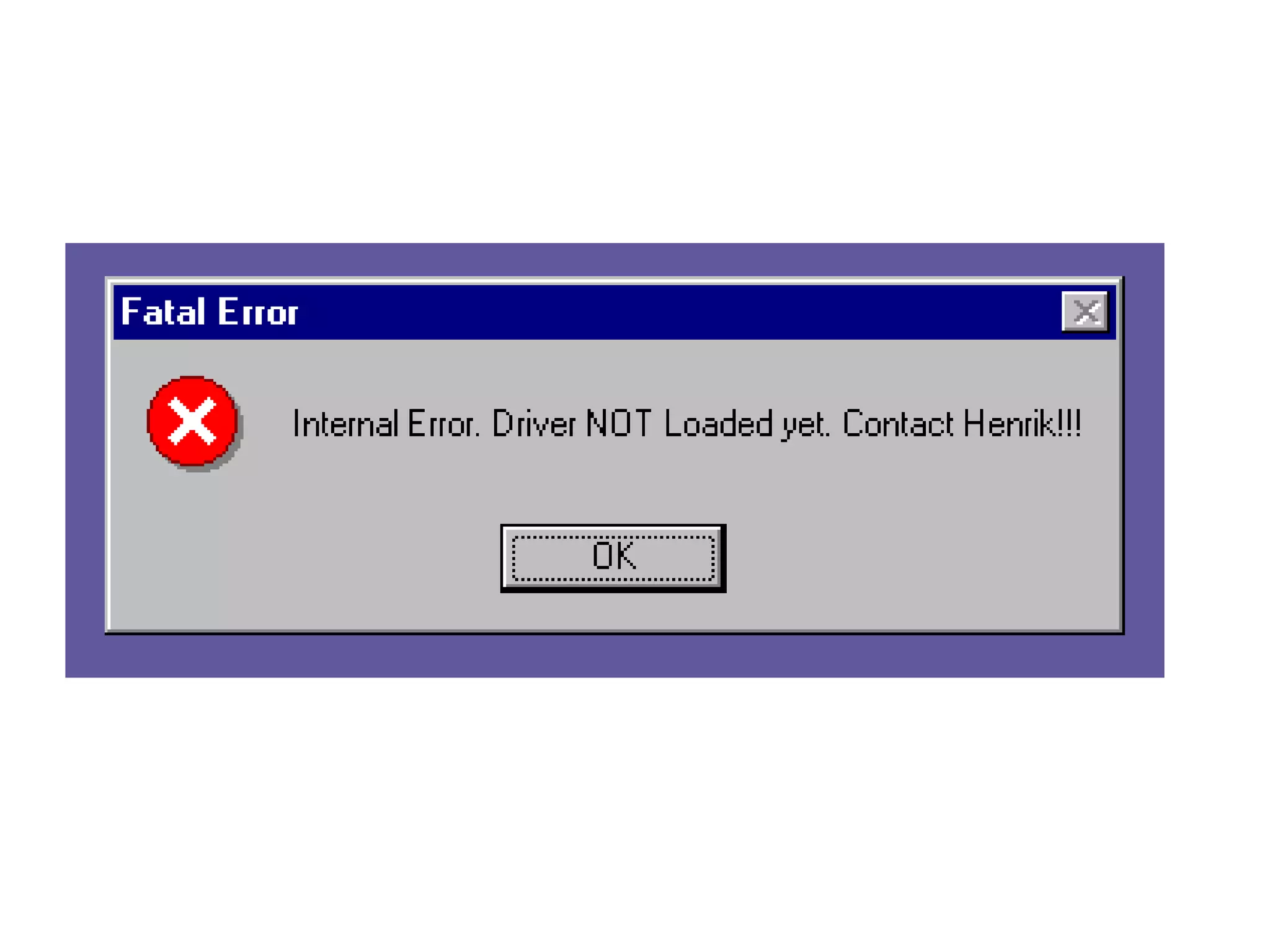
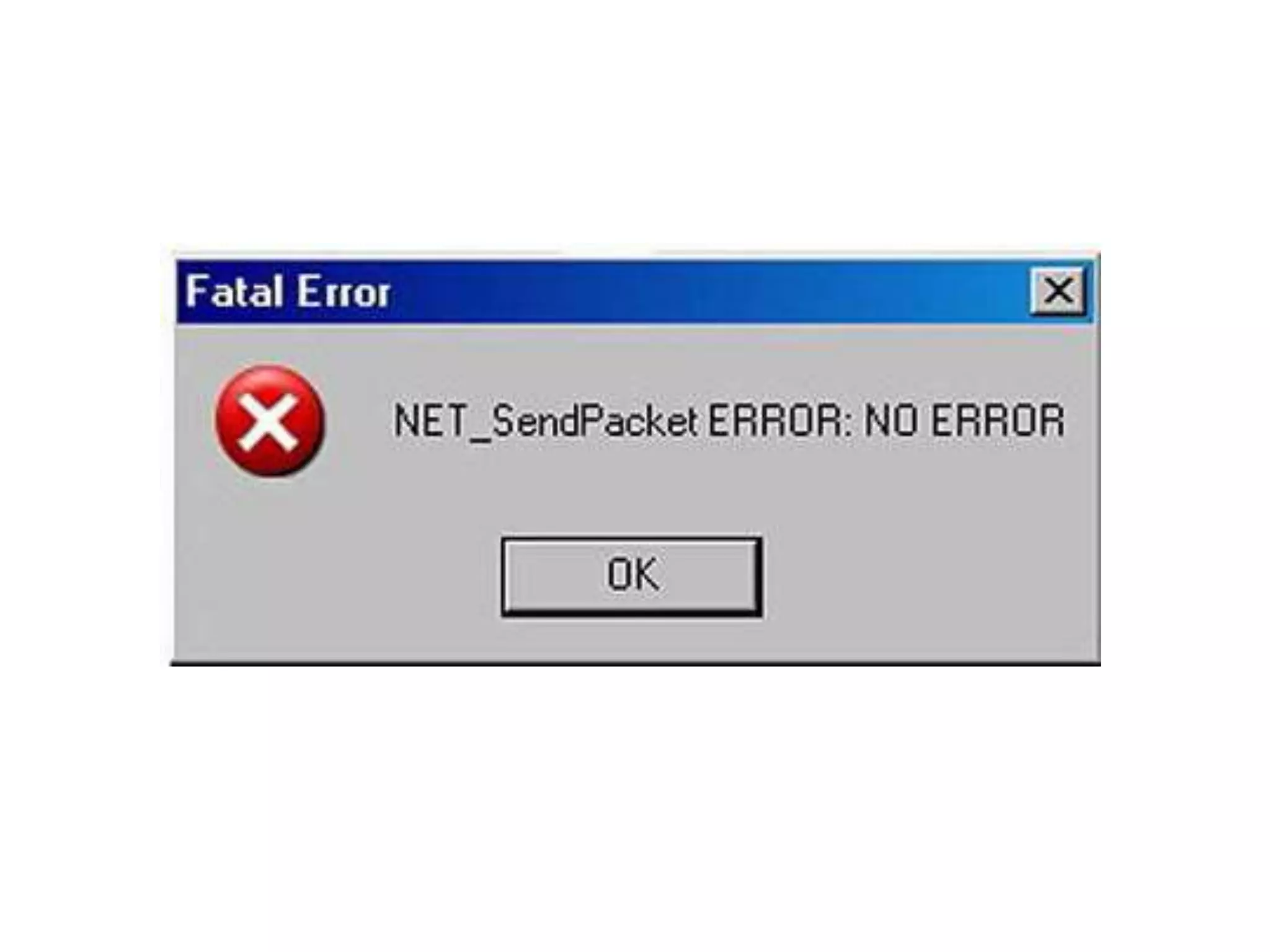
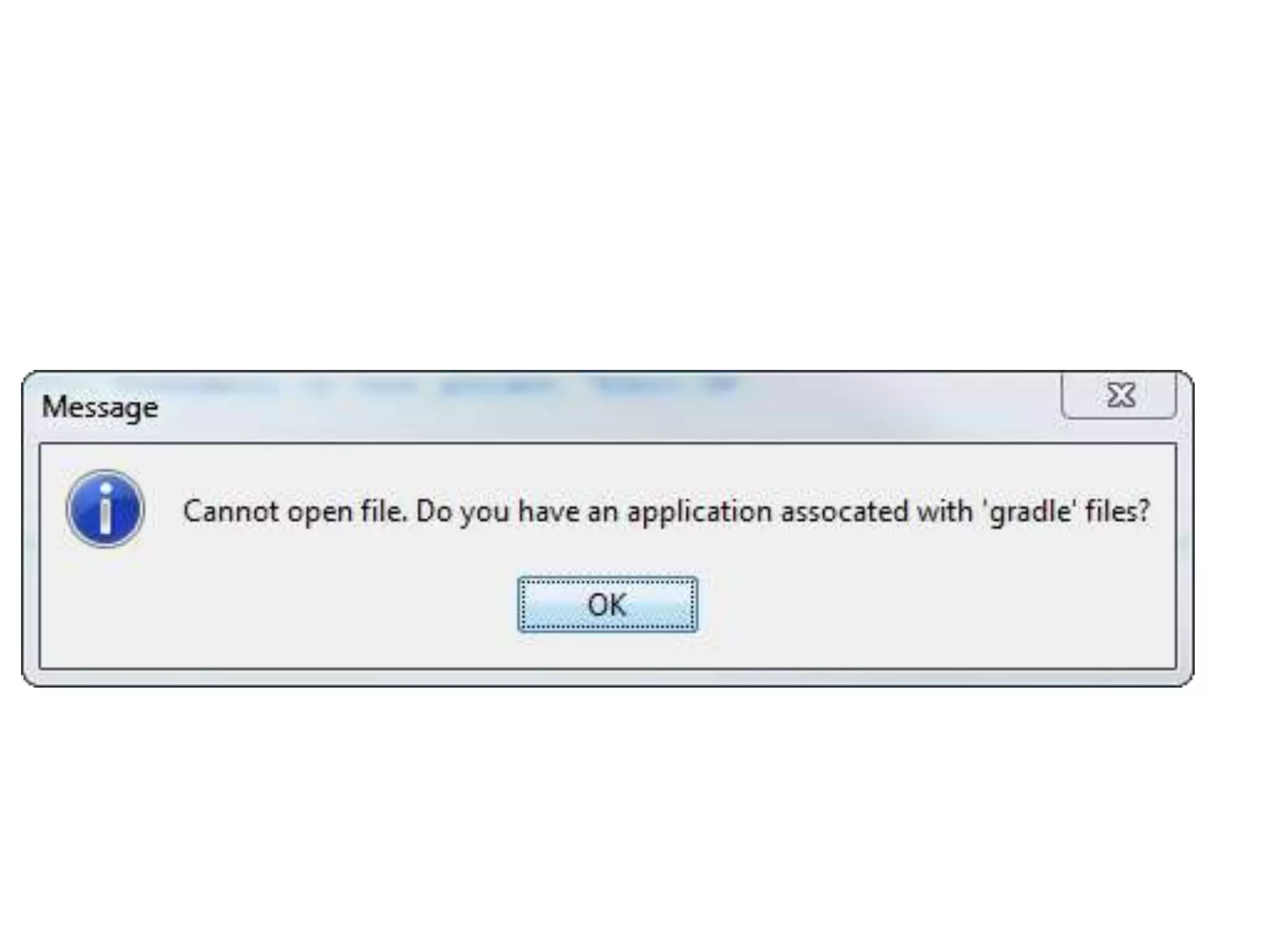
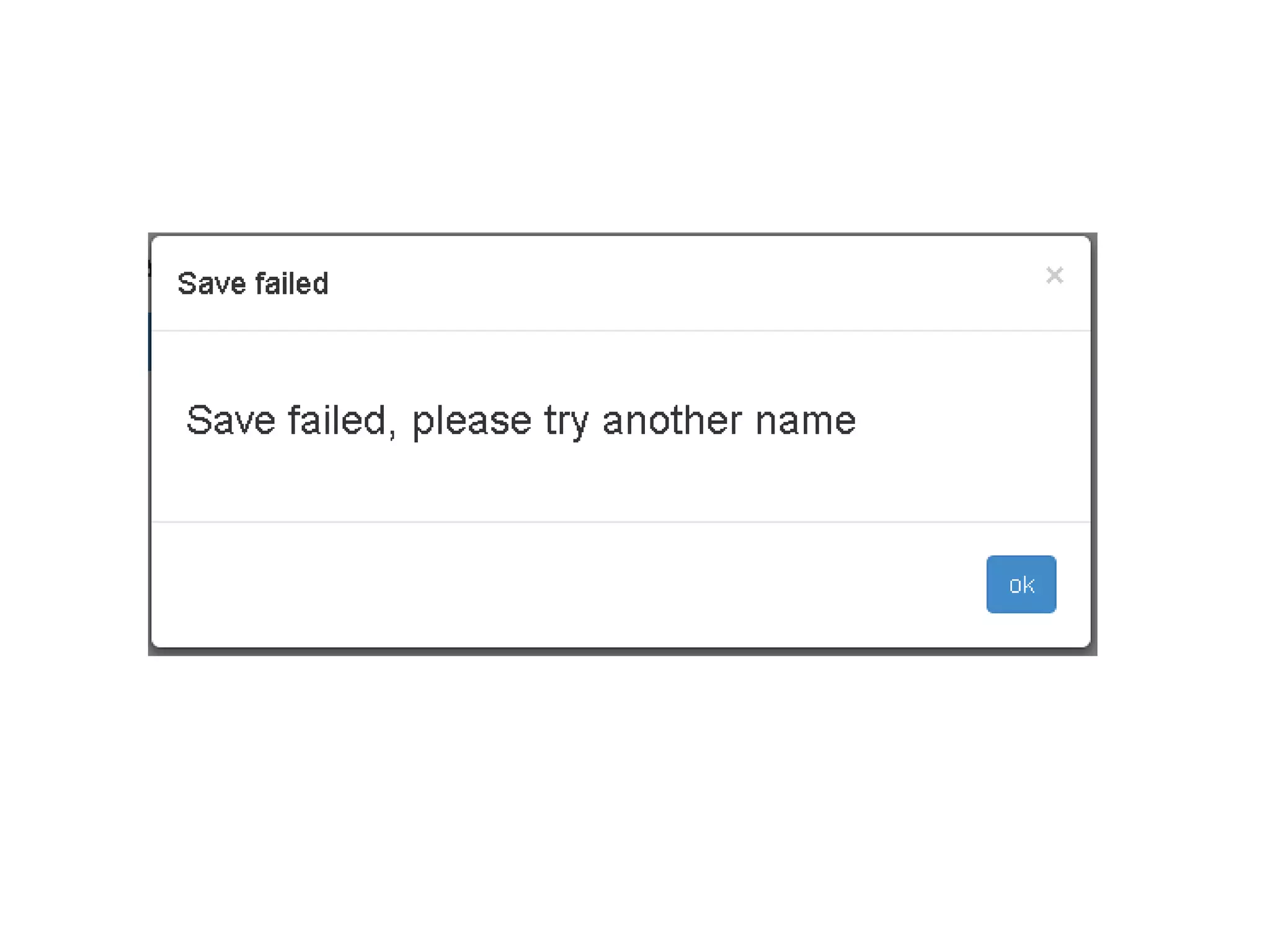
Bad error messages
What is a "bad error message?"
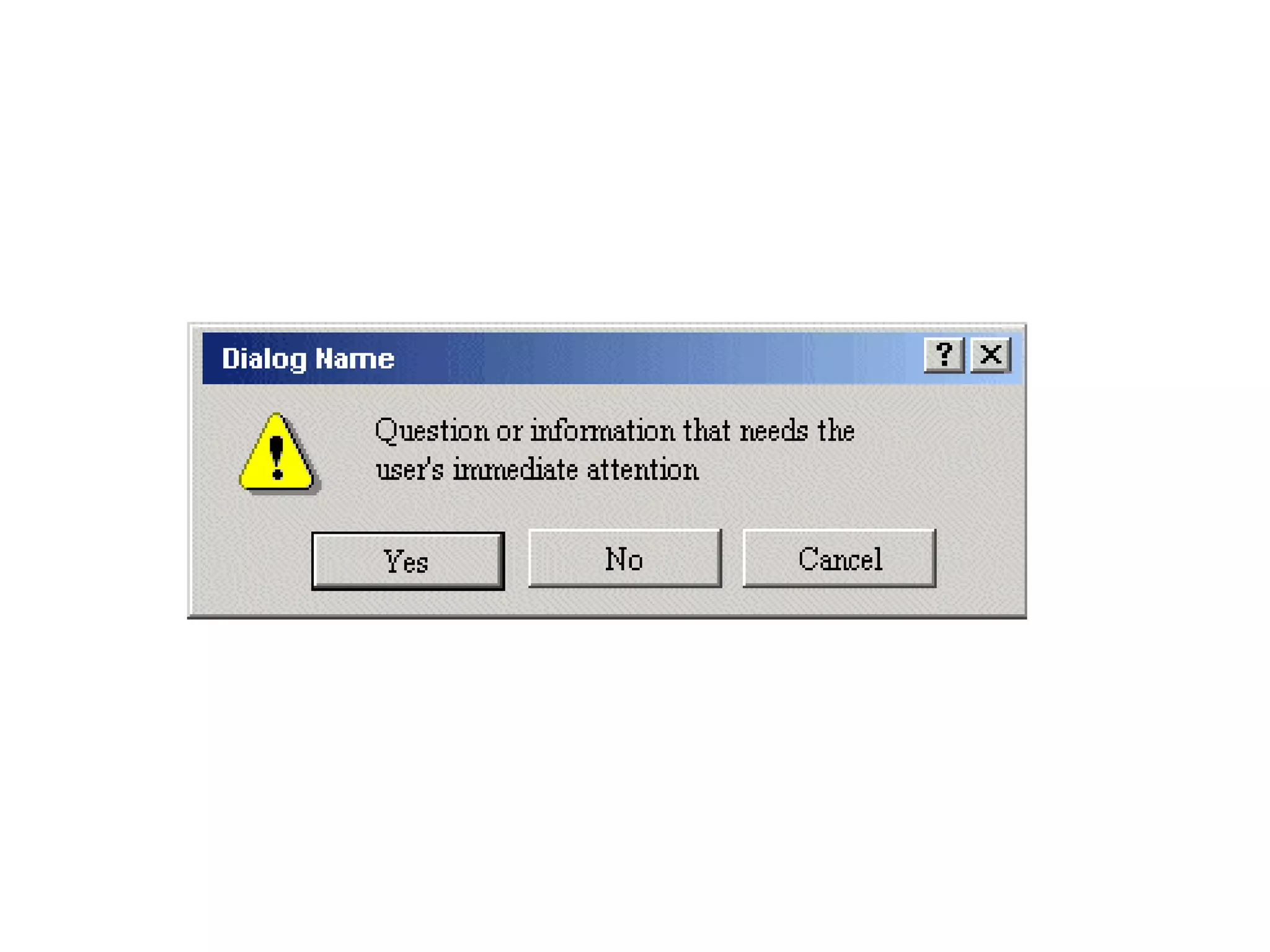
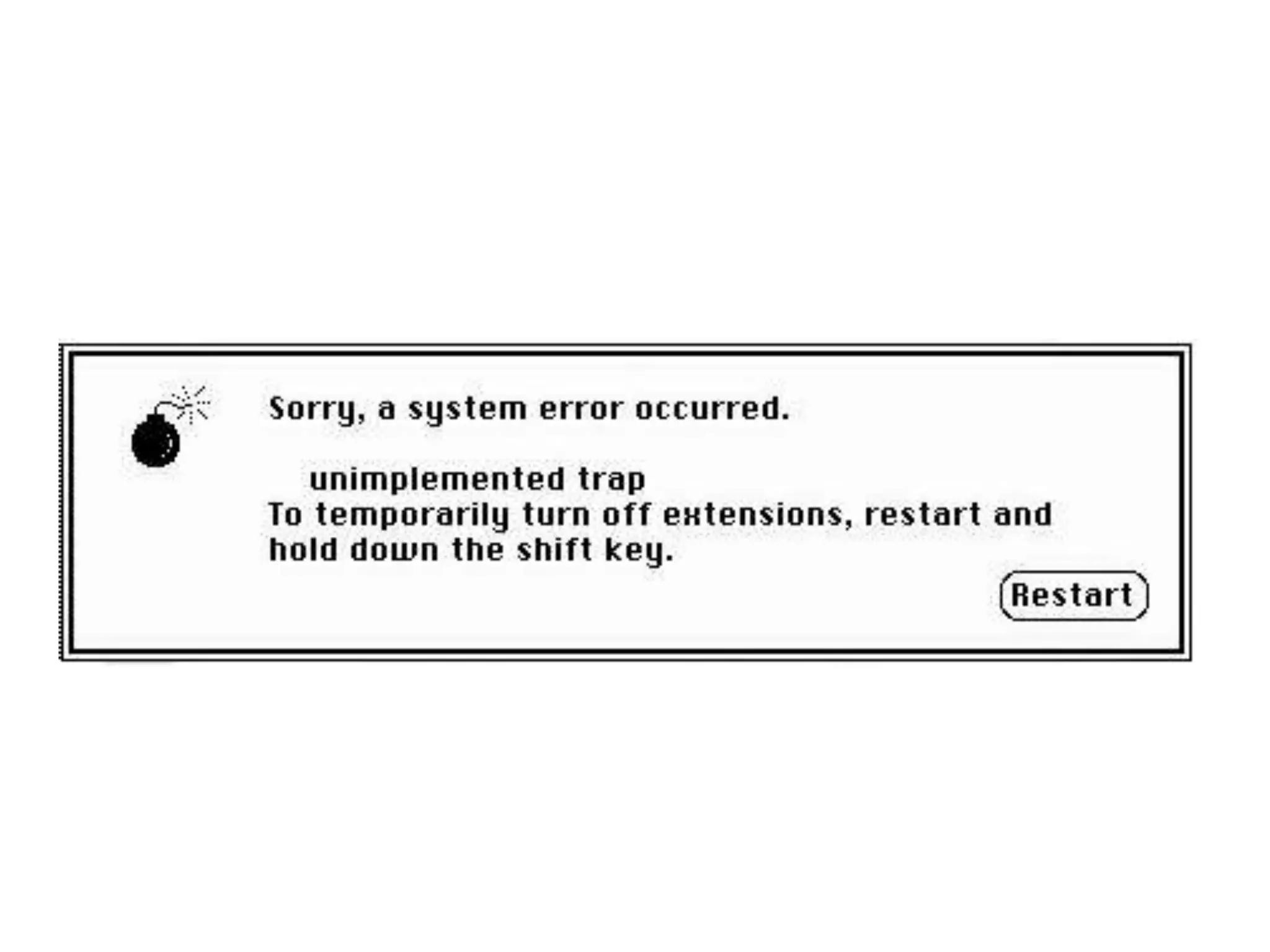
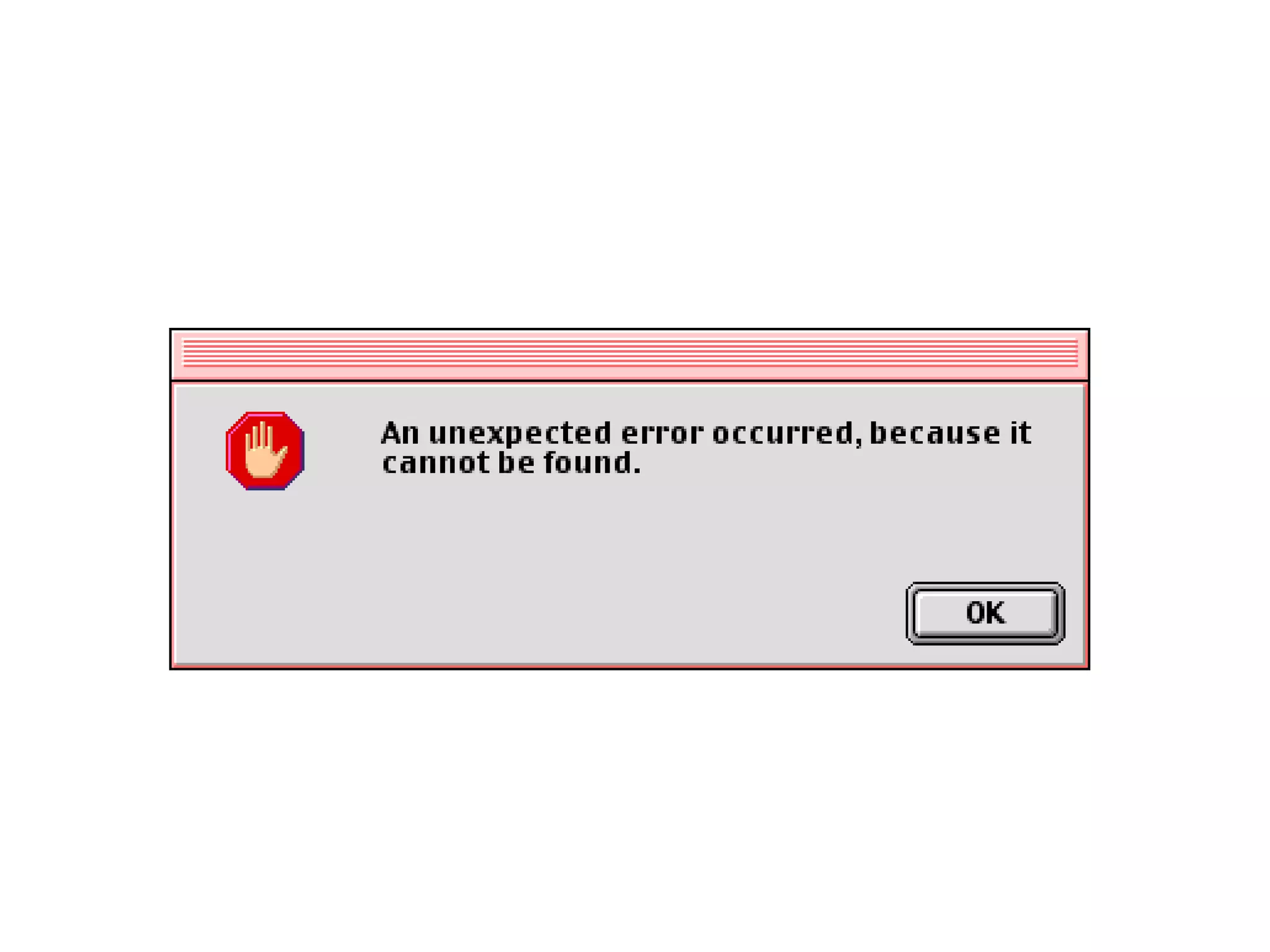
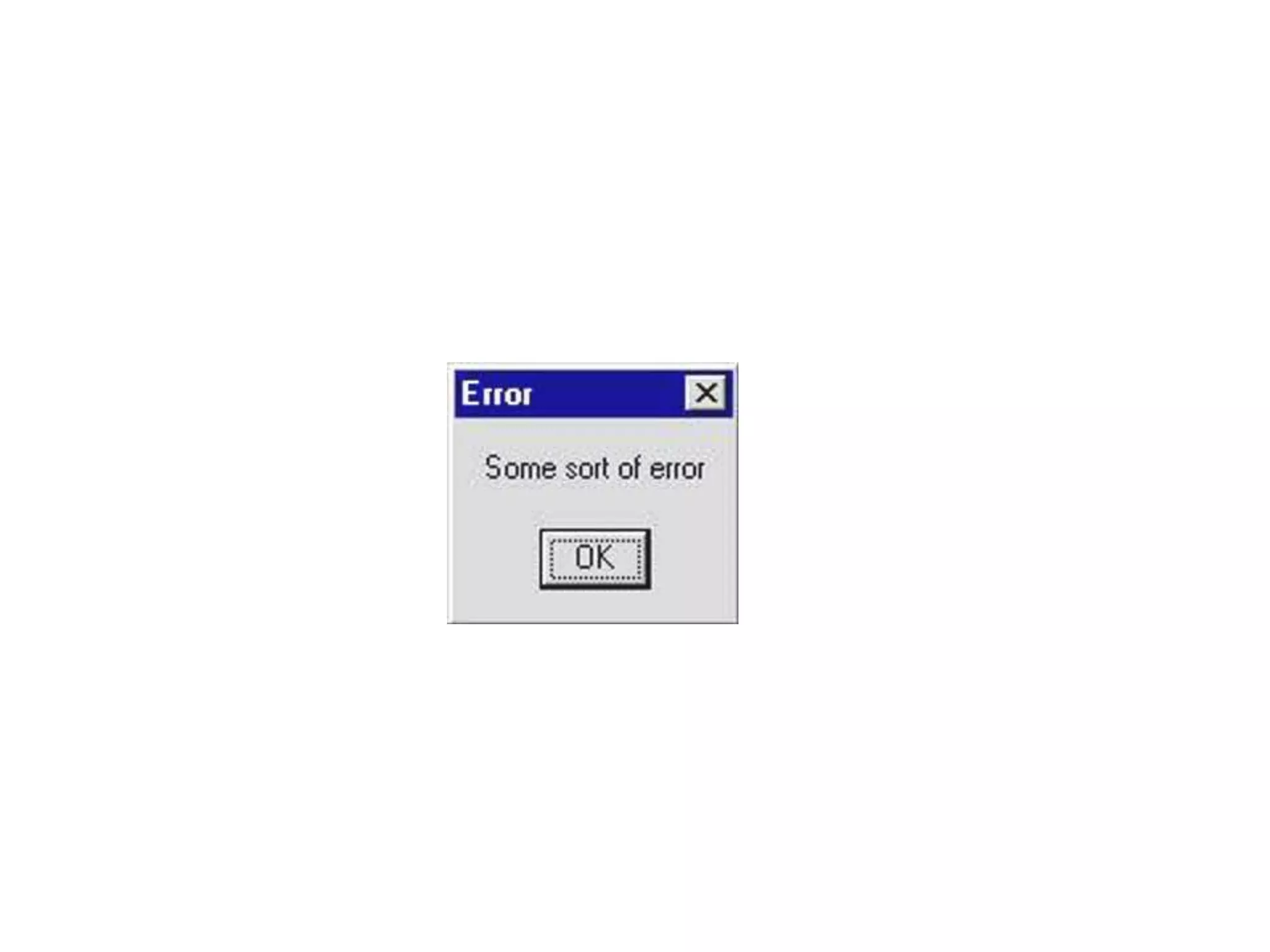
Simply put, a bad error message is a dialog box
or error that doesn't make sense to anyone but
the person who programmed it in the first place.
We've all seen them, usually in very frustrating
moments when our computer or website is not
working properly.
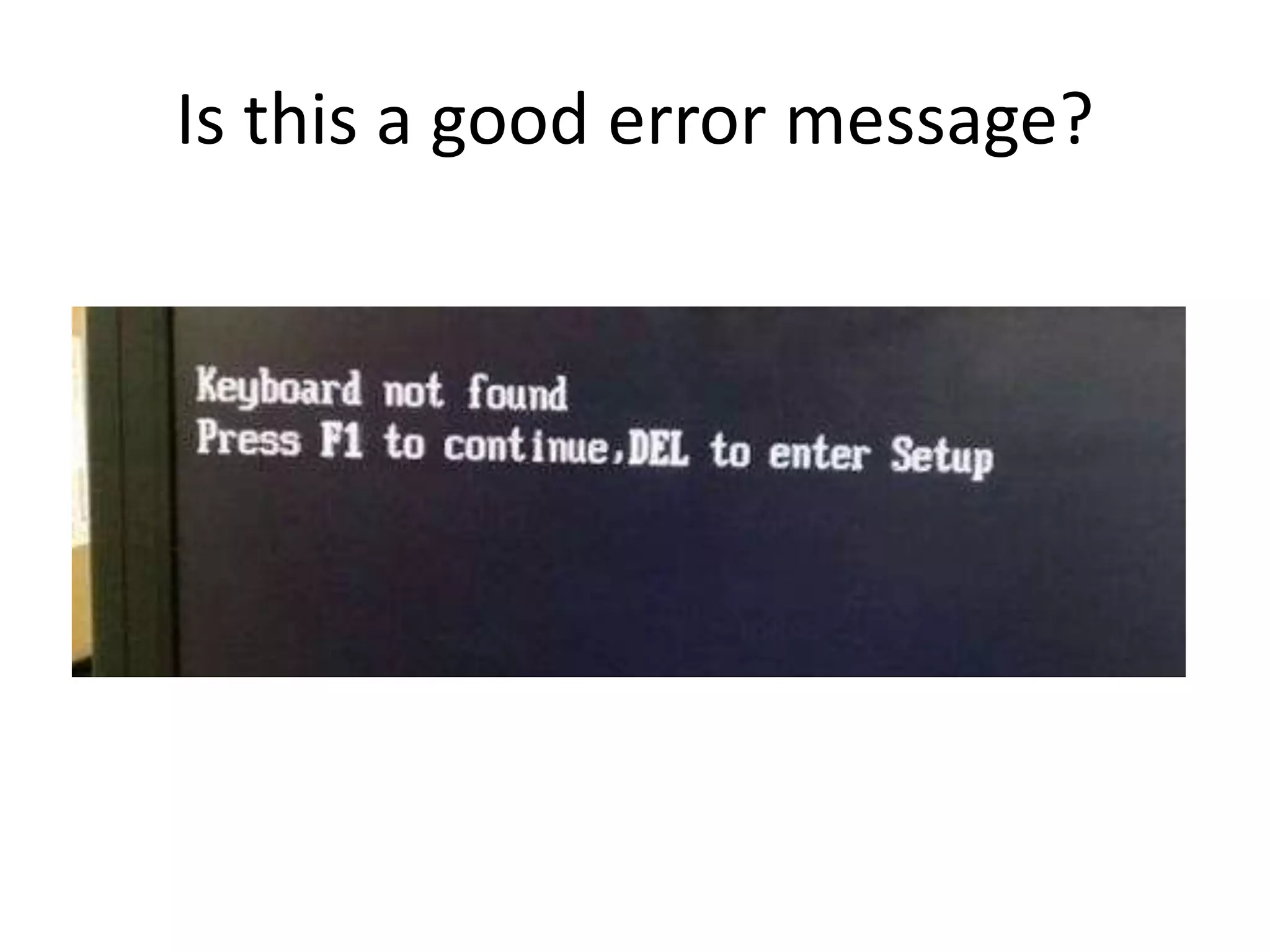
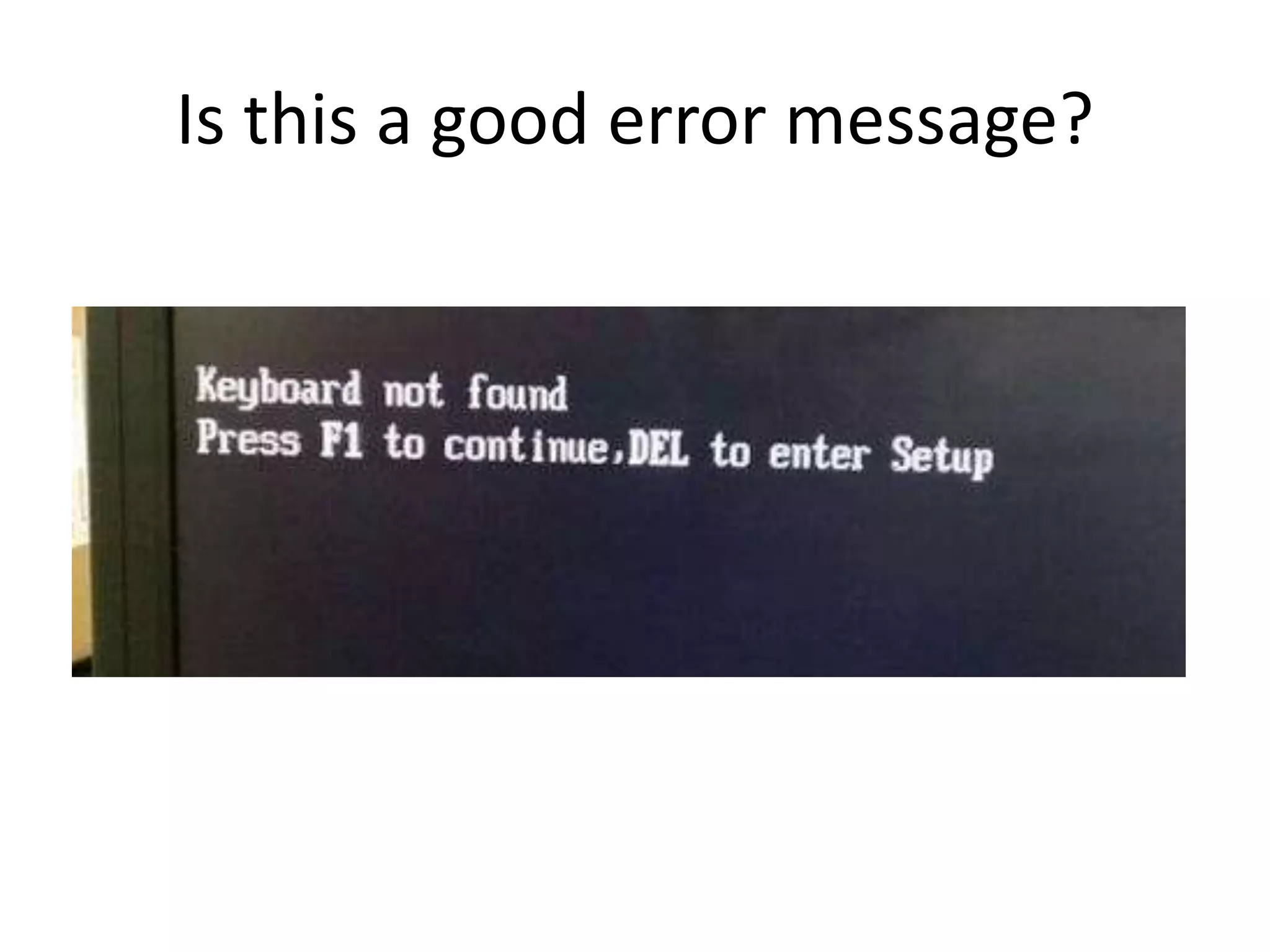
Is this a good error message?
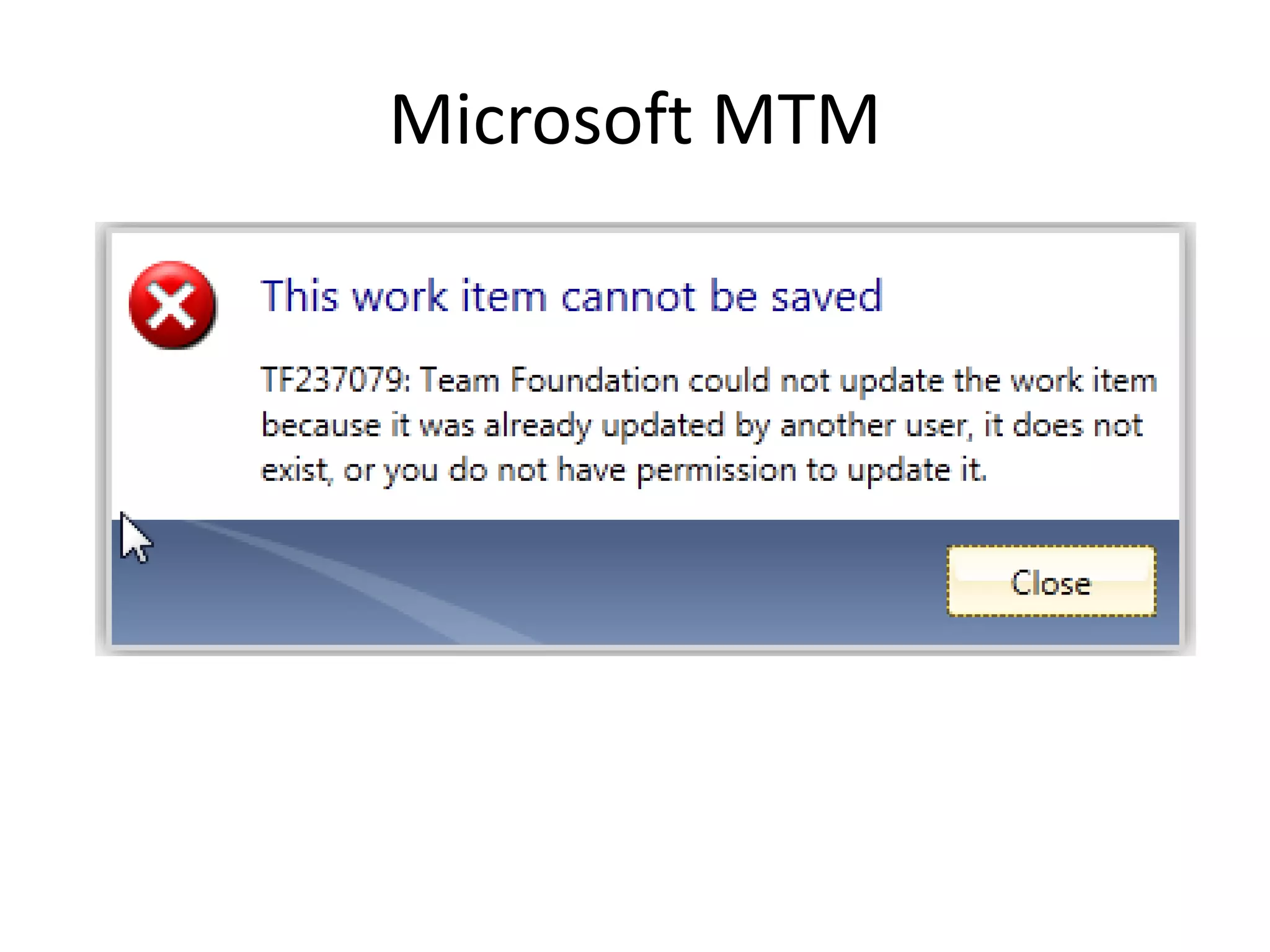
Microsoft MTM
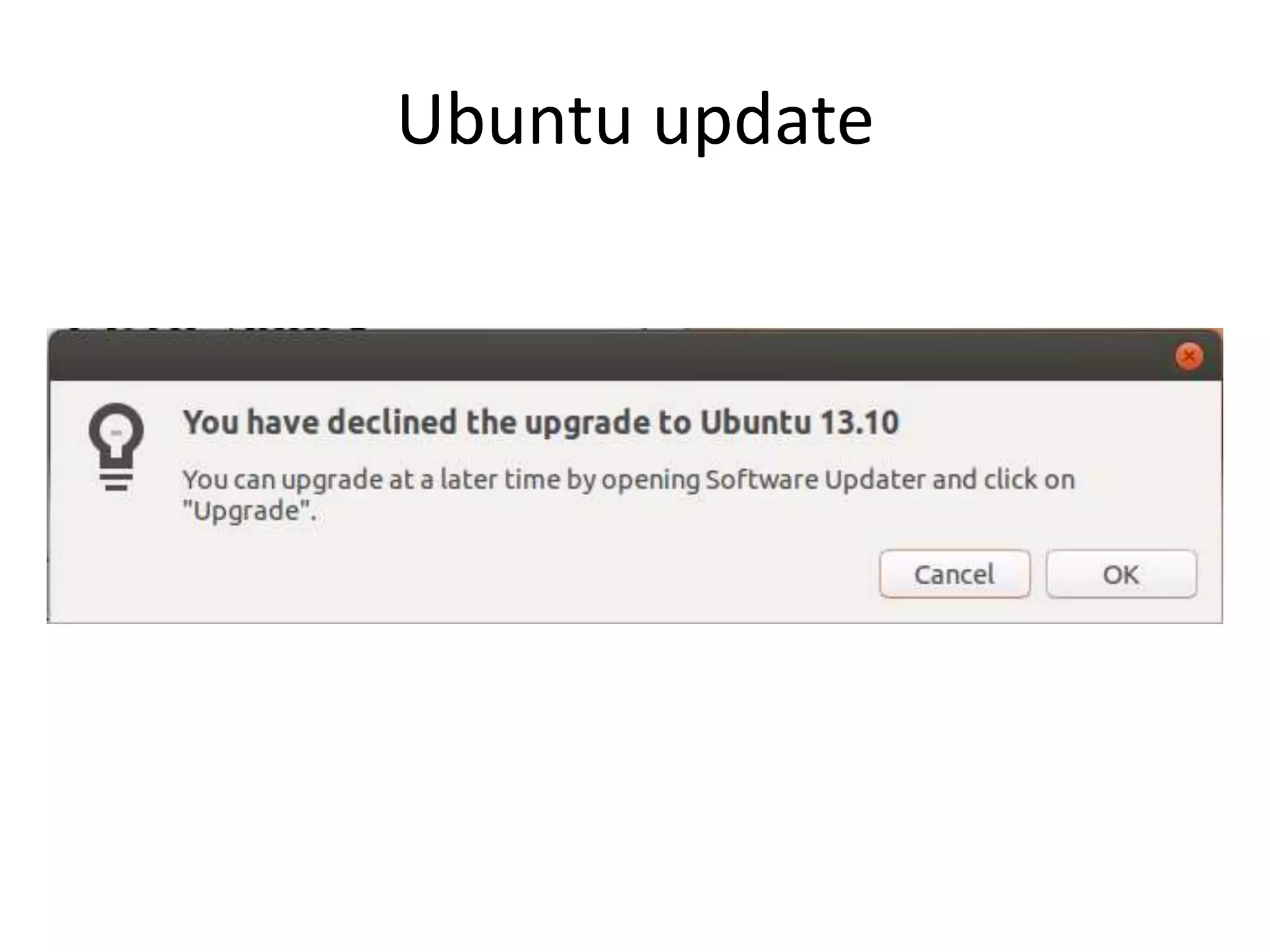
Ubuntu update
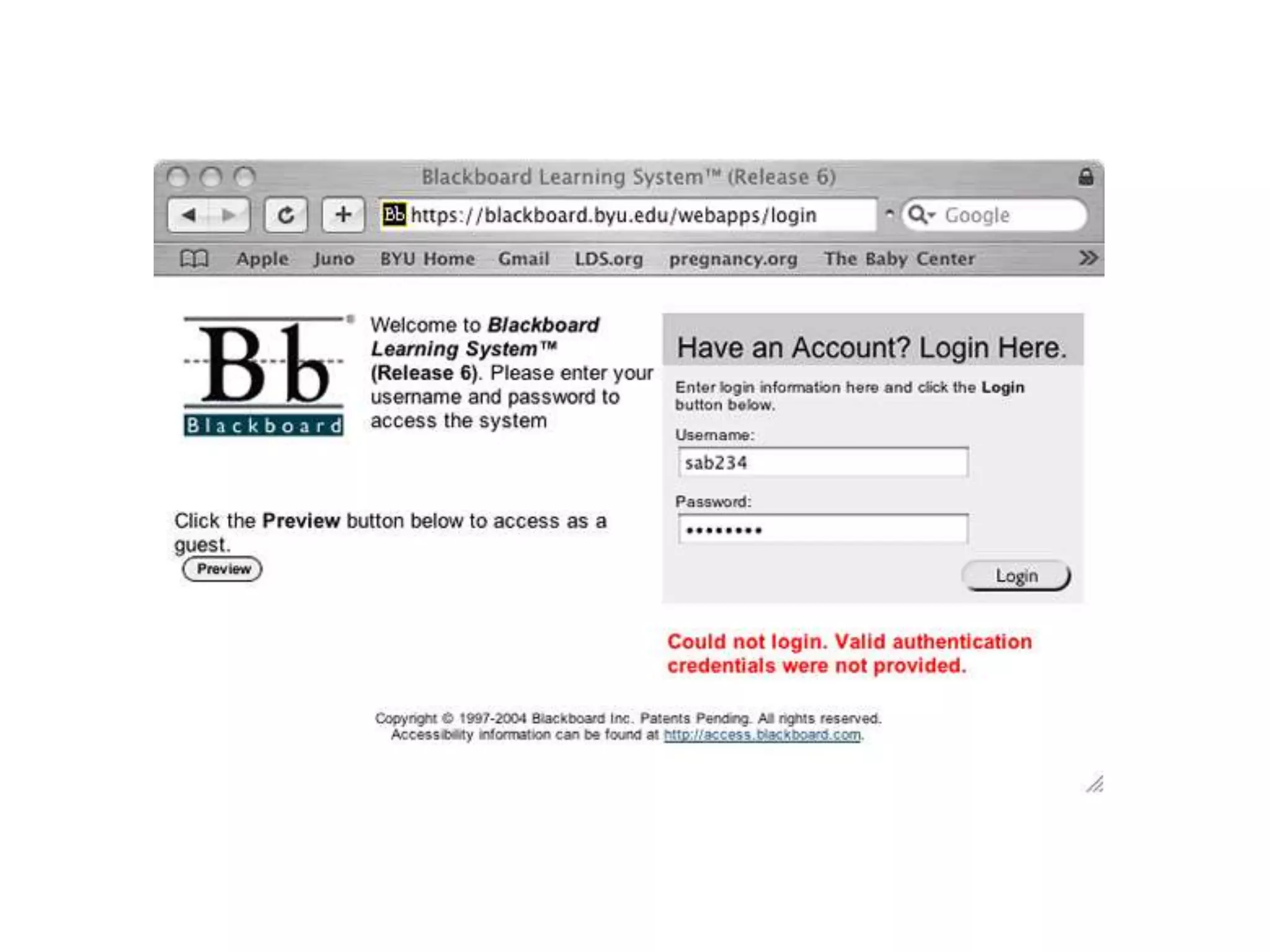
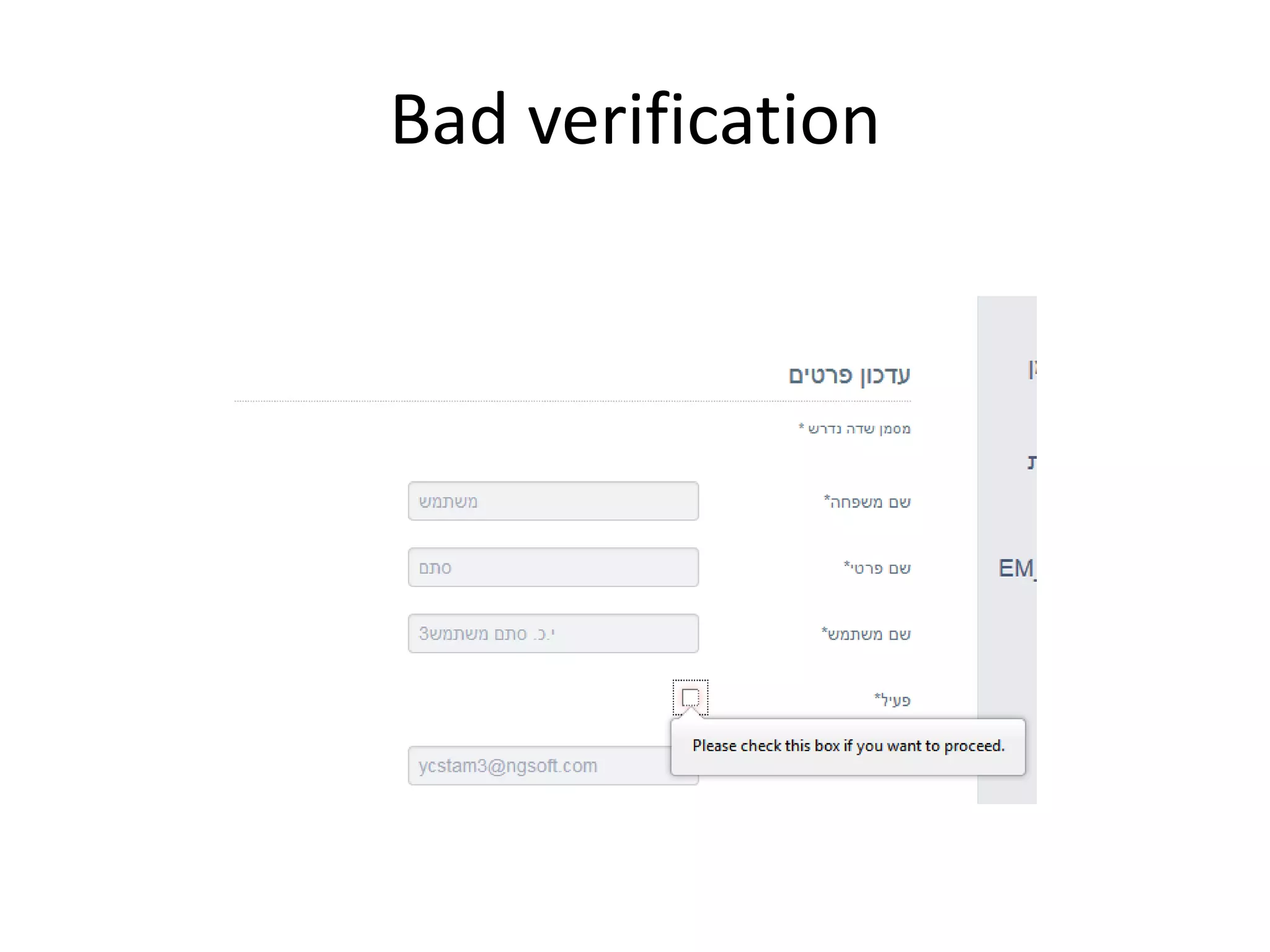
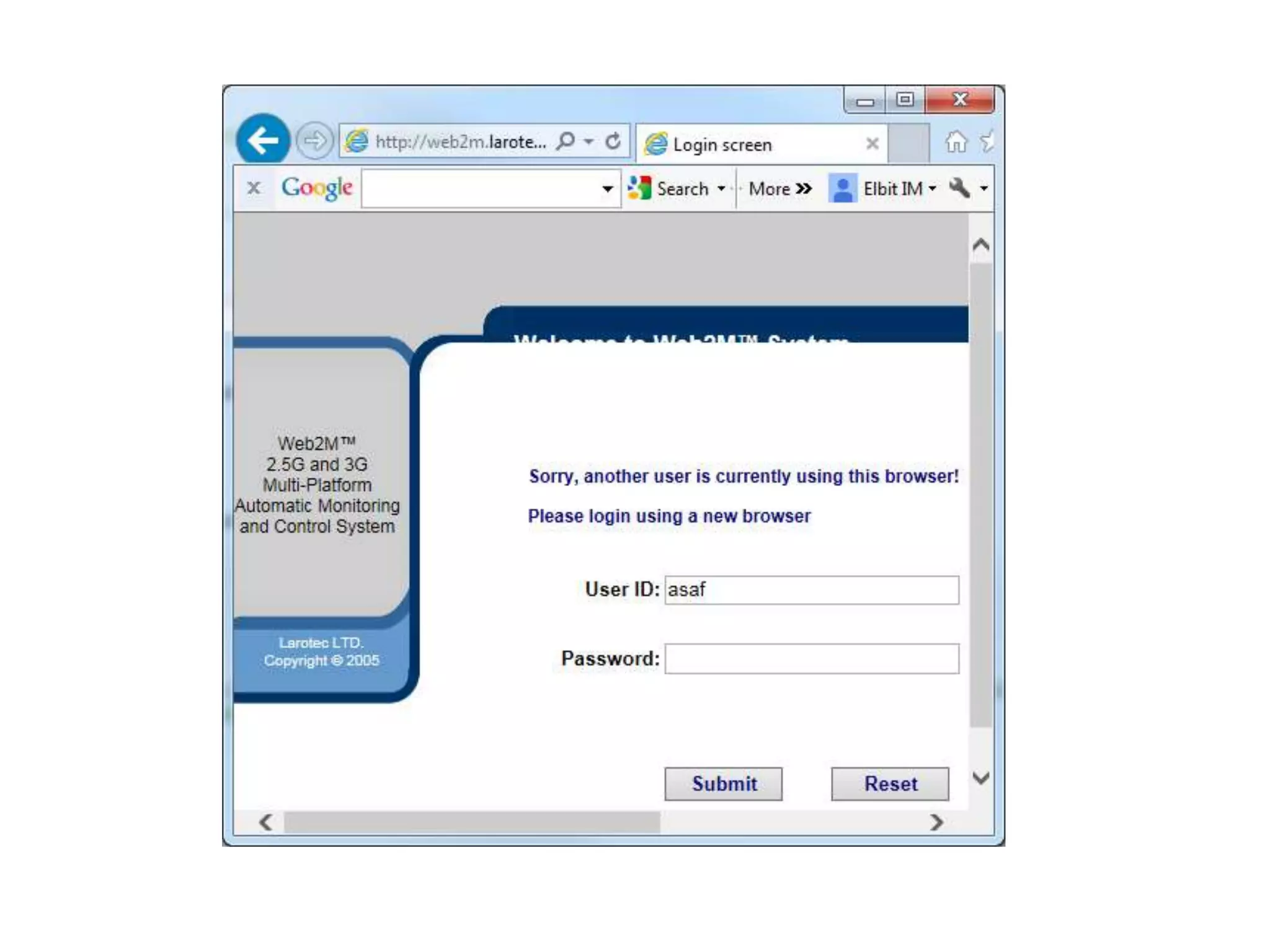
Bad verification
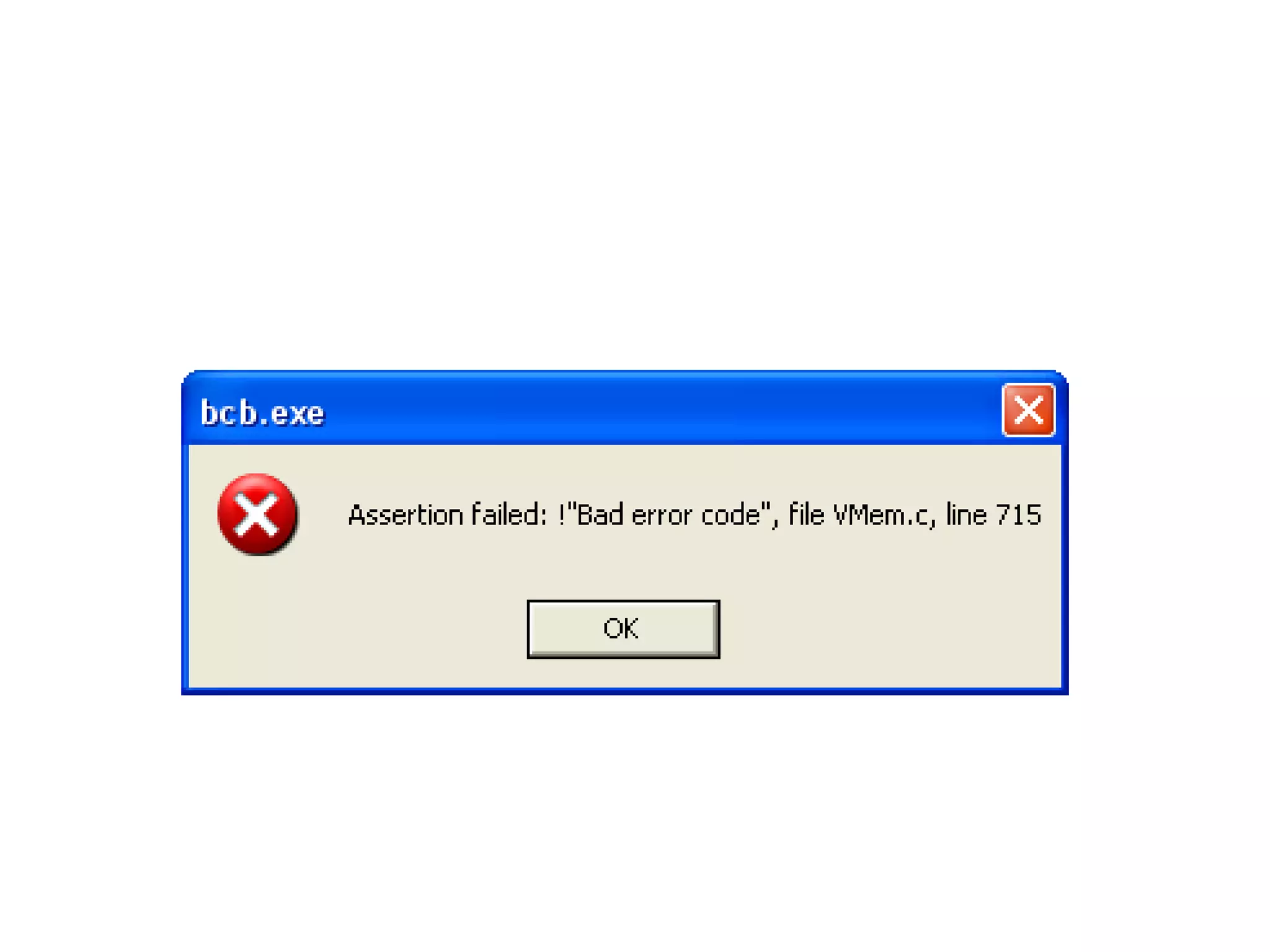
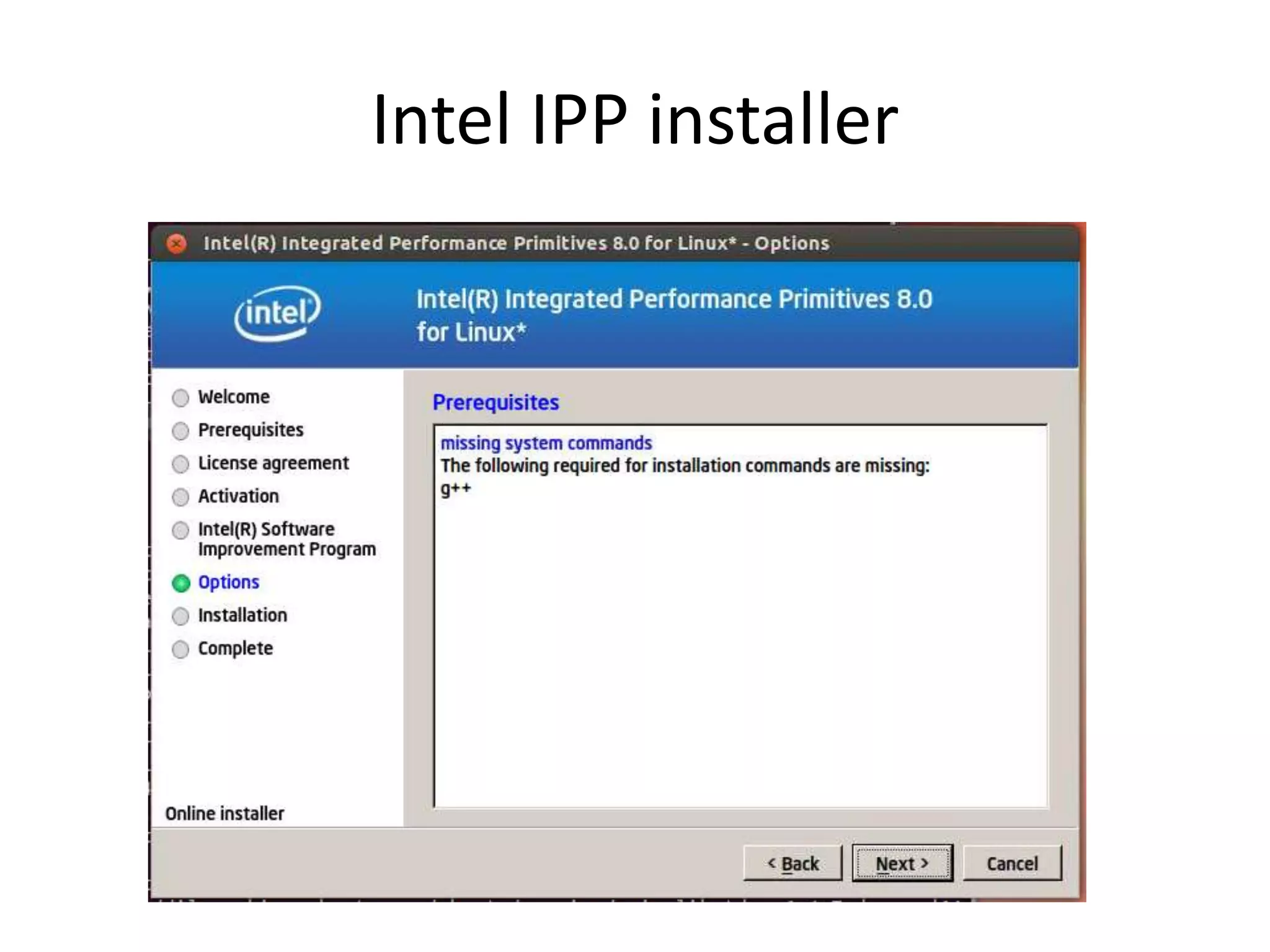
Intel IPP installer
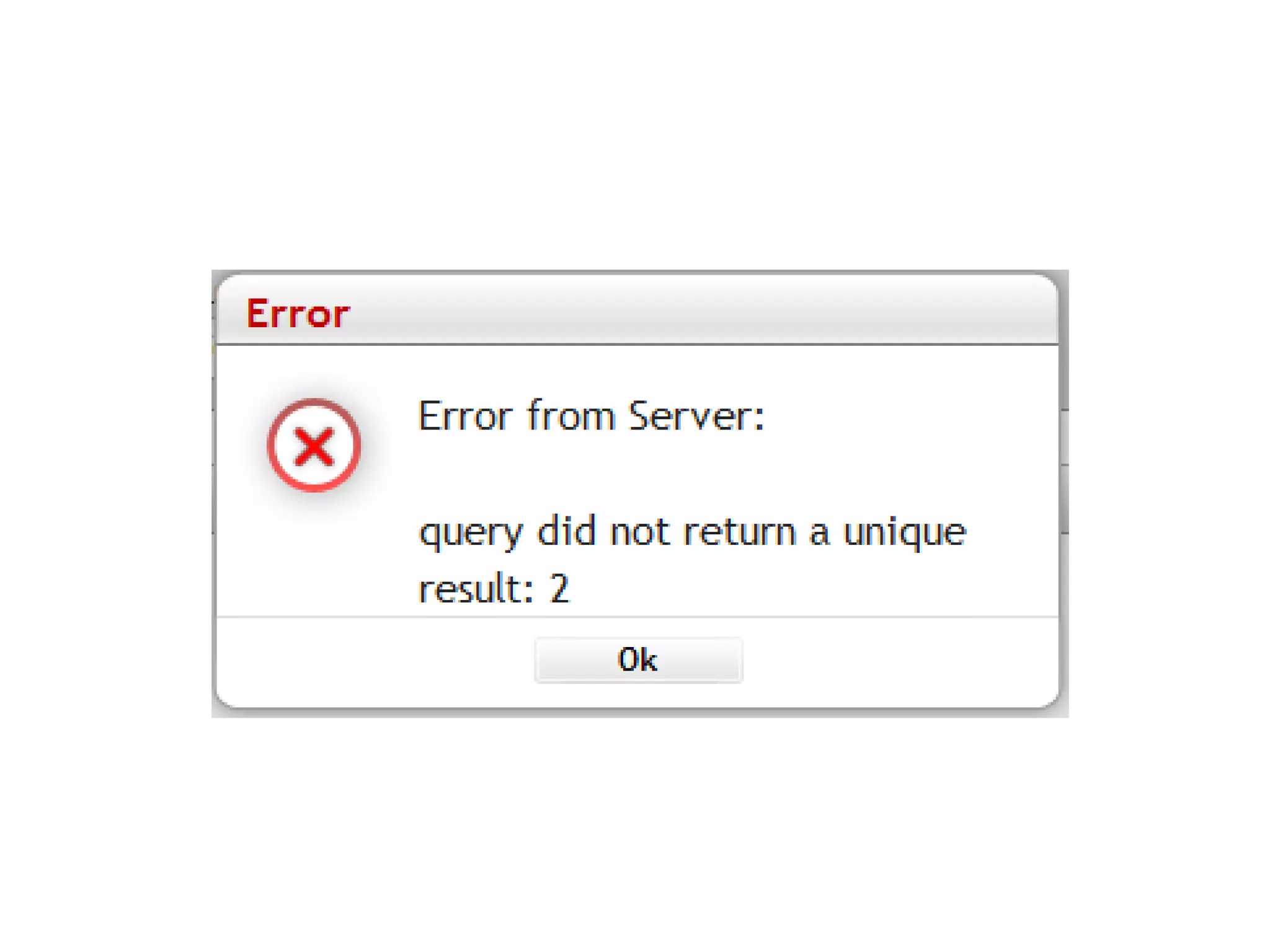
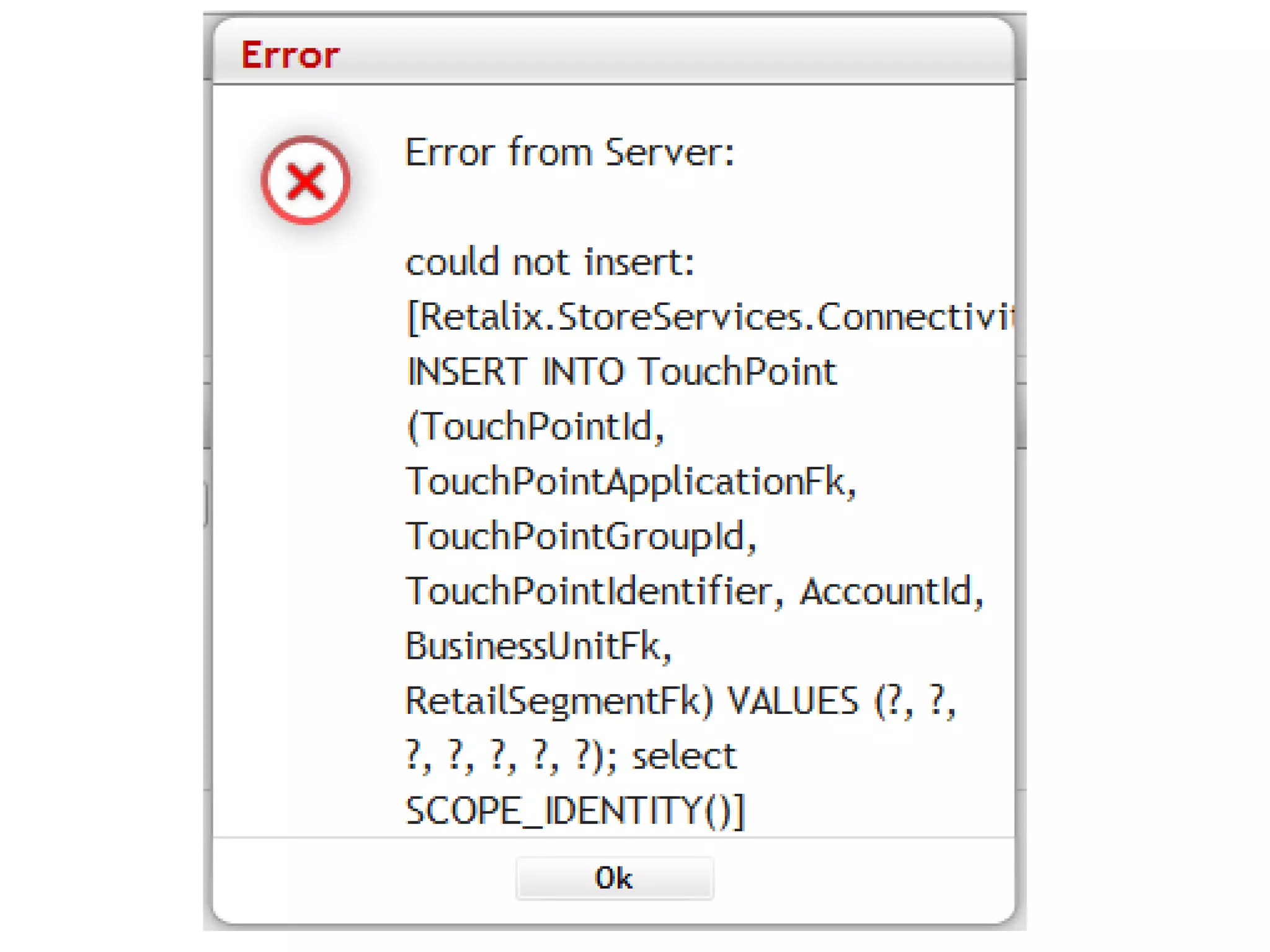
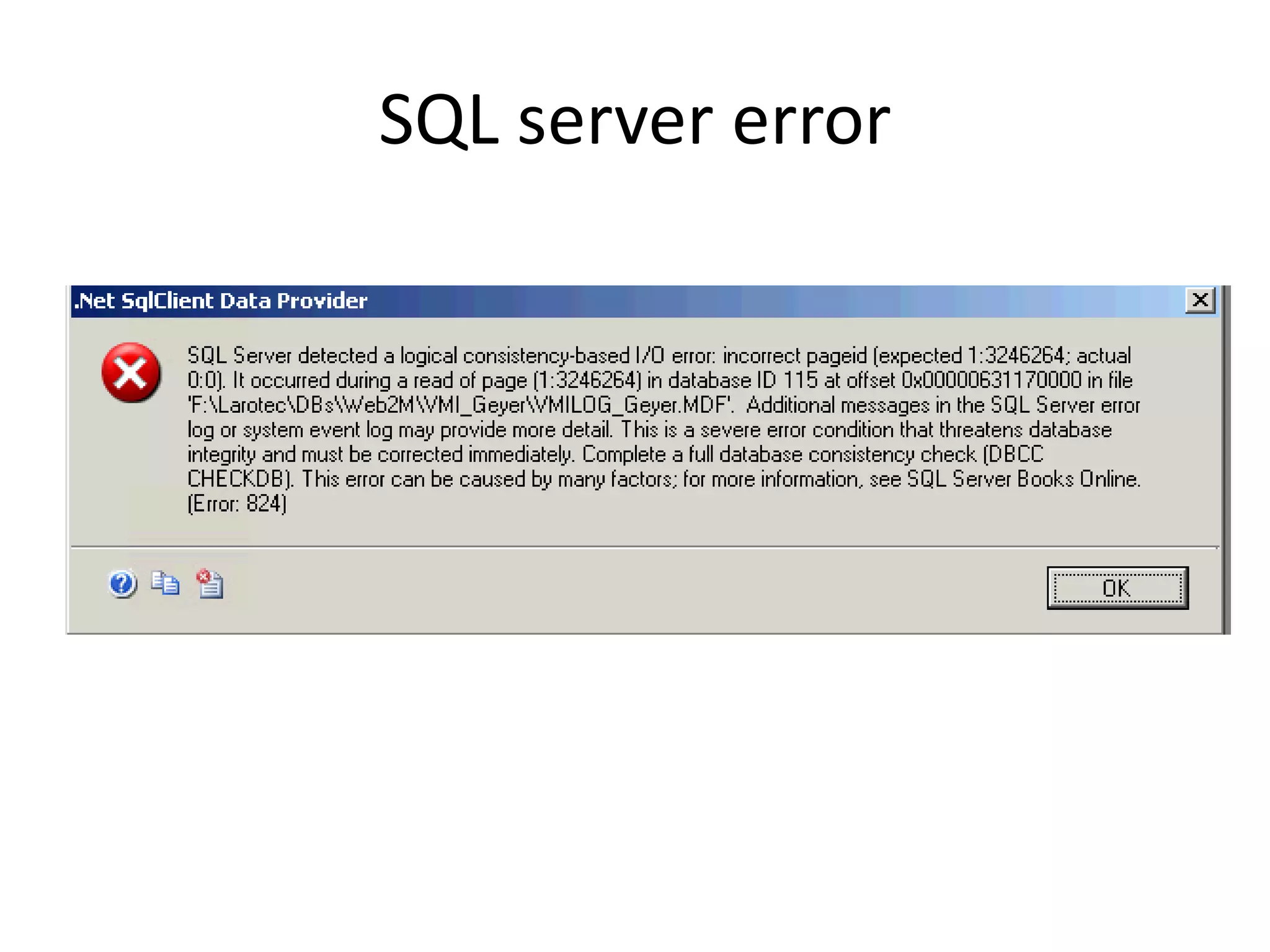
SQL server error
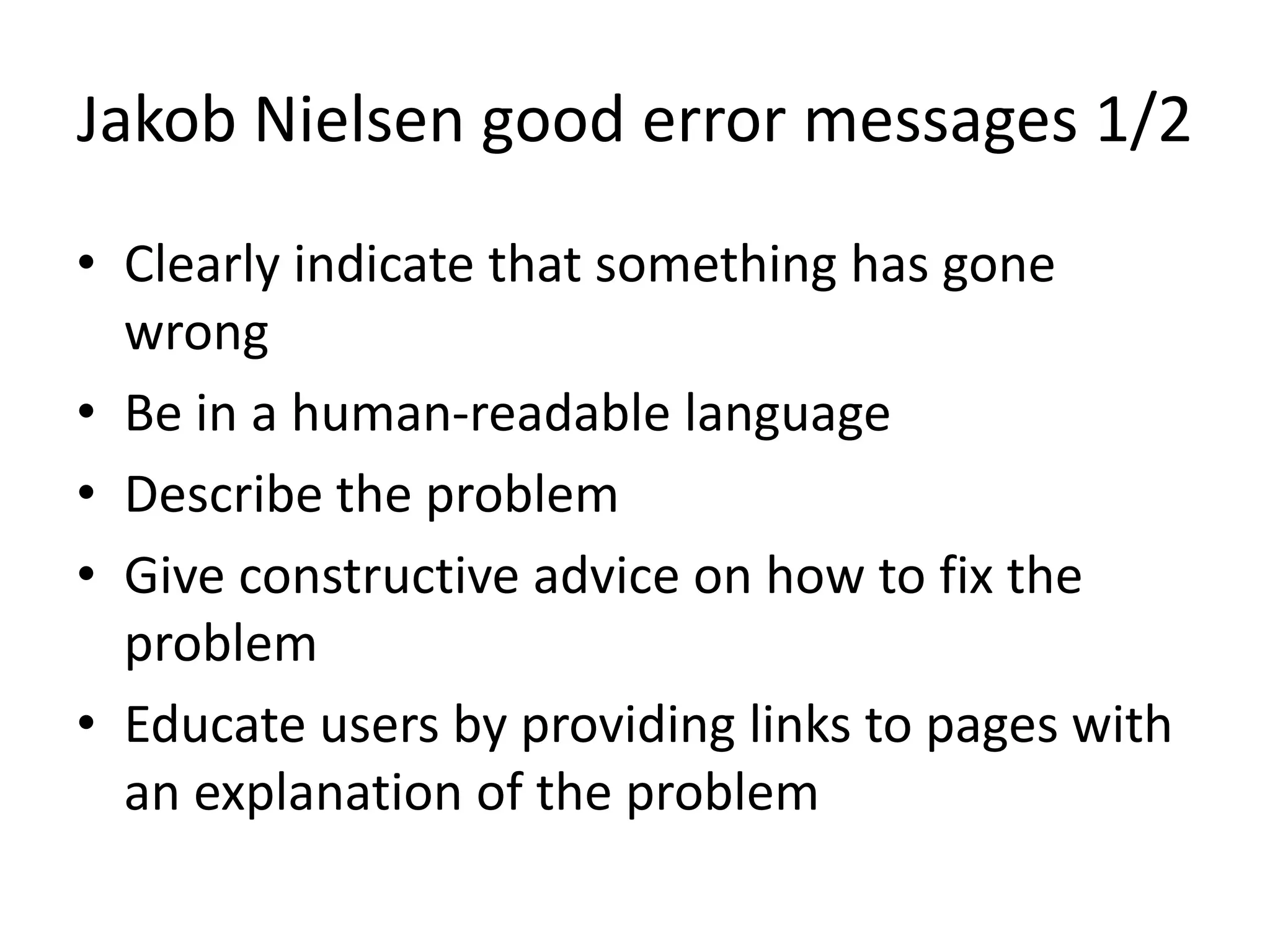
Jakob Nielsen good error messages 1/2
• Clearly indicate that something has gone
wrong
• Be in a human-readable language
• Describe the problem
• Give constructive advice on how to fix the
problem
• Educate users by providing links to pages with
an explanation of the problem
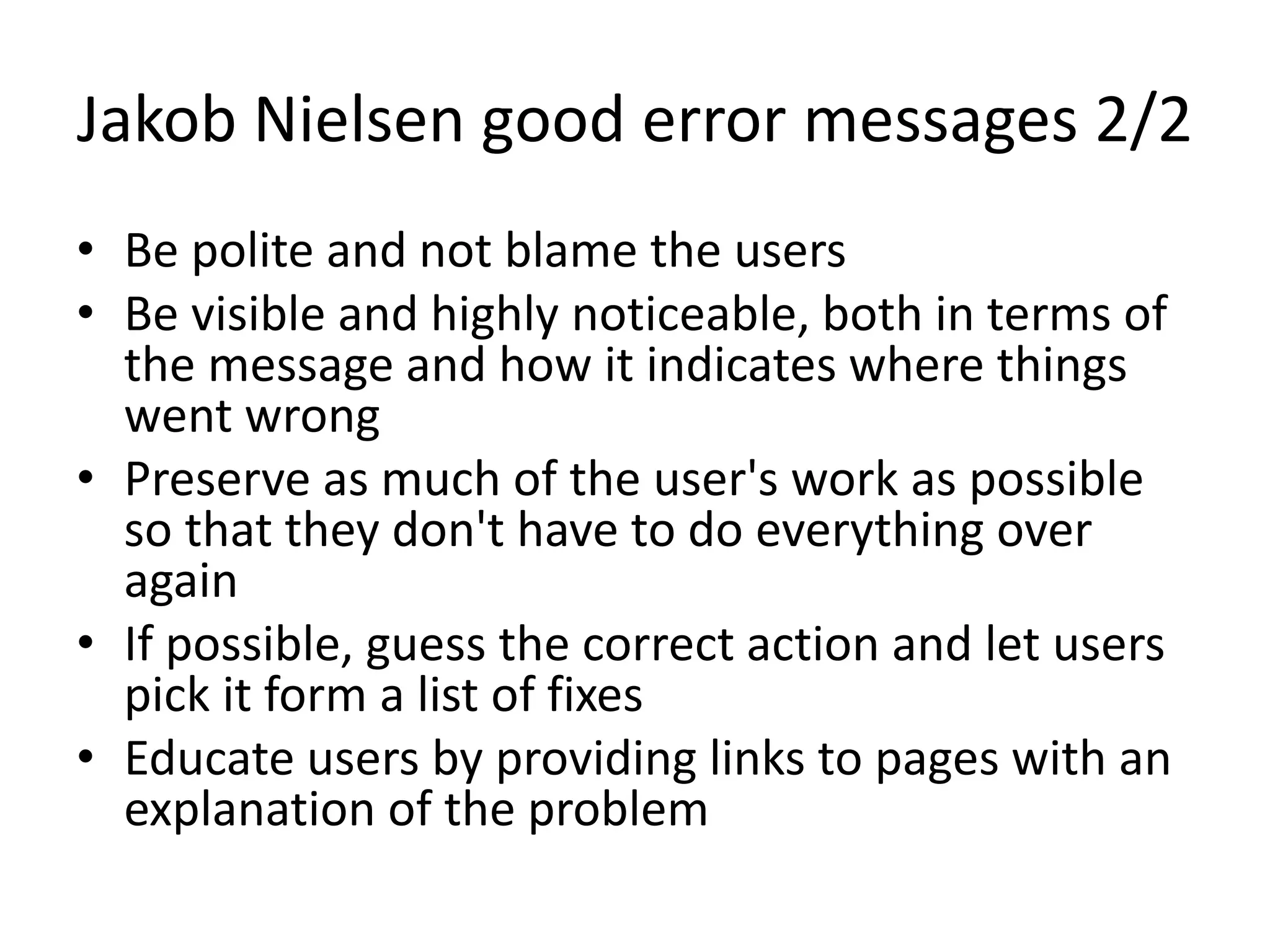
Jakob Nielsen good error messages 2/2
• Be polite and not blame the users
• Be visible and highly noticeable, both in terms of
the message and how it indicates where things
went wrong
• Preserve as much of the user's work as possible
so that they don't have to do everything over
again
• If possible, guess the correct action and let users
pick it form a list of fixes
• Educate users by providing links to pages with an
explanation of the problem
The 3 basic rules
• Describe What went wrong.
• Explain How this error can be avoided.
• Provide steps to solve the error or examples
for how the function should be used correctly.
Is this a good error message?
Refferences
• http://www.instructionaldesign.org/bad_error
_messages.html
• http://www.retailshakennotstirred.com/retail-
shaken-not-stirred/2009/10/conversion-tip-
dont-let-bad-error-messages-cost-you-
sales.html
• http://technologizer.com/2008/09/18/errorm
essage/

Bad error messages

Editor's Notes

  • #4 Look at this one: Althuogh funny – it’s a good error.
  • #12 Microsoft Jscript null refference error.
  • #15 Win32 pre sp1 API error
  • #17 This is what you get for adding a new touchpoint
  • #18 And this happens when you give a computer name for an already existing POS
  • #28 Jakob Nielsen has been called: "the king of usability" (Internet Magazine) "the guru of Web page usability" (The New York Times) "the next best thing to a true time machine" (USA Today) "the smartest person on the Web" (ZDNet AnchorDesk) "the world's leading expert on Web usability" (U.S. News & World Report) one of the top 10 minds in small business (FORTUNE Small Business) "the world's leading expert on user-friendly design" (Stuttgarter Zeitung, Germany) "knows more about what makes Web sites work than anyone else on the planet" (Chicago Tribune) "one of the world's foremost experts in Web usability" (Business Week) "the Web's usability czar" (WebReference.com) "the reigning guru of Web usability" (FORTUNE) "eminent Web usability guru" (CNN) "perhaps the best-known design and usability guru on the Internet" (Financial Times) "the usability Pope" (Wirtschaftswoche Magazine, Germany) "new-media pioneer" (Newsweek) One of the "world's most influential designers" (Businessweek) Jakob Nielsen, Ph.D., is a User Advocate and principal of the Nielsen Norman Group which he co-founded with Dr. Donald A. Norman (former VP of research at Apple Computer). Before starting NNG in 1998 he was a Sun Microsystems Distinguished Engineer. Dr. Nielsen founded the "discount usability engineering" movement for fast and cheap improvements of user interfaces and has invented several usability methods, including heuristic evaluation. He holds 79 United States patents, mainly on ways of making the Internet easier to use.
  • #29 Jakob Nielsen has been called: "the king of usability" (Internet Magazine) "the guru of Web page usability" (The New York Times) "the next best thing to a true time machine" (USA Today) "the smartest person on the Web" (ZDNet AnchorDesk) "the world's leading expert on Web usability" (U.S. News & World Report) one of the top 10 minds in small business (FORTUNE Small Business) "the world's leading expert on user-friendly design" (Stuttgarter Zeitung, Germany) "knows more about what makes Web sites work than anyone else on the planet" (Chicago Tribune) "one of the world's foremost experts in Web usability" (Business Week) "the Web's usability czar" (WebReference.com) "the reigning guru of Web usability" (FORTUNE) "eminent Web usability guru" (CNN) "perhaps the best-known design and usability guru on the Internet" (Financial Times) "the usability Pope" (Wirtschaftswoche Magazine, Germany) "new-media pioneer" (Newsweek) One of the "world's most influential designers" (Businessweek) Jakob Nielsen, Ph.D., is a User Advocate and principal of the Nielsen Norman Group which he co-founded with Dr. Donald A. Norman (former VP of research at Apple Computer). Before starting NNG in 1998 he was a Sun Microsystems Distinguished Engineer. Dr. Nielsen founded the "discount usability engineering" movement for fast and cheap improvements of user interfaces and has invented several usability methods, including heuristic evaluation. He holds 79 United States patents, mainly on ways of making the Internet easier to use.
  • #30 What Error messages written in a negative or even neutral tone can sound accusatory, suggesting that the visitor has misread instructions, filled out a form incorrectly, or otherwise screwed up. Being blamed for an error by a computer is off-putting. Use when Use this pattern when writing the copy for error messages at your site. You were planning to write those messages, right? You weren't going to forget about them (yielding helpful dialog boxes that say something like "Error 41"), right? You weren't going to expect your engineers to write them (yielding helpful dialog boxes that say something like "Error 41: Error 41 has occurred"), were you? How Writing in a conversational tone, explain to the extent possible what has gone wrong, why, and what to do next, if anything. Be sure to express the error in terms of a failure on the part of the system. Even if the cause of the error is the user's failure to comply with an instruction, assume that the instructions were unclear or that the entry form didn't provide sufficient guidance. Don't blame the user for the error. Take the blame, apologize, and move forward. Special cases Saying "Oops" is one way to mimic a very human way of noticing a problem and taking responsibility at the same time. However, as Bill Cosby once joked, you never want to hear your surgeon say "Oops." It's equally true that for sites dealing with sensitive personal information or circumstances (such as, for example, medical or financial contexts), a more formal tone may be appropriate to avoid the appearance of flippancy. Even in a formal or sensitive situation, it's equally important to avoid blaming the victim when a problem occurs. Examples GetSatisfaction.com takes responsibility ("We couldn't find it") when a search turns up no results (Figure 2.10).
  • #31 Yes! It is! It describes what is wrong It explains how the error can be avoided (press F1 to continue). It provides steps hot to fix it (you will need to connect a keyboard to do these steps!).