Back to Basics 2017 : Webinar 3
Einführung in Replica Sets
Benjamin Lorenz
Senior Solutions Architect
MongoDB Frankfurt
3
Zusammenfassung von Teil 1 und Teil 2
• Warum NoSQL
• Unterschiedliche Typen von NoSQL-Datenbanken
• MongoDB: Detaillierte Übersicht
• Datenbankkonzepte
• Installieren von MongoDB
• Erstellen einer einfachen Blogging-Anwendung
• Hinzufügen eines Index
• Abfrageoptimierung mit explain()
4
Ablauf heute
• Dauerhaftigkeit (durability) von Daten
• Der MongoDB-Ansatz: Das Replica Set
• Replica Set-Lebenszyklus
• Programmierung mit einem Replica Set
5
HighAvailability and Data Durability – Replica Sets
SecondarySecondary
Primary
6
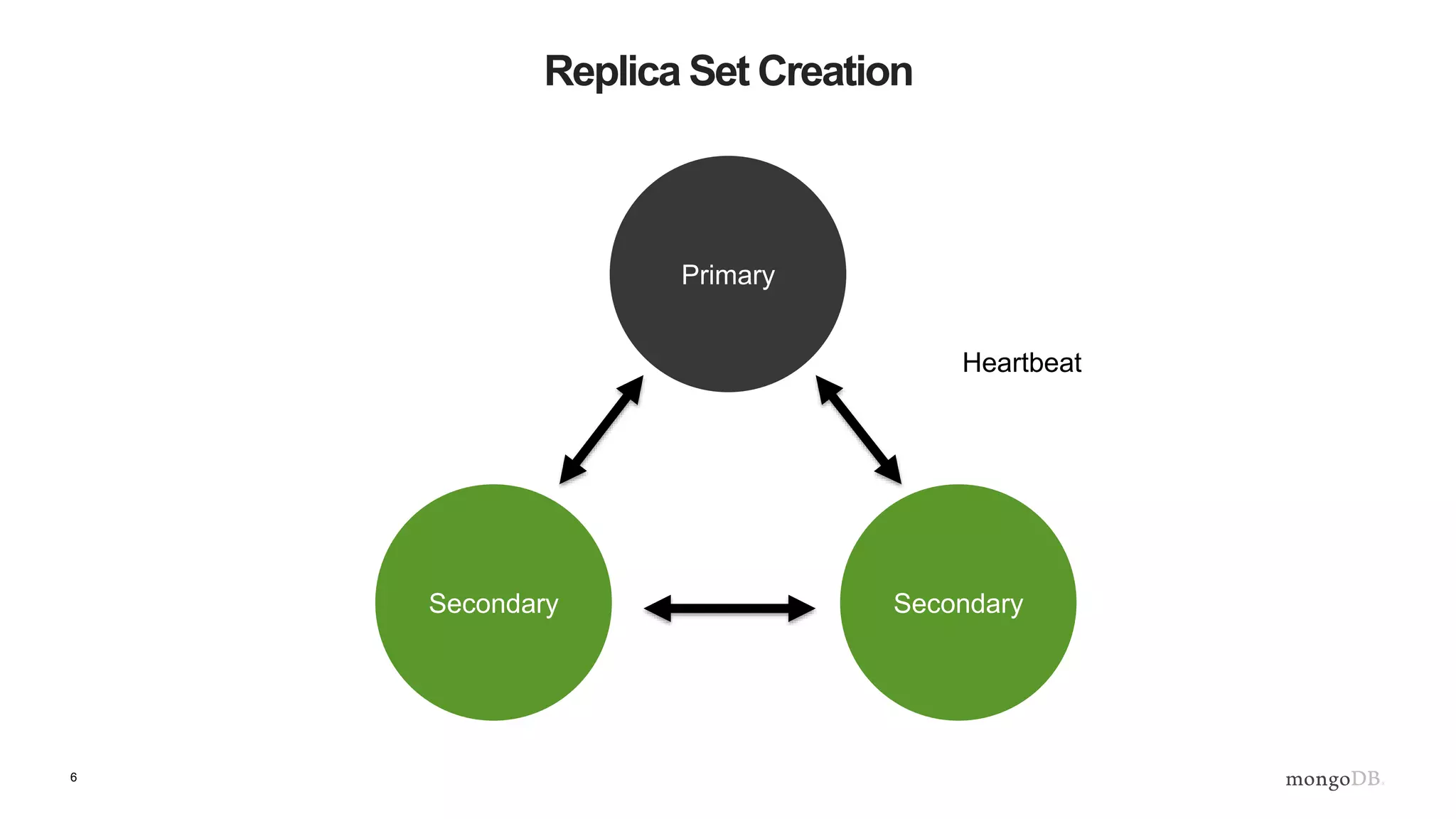
Replica Set Creation
SecondarySecondary
Primary
Heartbeat
7
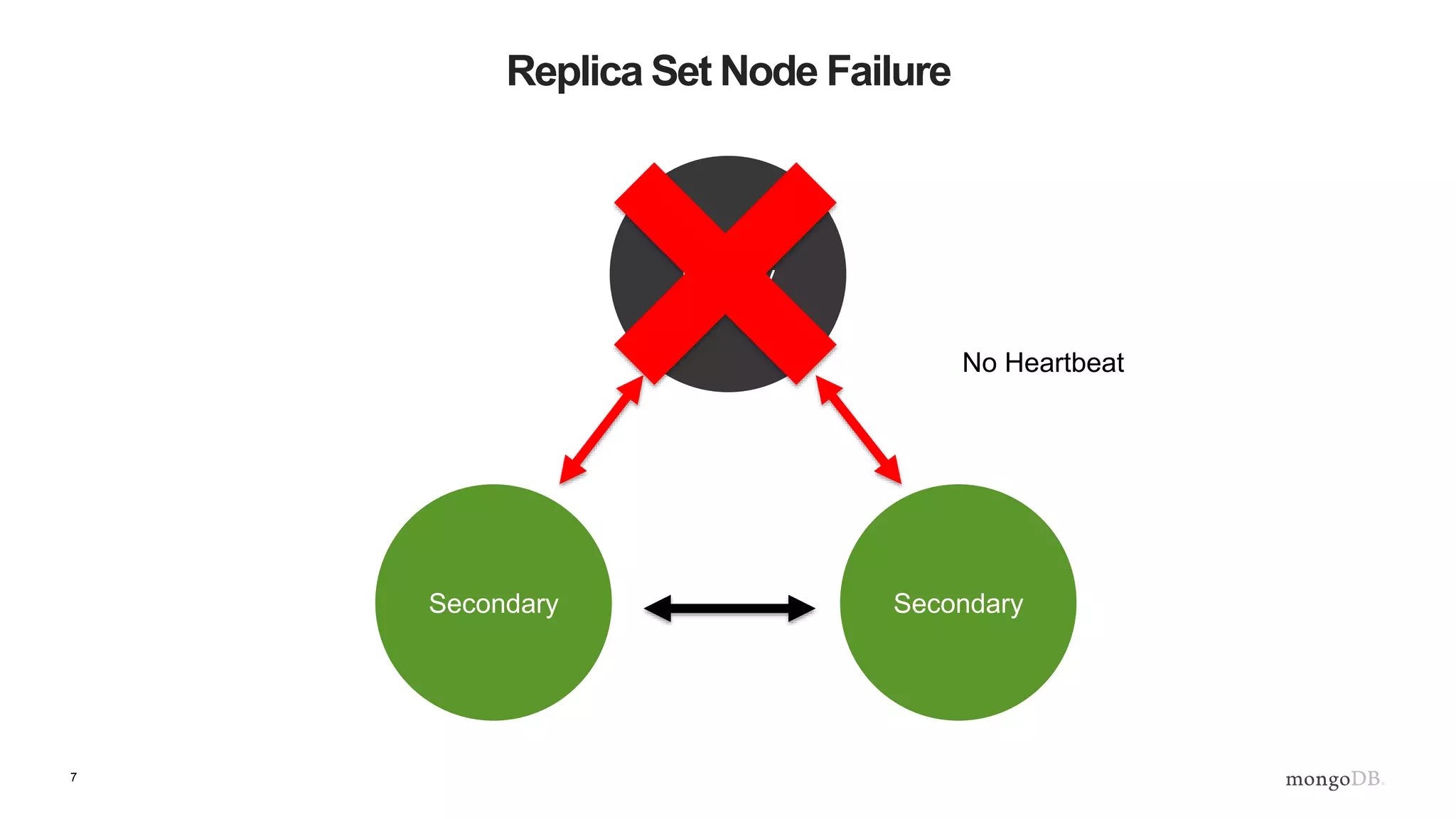
Replica Set Node Failure
SecondarySecondary
Primary
No Heartbeat
8
Replica Set Recovery
SecondarySecondary
Heartbeat
And Election
9
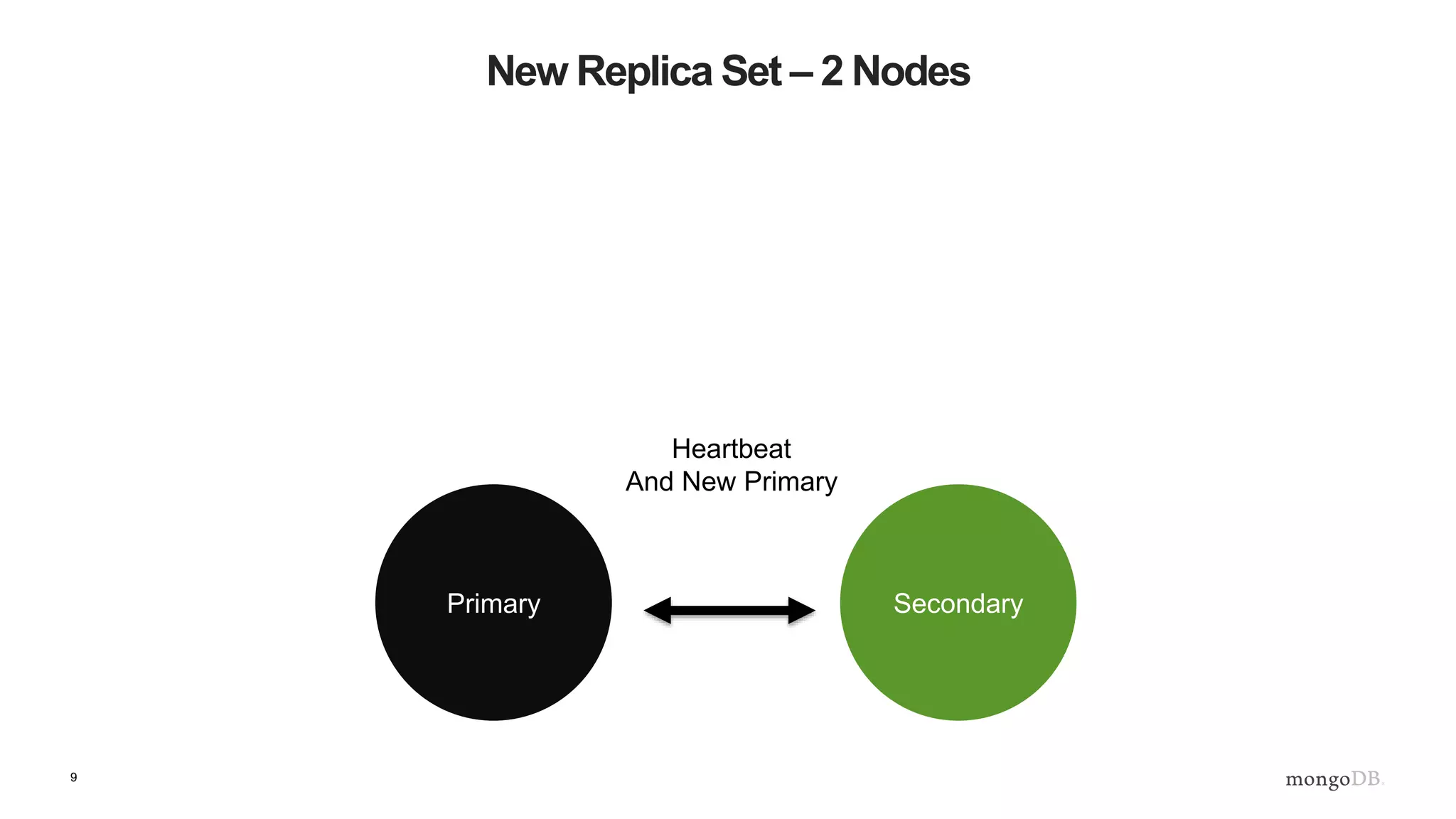
New Replica Set – 2 Nodes
SecondaryPrimary
Heartbeat
And New Primary
10
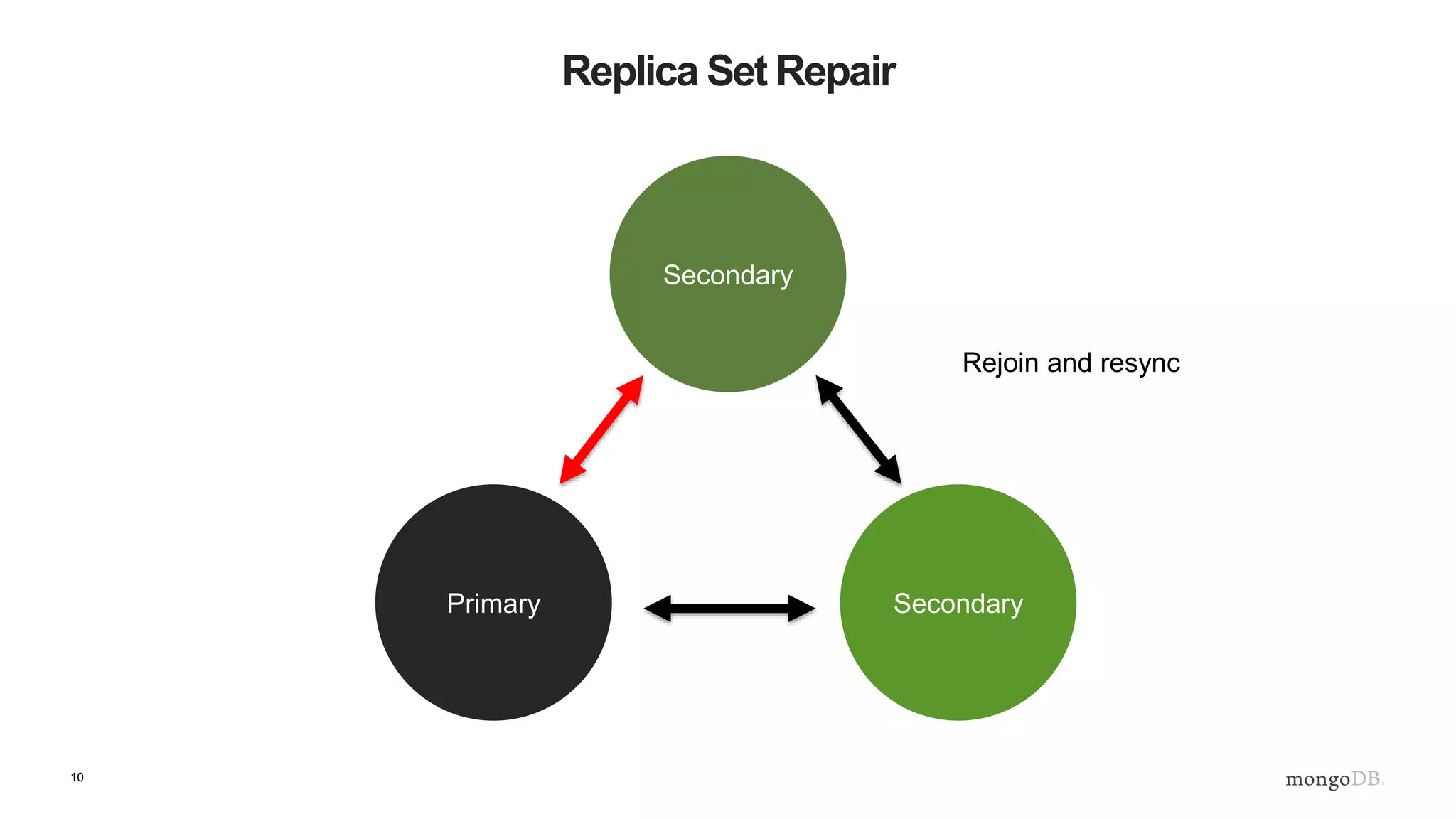
Replica Set Repair
SecondaryPrimary
Secondary
Rejoin and resync
11
Replica Set Stable
SecondaryPrimary
Secondary
Heartbeat
Developing with Replica Sets
13
Driver Responsibilities
https://github.com/mongodb/mongo-python-driver
Driver
Authentication
& Security
Python<->BSON
Error handling &
Recovery
Wire
Protocol
Topology
Management
Connection Pool
14
Strong Consistency
SecondarySecondary
Primary
Client Application
Client Driver
Write
Read
15
Eventual Consistency
SecondarySecondary
Primary
Client Application
Client Driver
Write
16
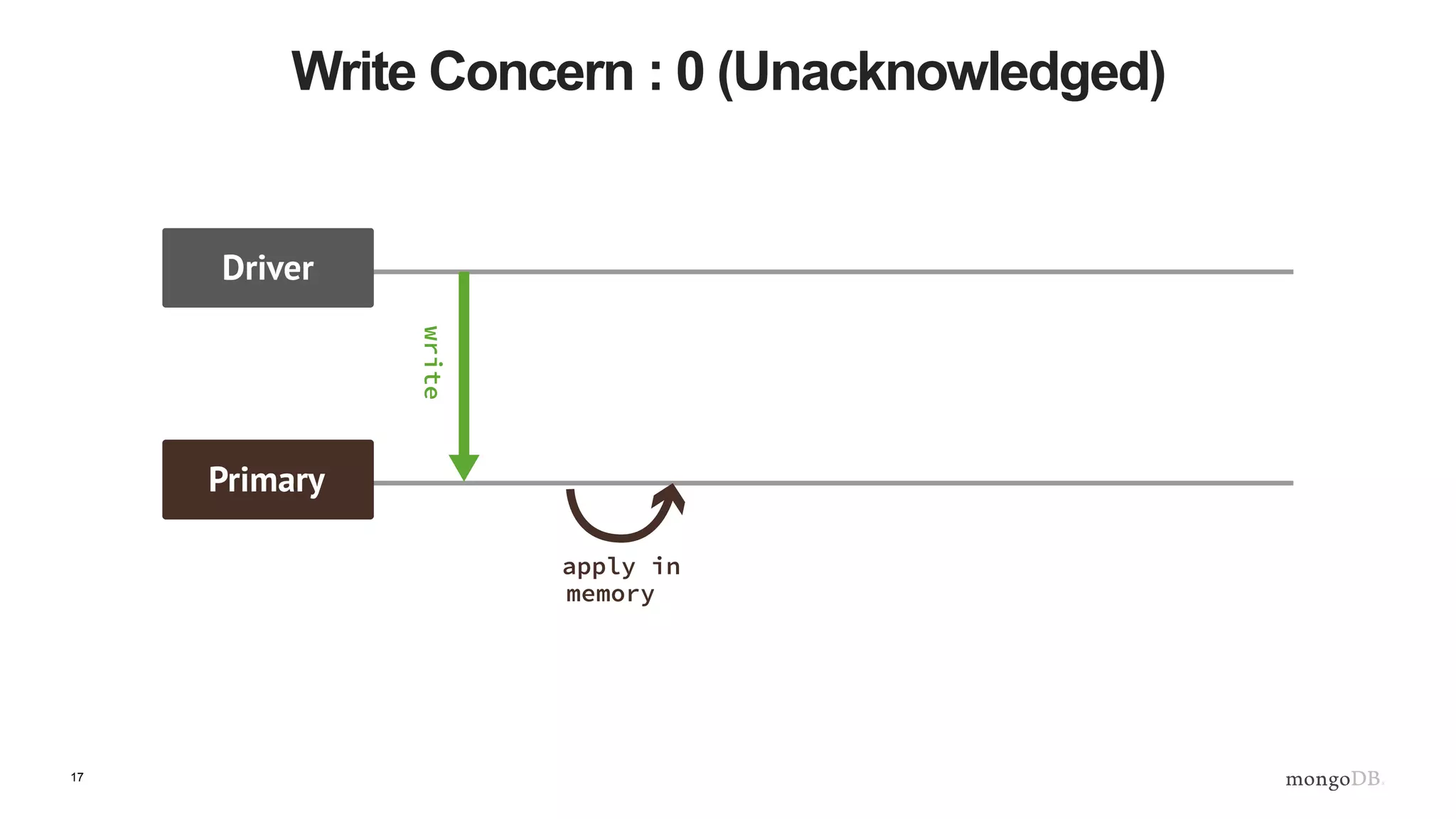
Write Concerns
• Network acknowledgement
• Wait for error
• Wait for journal sync
• Wait for replication
17
Write Concern : 0 (Unacknowledged)
18
Write Concern : 1 (Acknowledged)
19
Write Concern : majority
20
Driver Responsibilities
https://github.com/mongodb/mongo-python-driver
Driver
Authentication
& Security
Python<->BSON
Error handling &
Recovery
Wire
Protocol
Topology
Management
Connection Pool
21
Start MongoClient
c = MongoClient( "host1, host2",
replicaSet="replset" )
22
Client Side View
Secondary
host2
Secondary
host3
Primary
host1
Mongo
Client
MongoClient( "host1, host2",
replicaSet="replset" )
23
Client Side View
Secondary
host2
Secondary
host3
Primary
host1
Mongo
Client
Monitor
Thread 1
Monitor
Thread 2
{ ismaster : False,
secondary: True,
hosts : [ host1, host2, host3 ] }
24
What Does ismaster show?
>>> pprint.pprint( db.command( "ismaster" ))
{u'hosts': [u'JD10Gen-old.local:27017',
u'JD10Gen-old.local:27018',
u'JD10Gen-old.local:27019'],
u'ismaster' : False,
u'secondary': True,
u'setName' : u'replset',
…}
>>>
25
Topology
Current
Topology
ismaster
New
Topology
26
Client Side View
Secondary
host2
Secondary
host3
Primary
host1
Mongo
Client
Monitor
Thread 1
Monitor
Thread 2
27
Client Side View
Secondary
host2
Secondary
host3
Primary
host1
Mongo
Client
Monitor
Thread 1
Monitor
Thread 2
Monitor
Thread 3
28
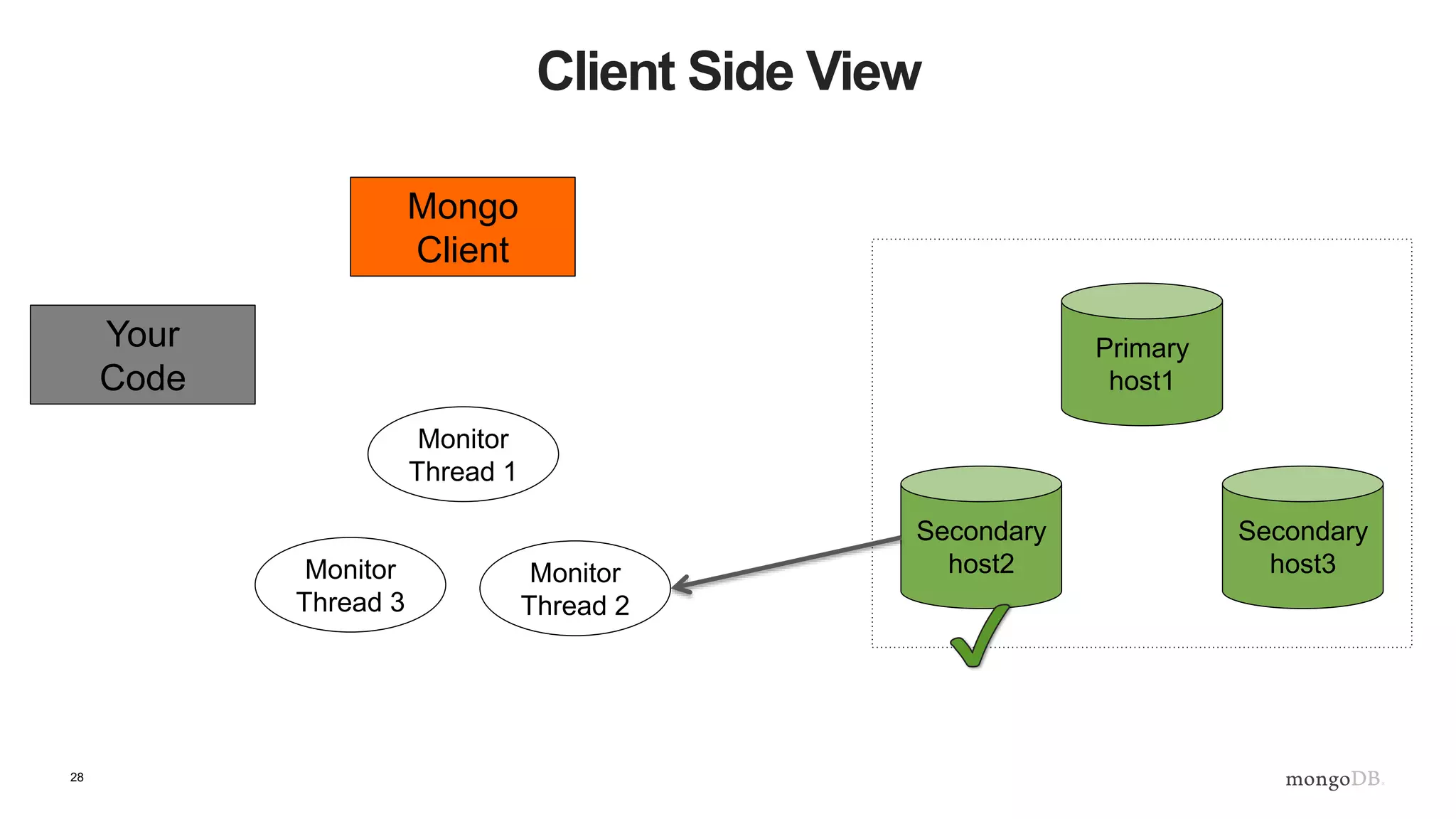
Client Side View
Secondary
host2
Secondary
host3
Primary
host1
Mongo
Client
Monitor
Thread 1
Monitor
Thread 2
Monitor
Thread 3
Your
Code
29
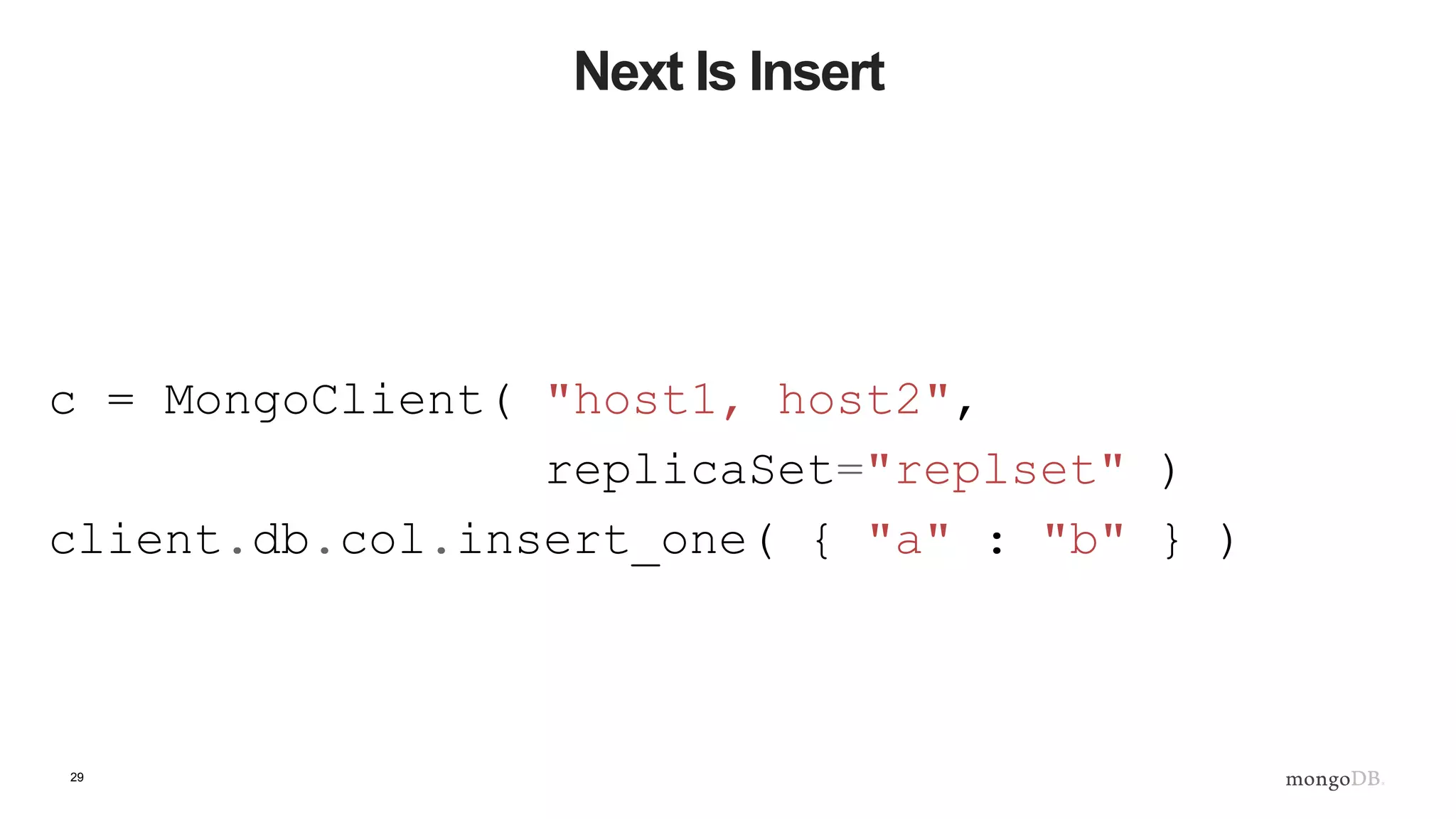
Next Is Insert
c = MongoClient( "host1, host2",
replicaSet="replset" )
client.db.col.insert_one( { "a" : "b" } )
30
Insert Will Block
Secondary
host2
Secondary
host3
Primary
host1
Mongo
Client
Monitor
Thread 1
Monitor
Thread 2
Monitor
Thread 3
Your
Code
Insert
31
ismaster response from Host 1
Secondary
host2
Secondary
host3
Primary
host1
Mongo
Client
Monitor
Thread 1
Monitor
Thread 2
Monitor
Thread 3
Your
Code
Insert
ismaster
32
Now Write Can Proceed
Secondary
host2
Secondary
host3
Primary
host1
Mongo
Client
Monitor
Thread 1
Monitor
Thread 2
Monitor
Thread 3
Your
Code
Insert Insert
33
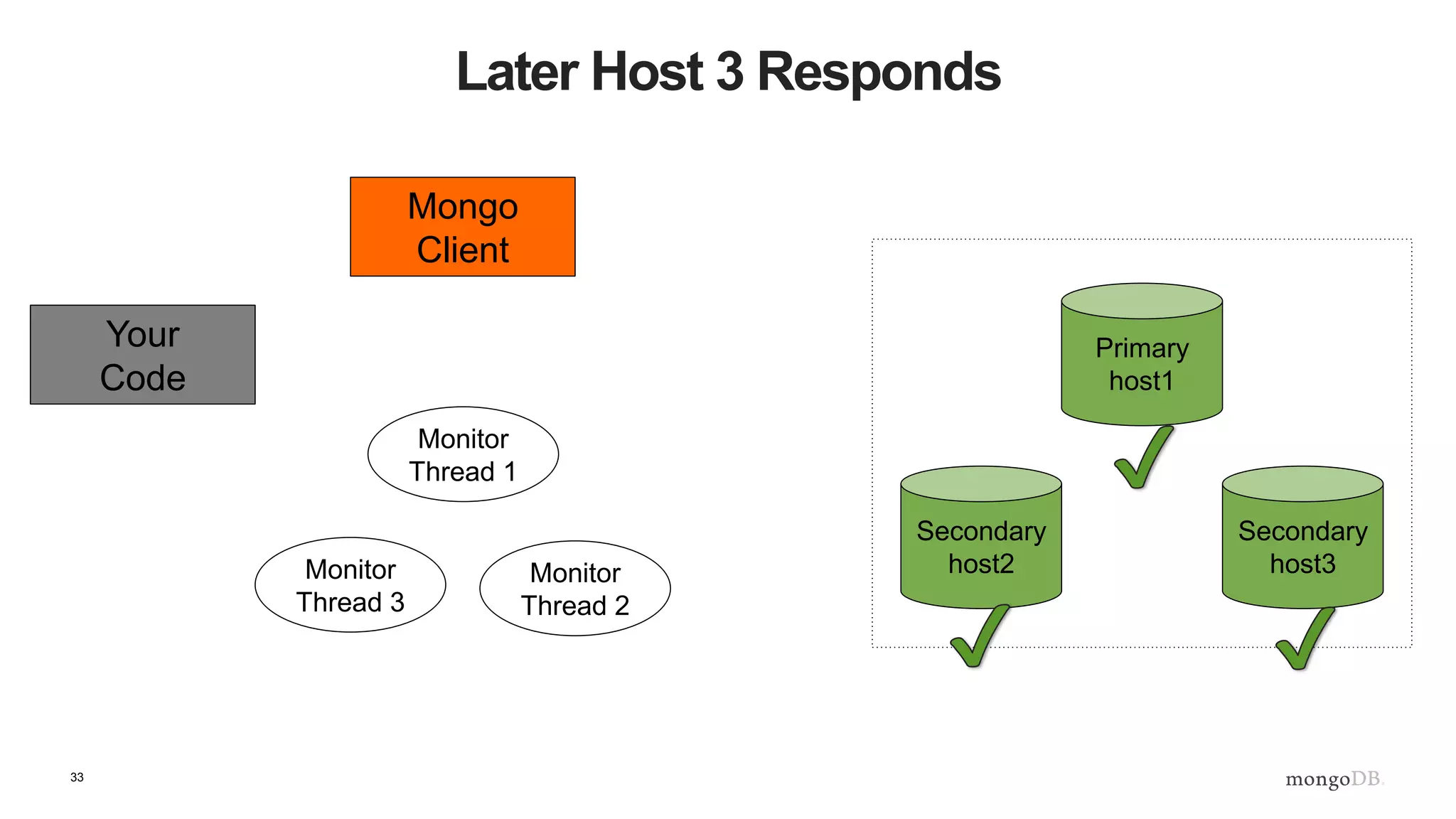
Later Host 3 Responds
Secondary
host2
Secondary
host3
Primary
host1
Mongo
Client
Monitor
Thread 1
Monitor
Thread 2
Monitor
Thread 3
Your
Code
34
Steady State
Secondary
host2
Secondary
host3
Primary
host1
Mongo
Client
Monitor
Thread 1
Monitor
Thread 2
Monitor
Thread 3
Your
Code
35
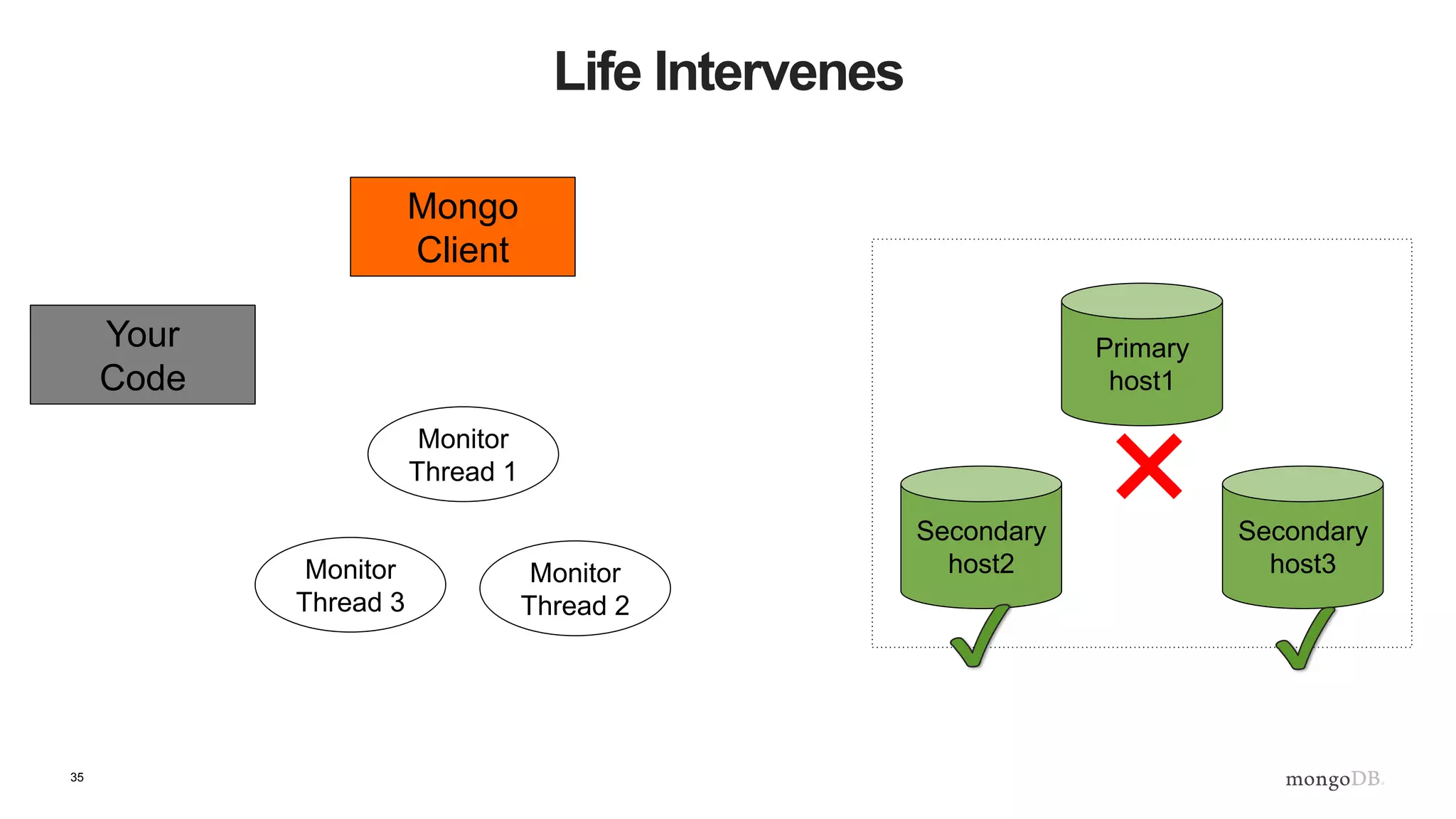
Life Intervenes
Secondary
host2
Secondary
host3
Primary
host1
Mongo
Client
Monitor
Thread 1
Monitor
Thread 2
Monitor
Thread 3
Your
Code
✖
36
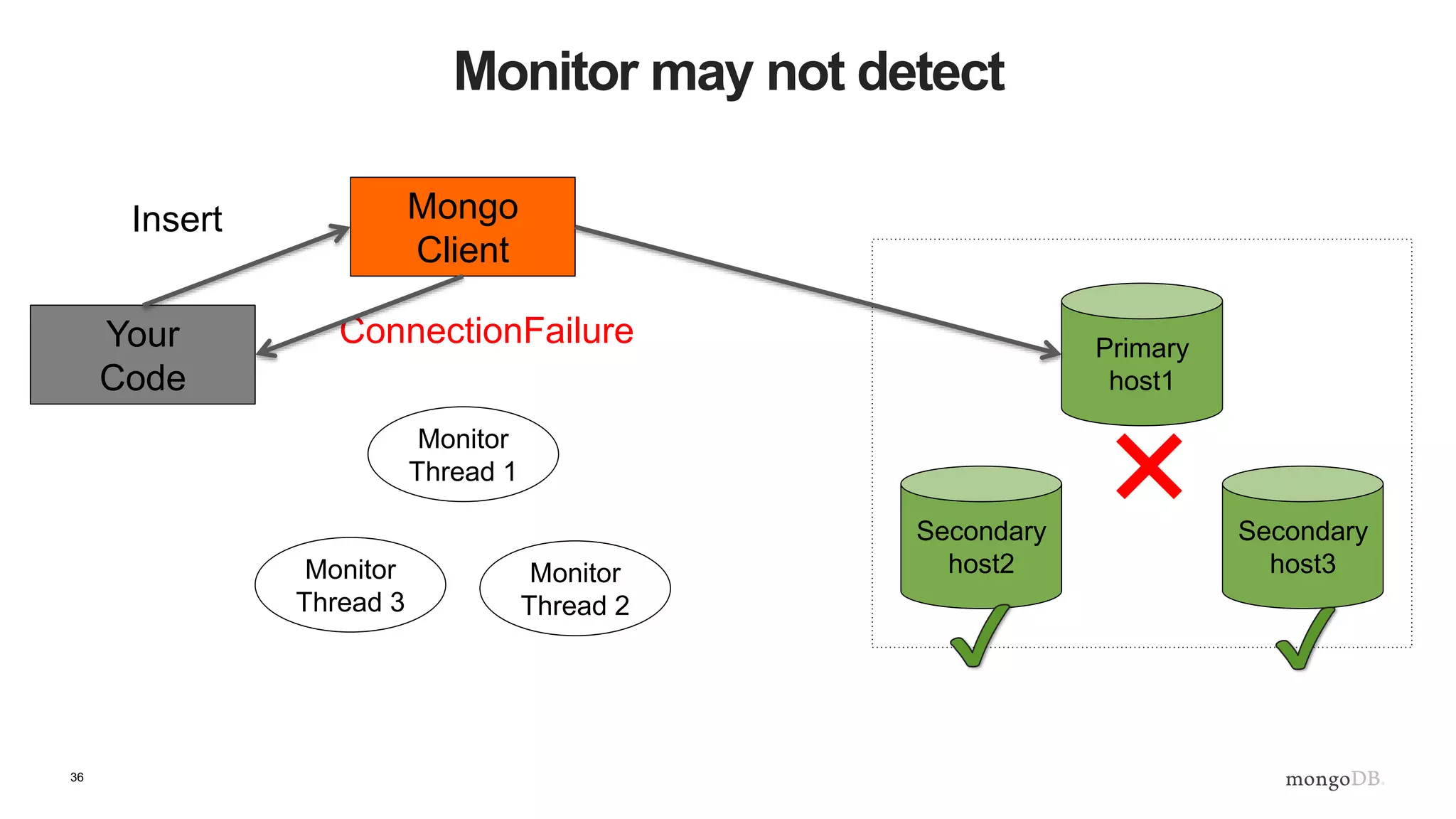
Monitor may not detect
Secondary
host2
Secondary
host3
Primary
host1
Mongo
Client
Monitor
Thread 1
Monitor
Thread 2
Monitor
Thread 3
Your
Code
✖
Insert
ConnectionFailure
37
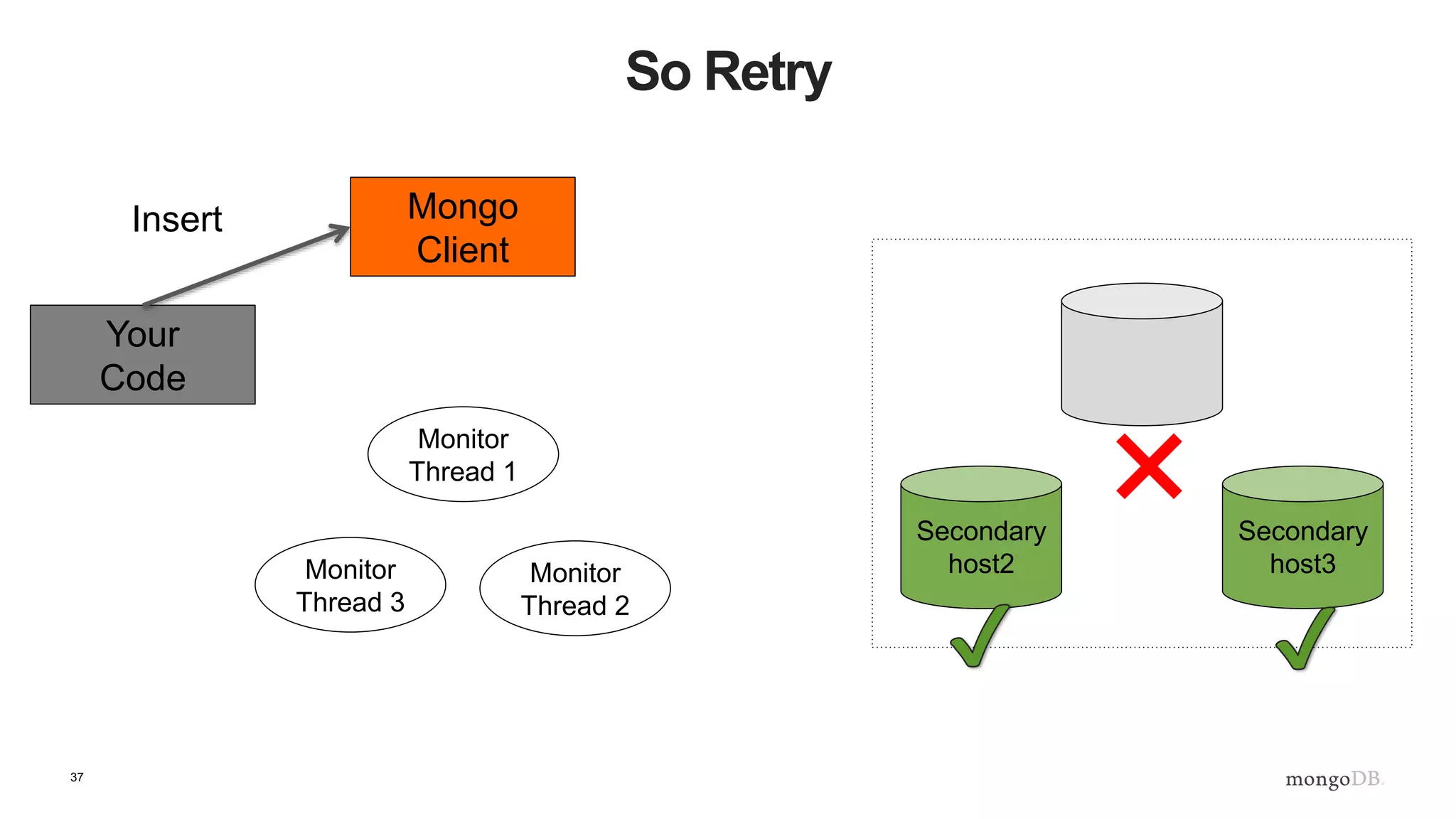
So Retry
Secondary
host2
Secondary
host3
Mongo
Client
Monitor
Thread 1
Monitor
Thread 2
Monitor
Thread 3
Your
Code
✖
Insert
38
Check for Primary
Secondary
host2
Secondary
host3
Mongo
Client
Monitor
Thread 1
Monitor
Thread 2
Monitor
Thread 3
Your
Code
✖
Insert
39
Host 2 Is Primary
Primary
host2
Secondary
host3
Mongo
Client
Monitor
Thread 1
Monitor
Thread 2
Monitor
Thread 3
Your
Code
✖
Insert
40
Steady State
Secondary
host2
Secondary
host3
Primary
host1
Mongo
Client
Monitor
Thread 1
Monitor
Thread 2
Monitor
Thread 3
Your
Code
41
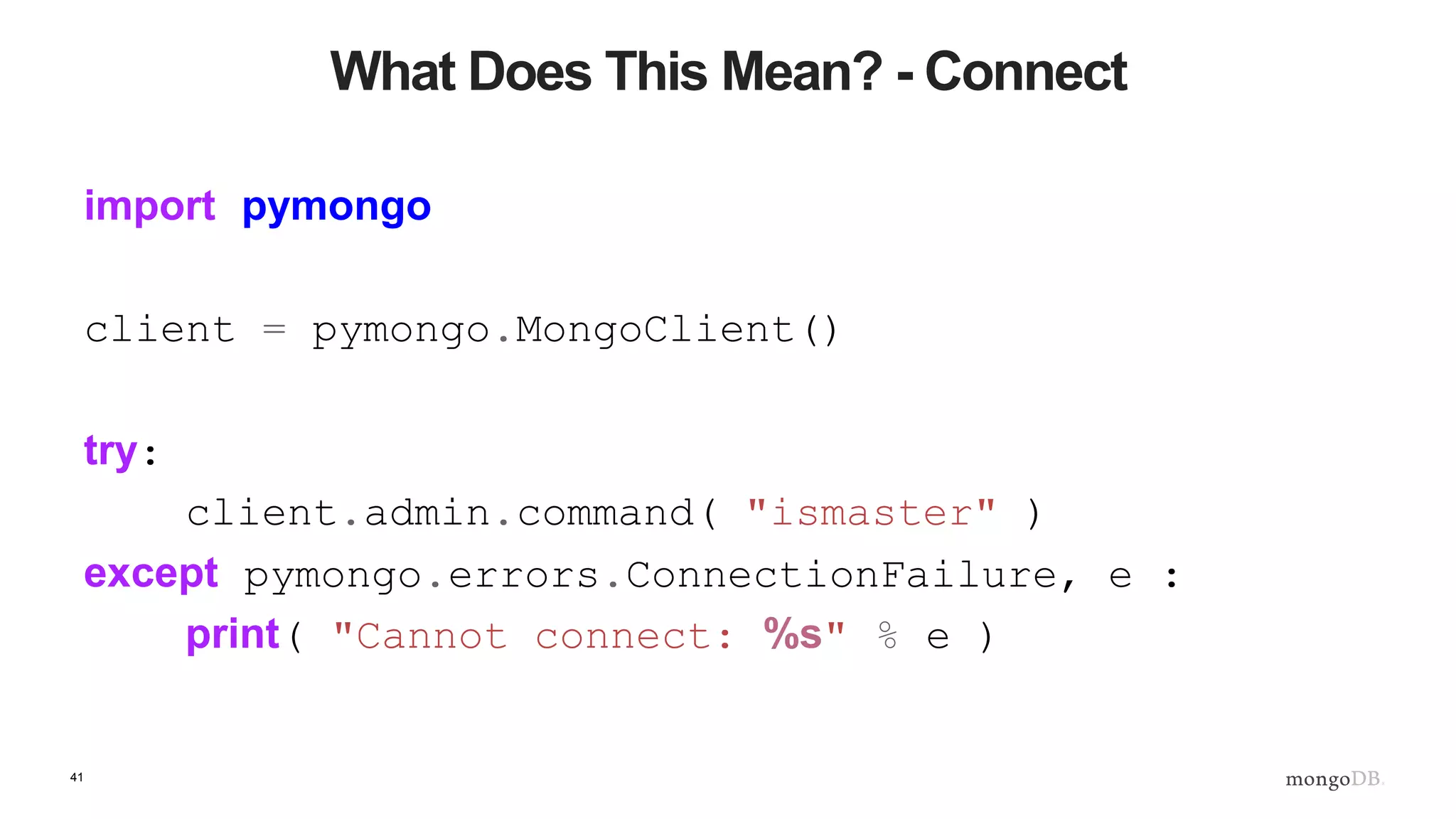
What Does This Mean? - Connect
import pymongo
client = pymongo.MongoClient()
try:
client.admin.command( "ismaster" )
except pymongo.errors.ConnectionFailure, e :
print( "Cannot connect: %s" % e )
42
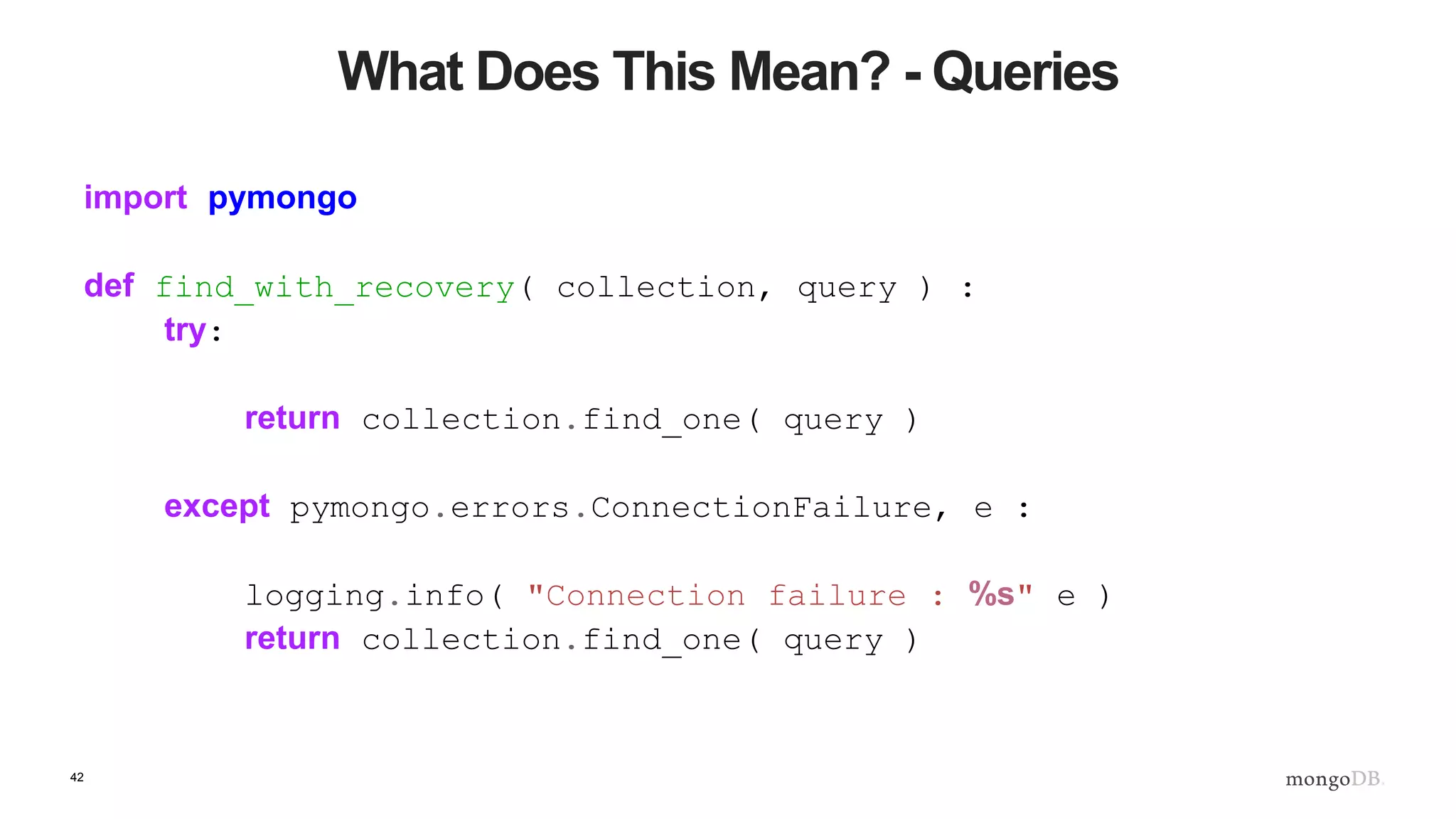
What Does This Mean? - Queries
import pymongo
def find_with_recovery( collection, query ) :
try:
return collection.find_one( query )
except pymongo.errors.ConnectionFailure, e :
logging.info( "Connection failure : %s" e )
return collection.find_one( query )
43
What Does This Mean? - Inserts
def insert_with_recovery( collection, doc ) :
doc[ "_id" ] = ObjectId()
try:
collection.insert_one( doc )
except pymongo.errors.ConnectionFailure, e:
logging.info( "Connection error: %s" % e )
try:
collection.insert_one( doc )
except DuplicateKeyError:
pass
44
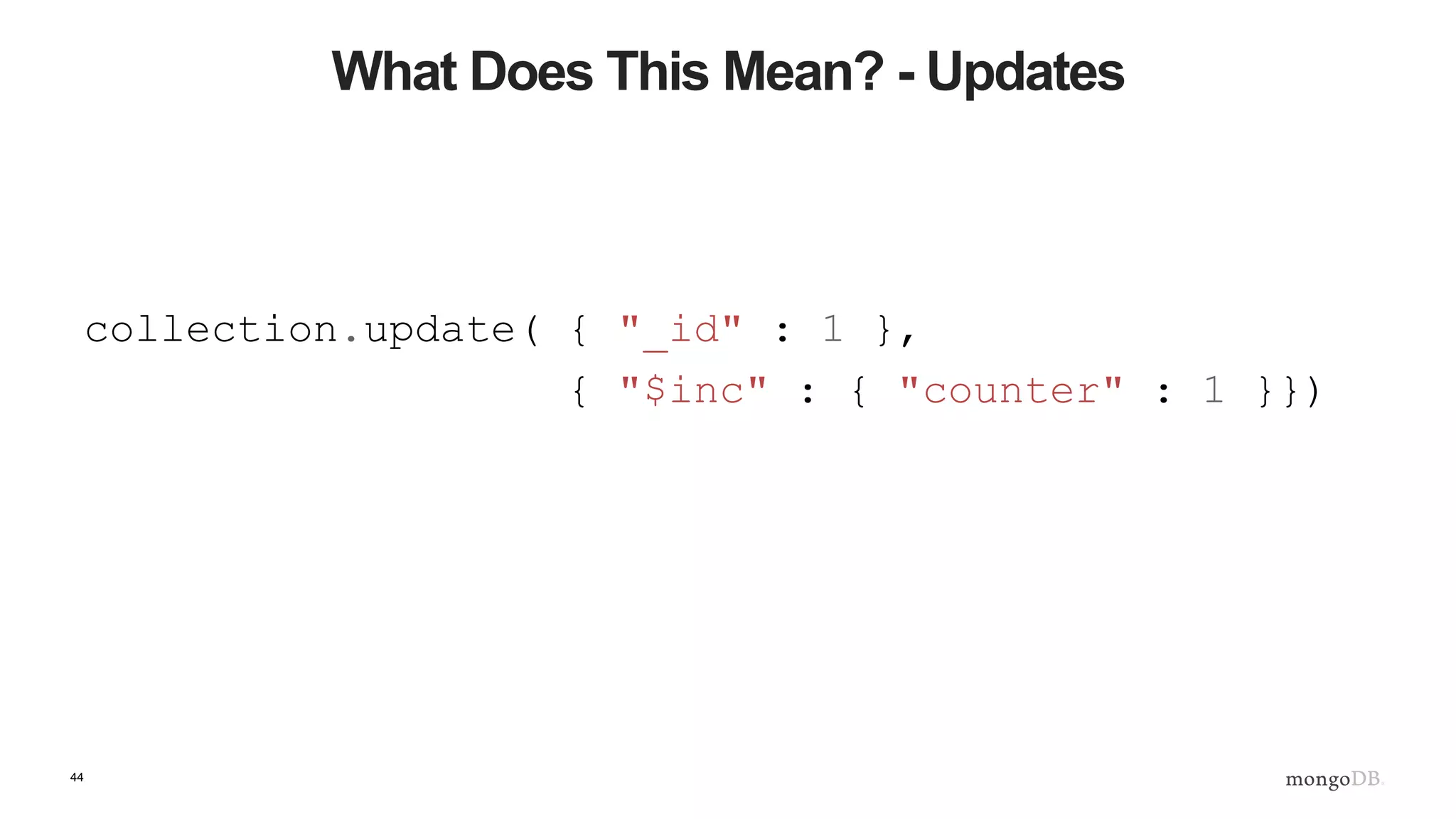
What Does This Mean? - Updates
collection.update( { "_id" : 1 },
{ "$inc" : { "counter" : 1 }})
45
More Reading
• The spec author Jess Jiryu Davis has a collection of links and his better
version of this talk
https://emptysqua.re/blog/server-discovery-and-monitoring-in-mongodb-
drivers/
• The full server discovery and monitoring spec is on GitHub
https://github.com/mongodb/specifications/blob/master/source/server-
discovery-and-monitoring/server-discovery-and-monitoring.rst
Q&A

Back to Basics German 3: Einführung in Replica Sets

Editor's Notes

  • #3 Who I am, how long have I been at MongoDB.
  • #14 Present a native language interface - converts python types to BSON objects Convert the JSON query language into commands for the database Convert JSON data into BSON data and vice-versa Handles interfacing to different MongoDB topologies Helps recover from server side outages/network errors Manages the client side connection pool The pymongo driver code is on Github (Apache License)
  • #21 Present a native language interface - converts python types to BSON objects Convert the JSON query language into commands for the database Convert JSON data into BSON data and vice-versa Handles interfacing to different MongoDB topologies Helps recover from server side outages/network errors Manages the client side connection pool The pymongo driver code is on Github (Apache License)
  • #23 Calls i
  • #24 Calls i
  • #26 State machine, full set of states defined in spec.
  • #27 Calls i
  • #28 Calls i
  • #29 Calls i
  • #31 Needs a primary to complete a write.
  • #32 Needs a primary to complete a write.
  • #33 Needs a primary to complete a write.
  • #34 Needs a primary to complete a write.
  • #35 Each thread wakes every 10 seconds. Runs ismaster, sleeps. We use ismaster to check latency. Keep topology description up to date.
  • #36 Each thread wakes every 10 seconds. Runs ismaster, sleeps. We use ismaster to check latency. Keep topology description up to date.
  • #37 Each thread wakes every 10 seconds. Runs ismaster, sleeps. We use ismaster to check latency. Keep topology description up to date.
  • #38 Primary is marked as unknown Wakes up all monitor threads to check for a primary.
  • #39 Primary is marked as unknown Wakes up all monitor threads to check for a primary every half second.
  • #40 Primary is marked as unknown Wakes up all monitor threads to check for a primary every half second.
  • #41 Each thread wakes every 10 seconds. Runs ismaster, sleeps. We use ismaster to check latency. Keep topology description up to date.
  • #43 Try once. This will accomdate elections. Other errore should be propagated.
  • #44 Try once. This will accomdate elections. Other errore should be propagated.
  • #45 Can you afford to over or under count. Operations need to be idempotent. Turn an update into a write of a document, cf EventSourcing. Then aggregate on the server.