May 19, 2009 Gene Leganza Vice President, Principal Analyst Forrester Research Case Studies: Business Architecture Aids IT Transformation
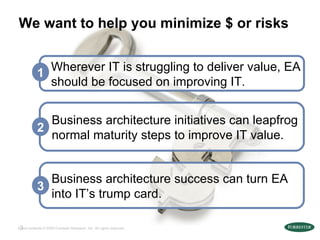
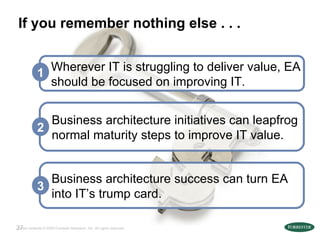
We want to help you minimize $ or risks Business architecture success can turn EA into IT’s trump card. 3 Business architecture initiatives can leapfrog normal maturity steps to improve IT value. 2 Wherever IT is struggling to deliver value, EA should be focused on improving IT. 1
Business architecture: IT’s secret weapon  Source: StrategyWorld.com (http://www.strategypage.com/militaryforums/532-344.aspx) Entire contents © 2009 Forrester Research, Inc. All rights reserved.
Agenda EA’s place in the IT value proposition Case study No. 1: Discovering the emergent strategy  Case study No. 2: Getting tactical to get strategic  Case study No. 3: Opportunistically driving EA value through BA A common thread: Increased IT credibility and value A game plan to consider
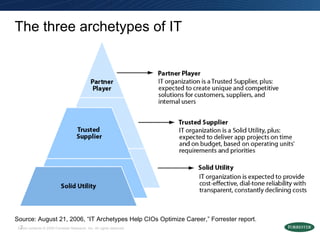
Source: August 21, 2006, “IT Archetypes Help CIOs Optimize Career,” Forrester report. The three archetypes of IT
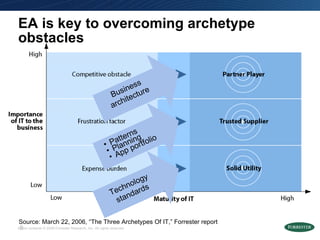
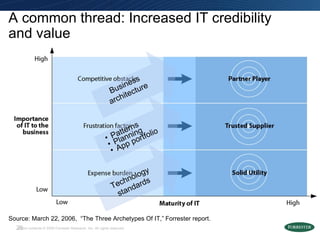
EA is key to overcoming archetype obstacles Source: March 22, 2006, “The Three Archetypes Of IT,” Forrester report Technology standards Patterns Planning App portfolio Business architecture
When should you begin to work on being a Partner Player? Now! Maturity models do not dictate strictly sequential behavior. Just as no one would wait for I&O perfection before working on project management, don’t wait to be a Trusted Supplier before working on partnering with the business. Simply getting better at service delivery is not enough. Business architecture efforts in right-sized steps can raise the perception of the value of IT before you have reached Solid Utility and Trusted Supplier nirvana.
Agenda EA’s place in the IT value proposition Case study No. 1: Discovering the emergent strategy  Case study No. 2: Getting tactical to get strategic  Case study No. 3: Opportunistically driving EA value through BA A common thread: Increased IT credibility and value A game plan to consider
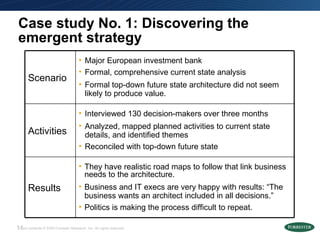
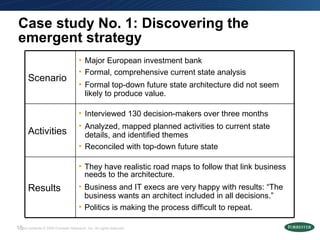
Case study No. 1: Discovering the emergent strategy  They have realistic road maps to follow that link business needs to the architecture.  Business and IT execs are very happy with results: “The business wants an architect included in all decisions.” Politics is making the process difficult to repeat. Results Interviewed 130 decision-makers over three months Analyzed, mapped planned activities to current state details, and identified themes Reconciled with top-down future state Activities Major European investment bank Formal, comprehensive current state analysis Formal top-down future state architecture did not seem likely to produce value. Scenario
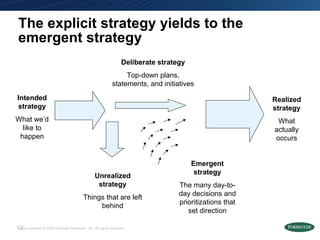
The explicit strategy yields to the emergent strategy Intended strategy What we’d like to happen Emergent strategy The many day-to-day decisions and prioritizations that set direction Realized strategy What actually occurs Unrealized strategy Things that are left behind Deliberate strategy Top-down plans, statements, and initiatives
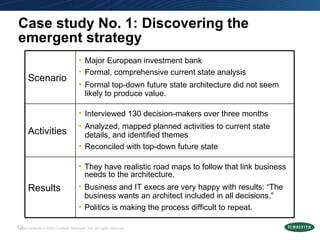
Case study No. 1: Discovering the emergent strategy  They have realistic road maps to follow that link business needs to the architecture.  Business and IT execs are very happy with results: “The business wants an architect included in all decisions.” Politics is making the process difficult to repeat. Results Interviewed 130 decision-makers over three months Analyzed, mapped planned activities to current state details, and identified themes Reconciled with top-down future state Activities Major European investment bank Formal, comprehensive current state analysis Formal top-down future state architecture did not seem likely to produce value. Scenario
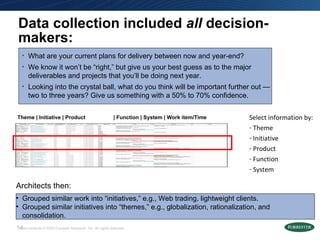
Data collection included  all  decision-makers: What are your current plans for delivery between now and year-end? We know it won’t be “right,” but give us your best guess as to the major deliverables and projects that you’ll be doing next year. Looking into the crystal ball, what do you think will be important further out — two to three years? Give us something with a 50% to 70% confidence. Grouped similar work into “initiatives,” e.g., Web trading, lightweight clients. Grouped similar initiatives into “themes,” e.g., globalization, rationalization, and consolidation. Architects then: Theme | Initiative | Product | Function | System | Work item/Time  Select information by: Theme Initiative Product Function System
Case study No. 1: Discovering the emergent strategy  They have realistic road maps to follow that link business needs to the architecture.  Business and IT execs are very happy with results: “The business wants an architect included in all decisions.” Politics is making the process difficult to repeat. Results Interviewed 130 decision-makers over three months Analyzed, mapped planned activities to current state details, and identified themes Reconciled with top-down future state Activities Major European investment bank Formal, comprehensive current state analysis Formal top-down future state architecture did not seem likely to produce value. Scenario
Agenda EA’s place in the IT value proposition Case study No. 1: Discovering the emergent strategy  Case study No. 2: Getting tactical to get strategic   Case study No. 3: Opportunistically driving EA value through BA A common thread: Increased IT credibility and value A game plan to consider
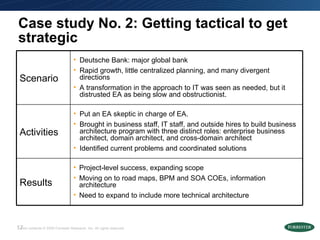
Case study No. 2: Getting tactical to get strategic  Project-level success, expanding scope Moving on to road maps, BPM and SOA COEs, information architecture  Need to expand to include more technical architecture  Results Put an EA skeptic in charge of EA. Brought in business staff, IT staff, and outside hires to build business architecture program with three distinct roles: enterprise business architect, domain architect, and cross-domain architect Identified current problems and coordinated solutions Activities Deutsche Bank: major global bank Rapid growth, little centralized planning, and many divergent directions A transformation in the approach to IT was seen as needed, but it distrusted EA as being slow and obstructionist. Scenario
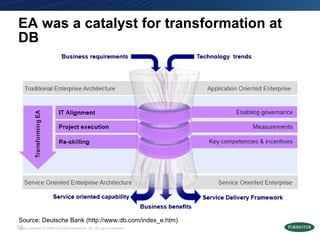
EA was a catalyst for transformation at DB Source: Deutsche Bank (http://www.db.com/index_e.htm)
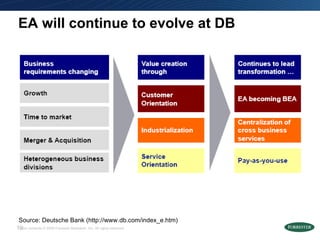
EA will continue to evolve at DB Source: Deutsche Bank (http://www.db.com/index_e.htm)
Agenda EA’s place in the IT value proposition Case study No. 1: Discovering the emergent strategy  Case study No. 2: Getting tactical to get strategic  Case study No. 3: Opportunistically driving EA value through BA A common thread: Increased IT credibility and value A game plan to consider
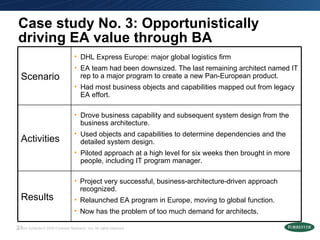
Case study No. 3: Opportunistically driving EA value through BA Project very successful, business-architecture-driven approach recognized. Relaunched EA program in Europe, moving to global function. Now has the problem of too much demand for architects.  Results Drove business capability and subsequent system design from the business architecture.  Used objects and capabilities to determine dependencies and the detailed system design. Piloted approach at a high level for six weeks then brought in more people, including IT program manager. Activities DHL Express Europe: major global logistics firm EA team had been downsized. The last remaining architect named IT rep to a major program to create a new Pan-European product. Had most business objects and capabilities mapped out from legacy EA effort. Scenario
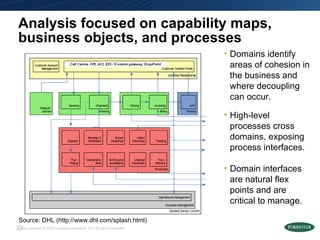
Analysis focused on capability maps, business objects, and processes  Domains identify areas of cohesion in the business and where decoupling can occur. High-level processes cross domains, exposing process interfaces. Domain interfaces are natural flex points and are critical to manage. Source: DHL (http://www.dhl.com/splash.html)
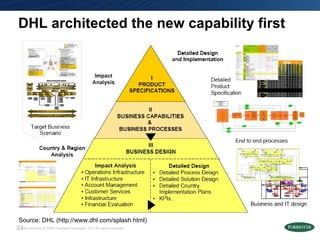
DHL architected the new capability first Source: DHL (http://www.dhl.com/splash.html)
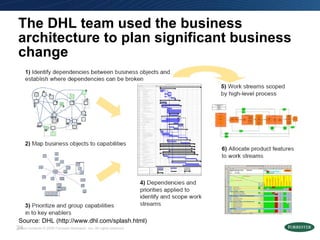
The DHL team used the business architecture to plan significant business change Source: DHL (http://www.dhl.com/splash.html)
Agenda EA’s place in the IT value proposition Case study No. 1: Discovering the emergent strategy  Case study No. 2: Getting tactical to get strategic  Case study No. 3: Opportunistically driving EA value through BA A common thread: Increased IT credibility and value A game plan to consider
Source: March 22, 2006,  “The Three Archetypes Of IT,”   Forrester report. A common thread: Increased IT credibility and value Technology standards Patterns Planning App portfolio Business architecture
If you remember nothing else . . . Business architecture success can turn EA into IT’s trump card. 3 Business architecture initiatives can leapfrog normal maturity steps to improve IT value. 2 Wherever IT is struggling to deliver value, EA should be focused on improving IT. 1
Agenda EA’s place in the IT value proposition Case study No. 1: discovering the emergent strategy  Case study No. 2: getting tactical to get strategic  Case study No. 3: opportunistically driving EA value through BA A common thread: increased IT credibility and value A game plan to consider
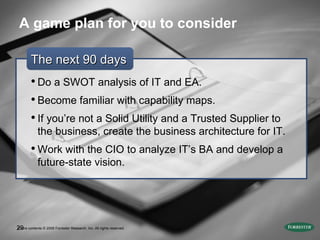
A game plan for you to consider The next 90 days Do a SWOT analysis of IT and EA. Become familiar with capability maps. If you’re not a Solid Utility and a Trusted Supplier to the business, create the business architecture for IT. Work with the CIO to analyze IT’s BA and develop a future-state vision. Entire contents © 2009 Forrester Research, Inc. All rights reserved.
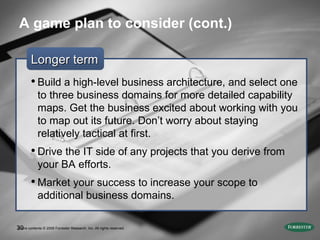
A game plan to consider (cont.) Longer term Build a high-level business architecture, and select one to three business domains for more detailed capability maps. Get the business excited about working with you to map out its future. Don’t worry about staying relatively tactical at first. Drive the IT side of any projects that you derive from your BA efforts.  Market your success to increase your scope to additional business domains. Entire contents © 2009 Forrester Research, Inc. All rights reserved.
Thank you Gene Leganza +1 203.761.8848  [email_address] www.forrester.com
Selected Forrester research April 7, 2009, “EA’s Next Evolution: Business-Centric Architecture” January 7, 2009, “Choose From Five Basic Approaches To Business Architecture Based On Your Context And Goals”  December 3, 2008, “Create Greater EA Impact By Analyzing Your Value Chain” October 24, 2008, “Business Architecture’s Time Has Come”

BA Case Studies Show EA-IT Value Forrester ITF09

  • 1.
  • 2.
    May 19, 2009Gene Leganza Vice President, Principal Analyst Forrester Research Case Studies: Business Architecture Aids IT Transformation
  • 3.
    We want tohelp you minimize $ or risks Business architecture success can turn EA into IT’s trump card. 3 Business architecture initiatives can leapfrog normal maturity steps to improve IT value. 2 Wherever IT is struggling to deliver value, EA should be focused on improving IT. 1
  • 4.
    Business architecture: IT’ssecret weapon Source: StrategyWorld.com (http://www.strategypage.com/militaryforums/532-344.aspx) Entire contents © 2009 Forrester Research, Inc. All rights reserved.
  • 5.
    Agenda EA’s placein the IT value proposition Case study No. 1: Discovering the emergent strategy Case study No. 2: Getting tactical to get strategic Case study No. 3: Opportunistically driving EA value through BA A common thread: Increased IT credibility and value A game plan to consider
  • 6.
    Agenda EA’s placein the IT value proposition Case study No. 1: Discovering the emergent strategy Case study No. 2: Getting tactical to get strategic Case study No. 3: Opportunistically driving EA value through BA A common thread: Increased IT credibility and value A game plan to consider
  • 7.
    Source: August 21,2006, “IT Archetypes Help CIOs Optimize Career,” Forrester report. The three archetypes of IT
  • 8.
    EA is keyto overcoming archetype obstacles Source: March 22, 2006, “The Three Archetypes Of IT,” Forrester report Technology standards Patterns Planning App portfolio Business architecture
  • 9.
    When should youbegin to work on being a Partner Player? Now! Maturity models do not dictate strictly sequential behavior. Just as no one would wait for I&O perfection before working on project management, don’t wait to be a Trusted Supplier before working on partnering with the business. Simply getting better at service delivery is not enough. Business architecture efforts in right-sized steps can raise the perception of the value of IT before you have reached Solid Utility and Trusted Supplier nirvana.
  • 10.
    Agenda EA’s placein the IT value proposition Case study No. 1: Discovering the emergent strategy Case study No. 2: Getting tactical to get strategic Case study No. 3: Opportunistically driving EA value through BA A common thread: Increased IT credibility and value A game plan to consider
  • 11.
    Case study No.1: Discovering the emergent strategy They have realistic road maps to follow that link business needs to the architecture. Business and IT execs are very happy with results: “The business wants an architect included in all decisions.” Politics is making the process difficult to repeat. Results Interviewed 130 decision-makers over three months Analyzed, mapped planned activities to current state details, and identified themes Reconciled with top-down future state Activities Major European investment bank Formal, comprehensive current state analysis Formal top-down future state architecture did not seem likely to produce value. Scenario
  • 12.
    The explicit strategyyields to the emergent strategy Intended strategy What we’d like to happen Emergent strategy The many day-to-day decisions and prioritizations that set direction Realized strategy What actually occurs Unrealized strategy Things that are left behind Deliberate strategy Top-down plans, statements, and initiatives
  • 13.
    Case study No.1: Discovering the emergent strategy They have realistic road maps to follow that link business needs to the architecture. Business and IT execs are very happy with results: “The business wants an architect included in all decisions.” Politics is making the process difficult to repeat. Results Interviewed 130 decision-makers over three months Analyzed, mapped planned activities to current state details, and identified themes Reconciled with top-down future state Activities Major European investment bank Formal, comprehensive current state analysis Formal top-down future state architecture did not seem likely to produce value. Scenario
  • 14.
    Data collection included all decision-makers: What are your current plans for delivery between now and year-end? We know it won’t be “right,” but give us your best guess as to the major deliverables and projects that you’ll be doing next year. Looking into the crystal ball, what do you think will be important further out — two to three years? Give us something with a 50% to 70% confidence. Grouped similar work into “initiatives,” e.g., Web trading, lightweight clients. Grouped similar initiatives into “themes,” e.g., globalization, rationalization, and consolidation. Architects then: Theme | Initiative | Product | Function | System | Work item/Time Select information by: Theme Initiative Product Function System
  • 15.
    Case study No.1: Discovering the emergent strategy They have realistic road maps to follow that link business needs to the architecture. Business and IT execs are very happy with results: “The business wants an architect included in all decisions.” Politics is making the process difficult to repeat. Results Interviewed 130 decision-makers over three months Analyzed, mapped planned activities to current state details, and identified themes Reconciled with top-down future state Activities Major European investment bank Formal, comprehensive current state analysis Formal top-down future state architecture did not seem likely to produce value. Scenario
  • 16.
    Agenda EA’s placein the IT value proposition Case study No. 1: Discovering the emergent strategy Case study No. 2: Getting tactical to get strategic Case study No. 3: Opportunistically driving EA value through BA A common thread: Increased IT credibility and value A game plan to consider
  • 17.
    Case study No.2: Getting tactical to get strategic Project-level success, expanding scope Moving on to road maps, BPM and SOA COEs, information architecture Need to expand to include more technical architecture Results Put an EA skeptic in charge of EA. Brought in business staff, IT staff, and outside hires to build business architecture program with three distinct roles: enterprise business architect, domain architect, and cross-domain architect Identified current problems and coordinated solutions Activities Deutsche Bank: major global bank Rapid growth, little centralized planning, and many divergent directions A transformation in the approach to IT was seen as needed, but it distrusted EA as being slow and obstructionist. Scenario
  • 18.
    EA was acatalyst for transformation at DB Source: Deutsche Bank (http://www.db.com/index_e.htm)
  • 19.
    EA will continueto evolve at DB Source: Deutsche Bank (http://www.db.com/index_e.htm)
  • 20.
    Agenda EA’s placein the IT value proposition Case study No. 1: Discovering the emergent strategy Case study No. 2: Getting tactical to get strategic Case study No. 3: Opportunistically driving EA value through BA A common thread: Increased IT credibility and value A game plan to consider
  • 21.
    Case study No.3: Opportunistically driving EA value through BA Project very successful, business-architecture-driven approach recognized. Relaunched EA program in Europe, moving to global function. Now has the problem of too much demand for architects. Results Drove business capability and subsequent system design from the business architecture. Used objects and capabilities to determine dependencies and the detailed system design. Piloted approach at a high level for six weeks then brought in more people, including IT program manager. Activities DHL Express Europe: major global logistics firm EA team had been downsized. The last remaining architect named IT rep to a major program to create a new Pan-European product. Had most business objects and capabilities mapped out from legacy EA effort. Scenario
  • 22.
    Analysis focused oncapability maps, business objects, and processes Domains identify areas of cohesion in the business and where decoupling can occur. High-level processes cross domains, exposing process interfaces. Domain interfaces are natural flex points and are critical to manage. Source: DHL (http://www.dhl.com/splash.html)
  • 23.
    DHL architected thenew capability first Source: DHL (http://www.dhl.com/splash.html)
  • 24.
    The DHL teamused the business architecture to plan significant business change Source: DHL (http://www.dhl.com/splash.html)
  • 25.
    Agenda EA’s placein the IT value proposition Case study No. 1: Discovering the emergent strategy Case study No. 2: Getting tactical to get strategic Case study No. 3: Opportunistically driving EA value through BA A common thread: Increased IT credibility and value A game plan to consider
  • 26.
    Source: March 22,2006, “The Three Archetypes Of IT,” Forrester report. A common thread: Increased IT credibility and value Technology standards Patterns Planning App portfolio Business architecture
  • 27.
    If you remembernothing else . . . Business architecture success can turn EA into IT’s trump card. 3 Business architecture initiatives can leapfrog normal maturity steps to improve IT value. 2 Wherever IT is struggling to deliver value, EA should be focused on improving IT. 1
  • 28.
    Agenda EA’s placein the IT value proposition Case study No. 1: discovering the emergent strategy Case study No. 2: getting tactical to get strategic Case study No. 3: opportunistically driving EA value through BA A common thread: increased IT credibility and value A game plan to consider
  • 29.
    A game planfor you to consider The next 90 days Do a SWOT analysis of IT and EA. Become familiar with capability maps. If you’re not a Solid Utility and a Trusted Supplier to the business, create the business architecture for IT. Work with the CIO to analyze IT’s BA and develop a future-state vision. Entire contents © 2009 Forrester Research, Inc. All rights reserved.
  • 30.
    A game planto consider (cont.) Longer term Build a high-level business architecture, and select one to three business domains for more detailed capability maps. Get the business excited about working with you to map out its future. Don’t worry about staying relatively tactical at first. Drive the IT side of any projects that you derive from your BA efforts. Market your success to increase your scope to additional business domains. Entire contents © 2009 Forrester Research, Inc. All rights reserved.
  • 31.
    Thank you GeneLeganza +1 203.761.8848 [email_address] www.forrester.com
  • 32.
    Selected Forrester researchApril 7, 2009, “EA’s Next Evolution: Business-Centric Architecture” January 7, 2009, “Choose From Five Basic Approaches To Business Architecture Based On Your Context And Goals” December 3, 2008, “Create Greater EA Impact By Analyzing Your Value Chain” October 24, 2008, “Business Architecture’s Time Has Come”