



Social Media:
B2B Moving Beyond the Hype
iStrategy, London
26 November 2012

                      @jeremywoolf
Jeremy Woolf


                     text100.com
publicrelationships.blogspot.com
   linkedin.com/in/jeremywoolf
                  @jeremywoolf
     www.socialmedia-mba.com

                     @jeremywoolf
Social Media: Moving Beyond the Hype
•Beyond conventional B2B comms
• Engage directly with audiences, build trust and gather insight
• Marketing rhetoric vs. content and community
• Turn prospects into customers and customers into
  advocates
•Buyers and their journeys
•Workshop exercise
•Skype!
                                                    @jeremywoolf
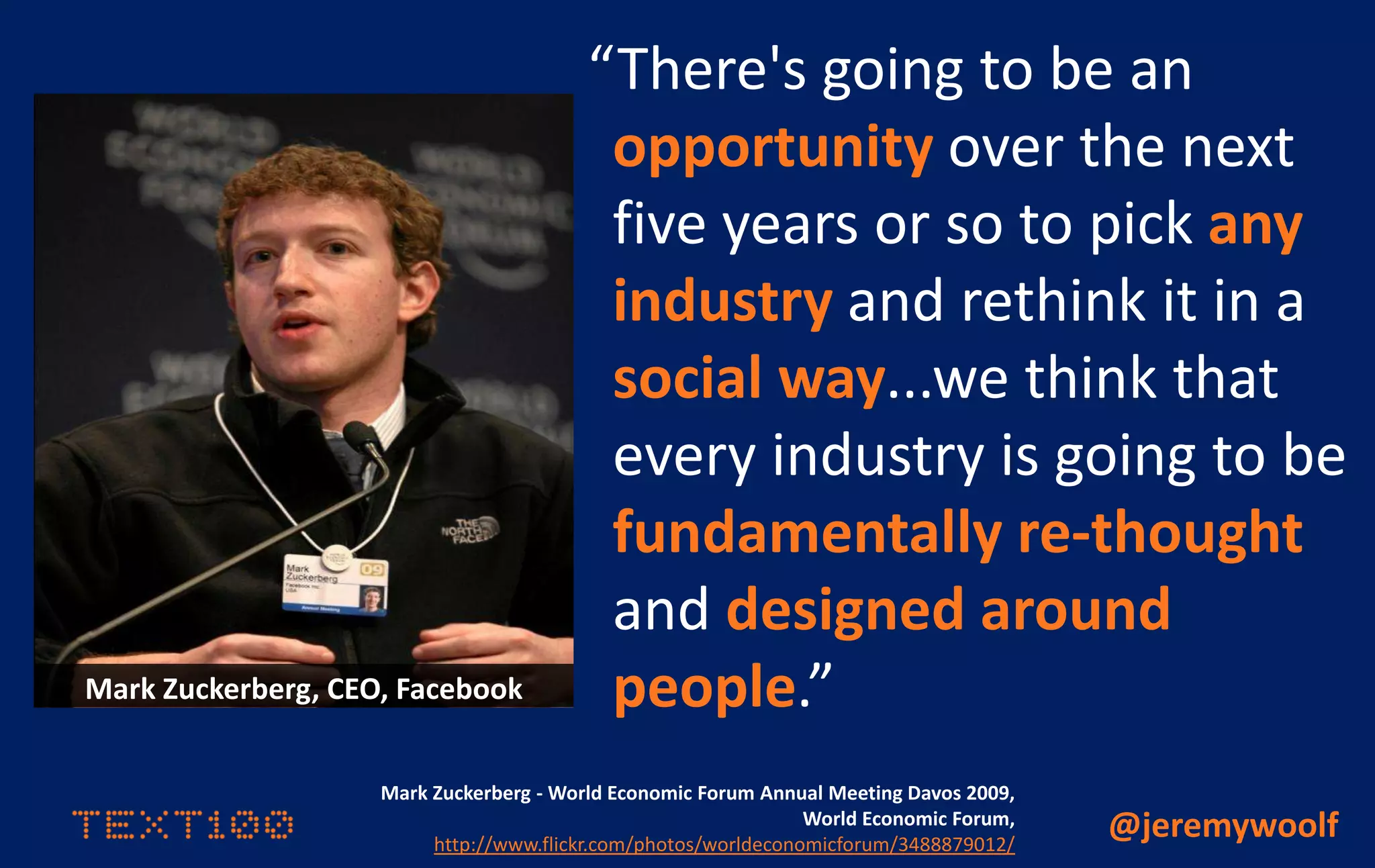
“There's going to be an
                                          opportunity over the next
                                          five years or so to pick any
                                          industry and rethink it in a
                                          social way...we think that
                                          every industry is going to be
                                          fundamentally re-thought
                                          and designed around
Mark Zuckerberg, CEO, Facebook            people.”
                    Mark Zuckerberg - World Economic Forum Annual Meeting Davos 2009,
                                                                World Economic Forum,
                         http://www.flickr.com/photos/worldeconomicforum/3488879012/
                                                                                        @jeremywoolf
1. Who do you sell to?
2. How do they buy?

                    @jeremywoolf
Buyer Personas

                 @jeremywoolf
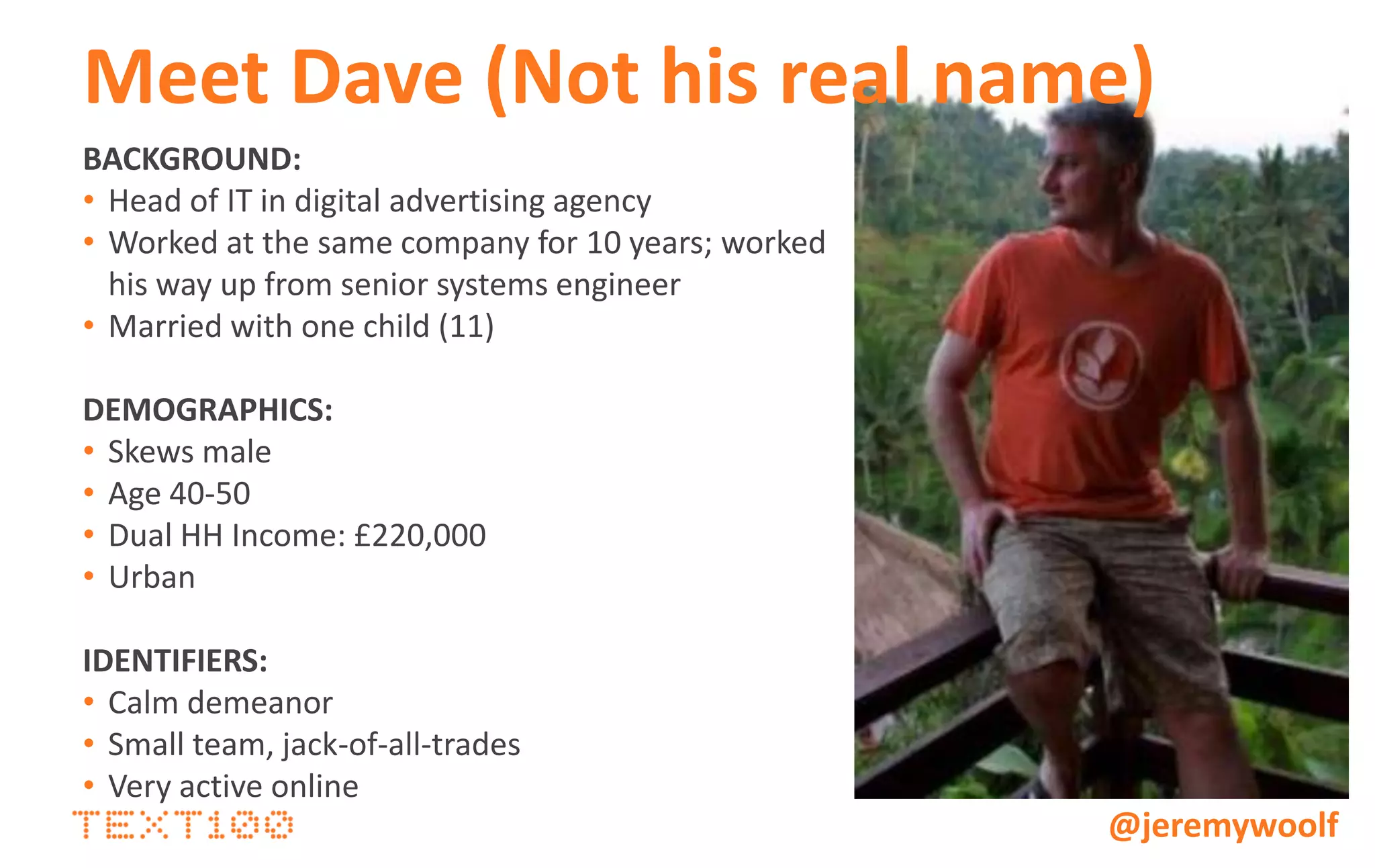
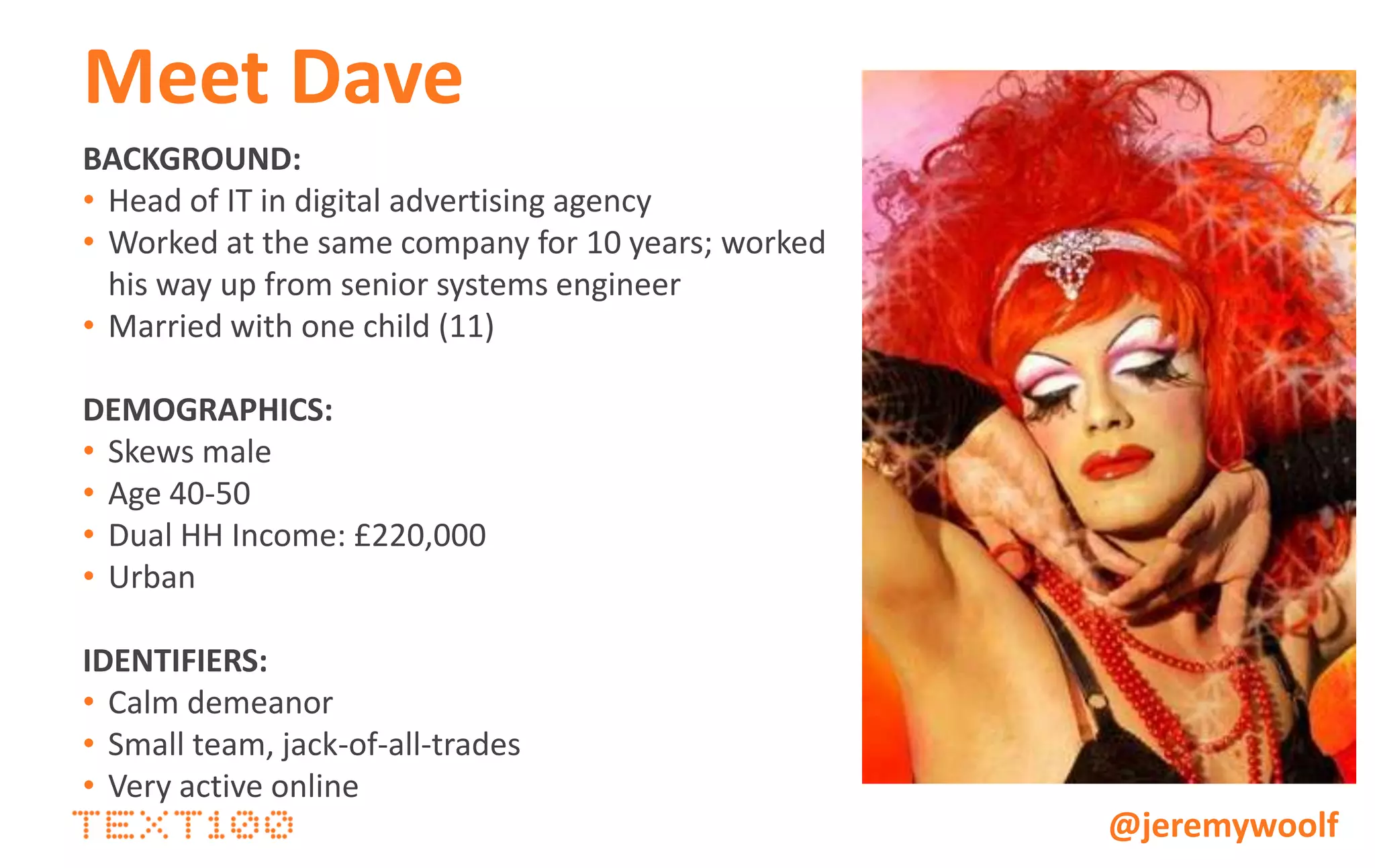
Meet Dave (Not his real name)
BACKGROUND:
• Head of IT in digital advertising agency
• Worked at the same company for 10 years; worked
  his way up from senior systems engineer
• Married with one child (11)

DEMOGRAPHICS:
• Skews male
• Age 40-50
• Dual HH Income: £220,000
• Urban

IDENTIFIERS:
• Calm demeanor
• Small team, jack-of-all-trades
• Very active online
                                                    @jeremywoolf
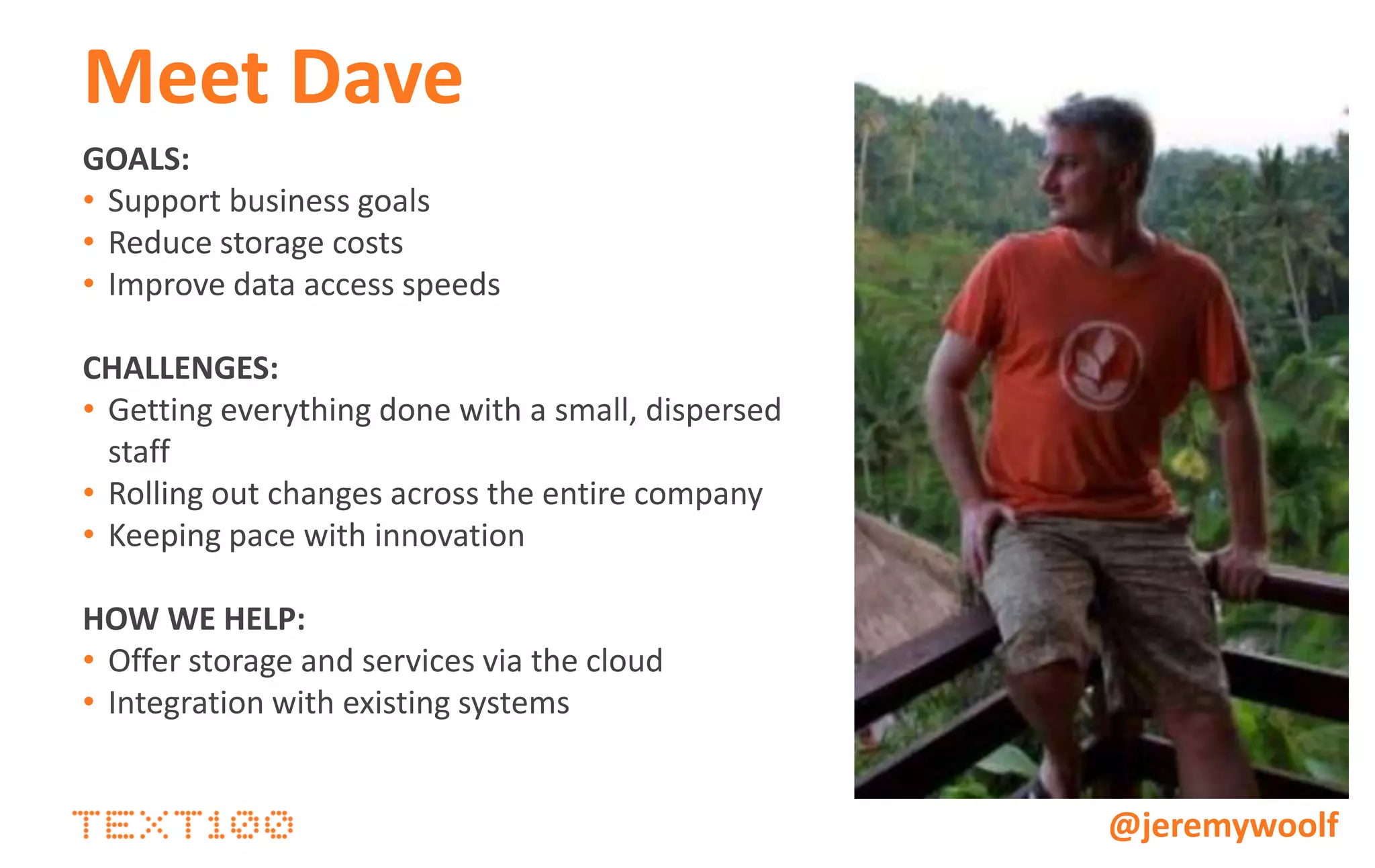
Meet Dave
GOALS:
• Support business goals
• Reduce storage costs
• Improve data access speeds

CHALLENGES:
• Getting everything done with a small, dispersed
  staff
• Rolling out changes across the entire company
• Keeping pace with innovation

HOW WE HELP:
• Offer storage and services via the cloud
• Integration with existing systems


                                                    @jeremywoolf
How Does Dave Buy?
(Obligatory social media
numbers bit)

                           @jeremywoolf
He’s
got
the
power

@jeremywoolf
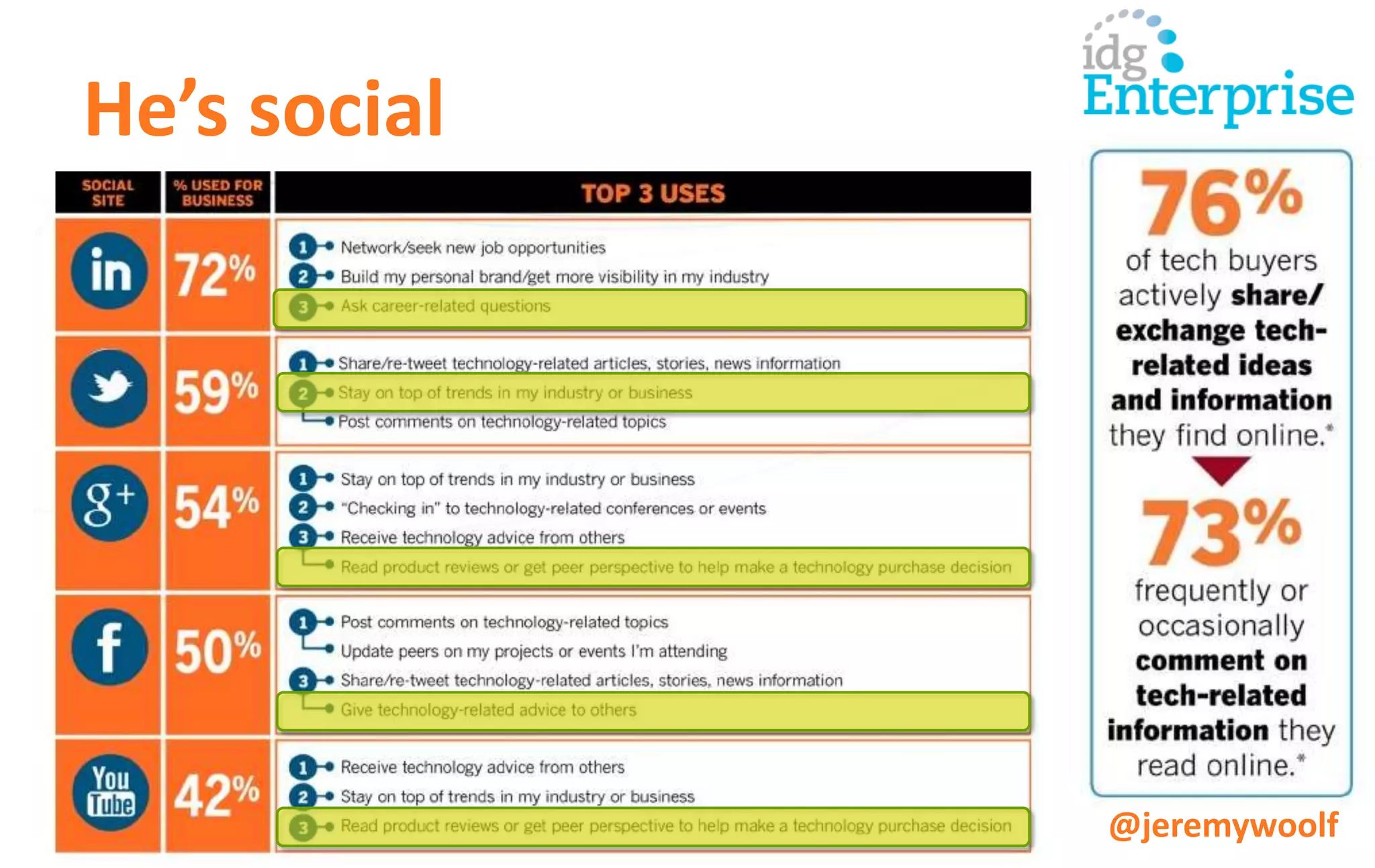
He’s social


              @jeremywoolf
He’s hungry for content…
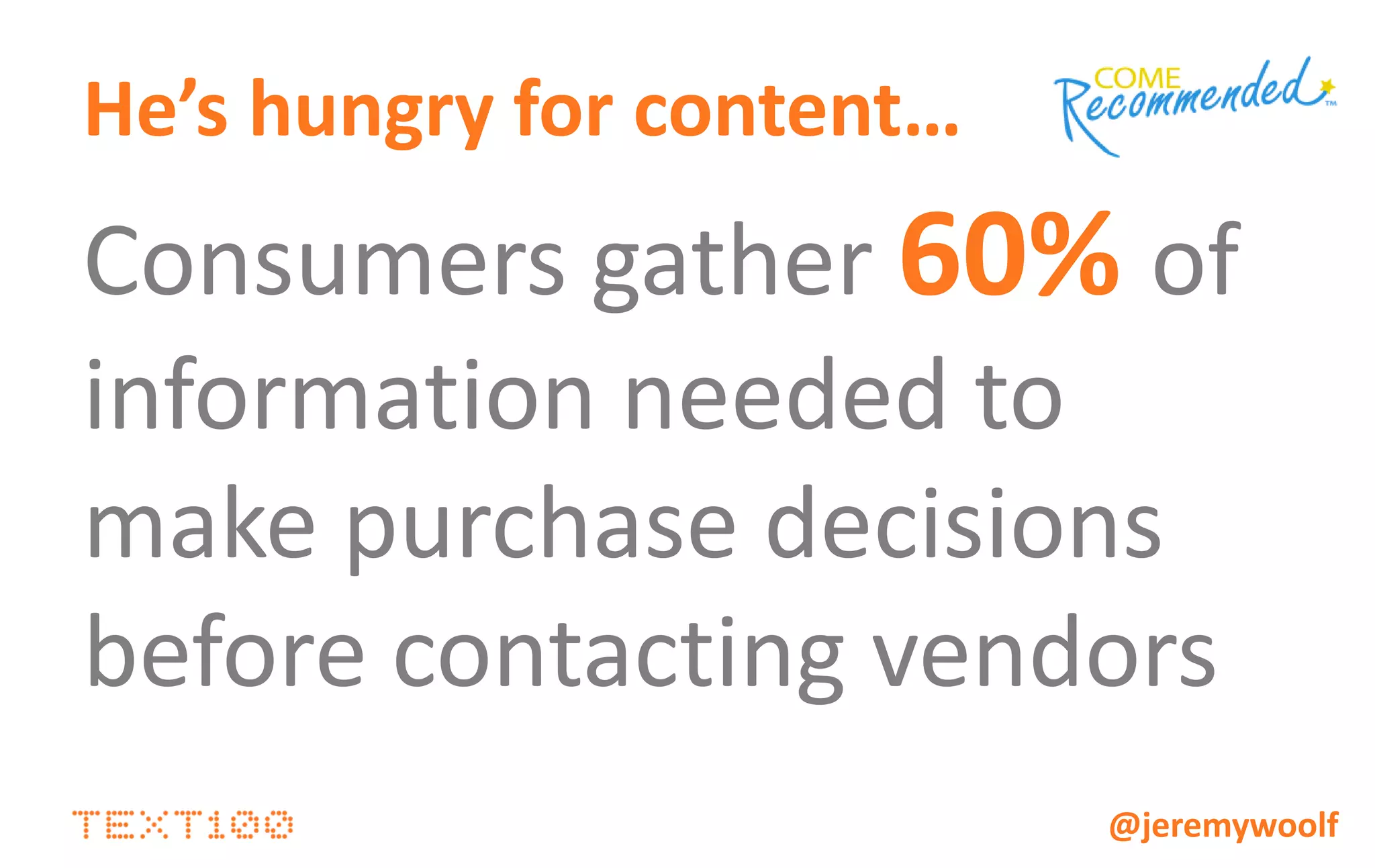
Consumers gather 60% of
information needed to
make purchase decisions
before contacting vendors
                           @jeremywoolf
He’s hungry for content…
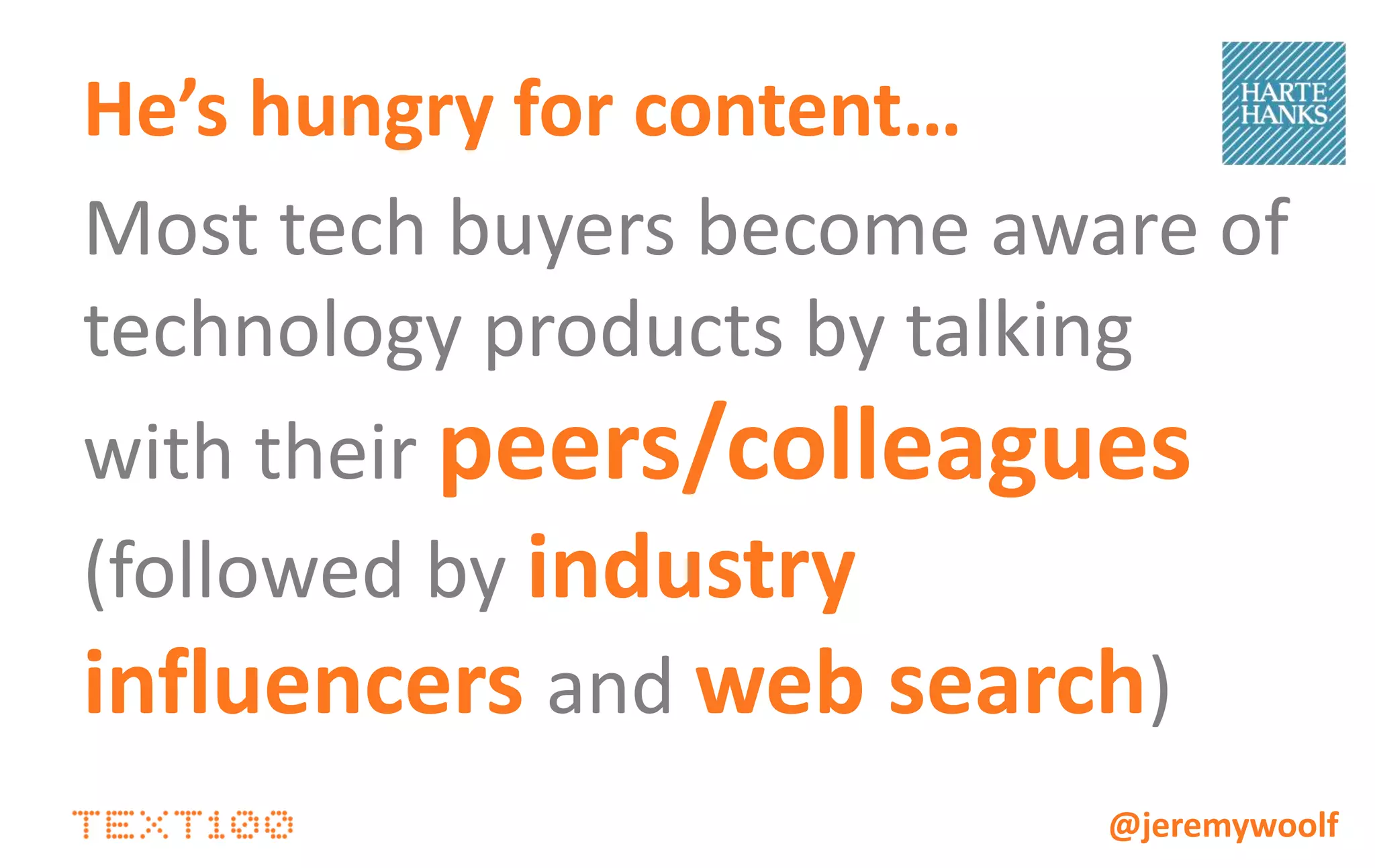
Most tech buyers become aware of
technology products by talking
with their peers/colleagues
(followed by industry
influencers and web search)
                           @jeremywoolf
He’s hungry for content…

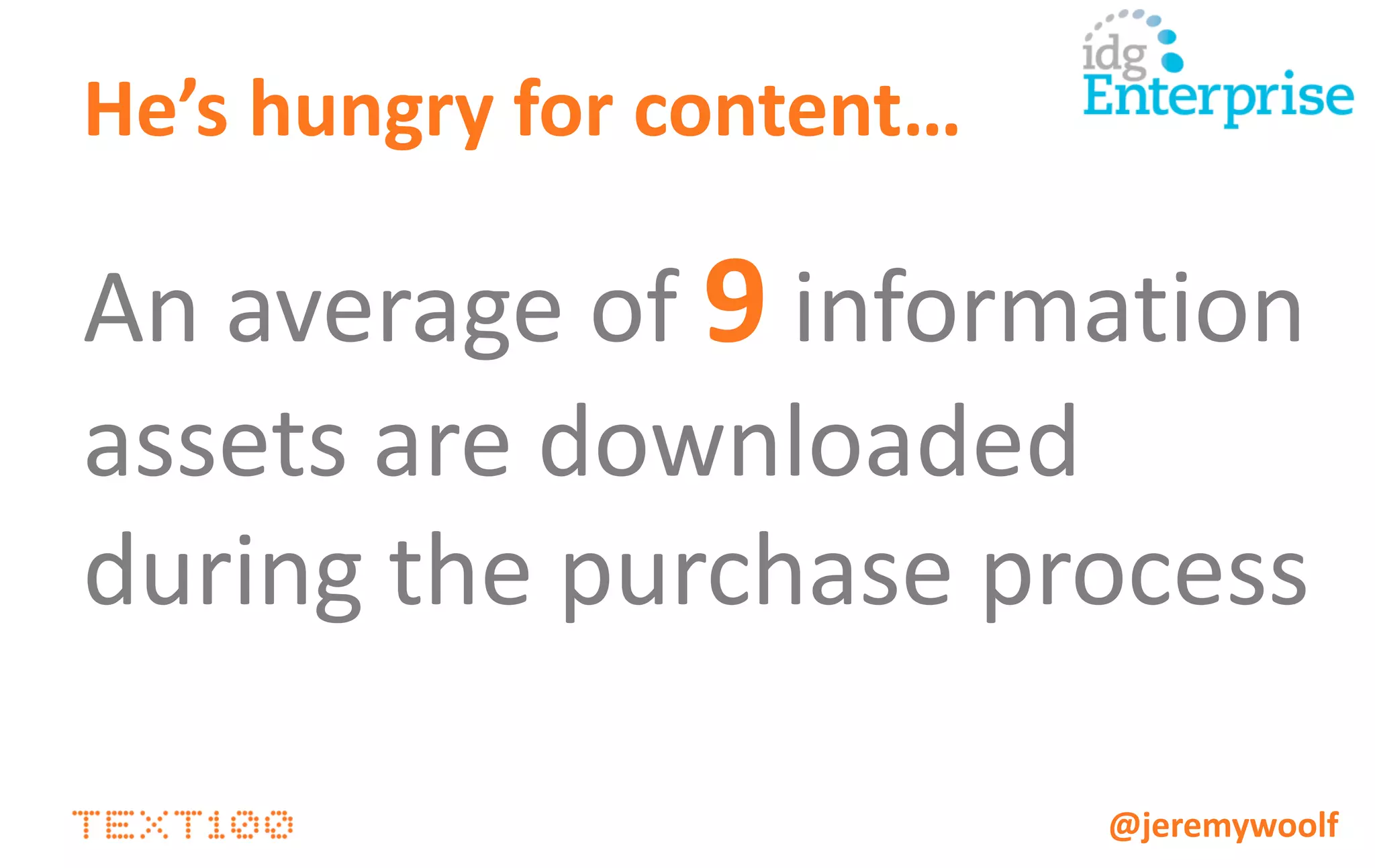
An average of 9 information
assets are downloaded
during the purchase process

                           @jeremywoolf
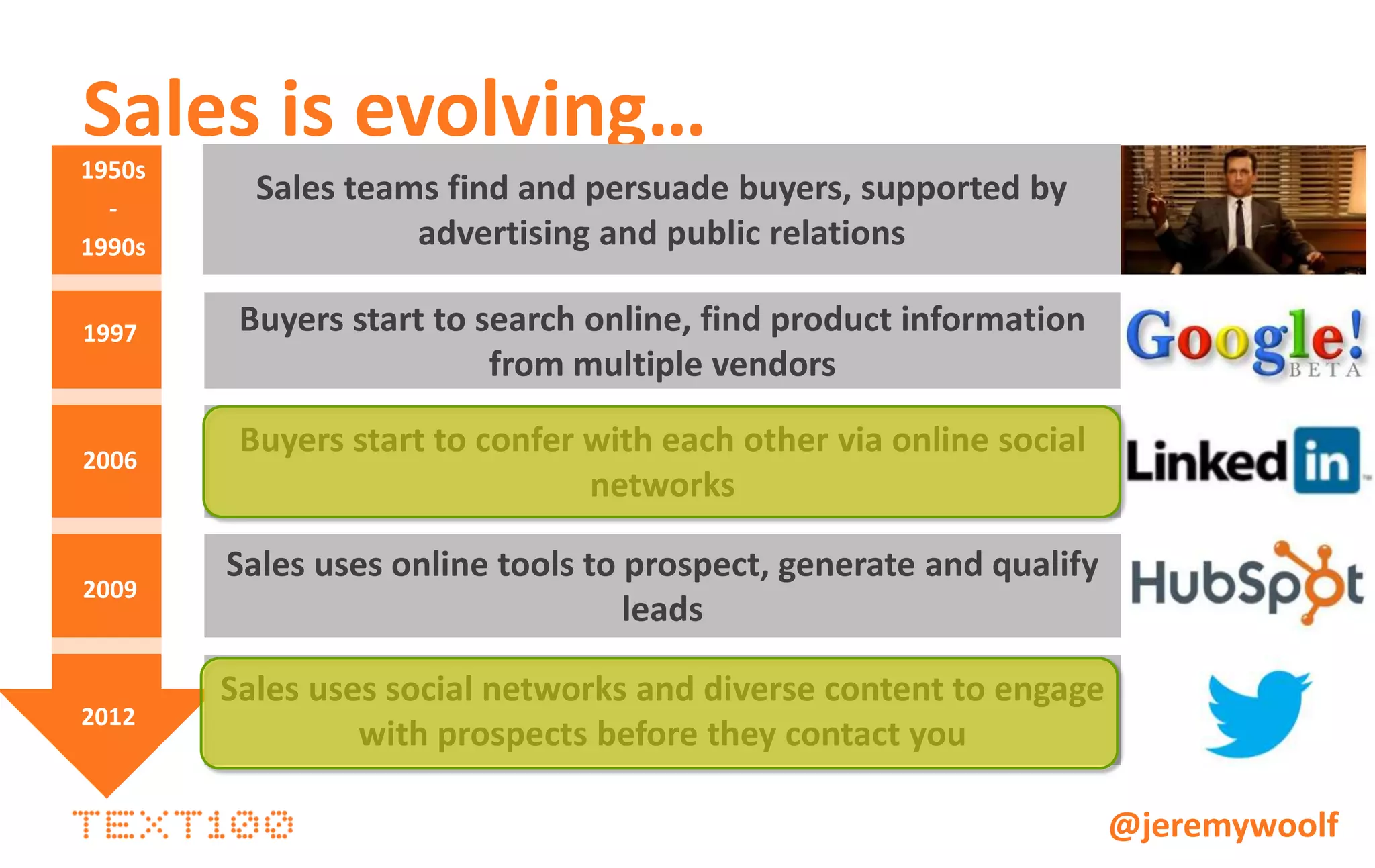
Sales is evolving…
1950s
  -
          Sales teams find and persuade buyers, supported by
1990s               advertising and public relations

1997     Buyers start to search online, find product information
                          from multiple vendors

2006
         Buyers start to confer with each other via online social
                                networks

        Sales uses online tools to prospect, generate and qualify
2009
                                   leads

        Sales uses social networks and diverse content to engage
2012
                 with prospects before they contact you

                                                                    @jeremywoolf
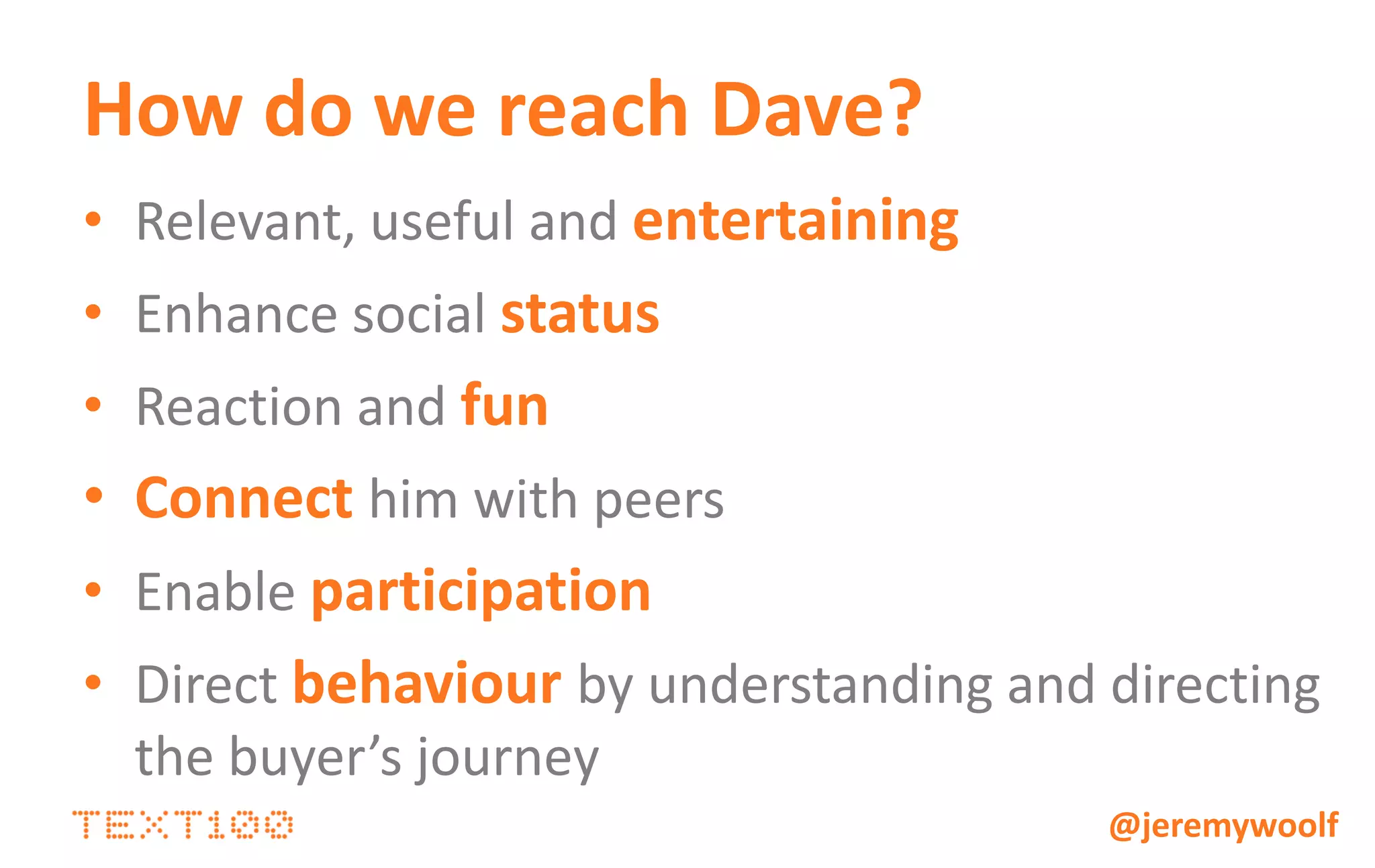
How do we reach Dave?
• Relevant, useful and entertaining
• Enhance social status
• Reaction and fun
• Connect him with peers
• Enable participation
• Direct behaviour by understanding and directing
  the buyer’s journey
                                        @jeremywoolf
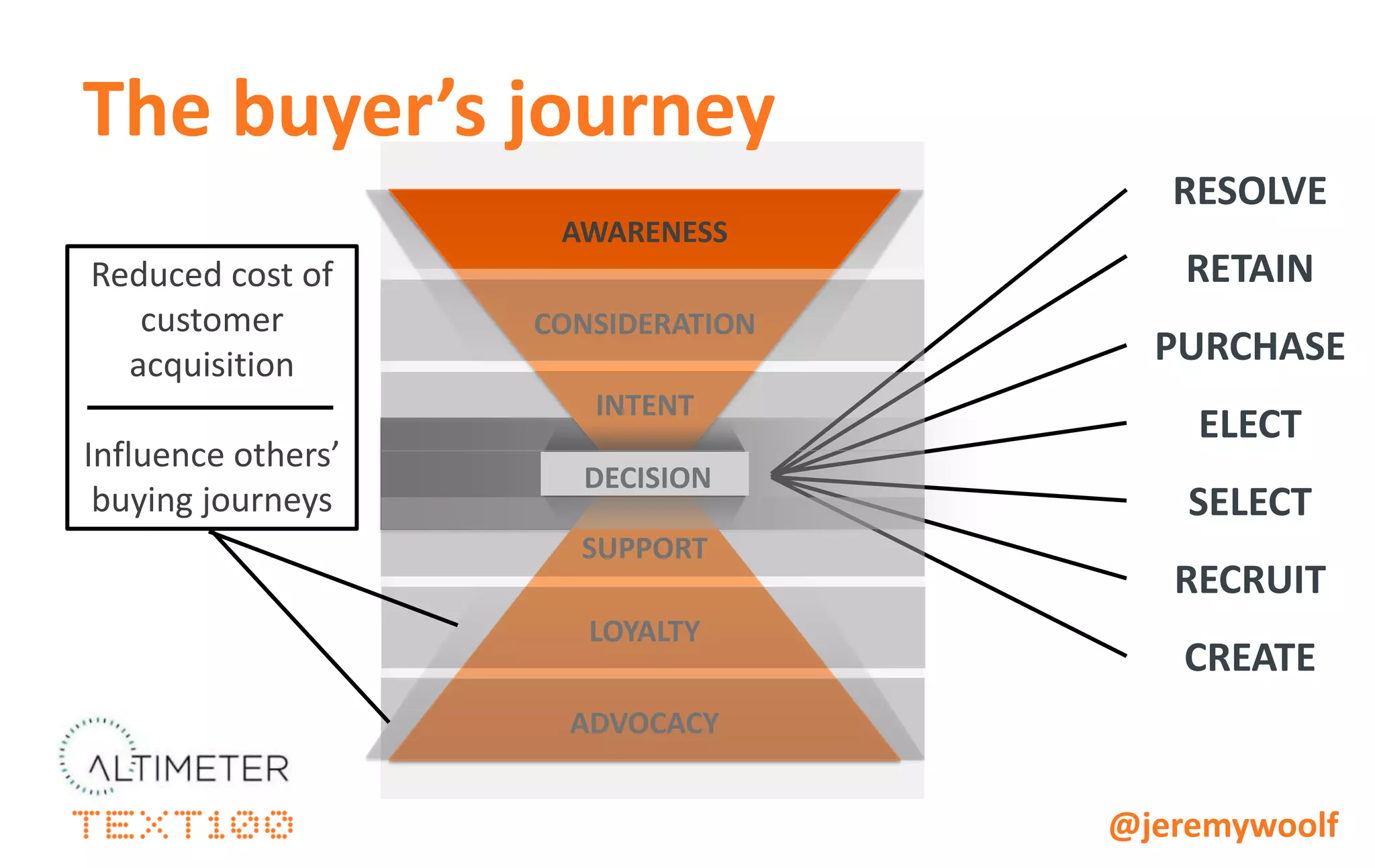
The buyer’s journey
                                       RESOLVE
                     AWARENESS
Reduced cost of                         RETAIN
   customer         CONSIDERATION
  acquisition                         PURCHASE
                       INTENT
                                        ELECT
Influence others’
                      DECISION
 buying journeys                        SELECT
                      SUPPORT
                                       RECRUIT
                       LOYALTY
                                       CREATE
                      ADVOCACY


                                    @jeremywoolf
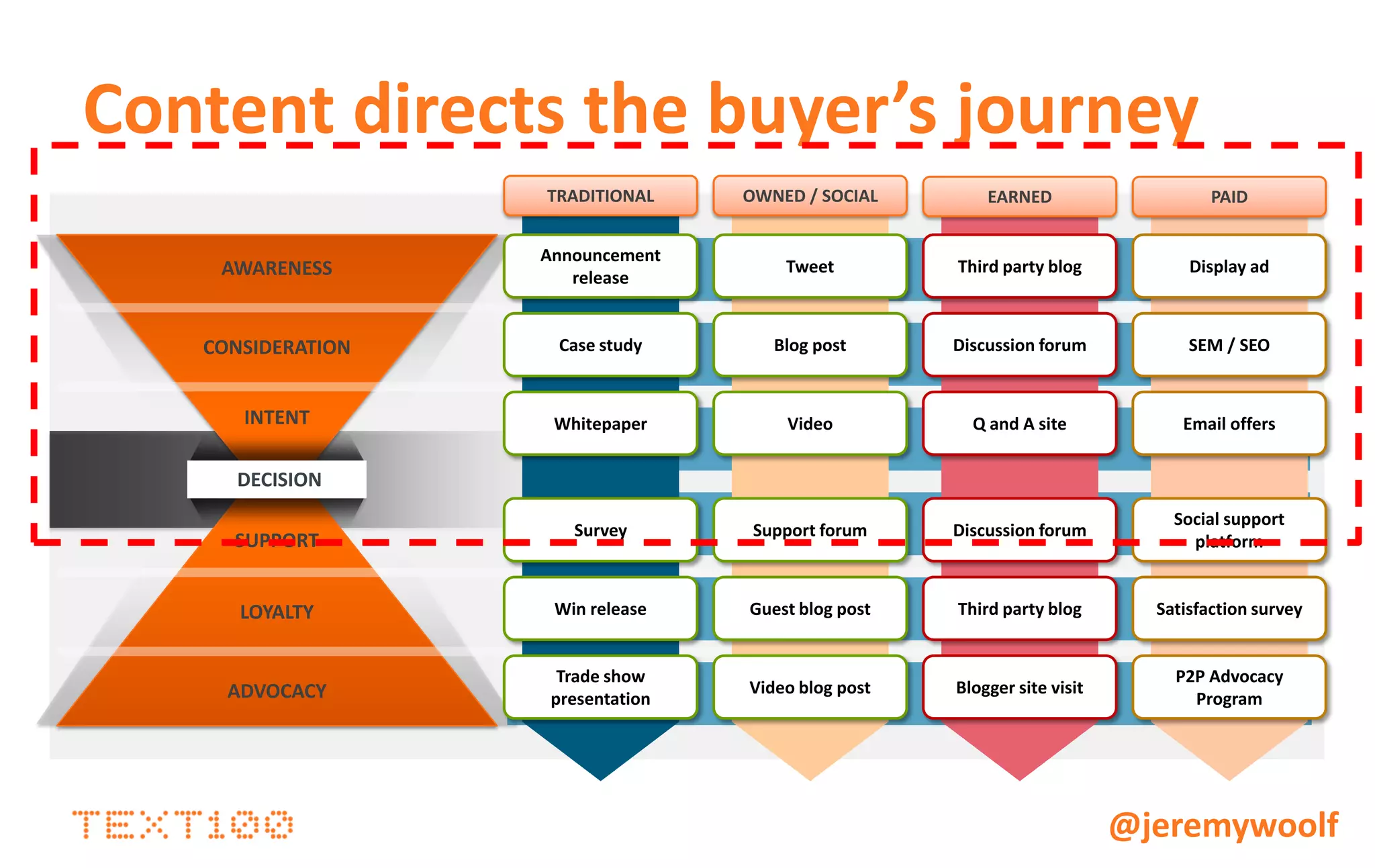
Content directs the buyer’s journey
                   TRADITIONAL     OWNED / SOCIAL        EARNED                    PAID


                   Announcement
    AWARENESS                          Tweet         Third party blog           Display ad
                      release


   CONSIDERATION     Case study       Blog post      Discussion forum           SEM / SEO


      INTENT        Whitepaper         Video           Q and A site            Email offers


     DECISION
                                                                              Social support
                      Survey        Support forum    Discussion forum
     SUPPORT                                                                    platform


      LOYALTY       Win release    Guest blog post   Third party blog       Satisfaction survey


                     Trade show                                               P2P Advocacy
     ADVOCACY                      Video blog post   Blogger site visit
                    presentation                                                Program


                                                                          @jeremywoolf
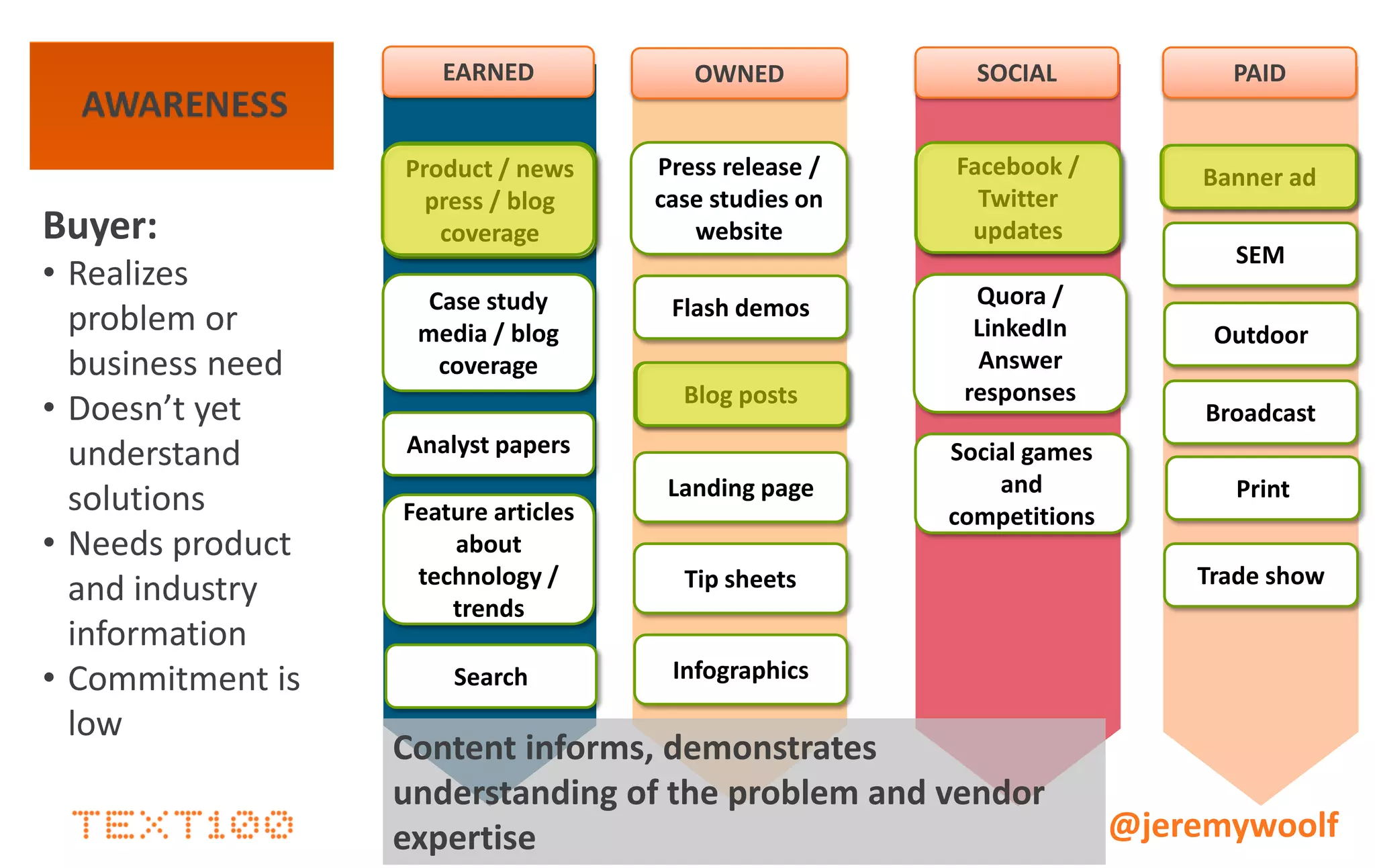
EARNED             OWNED            SOCIAL              PAID


                  Product / news     Press release /   Facebook /         Banner ad
                    press / blog     case studies on     Twitter
Buyer:               coverage           website         updates
                                                                             SEM
• Realizes
                    Case study        Flash demos        Quora /
  problem or       media / blog                          LinkedIn          Outdoor
  business need      coverage                            Answer
                                       Blog posts       responses
• Doesn’t yet                                                              Broadcast
  understand      Analyst papers                       Social games
                                      Landing page         and               Print
  solutions       Feature articles                     competitions
• Needs product       about
                   technology /        Tip sheets                         Trade show
  and industry        trends
  information
• Commitment is       Search          Infographics

  low
                  Content informs, demonstrates
                  understanding of the problem and vendor
                  expertise                                           @jeremywoolf
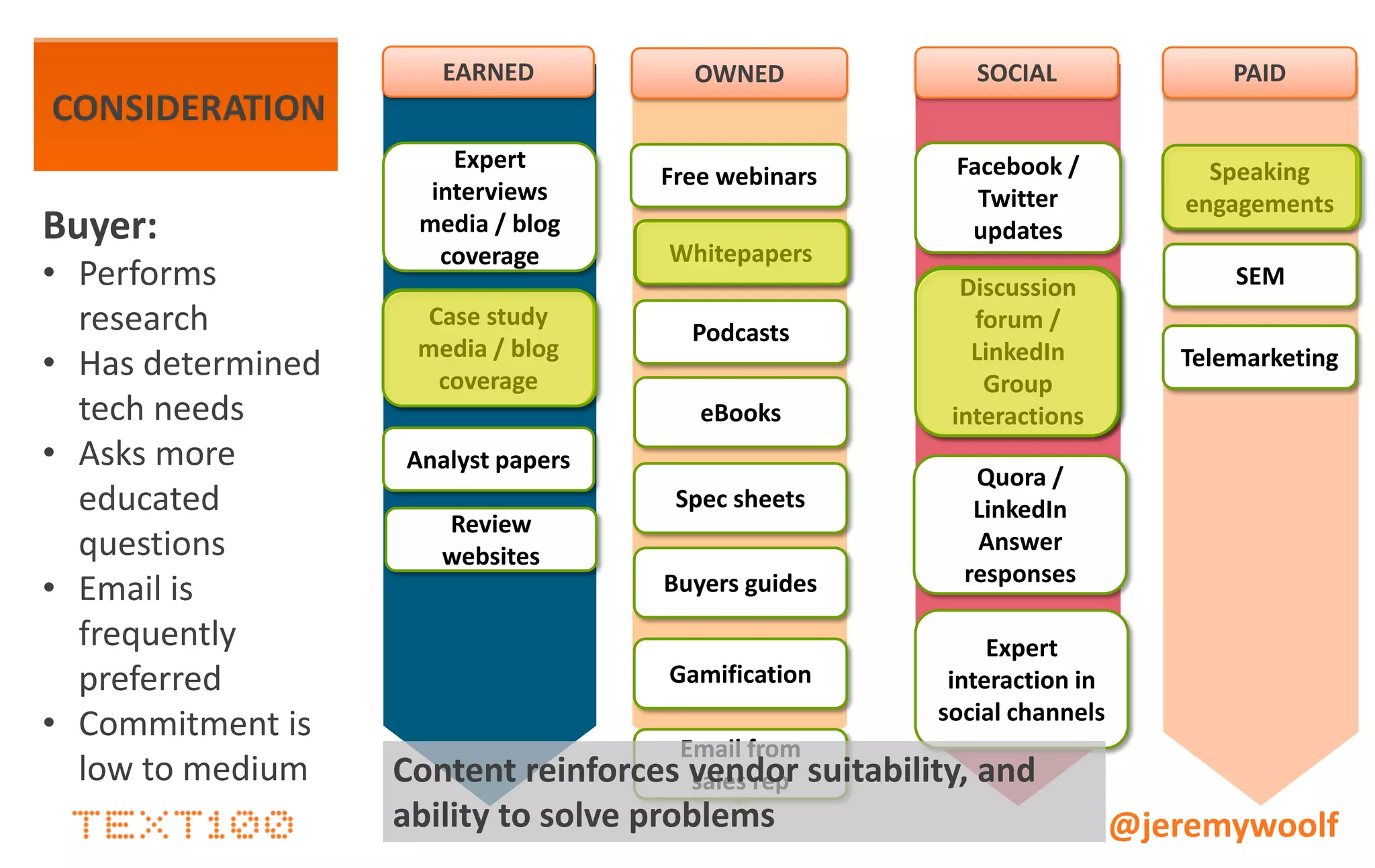
EARNED            OWNED                 SOCIAL             PAID


                       Expert                             Facebook /            Speaking
                                      Free webinars
                     interviews                             Twitter           engagements
Buyer:              media / blog                           updates
                      coverage        Whitepapers
• Performs                                                Discussion             SEM
  research           Case study
                                        Podcasts           forum /
                    media / blog                           LinkedIn
• Has determined      coverage                              Group
                                                                             Telemarketing

  tech needs                             eBooks          interactions
• Asks more        Analyst papers
                                                           Quora /
  educated                             Spec sheets         LinkedIn
                      Review
  questions           websites
                                                           Answer
                                                          responses
• Email is                            Buyers guides
  frequently                                                 Expert
  preferred                           Gamification       interaction in
                                                        social channels
• Commitment is
                                       Email from
  low to medium    Content   reinforces vendor suitability,
                                        sales rep             and
                   ability to solve problems                              @jeremywoolf
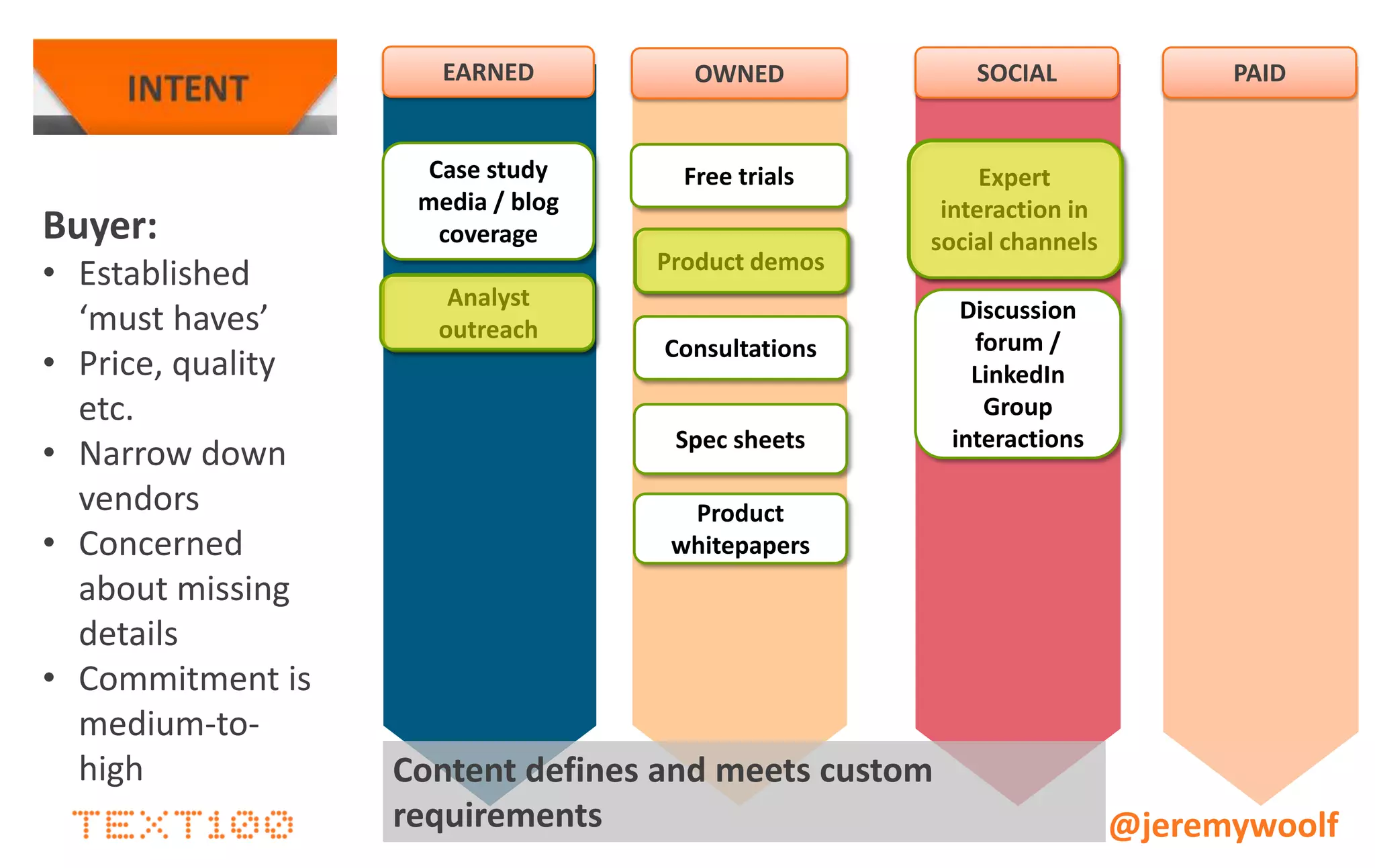
EARNED          OWNED             SOCIAL             PAID


                     Case study      Free trials        Expert
                    media / blog                    interaction in
Buyer:                coverage                     social channels
                                   Product demos
• Established
                      Analyst                          Discussion
  ‘must haves’       outreach
                                   Consultations        forum /
• Price, quality                                        LinkedIn
  etc.                                                   Group
                                    Spec sheets       interactions
• Narrow down
  vendors                            Product
• Concerned                         whitepapers
  about missing
  details
• Commitment is
  medium-to-
  high             Content defines and meets custom
                   requirements                                      @jeremywoolf
EARNED          OWNED              SOCIAL              PAID


                                   ROI calculators        Expert
                                                      interaction in
Buyer:                                               social channels
• Compare                           Consultations
  vendors
                                      Proofs of
• Detail is                           concept
  important
• 4.2 technology
  products /
  solutions
  examined
  before decision
• Commitment is
  high
                    Content arms buyer to make / endorse
                    decision                                           @jeremywoolf
@jeremywoolf
Helping buyers buy: Ninefold
         EARNED           OWNED           SOCIAL           PAID

                          Website         Twitter


                                         Foursquare


                                                          Bar tab


                                                         Trade show


                      Sales engagement


                      Proof of concept


         Case study

                                                      @jeremywoolf
Helping buyers buy
• Not usually a linear process
• Cross over between phases
• Many people involved in decisions
• Buyers armed to sell products internally
• Create relevant content for each person involved in the
  process
• Deliver content where, when and how it will have the
  greatest impact on the buying decision
• Understand the signals that indicate readiness to move
  between phases of the purchase process
• Simplify the buying process for customers
                                                 @jeremywoolf
Summary
1.Understand your buyer
2.Understand your buyer’s journey…
3.…and the content that helps them
4.Not all content is created equal
5.But it can drive decisions

                                     @jeremywoolf
Discussion


             @jeremywoolf
Jeremy Woolf


                     text100.com
publicrelationships.blogspot.com
   linkedin.com/in/jeremywoolf
                  @jeremywoolf
     www.socialmedia-mba.com

                     @jeremywoolf

iStrategy London - B2B Social Media – Moving Beyond the Hype Jeremy Woolf, Text100

  • 1.
    Social Media: B2B MovingBeyond the Hype iStrategy, London 26 November 2012 @jeremywoolf
  • 2.
    Jeremy Woolf text100.com publicrelationships.blogspot.com linkedin.com/in/jeremywoolf @jeremywoolf www.socialmedia-mba.com @jeremywoolf
  • 3.
    Social Media: MovingBeyond the Hype •Beyond conventional B2B comms • Engage directly with audiences, build trust and gather insight • Marketing rhetoric vs. content and community • Turn prospects into customers and customers into advocates •Buyers and their journeys •Workshop exercise •Skype! @jeremywoolf
  • 4.
    “There's going tobe an opportunity over the next five years or so to pick any industry and rethink it in a social way...we think that every industry is going to be fundamentally re-thought and designed around Mark Zuckerberg, CEO, Facebook people.” Mark Zuckerberg - World Economic Forum Annual Meeting Davos 2009, World Economic Forum, http://www.flickr.com/photos/worldeconomicforum/3488879012/ @jeremywoolf
  • 5.
    1. Who doyou sell to? 2. How do they buy? @jeremywoolf
  • 6.
    Buyer Personas @jeremywoolf
  • 7.
    Meet Dave (Nothis real name) BACKGROUND: • Head of IT in digital advertising agency • Worked at the same company for 10 years; worked his way up from senior systems engineer • Married with one child (11) DEMOGRAPHICS: • Skews male • Age 40-50 • Dual HH Income: £220,000 • Urban IDENTIFIERS: • Calm demeanor • Small team, jack-of-all-trades • Very active online @jeremywoolf
  • 8.
    Meet Dave GOALS: • Supportbusiness goals • Reduce storage costs • Improve data access speeds CHALLENGES: • Getting everything done with a small, dispersed staff • Rolling out changes across the entire company • Keeping pace with innovation HOW WE HELP: • Offer storage and services via the cloud • Integration with existing systems @jeremywoolf
  • 9.
    How Does DaveBuy? (Obligatory social media numbers bit) @jeremywoolf
  • 10.
  • 11.
    He’s social @jeremywoolf
  • 12.
    He’s hungry forcontent… Consumers gather 60% of information needed to make purchase decisions before contacting vendors @jeremywoolf
  • 13.
    He’s hungry forcontent… Most tech buyers become aware of technology products by talking with their peers/colleagues (followed by industry influencers and web search) @jeremywoolf
  • 14.
    He’s hungry forcontent… An average of 9 information assets are downloaded during the purchase process @jeremywoolf
  • 15.
    Sales is evolving… 1950s - Sales teams find and persuade buyers, supported by 1990s advertising and public relations 1997 Buyers start to search online, find product information from multiple vendors 2006 Buyers start to confer with each other via online social networks Sales uses online tools to prospect, generate and qualify 2009 leads Sales uses social networks and diverse content to engage 2012 with prospects before they contact you @jeremywoolf
  • 16.
    How do wereach Dave? • Relevant, useful and entertaining • Enhance social status • Reaction and fun • Connect him with peers • Enable participation • Direct behaviour by understanding and directing the buyer’s journey @jeremywoolf
  • 17.
    The buyer’s journey RESOLVE AWARENESS Reduced cost of RETAIN customer CONSIDERATION acquisition PURCHASE INTENT ELECT Influence others’ DECISION buying journeys SELECT SUPPORT RECRUIT LOYALTY CREATE ADVOCACY @jeremywoolf
  • 18.
    Content directs thebuyer’s journey TRADITIONAL OWNED / SOCIAL EARNED PAID Announcement AWARENESS Tweet Third party blog Display ad release CONSIDERATION Case study Blog post Discussion forum SEM / SEO INTENT Whitepaper Video Q and A site Email offers DECISION Social support Survey Support forum Discussion forum SUPPORT platform LOYALTY Win release Guest blog post Third party blog Satisfaction survey Trade show P2P Advocacy ADVOCACY Video blog post Blogger site visit presentation Program @jeremywoolf
  • 19.
    EARNED OWNED SOCIAL PAID Product / news Press release / Facebook / Banner ad press / blog case studies on Twitter Buyer: coverage website updates SEM • Realizes Case study Flash demos Quora / problem or media / blog LinkedIn Outdoor business need coverage Answer Blog posts responses • Doesn’t yet Broadcast understand Analyst papers Social games Landing page and Print solutions Feature articles competitions • Needs product about technology / Tip sheets Trade show and industry trends information • Commitment is Search Infographics low Content informs, demonstrates understanding of the problem and vendor expertise @jeremywoolf
  • 20.
    EARNED OWNED SOCIAL PAID Expert Facebook / Speaking Free webinars interviews Twitter engagements Buyer: media / blog updates coverage Whitepapers • Performs Discussion SEM research Case study Podcasts forum / media / blog LinkedIn • Has determined coverage Group Telemarketing tech needs eBooks interactions • Asks more Analyst papers Quora / educated Spec sheets LinkedIn Review questions websites Answer responses • Email is Buyers guides frequently Expert preferred Gamification interaction in social channels • Commitment is Email from low to medium Content reinforces vendor suitability, sales rep and ability to solve problems @jeremywoolf
  • 21.
    EARNED OWNED SOCIAL PAID Case study Free trials Expert media / blog interaction in Buyer: coverage social channels Product demos • Established Analyst Discussion ‘must haves’ outreach Consultations forum / • Price, quality LinkedIn etc. Group Spec sheets interactions • Narrow down vendors Product • Concerned whitepapers about missing details • Commitment is medium-to- high Content defines and meets custom requirements @jeremywoolf
  • 22.
    EARNED OWNED SOCIAL PAID ROI calculators Expert interaction in Buyer: social channels • Compare Consultations vendors Proofs of • Detail is concept important • 4.2 technology products / solutions examined before decision • Commitment is high Content arms buyer to make / endorse decision @jeremywoolf
  • 23.
  • 24.
    Helping buyers buy:Ninefold EARNED OWNED SOCIAL PAID Website Twitter Foursquare Bar tab Trade show Sales engagement Proof of concept Case study @jeremywoolf
  • 25.
    Helping buyers buy •Not usually a linear process • Cross over between phases • Many people involved in decisions • Buyers armed to sell products internally • Create relevant content for each person involved in the process • Deliver content where, when and how it will have the greatest impact on the buying decision • Understand the signals that indicate readiness to move between phases of the purchase process • Simplify the buying process for customers @jeremywoolf
  • 26.
    Summary 1.Understand your buyer 2.Understandyour buyer’s journey… 3.…and the content that helps them 4.Not all content is created equal 5.But it can drive decisions @jeremywoolf
  • 27.
    Discussion @jeremywoolf
  • 28.
    Jeremy Woolf text100.com publicrelationships.blogspot.com linkedin.com/in/jeremywoolf @jeremywoolf www.socialmedia-mba.com @jeremywoolf

Editor's Notes

  • #3 How many people are on….channel…And a little about me. Here’s my blog where you’ll catch my occasional ramblingsMy professional profile is on LinkedinAnd I’m more active on twitter, where you’ll get more frequent ramblingsI’m also co-author of the upcoming book, The Social Media MBA, will be available in February
  • #4 B2B companies are looking beyond conventional marketing communicationsUsing social media to engage directly with their audiences, build trust and gather customer insightBut prioritising marketing rhetoric over content creation, community building, and problem solvingMissing the opportunity to turn prospects into customers and customers into advocatesWe’ll take a look at today’s buyers and their journeysWorkshop exercise
  • #5 Net-net, the world has changed. Forever. Facebook CEO Mark Zuckerberg succinctly summed up the required changes during his company’s sFund event in October 2010. He said: “There's going to be an opportunity over the next five years or so to pick any industry and rethink it in a social way...we think that every industry is going to be fundamentally re-thought and designed around people.”Now admittedly, Mr. Zuckerberg – as the creator of the world’s largest social network – has a vested interest in company’s re-designing themselves around people. But it is hard to fault his logic. The people have spoken and they want change. And, perhaps what’s most critical is that they want change across the board. While many marketers have rather crassly embraced social media as a way of simply amplifying their output, the potential value goes well beyond clicks on a press release or amassing a follower count in the hundreds of thousands. We have a responsibility to create change because the people we want to reach don’t want to work with us on our terms any more.He’s talking about social business
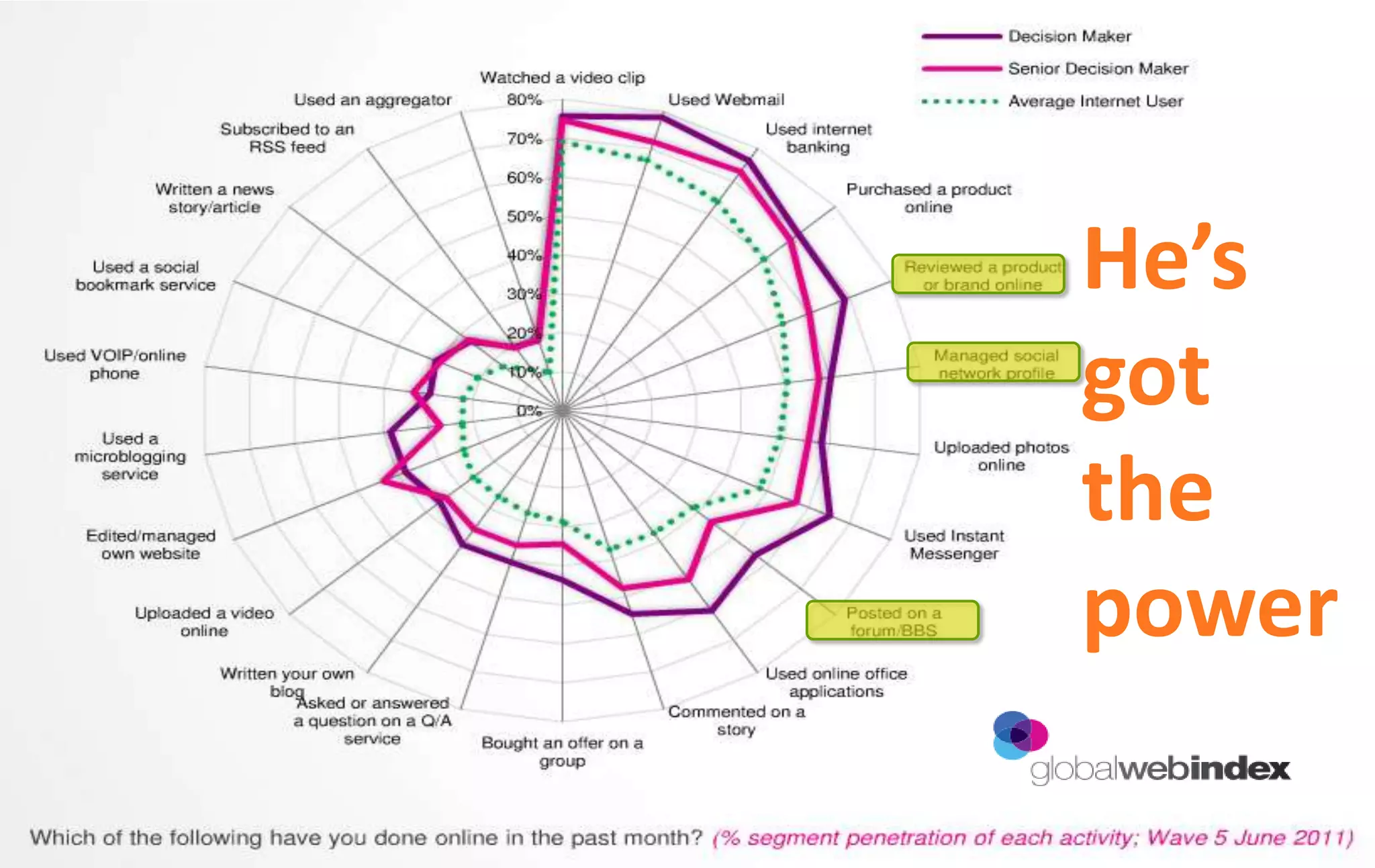
  • #11 Their decisionsare being influenced by social mediaThis data from research company GlobalWebIndex tells part of the storyDecision makers and senior decision makers are more likely to purchase a product online, review a product or brand online and manage a social network profile than average social media usersThey’re posting on forums or BBSsThey’re using microblogging services, writing their own blogs and editing their websitesThe opportunity – business decision makers are consistently more engaged in social media and online activity than average internet users (60% use social media) so there’s clearly an opportunity to engage and influence them through these channels. While senior decision makers are ahead of the norm, there’s even greater take up of social media amongst their junior colleagues – that makes sense, since we know that younger people tend to be more likely to use this stuff, but it’s also a good indicator of what we can expect in future. (Hat Tip to GWI)Why has this happened? What changed?
  • #12 IDG Enterprise
  • #13 Consumers gather 60 percent of information needed to make purchase decisions before contacting vendors - Come Recommended, LLC
  • #14 When researching solutions, buyers rely most on their peers, industry influencers and web search – ITSMA and PAC, How Customers Choose Study, 2010Most tech buyers (72%) say they typically become aware of technology products by talking with their peers/colleagues – Harte Hanks – Mapping the Technology buyers journey
  • #15 An average of nine informational assets are downloaded during the purchase process – IDG Enterprise, Customer Engagement: The Role of Content in the IT Purchase Process
  • #17 So how do we reach this new consumer?Keep it relevant, useful and entertainingEnhance social status within tribesAsk for a reaction and have a fun social interfaceConnect Gen C members with each other, not just with a brandEnable Gen C to participate in, play with or produce themselves and pass on
  • #18 The Customer Hourglass FrameworkThe challenge is that companies continue to build tactics in silos. Public Relations, Branding, Ecommerce and other groups might be building different social experiences for the same brand. These individual efforts result in an incomplete customer experience.The traditional purchase funnel is outdated. Think about how we can use that funnel to be more effective, ala "Flip the Funnel" (Joseph Jaffe). The Customer Hourglass is a model for this alternative thinking and looks at the entire customer experience: Awareness, Consideration, Intent, Purchase, Support, Loyalty, Advocacy. Jeremiah’s presentation explores each of these brand and customer experiences as it relates to social media.Awareness: Customers & prospects may not know who you are, so the goal is to become top of mind. A great example: AmEx OPEN Forum surfaces small business owner discussions and networking opportunities. This community enables small business owners to connect with each other and gain insights and expertise from thought leader contributed content.Awareness Key Take Aways:Expect paid media such as advertising to fuel the Awareness phaseOften rely on content about lifestyle and pain points of customersConsideration: It’s about letting customers advocate for you. Leverage your customer’s content. Example: Epson has included customer reviews. Visitors who interacted with reviews were 67% more likely to convert. They also had a 25% higher average order value. The downside of other people’s content is you lose control.Consideration Take Aways:Repurpose your product inventory information an apply it to the real worldAggregate 3rd party reviews to your corporate websiteRepurpose your reviews on your corporate website to 3rd party websites and blogs: extend and repurposeIntent: Customer interactions with ecommerce content provides opportunities to share their intent with relevant networks.  Example: Levi’s incorporates the "Like" button. Shoppers can "Like" and post comments about products straight to their Facebook wall. Customers see an instant shopping cart based on previous friend’s "Likes". The caveat is that the data isn’t always correct, but is improving. Levi’s isn’t sharing performance numbers but they’re continuing this activity, so something is happening for them to warrant continued investment.Intent Takeaways:While still emerging, social features are fueling sales efforts by adding richer context to the customer experienceExpect next gen apps to re-populate wish lists and shopping cartsPurchase - Tapping into friends at POP (point of purchase). This is where to connect with customers at the point of decision in the ecommerce experience. An example is Facebook launching group buying deals.  Another is Sony using group buying incentives to promote an album launch (Britney Spears). If a visitor got 5 friends to pre-order they all get 20% off.  Sony reports a 50% traffic bump at launch.Purchase Takeaways:Social features allow friends to share point of purchase with othersWOM (word of mouth) can be measured and attributed to individualsExpect in the future that virtual currency or virtual goods will offer consumers discounts or exclusive dealsSupport: Using these technologies to encourage customers to have a great experience. Example: Wells Fargo – @askwellsfargo is used to listen to customers and offer assistance. In the regulated space there are important concerns around privacy, so conversations are often taken to private chat or channels. Q/A tools, forums and similar applications can be used to encourage customers to support each other.Support Takeaways:Reduce support costs by giving information to consumers on handUse a tiered approach" load up FAQ first. Follow up providing the ability for them to conduct peer to peer support. Provide them with direct to company support when the first 2 avenues have been exhaustedLoyalty: The social application to this phase extends to multiple areas. Example: Hilton developed a mobile application "Top Guests", which is basically a white label version of Foursquare for the hospitality industry. Honors members can give a Facebook friend 25% off Doubletree B&B reservation once they check in.Loyalty Takeaways:Loyalty programs of the past are based on long term commitment and total potential spending valueIn the future, companies will factor in game mechanics, badgingAdvocacy: Another phase that extends to multiple areas, involves enabling customers to serve as brand ambassadors.  Example: TurboTax Inner Circul uses a community management tool.Another Advocacy example is Microsoft MVP – Most Valuable Professional. Every year 4,000 MVPs are nominated by peers, employees, and other MVPs then selected by an internal panel. Term of service is 1 year. It gets customers to do the work of evangelizing the brand.Advocacy Takeaway:The holy grail of marketing, this is the lowest cost of acquisition, most effective marketingSummary: Remember that customers are behaving in new ways, in new places and have new expectations. Think beyond the silos.
  • #19 Connecting to customers is going to get more complicated, and brands (and their partners) must pay attention to the Dynamic Customer Journey.We want to hear your point of view on the Dynamic Customer Journey (either in the comments below, or from your own blog) and we’ll cross-link to thoughtful discussions.  Introducing The Dynamic Customer JourneyWe see this disruptive theme as consumers being able to use many sources, devices, and mediums at any given time, giving them more options and choices. The result? Consumers are enabled to have a unique path each time, making it harder to predict. This means the experience becomes increasingly fragmented for the brand, as they struggle to reach consumers across all these choices of sources, mediums, and channels.What’s the opposite of a Dynamic Customer Journey? Back in the early mid-century, consumers had only a few TV channels and a few newspaper outlets to choose from. As a result, the experience was predictable, easy to target, and one-size-fitted-all. Today, this has drastically fragmented and is ever changing.The metaphor I use, is when I’m in Times Square NY, and I’ve so many choices to look at logos, ads, and content across many screens, the real world, and people to talk to. We see a similar experience being present in front of consumers wherever they go, even in their living room with so many choices between TVs, laptops, tablets, mobile devices and soon-to-be Google Glass augmented reality.The Factors that Impact the Dynamic Customer Journey  Multiply ComplexityA corporation that’s seeking to connect to their customers must understand all of these forces that impact the journey.  They must be able to quantify the following for every persona:New sources of information: Aside from press, media, analysts they are also relying on the crowd, and their friends. Soon augmented reality will allow for new data forms we’ve not yet seen.  (that’s about 5 factors)New forms of media: The channels as we know them Paid Owned and Earned are starting to intermix, as a result a new form of media is impacting them. Social websites have social ads, making content and advertising a new form. (that’s about 3 factors)New screens: Traditionally we’ve thought of TV, Laptop, and Mobile, but now we must factor in a tablet experience (which is different than the aforementioned) and with Google Glass augmented reality coming, that will be a fifth screen to build a strategy for.  (that’s 5 factors)To understand the complexity, this model suggests 5X3X5 which is 75 different permutations.  Next, the brand must understand this for every single phase: awareness, consideration, intent, purchase, support, loyalty, advocacy, (that’s 7 steps, resulting in 525 permutations per persona) then multiple times every product group and then geography, the math is staggering on the complexity.Call to Action: Share your Point of ViewThis theme is complicated, so in our Open Research model, we’re calling for the community to source and share ideas, so we can collectively learn together.  Want to get involved? We’ve published more on our POV on the official Altimeter Blog, and if you wanted to share your perspective, we want to hear, and will link to the community discussion.Technology innovators: What new devices, software, data do you see emerging that’s resulting in customers having more choices in their journey?Agencies and Service providers: How will brands need to catch up in their go to market strategy? How should brands restructure their internal organization to accommodate this change?Brands and Companies: What are you seeking from your solution partners to help bridge this gap? What do you need from technology and service providers to move forward?
  • #20 Connecting to customers is going to get more complicated, and brands (and their partners) must pay attention to the Dynamic Customer Journey.We want to hear your point of view on the Dynamic Customer Journey (either in the comments below, or from your own blog) and we’ll cross-link to thoughtful discussions.  Introducing The Dynamic Customer JourneyWe see this disruptive theme as consumers being able to use many sources, devices, and mediums at any given time, giving them more options and choices. The result? Consumers are enabled to have a unique path each time, making it harder to predict. This means the experience becomes increasingly fragmented for the brand, as they struggle to reach consumers across all these choices of sources, mediums, and channels.What’s the opposite of a Dynamic Customer Journey? Back in the early mid-century, consumers had only a few TV channels and a few newspaper outlets to choose from. As a result, the experience was predictable, easy to target, and one-size-fitted-all. Today, this has drastically fragmented and is ever changing.The metaphor I use, is when I’m in Times Square NY, and I’ve so many choices to look at logos, ads, and content across many screens, the real world, and people to talk to. We see a similar experience being present in front of consumers wherever they go, even in their living room with so many choices between TVs, laptops, tablets, mobile devices and soon-to-be Google Glass augmented reality.The Factors that Impact the Dynamic Customer Journey  Multiply ComplexityA corporation that’s seeking to connect to their customers must understand all of these forces that impact the journey.  They must be able to quantify the following for every persona:New sources of information: Aside from press, media, analysts they are also relying on the crowd, and their friends. Soon augmented reality will allow for new data forms we’ve not yet seen.  (that’s about 5 factors)New forms of media: The channels as we know them Paid Owned and Earned are starting to intermix, as a result a new form of media is impacting them. Social websites have social ads, making content and advertising a new form. (that’s about 3 factors)New screens: Traditionally we’ve thought of TV, Laptop, and Mobile, but now we must factor in a tablet experience (which is different than the aforementioned) and with Google Glass augmented reality coming, that will be a fifth screen to build a strategy for.  (that’s 5 factors)To understand the complexity, this model suggests 5X3X5 which is 75 different permutations.  Next, the brand must understand this for every single phase: awareness, consideration, intent, purchase, support, loyalty, advocacy, (that’s 7 steps, resulting in 525 permutations per persona) then multiple times every product group and then geography, the math is staggering on the complexity.Call to Action: Share your Point of ViewThis theme is complicated, so in our Open Research model, we’re calling for the community to source and share ideas, so we can collectively learn together.  Want to get involved? We’ve published more on our POV on the official Altimeter Blog, and if you wanted to share your perspective, we want to hear, and will link to the community discussion.Technology innovators: What new devices, software, data do you see emerging that’s resulting in customers having more choices in their journey?Agencies and Service providers: How will brands need to catch up in their go to market strategy? How should brands restructure their internal organization to accommodate this change?Brands and Companies: What are you seeking from your solution partners to help bridge this gap? What do you need from technology and service providers to move forward?
  • #21 Connecting to customers is going to get more complicated, and brands (and their partners) must pay attention to the Dynamic Customer Journey.We want to hear your point of view on the Dynamic Customer Journey (either in the comments below, or from your own blog) and we’ll cross-link to thoughtful discussions.  Introducing The Dynamic Customer JourneyWe see this disruptive theme as consumers being able to use many sources, devices, and mediums at any given time, giving them more options and choices. The result? Consumers are enabled to have a unique path each time, making it harder to predict. This means the experience becomes increasingly fragmented for the brand, as they struggle to reach consumers across all these choices of sources, mediums, and channels.What’s the opposite of a Dynamic Customer Journey? Back in the early mid-century, consumers had only a few TV channels and a few newspaper outlets to choose from. As a result, the experience was predictable, easy to target, and one-size-fitted-all. Today, this has drastically fragmented and is ever changing.The metaphor I use, is when I’m in Times Square NY, and I’ve so many choices to look at logos, ads, and content across many screens, the real world, and people to talk to. We see a similar experience being present in front of consumers wherever they go, even in their living room with so many choices between TVs, laptops, tablets, mobile devices and soon-to-be Google Glass augmented reality.The Factors that Impact the Dynamic Customer Journey  Multiply ComplexityA corporation that’s seeking to connect to their customers must understand all of these forces that impact the journey.  They must be able to quantify the following for every persona:New sources of information: Aside from press, media, analysts they are also relying on the crowd, and their friends. Soon augmented reality will allow for new data forms we’ve not yet seen.  (that’s about 5 factors)New forms of media: The channels as we know them Paid Owned and Earned are starting to intermix, as a result a new form of media is impacting them. Social websites have social ads, making content and advertising a new form. (that’s about 3 factors)New screens: Traditionally we’ve thought of TV, Laptop, and Mobile, but now we must factor in a tablet experience (which is different than the aforementioned) and with Google Glass augmented reality coming, that will be a fifth screen to build a strategy for.  (that’s 5 factors)To understand the complexity, this model suggests 5X3X5 which is 75 different permutations.  Next, the brand must understand this for every single phase: awareness, consideration, intent, purchase, support, loyalty, advocacy, (that’s 7 steps, resulting in 525 permutations per persona) then multiple times every product group and then geography, the math is staggering on the complexity.Call to Action: Share your Point of ViewThis theme is complicated, so in our Open Research model, we’re calling for the community to source and share ideas, so we can collectively learn together.  Want to get involved? We’ve published more on our POV on the official Altimeter Blog, and if you wanted to share your perspective, we want to hear, and will link to the community discussion.Technology innovators: What new devices, software, data do you see emerging that’s resulting in customers having more choices in their journey?Agencies and Service providers: How will brands need to catch up in their go to market strategy? How should brands restructure their internal organization to accommodate this change?Brands and Companies: What are you seeking from your solution partners to help bridge this gap? What do you need from technology and service providers to move forward?
  • #22 Connecting to customers is going to get more complicated, and brands (and their partners) must pay attention to the Dynamic Customer Journey.We want to hear your point of view on the Dynamic Customer Journey (either in the comments below, or from your own blog) and we’ll cross-link to thoughtful discussions.  Introducing The Dynamic Customer JourneyWe see this disruptive theme as consumers being able to use many sources, devices, and mediums at any given time, giving them more options and choices. The result? Consumers are enabled to have a unique path each time, making it harder to predict. This means the experience becomes increasingly fragmented for the brand, as they struggle to reach consumers across all these choices of sources, mediums, and channels.What’s the opposite of a Dynamic Customer Journey? Back in the early mid-century, consumers had only a few TV channels and a few newspaper outlets to choose from. As a result, the experience was predictable, easy to target, and one-size-fitted-all. Today, this has drastically fragmented and is ever changing.The metaphor I use, is when I’m in Times Square NY, and I’ve so many choices to look at logos, ads, and content across many screens, the real world, and people to talk to. We see a similar experience being present in front of consumers wherever they go, even in their living room with so many choices between TVs, laptops, tablets, mobile devices and soon-to-be Google Glass augmented reality.The Factors that Impact the Dynamic Customer Journey  Multiply ComplexityA corporation that’s seeking to connect to their customers must understand all of these forces that impact the journey.  They must be able to quantify the following for every persona:New sources of information: Aside from press, media, analysts they are also relying on the crowd, and their friends. Soon augmented reality will allow for new data forms we’ve not yet seen.  (that’s about 5 factors)New forms of media: The channels as we know them Paid Owned and Earned are starting to intermix, as a result a new form of media is impacting them. Social websites have social ads, making content and advertising a new form. (that’s about 3 factors)New screens: Traditionally we’ve thought of TV, Laptop, and Mobile, but now we must factor in a tablet experience (which is different than the aforementioned) and with Google Glass augmented reality coming, that will be a fifth screen to build a strategy for.  (that’s 5 factors)To understand the complexity, this model suggests 5X3X5 which is 75 different permutations.  Next, the brand must understand this for every single phase: awareness, consideration, intent, purchase, support, loyalty, advocacy, (that’s 7 steps, resulting in 525 permutations per persona) then multiple times every product group and then geography, the math is staggering on the complexity.Call to Action: Share your Point of ViewThis theme is complicated, so in our Open Research model, we’re calling for the community to source and share ideas, so we can collectively learn together.  Want to get involved? We’ve published more on our POV on the official Altimeter Blog, and if you wanted to share your perspective, we want to hear, and will link to the community discussion.Technology innovators: What new devices, software, data do you see emerging that’s resulting in customers having more choices in their journey?Agencies and Service providers: How will brands need to catch up in their go to market strategy? How should brands restructure their internal organization to accommodate this change?Brands and Companies: What are you seeking from your solution partners to help bridge this gap? What do you need from technology and service providers to move forward?
  • #23 Connecting to customers is going to get more complicated, and brands (and their partners) must pay attention to the Dynamic Customer Journey.We want to hear your point of view on the Dynamic Customer Journey (either in the comments below, or from your own blog) and we’ll cross-link to thoughtful discussions.  Introducing The Dynamic Customer JourneyWe see this disruptive theme as consumers being able to use many sources, devices, and mediums at any given time, giving them more options and choices. The result? Consumers are enabled to have a unique path each time, making it harder to predict. This means the experience becomes increasingly fragmented for the brand, as they struggle to reach consumers across all these choices of sources, mediums, and channels.What’s the opposite of a Dynamic Customer Journey? Back in the early mid-century, consumers had only a few TV channels and a few newspaper outlets to choose from. As a result, the experience was predictable, easy to target, and one-size-fitted-all. Today, this has drastically fragmented and is ever changing.The metaphor I use, is when I’m in Times Square NY, and I’ve so many choices to look at logos, ads, and content across many screens, the real world, and people to talk to. We see a similar experience being present in front of consumers wherever they go, even in their living room with so many choices between TVs, laptops, tablets, mobile devices and soon-to-be Google Glass augmented reality.The Factors that Impact the Dynamic Customer Journey  Multiply ComplexityA corporation that’s seeking to connect to their customers must understand all of these forces that impact the journey.  They must be able to quantify the following for every persona:New sources of information: Aside from press, media, analysts they are also relying on the crowd, and their friends. Soon augmented reality will allow for new data forms we’ve not yet seen.  (that’s about 5 factors)New forms of media: The channels as we know them Paid Owned and Earned are starting to intermix, as a result a new form of media is impacting them. Social websites have social ads, making content and advertising a new form. (that’s about 3 factors)New screens: Traditionally we’ve thought of TV, Laptop, and Mobile, but now we must factor in a tablet experience (which is different than the aforementioned) and with Google Glass augmented reality coming, that will be a fifth screen to build a strategy for.  (that’s 5 factors)To understand the complexity, this model suggests 5X3X5 which is 75 different permutations.  Next, the brand must understand this for every single phase: awareness, consideration, intent, purchase, support, loyalty, advocacy, (that’s 7 steps, resulting in 525 permutations per persona) then multiple times every product group and then geography, the math is staggering on the complexity.Call to Action: Share your Point of ViewThis theme is complicated, so in our Open Research model, we’re calling for the community to source and share ideas, so we can collectively learn together.  Want to get involved? We’ve published more on our POV on the official Altimeter Blog, and if you wanted to share your perspective, we want to hear, and will link to the community discussion.Technology innovators: What new devices, software, data do you see emerging that’s resulting in customers having more choices in their journey?Agencies and Service providers: How will brands need to catch up in their go to market strategy? How should brands restructure their internal organization to accommodate this change?Brands and Companies: What are you seeking from your solution partners to help bridge this gap? What do you need from technology and service providers to move forward?
  • #25 Connecting to customers is going to get more complicated, and brands (and their partners) must pay attention to the Dynamic Customer Journey.We want to hear your point of view on the Dynamic Customer Journey (either in the comments below, or from your own blog) and we’ll cross-link to thoughtful discussions.  Introducing The Dynamic Customer JourneyWe see this disruptive theme as consumers being able to use many sources, devices, and mediums at any given time, giving them more options and choices. The result? Consumers are enabled to have a unique path each time, making it harder to predict. This means the experience becomes increasingly fragmented for the brand, as they struggle to reach consumers across all these choices of sources, mediums, and channels.What’s the opposite of a Dynamic Customer Journey? Back in the early mid-century, consumers had only a few TV channels and a few newspaper outlets to choose from. As a result, the experience was predictable, easy to target, and one-size-fitted-all. Today, this has drastically fragmented and is ever changing.The metaphor I use, is when I’m in Times Square NY, and I’ve so many choices to look at logos, ads, and content across many screens, the real world, and people to talk to. We see a similar experience being present in front of consumers wherever they go, even in their living room with so many choices between TVs, laptops, tablets, mobile devices and soon-to-be Google Glass augmented reality.The Factors that Impact the Dynamic Customer Journey  Multiply ComplexityA corporation that’s seeking to connect to their customers must understand all of these forces that impact the journey.  They must be able to quantify the following for every persona:New sources of information: Aside from press, media, analysts they are also relying on the crowd, and their friends. Soon augmented reality will allow for new data forms we’ve not yet seen.  (that’s about 5 factors)New forms of media: The channels as we know them Paid Owned and Earned are starting to intermix, as a result a new form of media is impacting them. Social websites have social ads, making content and advertising a new form. (that’s about 3 factors)New screens: Traditionally we’ve thought of TV, Laptop, and Mobile, but now we must factor in a tablet experience (which is different than the aforementioned) and with Google Glass augmented reality coming, that will be a fifth screen to build a strategy for.  (that’s 5 factors)To understand the complexity, this model suggests 5X3X5 which is 75 different permutations.  Next, the brand must understand this for every single phase: awareness, consideration, intent, purchase, support, loyalty, advocacy, (that’s 7 steps, resulting in 525 permutations per persona) then multiple times every product group and then geography, the math is staggering on the complexity.Call to Action: Share your Point of ViewThis theme is complicated, so in our Open Research model, we’re calling for the community to source and share ideas, so we can collectively learn together.  Want to get involved? We’ve published more on our POV on the official Altimeter Blog, and if you wanted to share your perspective, we want to hear, and will link to the community discussion.Technology innovators: What new devices, software, data do you see emerging that’s resulting in customers having more choices in their journey?Agencies and Service providers: How will brands need to catch up in their go to market strategy? How should brands restructure their internal organization to accommodate this change?Brands and Companies: What are you seeking from your solution partners to help bridge this gap? What do you need from technology and service providers to move forward?
  • #29 And a little about me. Here’s my blog where you’ll catch my occasional ramblingsMy professional profile is on LinkedinAnd I’m more active on twitter, where you’ll get more frequent ramblingsI’m also co-author of the upcoming book, The Social Media MBA, will be available in February