INSTITUTO CULTURAL PERUANO NORTEAMERICANO-CUSCO
LESSSON PLAN
Reciprocal teaching is not just about having students repeat directions or ask questions of
their classmates. Reciprocal teaching also emphasizes sustained opportunities for complex
language use. What opportunities will you create for students to practice with the different
functionslistedbelow? How will you support studentproduction e.g. by using the board, by
modeling the language function you want them to engage in, etc. How will you provide
feedback?
Teacher’sname: ScarlettAragon
Course:B03 Date: August13th
Unit: 10 Lesson: 1
Objective:Ss.will be able todescribe theirfoodhabits..
Essential Questions:
Do youeat vegetablesandfruitseveryday?
LessonSequence
WARM UP: Divide the class in two groups. Play a game called Word Chain. Students have to
write a word, and the second person in line will write another word that starts with the last
letter from the prior word. The group with more words, gets a point.
> VOCABULARY
Choose differentstudentstoread aloud.Then repeatto practice pronunciation.Andgo to the
vocabulary booster, practice the extra vocabulary by repeating and ask students which of the
foods from the vocabulary they prefer.
> LISTENING COMPREHENSION
First, listen and take notes. Check according to the exercise. Andif necessary,listen twice.Ask
students a couple of questionsto check comprehension.Complete on the board. Ask students
whether it's going to be for points or not. If everything is good, give them an extra point.
> PAIR WORK
Have students discuss which their favorite food is and explain why. Students will report their
classmates' answer to the class. Using the correct use of subjects and the correct form of the
verbs.
> GRAMMAR
Give students some time to read the grammar box. Write a couple of examples on the board.
Askstudentswhattheyunderstoodfromthe grammar box.Identifystructure andaskstudents
to write other examples on their own. Correct if necessary.
WRAPUP:studentswill write some questionsinpairsaskingeach otherabout what theyhave
inside their refrigerators.
INSTITUTO CULTURAL PERUANO NORTEAMERICANO-CUSCO
LESSSON PLAN
Reciprocal teaching is not just about having students repeat directions or ask questions of
their classmates. Reciprocal teaching also emphasizes sustained opportunities for complex
language use. What opportunities will you create for students to practice with the different
functionslistedbelow? How will you support studentproduction e.g. by using the board, by
modeling the language function you want them to engage in, etc. How will you provide
feedback?
Teacher’sname: ScarlettAragon
Course:B03 Date: August14th
Unit: 10 Lesson:1 + 2
Objective:Ss.will be able toofferandask forfoods.
Essential Questions:
What are youin the moodfor? Wouldyoulike a...?
LessonSequence
WARM UP: Divide the class in two groups. Play a game called Word Chain. Students have to
write a word, and the second person in line will write another word that starts with the last
letter from the prior word. The group with more words, gets a point.
> VOCABULARY
Choose differentstudentstoreadaloud.Thenrepeattopractice pronunciationandaskstudents
which of the foods from the vocabulary they prefer.
> PAIR WORK
Have students discuss which their favorite food is and explain why. Students will report their
classmates' answer to the class. Using the correct use of subjects and the correct form of the
verbs...
> CONVERSATION MODEL
First, ask students to describe the picture from the conversationmodel. Then listen and check
newwordstoexplaintheirmeaning.Askstudentsacouple of questionsaboutthe conversation
to check comprehension. Then choose students to read out loud the conversation.
> PAIR WORK
In pairs,studentswill create asimilarconversationusingthe vocabularyandgrammar.Thenact
it out for the class.
WRAP UP: students will check in advance the the vocabulary from next page.
INSTITUTO CULTURAL PERUANO NORTEAMERICANO-CUSCO
LESSSON PLAN
Reciprocal teaching is not just about having students repeat directions or ask questions of
their classmates. Reciprocal teaching also emphasizes sustained opportunities for complex
language use. What opportunities will you create for students to practice with the different
functionslistedbelow? How will you support studentproduction e.g. by using the board, by
modeling the language function you want them to engage in, etc. How will you provide
feedback?
Teacher’sname: ScarlettAragon
Course:B03 Date: August15th
Unit: 10 Lesson:2
Objective:Ss.will be able toofferandask forfoods.
Essential Questions:
What are youin the moodfor? Wouldyoulike a...?
LessonSequence
WARM UP:Divide the class intwo groups. Write the alphabeton the board and give students
a category. Based on that category, students will write on the board all the words relatedto
that category starting with each letter of the alphabet in order.
> VOCABULARY
Choose different students to read aloud. Then repeat to practice pronunciation, and ask
studentswhichof the foodsfromthe vocabularytheyprefer.Tellstudentsaboutthe noncount
nouns. Explain that they are neither singular nor plural..
> PAIR WORK
Have students discuss which their favorite food is and explain why. Students will reporte their
classmates' answer to the class. Using the correct use of subjetcs and the correct form of the
verbs.
> GRAMMAR
Give students some time to read the grammar box. Write a couple of examples on the board.
Ask students what they understood from the grammar box. Identify structure. Name a couple
of nouns and have students identify which ones are count nouns and which are non-count
nouns. Ask students to write other examples on their own. Correct if necessary.
WRAP UP: have students close their books and after dividing them in two groups, students
will write only the non count nouns they remember.
INSTITUTO CULTURAL PERUANO NORTEAMERICANO-CUSCO
LESSSON PLAN
Reciprocal teaching is not just about having students repeat directions or ask questions of
their classmates. Reciprocal teaching also emphasizes sustained opportunities for complex
language use. What opportunities will you create for students to practice with the different
functionslistedbelow? How will you support studentproduction e.g. by using the board, by
modeling the language function you want them to engage in, etc. How will you provide
feedback?
Teacher’sname: ScarlettAragon
Course:B03 Date: August16th
Unit: 10 Lesson: 2 + 3
Objective:Ss.will be able toofferandask forfoods.
Essential Questions:
What are youin the moodfor? Wouldyoulike a...?
LessonSequence
WARM UP:Divide the class in two groups. Write a letteron the board and have students
write as many words as possible inone minute that start with that letter.
> GRAMMAR
Give studentssome time toreadthe grammar box.Write a couple of examplesonthe board.
Askstudentswhattheyunderstoodfromthe grammarbox.Identifystructure.Nameacouple
of nounsandhave studentsidentifywhichonesare countnounsandwhichare non count
nouns.Askstudentstowrite otherexamplesontheirown.Correctif necessary.
> GRAMMAR PRACTICE
Studentswill complete the gapsbelowwiththe correctwordaccordingto the grammar. After
comparinganswersinpairsand completingonthe board.Askstudentswhethertheywantthis
exercise tobe forpoints.If everythingisokay,give studentsone extrapointtomotivate their
participationandwell grammarunderstanding.
> VOCABULARY
Choose differentstudentstoreadaloud.Thenrepeattopractice pronunciation.
> GRAMMAR
Give studentssome time toreadthe grammar box.Write a couple of exampleson the board.
Askstudentswhattheyunderstoodfromthe grammarbox.Identifystructure andaskstudents
to write othwrexamplesontheirown.Correctif necessary.
> GRAMMAR PRACTICE
Studentswill complete the gapsbelowwiththe correctwordaccordingto the grammar. After
comparinganswersinpairsand completingonthe board.Askstudentswhethertheywantthis
exercise tobe forpoints.
WRAP UP:students will write some questionsinpairs asking each other about what they
have inside theirrefrigerators.
INSTITUTO CULTURAL PERUANO NORTEAMERICANO-CUSCO
LESSSON PLAN
Reciprocal teaching is not just about having students repeat directions or ask questions of
their classmates. Reciprocal teaching also emphasizes sustained opportunities for complex
language use. What opportunities will you create for students to practice with the different
functionslistedbelow? How will you support studentproduction e.g. by using the board, by
modeling the language function you want them to engage in, etc. How will you provide
feedback?
Teacher’sname: ScarlettAragon
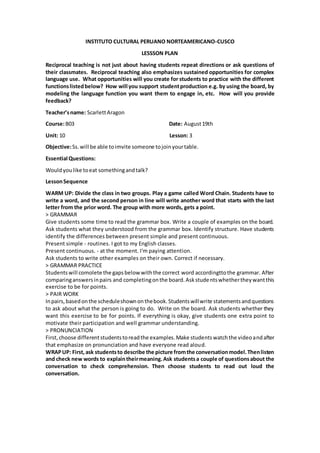
Course:B03 Date: August19th
Unit: 10 Lesson: 3
Objective:Ss.will be able toimvite someone tojoinyourtable.
Essential Questions:
Wouldyoulike toeat somethingandtalk?
LessonSequence
WARM UP: Divide the class in two groups. Play a game called Word Chain. Students have to
write a word, and the second person in line will write another word that starts with the last
letter from the prior word. The group with more words, gets a point.
> GRAMMAR
Give students some time to read the grammar box. Write a couple of examples on the board.
Ask students what they understood from the grammar box. Identify structure. Have students
identify the differences between present simple and present continuous.
Present simple - routines. I got to my English classes.
Present continuous. - at the moment. I'm paying attention.
Ask students to write other examples on their own. Correct if necessary.
> GRAMMAR PRACTICE
Studentswill comolete the gapsbelow withthe correct word accordingttothe grammar. After
comparinganswersinpairs and completingonthe board.Askstudentswhethertheywantthis
exercise to be for points.
> PAIR WORK
Inpairs,basedonthe scheduleshownonthebook.Studentswillwrite statementsandquestions
to ask about what the person is going to do. Write on the board. Ask students whether they
want this exercise to be for points. If everything is okay, give students one extra point to
motivate their participation and well grammar understanding.
> PRONUNCIATION
First,choose differentstudentstoreadthe examples.Make studentswatchthe videoandafter
that emphasize on pronunciation and have everyone read aloud.
WRAPUP: First, ask studentsto describe the picture fromthe conversationmodel.Thenlisten
and check new words to explaintheirmeaning.Ask studentsa couple of questionsabout the
conversation to check comprehension. Then choose students to read out loud the
conversation.
INSTITUTO CULTURAL PERUANO NORTEAMERICANO-CUSCO
LESSSON PLAN
Reciprocal teaching is not just about having students repeat directions or ask questions of
their classmates. Reciprocal teaching also emphasizes sustained opportunities for complex
language use. What opportunities will you create for students to practice with the different
functionslistedbelow? How will you support studentproduction e.g. by using the board, by
modeling the language function you want them to engage in, etc. How will you provide
feedback?
Teacher’sname: ScarlettAragon
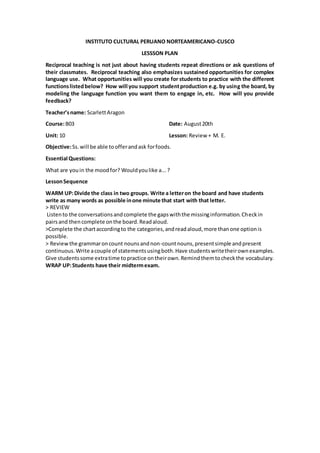
Course:B03 Date: August20th
Unit: 10 Lesson: Review + M. E.
Objective:Ss.will be able toofferandask forfoods.
Essential Questions:
What are youin the moodfor? Wouldyoulike a...?
LessonSequence
WARM UP:Divide the class in two groups. Write a letteron the board and have students
write as many words as possible inone minute that start with that letter.
> REVIEW
Listento the conversationsandcomplete the gapswiththe missinginformation.Checkin
pairsand thencomplete onthe board.Readaloud.
>Complete the chartaccordingto the categories,andreadaloud,more thanone optionis
possible.
> Review the grammaroncount nounsandnon-countnouns,presentsimple andpresent
continuous.Write acouple of statementsusingboth.Have studentswritetheirownexamples.
Give studentssome extratime topractice ontheirown.Remindthemtocheckthe vocabulary.
WRAP UP:Students have their midtermexam.
INSTITUTO CULTURAL PERUANO NORTEAMERICANO-CUSCO
LESSSON PLAN
Reciprocal teaching is not just about having students repeat directions or ask questions of
their classmates. Reciprocal teaching also emphasizes sustained opportunities for complex
language use. What opportunities will you create for students to practice with the different
functionslistedbelow? How will you support studentproduction e.g. by using the board, by
modeling the language function you want them to engage in, etc. How will you provide
feedback?
Teacher’sname: ScarlettAragon
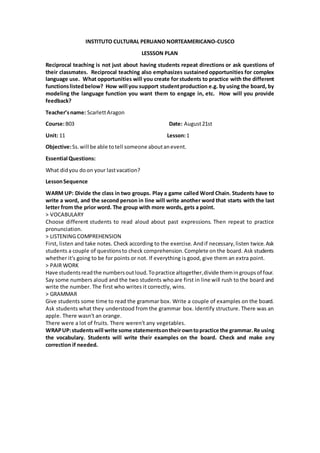
Course:B03 Date: August21st
Unit: 11 Lesson:1
Objective:Ss.will be able totell someone aboutanevent.
Essential Questions:
What didyou doon your lastvacation?
LessonSequence
WARM UP: Divide the class in two groups. Play a game called Word Chain. Students have to
write a word, and the second person in line will write another word that starts with the last
letter from the prior word. The group with more words, gets a point.
> VOCABULARY
Choose different students to read aloud about past expressions. Then repeat to practice
pronunciation.
> LISTENING COMPREHENSION
First, listen and take notes. Check according to the exercise. Andif necessary,listen twice.Ask
students a couple of questionsto check comprehension.Complete on the board. Ask students
whether it's going to be for points or not. If everything is good, give them an extra point.
> PAIR WORK
Have studentsreadthe numbersoutloud.Topractice altogether,divide themingroupsof four.
Say some numbers aloud and the two students whoare first in line will rush to the board and
write the number. The first who writes it correctly, wins.
> GRAMMAR
Give students some time to read the grammar box. Write a couple of examples on the board.
Ask students what they understood from the grammar box. Identify structure. There was an
apple. There wasn't an orange.
There were a lot of fruits. There weren't any vegetables.
WRAPUP:studentswill write some statementsontheirowntopractice the grammar.Re using
the vocabulary. Students will write their examples on the board. Check and make any
correction if needed.
INSTITUTO CULTURAL PERUANO NORTEAMERICANO-CUSCO
LESSSON PLAN
Reciprocal teaching is not just about having students repeat directions or ask questions of
their classmates. Reciprocal teaching also emphasizes sustained opportunities for complex
language use. What opportunities will you create for students to practice with the different
functionslistedbelow? How will you support studentproduction e.g. by using the board, by
modeling the language function you want them to engage in, etc. How will you provide
feedback?
Teacher’sname: ScarlettAragon
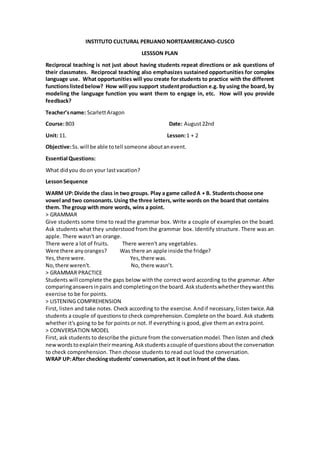
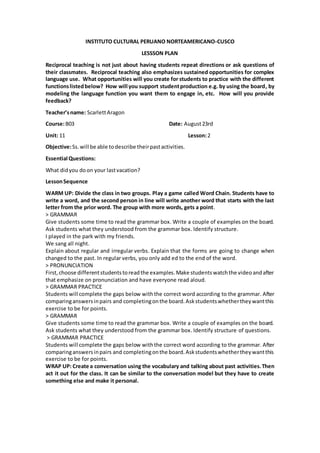
Course:B03 Date: August22nd
Unit: 11. Lesson:1 + 2
Objective:Ss.will be able totell someone aboutanevent.
Essential Questions:
What didyou doon your lastvacation?
LessonSequence
WARM UP:Divide the class in two groups. Play a game calledA + B. Studentschoose one
vowel and two consonants.Using the three letters,write words on the board that contains
them. The group with more words, wins a point.
> GRAMMAR
Give students some time to read the grammar box. Write a couple of examples on the board.
Ask students what they understood from the grammar box. Identify structure. There was an
apple. There wasn't an orange.
There were a lot of fruits. There weren't any vegetables.
Were there anyoranges? Was there an apple inside the fridge?
Yes,there were. Yes,there was.
No,there weren't. No, there wasn’t.
> GRAMMAR PRACTICE
Students will complete the gaps below withthe correct word according to the grammar. After
comparinganswersinpairs and completingonthe board.Askstudentswhethertheywantthis
exercise to be for points.
> LISTENING COMPREHENSION
First, listen and take notes. Check according to the exercise. Andif necessary,listen twice.Ask
students a couple of questionsto check comprehension.Complete on the board. Ask students
whether it's going to be for points or not. If everything is good, give them an extra point.
> CONVERSATION MODEL
First, ask students to describe the picture from the conversationmodel. Then listen and check
newwordstoexplaintheirmeaning.Askstudentsacouple of questionsaboutthe conversation
to check comprehension. Then choose students to read out loud the conversation.
WRAP UP:After checkingstudents’conversation,act it out in front of the class.
INSTITUTO CULTURAL PERUANO NORTEAMERICANO-CUSCO
LESSSON PLAN
Reciprocal teaching is not just about having students repeat directions or ask questions of
their classmates. Reciprocal teaching also emphasizes sustained opportunities for complex
language use. What opportunities will you create for students to practice with the different
functionslistedbelow? How will you support studentproduction e.g. by using the board, by
modeling the language function you want them to engage in, etc. How will you provide
feedback?
Teacher’sname: ScarlettAragon
Course:B03 Date: August23rd
Unit: 11 Lesson:2
Objective:Ss.will be able todescribe theirpastactivities.
Essential Questions:
What didyou doon your lastvacation?
LessonSequence
WARM UP: Divide the class in two groups. Play a game called Word Chain. Students have to
write a word, and the second person in line will write another word that starts with the last
letter from the prior word. The group with more words, gets a point.
> GRAMMAR
Give students some time to read the grammar box. Write a couple of examples on the board.
Ask students what they understood from the grammar box. Identify structure.
I played in the park with my friends.
We sang all night.
Explain about regular and irregular verbs. Explain that the forms are going to change when
changed to the past. In regular verbs, you only add ed to the end of the word.
> PRONUNCIATION
First,choose differentstudentstoreadthe examples.Make studentswatchthe videoandafter
that emphasize on pronunciation and have everyone read aloud.
> GRAMMAR PRACTICE
Students will complete the gaps below withthe correct word according to the grammar. After
comparinganswersinpairs and completingonthe board.Askstudentswhethertheywantthis
exercise to be for points.
> GRAMMAR
Give students some time to read the grammar box. Write a couple of examples on the board.
Ask students what they understood from the grammar box. Identify structure of questions.
> GRAMMAR PRACTICE
Students will complete the gaps below withthe correct word according to the grammar. After
comparinganswersinpairs and completingonthe board.Askstudentswhethertheywantthis
exercise to be for points.
WRAP UP: Create a conversation using the vocabulary and talking about past activities.Then
act it out for the class. It can be similar to the conversation model but they have to create
something else and make it personal.
INSTITUTO CULTURAL PERUANO NORTEAMERICANO-CUSCO
LESSSON PLAN
Reciprocal teaching is not just about having students repeat directions or ask questions of
their classmates. Reciprocal teaching also emphasizes sustained opportunities for complex
language use. What opportunities will you create for students to practice with the different
functionslistedbelow? How will you support studentproduction e.g. by using the board, by
modeling the language function you want them to engage in, etc. How will you provide
feedback?
Teacher’sname: ScarlettAragon
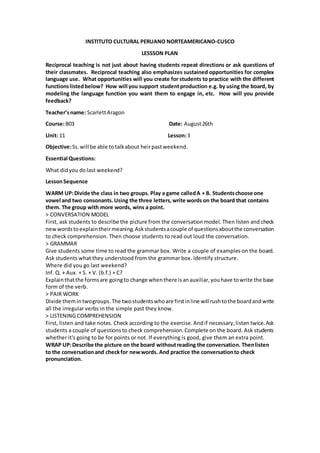
Course:B03 Date: August26th
Unit: 11 Lesson:3
Objective:Ss.will be able totalkabout heirpastweekend.
Essential Questions:
What didyou dolast weekend?
LessonSequence
WARM UP:Divide the class in two groups. Play a game calledA + B. Studentschoose one
vowel and two consonants.Using the three letters,write words on the board that contains
them. The group with more words, wins a point.
> CONVERSATION MODEL
First, ask students to describe the picture from the conversationmodel. Then listen and check
newwordstoexplaintheirmeaning.Askstudentsacouple of questionsaboutthe conversation
to check comprehension. Then choose students to read out loud the conversation.
> GRAMMAR
Give students some time to read the grammar box. Write a couple of examples on the board.
Ask students what they understood from the grammar box. Identify structure.
Where did you go last weekend?
Inf. Q. + Aux. + S. + V. (b.f.) + C?
Explainthatthe formsare goingto change whenthere isanauxiliar,youhave towrite the base
form of the verb.
> PAIR WORK
Divide themintwogroups. The twostudentswhoare firstinline willrushtothe boardandwrite
all the irregular verbs in the simple past they know.
> LISTENING COMPREHENSION
First, listen and take notes. Check according to the exercise. Andif necessary,listen twice.Ask
students a couple of questionsto check comprehension.Complete on the board. Ask students
whether it's going to be for points or not. If everything is good, give them an extra point.
WRAP UP:Describe the picture on the board withoutreading the conversation. Thenlisten
to the conversationand checkfor newwords. And practice the conversationto check
pronunciation.
INSTITUTO CULTURAL PERUANO NORTEAMERICANO-CUSCO
LESSSON PLAN
Reciprocal teaching is not just about having students repeat directions or ask questions of
their classmates. Reciprocal teaching also emphasizes sustained opportunities for complex
language use. What opportunities will you create for students to practice with the different
functionslistedbelow? How will you support studentproduction e.g. by using the board, by
modeling the language function you want them to engage in, etc. How will you provide
feedback?
Teacher’sname: ScarlettAragon
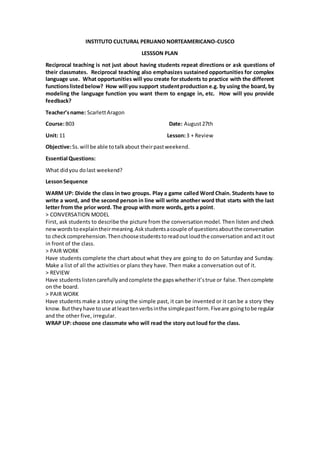
Course:B03 Date: August27th
Unit: 11 Lesson:3 + Review
Objective:Ss.will be able totalkabout theirpastweekend.
Essential Questions:
What didyou dolast weekend?
LessonSequence
WARM UP: Divide the class in two groups. Play a game called Word Chain. Students have to
write a word, and the second person in line will write another word that starts with the last
letter from the prior word. The group with more words, gets a point.
> CONVERSATION MODEL
First, ask students to describe the picture from the conversationmodel. Then listen and check
newwordstoexplaintheirmeaning.Askstudentsacouple of questionsaboutthe conversation
to checkcomprehension.Thenchoosestudentstoreadoutloudthe conversation andactitout
in front of the class.
> PAIR WORK
Have students complete the chart about what they are going to do on Saturday and Sunday.
Make a list of all the activities or plans they have. Then make a conversation out of it.
> REVIEW
Have studentslistencarefullyandcomplete the gapswhetherit’strue or false.Thencomplete
on the board.
> PAIR WORK
Have students make a story using the simple past, it can be invented or it can be a story they
know.Buttheyhave touse atleasttenverbsinthe simplepastform.Fiveare goingtobe regular
and the other five, irregular.
WRAP UP: choose one classmate who will read the story out loud for the class.
INSTITUTO CULTURAL PERUANO NORTEAMERICANO-CUSCO
LESSSON PLAN
Reciprocal teaching is not just about having students repeat directions or ask questions of
their classmates. Reciprocal teaching also emphasizes sustained opportunities for complex
language use. What opportunities will you create for students to practice with the different
functionslistedbelow? How will you support studentproduction e.g. by using the board, by
modeling the language function you want them to engage in, etc. How will you provide
feedback?
Teacher’sname: ScarlettAragon
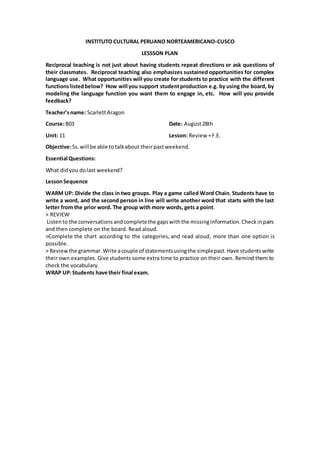
Course:B03 Date: August28th
Unit: 11 Lesson: Review +F.E.
Objective:Ss.will be able totalkabout theirpastweekend.
Essential Questions:
What didyou dolast weekend?
LessonSequence
WARM UP: Divide the class in two groups. Play a game called Word Chain. Students have to
write a word, and the second person in line will write another word that starts with the last
letter from the prior word. The group with more words, gets a point.
> REVIEW
Listento the conversationsandcompletethe gapswiththe missinginformation.Checkinpairs
and then complete on the board. Read aloud.
>Complete the chart according to the categories, and read aloud, more than one option is
possible.
> Review the grammar.Write acouple of statementsusingthe simplepast.Have studentswrite
their own examples. Give students some extra time to practice on their own. Remind them to
check the vocabulary.
WRAP UP:Students have their final exam.

B03.docx

  • 1.
    INSTITUTO CULTURAL PERUANONORTEAMERICANO-CUSCO LESSSON PLAN Reciprocal teaching is not just about having students repeat directions or ask questions of their classmates. Reciprocal teaching also emphasizes sustained opportunities for complex language use. What opportunities will you create for students to practice with the different functionslistedbelow? How will you support studentproduction e.g. by using the board, by modeling the language function you want them to engage in, etc. How will you provide feedback? Teacher’sname: ScarlettAragon Course:B03 Date: August13th Unit: 10 Lesson: 1 Objective:Ss.will be able todescribe theirfoodhabits.. Essential Questions: Do youeat vegetablesandfruitseveryday? LessonSequence WARM UP: Divide the class in two groups. Play a game called Word Chain. Students have to write a word, and the second person in line will write another word that starts with the last letter from the prior word. The group with more words, gets a point. > VOCABULARY Choose differentstudentstoread aloud.Then repeatto practice pronunciation.Andgo to the vocabulary booster, practice the extra vocabulary by repeating and ask students which of the foods from the vocabulary they prefer. > LISTENING COMPREHENSION First, listen and take notes. Check according to the exercise. Andif necessary,listen twice.Ask students a couple of questionsto check comprehension.Complete on the board. Ask students whether it's going to be for points or not. If everything is good, give them an extra point. > PAIR WORK Have students discuss which their favorite food is and explain why. Students will report their classmates' answer to the class. Using the correct use of subjects and the correct form of the verbs. > GRAMMAR Give students some time to read the grammar box. Write a couple of examples on the board. Askstudentswhattheyunderstoodfromthe grammar box.Identifystructure andaskstudents to write other examples on their own. Correct if necessary. WRAPUP:studentswill write some questionsinpairsaskingeach otherabout what theyhave inside their refrigerators.
  • 2.
    INSTITUTO CULTURAL PERUANONORTEAMERICANO-CUSCO LESSSON PLAN Reciprocal teaching is not just about having students repeat directions or ask questions of their classmates. Reciprocal teaching also emphasizes sustained opportunities for complex language use. What opportunities will you create for students to practice with the different functionslistedbelow? How will you support studentproduction e.g. by using the board, by modeling the language function you want them to engage in, etc. How will you provide feedback? Teacher’sname: ScarlettAragon Course:B03 Date: August14th Unit: 10 Lesson:1 + 2 Objective:Ss.will be able toofferandask forfoods. Essential Questions: What are youin the moodfor? Wouldyoulike a...? LessonSequence WARM UP: Divide the class in two groups. Play a game called Word Chain. Students have to write a word, and the second person in line will write another word that starts with the last letter from the prior word. The group with more words, gets a point. > VOCABULARY Choose differentstudentstoreadaloud.Thenrepeattopractice pronunciationandaskstudents which of the foods from the vocabulary they prefer. > PAIR WORK Have students discuss which their favorite food is and explain why. Students will report their classmates' answer to the class. Using the correct use of subjects and the correct form of the verbs... > CONVERSATION MODEL First, ask students to describe the picture from the conversationmodel. Then listen and check newwordstoexplaintheirmeaning.Askstudentsacouple of questionsaboutthe conversation to check comprehension. Then choose students to read out loud the conversation. > PAIR WORK In pairs,studentswill create asimilarconversationusingthe vocabularyandgrammar.Thenact it out for the class. WRAP UP: students will check in advance the the vocabulary from next page.
  • 3.
    INSTITUTO CULTURAL PERUANONORTEAMERICANO-CUSCO LESSSON PLAN Reciprocal teaching is not just about having students repeat directions or ask questions of their classmates. Reciprocal teaching also emphasizes sustained opportunities for complex language use. What opportunities will you create for students to practice with the different functionslistedbelow? How will you support studentproduction e.g. by using the board, by modeling the language function you want them to engage in, etc. How will you provide feedback? Teacher’sname: ScarlettAragon Course:B03 Date: August15th Unit: 10 Lesson:2 Objective:Ss.will be able toofferandask forfoods. Essential Questions: What are youin the moodfor? Wouldyoulike a...? LessonSequence WARM UP:Divide the class intwo groups. Write the alphabeton the board and give students a category. Based on that category, students will write on the board all the words relatedto that category starting with each letter of the alphabet in order. > VOCABULARY Choose different students to read aloud. Then repeat to practice pronunciation, and ask studentswhichof the foodsfromthe vocabularytheyprefer.Tellstudentsaboutthe noncount nouns. Explain that they are neither singular nor plural.. > PAIR WORK Have students discuss which their favorite food is and explain why. Students will reporte their classmates' answer to the class. Using the correct use of subjetcs and the correct form of the verbs. > GRAMMAR Give students some time to read the grammar box. Write a couple of examples on the board. Ask students what they understood from the grammar box. Identify structure. Name a couple of nouns and have students identify which ones are count nouns and which are non-count nouns. Ask students to write other examples on their own. Correct if necessary. WRAP UP: have students close their books and after dividing them in two groups, students will write only the non count nouns they remember.
  • 4.
    INSTITUTO CULTURAL PERUANONORTEAMERICANO-CUSCO LESSSON PLAN Reciprocal teaching is not just about having students repeat directions or ask questions of their classmates. Reciprocal teaching also emphasizes sustained opportunities for complex language use. What opportunities will you create for students to practice with the different functionslistedbelow? How will you support studentproduction e.g. by using the board, by modeling the language function you want them to engage in, etc. How will you provide feedback? Teacher’sname: ScarlettAragon Course:B03 Date: August16th Unit: 10 Lesson: 2 + 3 Objective:Ss.will be able toofferandask forfoods. Essential Questions: What are youin the moodfor? Wouldyoulike a...? LessonSequence WARM UP:Divide the class in two groups. Write a letteron the board and have students write as many words as possible inone minute that start with that letter. > GRAMMAR Give studentssome time toreadthe grammar box.Write a couple of examplesonthe board. Askstudentswhattheyunderstoodfromthe grammarbox.Identifystructure.Nameacouple of nounsandhave studentsidentifywhichonesare countnounsandwhichare non count nouns.Askstudentstowrite otherexamplesontheirown.Correctif necessary. > GRAMMAR PRACTICE Studentswill complete the gapsbelowwiththe correctwordaccordingto the grammar. After comparinganswersinpairsand completingonthe board.Askstudentswhethertheywantthis exercise tobe forpoints.If everythingisokay,give studentsone extrapointtomotivate their participationandwell grammarunderstanding. > VOCABULARY Choose differentstudentstoreadaloud.Thenrepeattopractice pronunciation. > GRAMMAR Give studentssome time toreadthe grammar box.Write a couple of exampleson the board. Askstudentswhattheyunderstoodfromthe grammarbox.Identifystructure andaskstudents to write othwrexamplesontheirown.Correctif necessary. > GRAMMAR PRACTICE Studentswill complete the gapsbelowwiththe correctwordaccordingto the grammar. After comparinganswersinpairsand completingonthe board.Askstudentswhethertheywantthis exercise tobe forpoints. WRAP UP:students will write some questionsinpairs asking each other about what they have inside theirrefrigerators.
  • 5.
    INSTITUTO CULTURAL PERUANONORTEAMERICANO-CUSCO LESSSON PLAN Reciprocal teaching is not just about having students repeat directions or ask questions of their classmates. Reciprocal teaching also emphasizes sustained opportunities for complex language use. What opportunities will you create for students to practice with the different functionslistedbelow? How will you support studentproduction e.g. by using the board, by modeling the language function you want them to engage in, etc. How will you provide feedback? Teacher’sname: ScarlettAragon Course:B03 Date: August19th Unit: 10 Lesson: 3 Objective:Ss.will be able toimvite someone tojoinyourtable. Essential Questions: Wouldyoulike toeat somethingandtalk? LessonSequence WARM UP: Divide the class in two groups. Play a game called Word Chain. Students have to write a word, and the second person in line will write another word that starts with the last letter from the prior word. The group with more words, gets a point. > GRAMMAR Give students some time to read the grammar box. Write a couple of examples on the board. Ask students what they understood from the grammar box. Identify structure. Have students identify the differences between present simple and present continuous. Present simple - routines. I got to my English classes. Present continuous. - at the moment. I'm paying attention. Ask students to write other examples on their own. Correct if necessary. > GRAMMAR PRACTICE Studentswill comolete the gapsbelow withthe correct word accordingttothe grammar. After comparinganswersinpairs and completingonthe board.Askstudentswhethertheywantthis exercise to be for points. > PAIR WORK Inpairs,basedonthe scheduleshownonthebook.Studentswillwrite statementsandquestions to ask about what the person is going to do. Write on the board. Ask students whether they want this exercise to be for points. If everything is okay, give students one extra point to motivate their participation and well grammar understanding. > PRONUNCIATION First,choose differentstudentstoreadthe examples.Make studentswatchthe videoandafter that emphasize on pronunciation and have everyone read aloud. WRAPUP: First, ask studentsto describe the picture fromthe conversationmodel.Thenlisten and check new words to explaintheirmeaning.Ask studentsa couple of questionsabout the conversation to check comprehension. Then choose students to read out loud the conversation.
  • 6.
    INSTITUTO CULTURAL PERUANONORTEAMERICANO-CUSCO LESSSON PLAN Reciprocal teaching is not just about having students repeat directions or ask questions of their classmates. Reciprocal teaching also emphasizes sustained opportunities for complex language use. What opportunities will you create for students to practice with the different functionslistedbelow? How will you support studentproduction e.g. by using the board, by modeling the language function you want them to engage in, etc. How will you provide feedback? Teacher’sname: ScarlettAragon Course:B03 Date: August20th Unit: 10 Lesson: Review + M. E. Objective:Ss.will be able toofferandask forfoods. Essential Questions: What are youin the moodfor? Wouldyoulike a...? LessonSequence WARM UP:Divide the class in two groups. Write a letteron the board and have students write as many words as possible inone minute that start with that letter. > REVIEW Listento the conversationsandcomplete the gapswiththe missinginformation.Checkin pairsand thencomplete onthe board.Readaloud. >Complete the chartaccordingto the categories,andreadaloud,more thanone optionis possible. > Review the grammaroncount nounsandnon-countnouns,presentsimple andpresent continuous.Write acouple of statementsusingboth.Have studentswritetheirownexamples. Give studentssome extratime topractice ontheirown.Remindthemtocheckthe vocabulary. WRAP UP:Students have their midtermexam.
  • 7.
    INSTITUTO CULTURAL PERUANONORTEAMERICANO-CUSCO LESSSON PLAN Reciprocal teaching is not just about having students repeat directions or ask questions of their classmates. Reciprocal teaching also emphasizes sustained opportunities for complex language use. What opportunities will you create for students to practice with the different functionslistedbelow? How will you support studentproduction e.g. by using the board, by modeling the language function you want them to engage in, etc. How will you provide feedback? Teacher’sname: ScarlettAragon Course:B03 Date: August21st Unit: 11 Lesson:1 Objective:Ss.will be able totell someone aboutanevent. Essential Questions: What didyou doon your lastvacation? LessonSequence WARM UP: Divide the class in two groups. Play a game called Word Chain. Students have to write a word, and the second person in line will write another word that starts with the last letter from the prior word. The group with more words, gets a point. > VOCABULARY Choose different students to read aloud about past expressions. Then repeat to practice pronunciation. > LISTENING COMPREHENSION First, listen and take notes. Check according to the exercise. Andif necessary,listen twice.Ask students a couple of questionsto check comprehension.Complete on the board. Ask students whether it's going to be for points or not. If everything is good, give them an extra point. > PAIR WORK Have studentsreadthe numbersoutloud.Topractice altogether,divide themingroupsof four. Say some numbers aloud and the two students whoare first in line will rush to the board and write the number. The first who writes it correctly, wins. > GRAMMAR Give students some time to read the grammar box. Write a couple of examples on the board. Ask students what they understood from the grammar box. Identify structure. There was an apple. There wasn't an orange. There were a lot of fruits. There weren't any vegetables. WRAPUP:studentswill write some statementsontheirowntopractice the grammar.Re using the vocabulary. Students will write their examples on the board. Check and make any correction if needed.
  • 8.
    INSTITUTO CULTURAL PERUANONORTEAMERICANO-CUSCO LESSSON PLAN Reciprocal teaching is not just about having students repeat directions or ask questions of their classmates. Reciprocal teaching also emphasizes sustained opportunities for complex language use. What opportunities will you create for students to practice with the different functionslistedbelow? How will you support studentproduction e.g. by using the board, by modeling the language function you want them to engage in, etc. How will you provide feedback? Teacher’sname: ScarlettAragon Course:B03 Date: August22nd Unit: 11. Lesson:1 + 2 Objective:Ss.will be able totell someone aboutanevent. Essential Questions: What didyou doon your lastvacation? LessonSequence WARM UP:Divide the class in two groups. Play a game calledA + B. Studentschoose one vowel and two consonants.Using the three letters,write words on the board that contains them. The group with more words, wins a point. > GRAMMAR Give students some time to read the grammar box. Write a couple of examples on the board. Ask students what they understood from the grammar box. Identify structure. There was an apple. There wasn't an orange. There were a lot of fruits. There weren't any vegetables. Were there anyoranges? Was there an apple inside the fridge? Yes,there were. Yes,there was. No,there weren't. No, there wasn’t. > GRAMMAR PRACTICE Students will complete the gaps below withthe correct word according to the grammar. After comparinganswersinpairs and completingonthe board.Askstudentswhethertheywantthis exercise to be for points. > LISTENING COMPREHENSION First, listen and take notes. Check according to the exercise. Andif necessary,listen twice.Ask students a couple of questionsto check comprehension.Complete on the board. Ask students whether it's going to be for points or not. If everything is good, give them an extra point. > CONVERSATION MODEL First, ask students to describe the picture from the conversationmodel. Then listen and check newwordstoexplaintheirmeaning.Askstudentsacouple of questionsaboutthe conversation to check comprehension. Then choose students to read out loud the conversation. WRAP UP:After checkingstudents’conversation,act it out in front of the class.
  • 9.
    INSTITUTO CULTURAL PERUANONORTEAMERICANO-CUSCO LESSSON PLAN Reciprocal teaching is not just about having students repeat directions or ask questions of their classmates. Reciprocal teaching also emphasizes sustained opportunities for complex language use. What opportunities will you create for students to practice with the different functionslistedbelow? How will you support studentproduction e.g. by using the board, by modeling the language function you want them to engage in, etc. How will you provide feedback? Teacher’sname: ScarlettAragon Course:B03 Date: August23rd Unit: 11 Lesson:2 Objective:Ss.will be able todescribe theirpastactivities. Essential Questions: What didyou doon your lastvacation? LessonSequence WARM UP: Divide the class in two groups. Play a game called Word Chain. Students have to write a word, and the second person in line will write another word that starts with the last letter from the prior word. The group with more words, gets a point. > GRAMMAR Give students some time to read the grammar box. Write a couple of examples on the board. Ask students what they understood from the grammar box. Identify structure. I played in the park with my friends. We sang all night. Explain about regular and irregular verbs. Explain that the forms are going to change when changed to the past. In regular verbs, you only add ed to the end of the word. > PRONUNCIATION First,choose differentstudentstoreadthe examples.Make studentswatchthe videoandafter that emphasize on pronunciation and have everyone read aloud. > GRAMMAR PRACTICE Students will complete the gaps below withthe correct word according to the grammar. After comparinganswersinpairs and completingonthe board.Askstudentswhethertheywantthis exercise to be for points. > GRAMMAR Give students some time to read the grammar box. Write a couple of examples on the board. Ask students what they understood from the grammar box. Identify structure of questions. > GRAMMAR PRACTICE Students will complete the gaps below withthe correct word according to the grammar. After comparinganswersinpairs and completingonthe board.Askstudentswhethertheywantthis exercise to be for points. WRAP UP: Create a conversation using the vocabulary and talking about past activities.Then act it out for the class. It can be similar to the conversation model but they have to create something else and make it personal.
  • 10.
    INSTITUTO CULTURAL PERUANONORTEAMERICANO-CUSCO LESSSON PLAN Reciprocal teaching is not just about having students repeat directions or ask questions of their classmates. Reciprocal teaching also emphasizes sustained opportunities for complex language use. What opportunities will you create for students to practice with the different functionslistedbelow? How will you support studentproduction e.g. by using the board, by modeling the language function you want them to engage in, etc. How will you provide feedback? Teacher’sname: ScarlettAragon Course:B03 Date: August26th Unit: 11 Lesson:3 Objective:Ss.will be able totalkabout heirpastweekend. Essential Questions: What didyou dolast weekend? LessonSequence WARM UP:Divide the class in two groups. Play a game calledA + B. Studentschoose one vowel and two consonants.Using the three letters,write words on the board that contains them. The group with more words, wins a point. > CONVERSATION MODEL First, ask students to describe the picture from the conversationmodel. Then listen and check newwordstoexplaintheirmeaning.Askstudentsacouple of questionsaboutthe conversation to check comprehension. Then choose students to read out loud the conversation. > GRAMMAR Give students some time to read the grammar box. Write a couple of examples on the board. Ask students what they understood from the grammar box. Identify structure. Where did you go last weekend? Inf. Q. + Aux. + S. + V. (b.f.) + C? Explainthatthe formsare goingto change whenthere isanauxiliar,youhave towrite the base form of the verb. > PAIR WORK Divide themintwogroups. The twostudentswhoare firstinline willrushtothe boardandwrite all the irregular verbs in the simple past they know. > LISTENING COMPREHENSION First, listen and take notes. Check according to the exercise. Andif necessary,listen twice.Ask students a couple of questionsto check comprehension.Complete on the board. Ask students whether it's going to be for points or not. If everything is good, give them an extra point. WRAP UP:Describe the picture on the board withoutreading the conversation. Thenlisten to the conversationand checkfor newwords. And practice the conversationto check pronunciation.
  • 11.
    INSTITUTO CULTURAL PERUANONORTEAMERICANO-CUSCO LESSSON PLAN Reciprocal teaching is not just about having students repeat directions or ask questions of their classmates. Reciprocal teaching also emphasizes sustained opportunities for complex language use. What opportunities will you create for students to practice with the different functionslistedbelow? How will you support studentproduction e.g. by using the board, by modeling the language function you want them to engage in, etc. How will you provide feedback? Teacher’sname: ScarlettAragon Course:B03 Date: August27th Unit: 11 Lesson:3 + Review Objective:Ss.will be able totalkabout theirpastweekend. Essential Questions: What didyou dolast weekend? LessonSequence WARM UP: Divide the class in two groups. Play a game called Word Chain. Students have to write a word, and the second person in line will write another word that starts with the last letter from the prior word. The group with more words, gets a point. > CONVERSATION MODEL First, ask students to describe the picture from the conversationmodel. Then listen and check newwordstoexplaintheirmeaning.Askstudentsacouple of questionsaboutthe conversation to checkcomprehension.Thenchoosestudentstoreadoutloudthe conversation andactitout in front of the class. > PAIR WORK Have students complete the chart about what they are going to do on Saturday and Sunday. Make a list of all the activities or plans they have. Then make a conversation out of it. > REVIEW Have studentslistencarefullyandcomplete the gapswhetherit’strue or false.Thencomplete on the board. > PAIR WORK Have students make a story using the simple past, it can be invented or it can be a story they know.Buttheyhave touse atleasttenverbsinthe simplepastform.Fiveare goingtobe regular and the other five, irregular. WRAP UP: choose one classmate who will read the story out loud for the class.
  • 12.
    INSTITUTO CULTURAL PERUANONORTEAMERICANO-CUSCO LESSSON PLAN Reciprocal teaching is not just about having students repeat directions or ask questions of their classmates. Reciprocal teaching also emphasizes sustained opportunities for complex language use. What opportunities will you create for students to practice with the different functionslistedbelow? How will you support studentproduction e.g. by using the board, by modeling the language function you want them to engage in, etc. How will you provide feedback? Teacher’sname: ScarlettAragon Course:B03 Date: August28th Unit: 11 Lesson: Review +F.E. Objective:Ss.will be able totalkabout theirpastweekend. Essential Questions: What didyou dolast weekend? LessonSequence WARM UP: Divide the class in two groups. Play a game called Word Chain. Students have to write a word, and the second person in line will write another word that starts with the last letter from the prior word. The group with more words, gets a point. > REVIEW Listento the conversationsandcompletethe gapswiththe missinginformation.Checkinpairs and then complete on the board. Read aloud. >Complete the chart according to the categories, and read aloud, more than one option is possible. > Review the grammar.Write acouple of statementsusingthe simplepast.Have studentswrite their own examples. Give students some extra time to practice on their own. Remind them to check the vocabulary. WRAP UP:Students have their final exam.