B H
1. The first issue that jumped out to me is that the president and
two vice presidents were the ones to develop the program. Our
lecture notes and the text tell us that safety is one topic where
management and employees can usually come to an
agreement. Everyone wants a safe work environment. We are
also taught that consultation is the best way to approach health
and safety at work. Again, this means involving more than three
people at the company. For starters, I would recommend that the
safety program be dismantled and reconstructed by a committee
consisting of at least 50% employees, not just senior leadership.
I would keep this committee as small as possible and not have it
controlled by one person only. The committee should be formed
of employees from all sections and representing all possible
departments where health and safety are potential issues.
2. The first issue that jumped out to me is that the president and
two vice presidents were the ones to develop the program. Our
lecture notes and the text tell us that safety is one topic where
management and employees can usually come to an agreement.
Everyone wants a safe work environment. We are also taught
that consultation is the best way to approach health and safety
at work. Again, this means involving more than three people at
the company. For starters, I would recommend that the safety
program be dismantled and reconstructed by a committee
consisting of at least 50% employees, not just senior leadership.
I would keep this committee as small as possible and not have it
controlled by one person only. The committee should be formed
of employees from all sections and representing all possible
departments where health and safety are potential issues.
N S
1. 1.Top of Form
There could be a number of problems with CMI's safety
awareness plan. One major one is that they could not be
promoting safety. That is the first step into getting the program
to work...employee involvement. First the awareness program
was developed by the president and the vice presidents. A safety
awareness program can be more successful if employees are
involved in the development, and remain involved as it is
adjusted and refined. Rules should be in place, and employers
must ensure that those rules are followed and enforced
consistently. Incentives and competition could be another way
to promote safety in the work place. Our text cites that having
employees work in teams and have them determine the
incentives will keep them involved and promote safety. Also, of
course keeping employees up to date on all rules will also
promote safety.
2. I think the supervisor's response to employee complaints
about John Randall is not appropriate at all. Even thought it is
difficult, home problems should not be brought into the work
place. Especially if coworkers are complaining about someone's
behavior. This does not promote safety at all. To say that
Randall will get over it and to disclose that he has personal
problems is not appropriate. The supervisor should instead say
that he will touch base with the employee and have an initial
meeting to see if the behavior changes. There should be
consequences and zero tolerance for violence in the workplace.
If other employees are at risk, Randall should be dismissed if
the behavior is not corrected.
J V
1. This safety awareness program could be perfect in their mind
and pocket, and that could be the major problem they are facing.
The need of safety advisers and the opinion of others is what
makes a safety awareness program successful. We need to
consider what type of work this company is performing as well
as which employees or tasks are creating the problems. Hiring a
third-party company could help detect those how are the bad
sheep, as well as to provide advice to upper management of all
available trainings and possible ways to reduce the accident
percentage. The certification of all supervisors, as well as to
letting them know the possible accidents they could face in their
work area and how they could avoid them. Give incentive to
those who made a fantastic job on a monthly-basis. Make the
employees feel that they are part of the family, that their safety
is priority to them. With all of these in hand, a safety program
could be created.Bottom of Form
2. First of all, everyone has problems outside the workplace. It
depends on us if we drag them with us or just leave them at
home. I think that the supervisor action should be to
immediately have a private conversation with Mr. Randall, to
see in what way he could help him go through rough times. Let
him know the importance of work safety, and the possible
consequences his actions could take him. I agree that employees
should have patient but to some extent. If for some reason, Mr.
Randal actions continue to be the same, and continues to bother
other employees, it is the supervisor responsibility to notify
upper management that this person needs counseling of some
type before something happens.
M V
1. I believe the program they are implementing it may be a good
program to him and his two vice presidents, but they didn’t take
the time to review the program with the everyone else in the
company. The program may be a good approach from upper
management to help with safety but they created a program only
based on information they get from a computer or statistics but
not the actual people that perform the job and know what unsafe
action have to really be fix and what is actually hurting the
company in health and safety. Is good to have a standardized
program but its always good to create the program than present
it to the supervisor for them to review it with the employees in
order for them to be able to adjust to program to the reality in
production and not only with the books show. Testing the
program for a month after the review and re-review for at least
6 more month on a monthly basis will help adjust the program
until they can have a program that will really focus on the needs
of the employee and not only on the need of upper management.
2. I think the supervisors should be handling this issues more in
depth and should be taking it more serious because any issues
Josh has even if is personal it shouldn’t be affecting his
behavior at work and if it is he should take care of the problem
before it affect his employment. The supervisor is doing good
on just letting the other employees that Josh has personal issues
and that he will get over it but after making the other employees
feel comfortable he should approach Josh and have a meeting
with him to make him feel that you care and that you want to
help him and guide him to professional help before the situation
escalates to sometime bigger than just a small blow up. In the
army we have a program called ACE which stand for Ask, Care,
and Escort. This program has help a lot of soldier because as
soon as you notice that something is wrong we go to the soldier
and ASK specific question directly to the concerns that are been
notice than we CARE which allow the soldier to know that he is
not alone and that someone cares for him to get better and
lastly, we ESCORT the soldier to get help from professional
help and never leave the soldier by itself until properly help.
Guiding Josh to the proper help will be great in order for him to
get better and even allow him to take time off in order for him
to fix his problem and come back to work and ready.
J W
1. At first glance, it doesn’t appear that CMI top executives
involved a broad base of company employees in the
development and implementation of the safety program. As
Goetsch (2013) suggests, the employees usually know better
than senior leadership where the day-to-day hazards exist thus
more ways to try and mitigate incidents. He goes on to state that
the most effective program is one in which employees are
directly involved with creating, overseeing, and adjusting as
needed. My recommendation for improvements would be for the
president and vice presidents to re-evaluate the integrity of their
initial safety program and consider an employee-developed
program with final approval given by senior leadership. Mid-
level supervisors should lead each diverse team of employees
in: a) identifying role-specific hazards, b) recommending
safety/prevention measures, c) suggesting appropriate
monitoring and follow-up protocols, and d) periodically
reviewing the safety program for any necessary updates. This
team-led approach should help ensure more employees are
“bought-in” to the safety program and the company should see a
decrease in the number of incidents.
2. The supervisor’s response appears to be a little too passive
considering the nature of the employee’s behavior and the
concerns expressed by fellow co-workers. Although the
employee does have rights, the company has a responsibility to
act both delicately and quickly or it may find itself subject to
negligence charges. It’s simply not enough for the supervisor to
assume that an incident, should it occur, could be covered under
Workers Compensation laws and therefore reduce the liability to
the firm. The supervisor should follow all applicable rules or
policies in trying to help Mr. Randall. This could include but is
not limited to the following: a) respond to the potential threat,
b) investigate if needed, c) take disciplinary action if necessary,
d) provide support, counseling, or anger management, and e)
return the workplace to its normal environment. My personal
preference or style of conflict resolution would be to have a
one-on-one conversation with Mr. Randall in a location of his
choosing. I would probably invite a witness but ask Mr. Randall
if it was fine before visiting with him. I would just try to get
him to do most of the talking by asking questions and doing a
lot of listening. In a simple case, if the talks led to a mutually
agreeable modification at the workplace that could positively
influence his behavior, we would probably try to implement the
change. Sometimes, just giving an employee a periodic or
recurring “ear” for him/her to vent may be enough to modify
behavior over time.
References
Goetsch, David L. (2013). Construction Safety and Health, 2nd
Edition. Upper Saddle River, New Jersey: Pearson Education,
Inc.
Running head: PHASE2 1
PHASE 2 7
Hospital Readmission
Name
Institutional Affiliation
Hospital Readmission
Introduction
Health care readmission tends to be the episode when the
patient who had been previously discharged from the health
facility is admitted again within a particular tie interval. The
rates of readmission have been used recently in the health care
services research as a tool that is used to measure the quality of
health care services. The health care readmission rates were
included in the reimbursement decision for the Centers for
Medicare and Medicaid Services as a segment of the patient
protection and affordable care Act of the year 2010, which
focuses on punishing health care systems which have high and
expected rates of readmission through the use of the Hospital
Readmission Reduction Program. Following the introduction of
this penalty, several other programs have been introduced in
order to minimize the health care readmission rate. Some of the
programs that have been developed are The Community Based
Care Transition Program, Independence At Home Demonstration
Program as well as the Bundled Payments for Care Improvement
initiative. Also, the health care facility and programs tends to
use different time frames to measure the rate of readmission,
and the ordinary time frame used is within 30 days of discharge.
This research paper will how health care readmission may
impact a health facility both negatively when it is high and
decisive when it is low(Al-Amin, 2016). Health care
readmission has contributed to increased cost in health care
provision and a the same time it lowers the quality and patient
satisfaction on the health care services provided to him or her.
Hospital readmission as a health issue
Every health facility's primary goal is to provide its
patients with quality and satisfactory health care services.
Health care that offers its patients with quality and adequate
health care services it presents itself with the opportunity of
improving its quality of services and also be able to increase the
satisfaction of its patient population. The readmission rate in
the health care facility and the cost of readmission tend to differ
based on the age and the severity of the ailment of the patient.
Primarily readmission tends to increase the health care cost, and
at the same time, it reduces the quality and satisfactoriness of
the healthcare services. Following a MedPAC's report obtained
in the year 2007 the Congress was able to identify that about
18% of the Medicare patient had been readmitted to their
respective health care facilities within 30 day period of
discharge, the readmission for the patients accounted for about
$15 billion(Al-Amin, 2016). This asserts that patients tend to
suffer both poor quality health care services as well as high cost
in health care.
Health care readmissions or returns may, but they tend to
develop a significant set back for the patient. The primary
reason for the numerous readmission in the health care
facilities is contributed by medical errors, failure of the
treatment plan, defects in care, shortcomings in preparing the
patients and their families the health care outside the health
facility(Lackey, 2015). If the health care facilities do not
continue researching on ways to provide quality care to the
patients by reducing the rate of readmission the health care cost
will always remain high while the quality of health care cost
continues to be reduced.
Significance of hospital readmission to the nursing
Many patients tend to be in and out of the hospital,
primarily about 20% of Medicare patients; they are often
readmitted within 30 days. The main reason for this frequent
readmission is the inability to create discharge processes which
are of quality standard, minimal preparation of patients and
families for the discharge, poor communication and minimum
education to he patients in regards to the essentialness of the
treatment approach. Several studies tend to link the increasing
rate of readmission with inadequate follow up by the primary
care providers and other concerned healthcare facilities(Ballard-
Hernandez, 2010). It is often essential for the patient to be
provided with a follow-up appointment within 2 to 7 days after
discharge. Nurses tend to play a significant role in ensuring the
rate of readmission in the facility has reduced.
Nurses have often developed relationships with patients, and it
is their duty to provide the enlightenment to patients regarding
the essentialness of a timely follow-up. Nurse tend to be critical
players in the healthcare team. Thus they are required to have a
clear and better understanding of the continues care program.
The knowledge of nurses plays a significant role in the
development of approaches that may be used to develop a
follow as well as continuous care in order to limit readmission,
promote practical usage of resources and also be able to reduce
cost. Currently, several health facilitates are often engaging
their patients with health training before discharging them in
order to reduce the rate of readmission. A health facility that
tends to establish a nursing unit that is skilled has the ability to
improve health care coordination as well as quality(Ballard-
Hernandez, 2010). Following efficient communication,
planning, education as well as coordination the nurses and the
Nurse case Managers may be able to reduce hospital
readmission effectively. From the point of admission, the nurses
may mitigate the risk of readmission at several points during the
predischarge and the post-discharge periods through;
appropriately determining the patient's readiness for discharge.
By compiling a comprehensive and accurate discharge summary.
Through helping to determine an appropriate post-discharge
care setting. Through coordinating care with multiple settings
and providers, involving the patient and family caregivers in the
plan of care as well as conducting post-discharge follow-up
phone calls.
Purpose of the Research
The main aim of this research paper is to develop an
understanding of how health care readmission may be reduced
to improve quality and also reduce the health care cost. The
research will focus on the development of strategies that may
enhance the quality of health care through education of the
patients regarding the essentialness of a follow- up after
discharge. Nurses play a significant role in ensuring that quality
health care services have been administered to the
patients(Bottle, Aylin, & Bell, 2013). The research also seeks to
focus on understanding how nurse may contribute to ensuring
that the hospital readmissions rate is reduced. The research
paper also seeks to examine how communication minimizes the
frequency of readmission. It will focus on how communication
may improve the collaboration between the Professional Care
Providers, the home health care agencies, among other agencies
that are responsible for a successful discharge of the patient.
Information exchange among these agencies during transitional
care may aid in the reduction of hospital readmission
Research Question
Health care readmission is often regarded to be an
essential tool for measuring the quality of the health care
services that particular health care services provider. It is not
quite easy to measure quality based on readmission rate of the
patient, but it tends to make more sense that a patient tends to
be readimitted because the services he was provided with were
not of high quality hence not being able to meet his or her
health needs. Often readmission is caused by adverse outcomes
from a previous treatment(Axon & Williams, 2011). Thus, the
research topic for this paper is, "Does the rate of readmission
in the health facility accurately measure the quality of health
services provided by the health care facility?"
Master's Essentials that aligned with your topic
Master essentials often provide nurses with valuable skills
as well as the knowledge that aids them to change, promote, and
improve the different roles in the healthcare setting. The
master's essentials tend to align with the research topic that I
chose are the quality improvement and safety- this essential
aligns with my problem because it focuses on aspects that may
be implemented to assist in the advancement of a health care
service as well as reduce the health care cost. Interprofessional
Collaboration for Improving Patient and Population Health
Outcomes is another essential that aligns to my research topic-
this primary focuses at developing sufficient teamwork among
the health care providers in order to improve the quality of
health care service. Informatics and Healthcare Technologies is
the last master's essential that relates to my research topic- this
topic mainly focuses on the ability to use information
technology to promote quality and satisfactory health care
services..
References
Al-Amin, M. (2016). Hospital characteristics and 30-day all-
cause readmission rates. Journal of Hospital Medicine, 11(10),
682-687. doi:10.1002/jhm.2606
Axon, R. N., & Williams, M. V. (2011). Hospital Readmission
as an Accountability Measure. JAMA, 305(5), 504.
doi:10.1001/jama.2011.72
Ballard-Hernandez, J. (2010). Nurse practitioners improving the
transition from hospital to home and reducing acute care
readmission rates in heart failure patients. Heart & Lung, 39(4),
365-366. doi:10.1016/j.hrtlng.2010.05.031
Bottle, A., Aylin, P., & Bell, D. (2013). Predictors of
Readmission in Heart Failure Patients Vary by Cause of
Readmission: Hospital-Level Cause-Specific Readmission Rates
Show No Correlation. 2013 IEEE International Conference on
Healthcare Informatics. doi:10.1109/ichi.2013.88
Lackey, T. L. (2015). How transitional care can be the answer
to reducing hospital readmission. Heart & Lung, 44(6), 557-558.
doi:10.1016/j.hrtlng.2015.10.035
Designing and Implementation
Name
Institutional Affiliation
Designing and Implementation
Brief Literature review
Preventable hospitable readmission is a significant and
growing concern in the United States healthcare sector. The
issue of hospital readmission represents about 20% of the
hospitalization, and the patient incurs about $18- $25 billion of
unnecessary cost. The Medicare reimbursement financial
incentives and the National quality initiatives have made
significant efforts which are aimed at reducing the rate of
readmission following several strategies and interventions (Al-
Amin, 2016).
The rate of readmission for the Medicaid and Medicare
beneficiaries has continued to increase hence impacting the
United States health care provision negatively. The primary
reason for the numerous readmission in the health care facilities
is contributed by medical errors, failure of the treatment plan,
defects in care, shortcomings in preparing the patients and their
families the health care outside the health facility(Lackey,
2015). The main reason for this frequent readmission is the
inability to create discharge processes which are of quality
standard, minimal preparation of patients and families for the
discharge, poor communication and minimum education to he
patients in regards to the essentialness of the treatment
approach. Several studies tend to link the increasing rate of
readmission with inadequate follow up by the primary care
providers and other concerned healthcare facilities
As the cost of health care continues to increase and the health
care reimbursement being dependent on the length of stay and
satisfaction of the patient, the rate of hospital readmission has
become a tool that used to measure the quality of patient care a
health facility provides(Axon & Williams, 2011). Despite being
a tool of measuring quality, the rate of hospital readmission
also tends to impact the well being of the patient. The research
topic tends to have a public significance due to the health
disparities for those with high risks for readmission.
The knowledge of nurses plays a significant role in the
development of approaches that may be used to develop a
follow as well as continuous care to limit readmission, promote
practical usage of resources and also be able to reduce cost.
Currently, health facilitates are often engaging their patients
with health training before discharging them to reduce the rate
of readmission. Nurses play a significant role in ensuring that
quality health care services have been administered to the
patients. A health facility that tends to establish a skilled
nursing unit can improve health care coordination as well as
quality(Ballard-Hernandez, 2010). Following efficient
communication, planning, education as well as coordination the
nurses and the Nurse case Managers may be able to reduce
hospital readmission effectively.
Also, communication may improve the collaboration
between the Professional Care Providers, the home health care
agencies, among other agencies that are responsible for a
successful discharge of the patient. Information exchange
among these agencies during transitional care may aid in the
reduction of hospital readmission (Bottle, Aylin, & Bell, 2013).
Through effective communication approach standard
coordinating care with multiple settings and providers,
involving the patient and family caregivers in the plan of care
as well as conducting post-discharge follow-up phone calls may
be developed hence minimizing the rate of hospital readmission
which in turn improves the quality of health care and reduces
the health care cost.
Methodology and design of the study
The health facility readmission has continued to increase
the cost of health care in the United States. Health care
readmission is often regarded to be an essential tool for
measuring the quality of the health care services that particular
health care services provider. It is not quite easy to measure
quality based on readmission rate of the patient, but it tends to
make more sense that a patient tends to be readmitted because
the services he was provided with were not of high quality
hence not being able to meet his or her health needs. Often
readmission is caused by adverse outcomes from a previous
treatment. The primary purpose of this study is to determine if
the rate of hospital readmission tends to be an accurate measure
of quality in the health sector.
To be able to attain effective results relating to the
research question the study design that I used was the
grounded theory approach. The study design was the most
appropriate approach because it tends to emphasize on
developing hypothesis based on the research information
collected. The strategy would assist me in being able to
understand the research question and situation of research to
develop a theory that asserts that the frequency of hospital
readmission tends to measure the quality of health services
provided by the health care facility. The setting of the study
design involved several patient care units at a tertiary- care and
academic center hospital. The methodology that was used to
attain information was interviewing the patients based on how
they felt if they would be readmitted within 30 days of
discharge. Also, the care providers were interviewed on what
they thought was the primary cause of readmission and how it
impacted the relationship they have with their patients. The
interview conducted on the patients involved a questionnaire
which comprised of about five items. Every item required the
patient to provide a yes or no answer. Besides, there was a face
to face interview, which allowed the researcher to attain the
patient’s perspective on the issue of readmission. Also, the
health care providers were provided with a question which had
eight items all which were in relation to ways of reducing
hospital readmission. Also, the researchers conducted a face to
face interview, which enabled them to understand the health
providers perspective on health readmission and how they
measure the quality of health they provide. Generally, to be able
to attain the relevant information, the researchers used the semi-
structured interviews on health care providers and patients in
different health care settings. A typical sampling case study of
about 20 health care providers and 50 patients was conducted.
The interviews focused on the issue of readmission, and also
codes were developed and analyzed based on the responses
using the grounded theory.
Sampling methodology
The research was conducted at various patient care units in
a leading public health facility in the United States. The first
services of the health facility were Surgical ICUs,
Cardiovascular, and general medical services. The health
facility often provides health care services to more than 40, 000
patients annually, and it holds an average of 700-bed capacity.
The rates that were used in the study were similar to the
national standards.
The participants of the study were recruited using public
advertisements, as well as referrals. The recruitment process
avoided the exclusion and inclusion criteria because the survey
was a typical case sampling. Therefore the individuals who were
selected to participate in the study were conventional health
care providers who were the representative to the health care
process while the patients typically represented the community
population and how they felt in regards to hospitalization.
The Institutional Review Board and the Nursing Research
Review Committee approved the study. Also, every individual
participating was provided with a copy of consent as a
participants reference. Before commencing with the research or
interview the researcher verbally reviewed the study with the
participant in detail. Individuals interested in participating in
the survey provided a verbal affirmation of consent. Written
consent was waived to prevent linking of personal identifiers to
the interview data during the consent process period.
Research tools
Researchers may use different techniques to attain
information for their research. The methods may be either
primary or secondary. The primary tools for achieving
knowledge include the questionnaires as well as statistical data.
On the other hand, secondary research tools include the internet,
research journals, and interviewing people. The tools that I
found to be essential and necessary in the study were the
internet, talk from the research participants, and the research
journals. All these tools enable me to have a more in-depth
understanding of the research question in focus.
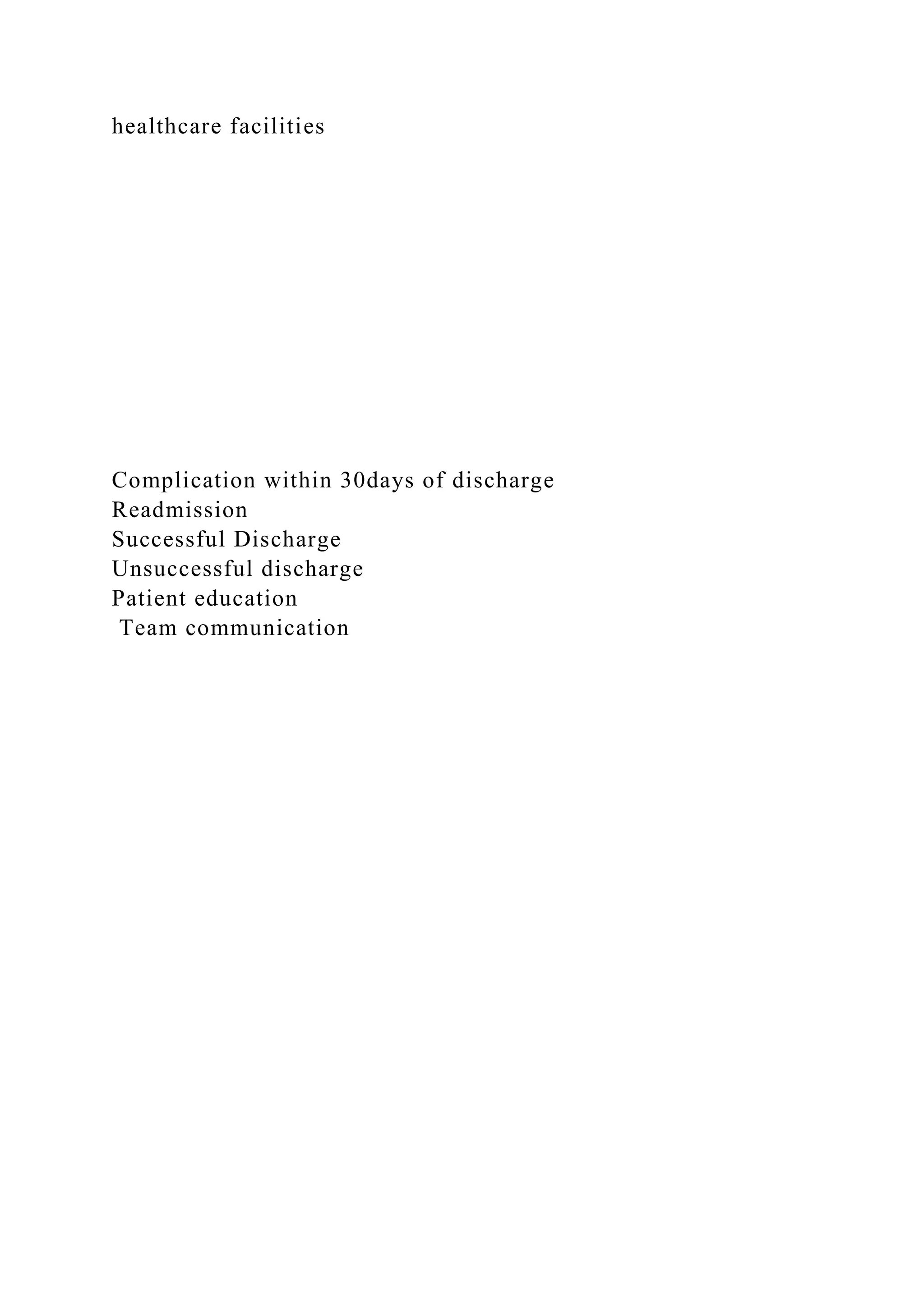
Algorithm or flowchart created
The findings of the research showed that health care
readmission was majorly contributed by the inability to create
discharge processes which are of quality standard, minimal
preparation of patients and families for the discharge, poor
communication and minimum education to he patients in regards
to the essentialness of the treatment approach. Several studies
tend to link the increasing rate of readmission with inadequate
follow up by the primary care providers and other concerned
healthcare facilities
Complication within 30days of discharge
Readmission
Successful Discharge
Unsuccessful discharge
Patient education
Team communication
References
Al-Amin, M. (2016). Hospital characteristics and 30-day all-
cause readmission rates. Journal of Hospital Medicine, 11(10),
682-687. doi:10.1002/jhm.2606
Axon, R. N., & Williams, M. V. (2011). Hospital Readmission
as an Accountability Measure. JAMA, 305(5), 504.
doi:10.1001/jama.2011.72
Ballard-Hernandez, J. (2010). Nurse practitioners improving the
transition from hospital to home and reducing acute care
readmission rates in heart failure patients. Heart & Lung, 39(4),
365-366. doi:10.1016/j.hrtlng.2010.05.031
Bottle, A., Aylin, P., & Bell, D. (2013). Predictors of
Readmission in Heart Failure Patients Vary by Cause of
Readmission: Hospital-Level Cause-Specific Readmission Rates
Show No Correlation. 2013 IEEE International Conference on
Healthcare Informatics. doi:10.1109/ichi.2013.88
Lackey, T. L. (2015). How transitional care can be the answer
to reducing hospital readmission. Heart & Lung, 44(6), 557-558.
doi:10.1016/j.hrtlng.2015.10.035
Implementation
Name
Institutional Affiliation
Implementation
Introduction
Following the financial penalties that are being posted on
health facilities with a high rate of readmission, more health
facilities are being encouraged to develop efforts which will
reduce the rate of hospital readmission. The health facilities are
creating different interventions which tend to involve several
components such as patient education, medication
reconciliation, evaluation of the patient needs as well as
planning for timely follow-up and appointments. The
Affordable Act of 2010 has continued to hold the health
facilities responsible for the rate of readmission, which may be
prevented. The NCAL/AHCA Quality Initiative tends to include
measurable goals of minimizing the 30day hospital readmission
b.y about 15%. This means that the health facilities are under
tight pressure to protect their revenue and still be able to
provide the patients with quality and satisfactory health care
services. In the research conducted it proved that most health
care readmissions tend to occur due to the inability to create
discharge processes which are of quality standard, minimal
preparation of patients and families for the discharge, poor
communication and minimum education to he patients in regards
to the essentialness of the treatment approach. Several studies
tend to link the increasing rate of readmission with inadequate
follow up by the primary care providers and other concerned
healthcare facilities. The answer to resolving this issue tends to
be revolving around predictable steps which may be taken to
improve these measures. Every health facility that wants to
continue providing health care services to the United States
citizens it needs to ensure that it has an approach of minimizing
the rate of hospital readmission. This paper will focus on the
necessary steps that a health facility may use to ensure that it
minimizes the rate of readmission in the future.
Implimenting steps to reduce hospital readmission
1. Tightening the healthcare processes
Most the causes of the preventable readmissions in the
health facilities tend to revolve around issues which are
predictable and may be understood as well as managed, ranging
from the intake process to the discharge process. The healthcare
facility needs to engage its team players to be able to identify as
well as troubleshoot the segments in the health facility that
contribute to readmission (Simorangkir & McGuire, 2017).
Some of the areas that most health facilities need to focus on
are the preadmission process- this tends to be a kind of
readmission that tends to occur because the health facility is not
able to effectively care for the patient. The health facility needs
to focus on this segment to be able to understand the level of
expertise it needs to add in its team to provide quality care. It is
essential for the health facility to train its staff to enable them
to be able to take higher volumes of specialized diagnoses. The
health facility needs to track the outcome and provide a report
to the health facility- this provides evidence that the specialties
are doing their work effectively.
Advance Directives is another approach that the health
facility can tighten its health care processes. This step tends to
have a significant implication because it assists in reducing
questions from the staff, it mitigates the concerns of the family
members, as well as it, prevent hospital readmission by
maintaining resident within your building (Nuckols, 2015). The
health facility needs to work its workforce to ensure and adjust
workflows by collecting advance directives information during
the period of admission to be able to develop adequate
treatment approach for the patient. The health facility needs to
make the collection of advance directives a requirement for
every admission will assist it to be able to create a medication
approach that is much easier to follow to reduce readmission.
Also, it is essential to identify the best storage approach to store
the advance directives of every patient.
Evaluating vendor contracts is another way of tightening
health care processes. A vendor may contribute to the increase
in the rate of readmission if he or she does not deliver the
required medical tools or medicine on the required time
(Nuckols, 2015). Thus every health facility needs to constantly
review the vendor contracts to maintain vendors with a constant
supply and do away with those who do not provide the supplies
on time. Also, it is essential to challenge vendors to tighten
turnaround times for services and make service levels
conditions of contracts. And help prevent readmissions by
speeding needed services that help stabilize patients conditions.
Nurse Skill Assessment is another step that the health
facility may use to tighten the health care process. Generally, in
the current era, patients are not only seeking to be provided
with health services rather they are seeking for servicing, which
satisfy their needs and are of high quality (Nuckols, 2015). It is
essential to constantly evaluate the skills of the nurses in the
health facility to be able to offer them training where necessary.
Evaluation of the skills and qualification will also motivate the
nurse to continue improving their knowledge hence reducing the
rate of readmission.
2. Improving Patient Care
Several readmission in the health facilities may be prevented
following a lower cost intervention, which is often designed to
improve the experience of the patient. The health facility needs
to maintain close monitoring in their patients to identify
changes in the patient's health.
Monitoring of the ADL score is an excellent method of
improving patient care because it tends to track even the minor
changes that may occur in the patient's health status. This
means that a reduction in the ADL scores the health care
facility and the health providers are provided with the heads up
that they need to change on the treatment plan and develop a
medication plan that supports the patient's health (Enos, 2017).
Constant monitoring of the ADL scores can assist the health
facility in minimizing the rate of unnecessary readmissions.
Creation of alerts is another way that a health facility may
improve the care of its patients by developing techniques to
monitor the changes in the patient's condition and follow up
treatment (Enos, 2017). When the patient’ condition is more
critical, the higher the need for health care to pay close
attention to his or her health condition to determine if the
condition is improving or deteriorating.
Managing medication is a critical aspect of ensuring that the
patients’ care is improved. Several pieces of research have
proved that medication adherence reduces the rate of
readmission with about 10- 20%. It is essential for the health
facility administration to concentrate on identify the trends of
refusal of care and also monitor the reasons behind the refusal
trends to be able to develop a treatment approach that the
patient prefers.
Developing an effective discharge planning is another step that
may assist the health facility in improving its patient care as
well as reduce the rate of readmission. The health facility needs
to develop concise instructions which tend to promote
adherence and healing by developing an easy to follow and
apply discharge instructions which include medication, side
effects of the treatment as well as assistive medical devices.
3. Excellent data management
The effort the health facility makes to reduce the rate of
readmission is directly linked to how excellent and effective
they collect the patients’ data. Data collection and management
is an essential segment in ensuring that any health facility can
provide quality care outcome. This step mainly focuses on how
data is captured, used, as well as the leverage care data within
the health care operation (Askren-Gonzalez & Frater, 2012).
Improving the workflow of data capture is the first step to
having excellent data management. When the health facility can
collect more data from the patient, it can have a better image of
the patient’s health. When data is captured more, it provides
room for triggering negative alerts regarding the patient’s
health. It is essential to scrutinize every workflow to tighten up
the time between interaction and documentationThis enables the
health care facility to be able to address issues which trigger a
high rate of readmission.
Patient condition Summary is another step that assists the
health facility in improving its data management (Askren-
Gonzalez & Frater, 2012). This step aids in preventing
unnecessary hospital readmission by focusing on the causative
aspects and developing a consolidated image of the patient’s
health. For instance, the patient may react differently with the
treatment provided, and due to the frequent condition summary,
the health care can identify the issue and change the medication
plan.
Implementing a Quality Assessment, Performance
Initiative (QAPI) allows the health care facility to develop new
policies which enforce quality and management tracking. This
initiative may aid in the reduction of hospital readmission by
Pointing out and fixing the risk areas. QAPI enables health care
to maintain quality care through the use of patient data.
References
Askren-Gonzalez, A., & Frater, J. (2012). Case Management
Programs for Hospital Readmission Prevention. Professional
Case Management, 17(5), 219-226.
doi:10.1097/ncm.0b013e318257347d
Enos, G. (2017). Provider team steps in to reduce payer's
hospital readmission rate. Mental Health Weekly, 27(15), 1-7.
doi:10.1002/mhw.30999
Nuckols, T. K. (2015). County-Level Variation in Readmission
Rates: Implications for the Hospital Readmission Reduction
Program's Potential to Succeed. Health Services
Research, 50(1), 12-19. doi:10.1111/1475-6773.12268
Simorangkir, H., & McGuire, S. J. (2017). Training in
Readmission Reduction in an Indonesian Hospital. Hospital
Topics, 95(2), 40-50. doi:10.1080/00185868.2017.1300477
Results
Name
Institutional Affiliation
Results
Introduction
Health care readmission tends to be the episode when the
patient who had been previously discharged from the health
facility is admitted again within a particular tie interval. The
rates of readmission have been used recently in the health care
services research as a tool that is used to measure the quality of
health care services. The health care readmission rates were
included in the reimbursement decision for the Centers for
Medicare and Medicaid Services as a segment of the patient
protection and affordable care Act of the year 2010, which
focuses on punishing health care systems which have high and
expected rates of readmission through the use of the Hospital
Readmission Reduction Program. Following the introduction of
this penalty, several other programs have been introduced to
minimize the health care readmission rate. Some of the
programs that have been developed are The Community Based
Care Transition Program, Independence At Home Demonstration
Program as well as the Bundled Payments for Care Improvement
initiative. Also, the health care facility and programs tend to
use different time frames to measure the rate of readmission,
and the ordinary time frame used is within 30 days of discharge.
This research paper will how health care readmission may
impact a health facility both negatively when it is high and
decisive when it is low (Al-Amin, 2016). Health care
readmission has contributed to increased cost in health care
provision and a the same time it lowers the quality and patient
satisfaction on the health care services provided to him or her.
Brief introduction to the purpose of the study
The health facility readmission has continued to increase the
cost of health care in the United States. Health care readmission
is often regarded to be an essential tool for measuring the
quality of the health care services that particular health care
services provider. It is not quite easy to measure quality based
on readmission rate of the patient, but it tends to make more
sense that a patient tends to be readmitted because the services
he was provided with were not of high quality hence not being
able to meet his or her health needs(Lackey, 2015). Often
readmission is caused by adverse outcomes from a previous
treatment. The primary purpose of this study is to determine if
the rate of hospital readmission tends to be an accurate measure
of quality in the health sector.
Results
Upon conducting the research, the research team was able
to identify two major factors that contributed to the increase in
the rate of readmission in health care facilities in the United
States. The two main factors that were identified were poor
information use and management and poor communication
pattern.
Poor information use and management
The findings showed that during the period of admission,
information collected tends to be lightly reviewed. Hence the
decision made based on the information attained tends to not
appropriately support the patient's health, which leads to
readmission within 30 days of discharge(Axon & Williams,
2011). It was also noted that upon readmission, the health
providers often reviewed the information critically from the
past patient’s health records to provide the patient with
satisfactory health care service. It was noted that when the
health care providers reviewed the patient’s past medical
record, they were able to develop valid decision in regards to
the improvement of the patient’s health, hence reducing the rate
of readmission. Often health facilities tend to use the previous
information to develop a clinical decision and following on how
the information is used and managed may significantly
determine the diagnosis as well as the treatment approach a
patient is provided with.
During admission, the patient should provide his or her past
medical information to assist the health practitioners being able
to develop accurate clinical decision regarding their health
issues. The health care providers need to create a well-
documented treatment plan to be able to understand what
triggered the readmission and be able to fix the issue(Ballard-
Hernandez, 2010). The health facilities need to use advanced
technology to record the medical activities and the treatment
strategies that they have offered to the patient in order to have
an easier way to develop a follow-up.
Poor communication pattern
Communication plays a significant role in ensuring that a
patient is provided with quality and satisfactory care. For
instance, through effective communication approach standard
coordinating care with multiple settings and providers,
involving the patient and family caregivers in the plan of care
as well as conducting post-discharge follow-up phone calls may
be developed hence minimizing the rate of hospital readmission
which in turn improves the quality of health care and reduces
the health care cost(Bottle, Aylin, & Bell, 2013). Following the
findings on the research conducted, it was noted that the
communication pattern between the health care providers and
health care providers to patients being discharged contributed
significantly to the increase in the rate of rehospitalization.
Most of the patients who participated in the research asserted
that they did not clearly understand how transitional care
worked; hence, they were not able to precisely follow the
doctors prescription.
Most of the patient provided recommendations that the health
care providers should develop a discharge training program
which enlightened the patients on how to take care of
themselves while they are at home to reduce readmission as well
as the health care cost. Also, communication between the health
care providers was found to contribute to the increase in the rate
of readmission majorly(Bottle, Aylin, & Bell, 2013). Some of
the participants of the research who were health care providers
asserted that poor communication pattern was also a great
contributor to misdiagnosis. They asserted that excellent
communication among the work teams greatly impacted the
health outcome because they would be able to discuss the
essential aspects regarding the patient’s health and be able to
develop a strong clinical decision. They asserted despite
understanding the patient's situation from his or her past
medical records, and it was essential for the health care
providers to discuss on the best treatment approach that the
patient would be provided by focusing on quality and satisfying
the needs of the patient.
Discussion
The study aimed at understanding if the rate of
readmissions in a health facility may be used to determine the
type of quality the health facility offers. The findings asserted
that the patient’s past medical record plays a significant role to
determine the clinical decision that is to be made. The health
providers to always review the patient’s past information record
to be able to understand the health status of the patient to avoid
readmission. On the other hand, communication plays a critical
role in the patient’s health provision. Thus, the health care
providers need to come together, and it is through
communication; they can be able to develop an effective
treatment plan. The findings of the research have provided
proof that the rate of readmission in a health care facility may
be used to determine if the health services provided are of high
quality.
Limitations of the Study
Despite including patients and health care providers in the
research, the study mainly focused on the activities that
contribute to the increase of readmission rate and how the
health care providers contributed to these aspects. The research
only focused on asking the patients how they felt readmission
was impacted them.
Study implications and future works
The findings attained from the study created a room for
further investigation on the issue of readmission by focusing on
the behavior as well as thinking among the health providers.
The investigation would assist the researchers in understanding
how the health care provider’s thinking and behavior impact the
patient care decision and the treatment approach.
Conclusion
The results attained from the research showed that poor use and
management of patient information and poor communication
pattern is a major contributor of increased high readmission rate
in the health sector. The finding also asserted that health care
providers tend to become more conservative when they are
found in the situation of patient readmission. Generally, the
findings of the research have provided proof that the rate of
readmission in a health care facility may be used to determine if
the health services provided are of high quality.
References
Al-Amin, M. (2016). Hospital characteristics and 30-day all-
cause readmission rates. Journal of Hospital Medicine, 11(10),
682-687. doi:10.1002/jhm.2606
Axon, R. N., & Williams, M. V. (2011). Hospital Readmission
as an Accountability Measure. JAMA, 305(5), 504.
doi:10.1001/jama.2011.72
Ballard-Hernandez, J. (2010). Nurse practitioners improving the
transition from hospital to home and reducing acute care
readmission rates in heart failure patients. Heart & Lung, 39(4),
365-366. doi:10.1016/j.hrtlng.2010.05.031
Bottle, A., Aylin, P., & Bell, D. (2013). Predictors of
Readmission in Heart Failure Patients Vary by Cause of
Readmission: Hospital-Level Cause-Specific Readmission Rates
Show No Correlation. 2013 IEEE International Conference on
Healthcare Informatics. doi:10.1109/ichi.2013.88
Lackey, T. L. (2015). How transitional care can be the answer
to reducing hospital readmission. Heart & Lung, 44(6), 557-558.
doi:10.1016/j.hrtlng.2015.10.035
Criteria
1.25 Point
1 Point
0.75 Point
0
Participation
Weight 25.00%
100 %
3 Posts
80 %
2 Posts
60 %
1 Post
0 %
0 Posts
Quality of information
Weight 25.00%
100 %
Information is clear and relates to topic
80 %
Information is somewhat clear and might relate to topic
60 %
Information has little relation to topic and is not clearly
displayed
0 %
Information is not clear and it does not relate to topic
Resources
Weight 25.00%
100 %
Provides relevant resources using APA guidelines
80 %
Provides relevant resources without APA guidelines
60 %
Limited on the resources provided with major errors in APA
0 %
Does not provide any resources
Critical Thinking
Weight 25.00%
100 %
Enhances the critical thinking process through premise
reflection
80 %
Enhances the critical thinking process without premise
reflection
60 %
Does enhance the critical thinking process in a very limited
manner
0 %
Does not enhance the critical thinking process
1
The Essentials of Master’s Education in Nursing
March 21, 2011
TABLE OF CONTENTS
Introduction 3
Master’s Education in Nursing and Areas of Practice 5
Context for Nursing Practice 6
Master’s Nursing Education Curriculum 7
The Essentials of Master’s Education in Nursing
I. Background for Practice from Sciences and Humanities 9
II. Organizational and Systems Leadership 11
III. Quality Improvement and Safety 13
IV. Translating and Integrating Scholarship into Practice 15
V. Informatics and Healthcare Technologies 17
VI. Health Policy and Advocacy 20
VII. Interprofessional Collaboration for Improving Patient
and Population Health Outcomes 22
VIII. Clinical Prevention and Population Health for
Improving Health 24
IX. Master’s-Level Nursing Practice 26
Clinical/Practice Learning Expectations for Master’s Programs
29
Summary 31
Glossary 31
2
References 40
Appendix A: Task Force on the Essentials of Master’s
Education in Nursing 49
Appendix B: Participants who attended Stakeholder Meetings 50
Appendix C: Schools of Nursing that Participated in the
Regional Meetings
or Provided Feedback 52
Appendix D: Professional Organizations that Participated in the
Regional
Meetings or Provided Feedback 63
Appendix E: Healthcare Systems that Participated in the
Regional Meetings 64
3
The Essentials of Master’s Education in Nursing
March 21, 2011
The Essentials of Master’s Education in Nursing reflect the
profession’s continuing call for
imagination, transformative thinking, and evolutionary change
in graduate education. The
extraordinary explosion of knowledge, expanding technologies,
increasing diversity, and global
health challenges produce a dynamic environment for nursing
and amplify nursing’s critical
contributions to health care. Master’s education prepares nurses
for flexible leadership and
critical action within complex, changing systems, including
health, educational, and
organizational systems. Master’s education equips nurses with
valuable knowledge and skills to
lead change, promote health, and elevate care in various roles
and settings. Synergy with these
Essentials, current and future healthcare reform legislation, and
the action-oriented
recommendations of the Initiative on the Future of Nursing
(IOM, 2010) highlights the value and
transforming potential of the nursing profession.
These Essentials are core for all master’s programs in nursing
and provide the necessary
curricular elements and framework, regardless of focus, major,
or intended practice setting. These
Essentials delineate the outcomes expected of all graduates of
master’s nursing programs. These
Essentials are not prescriptive directives on the design of
programs. Consistent with the
Baccalaureate and Doctorate of Nursing Practice Essentials, this
document does not address
preparation for specific roles, which may change and emerge
over time. These Essentials also
provide guidance for master’s programs during a time when
preparation for specialty advanced
nursing practice is transitioning to the doctoral level.
Master’s education remains a critical component of the nursing
education trajectory to prepare
nurses who can address the gaps resulting from growing
healthcare needs. Nurses who obtain the
competencies outlined in these Essentials have significant value
for current and emerging roles in
healthcare delivery and design through advanced nursing
knowledge and higher level leadership
skills for improving health outcomes. For some nurses, master’s
education equips them with a
fulfilling lifetime expression of their mastery area. For others,
this core is a graduate foundation
for doctoral education. Each preparation is valued.
Introduction
The dynamic nature of the healthcare delivery system
underscores the need for the
nursing profession to look to the future and anticipate the
healthcare needs for which
nurses must be prepared to address. The complexities of health
and nursing care today
make expanded nursing knowledge a necessity in contemporary
care settings. The
transformation of health care and nursing practice requires a
new conceptualization of
master’s education. Master’s education must prepare the
graduate to:
• Lead change to improve quality outcomes,
4
• Advance a culture of excellence through lifelong learning,
• Build and lead collaborative interprofessional care teams,
• Navigate and integrate care services across the healthcare
system,
• Design innovative nursing practices, and
• Translate evidence into practice.
Graduates of master’s degree programs in nursing are prepared
with broad knowledge
and practice expertise that builds and expands on baccalaureate
or entry-level nursing
practice. This preparation provides graduates with a fuller
understanding of the discipline
of nursing in order to engage in higher level practice and
leadership in a variety of
settings and commit to lifelong learning. For those nurses
seeking a terminal degree, the
highest level of preparation within the discipline, the new
conceptualization for master’s
education will allow for seamless movement into a research or
practice-focused doctoral
program (AACN, 2006, 2010).
The nine Essentials addressed in this document delineate the
knowledge and skills that all
nurses prepared in master’s nursing programs acquire. These
Essentials guide the
preparation of graduates for diverse areas of practice in any
healthcare setting.
• Essential I: Background for Practice from Sciences and
Humanities
o Recognizes that the master’s-prepared nurse integrates
scientific findings
from nursing, biopsychosocial fields, genetics, public health,
quality
improvement, and organizational sciences for the continual
improvement
of nursing care across diverse settings.
• Essential II: Organizational and Systems Leadership
o Recognizes that organizational and systems leadership are
critical to the
promotion of high quality and safe patient care. Leadership
skills are
needed that emphasize ethical and critical decision making,
effective
working relationships, and a systems-perspective.
• Essential III: Quality Improvement and Safety
o Recognizes that a master’s-prepared nurse must be articulate
in the
methods, tools, performance measures, and standards related to
quality, as
well as prepared to apply quality principles within an
organization.
• Essential IV: Translating and Integrating Scholarship into
Practice
o Recognizes that the master’s-prepared nurse applies research
outcomes
within the practice setting, resolves practice problems, works as
a change
agent, and disseminates results.
• Essential V: Informatics and Healthcare Technologies
5
o Recognizes that the master’s-prepared nurse uses patient-care
technologies
to deliver and enhance care and uses communication
technologies to
integrate and coordinate care.
• Essential VI: Health Policy and Advocacy
o Recognizes that the master’s-prepared nurse is able to
intervene at the
system level through the policy development process and to
employ
advocacy strategies to influence health and health care.
• Essential VII: Interprofessional Collaboration for Improving
Patient and
Population Health Outcomes
o Recognizes that the master’s-prepared nurse, as a member and
leader of
interprofessional teams, communicates, collaborates, and
consults with
other health professionals to manage and coordinate care.
• Essential VIII: Clinical Prevention and Population Health for
Improving
Health
o Recognizes that the master’s-prepared nurse applies and
integrates broad,
organizational, client-centered, and culturally appropriate
concepts in the
planning, delivery, management, and evaluation of evidence-
based clinical
prevention and population care and services to individuals,
families, and
aggregates/identified populations.
• Essential IX: Master’s-Level Nursing Practice
o Recognizes that nursing practice, at the master’s level, is
broadly defined
as any form of nursing intervention that influences healthcare
outcomes
for individuals, populations, or systems. Master’s-level nursing
graduates
must have an advanced level of understanding of nursing and
relevant
sciences as well as the ability to integrate this knowledge into
practice. .
Nursing practice interventions include both direct and indirect
care
components.
Master’s Education in Nursing and Areas of Practice
Graduates with a master’s degree in nursing are prepared for a
variety of roles and areas
of practice. Graduates may pursue new and innovative roles that
result from health
reform and changes in an evolving and global healthcare
system. Some graduates will
pursue direct care practice roles in a variety of settings (e.g.,
the Clinical Nurse Leader,
nurse educator). Others may choose indirect care roles or areas
of practice that focus on
aggregate, systems, or have an organizational focus, (e.g.
nursing or health program
management, informatics, public health, or clinical research
coordinator). In addition to
developing competence in the nine Essential core areas
delineated in this document, each
graduate will have additional coursework in an area of practice
or functional role. This
coursework may include more in-depth preparation and
competence in one or two of the
Essentials or in an additional/ supplementary area of practice.
For example, more concentrated coursework or further
development of the knowledge
and skills embedded in Essential IV (Translational Scholarship
for Evidence-Based
Practice) will prepare the nurse to manage research projects for
nurse scientists and other
6
healthcare researchers working in multi-professional research
teams. More in-depth
preparation in Essential II (Organizational and System
Leadership) will provide
knowledge useful for nursing management roles.
In some instances, graduates of master’s in nursing programs
will seek to fill roles as
educators. As outlined in Essential IX, all master’s-prepared
nurses will develop
competence in applying teaching/learning principles in work
with patients and/or students
across the continuum of care in a variety of settings. However,
as recommended in the
Carnegie Foundation report (2009), Educating Nurses: A Call
for Radical
Transformation, those individuals, as do all master’s graduates,
who choose a nurse
educator role require preparation across all nine Essential areas,
including graduate-level
clinical practice content and experiences. In addition, a program
preparing individuals for
a nurse educator role should include preparation in curriculum
design and development,
teaching methodologies, educational needs assessment, and
learner-centered theories and
methods. Master’s prepared nurses may teach patients and their
families and/or student
nurses, staff nurses, and variety of direct-care providers. The
master’s prepared nurse
educator differs from the BSN nurse in depth of his/her
understanding of the nursing
discipline, nursing practice, and the added pedagogical skills.
To teach students, patients,
and caregivers regarding health promotion, disease prevention,
or disease management,
the master’s-prepared nurse educator builds on baccalaureate
knowledge with graduate-
level content in the areas of health assessment,
physiology/pathophysiology, and
pharmacology to strengthen his/her scientific background and
facilitate his/her
understanding of nursing and health-related information. Those
master’s students who
aspire to faculty roles in baccalaureate and higher degree
programs will be advised that
additional education at the doctoral level is needed (AACN,
2008).
Context for Nursing Practice
Health care in the United States and globally is changing
dramatically. Interest in
evolving health care has prompted greater focus on health
promotion and illness
prevention, along with cost-effective approaches to high acuity,
chronic disease
management, care coordination, and long-term care. Public
concerns about cost of health
care, fiscal sustainability, healthcare quality, and development
of sustainable solutions to
healthcare problems are driving reform efforts. Attention to
affordability and accessibility
of health care, maintaining healthy environments, and
promoting personal and
community responsibility for health is growing among the
public and policy makers.
In addition to broad public mandates for a reformed and
responsive healthcare system, a
number of groups are calling for changes in the ways all health
professionals are educated
to meet current and projected needs for contemporary care
delivery. The Institute of
7
Medicine (IOM), an interprofessional healthcare panel,
described a set of core
competencies that all health professionals regardless of
discipline will demonstrate: 1) the
provision of patient-centered care, 2) working in
interprofessional teams, 3) employing
evidence-based practice, 4) applying quality improvement
approaches, and 5) utilizing
informatics (IOM, 2003).
Given the ongoing public trust in nursing (Gallup, 2010), and
the desire for fundamental
reorganization of relationships among individuals, the public,
healthcare organizations
and healthcare professionals, graduate education for nurses is
needed that is wide in
scope and breadth, emphasizes all systems-level care and
includes mastery of practice
knowledge and skills. Such preparation reflects mastery of
higher level thinking and
conceptualization skills than at the baccalaureate level, as well
as an understanding of the
interrelationships among practice, ethical, and legal issues;
financial concerns and
comparative effectiveness; and interprofessional teamwork.
Master’s Nursing Education Curriculum
The master’s nursing curriculum is conceptualized in Figure 1
and includes three
components:
1. Graduate Nursing Core: foundational curriculum content
deemed essential
for all students who pursue a master’s degree in nursing
regardless of the
functional focus.
2. Direct Care Core: essential content to provide direct patient
services at an
advanced level.
3. Functional Area Content: those clinical and didactic learning
experiences
identified and defined by the professional nursing organizations
and
certification bodies for specific nursing roles or functions.
This document delineates the graduate nursing core
competencies for all master’s
graduates. These core outcomes reflect the many changes in the
healthcare system
occurring over the past decade. In addition, these expected
outcomes for all master’s
degree graduates reflect the increasing responsibility of nursing
in addressing many of the
gaps in health care as well as growing patient and population
needs.
Master’s nursing education, as is all nursing education, is
evolving to meet these needs
and to prepare nurses to assume increasing accountabilities,
responsibilities, and
leadership positions. As master’s nursing education is re-
envisioned and preparation of
individuals for advanced specialty nursing practice transitions
to the practice doctorate
these Essentials delineate the foundational, core expectations
for these master’s program
graduates until the transition is completed.
8
Figure 1: Model of Master’s Nursing Curriculum
* All master’s degree programs that prepare graduates for roles
that have a component of
direct care practice are required to have graduate level
content/coursework in the
following three areas: physiology/pathophysiology, health
assessment, and
pharmacology. However, graduates being prepared for any one
of the four APRN roles
(CRNA, CNM, CNS, or CNP), must complete three separate
comprehensive, graduate
level courses that meet the criteria delineated in the 2008
Consensus Model for APRN
Licensure, Accreditation, Certification and Education.
(http://www.aacn.nche.edu/education/pdf/APRNReport.pdf). In
addition, the expected
outcomes for each of these three APRN core courses are
delineated in The Essentials of
Doctoral Education for Advanced Nursing Practice (pg. 23-24)
(http://www.aacn.nche.edu/DNP/pdf/Essentials.pdf).
+ The nursing educator is a direct care role and therefore
requires graduate-level content
in the three Direct Care Core courses. All graduates of a
master’s nursing program must
have supervised practice experiences that are sufficient to
demonstrate mastery of the
Essentials. The term “supervised” is used broadly and can
include precepted experiences
with faculty site visits. These learning experiences may be
accomplished through diverse
teaching methods, including face-to-face or simulated methods.
In addition, development of clinical proficiency is facilitated
through the use of focused
and sustained clinical experiences designed to strengthen
patient care delivery skills, as
9
well as system assessment and intervention skills, which will
lead to an enhanced
understanding of organizational dynamics. These immersion
experiences afford the
student an opportunity to focus on a population of interest or
may focus on a specific
role. Most often, the immersion experience occurs toward the
end of the program as a
culminating synthesis experience.
The Essentials of Master’s Education in Nursing
Essential I: Background for Practice from Sciences and
Humanities
Rationale
Master’s-prepared nurses build on the competencies gained in a
baccalaureate nursing
program by developing a deeper understanding of nursing and
the related sciences needed
to fully analyze, design, implement, and evaluate nursing care.
These nurses are well
prepared to provide care to diverse populations and cohorts of
patients in clinical and
community-based systems. The master’s-prepared nurse
integrates findings from the
sciences and the humanities, biopsychosocial fields, genetics,
public health, quality
improvement, health economics, translational science, and
organizational sciences for the
continual improvement of nursing care at the unit, clinic, home,
or program level.
Master’s-prepared nursing care reflects a more sophisticated
understanding of
assessment, problem identification, design of interventions, and
evaluation of aggregate
outcomes than baccalaureate-prepared nursing care.
Students being prepared for direct care roles will have graduate-
level content that builds
upon an undergraduate foundation in health assessment,
pharmacology, and
pathophysiology. Having master’s-prepared graduates with a
strong background in these
three areas is seen as imperative from the practice perspective.
It is recommended that the
master’s curriculum preparing individuals for direct care roles
include three separate
graduate-level courses in these three content areas. In addition,
the inclusion of these
three separate courses facilitates the transition of these master’s
program graduates into
the DNP advanced-practice registered-nurse programs.
Master’s-prepared nurses understand the intersection between
systems science and
organizational science in order to serve as integrators within
and across systems of care.
Care coordination is based on systems science (Nelson et al.,
2008). Care management
incorporates an understanding of the clinical and community
context, and the research
relevant to the needs of the population. Nurses at this level use
advanced clinical
reasoning for ambiguous and uncertain clinical presentations,
and incorporate concerns of
family, significant others, and communities into the design and
delivery of care.
Master’s-prepared nurses use a variety of theories and
frameworks, including nursing and
ethical theories in the analysis of clinical problems, illness
prevention, and health
promotion strategies. Knowledge from information sciences,
health communication, and
health literacy are used to provide care to multiple populations.
These nurses are able to
10
address complex cultural issues and design care that responds to
the needs of multiple
populations, who may have potentially conflicting cultural
needs and preferences. As
healthcare technology becomes more sophisticated and its use
more widespread,
master’s-prepared nurse are able to evaluate when its use is
appropriate for diagnostic,
educational, and therapeutic interventions. Master’s-prepared
nurses use improvement
science and quality processes to evaluate outcomes of the
aggregate of patients,
community members, or communities under their care, monitor
trends in clinical data,
and understand the implications of trends for changing nursing
care.
The master’s-degree program prepares the graduate to:
1. Integrate nursing and related sciences into the delivery of
advanced nursing care to
diverse populations.
2. Incorporate current and emerging genetic/genomic evidence
in providing advanced
nursing care to individuals, families, and communities while
accounting for patient
values and clinical judgment.
3. Design nursing care for a clinical or community-focused
population based on
biopsychosocial, public health, nursing, and organizational
sciences.
4. Apply ethical analysis and clinical reasoning to assess,
intervene, and evaluate
advanced nursing care delivery.
5. Synthesize evidence for practice to determine appropriate
application of interventions
across diverse populations.
6. Use quality processes and improvement science to evaluate
care and ensure patient
safety for individuals and communities.
7. Integrate organizational science and informatics to make
changes in the care
environment to improve health outcomes.
8. Analyze nursing history to expand thinking and provide a
sense of professional
heritage and identity.
Sample Content
• Healthcare economics and finance models
• Advanced nursing science, including the major streams of
nursing scientific
development
• Scientific bases of illness prevention, health promotion, and
wellness
• Genetics, genomics, and pharmacogenomics
• Public health science, such as basic epidemiology,
surveillance, environmental
science, and population health analysis and program planning
• Organizational sciences
11
• Systems science and integration, including microsystems,
mesosystems, and macro-
level systems
• Chaos theory and complexity science
• Leadership science
• Theories of bioethics
• Information science
• Quality processes and improvement science
• Technology assessment
• Nursing Theories
Essential II: Organizational and Systems Leadership
Rationale
Organizational and systems leadership are critical to the
promotion of high quality and
safe patient care. Leadership skills are needed that emphasize
ethical and critical decision
making. The master’s-prepared nurse’s knowledge and skills in
these areas are consistent
with nursing and healthcare goals to eliminate health disparities
and to promote
excellence in practice. Master’s-level practice includes not only
direct care but also a
focus on the systems that provide care and serve the needs of a
panel of patients, a
defined population, or community.
To be effective, graduates must be able to demonstrate
leadership by initiating and
maintaining effective working relationships using mutually
respectful communication
and collaboration within interprofessional teams, demonstrating
skills in care
coordination, delegation, and initiating conflict resolution
strategies. The master’s-
prepared nurse provides and coordinates comprehensive care for
patients–individuals,
families, groups, and communities–in multiple and varied
settings. Using information
from numerous sources, these nurses navigate the patient
through the healthcare system
and assume accountability for quality outcomes. Skills essential
to leadership include
communication, collaboration, negotiation, delegation, and
coordination.
Master’s-prepared nurses are members and leaders of healthcare
teams that deliver a
variety of services. These graduates bring a unique blend of
knowledge, judgment, skills,
and caring to the team. As a leader and partner with other health
professionals, these
nurses seek collaboration and consultation with other providers
as necessary in the
design, coordination, and evaluation of patient care outcomes.
In an environment with ongoing changes in the organization and
financing of health care,
it is imperative that all master’s-prepared nurses have a keen
understanding of healthcare
policy, organization, and financing. The purpose of this content
is to prepare a graduate
to provide quality cost-effective care; to participate in the
implementation of care; and to
12
assume a leadership role in the management of human, fiscal,
and physical healthcare
resources. Program graduates understand the economies of care,
business principles, and
how to work within and affect change in systems.
The master’s-prepared nurse must be able to analyze the impact
of systems on patient
outcomes, including analyzing error rates. These nurses will be
prepared with knowledge
and expertise in assessing organizations, identifying systems’
issues, and facilitating
organization-wide changes in practice delivery. Master’s-
prepared nurses must be able to
use effective interdisciplinary communication skills to work
across departments
identifying opportunities and designing and testing systems and
programs to improve
care. In addition, nurse practice at this level requires an
understanding of complexity
theory and systems thinking, as well as the business and
financial acumen needed for the
analysis of practice quality and costs.
The master’s-degree program prepares the graduate to:
1. Apply leadership skills and decision making in the provision
of culturally responsive,
high-quality nursing care, healthcare team coordination, and the
oversight and
accountability for care delivery and outcomes.
2. Assume a leadership role in effectively implementing patient
safety and quality
improvement initiatives within the context of the
interprofessional team using effective
communication (scholarly writing, speaking, and group
interaction) skills.
3. Develop an understanding of how healthcare delivery systems
are organized and
financed (and how this affects patient care) and identify the
economic, legal, and political
factors that influence health care.
4. Demonstrate the ability to use complexity science and
systems theory in the design,
delivery, and evaluation of health care.
5. Apply business and economic principles and practices,
including budgeting,
cost/benefit analysis, and marketing, to develop a business plan.
6. Design and implement systems change strategies that improve
the care environment.
7. Participate in the design and implementation of new models
of care delivery and
coordination.
13
Sample Content
• Leadership, including theory, leadership styles, contemporary
approaches, and
strategies (organizing, managing, delegating, supervising,
collaborating, coordinating)
• Data-driven decision-making based on an ethical framework to
promote culturally
responsive, quality patient care in a variety of settings,
including creative and imaginative
strategies in problem solving
• Communication–both interpersonal and organizational–
including elements and
channels, models, and barriers
• Conflict, including conflict resolution, mediation, negotiation,
and managing conflict
• Change theory and social change theories
• Systems theory and complexity science
• Healthcare systems and organizational relationships (e.g.,
finance, organizational
structure, and delivery of care, including
mission/vision/philosophy and values)
• Healthcare finance, including budgeting, cost/benefit analysis,
variance analysis, and
marketing
• Operations research (e.g., queuing theory, supply chain
management, and systems
designs in health care)
• Teams and teamwork, including team leadership, building
effective teams, and
nurturing teams
Essential III: Quality Improvement and Safety
Rationale
Continuous quality improvement involves every level of the
healthcare organization. A
master’s-prepared nurse must be articulate in the methods,
tools, performance measures,
culture of safety principles, and standards related to quality, as
well as prepared to apply
quality principles within an organization to be an effective
leader and change agent.
The Institute of Medicine report (1998) To Err is Human
defined patient safety as
“freedom from accidental injury” and stated that patients should
not be at greater risk for
accidental injury in a hospital or healthcare setting than they are
in their own home.
Improvement in patient safety along with reducing and
ultimately eliminating harm to
patients is fundamental to quality care. Skills are needed that
assist in identifying actual
or potential failures in processes and systems that lead to
breakdowns and errors and then
redesigning processes to make patients safe.
Knowledge and skills in human factors and basic safety design
principles that affect
unsafe practices are essential. Graduates of master’s-level
programs must be able to
analyze systems and work to create a just culture of safety in
which personnel feel
comfortable disclosing errors—including their own—while
maintaining professional
14
accountability. Learning how to evaluate, calculate, and
improve the overall reliability of
processes are core skills needed by master’s-prepared nurses.
Knowledge of both the potential and the actual impact of
national patient safety
resources, initiatives, and regulations and the use of national
benchmarks are required.
Changes in healthcare reimbursement with the introduction of
Medicare’s list of “never
events” and the regulatory push for more transparency on
quality outcomes require
graduates to be able to determine if the outcomes of standards
of practice, performance,
and competence have been met and maintained.
The master’s-prepared nurse provides leadership across the care
continuum in diverse
settings using knowledge regarding high reliability
organizations. These organizations
achieve consistently safe and effective performance records
despite unpredictable
operating environments or intrinsically hazardous endeavors
(Weick, 2001). The
master’s-prepared nurse will be able to monitor, analyze, and
prioritize outcomes that
need to be improved. Using quality improvement and high
reliability organizational
principles, these nurses will be able to quantify the impact of
plans of action.
The master’s-degree program prepares the graduate to:
1. Analyze information about quality initiatives recognizing the
contributions of
individuals and inter-professional healthcare teams to improve
health outcomes across the
continuum of care.
2. Implement evidence-based plans based on trend analysis and
quantify the impact on
quality and safety.
3. Analyze information and design systems to sustain
improvements and promote
transparency using high reliability and just culture principles.
4. Compare and contrast several appropriate quality
improvement models.
5. Promote a professional environment that includes
accountability and high-level
communication skills when involved in peer review, advocacy
for patients and families,
reporting of errors, and professional writing.
6. Contribute to the integration of healthcare services within
systems to affect safety and
quality of care to improve patient outcomes and reduce
fragmentation of care.
7. Direct quality improvement methods to promote culturally
responsive, safe, timely,
effective, efficient, equitable, and patient-centered care.
8. Lead quality improvement initiatives that integrate socio-
cultural factors affecting the
delivery of nursing and healthcare services.
15
Sample Content
• Quality improvement models differentiating structure, process,
and outcome indicators
• Principles of a just culture and relationship to analyzing errors
• Quality improvement methods and tools: Brainstorming,
Fishbone cause and effect
diagram, flow chart, Plan, Do Study, Act (PDSA), Plan, Do,
Check, Act (PDCA),Find,
Organize, Clarify, Understand, Select-Plan, Do, Check, Act
(FOCUS-PDCA), Six Sigma,
Lean
• High-Reliability Organizations (HROs) / High-reliability
techniques
• National patient safety goals and other relevant regulatory
standards (e.g., CMS core
measures, pay for performance indicators, and never events)
• Nurse-sensitive indicators
• Data management (e.g., collection tools, display techniques,
data analysis, trend
analysis, control charts)
•Analysis of errors (e.g., Root Cause Analysis [RCA], Failure
Mode Effects Analysis
[FMEA], serious safety events)
• Communication (e.g., hands-off communication, chain-of-
command, error disclosure)
• Participate in executive patient safety rounds
• Simulation training in a variety of settings (e.g., disasters,
codes, and other high-risk
clinical areas)
• RN fit for duty/impact of fatigue and distractions in care
environment on patient safety
Essential IV: Translating and Integrating Scholarship into
Practice
Rationale
Professional nursing practice at all levels is grounded in the
ethical translation of current
evidence into practice. Fundamentally, nurses need a
questioning/inquiring attitude
toward their practice and the care environment.
The master’s-prepared nurse examines policies and seeks
evidence for every aspect of
practice, thereby translating current evidence and identifying
gaps where evidence is
lacking. These nurses apply research outcomes within the
practice setting, resolve
practice problems (individually or as a member of the
healthcare team), and disseminate
results both within the setting and in wider venues in order to
advance clinical practice.
Changing practice locally, as well as more broadly, demands
that the master’s-prepared
nurse is skilled at challenging current practices, procedures, and
policies. The emerging
sciences referred to as implementation or improvement sciences
are providing evidence
about the processes that are effective when making needed
changes where the change
processes and context are themselves evidence based
(Damschroder et al., 2009; Sobo,
Bowman, & Gifford, 2008; van Achterberg, Schoonhoven, &
Grol, 2008). Master’s-
16
prepared nurses, therefore, must be able to implement change
deemed appropriate given
context and outcome analysis, and to assist others in efforts to
improve outcomes.
Master’s-prepared nurses lead continuous improvement
processes based on translational
research skills. The cyclical processes in which these nurses are
engaged includes
identifying questions needing answers, searching or creating the
evidence for potential
solutions/innovations, evaluating the outcomes, and identifying
additional questions.
Master’s-prepared nurses, when appropriate, lead the healthcare
team in the
implementation of evidence-based practice. These nurses
support staff in lifelong
learning to improve care decisions, serving as a role model and
mentor for evidence-
based decision making. Program graduates must possess the
skills necessary to bring
evidence-based practice to both individual patients for whom
they directly care and to
those patients for whom they are indirectly responsible. Those
skills include knowledge
acquisition and dissemination, working in groups, and change
management.
The master’s-degree program prepares the graduate to:
1. Integrate theory, evidence, clinical judgment, research, and
interprofessional
perspectives using translational processes to improve practice
and associated health
outcomes for patient aggregates.
2. Advocate for the ethical conduct of research and translational
scholarship (with
particular attention to the protection of the patient as a research
participant).
3. Articulate to a variety of audiences the evidence base for
practice decisions, including
the credibility of sources of information and the relevance to
the practice problem
confronted.
4. Participate, leading when appropriate, in collaborative teams
to improve care
outcomes and support policy changes through knowledge
generation, knowledge
dissemination, and planning and evaluating knowledge
implementation.
5. Apply practice guidelines to improve practice and the care
environment.
6. Perform rigorous critique of evidence derived from databases
to generate meaningful
evidence for nursing practice.
Sample Content:
• Research process
• Implementation/Improvement science
• Evidence-based practice:
17
� Clinical decision making
� Critical thinking
� Problem identification
� Outcome measurement
• Translational science:
� Data collection in nursing practice
� Design of databases that generate meaningful evidence for
nursing practice
� Data analysis in practice
� Evidence-based interventions
� Prediction and analysis of outcomes
� Patterns of behavior and outcomes
� Gaps in evidence for practice
� Importance of cultural relevance
• Scholarship:
� Application of research to the clinical setting
� Resolution of clinical problems
� Appreciative inquiry
� Dissemination of results
• Advocacy in research
• Research ethics
• Knowledge acquisition
• Group process
• Management of change
• Evidence-based policy development in practice
• Quality improvement models/methodologies
• Safety issues in practice
• Innovation processes
Essential V: Informatics and Healthcare Technologies
Rationale
Informatics and healthcare technologies encompass five broad
areas:
• Use of patient care and other technologies to deliver and
enhance care;
• Communication technologies to integrate and coordinate care;
• Data management to analyze and improve outcomes of care;
• Health information management for evidence-based care and
health education;
and
18
• Facilitation and use of electronic health records to improve
patient care.
Knowledge and skills in each of these four broad areas is
essential for all master’s-
prepared nurses. The extent and focus of each will vary
depending upon the nurse’s role,
setting, and practice focus.
Knowledge and skills in information and healthcare technology
are critical to the delivery
of quality patient care in a variety of settings (IOM, 2003a).
The use of technologies to
deliver, enhance, and document care is changing rapidly. In
addition, information
technology systems, including decision-support systems, are
essential to gathering
evidence to impact practice. Improvement in cost effectiveness
and safety depend on
evidence-based practice, outcomes research, interprofessional
care coordination, and
electronic health records, all of which involve information
management and technology
(McNeil et al., 2006). As nursing and healthcare practices
evolve to better meet patient
needs, the application of these technologies will change as well.
As the use of technology expands, the master’s-prepared nurse
must have the knowledge
and skills to use current technologies to deliver and coordinate
care across multiple
settings, analyze point of care outcomes, and communicate with
individuals and groups,
including the media, policymakers, other healthcare
professionals, and the public.
Integral to these skills is an attitude of openness to innovation
and continual learning, as
information systems and care technologies are constantly
changing, including their use at
the point of care.
Graduates of master’s-level nursing programs will have
competence to determine the
appropriate use of technologies and integrate current and
emerging technologies into
one’s practice and the practice of others to enhance care
outcomes. In addition, the
master’s-prepared nurse will be able to educate other health
professionals, staff, patients,
and caregivers using current technologies and about the
principles related to the safe and
effective use of care and information technologies.
Graduates ethically manage data, information, knowledge, and
technology to
communicate effectively with healthcare team, patients, and
caregivers to integrate safe
and effective care within and across settings. Master’s-prepared
nurses use research and
clinical evidence to inform practice decisions.
Master’s-degree graduates are prepared to gather, document,
and analyze outcome data
that serve as a foundation for decision making and the
implementation of interventions or
strategies to improve care outcomes. The master’s-prepared
nurse uses statistical and
epidemiological principles to synthesize these data,
information, and knowledge to
evaluate and achieve optimal health outcomes.
The usefulness of electronic health records and other health
information management
systems to evaluate care outcomes is improved by standardized
terminologies. Integration
19
of standardized terminologies in information systems supports
day-to-day nursing
practice and also the capacity to enhance interprofessional
communication and generate
standardized data to continuously evaluate and improve practice
(American Nurses
Association, 2008). Master’s-prepared nurses use information
and communication
technologies to provide guidance and oversight for the
development and implementation
of health education programs, evidence-based policies, and
point-of-care practices by
members of the interdisciplinary care team.
Health information is growing exponentially. Health literacy is
a powerful tool in health
promotion, disease prevention, management of chronic
illnesses, and quality of life–all of
which are hallmarks of excellence in nursing practice. Master’s-
prepared nurses serve as
information managers, patient advocates, and educators by
assisting others(including
patients, students, caregivers and healthcare professionals) in
accessing, understanding,
evaluating, and applying health-related information. The
master’s-prepared nurse designs
and implements education programs for cohorts of patients or
other healthcare providers
using information and communication technologies.
The master’s-degree program prepares the graduate to:
1. Analyze current and emerging technologies to support safe
practice environments,
and to optimize patient safety, cost-effectiveness, and health
outcomes.
2. Evaluate outcome data using current communication
technologies, information
systems, and statistical principles to develop strategies to
reduce risks and improve
health outcomes.
3. Promote policies that incorporate ethical principles and
standards for the use of health
and information technologies.
4. Provide oversight and guidance in the integration of
technologies to document patient
care and improve patient outcomes.
5. Use information and communication technologies, resources,
and principles of
learning to teach patients and others.
6. Use current and emerging technologies in the care
environment to support lifelong
learning for self and others.
Sample Content
• Use of technology, information management systems, and
standardized
terminology
20
• Use of standardized terminologies to document and analyze
nursing care
outcomes
• Bio-health informatics
• Regulatory requirements for electronic data monitoring
systems
• Ethical and legal issues related to the use of information
technology, including
copyright, privacy, and confidentiality issues
• Retrieval information systems, including access, evaluation of
data, and
application of relevant data to patient care
• Statistical principles and analyses of outcome data
• Online review and resources for evidence-based practice
• Use and implementation of technology for virtual care
delivery and monitoring
• Electronic health record, including policies related to the
implementation of and
use to impact care outcomes
• Complementary roles of the master’s-prepared nursing and
information
technology professionals, including nurse informaticist and
quality officer
• Use of technology to analyze data sets and their use to
evaluate patient care
outcomes
• Effective use of educational/instructional technology
• Point-of-care information systems and decision support
systems
Essential VI: Health Policy and Advocacy
Rationale
The healthcare environment is ever-evolving and influenced by
technological, economic,
political, and sociocultural factors locally and globally.
Graduates of master’s degree
nursing programs have requisite knowledge and skills to
promote health, help shape the
health delivery system, and advance values like social justice
through policy processes
and advocacy. Nursing’s call to political activism and policy
advocacy emerges from
many different viewpoints. As more evidence links the broad
psychosocial, economic,
and cultural factors to health status, nurses are compelled to
incorporate these factors into
their approach to care. Most often, policy processes and system-
level strategies yield the
strongest influence on these broad determinants of health. Being
accountable for
improving the quality of healthcare delivery, nurses must
understand the legal and
political determinants of the system and have the requisite skills
to partner for an
improved system. Nurses’ involvement in policy debates brings
our professional values
to bear on the process (Warner, 2003). Master’s-prepared nurses
will use their political
efficacy and competence to improve the health outcomes of
populations and improve the
quality of the healthcare delivery system.
21
Policy shapes healthcare systems, influences social
determinants of health, and therefore
determines accessibility, accountability, and affordability of
health care. Health policy
creates conditions that promote or impede equity in access to
care and health outcomes.
Implementing strategies that address health disparities serves as
a prelude to influencing
policy formation. In order to influence policy, the master’s-
prepared nurse needs to work
within and affect change in systems. To effectively collaborate
with stakeholders, the
master’s-prepared nurse must understand the fiscal context in
which they are practicing
and make the linkages among policy, financing, and access to
quality health care. The
graduate must understand the principles of healthcare
economics, finance, payment
methods, and the relationships between policy and health
economics.
Advocacy for patients, the profession, and health-promoting
policies is operationalized in
divergent ways. Attributes of advocacy include safeguarding
autonomy, promoting social
justice, using ethical principles, and empowering self and others
(Grace, 2001; Hanks,
2007; Xiaoyan & Jezewski, 2006). Giving voice and persuasion
to needs and preferred
direction at the individual, institution, state, or federal policy
level is integral for the
master’s-prepared nurse.
The master’s-degree program prepares the graduate to:
1. Analyze how policies influence the structure and financing of
health care,
practice, and health outcomes.
2. Participate in the development and implementation of
institutional, local, and state
and federal policy.
3. Examine the effect of legal and regulatory processes on
nursing practice,
healthcare delivery, and outcomes.
4. Interpret research, bringing the nursing perspective, for
policy makers and
stakeholders.
5. Advocate for policies that improve the health of the public
and the profession of
nursing.
Sample Content
• Policy process: development, implementation, and evaluation
• Structure of healthcare delivery systems
• Theories and models of policy making
• Policy making environments: values, economies, politics,
social
• Policy-making process at various levels of government
• Ethical and value-based frameworks guiding policy making
22
• General principles of microeconomics and macroeconomics,
accounting, and
marketing strategies.
• Globalization and global health
• Interaction between regulatory processes and quality control
• Health disparities
• Social justice
• Political activism
• Economics of health care
Essential VII: Interprofessional Collaboration for Improving
Patient and
Population Health Outcomes
Rationale
In a redesigned health system a greater emphasis will be placed
on cooperation,
communication, and collaboration among all health
professionals in order to integrate
care in teams and ensure that care is continuous and reliable.
Therefore, an expert panel
at the Institute of Medicine (IOM) identified working in
interdisciplinary teams as one of
the five core competencies for all health professionals (IOM,
2003).
Interprofessional collaboration is critical for achieving clinical
prevention and health
promotion goals in order to improve patient and population
health outcomes (APTR,
2008; 2009). Interprofessional practice is critical for improving
patient care outcomes
and, therefore, a key component of health professional
education and lifelong learning
(American Association of Colleges of Nursing & the
Association of American Medical
Colleges, 2010).
The IOM also recognized the need for care providers to
demonstrate a greater awareness
to “patient values, preferences, and cultural values,” consistent
with the Healthy People
2010 goal of achieving health equity through interprofessional
approaches (USHHS,
2000). In this context, knowledge of broad determinants of
health will enable the
master’s graduate to succeed as a patient advocate, cultural and
systems broker, and to
lead and coordinate interprofessional teams across care
environments in order to reduce
barriers, facilitate access to care, and improve health outcomes.
Successfully leading
these teams is achieved through skill development and
demonstrating effective
communication, planning, and implementation of care directly
with other healthcare
professionals (AACN, 2007).
Improving patient and population health outcomes is contingent
on both horizontal and
vertical health delivery systems that integrate research and
clinical expertise to provide
patient-centered care. Inherently the systems must include
patients’ expressed values,
needs, and preferences for shared decision making and
management of their care. As
23
members and leaders of interprofessional teams, the master’s-
prepared nurse will actively
communicate, collaborate, and consult with other health
professionals to manage and
coordinate care across systems.
The master’s-degree program prepares the graduate to:
1. Advocate for the value and role of the professional nurse as
member and leader of
interprofessional healthcare teams.
2. Understand other health professions’ scopes of practice to
maximize contributions
within the healthcare team.
3. Employ collaborative strategies in the design, coordination,
and evaluation of
patient-centered care.
4. Use effective communication strategies to develop,
participate, and lead
interprofessional teams and partnerships.
5. Mentor and coach new and experienced nurses and other
members of the
healthcare team.
6. Functions as an effective group leader or member based on an
in-depth
understanding of team dynamics and group processes.
Sample Content
• Scopes of practice for nursing and other professions
• Differing world views among healthcare team members
• Concepts of communication, collaboration, and coordination
• Conflict management strategies and principles of negotiation
• Organizational processes to enhance communication
• Types of teams and team roles
• Stages of team development
• Diversity of teams
• Cultural diversity
• Patient-centered care
• Change theories
• Multiple-intelligence theory
• Group dynamics
• Power structures
• Health-work environments
24
Essential VIII: Clinical Prevention and Population Health for
Improving Health
Rationale
Globally, the burden of illness, communicable disease, chronic
disease conditions, and
subsequent health inequity and disparity, is borne by those
living in poverty and living in
low-income and middle-income countries (Beaglehole et al.,
2007; Gaziano et al., 2007;
WHO, 2008). Similarly, in the U.S. population, health
disparities continue to affect
disproportionately low-income communities, people of color,
and other vulnerable
populations (USHHS, 2006).
The implementation of clinical prevention and population health
activities is central to
achieving the national goal of improving the health status of the
population of the United
States. Unhealthy lifestyle behaviors continue to account for
over 50 percent of
preventable deaths in the U.S., yet prevention interventions
remain under-utilized in
healthcare settings. In an effort to address this national goal,
Healthy People 2010
supported the transformation of clinical education by creating
an objective to increase the
proportion of schools of medicine, nursing, and other health
professionals that have a
basic curriculum that includes the core competencies in health
promotion and disease
prevention (Allan et al., 2004; USHHS, 2000). In the Healthy
People 2010 Midcourse
Review, health disparities are not declining overall, reiterating
the necessity to implement
and evaluate the effectiveness of disease prevention and health
promotion efforts
(USHHS, 2006). Cognizant of these trends and successive
health outcome data, it will be
necessary to re-evaluate these data and for nursing to re-assess
its leadership role and
responsibility toward improving the population’s health.
The Healthy People Curriculum Task Force developed the
Clinical Prevention and
Population Health Curriculum Framework, which identifies four
focal areas, including
individual and population-oriented preventive interventions.
This curriculum guides the
development and evaluation of educational competencies
expected of health
professionals in clinical prevention and population health, and
endorsed by clinical
professional associations, including AACN (Allan, 2004; APTR,
2009).
As the diversity of the U.S. population increases, it is crucial
that the health system
provides care and services that are equitable and responsive to
the unique cultural and
ethnic identity, socio-economic condition, emotional and
spiritual needs, and values of
patients and the population (IOM, 2001; 2003). Nursing
leadership within health systems
is required to design and ensure the delivery of clinical
prevention interventions and
population-based care that promotes health, reduces the risk of
chronic illness, and
prevents disease. Acquiring the skills and knowledge necessary
to meet this demand is
essential for nursing practice (Allan et al., 2004; Allan et al.,
2005).
25
The master’s-prepared nurse applies and integrates broad,
organizational, patient-
centered, and culturally responsive concepts into daily practice.
Mastery of these
concepts based on a variety of theories is essential in the design
and delivery (planning,
management, and evaluation) of evidence-based clinical
prevention and population care
and services to individuals, families, communities, and
aggregates/clinical populations
nationally and globally.
The master’s-degree program prepares the graduate to:
1. Synthesize broad ecological, global and social determinants
of health; principles
of genetics and genomics; and epidemiologic data to design and
deliver evidence-
based, culturally relevant clinical prevention interventions and
strategies.
2. Evaluate the effectiveness of clinical prevention
interventions that affect
individual and population-based health outcomes using health
information
technology and data sources.
3. Design patient-centered and culturally responsive strategies
in the delivery of
clinical prevention and health promotion interventions and/or
services to
individuals, families, communities, and aggregates/clinical
populations.
4. Advance equitable and efficient prevention services, and
promote effective
population-based health policy through the application of
nursing science and
other scientific concepts.
5. Integrate clinical prevention and population health concepts
in the development of
culturally relevant and linguistically appropriate health
education, communication
strategies, and interventions.
Sample Content
• Environmental health
• Epidemiology
• Biostatistical methods and analysis
• Disaster preparedness and management
• Emerging science of complementary and alternative medicine
and therapeutics
• Ecological model of the social determinants of health
• Teaching and learning theories
• Health disparities, equity and social justice
• Program planning, design, and evaluation
• Quality improvement and change management
• Health promotion and disease prevention
• Application of health behavior modification
• Health services financing
• Health information management
26
• Ethical frameworks
• Interprofessional collaboration
• Theories and applications of health literacy and health
communication
• Genetics/genomic risk assessment for vulnerable populations
• Organization of clinical, public health, and global systems
• Frameworks for community and political engagement,
advocacy, and
empowerment
• Frameworks for addressing global health and emerging health
issues
• Nursing Theories
Essential IX: Master’s-Level Nursing Practice
Rationale
Essential IX describes master’s-level nursing practice at the
completion of the master’s
program in nursing. Nursing practice at the master’s level is
broadly defined as any form
of nursing intervention that influences healthcare outcomes for
individuals, populations,
or systems. Master’s-level nursing graduates must have an
expanded level of
understanding of nursing and related sciences built on the
Essentials of Baccalaureate
Education for Professional Nursing Practice. Master’s-prepared
nurses have developed a
deeper understanding of the nursing profession based on
reflective practices and continue
to develop their own plans for lifelong learning and professional
development.
Nursing-practice interventions include both direct and indirect
care components. As a
practice discipline, clinical care is the core business of nursing
practice whether the
graduate is focused on the provision of care to individuals,
population-focused care,
administration, informatics, education or health policy. Master’s
nursing education
prepares graduates to implement safe, quality care in a variety
of settings and roles.
This Essential includes the practice-focused outcomes for all
master’s-prepared nurses.
Master’s level nursing practice builds upon the practice
competencies delineated in the
Essentials of Baccalaureate Education for Professional Nursing
Practice (AACN, 2008).
Master’s-prepared nurses possess a mastery level of
understanding of nursing theory,
science and practice. Recent and evolving trends in health care
require integration of key
concepts into all master’s-prepared nursing practice. This
includes concepts related to
quality improvement, patient safety, economics of health care,
environmental science,
epidemiology, genetics/genomics, gerontology, global
healthcare environment and
perspectives, health policy, informatics, organizations and
systems, communication,
negotiation, advocacy, and interprofessional practice.
Master’s nursing education prepares graduates to influence the
delivery of safe, quality
care to diverse populations in a variety of settings and roles.
The realities of a global
society, expanding technologies, and an increasingly diverse
population require these
27
nurses to master complex information, to coordinate a variety of
care experiences, to use
technology for healthcare information and evaluation of nursing
outcomes, and to assist
diverse patients with managing an increasingly complex system
of care. The master’s-
prepared nurse is accountable for assessing the impact of
research and advocates for
participants, personnel, and systems integrity. As master’s-
prepared nurses practicing in
any setting or role, graduates must understand the foundations
of care and the art and
science of nursing practice as it relates to individuals, families,
and clinical populations
within an increasingly complex healthcare system. The
extraordinary explosion of
knowledge in the field also requires an increased emphasis on
lifelong learning.
Essential IX specifies the foundational practice competencies
that cut across all areas of
practice and are seen as requisite for all master’s level nursing
practice. Master’s-degree
nursing programs provide learning experiences that are based in
a variety of settings.
These learning experiences will be integrated throughout the
master’s program of study,
to provide additional practice experiences beyond those
acquired in a baccalaureate or
entry-level nursing program.
The master’s-degree program prepares the graduate to:
1. Conduct a comprehensive and systematic assessment as a
foundation for decision
making.
2. Apply the best available evidence from nursing and other
sciences as the
foundation for practice.
3. Advocate for patients, families, caregivers, communities and
members of the
healthcare team.
4. Use information and communication technologies to
advance patient education,
enhance accessibility of care, analyze practice patterns, and
improve health care
outcomes, including nurse sensitive outcomes.
5. Use leadership skills to teach, coach, and mentor other
members of the healthcare
team.
6. Use epidemiological, social, and environmental data in
drawing inferences
regarding the health status of patient populations and
interventions to promote and
preserve health and healthy lifestyles.
7. Use knowledge of illness and disease management to
provide evidence-based care
to populations, perform risk assessments, and design plans or
programs of care.
8. Incorporate core scientific and ethical principles in
identifying potential and
actual ethical issues arising from practice, including the use of
technologies, and
in assisting patients and other healthcare providers to address
such issues.
28
9. Apply advanced knowledge of the effects of global
environmental, individual and
population characteristics to the design, implementation, and
evaluation of care.
10. Employ knowledge and skills in economics, business
principles, and systems in
the design, delivery, and evaluation of care.
11. Apply theories and evidence-based knowledge in leading, as
appropriate, the
healthcare team to design, coordinate, and evaluate the delivery
of care.
12. Apply learning, and teaching principles to the design,
implementation, and
evaluation of health education programs for individuals or
groups in a variety of
settings.
13. Establish therapeutic relationships to negotiate patient-
centered, culturally
appropriate, evidence-based goals and modalities of care.
14. Design strategies that promote lifelong learning of self and
peers and that
incorporate professional nursing standards and accountability
for practice.
15. Integrate an evolving personal philosophy of nursing and
healthcare into one’s
nursing practice.
Sample Content
• Principles of leadership, including horizontal and vertical
leadership
• Effective use of self
• Advocacy for patients, families, and the discipline
• Conceptual analysis of the master’s-prepared nurse’s role(s)
• Principles of lateral integration of care
• Clinical Outcomes Management, including the measurement
and analysis of patient
outcomes
• Epidemiology
• Biostatistics
• Health promotion and disease reduction/ prevention
management for patients and
clinical populations
• Risk assessment
• Health literacy
• Principles of mentoring, coaching and counseling
• Principles of adult learning
• Evidence-based practice:
o Clinical decision making and judgment
o Critical thinking
o Problem Identification
o Outcome measurement
29
• Care environment management
• Team coordination, including delegation, coaching,
interdisciplinary care, group
process
• Negotiation, understanding group dynamics, conflict
resolution
• Healthcare reimbursement and reform and how it impacts
practice
• Resource allocation
• Use of healthcare technologies to improve patient care
delivery and outcomes
• Healthcare finance and socioeconomic principles
• Principles of quality management/risk reduction/patient safety
• Informatics principles and use of standardized language to
document care and
outcomes of care
• Educational strategies
• Learning styles
• Cultural competence/awareness
• Global health care environment, international law, geopolitics,
and geo-economics
• Nursing and other scientific theories
• Appreciative inquiry
• Reflective practices
Clinical/Practice Learning Expectations for Master’s Programs
All graduates of a master’s nursing program must have
supervised clinical experiences,
which are sufficient to demonstrate mastery of the Essentials.
The term “supervised” is
used broadly and can include precepted experiences with faculty
site visits. These
learning experiences may be accomplished through diverse
teaching methodologies,
including face-to-face and simulated means. The primary goals
of clinical learning
experiences are the opportunities to:
• Lead change to improve quality care outcomes,
• Advance a culture of excellence through lifelong learning
• Build and lead collaborative interprofessional care teams,
• Navigate and integrate care services across the healthcare
system,
• Design innovative nursing practices, and
• Translate evidence into practice.
Mastery in nursing practice is acquired by the student through a
series of applied learning
experiences designed to allow the learner to integrate cognitive
learning with the
30
affective and psychomotor domains of nursing practice. The
clinical/practice experiences
allow the learner to experiment and acquire competence with
new knowledge and skills.
These experiences provide the opportunity for delivery of
services or programs of wide
diversity and focus and may occur in multiple settings including
hospitals, community
settings, public health departments, primary care practice
offices, integrated health care
systems, and an array of other settings.
The clinical experience is an opportunity to integrate didactic
learning, promote
innovative thinking, and test new potential solutions to
clinical/practice or system issues.
Therefore, the development of new skills and practice
expectations can be facilitated
through the use of creative learning opportunities in diverse
settings. These learning
opportunities may include experiences in business, industries,
and with disciplines that
are recognized as innovators in safety, quality, finance,
management, or technology.
Through these experiences, the student may develop an
appreciation and use the wisdom
from other industries and disciplines in nursing practice that
can occur through
application of knowledge or evidence developed in other
industries.
These learning experiences also can occur using simulation
designed as a mechanism for
verifying early mastery of new levels of practice or designed to
create access to data or
health care situations that are not readily accessible to the
student. These experiences may
include simulated mass casualty events, simulated database
problems, simulated
interpersonal communication scenarios, and other new emerging
learning technologies.
The simulation is an adjunct to the learning that will occur with
direct human interface or
human experience learning.
Development of mastery also is facilitated through the use of
focused and sustained
clinical experiences, which provide the learner with the
opportunity to master the patient
care delivery skills as well as the system assessment and
intervention skills which require
an understanding of organizational dynamics. These immersion
experiences afford the
student an opportunity to focus on a population of interest and a
specific role. Most often,
the immersion experience occurs toward the end of the program
as a culminating
synthesis experience for the program. In some instances, the
master’s student may engage
in a clinical experience at the student’s employing agency. This
arrangement requires a
systematic assessment of that setting’s ability to allow the
student to engage in new
practice activities, framed by the learning objectives of the
program, and overseen or
supervised by a mentor/preceptor or faculty member. This type
of learning experience
will be designed to assist the learner to acquire master’s-degree
nursing knowledge and
practice master’s-degree roles.
Supervised clinical experiences will be verified and
documented. One example of such
documentation is the use of a professional portfolio. This
portfolio may also provide a
31
foundation or template for the graduate’s future professional
career trajectory and
experiences.
Summary
The Essentials of Master’s Education in Nursing serves to
transform nursing education
and is critical to the innovations needed in health care. Due to
the ever-changing and
complex healthcare environment, this document emphasizes that
the master’s-prepared
nurse will be able to: 1) lead change for quality care outcomes;
2) advance a culture of
excellence through lifelong learning; 3) build and lead
collaborative interprofessional
care teams; 4) navigate and integrate care services across the
healthcare system; 5) design
innovative nursing practices; and 6) translate evidence into
practice. Master’s degree
nursing programs prepare graduates with enhanced nursing
knowledge and skills to
address the evolving needs of the healthcare system.
Essentials I-IX delineate the outcomes expected of graduates of
master’s nursing
programs. Achievement of these outcomes will enable graduates
to lead and practice in
complex healthcare systems in a variety of direct and/or indirect
care roles. The breadth
of knowledge, the extent of experiential learning, and therefore
the time needed to
accomplish each Essential will vary, and each Essential does
not require a separate course
for achievement of the outcomes.
Clinical experiences in master’s programs are opportunities to
integrate didactic learning,
promote innovative thinking and test new potential solutions to
clinical/practice or
system issues. Therefore, the development of new skills and
practice expectations can be
facilitated through the use of creative learning opportunities in
diverse settings. In
addition, the extraordinary explosion of knowledge in the
healthcare field requires the
master’s-prepared nurse to have an increased emphasis on
lifelong learning and
professional development.
Glossary
Administration: Administration comprises working with and
through others to achieve
the mission, values, and vision of an organization.
Administration is an executive
function within an organization and has ultimate accountability
for defining and
achieving the organization’s strategic plan. Administration
designates responsibility for
implementing organizational goals. (Council on Graduate
Education for Administration
in Nursing, 2010)
Advanced Nursing Practice: Any form of nursing intervention
that influences health care
outcomes for individuals or populations, including the direct
care of individual patients,
32
management of care for individuals and populations,
administration of nursing and health
care organizations, and the development and implementation of
health policy (AACN,
2004).
Advanced Practice Registered Nurse (APRN): a nurse:
1. who has completed an accredited graduate-level education
program preparing him/her
for one of the four recognized APRN roles;
2. who has passed a national certification examination that
measures APRN, role and
population-focused competencies and who maintains continued
competence as evidenced
by recertification in the role and population through the national
certification program;
3. who has acquired advanced clinical knowledge and skills
preparing him/her to provide
direct care to patients, as well as a component of indirect care;
however, the defining
factor for all APRNs is that a significant component of the
education and practice focuses
on direct care of individuals;
4. whose practice builds on the competencies of registered
nurses (RNs) by
demonstrating a greater depth and breadth of knowledge, a
greater synthesis of data,
increased complexity of skills and interventions, and greater
role autonomy;
5. who is educationally prepared to assume responsibility and
accountability for health
promotion and/or maintenance as well as the assessment,
diagnosis, and management of
patient problems, which includes the use and prescription of
pharmacologic and non-
pharmacologic interventions;
6. who has clinical experience of sufficient depth and breadth to
reflect the intended
license; and
7. who has obtained a license to practice as an APRN in one of
the four APRN roles:
certified registered nurse anesthetist (CRNA), certified nurse-
midwife (CNM), clinical
nurse specialist (CNS), or certified nurse practitioner (CNP).
(APRN Consensus Model, 2008)
Advocacy: Defending or maintaining a cause or proposal on
behalf of the patient, client,
or profession to achieve societal or other goals
(Interprofessional Professionalism
Collaborative, 2008)
Aggregate(s): A community or a group of individuals defined by
shared characteristics
such as, age, culture, diagnosis, gender, geography, or values
(adapted from Allan et al.,
2004).
Altruism: A concern for the welfare and well being of others. In
professional practice,
altruism is reflected by the nurse’s concern and advocacy for
the welfare of patients,
other nurses, and other healthcare providers (American
Association of Colleges of
Nursing, 2008, p. 27).
Autonomy: The right to self-determination. Professional
practice reflects autonomy when
the nurse respects patients’ rights to make decisions about their
health care (AACN,
2008, p. 27).
33
Care Coordination: Ensures patients receive well-coordinated
care across all healthcare
organizations, settings, and levels of care (National Priorities
Partnership, 2008).
Clinical Practice: The care of individuals or families,
irrespective of setting.
Clinical Prevention: Health promotion and risk reduction/illness
prevention for
individuals, families, aggregates, or clinical populations (Allan
et al, 2004).
Clinical Preventive Services: Screening, vaccination,
counseling, or other preventive
service delivered to one patient at a time by a healthcare
practitioner in an office, clinic,
healthcare system, or other practice environment (adapted from
Centers for Disease
Control and Prevention, 2009). See also Community Preventive
Services.
Community Preventive Services: Interventions that provide or
increase the provision of
preventive services such as screening, education, counseling, or
other programs to groups
of people, in community settings, healthcare systems, or other
practice environments
(adapted from Centers for Disease Control and Prevention,
2009). See also Clinical
Preventive Services.
Culturally Responsive: Culturally responsive refers to being
cognizant of patients’
norms, beliefs, language, and behaviors that not only shape the
meaning of their health
but also their health-seeking and health-related behaviors. The
constructs reinforce the
idea that each practitioner should be engaged continuously in
self reflection about their
own personal beliefs, norms, behaviors and language and how
together they guide their
perceptions, beliefs, and interactions with patients. The
culturally responsive practitioner
focuses on the importance of building upon each patient’s
personal strengths as well as
available resource and supports which provide the foundational
underpinning of these
respective strengths. The culturally responsive practitioner also
engages in a dynamic,
respectful, and reciprocal dialogue with each person
irrespective of their race, ethnicity,
gender, social position, sexual orientation, immigration status,
and educational level
(Ring et al, 2009).
Delivery: The planning, management, and evaluation of
evidence-based practice and
clinical care across healthcare settings.
Direct Care/ Indirect Care:
Direct care refers to nursing care provided to individuals or
families that is intended to
achieve specific health goals or achieve selected health
outcomes. Direct care may be
provided in a wide range of settings, including acute and critical
care, long term care,
home health, community-based settings, and educational
settings (AACN, 2004, 2006;
Suby, 2009; Upenieks, Akhavan, Kotlerman et al., 2007).
34
Indirect care refers to nursing decisions, actions, or
interventions that are provided
through or on behalf of individuals, families, or groups. These
decisions or interventions
create the conditions under which nursing care or self care may
occur. Nurses might use
administrative decisions, population or aggregate health
planning, or policy development
to affect health outcomes in this way. Nurses who function in
administrative capacities
are responsible for direct care provided by other nurses. Their
administrative decisions
create the conditions under which direct care is provided. Public
health nurses organize
care for populations or aggregates to create the conditions under
which care and
improved health outcomes are more likely. Health policies
create broad scale conditions
for delivery of nursing and health care (AACN, 2004, 2006;
Suby, 2009; Upenieks,
Akhavan, Kotlerman et al., 2007).
Diverse populations: Diversity is an all-inclusive concept, and
includes differences in
race, color, ethnicity, national origin, immigration status
(refugee, sojourner, immigrant,
or undocumented), religion, age, gender, gender identity, sexual
orientation,
ability/disability, political beliefs, social and economic status,
education, occupation,
spirituality, marital and parental status, urban versus rural
residence, enclave identity, and
other attributes of groups of people in society (Giger et al.,
2007; Purnell & Paulanka,
2008).
Ethics: The rules or principles that govern right conduct (Kozier
& Erb, 2007).
Evidenced-based Practice: The integration of best research
evidence, clinical research,
and patient values in making decisions about the care of
individual patients (IOM, 2003).
Genetics: Study of individual genes and their impact on
relatively rare single-gene
disorders (Guttmacher & Collins, 2002).
Genomics: Study of all the genes in the human genome together,
including their
interactions with each other, the environment, and the influence
of other psychosocial and
cultural factors (Guttmacher & Collins, 2002).
Health Disparities: Health disparities are differences in the
incidence, prevalence,
mortality, and burden of disease and other adverse health
conditions that exist among
specific population groups in the United States (National
Institutes of Health, 2002-
2006). The definition of health disparities assumes not only a
difference in health but a
difference in which disadvantaged social groups—who have
persistently experienced
social disadvantage or discrimination—systematically
experience worse health or greater
health risks than more advantaged social groups (Braveman,
2006). Consideration of who
is considered to be within a health disparity population has
policy and resource
implications (American Association of Colleges of Nursing,
2009).
35
Health Education Programs: Any program designed to educate
individuals, families,
groups, communities, health professionals to improve health
outcomes.
Health Equity: A basic principle that all people have a right to
health. Health equity
concerns those differences in population health that can be
traced to unequal economic
and social conditions and are systemic and avoidable and thus
inherently unjust and
unfair (Brennan, Baker, & Meltzer, 2008).
Health Literacy: The degree to which individuals have the
capacity to obtain, process,
and understand basic health information and services needed to
make appropriate health
decisions (U.S. Department of Health and Human Services,
2000b).
High-Reliability Organizations (HRO): Organizations or
systems that operate in
hazardous conditions but have fewer than their fair share of
adverse events (Weick, 2001;
Reason, 2001). Commonly discussed examples include air
traffic control systems,
nuclear power plants, and naval aircraft carriers (LaPorte, 1988;
Roberts, 1990). It is
worth noting that, in the patient safety literature, HROs are
considered to operate with
nearly failure-free performance records, not simply better than
average ones. These
organizations achieve consistently safe and effective
performance records despite
unpredictable operating environments or intrinsically hazardous
endeavors. Some
common features of HROs include:
• Preoccupation with failure—the acknowledgment of the high-
risk, error-prone
nature of an organization’s activities and the determination to
achieve consistently
safe operations.
• Commitment to resilience—the development of capacities to
detect unexpected
threats and contain them before they cause harm, or bounce
back when they do.
• Sensitivity to operations—an attentiveness to the issues facing
workers at the
frontline. This feature comes into play when conducting
analyses of specific
events but also in connection with organizational decision
making. Management
units at the frontline are given some autonomy in identifying
and responding to
threats, rather than adopting a rigid top-down approach.
• A culture of safety—the atmosphere in which individuals feel
comfortable
drawing attention to potential hazards or actual failures without
fear of censure
from management (Agency for Healthcare Research and
Quality, 2009).
Horizontal and Vertical Health Delivery Systems: Health
systems are comprised of a
“horizontal system” focused on integrated resource sharing
health services, providing
prevention and care for prevailing health problems, and of
“vertical systems” focused on
disease specific interventions for specific health conditions
(World Health Organization,
2010).
Human Dignity: Respect for the inherent worth and uniqueness
of individuals and
populations. In professional practice, concern for human dignity
is reflected when the
36
nurse values and respects all patients and colleagues (American
Association of Colleges
of Nursing, 2008, p. 28).
Informatics: The use of information and technology to
communicate, manage
knowledge, mitigate error, and support decision making
(Quality and Safety Education
for Nurses, 2010).
Integrity: Acting in accordance with an appropriate code of
ethics and accepted standards
of practice. Integrity is reflected in professional practice when
the nurse is honest and
provides care based on an ethical framework that is accepted
within the profession
(AACN, 2008, p. 28).
Interprofessional: Working across healthcare professions to
cooperate, collaborate,
communicate, and integrate care in teams to ensure that care is
continuous and reliable.
The team consists of the patient, the nurse, and other healthcare
providers as appropriate
(IOM, 2003)
Just Culture: This phrase was popularized in the patient safety
lexicon by a report
(Marx, 2001) that outlined principles for achieving a culture in
which frontline personnel
are comfortable disclosing errors—including their own—while
maintaining professional
accountability. The examples in the report relate to transfusion
safety, but the principles
clearly generalize across domains within health care
organizations.
Traditionally, healthcare’s culture has held individuals
accountable for all errors or
mishaps that befall patients under their care. By contrast, a just
culture recognizes that
individual practitioners should not be held accountable for
system failings over which
they have no control. A just culture also recognizes many
individual or “active” errors
represent predictable interactions between human operators and
the systems in which
they work. However, in contrast to a culture that touts “no
blame” as its governing
principle, a just culture does not tolerate conscious disregard of
clear risks to patients or
gross misconduct.
In summary, a just culture recognizes that competent
professionals make mistakes and
acknowledges that even competent professionals will develop
unhealthy norms but has
zero tolerance for reckless behavior (Agency for Healthcare
Research and Quality, 2009).
Leadership: Leadership is the process of influencing others
toward the attainment of one
or more goals. Leadership comprises two types: formal and
informal. Formal leadership
occurs through official titular designations within an
organization or society. Informal
leadership occurs when the perceptions and actions of others are
influenced by
individuals without such official organizational or societal
designations. Leadership is not
limited to the accomplishment of organizational goals (Council
on Graduate Education
for Administration in Nursing, 2010).
37
Liberal Education: A comprehensive sets of aims and outcomes
that are essential both
for a globally engaged democracy and for a dynamic,
innovation-fueled economy
(American Association of Colleges &Universities, 2007).
Management: Management is the process of aligning resources
with needs to attain
specific goals. Management includes planning, organizing,
motivating, monitoring, and
evaluating human and material resources. Although management
usually refers to a mid-
level formal leadership function within an organization, it is
also the process used at any
level to align and allocate resources (Council on Graduate
Education for Administration
in Nursing, 2010).
Metaparadigm: Represents the worldview of a discipline (the
most global perspective
that subsumes more specific views and approaches to the central
concepts with which it is
concerned). There is considerable agreement that nursing's
metaparadigm consists of the
central concepts of person, environment, health, and nursing
(Powers & Knapp, 1990, p.
87).
Macrosystem: Actions taken by senior leaders who are
responsible for organization-wide
performance (Nelson et al, 2007, p.205).
Mesosystem: Actions taken by the midlevel leaders who are
responsible for large clinical
programs, clinical support services, and administrative services
(Nelson et al., 2007,
p.205)
Microsystem: Clinical Microsystems are the small, functional
frontline units that provide
most health care to most people (Nelson et al., 2007, p.3).
Nursing Science: A basic science that is the substantive,
discipline-specific knowledge
that focuses on the human-universe-health process articulated in
nursing frameworks and
theories. The discipline-specific knowledge resides within
schools of thought that reflect
differing philosophical perspectives that give rise to
ontological, epistemological, and
methodological processes for the development and use of
knowledge concerning
nursing’s unique phenomenon of concern (Parse et al., 2000).
Organizational Science: An interdisciplinary field of inquiry
focusing on employee and
organizational health, well-being, and effectiveness.
Organizational Science is both a
science and a practice, founded on the notion that enhanced
understanding leads to
applications and interventions that benefit the individual, work
groups, the organization,
the customer, the community, and the larger society in which
the organization operates
(University of North Carolina, 2009).
Patient: The term refers to the recipient of a healthcare service
or intervention at the
individual, family, community, aggregate/population level.
Further, patients may function
in independent, interdependent, or dependent roles, and may
seek or receive nursing
38
interventions related to disease prevention, health promotion, or
health maintenance, as
well as illness and end-of-life care. Depending on the context or
setting, patients may, at
times, more appropriately be termed clients, consumers, or
clients of nursing services
(AACN, 1998, p. 2).
Population: Refers to a set of persons having a common
personal or environmental
characteristic. The common characteristic might be anything
thought to relate to health,
such as age, race, sex, social class, medical diagnosis, level of
disability, exposure to a
toxin, or participation in a health-seeking behavior, such as
smoking cessation. It is the
researcher or health practitioner who identifies the
characteristic and set of persons that
make up this population (Maurer & Smith, 2004).
Population-based Health: Inclusive of aggregates, community,
and/or clinical
populations that consider the environmental, occupational, and
cultural, socio-economic
and other dimensions of health (Allan et al., 2004), and derives
evidence from population
level data and statistics (Starfield, Hyde, Gervas, & Heath,
2007).
Professionalism: The consistent demonstration of core values
evidenced by nurses
working with other professionals to achieve optimal health and
wellness outcomes in
patients, families, and communities by wisely applying
principles of altruism, excellence,
caring, ethics, respect, communication, and accountability
(Interprofessional
Professionalism Collaborative, 2008). Professionalism involves
accountability for one’s
self and nursing practice, including continuous professional
engagement and lifelong
learning. As discussed in the American Nurses Association
Code of Ethics for Nursing
(2005, p.16), “The nurse is responsible for individual nursing
practice and determines the
appropriate delegation of tasks consistent with the nurse’s
obligation to provide optimum
patient care.” Also, inherent in accountability is responsibility
for individual actions and
behaviors, including civility. In order to demonstrate
professionalism, civility must be
present. Civility is a fundamental set of accepted behaviors for
a society/culture upon
which professional behaviors are based (Hammer, 2003;
American Association of
Colleges of Nursing, 2008).
Quality Improvement (QI): In health care, QI refers to giving
patients the appropriate
care at the appropriate time and place with the appropriate mix
of information and
supporting resources. In many cases, healthcare systems are
overly cumbersome,
fragmented, and indifferent to patients' needs. Quality
improvement tools range from
those that simply make recommendations but leave decision-
making largely in the hands
of individual practitioners (e.g., practice guidelines) to those
that prescribe patterns of
care (e.g., critical pathways). Typically, QI efforts are strongly
rooted in evidence-based
procedures and rely extensively on data collected about
processes and outcomes (Robert
Wood Johnson Foundation, 2009).
39
Risk Management/Risk Mitigation: A managed program or
effort directed at reducing
risk, avoiding accidents, and making effective use of purchased
insurance (American
Nurses Association, 2009).
Self Mastery: The intentional growth and development of
physical, emotional, mental,
and spiritual being. It allows for flexibility; comfort with chaos,
ambiguity, and
uncertainty; and the ability to let go of control. The journey of
self-mastery increases our
capacity to support and move others beyond fear (Viney &
Rivers, 2007).
Social Justice: This concept relates to upholding moral, legal,
and humanistic principles.
This value is reflected in professional practice when assuring
equal treatment under the
law and equal access to quality health care (American
Association of Colleges of
Nursing, 2007). Social Justice is acting in accordance with fair
treatment regardless of
economic status, race, ethnicity, age, citizenship, disability, or
sexual orientation”
(American Association of Colleges of Nursing, 2008, p. 28).
Translational research: Translational research includes two
areas of translation. One is
the process of applying discoveries generated during research in
the laboratory, and in
preclinical studies, to the development of trials and studies in
humans. The second area of
translation concerns research aimed at enhancing the adoption
of best practices in the
community.
Values: Something of worth; a belief held dearly by a person
(Kozier & Erb, 2007).
Vulnerable Populations: Refers to social groups with increased
relative risk (e.g.,
exposure to risk factors) or susceptibility to health-related
problems. Vulnerability is
evidenced in higher comparative mortality rates, lower life
expectancy, reduced access to
care, and diminished quality of life (UCLA School of Nursing,
2008).
40
References
Advanced Practice Consensus Work Group & National Council
of State Boards of
Nursing. (2008). Consensus model for regulation of APRNs:
Licensure,
accreditation, certification, & education. Retrieved August 3,
2010 from
http://www.aacn.nche.edu/Education/
Agency for Healthcare Research and Quality. (2009). AHRQ
patient safety network
Glossary. Retrieved June 20, 2009,
http://www.psnet.ahrq.gov/glossary.aspx#J
Agency for Healthcare Research and Quality. (2009). The guide
to clinical preventive
services 2009: Recommendations of the U.S. Preventive
Services task force.
Retrieved December 06, 2009, from
http://www.ahrq.gov/clinic/USpstfix.htm.
Aiken, L. H, Clarke, S. P., Cheung, R. B., Sloane, D. M., &
Silber, J. H. (2003).
Education levels of hospital nurses and surgical patient
mortality. Journal of the
American Medical Association, 290(12), 1617-1623.
Allan, J., Agar Barwick, T., Cashman, S., Cawley, J. F., Day,
C., Douglass, C. W. et al.
(2004). Clinical prevention and population health. American
Journal of
Preventive Medicine, 27(5), 470-481.
Allan, J., Stanley, J., Crabtree, M., Werner, K., & .Swenson, M.
(2005). Clinical
prevention and population health curriculum framework: The
nursing perspective.
Journal of Professional Nursing, 21(5), 259-267.
Alliance for Nursing Informatics. (2010). ANI and the TIGER
initiative. Retrieved July
29, 2010, from http://www.allianceni.org/tiger.asp.
American Academy of Nurses. (2009). Nurses transforming
health care using genetics
and Genomics. Washington, DC: Author.
American Association of Colleges of Nursing. (2004). Position
statement on the practice
doctorate in nursing. Washington, DC: Author.
American Association of Colleges of Nursing. (2006).
Essentials of doctoral education
for advanced nursing practice. Washington, DC: Author.
American Association of Colleges of Nursing. (2007). White
paper on the education and
role of the clinical nurse leader™. Washington, DC: Author.
American Association of Colleges of Nursing. (2008). The
essentials of baccalaureate
education for professional nursing practice. Washington, DC:
Author.
41
American Association of Colleges of Nursing. (2008). Position
statement on the
preferred vision of the professoriate in baccalaureate and
graduate nursing
programs. Washington, DC: Author American Association of
Colleges of
Nursing.
American Association of Colleges of Nursing (2009). Toolkit of
resources for cultural
competent education for baccalaureate nurses. Washington, DC:
Author.
American Association of Colleges of Nursing, (2010).
Establishing a culturally
competent master’s and doctorally prepared nursing workforce.
Washington, DC:
Author.
American Association of Colleges of Nursing and Association
of American Medical
Colleges. (2010). Lifelong learning in medicine and nursing,
Final conference
report. Retrieved August 2, 2010, from
http://www.aacn.nche.edu/Education/pdf/MacyReport.pdf.
American Association of Colleges of Nursing, (2010). Position
statement on the research-
focused doctoral programming in nursing: pathways to
excellence. Washington,
DC: Author.
American Association for the History of Nursing (2001).
Position paper on history in the
curriculum. Access at http://www.aahn.org/position.html
American Nurses Association. (2005). Code of ethics for nurses
with interpretive
statements. Silver Spring, MD: Author
American Nurses Association. (2009). The nursing risk
management series: Common
insurance and legal terms. Retrieved July 8, 2009, from
http://www.nursingworld.org/mods/archive/mod311/cerm2at1.ht
m
APRN Joint Dialogue Group (2008). Consensus Model for
APRN Regulation: Licensure,
Accreditation, Certification, & Education. Retrieved February
2, 2011, from
http://www.aacn.nche.edu/Education/pdf/APRNReport.pdf (page
7)Association for
Prevention Teaching and Research. (2009). Clinical prevention
and population
health curriculum framework. Retrieved August 3, 2010, from
http://www.atpm.org/CPPH_Framework/index.html
Association of American Colleges and Universities. (2007).
College learning for the new
global century: A report from the national leadership council for
Liberal
Education & America’s Promise. Washington, DC: Author.
Bakken, S. (2006). Informatics for patient safety: A nursing
research perspective. Annual
Review of Nursing Research, 24, 219-254.
42
Bakken, S., Stone, P., & Larson, E. (2007). A nursing
informatics research agenda for
2008-18: Contextual influences and key components. Nursing
Outlook, 56(5),
206-214.
Bartels, J. E. (2005). Educating nurses for the 21st century.
Nursing and Health Sciences,
7, 221-225.
Beaglehole, R., Ebrahim, S., Reddy, S., Voute, J., & Leeder. S.
(2007). Prevention of
chronic disease: A call to action. Lancet, 370, 2152-2157.
Benner, P., Sutphen, M., Leonard, V., & Day, L. (2009).
Educating nurses: A call for
radical transformation. San Francisco, CA: Jossey-Bass.
Braveman, P. (2006). Health disparities and health equity:
Concepts and measurement.
Annual Review of Public Health, 27, 167-194.
Brennan Ramirez, L. K., Baker, E. A., & Meltzer, M. (2008).
Promoting health equity: A
resource to help communities address social determinants of
health. Atlanta: US
Department of Health and Human Services, Centers for Disease
Control and
Prevention.
Brown, S.J. (2009). Evidenced-based nursing: The research-
practice connection.
Norwich, VT: Jones & Bartlett.
The California Endowment. (2003). Principles and
recommended standards for cultural
competence education of health care professionals. Woodland,
CA: Author.
Center for Clinical and Translational Sciences (2010). What is
translational research?
Retrieved August 3, 2010, from http://ccts.uth.tmc.edu/what-is-
translational-
research
Center for Vulnerable Population Research, UCLA School of
Nursing. (2008). Who are
vulnerable populations? Retrieved August 18, 2008, from
http://www.nursing.ucla.edu/orgs/cvpr/whoarevulnerable.html
Centers for Disease Control & Prevention. (2009). The guide to
community preventive
services glossary. Retrieved December 06, 2009 from
http://www.thecommunityguide.org/about/glossary.html.
Consensus Panel on Genetic/Genomic Nursing Competencies.
(2009). Essentials of
genetic and genomic nursing: Competencies, curricula
guidelines, and outcome
indicators, 2nd Ed. Silver Spring, MD: American Nurses
Association.
Cronenwett, L., Sherwood, G., Barnsteiner, J., Disch, J.,
Johnson, J., Mitchell, P. et al.
(2007). Quality and safety education for nurses. Nursing
Outlook, 55(3), 122-131.
43
Cronenwett, L., Sherwood, G., Pohl, J., Barnsteiner, J., Moore,
S., Sullivan, et al. (2009).
Quality and safety education for advanced nursing practice.
Nursing Outlook,
57(6), 338-348.
Damschroder, L., Aron, D., Keith, R., Kirsh, S., Alexander, J.,
& Lowery, J. (2009).
Fostering implementation of health services research findings
into practice: A
consolidated framework for advancing implementation science,
Implementation
Science, 4, 50-64.
Donabedien, A. (1983). Quality assessment and monitoring.
Evaluation & the Health
Profession, 6(3), 363-375.
Fazzi, R., Agoglia, R., & Mazza, G. (2006). Briggs National
Quality Improvement
Hospitalization reduction. Caring, 25(2), 70-75.
Gallup Poll. (2006). Honesty/ethics in professions. Retrieved
August 18, 2008, from
http://www.galluppoll.com/content/?ci=1654&pg=1
Gaziano, T., Galea, G., & Reddy, K. S. (2007). Scaling up for
interventions for chronic
disease prevention: The evidence. Lancet, 370, 1939-1946.
Giger, J., Davidhizar, R., Purnell, L., Harden, J., Phillips, J., &
Strickland, O. (2007).
American Academy of Nursing Expert Panel Report: Developing
cultural
competence to eliminate health disparities in ethnic minorities
and other
vulnerable populations. Journal of Transcultural Nursing, 18(2),
95-102.
Grace, P. J. (2001). Professional advocacy: Widening the scope
of accountability.
Nursing Philosophy, 2(2), 151-162.
Greco, K. E., & Salveson, C. (2009). Identifying genetics and
genomics nursing
competencies common among published recommendations.
Journal of Nursing
Education, 48(10), 557-565.
Greenhalgh, T., Robert, G., Macfarlane, F., Bate, P., &
Kyriakidou, O.
(2004). Diffusion of innovations in service organizations:
Systematic
review and recommendations. The Milbank Quarterly, 82(4),
581-629.
Guttmacher, A., & Collins, F. (2002). Genomic medicine a
primer. New England Journal
of Medicine, 347, 1512-20.
Hammer, D. (2003). Civility and professionalism. In A. Berger
(Ed.), Promoting Civility
in Pharmacy Education (pp.7191). Binghamton: Pharmaceutical
Products Press.
Hanks, R.G. (2007). Barriers to nursing advocacy: A concept
analysis. Nursing Forum
42(4), 171-178.
44
Hebda, T., & Calderone, T.L. (2010). What nurse educators
need to know about the
TIGER initiative. Nurse Educator, 35(2), 56-60.
Hughes, R. G., & Blegen, M. (2008). Medication administration
safety. In R.G. Hughes
(Ed.), Patient safety and quality: An evidence-based handbook
for nurses.
Rockville, MD: Agency for Healthcare Research and Quality.
Institute for Health Metrics. (2007). Incentives for quality
care—Is this the future?
Retrieved from http://www.healthmetrics.org/eNews/index.html.
Institute of Medicine. (2000). To err is human: Building a safer
health system.
Washington, DC: National Academies Press.
Institute of Medicine (2001). Crossing the quality chasm: A new
health system for the
21st century. Washington, DC: National Academy Press.
Institute of Medicine. (2003). Health professions education: A
bridge to quality.
Washington, DC: National Academies Press.
Institute of Medicine. (2004). Keeping patients safe:
Transforming the work environment
of nurses. Washington, DC: National Academies Press.
Institute of Medicine. (2005). Building a better delivery system:
A new
engineering/health care partnership. Washington, DC: National
Academies Press.
Institute of Medicine. (2008). Retooling for an aging America:
Building the healthcare
workforce. Washington, DC: National Academies Press.
Institute of Medicine. (2009). Redesigning continuing education
in the health
professions. Washington, DC: National Academies Press.
Institute of Medicine. (2010). Robert Wood Johnson Foundation
initiative on the future
of nursing, at the Institute of Medicine. Retrieved on February
16, 2010, from
http://www.iom.edu/Activities/Workforce/Nursing.aspx
Interprofessional Professionalism Collaborative. (2008).
Interprofessional
professionalism: What’s all the fuss? [PowerPoint slides].
Presented at the
American Physical Therapy Meeting on February 7, 2008, in
Nashville, TN.
Klein, J. (1990). Interdisciplinarity, history, theory and
practice. Detroit, MI: Wayne
State University Press.
45
Kozier, B., & Erb, G. (2007). Fundamentals of nursing:
Concepts, process, and practice.
Upper Saddle River, NJ: Prentice Hall.
LaPorte, T. R. (1988). The United States air traffic system:
Increasing reliability in the
midst of rapid growth. In R. Mayntz & T.P. Hughes (Eds.), The
Development of
large technical systems (pp. 215-244). Boulder: Westview Press.
Malloch, K., & Porter O’Grady, T. (2009). The Quantum
Leader: Applications for the
New World of Work (2nd ed.). Sudbury, MA: Jones & Bartlett.
Marx, D. (2001) Patient safety and the “just culture:” A primer
for health care
executives. New York, NY: Columbia University.
Maurer, F., & Smith, C. M. (2004). Community/public health
nursing. St. Louis, MO:
Elsevier.
May, K. M., Phillips, L. R., Ferketich, S. L., & Verran, J. A.
(2003). Public health
nursing: The generalist in a specialized environment. Public
Health Nursing,
20(4), 252-259.
McCormick, K., Delaney, C., Brennan, P., Effken, J., Kendrick,
K., Murphy, J. et al.
(2007). Guideposts of the future – An agenda for nursing
informatics. Journal of
American Medical Informatics Association, 14, 19-24.
McDaniel, A., & Delaney, C. (2007). Training scientists in the
nursing informatics
research agenda. Nursing Outlook, 55(2), 115-116.
Melnyk, B. M., & Fineout-Overholt, E. (2005). Evidence-based
practice in nursing and
healthcare: A guide to best practice. Philadelphia: Lippincott
Williams &
Wilkins.
Mitchell, P. H., Belza, B., Schaad, D. C., Robins, L. S.,
Gianola, F. J., Odegaard, P. S. et
al. (2006). Working across the boundaries of health professions
disciplines in
education, research, and service: The University of Washington
experience.
Academic Medicine, 81(10), 891-896.
National Institutes of Health. (2002-2006). Strategic research
plan and budget to reduce
and ultimately eliminate health disparities, Vol. 1, fiscal years
2002-2006.
Retrieved August 3, 2010, from
http://ncmhd.nih.gov/our_programs/strategic/pubs/VolumeI_031
003EDrev.pdf
National Institutes of Health. (2009). Family history and
improving health [PDF
document]. Retrieved from panel statement:
http://consensus.nih.gov/2009/familyhistorystatement.htm
46
National Priorities Partnership. (2008). National priorities and
goals: Aligning our efforts
to transform america’s healthcare. Washington, DC: National
Quality Forum.
National Research Council. (2005). Advancing the nation’s
health needs: NIH research
training programs. Washington. DC: National Academies Press.
Nelson, E., Batalden, P., & Godfrey, M. (2007). Quality by
design: a clinical
microsystems approach. San Francisco: Jossey Bass.
Nelson, E. C., Godfrey, M. M., Batalden, P. B., Berry, S. A.,
Bothe, A. E., McKinley,
K.E. et al. (2008). Clinical microsystems, Part 1. The building
blocks of health
systems. The Joint Commission Journal on Quality and Patient
Safety, 34(7),
367-378.
O’Connell, M. B., Korner, E. J., Rickles, N. M., & Sias, J. J.
(2007). Cultural competence
in health care and its implications for pharmacy Part 1
Overview of key concepts
in multicultural health care. Pharmacotherapy, 27(7), 1062-
1079.
O’Daniel, M, & Rosenstein, A. (2008). Professional
communication and team
collaboration. In R.G. Hughes (Ed.), Patient safety and quality:
An evidence-based
handbook for nurses. Rockville, MD: Agency for Healthcare
Research and
Quality.
Parse, R. R., Barrett, E., Bourgeois, M., Dee, V., Egan, E.,
Germain, C. et al. (2000).
Nursing theory-guided practice: A definition. Nursing Science
Quarterly, 13, 177.
Payler, J., Meyer, E., & Humphris, D. (2008). Pedagogy for
interdisciplinary education—
what do we know and how can we evaluate it? Health and
Social Care, 7(2), 64-
78.
Prows, C. A., & Prows, D. R. (2004). Medication selection by
genotype: how genetics is
changing drug prescribing and efficacy. American Journal of
Nursing, 104(5), 60-
71.
Porter-O’Grady, T., & Malloch, K. (2007). Quantum leadership:
A resource for health
care innovation, 2nd ed. Sudbury, MA: Jones & Bartlett.
Porter-O’Grady, T., & Malloch, K. (2009). Innovation
leadership: Creating the
landscape of health care. Sudbury, MA: Jones & Bartlett.
Powers, B.A., Knapp, T.R. (1990). A dictionary of nursing
theory and research.
Newbury Park, CA: Sage Publications.
Purnell, L. D., & Paulanka, B. J. (2008). Transcultural health
care: A culturally
competent approach, 3rd ed. Philadelphia: F.A. Davis.
47
Quality and Safety Education for Nurses. (2010). Graduate
competency KSAs. Retrieved
May 28, 2010, from
http://www.qsen.org/ksas_graduate.php#informatics.
Quam, L., Smith, D., & Yach, D. (2006). Rising to the global
challenge of the chronic
disease epidemic. Lancet, 368, 1221-1223.
Reason, J. (2000). Human error: models and management. BMJ,
320, 768-770.
Ring, J., Nyquist, J., Mitchell, S., (2009). Curriculum for
culturally responsive care: the
step-by-step guide for cultural competence training. Oxford:
Radcliffe Publishing
Rindfleisch, T. (1997). Privacy, information technology and
healthcare. New York:
ACM Press.
Robert Wood Johnson Foundation. (2009). Glossary of health
care quality terms.
Retrieved June 30, 2009, from
http://www.rwjf.org/qualityequality/glossary.jsp
Roberts, K. H. (1990). Managing high reliability organizations.
California Management
Review, 32, 101-113.
Schim, S. M., Benkert, R., Bell, S. E., Walker, D. S., &
Danforth, C.A. (2006). Social
justice: Added metaparadigm concept for urban health nursing.
Public Health
Nursing, 24(1), 73-80.
Sobo, E., Bowman, C., & Gifford, A. (2008). Behind the scenes
in health care
improvement: The complex structures and emergent strategies
of implementation
science. Social Science and Medicine, 67(10), 1530-1540.
Suby, C. (2009). Indirect care: The measure of how we support
our staff. Creative
Nursing, 15(2), 98-103. DOI: 10.1891/1078-4535.15.2.98.
Spenceley, S. M., Reutter, L., & Allen, M. N. (2006). The road
less traveled: Nursing
advocacy at the policy level. Policy, Politics, & Nursing
Practice, 7(3), 180-194.
Stanley, J.M. (2008). AACN Shaping a Future Vision for
Nursing. In B.A. Moyer & R.A.
Wittman-Price (Eds.), Nursing Education: Foundations for
Practice Excellence.
(pp. 299-310). Philadelphia: F.A. Davis.
Starfield, B., Hyde, J., Gervas, J., & Heath, I. (2008). The
concept of prevention: A good
idea gone astray? Journal of Epidemiology and Community
Health, 62, 580–583.
United States Department of Health and Human Services.
(2000). Healthy people 2010.
McLean, VA: International Medical Publishing.
48
U.S. Department of Health and Human Services. (2000b). Plain
language: A promising
strategy for clearly communicating health information and
improving health
literacy. Retrieved August 18, 2008, from
http://www.health.gov/communication/literacy/plainlanguage/Pl
ainLanguage.htm
U.S. Department of Health and Human Services. (2006).
Healthy people 2010 midcourse
Review. Retrieved December 8, 2009, from
http://www.healthypeople.gov/Data/midcourse/pdf/ExecutiveSu
mmary.pdf.
University of North Carolina at Charlotte. (2009).
Organizational science. Retrieved July
8, 2009, from http://orgscience.uncc.edu.
Upenieks, V.V., Akhavan, J., Kotlerman, J., Esser, J., & Ngo,
M.J. (2007). Value-added
care: A new way of assessing staffing ratios and workload
variability. Journal of
Nursing Administration, 37(5), 243-252.
van Achterberg, T., Schoonhoven, L., & Grol, R. (2008).
Nursing implementation
science: How evidence-based nursing requires evidence-based
implementation,
Journal of Nursing Scholarship, 40(4), 302-310.
Viney, M., & Rivers, N. (2007). Frontline managers lead an
innovative improvement
model. Nursing Management, 38, 10.
Warner, J. R. (2003). A phenomenological approach to political
competence: Stories of
nurse activities. Policy, Politics, & Nursing Practice, 4(2), 135-
143.
Weick K. E., & Sutcliffe, K. M. (2001). Managing the
Unexpected: Assuring High
Performance in an Age of Complexity. San Francisco, CA:
Jossey-Bass.
World Health Organization. (2008). 2008-2013 Action plan for
the global strategy for the
prevention and control of noncommunicable diseases. Retrieved
December 8,
2009, from http://www.who.int/nmh/Actionplan-PC-NCD-
2008.pdf.
World Health Organization. (2010). Vertical-horizontal synergy
of the health workforce.
Bulletin of the World Health Organization, 83, 4.
Xiaoyan, B., & Jezewski, M. A. (2006). Developing a mid-range
theory of patient
advocacy through concept analysis. Journal of Advanced
Nursing, 57(1), 101-
110.
49
APPENDIX A
Task Force on The Essentials of Master’s Education in Nursing
Joanne Warner, PhD, RN, Chair
Dean, University of Portland
School of Nursing
Lynn Babington, PhD, RN
CCNE liaison
Northeastern University
School of Nursing
Jean Bartels, PhD, RN
Vice President for Academic Affairs
and Provost
Georgia Southern University
Joyce Batcheller, DNP, RN, NEA-BC,
FAAN, practice representative
Senior Vice President/System Chief
Nursing Officer
Seton Family of Hospitals
James Harris, DSN, RN, MBA,
FAAN, APRN-BC, practice
representative
Deputy Chief Nursing Officer
Department of Veterans Affairs
Patricia Martin, PhD, RN, FAAN
Dean, Wright State University
College of Nursing and Health
David Reyes, MN, MPH, RN, public
health practice liaison
Health Services Administrator
Public Health – Seattle & King County
Julie Sebastian, PhD, RN, FAAN
AACN Board liaison
Dean, University of Missouri-Saint
Louis
College of Nursing
Geraldine (Polly) Bednash, PhD, RN,
FAAN, staff liaison
Chief Executive Officer, Executive
Director
Kathy McGuinn, MSN, RN, CPHQ,
staff liaison
Director of Special Projects
Joan Stanley, PhD, RN, FAAN, staff
liaison
Senior Director of Education Policy
Horacio Oliveira, staff liaison
Education Policy and Special Projects
Coordinator
50
APPENDIX B
Participants who attended Stakeholder Meetings (N=18)
Carol J. Bickford
American Nurses Association
Senior Policy Fellow
Silver Spring, MD
Sandra Bruce
National Nursing Staff Development
Organization
Nurse Education Program Manager
Pensacola, FL
Evelyn Calvillo
AACN Cultural Competency Advisory
Group
Professor and Associate Director
California State University, Los Angeles
Los Angeles, CA
Michelle Cravetz
Association of State and Territorial
Directors of Nursing
Executive Director
Clifton Park, NY
Marjorie Godfrey
Dartmouth Institute for Health Policy
and Clinical Practice
Instructor
Hanover, NH
Hollye Harrington Jacobs
End-of-Life Nursing Education
Consortium
Project Director
Washington, DC
Mary Enzman Hines
American Holistic Nurses Association
President Elect
Flagstaff, AZ
Jean Jenkins
National Human Genome Research
Institute
Senior Clinical Advisor to the Director,
National Institutes of Health
Bethesda, MD
Rebecca Jones
Council on Graduate Education for
Administration in Nursing
Chancellor & Professor, West Suburban
College
E. Lombard, IL
Jean Matthews
Quad Council of Public Health Nursing
Organizations
Public Health Program Specialist/Nurse
Manager
Wheat Ridge, CO
Deborah M. Nadzam
Practice Leader, Patient Safety Services
Joint Commission Resources, Inc.
Oak Brook, IL
Carmen Paniagua & Kem Louie
National Coalition of Ethnic and
Minority Nurses Association
Little Rock, AR
51
Cecilia Plaza
American Association of Colleges of
Pharmacy
Director of Academic Affairs and
Assessment
Alexandria, VA
Mary-Anne Ponti
American Organization of Nurse
Executives (AONE)
Board Member
Washington, DC
Nancy Specter
National Council of State Boards of
Nursing
Director of Education
Chicago, IL
Kathy Stephens Williams
American Association of Critical Care
Nurses
Past Board Member
Aliso Viejo, CA
52
APPENDIX C
Schools of Nursing that Participated in the Regional Meetings
or Provided
Feedback (N=282)
Allen College
Waterloo, IA
Alverno College
Milwaukee, WI
Anderson University
Anderson, IN
Angelo State University
San Angelo, TX
Arkansas State University
State University, AR
Auburn University
Auburn, AL
Augustana College
Sioux Falls, SD
Aurora University
Aurora, IL
Azusa Pacific University
Azusa, CA
Ball State University
Muncie, IN
Bellarmine University
Louisville, KY
Bellevue University
Omaha, NE
Bellin College
Green Bay, WI
Benedictine University
Lisle, IL
Binghamton University
Binghamton, NY
Blessing-Rieman College of Nursing
Quincy, IL
Boise State University
Boise, ID
Brenau University
Gainesville, GA
Brigham Young University
Provo, UT
California Baptist University
Riverside, CA
California State University-Dominguez
Hills
San Rafael, CA
California State University-Fullerton
Fullerton, CA
53
California State University-Long Beach
Long Beach, CA
California State University-Los Angeles
Los Angeles, CA
California State University-San Marcos
San Marcos, CA
California State University-Stanislaus
Turlock, CA
California University of Pennsylvania
California, PA
Carlow University
Pittsburgh, PA
Case Western Reserve University
Cleveland, OH
Cedarville University
Cedarville, OH
Central Methodist University
Fayette , MO
Chamberlain College of Nursing
Columbus, OH
Chatham University
Pittsburgh, PA
Clayton State University
Huntertown, IN
Clemson University
Clemson, SC
College of Mount Saint Joseph
Cincinnati, OH
College of Notre Dame of Maryland
Baltimore, MD
College of Staten Island
Staten Island, NY
Columbus State University
Columbus, GA
Creighton University
Omaha, NE
Curry College
Milton, MA
Delaware State University
Dover, DE
DePaul University
Chicago, IL
DeSales University
Center Valley, PA
Drexel University
Philadelphia, PA
Duke University
Durham, NC
D'Youville College
Buffalo, NY
East Tennessee State University
Johnson City, TN
54
Eastern Mennonite University
Harrisonburg, VA
Eastern Michigan University
Ypsilanti, MI
Eastern University
St. Davids, PA
Edgewood College
Madison, WI
Elmhurst College
Elmhurst, IL
Elms College
Chicopee, MA
Emory University
Atlanta, GA
Excelsior College
Albany, NY
Felician College
Lodi, NJ
Ferris State University
Big Rapids, MI
Florida A&M University
Tallahassee, FL
Florida Atlantic University
Boca Raton, FL
Florida Gulf Coast University
Fort Myers, FL
Florida International University
Miami, FL
Florida State University
Tallahassee, FL
Framingham State College
Framingham, MA
George Mason University
Fairfax , VA
Georgetown University
Washington, DC
Georgia Southern University
Statesboro, GA
Goshen College
Goshen, IN
Governors State University
University Park, IL
Grand Canyon University
Phoenix, AZ
Grand Valley State University
Grand Rapids, MI
Grand View University
Des Moines, IA
Hawaii Pacific University
Kaneohe, HI
Holy Family University
Philadelphia, PA
55
Hunter College of CUNY
New York, NY
Idaho State University
Pocatello, ID
Immaculata University
Immaculata, PA
Indiana University of Pennsylvania
Indiana, PA
Indiana University-Purdue University
(Fort Wayne)
Fort Wayne, IN
Indiana University-Purdue University
(Indianapolis)
Indianapolis, IN
Indiana Wesleyan University
Marion, IN
InterAmerican College
National City, CA
James Madison University
Harrisonburg, VA
Jefferson College of Health Sciences
Roanoke, VA
Johns Hopkins University
Baltimore, MD
Kennesaw State University
Kennesaw, GA
Kent State University
Kent, OH
Keuka College
Keuka Park, NY
Loma Linda University
Loma Linda, CA
Lourdes College
Sylvania, OH
Loyola University Chicago
Chicago, IL
Loyola University New Orleans
New Orleans, LA
Lynchburg College
Lynchburg, VA
Madonna University
Livonia, MI
Marquette University
Milwaukee, WI
Marymount University
Arlington, VA
McKendree University
Lebanon, IL
McNeese State University
Lake Charles, LA
MGH Institute of Health Professions
Boston, MA
Michigan State University
East Lansing, MI
56
Millikin University
Bloomington, IL
Minnesota State University Moorhead
Moorhead, MN
Misericordia University
Dallas, PA
Monmouth University
West Long Branch, NJ
Moravian College
Bethlehem, PA
Mount Carmel College of Nursing
Columbus, OH
Mount St Mary's College
Los Angeles, CA
Muskingum University
New Concord, OH
National University
La Jolla, CA
Nazareth College
Rochester, NY
Nebraska Methodist College
Omaha, NE
Nebraska Wesleyan University
Lincoln, NE
Neumann College,
Aston, PA
New York University
New York, NY
North Dakota State University
Fargo, ND
North Park University
Chicago, IL
Northern Arizona University
Flagstaff, AZ
Northern Illinois University
DeKalb, IL
Northern Kentucky University
Highland Heights, KY
Northern Michigan University
Marquette, MI
Northwest Nazarene University
Nampa, ID
Northwestern State University of
Louisiana
Shreveport, LA
Norwich University
Northfield, VT
Nova Southeastern University
Fort Lauderdale, FL
Oakland University
Rochester, MI
Ohio University
Athens, OH
57
Old Dominion University
Norfolk, VA
Olivet Nazarene University
Bourbonnais, IL
Otterbein College
Westerville, OH
Pace University
New York, NY
Palm Beach Atlantic University
West Palm Beach, FL
Patty Hanks Shelton School of Nursing
Abilene, TX
Pennsylvania State University
University Park, PA
Prairie View A & M University
Houston, TX
Purdue University
West Lafayette, IN
Quinnipiac University
Hamden, CT
Research College of Nursing
Kansas City, MO
Rivier College
Nashua, NH
Robert Morris University
Moon Township, PA
Rush University Medical Center
Chicago, IL
Saginaw Valley State University
University Center, MI
Saint Ambrose University
Davenport, IA
Saint Anthony College of Nursing
Rockford, IL
Saint Cloud State University
St. Cloud, MN
Saint Joseph's College- New York
Brooklyn, NY
Saint Joseph's College of Maine
Standish, ME
Saint Louis University
St. Louis, MO
Saint Xavier University
Chicago, IL
Salem State College
Salem, MA
Salisbury University
Salisbury, MD
Samford University
Birmingham, AL
Samuel Merritt University
Oakland, CA
58
San Diego State University
San Diego, CA
San Francisco State University
San Francisco, CA
Seattle University
Seattle, WA
Shenandoah University
Winchester, VA
Simmons College
Boston, MA
South Dakota State University
Sioux Falls, SD
Southern Illinois University
Edwardsville
Edwardsville, IL
Southern University and A&M College
Baton Rouge, LA
Spring Hill College
Mobile, AL
Stevenson University
Stevenson, MD
SUNY Downstate Medical Center
Brooklyn, NY
SUNY Institute of Technology at
Utica/Rome
Utica, NY
SUNY Upstate Medical University
Syracuse, NY
Temple University
Philadelphia, PA
Texas A&M University-Corpus Christi
Corpus Christi, TX
Texas Christian University
Fort Worth, TX
Texas Tech University Health Sciences
Center
Lubbock, TX
Texas Woman's University
Denton , TX
The Catholic University of America
Washington, DC
The College of New Jersey
Ewing, NJ
The George Washington University
Washington, DC
The Ohio State University
Columbus, OH
The Sage Colleges
Albany , NY
The University of Alabama
Tuscaloosa, AL
The University of Alabama in Huntsville
Huntsville, AL
The University of Louisiana at Lafayette
Lafayette, LA
59
Thomas Jefferson University
Philadelphia, PA
Touro University
Henderson, NV
Towson University
Towson, MD
University at Buffalo
Buffalo, NY
University of Alaska Anchorage
Anchorage, AK
University of Arizona
Tucson, AZ
University of California-Davis
Davis, CA
University of California-San Francisco
San Francisco, CA
University of Central Arkansas
Conway, AR
University of Central Florida
Orlando, FL
University of Cincinnati
Cincinnati, OH
University of Colorado Denver
Denver, CO
University of Connecticut
Storrs, CT
University of Florida
Gainesville, FL
University of Hartford
West Hartford, CT
University of Hawaii at Manoa
Honolulu, HI
University of Houston-Victoria
Victoria, TX
University of Illinois at Chicago
Chicago, IL
University of Iowa
Iowa City, IA
University of Kansas
Kansas City, KS
University of Mary
Bismarck, ND
University of Maryland
Baltimore, MD
University of Massachusetts-Lowell
Lowell, MA
University of Michigan
Ann Arbor, MI
University of Medicine & Dentistry of
New Jersey
Newark, NJ
University of Mississippi Medical
Center
Jackson, MS
60
University of Missouri-Columbia
Columbia, MO
University of Missouri-Kansas City
Kansas City, MO
University of Missouri-Saint Louis
St Louis, MO
University of Nebraska
Lincoln, NE
University of Nevada-Las Vegas
Las Vegas, NV
University of Nevada-Reno
Reno, NV
University of New Hampshire
Durham, NH
University of New Mexico
Albuquerque, NM
University of North Alabama
Florence, AL
University of North Carolina-
Greensboro
Greensboro, NC
University of North Dakota
Grand Forks, ND
University of Northern Colorado
Greeley, CO
University of Pennsylvania
Philadelphia, PA
University of Phoenix
Phoenix, AZ
University of Pittsburgh
Pittsburg, PA
University of Portland
Portland, OR
University of Rhode Island
Kingston, RI
University of Rochester
Rochester, NY
University of Saint Francis- Illinois
Joliet, IL
University of Saint Francis- Indiana
Fort Wayne, IN
University of San Diego
San Diego, CA
University of San Francisco
San Francisco, CA
University of South Alabama
Mobile, AL
University of South Carolina
Columbia, SC
University of South Florida
Tampa, FL
University of Southern Indiana
Evansville, IN
61
University of Southern Maine
Portland, ME
University of Tennessee Health Science
Center
Memphis, TN
University of Texas Health Science
Center-Houston
Houston, TX
University of Texas Health Science
Center-San Antonio
San Antonio, TX
University of Texas-Arlington
Arlington, TX
University of Texas-Austin
Austin, TX
University of Texas-Brownsville
Brownsville, TX
University of Texas-Pan American
Edinburg, TX
University of Texas-Tyler
Tyler, TX
University of the Incarnate Word
San Antonio, TX
University of Toledo
Toledo, OH
University of Virginia
Charlottesville, VA
University of Washington
Seattle, WA
University of West Georgia
Carrollton, GA
University of Wisconsin-Milwaukee
Milwaukee, WI
University of Wisconsin-Oshkosh
Oshkosh, WI
University of Wyoming
Laramie, WY
Ursuline College
Pepper Pike, OH
Valdosta State University
Valdosta, GA
Villanova University
Villanova, PA
Virginia Commonwealth University
Richmond, VA
Viterbo University
LaCrosse, WI
Walden University
Minneapolis, MN
Washburn University
Topeka, KS
Washington State University
Spokane, WA
62
Washington State University
Vancouver, WA
Washington State University
Spokane, WA
Waynesburg University
Waynesburg, PA
Weber State University
Ogden, UT
Webster University
St. Louis, MO
Wesley College
Dover, DE
West Chester University
West Chester, PA
West Coast University
Costa Mesa, CA
West Suburban College of Nursing
Oak Park, IL
West Texas A&M University
Canyon, TX
West Virginia University
Morgantown, WV
Western Carolina University
Cullowhe, NC
Western Governors University
Salt Lake City, UT
Western Kentucky University
Bowling Green, KY
Western University of Health Sciences
Pomona, CA
Wichita State University
Wichita, KS
Widener University
Chester, PA
Wilkes University
Wilkes-Barre, PA
William Carey University
Hattiesburg, MS
William Paterson University
Wayne, NJ
Wilmington University
New Castle, DE
Winona State University
Winona, MN
Winston-Salem State University
Winston-Salem, NC
Wright State University
Dayton , OH
Yale University
New Haven, CT
York College of Pennsylvania
York, PA
63
APPENDIX D
Professional Organizations that Participated in the Regional
Meetings or Provided
Feedback (N=9)
American Academy of Nurse Practitioners National
Certification Program
Austin, TX
American Association for the History of Nursing
Wheat Ridge, CO
American Nurses Association
Silver Spring, MD
American Organization of Nurse Executives
Washington, DC
Genetic Health Care Expert Panel of the American Academy of
Nursing
Washington, DC
International Society of Nurses in Genetics
Pittsburgh, PA
Louisiana State Board of Nursing
Baton Rouge, LA
National Cancer Institute
Bethesda, MD
National Institutes of Health
Bethesda, MD
64
APPENDIX E
Healthcare Systems that Participated in the Regional Meetings
(N=3)
PinnacleHealth
Harrisburg, PA
Elmhurst Memorial Hospital
Elmhurst, IL
Portland VA Medical Center
Portland, OR
Week 5
Module 5.1: Preventing Workplace Violence
· Typical workplace violence situations
· Management and Prevention of Violence
· Legal considerations
Module 5.2: Promoting Safety
· Why Promote Safety?
· The Culture of Safety
· Approaches to Developing Culture
Textbook reading
Please refer to the chapter titles:
Preventing Workplace Violence
Promoting Safety
Assignment 5
Suggested format: Times New Roman 12 points, single spaced,
1” margin all around, APA style
for references
Plagiarism: All assignments will be checked for plagiarism
using SafeAssign. The similarity
index should not be greater than 35% on the report. You should
always provide references at the
end.
Explain the concept of Crime Reduction through Environmental
design. Also,
prepare a summary/analysis explaining the main points
(strategies and design) of
this concept using the following document:
http://humanics-es.com/cpted.pdf
Discussion Questions
1. Construction Management, Inc. (CMI) has a safety awareness
program, but it does not seem to be working. CMI’s president
and his two vice presidents developed the program themselves
and implemented it company wide six months ago.
Unfortunately, they have seen no decrease in the number of
accidents and incidents. What possible problems do you see
with CMI’s safety awareness program? What changes or
improvements would you recommend?
2. Employees of Bearden Construction Company have begun to
complain regularly about Josh Randall. They say that his
behavior has become unpredictable and that he blows up at the
slightest provocation. One employee even said, “This guy is
going to hurt somebody.” To each complaint, the supervisor’s
response is the same: “Be patient. Josh is a good man. He’s just
dealing with some personal problems right now. He’ll get over
it.” What do you think of the supervisor’s response to employee
concerns? How do you think this situation should be handled?
B H1. The first issue that jumped out to me is that the presiden.docx

B H1. The first issue that jumped out to me is that the presiden.docx

  • 1.
    B H 1. Thefirst issue that jumped out to me is that the president and two vice presidents were the ones to develop the program. Our lecture notes and the text tell us that safety is one topic where management and employees can usually come to an agreement. Everyone wants a safe work environment. We are also taught that consultation is the best way to approach health and safety at work. Again, this means involving more than three people at the company. For starters, I would recommend that the safety program be dismantled and reconstructed by a committee consisting of at least 50% employees, not just senior leadership. I would keep this committee as small as possible and not have it controlled by one person only. The committee should be formed of employees from all sections and representing all possible departments where health and safety are potential issues. 2. The first issue that jumped out to me is that the president and two vice presidents were the ones to develop the program. Our lecture notes and the text tell us that safety is one topic where management and employees can usually come to an agreement. Everyone wants a safe work environment. We are also taught that consultation is the best way to approach health and safety at work. Again, this means involving more than three people at the company. For starters, I would recommend that the safety program be dismantled and reconstructed by a committee consisting of at least 50% employees, not just senior leadership. I would keep this committee as small as possible and not have it controlled by one person only. The committee should be formed of employees from all sections and representing all possible departments where health and safety are potential issues. N S 1. 1.Top of Form There could be a number of problems with CMI's safety awareness plan. One major one is that they could not be promoting safety. That is the first step into getting the program

  • 2.
    to work...employee involvement.First the awareness program was developed by the president and the vice presidents. A safety awareness program can be more successful if employees are involved in the development, and remain involved as it is adjusted and refined. Rules should be in place, and employers must ensure that those rules are followed and enforced consistently. Incentives and competition could be another way to promote safety in the work place. Our text cites that having employees work in teams and have them determine the incentives will keep them involved and promote safety. Also, of course keeping employees up to date on all rules will also promote safety. 2. I think the supervisor's response to employee complaints about John Randall is not appropriate at all. Even thought it is difficult, home problems should not be brought into the work place. Especially if coworkers are complaining about someone's behavior. This does not promote safety at all. To say that Randall will get over it and to disclose that he has personal problems is not appropriate. The supervisor should instead say that he will touch base with the employee and have an initial meeting to see if the behavior changes. There should be consequences and zero tolerance for violence in the workplace. If other employees are at risk, Randall should be dismissed if the behavior is not corrected. J V 1. This safety awareness program could be perfect in their mind and pocket, and that could be the major problem they are facing. The need of safety advisers and the opinion of others is what makes a safety awareness program successful. We need to consider what type of work this company is performing as well as which employees or tasks are creating the problems. Hiring a third-party company could help detect those how are the bad sheep, as well as to provide advice to upper management of all available trainings and possible ways to reduce the accident
  • 3.
    percentage. The certificationof all supervisors, as well as to letting them know the possible accidents they could face in their work area and how they could avoid them. Give incentive to those who made a fantastic job on a monthly-basis. Make the employees feel that they are part of the family, that their safety is priority to them. With all of these in hand, a safety program could be created.Bottom of Form 2. First of all, everyone has problems outside the workplace. It depends on us if we drag them with us or just leave them at home. I think that the supervisor action should be to immediately have a private conversation with Mr. Randall, to see in what way he could help him go through rough times. Let him know the importance of work safety, and the possible consequences his actions could take him. I agree that employees should have patient but to some extent. If for some reason, Mr. Randal actions continue to be the same, and continues to bother other employees, it is the supervisor responsibility to notify upper management that this person needs counseling of some type before something happens. M V 1. I believe the program they are implementing it may be a good program to him and his two vice presidents, but they didn’t take the time to review the program with the everyone else in the company. The program may be a good approach from upper management to help with safety but they created a program only based on information they get from a computer or statistics but not the actual people that perform the job and know what unsafe action have to really be fix and what is actually hurting the company in health and safety. Is good to have a standardized program but its always good to create the program than present it to the supervisor for them to review it with the employees in order for them to be able to adjust to program to the reality in production and not only with the books show. Testing the
  • 4.
    program for amonth after the review and re-review for at least 6 more month on a monthly basis will help adjust the program until they can have a program that will really focus on the needs of the employee and not only on the need of upper management. 2. I think the supervisors should be handling this issues more in depth and should be taking it more serious because any issues Josh has even if is personal it shouldn’t be affecting his behavior at work and if it is he should take care of the problem before it affect his employment. The supervisor is doing good on just letting the other employees that Josh has personal issues and that he will get over it but after making the other employees feel comfortable he should approach Josh and have a meeting with him to make him feel that you care and that you want to help him and guide him to professional help before the situation escalates to sometime bigger than just a small blow up. In the army we have a program called ACE which stand for Ask, Care, and Escort. This program has help a lot of soldier because as soon as you notice that something is wrong we go to the soldier and ASK specific question directly to the concerns that are been notice than we CARE which allow the soldier to know that he is not alone and that someone cares for him to get better and lastly, we ESCORT the soldier to get help from professional help and never leave the soldier by itself until properly help. Guiding Josh to the proper help will be great in order for him to get better and even allow him to take time off in order for him to fix his problem and come back to work and ready. J W 1. At first glance, it doesn’t appear that CMI top executives involved a broad base of company employees in the development and implementation of the safety program. As Goetsch (2013) suggests, the employees usually know better than senior leadership where the day-to-day hazards exist thus more ways to try and mitigate incidents. He goes on to state that the most effective program is one in which employees are directly involved with creating, overseeing, and adjusting as
  • 5.
    needed. My recommendationfor improvements would be for the president and vice presidents to re-evaluate the integrity of their initial safety program and consider an employee-developed program with final approval given by senior leadership. Mid- level supervisors should lead each diverse team of employees in: a) identifying role-specific hazards, b) recommending safety/prevention measures, c) suggesting appropriate monitoring and follow-up protocols, and d) periodically reviewing the safety program for any necessary updates. This team-led approach should help ensure more employees are “bought-in” to the safety program and the company should see a decrease in the number of incidents. 2. The supervisor’s response appears to be a little too passive considering the nature of the employee’s behavior and the concerns expressed by fellow co-workers. Although the employee does have rights, the company has a responsibility to act both delicately and quickly or it may find itself subject to negligence charges. It’s simply not enough for the supervisor to assume that an incident, should it occur, could be covered under Workers Compensation laws and therefore reduce the liability to the firm. The supervisor should follow all applicable rules or policies in trying to help Mr. Randall. This could include but is not limited to the following: a) respond to the potential threat, b) investigate if needed, c) take disciplinary action if necessary, d) provide support, counseling, or anger management, and e) return the workplace to its normal environment. My personal preference or style of conflict resolution would be to have a one-on-one conversation with Mr. Randall in a location of his choosing. I would probably invite a witness but ask Mr. Randall if it was fine before visiting with him. I would just try to get him to do most of the talking by asking questions and doing a lot of listening. In a simple case, if the talks led to a mutually agreeable modification at the workplace that could positively influence his behavior, we would probably try to implement the change. Sometimes, just giving an employee a periodic or recurring “ear” for him/her to vent may be enough to modify
  • 6.
    behavior over time. References Goetsch,David L. (2013). Construction Safety and Health, 2nd Edition. Upper Saddle River, New Jersey: Pearson Education, Inc. Running head: PHASE2 1 PHASE 2 7 Hospital Readmission Name Institutional Affiliation Hospital Readmission Introduction Health care readmission tends to be the episode when the patient who had been previously discharged from the health facility is admitted again within a particular tie interval. The rates of readmission have been used recently in the health care services research as a tool that is used to measure the quality of health care services. The health care readmission rates were included in the reimbursement decision for the Centers for Medicare and Medicaid Services as a segment of the patient protection and affordable care Act of the year 2010, which focuses on punishing health care systems which have high and expected rates of readmission through the use of the Hospital Readmission Reduction Program. Following the introduction of this penalty, several other programs have been introduced in order to minimize the health care readmission rate. Some of the programs that have been developed are The Community Based Care Transition Program, Independence At Home Demonstration
  • 7.
    Program as wellas the Bundled Payments for Care Improvement initiative. Also, the health care facility and programs tends to use different time frames to measure the rate of readmission, and the ordinary time frame used is within 30 days of discharge. This research paper will how health care readmission may impact a health facility both negatively when it is high and decisive when it is low(Al-Amin, 2016). Health care readmission has contributed to increased cost in health care provision and a the same time it lowers the quality and patient satisfaction on the health care services provided to him or her. Hospital readmission as a health issue Every health facility's primary goal is to provide its patients with quality and satisfactory health care services. Health care that offers its patients with quality and adequate health care services it presents itself with the opportunity of improving its quality of services and also be able to increase the satisfaction of its patient population. The readmission rate in the health care facility and the cost of readmission tend to differ based on the age and the severity of the ailment of the patient. Primarily readmission tends to increase the health care cost, and at the same time, it reduces the quality and satisfactoriness of the healthcare services. Following a MedPAC's report obtained in the year 2007 the Congress was able to identify that about 18% of the Medicare patient had been readmitted to their respective health care facilities within 30 day period of discharge, the readmission for the patients accounted for about $15 billion(Al-Amin, 2016). This asserts that patients tend to suffer both poor quality health care services as well as high cost in health care. Health care readmissions or returns may, but they tend to develop a significant set back for the patient. The primary reason for the numerous readmission in the health care facilities is contributed by medical errors, failure of the treatment plan, defects in care, shortcomings in preparing the patients and their families the health care outside the health facility(Lackey, 2015). If the health care facilities do not
  • 8.
    continue researching onways to provide quality care to the patients by reducing the rate of readmission the health care cost will always remain high while the quality of health care cost continues to be reduced. Significance of hospital readmission to the nursing Many patients tend to be in and out of the hospital, primarily about 20% of Medicare patients; they are often readmitted within 30 days. The main reason for this frequent readmission is the inability to create discharge processes which are of quality standard, minimal preparation of patients and families for the discharge, poor communication and minimum education to he patients in regards to the essentialness of the treatment approach. Several studies tend to link the increasing rate of readmission with inadequate follow up by the primary care providers and other concerned healthcare facilities(Ballard- Hernandez, 2010). It is often essential for the patient to be provided with a follow-up appointment within 2 to 7 days after discharge. Nurses tend to play a significant role in ensuring the rate of readmission in the facility has reduced. Nurses have often developed relationships with patients, and it is their duty to provide the enlightenment to patients regarding the essentialness of a timely follow-up. Nurse tend to be critical players in the healthcare team. Thus they are required to have a clear and better understanding of the continues care program. The knowledge of nurses plays a significant role in the development of approaches that may be used to develop a follow as well as continuous care in order to limit readmission, promote practical usage of resources and also be able to reduce cost. Currently, several health facilitates are often engaging their patients with health training before discharging them in order to reduce the rate of readmission. A health facility that tends to establish a nursing unit that is skilled has the ability to improve health care coordination as well as quality(Ballard- Hernandez, 2010). Following efficient communication, planning, education as well as coordination the nurses and the Nurse case Managers may be able to reduce hospital
  • 9.
    readmission effectively. Fromthe point of admission, the nurses may mitigate the risk of readmission at several points during the predischarge and the post-discharge periods through; appropriately determining the patient's readiness for discharge. By compiling a comprehensive and accurate discharge summary. Through helping to determine an appropriate post-discharge care setting. Through coordinating care with multiple settings and providers, involving the patient and family caregivers in the plan of care as well as conducting post-discharge follow-up phone calls. Purpose of the Research The main aim of this research paper is to develop an understanding of how health care readmission may be reduced to improve quality and also reduce the health care cost. The research will focus on the development of strategies that may enhance the quality of health care through education of the patients regarding the essentialness of a follow- up after discharge. Nurses play a significant role in ensuring that quality health care services have been administered to the patients(Bottle, Aylin, & Bell, 2013). The research also seeks to focus on understanding how nurse may contribute to ensuring that the hospital readmissions rate is reduced. The research paper also seeks to examine how communication minimizes the frequency of readmission. It will focus on how communication may improve the collaboration between the Professional Care Providers, the home health care agencies, among other agencies that are responsible for a successful discharge of the patient. Information exchange among these agencies during transitional care may aid in the reduction of hospital readmission Research Question Health care readmission is often regarded to be an essential tool for measuring the quality of the health care services that particular health care services provider. It is not quite easy to measure quality based on readmission rate of the patient, but it tends to make more sense that a patient tends to be readimitted because the services he was provided with were
  • 10.
    not of highquality hence not being able to meet his or her health needs. Often readmission is caused by adverse outcomes from a previous treatment(Axon & Williams, 2011). Thus, the research topic for this paper is, "Does the rate of readmission in the health facility accurately measure the quality of health services provided by the health care facility?" Master's Essentials that aligned with your topic Master essentials often provide nurses with valuable skills as well as the knowledge that aids them to change, promote, and improve the different roles in the healthcare setting. The master's essentials tend to align with the research topic that I chose are the quality improvement and safety- this essential aligns with my problem because it focuses on aspects that may be implemented to assist in the advancement of a health care service as well as reduce the health care cost. Interprofessional Collaboration for Improving Patient and Population Health Outcomes is another essential that aligns to my research topic- this primary focuses at developing sufficient teamwork among the health care providers in order to improve the quality of health care service. Informatics and Healthcare Technologies is the last master's essential that relates to my research topic- this topic mainly focuses on the ability to use information technology to promote quality and satisfactory health care services.. References Al-Amin, M. (2016). Hospital characteristics and 30-day all- cause readmission rates. Journal of Hospital Medicine, 11(10), 682-687. doi:10.1002/jhm.2606 Axon, R. N., & Williams, M. V. (2011). Hospital Readmission as an Accountability Measure. JAMA, 305(5), 504. doi:10.1001/jama.2011.72 Ballard-Hernandez, J. (2010). Nurse practitioners improving the transition from hospital to home and reducing acute care readmission rates in heart failure patients. Heart & Lung, 39(4),
  • 11.
    365-366. doi:10.1016/j.hrtlng.2010.05.031 Bottle, A.,Aylin, P., & Bell, D. (2013). Predictors of Readmission in Heart Failure Patients Vary by Cause of Readmission: Hospital-Level Cause-Specific Readmission Rates Show No Correlation. 2013 IEEE International Conference on Healthcare Informatics. doi:10.1109/ichi.2013.88 Lackey, T. L. (2015). How transitional care can be the answer to reducing hospital readmission. Heart & Lung, 44(6), 557-558. doi:10.1016/j.hrtlng.2015.10.035 Designing and Implementation Name Institutional Affiliation Designing and Implementation Brief Literature review Preventable hospitable readmission is a significant and growing concern in the United States healthcare sector. The issue of hospital readmission represents about 20% of the hospitalization, and the patient incurs about $18- $25 billion of unnecessary cost. The Medicare reimbursement financial incentives and the National quality initiatives have made significant efforts which are aimed at reducing the rate of readmission following several strategies and interventions (Al- Amin, 2016). The rate of readmission for the Medicaid and Medicare beneficiaries has continued to increase hence impacting the
  • 12.
    United States healthcare provision negatively. The primary reason for the numerous readmission in the health care facilities is contributed by medical errors, failure of the treatment plan, defects in care, shortcomings in preparing the patients and their families the health care outside the health facility(Lackey, 2015). The main reason for this frequent readmission is the inability to create discharge processes which are of quality standard, minimal preparation of patients and families for the discharge, poor communication and minimum education to he patients in regards to the essentialness of the treatment approach. Several studies tend to link the increasing rate of readmission with inadequate follow up by the primary care providers and other concerned healthcare facilities As the cost of health care continues to increase and the health care reimbursement being dependent on the length of stay and satisfaction of the patient, the rate of hospital readmission has become a tool that used to measure the quality of patient care a health facility provides(Axon & Williams, 2011). Despite being a tool of measuring quality, the rate of hospital readmission also tends to impact the well being of the patient. The research topic tends to have a public significance due to the health disparities for those with high risks for readmission. The knowledge of nurses plays a significant role in the development of approaches that may be used to develop a follow as well as continuous care to limit readmission, promote practical usage of resources and also be able to reduce cost. Currently, health facilitates are often engaging their patients with health training before discharging them to reduce the rate of readmission. Nurses play a significant role in ensuring that quality health care services have been administered to the patients. A health facility that tends to establish a skilled nursing unit can improve health care coordination as well as quality(Ballard-Hernandez, 2010). Following efficient communication, planning, education as well as coordination the nurses and the Nurse case Managers may be able to reduce hospital readmission effectively.
  • 13.
    Also, communication mayimprove the collaboration between the Professional Care Providers, the home health care agencies, among other agencies that are responsible for a successful discharge of the patient. Information exchange among these agencies during transitional care may aid in the reduction of hospital readmission (Bottle, Aylin, & Bell, 2013). Through effective communication approach standard coordinating care with multiple settings and providers, involving the patient and family caregivers in the plan of care as well as conducting post-discharge follow-up phone calls may be developed hence minimizing the rate of hospital readmission which in turn improves the quality of health care and reduces the health care cost. Methodology and design of the study The health facility readmission has continued to increase the cost of health care in the United States. Health care readmission is often regarded to be an essential tool for measuring the quality of the health care services that particular health care services provider. It is not quite easy to measure quality based on readmission rate of the patient, but it tends to make more sense that a patient tends to be readmitted because the services he was provided with were not of high quality hence not being able to meet his or her health needs. Often readmission is caused by adverse outcomes from a previous treatment. The primary purpose of this study is to determine if the rate of hospital readmission tends to be an accurate measure of quality in the health sector. To be able to attain effective results relating to the research question the study design that I used was the grounded theory approach. The study design was the most appropriate approach because it tends to emphasize on developing hypothesis based on the research information collected. The strategy would assist me in being able to understand the research question and situation of research to develop a theory that asserts that the frequency of hospital readmission tends to measure the quality of health services
  • 14.
    provided by thehealth care facility. The setting of the study design involved several patient care units at a tertiary- care and academic center hospital. The methodology that was used to attain information was interviewing the patients based on how they felt if they would be readmitted within 30 days of discharge. Also, the care providers were interviewed on what they thought was the primary cause of readmission and how it impacted the relationship they have with their patients. The interview conducted on the patients involved a questionnaire which comprised of about five items. Every item required the patient to provide a yes or no answer. Besides, there was a face to face interview, which allowed the researcher to attain the patient’s perspective on the issue of readmission. Also, the health care providers were provided with a question which had eight items all which were in relation to ways of reducing hospital readmission. Also, the researchers conducted a face to face interview, which enabled them to understand the health providers perspective on health readmission and how they measure the quality of health they provide. Generally, to be able to attain the relevant information, the researchers used the semi- structured interviews on health care providers and patients in different health care settings. A typical sampling case study of about 20 health care providers and 50 patients was conducted. The interviews focused on the issue of readmission, and also codes were developed and analyzed based on the responses using the grounded theory. Sampling methodology The research was conducted at various patient care units in a leading public health facility in the United States. The first services of the health facility were Surgical ICUs, Cardiovascular, and general medical services. The health facility often provides health care services to more than 40, 000 patients annually, and it holds an average of 700-bed capacity. The rates that were used in the study were similar to the national standards. The participants of the study were recruited using public
  • 15.
    advertisements, as wellas referrals. The recruitment process avoided the exclusion and inclusion criteria because the survey was a typical case sampling. Therefore the individuals who were selected to participate in the study were conventional health care providers who were the representative to the health care process while the patients typically represented the community population and how they felt in regards to hospitalization. The Institutional Review Board and the Nursing Research Review Committee approved the study. Also, every individual participating was provided with a copy of consent as a participants reference. Before commencing with the research or interview the researcher verbally reviewed the study with the participant in detail. Individuals interested in participating in the survey provided a verbal affirmation of consent. Written consent was waived to prevent linking of personal identifiers to the interview data during the consent process period. Research tools Researchers may use different techniques to attain information for their research. The methods may be either primary or secondary. The primary tools for achieving knowledge include the questionnaires as well as statistical data. On the other hand, secondary research tools include the internet, research journals, and interviewing people. The tools that I found to be essential and necessary in the study were the internet, talk from the research participants, and the research journals. All these tools enable me to have a more in-depth understanding of the research question in focus. Algorithm or flowchart created The findings of the research showed that health care readmission was majorly contributed by the inability to create discharge processes which are of quality standard, minimal preparation of patients and families for the discharge, poor communication and minimum education to he patients in regards to the essentialness of the treatment approach. Several studies tend to link the increasing rate of readmission with inadequate follow up by the primary care providers and other concerned
  • 16.
    healthcare facilities Complication within30days of discharge Readmission Successful Discharge Unsuccessful discharge Patient education Team communication
  • 17.
    References Al-Amin, M. (2016).Hospital characteristics and 30-day all- cause readmission rates. Journal of Hospital Medicine, 11(10), 682-687. doi:10.1002/jhm.2606 Axon, R. N., & Williams, M. V. (2011). Hospital Readmission as an Accountability Measure. JAMA, 305(5), 504. doi:10.1001/jama.2011.72 Ballard-Hernandez, J. (2010). Nurse practitioners improving the transition from hospital to home and reducing acute care readmission rates in heart failure patients. Heart & Lung, 39(4), 365-366. doi:10.1016/j.hrtlng.2010.05.031 Bottle, A., Aylin, P., & Bell, D. (2013). Predictors of Readmission in Heart Failure Patients Vary by Cause of Readmission: Hospital-Level Cause-Specific Readmission Rates Show No Correlation. 2013 IEEE International Conference on Healthcare Informatics. doi:10.1109/ichi.2013.88 Lackey, T. L. (2015). How transitional care can be the answer to reducing hospital readmission. Heart & Lung, 44(6), 557-558. doi:10.1016/j.hrtlng.2015.10.035 Implementation Name Institutional Affiliation Implementation Introduction Following the financial penalties that are being posted on
  • 18.
    health facilities witha high rate of readmission, more health facilities are being encouraged to develop efforts which will reduce the rate of hospital readmission. The health facilities are creating different interventions which tend to involve several components such as patient education, medication reconciliation, evaluation of the patient needs as well as planning for timely follow-up and appointments. The Affordable Act of 2010 has continued to hold the health facilities responsible for the rate of readmission, which may be prevented. The NCAL/AHCA Quality Initiative tends to include measurable goals of minimizing the 30day hospital readmission b.y about 15%. This means that the health facilities are under tight pressure to protect their revenue and still be able to provide the patients with quality and satisfactory health care services. In the research conducted it proved that most health care readmissions tend to occur due to the inability to create discharge processes which are of quality standard, minimal preparation of patients and families for the discharge, poor communication and minimum education to he patients in regards to the essentialness of the treatment approach. Several studies tend to link the increasing rate of readmission with inadequate follow up by the primary care providers and other concerned healthcare facilities. The answer to resolving this issue tends to be revolving around predictable steps which may be taken to improve these measures. Every health facility that wants to continue providing health care services to the United States citizens it needs to ensure that it has an approach of minimizing the rate of hospital readmission. This paper will focus on the necessary steps that a health facility may use to ensure that it minimizes the rate of readmission in the future. Implimenting steps to reduce hospital readmission 1. Tightening the healthcare processes Most the causes of the preventable readmissions in the health facilities tend to revolve around issues which are predictable and may be understood as well as managed, ranging from the intake process to the discharge process. The healthcare
  • 19.
    facility needs toengage its team players to be able to identify as well as troubleshoot the segments in the health facility that contribute to readmission (Simorangkir & McGuire, 2017). Some of the areas that most health facilities need to focus on are the preadmission process- this tends to be a kind of readmission that tends to occur because the health facility is not able to effectively care for the patient. The health facility needs to focus on this segment to be able to understand the level of expertise it needs to add in its team to provide quality care. It is essential for the health facility to train its staff to enable them to be able to take higher volumes of specialized diagnoses. The health facility needs to track the outcome and provide a report to the health facility- this provides evidence that the specialties are doing their work effectively. Advance Directives is another approach that the health facility can tighten its health care processes. This step tends to have a significant implication because it assists in reducing questions from the staff, it mitigates the concerns of the family members, as well as it, prevent hospital readmission by maintaining resident within your building (Nuckols, 2015). The health facility needs to work its workforce to ensure and adjust workflows by collecting advance directives information during the period of admission to be able to develop adequate treatment approach for the patient. The health facility needs to make the collection of advance directives a requirement for every admission will assist it to be able to create a medication approach that is much easier to follow to reduce readmission. Also, it is essential to identify the best storage approach to store the advance directives of every patient. Evaluating vendor contracts is another way of tightening health care processes. A vendor may contribute to the increase in the rate of readmission if he or she does not deliver the required medical tools or medicine on the required time (Nuckols, 2015). Thus every health facility needs to constantly review the vendor contracts to maintain vendors with a constant supply and do away with those who do not provide the supplies
  • 20.
    on time. Also,it is essential to challenge vendors to tighten turnaround times for services and make service levels conditions of contracts. And help prevent readmissions by speeding needed services that help stabilize patients conditions. Nurse Skill Assessment is another step that the health facility may use to tighten the health care process. Generally, in the current era, patients are not only seeking to be provided with health services rather they are seeking for servicing, which satisfy their needs and are of high quality (Nuckols, 2015). It is essential to constantly evaluate the skills of the nurses in the health facility to be able to offer them training where necessary. Evaluation of the skills and qualification will also motivate the nurse to continue improving their knowledge hence reducing the rate of readmission. 2. Improving Patient Care Several readmission in the health facilities may be prevented following a lower cost intervention, which is often designed to improve the experience of the patient. The health facility needs to maintain close monitoring in their patients to identify changes in the patient's health. Monitoring of the ADL score is an excellent method of improving patient care because it tends to track even the minor changes that may occur in the patient's health status. This means that a reduction in the ADL scores the health care facility and the health providers are provided with the heads up that they need to change on the treatment plan and develop a medication plan that supports the patient's health (Enos, 2017). Constant monitoring of the ADL scores can assist the health facility in minimizing the rate of unnecessary readmissions. Creation of alerts is another way that a health facility may improve the care of its patients by developing techniques to monitor the changes in the patient's condition and follow up treatment (Enos, 2017). When the patient’ condition is more critical, the higher the need for health care to pay close attention to his or her health condition to determine if the condition is improving or deteriorating.
  • 21.
    Managing medication isa critical aspect of ensuring that the patients’ care is improved. Several pieces of research have proved that medication adherence reduces the rate of readmission with about 10- 20%. It is essential for the health facility administration to concentrate on identify the trends of refusal of care and also monitor the reasons behind the refusal trends to be able to develop a treatment approach that the patient prefers. Developing an effective discharge planning is another step that may assist the health facility in improving its patient care as well as reduce the rate of readmission. The health facility needs to develop concise instructions which tend to promote adherence and healing by developing an easy to follow and apply discharge instructions which include medication, side effects of the treatment as well as assistive medical devices. 3. Excellent data management The effort the health facility makes to reduce the rate of readmission is directly linked to how excellent and effective they collect the patients’ data. Data collection and management is an essential segment in ensuring that any health facility can provide quality care outcome. This step mainly focuses on how data is captured, used, as well as the leverage care data within the health care operation (Askren-Gonzalez & Frater, 2012). Improving the workflow of data capture is the first step to having excellent data management. When the health facility can collect more data from the patient, it can have a better image of the patient’s health. When data is captured more, it provides room for triggering negative alerts regarding the patient’s health. It is essential to scrutinize every workflow to tighten up the time between interaction and documentationThis enables the health care facility to be able to address issues which trigger a high rate of readmission. Patient condition Summary is another step that assists the health facility in improving its data management (Askren- Gonzalez & Frater, 2012). This step aids in preventing unnecessary hospital readmission by focusing on the causative
  • 22.
    aspects and developinga consolidated image of the patient’s health. For instance, the patient may react differently with the treatment provided, and due to the frequent condition summary, the health care can identify the issue and change the medication plan. Implementing a Quality Assessment, Performance Initiative (QAPI) allows the health care facility to develop new policies which enforce quality and management tracking. This initiative may aid in the reduction of hospital readmission by Pointing out and fixing the risk areas. QAPI enables health care to maintain quality care through the use of patient data. References Askren-Gonzalez, A., & Frater, J. (2012). Case Management Programs for Hospital Readmission Prevention. Professional Case Management, 17(5), 219-226. doi:10.1097/ncm.0b013e318257347d Enos, G. (2017). Provider team steps in to reduce payer's hospital readmission rate. Mental Health Weekly, 27(15), 1-7. doi:10.1002/mhw.30999 Nuckols, T. K. (2015). County-Level Variation in Readmission Rates: Implications for the Hospital Readmission Reduction Program's Potential to Succeed. Health Services Research, 50(1), 12-19. doi:10.1111/1475-6773.12268 Simorangkir, H., & McGuire, S. J. (2017). Training in Readmission Reduction in an Indonesian Hospital. Hospital Topics, 95(2), 40-50. doi:10.1080/00185868.2017.1300477
  • 23.
    Results Name Institutional Affiliation Results Introduction Health carereadmission tends to be the episode when the patient who had been previously discharged from the health facility is admitted again within a particular tie interval. The rates of readmission have been used recently in the health care services research as a tool that is used to measure the quality of health care services. The health care readmission rates were included in the reimbursement decision for the Centers for Medicare and Medicaid Services as a segment of the patient protection and affordable care Act of the year 2010, which focuses on punishing health care systems which have high and expected rates of readmission through the use of the Hospital Readmission Reduction Program. Following the introduction of this penalty, several other programs have been introduced to minimize the health care readmission rate. Some of the programs that have been developed are The Community Based Care Transition Program, Independence At Home Demonstration Program as well as the Bundled Payments for Care Improvement initiative. Also, the health care facility and programs tend to use different time frames to measure the rate of readmission, and the ordinary time frame used is within 30 days of discharge. This research paper will how health care readmission may impact a health facility both negatively when it is high and decisive when it is low (Al-Amin, 2016). Health care readmission has contributed to increased cost in health care provision and a the same time it lowers the quality and patient
  • 24.
    satisfaction on thehealth care services provided to him or her. Brief introduction to the purpose of the study The health facility readmission has continued to increase the cost of health care in the United States. Health care readmission is often regarded to be an essential tool for measuring the quality of the health care services that particular health care services provider. It is not quite easy to measure quality based on readmission rate of the patient, but it tends to make more sense that a patient tends to be readmitted because the services he was provided with were not of high quality hence not being able to meet his or her health needs(Lackey, 2015). Often readmission is caused by adverse outcomes from a previous treatment. The primary purpose of this study is to determine if the rate of hospital readmission tends to be an accurate measure of quality in the health sector. Results Upon conducting the research, the research team was able to identify two major factors that contributed to the increase in the rate of readmission in health care facilities in the United States. The two main factors that were identified were poor information use and management and poor communication pattern. Poor information use and management The findings showed that during the period of admission, information collected tends to be lightly reviewed. Hence the decision made based on the information attained tends to not appropriately support the patient's health, which leads to readmission within 30 days of discharge(Axon & Williams, 2011). It was also noted that upon readmission, the health providers often reviewed the information critically from the past patient’s health records to provide the patient with satisfactory health care service. It was noted that when the health care providers reviewed the patient’s past medical record, they were able to develop valid decision in regards to the improvement of the patient’s health, hence reducing the rate of readmission. Often health facilities tend to use the previous
  • 25.
    information to developa clinical decision and following on how the information is used and managed may significantly determine the diagnosis as well as the treatment approach a patient is provided with. During admission, the patient should provide his or her past medical information to assist the health practitioners being able to develop accurate clinical decision regarding their health issues. The health care providers need to create a well- documented treatment plan to be able to understand what triggered the readmission and be able to fix the issue(Ballard- Hernandez, 2010). The health facilities need to use advanced technology to record the medical activities and the treatment strategies that they have offered to the patient in order to have an easier way to develop a follow-up. Poor communication pattern Communication plays a significant role in ensuring that a patient is provided with quality and satisfactory care. For instance, through effective communication approach standard coordinating care with multiple settings and providers, involving the patient and family caregivers in the plan of care as well as conducting post-discharge follow-up phone calls may be developed hence minimizing the rate of hospital readmission which in turn improves the quality of health care and reduces the health care cost(Bottle, Aylin, & Bell, 2013). Following the findings on the research conducted, it was noted that the communication pattern between the health care providers and health care providers to patients being discharged contributed significantly to the increase in the rate of rehospitalization. Most of the patients who participated in the research asserted that they did not clearly understand how transitional care worked; hence, they were not able to precisely follow the doctors prescription. Most of the patient provided recommendations that the health care providers should develop a discharge training program which enlightened the patients on how to take care of themselves while they are at home to reduce readmission as well
  • 26.
    as the healthcare cost. Also, communication between the health care providers was found to contribute to the increase in the rate of readmission majorly(Bottle, Aylin, & Bell, 2013). Some of the participants of the research who were health care providers asserted that poor communication pattern was also a great contributor to misdiagnosis. They asserted that excellent communication among the work teams greatly impacted the health outcome because they would be able to discuss the essential aspects regarding the patient’s health and be able to develop a strong clinical decision. They asserted despite understanding the patient's situation from his or her past medical records, and it was essential for the health care providers to discuss on the best treatment approach that the patient would be provided by focusing on quality and satisfying the needs of the patient. Discussion The study aimed at understanding if the rate of readmissions in a health facility may be used to determine the type of quality the health facility offers. The findings asserted that the patient’s past medical record plays a significant role to determine the clinical decision that is to be made. The health providers to always review the patient’s past information record to be able to understand the health status of the patient to avoid readmission. On the other hand, communication plays a critical role in the patient’s health provision. Thus, the health care providers need to come together, and it is through communication; they can be able to develop an effective treatment plan. The findings of the research have provided proof that the rate of readmission in a health care facility may be used to determine if the health services provided are of high quality. Limitations of the Study Despite including patients and health care providers in the research, the study mainly focused on the activities that contribute to the increase of readmission rate and how the health care providers contributed to these aspects. The research
  • 27.
    only focused onasking the patients how they felt readmission was impacted them. Study implications and future works The findings attained from the study created a room for further investigation on the issue of readmission by focusing on the behavior as well as thinking among the health providers. The investigation would assist the researchers in understanding how the health care provider’s thinking and behavior impact the patient care decision and the treatment approach. Conclusion The results attained from the research showed that poor use and management of patient information and poor communication pattern is a major contributor of increased high readmission rate in the health sector. The finding also asserted that health care providers tend to become more conservative when they are found in the situation of patient readmission. Generally, the findings of the research have provided proof that the rate of readmission in a health care facility may be used to determine if the health services provided are of high quality. References Al-Amin, M. (2016). Hospital characteristics and 30-day all- cause readmission rates. Journal of Hospital Medicine, 11(10), 682-687. doi:10.1002/jhm.2606 Axon, R. N., & Williams, M. V. (2011). Hospital Readmission as an Accountability Measure. JAMA, 305(5), 504. doi:10.1001/jama.2011.72 Ballard-Hernandez, J. (2010). Nurse practitioners improving the transition from hospital to home and reducing acute care readmission rates in heart failure patients. Heart & Lung, 39(4), 365-366. doi:10.1016/j.hrtlng.2010.05.031 Bottle, A., Aylin, P., & Bell, D. (2013). Predictors of Readmission in Heart Failure Patients Vary by Cause of Readmission: Hospital-Level Cause-Specific Readmission Rates Show No Correlation. 2013 IEEE International Conference on Healthcare Informatics. doi:10.1109/ichi.2013.88
  • 28.
    Lackey, T. L.(2015). How transitional care can be the answer to reducing hospital readmission. Heart & Lung, 44(6), 557-558. doi:10.1016/j.hrtlng.2015.10.035 Criteria 1.25 Point 1 Point 0.75 Point 0 Participation Weight 25.00% 100 % 3 Posts 80 % 2 Posts 60 % 1 Post 0 % 0 Posts Quality of information Weight 25.00% 100 % Information is clear and relates to topic 80 % Information is somewhat clear and might relate to topic 60 % Information has little relation to topic and is not clearly displayed 0 % Information is not clear and it does not relate to topic Resources Weight 25.00% 100 % Provides relevant resources using APA guidelines
  • 29.
    80 % Provides relevantresources without APA guidelines 60 % Limited on the resources provided with major errors in APA 0 % Does not provide any resources Critical Thinking Weight 25.00% 100 % Enhances the critical thinking process through premise reflection 80 % Enhances the critical thinking process without premise reflection 60 % Does enhance the critical thinking process in a very limited manner 0 % Does not enhance the critical thinking process 1 The Essentials of Master’s Education in Nursing March 21, 2011 TABLE OF CONTENTS Introduction 3
  • 30.
    Master’s Education inNursing and Areas of Practice 5 Context for Nursing Practice 6 Master’s Nursing Education Curriculum 7 The Essentials of Master’s Education in Nursing I. Background for Practice from Sciences and Humanities 9 II. Organizational and Systems Leadership 11 III. Quality Improvement and Safety 13 IV. Translating and Integrating Scholarship into Practice 15 V. Informatics and Healthcare Technologies 17 VI. Health Policy and Advocacy 20 VII. Interprofessional Collaboration for Improving Patient and Population Health Outcomes 22 VIII. Clinical Prevention and Population Health for Improving Health 24 IX. Master’s-Level Nursing Practice 26 Clinical/Practice Learning Expectations for Master’s Programs 29 Summary 31
  • 31.
    Glossary 31 2 References 40 AppendixA: Task Force on the Essentials of Master’s Education in Nursing 49 Appendix B: Participants who attended Stakeholder Meetings 50 Appendix C: Schools of Nursing that Participated in the Regional Meetings or Provided Feedback 52 Appendix D: Professional Organizations that Participated in the Regional Meetings or Provided Feedback 63 Appendix E: Healthcare Systems that Participated in the Regional Meetings 64 3 The Essentials of Master’s Education in Nursing March 21, 2011
  • 32.
    The Essentials ofMaster’s Education in Nursing reflect the profession’s continuing call for imagination, transformative thinking, and evolutionary change in graduate education. The extraordinary explosion of knowledge, expanding technologies, increasing diversity, and global health challenges produce a dynamic environment for nursing and amplify nursing’s critical contributions to health care. Master’s education prepares nurses for flexible leadership and critical action within complex, changing systems, including health, educational, and organizational systems. Master’s education equips nurses with valuable knowledge and skills to lead change, promote health, and elevate care in various roles and settings. Synergy with these Essentials, current and future healthcare reform legislation, and the action-oriented recommendations of the Initiative on the Future of Nursing (IOM, 2010) highlights the value and transforming potential of the nursing profession. These Essentials are core for all master’s programs in nursing and provide the necessary curricular elements and framework, regardless of focus, major, or intended practice setting. These Essentials delineate the outcomes expected of all graduates of master’s nursing programs. These Essentials are not prescriptive directives on the design of programs. Consistent with the Baccalaureate and Doctorate of Nursing Practice Essentials, this document does not address preparation for specific roles, which may change and emerge over time. These Essentials also provide guidance for master’s programs during a time when
  • 33.
    preparation for specialtyadvanced nursing practice is transitioning to the doctoral level. Master’s education remains a critical component of the nursing education trajectory to prepare nurses who can address the gaps resulting from growing healthcare needs. Nurses who obtain the competencies outlined in these Essentials have significant value for current and emerging roles in healthcare delivery and design through advanced nursing knowledge and higher level leadership skills for improving health outcomes. For some nurses, master’s education equips them with a fulfilling lifetime expression of their mastery area. For others, this core is a graduate foundation for doctoral education. Each preparation is valued. Introduction The dynamic nature of the healthcare delivery system underscores the need for the nursing profession to look to the future and anticipate the healthcare needs for which nurses must be prepared to address. The complexities of health and nursing care today make expanded nursing knowledge a necessity in contemporary care settings. The transformation of health care and nursing practice requires a new conceptualization of master’s education. Master’s education must prepare the graduate to: • Lead change to improve quality outcomes,
  • 34.
    4 • Advance aculture of excellence through lifelong learning, • Build and lead collaborative interprofessional care teams, • Navigate and integrate care services across the healthcare system, • Design innovative nursing practices, and • Translate evidence into practice. Graduates of master’s degree programs in nursing are prepared with broad knowledge and practice expertise that builds and expands on baccalaureate or entry-level nursing practice. This preparation provides graduates with a fuller understanding of the discipline of nursing in order to engage in higher level practice and leadership in a variety of settings and commit to lifelong learning. For those nurses seeking a terminal degree, the highest level of preparation within the discipline, the new conceptualization for master’s education will allow for seamless movement into a research or practice-focused doctoral program (AACN, 2006, 2010). The nine Essentials addressed in this document delineate the knowledge and skills that all nurses prepared in master’s nursing programs acquire. These Essentials guide the
  • 35.
    preparation of graduatesfor diverse areas of practice in any healthcare setting. • Essential I: Background for Practice from Sciences and Humanities o Recognizes that the master’s-prepared nurse integrates scientific findings from nursing, biopsychosocial fields, genetics, public health, quality improvement, and organizational sciences for the continual improvement of nursing care across diverse settings. • Essential II: Organizational and Systems Leadership o Recognizes that organizational and systems leadership are critical to the promotion of high quality and safe patient care. Leadership skills are needed that emphasize ethical and critical decision making, effective working relationships, and a systems-perspective. • Essential III: Quality Improvement and Safety o Recognizes that a master’s-prepared nurse must be articulate in the methods, tools, performance measures, and standards related to quality, as well as prepared to apply quality principles within an organization. • Essential IV: Translating and Integrating Scholarship into Practice
  • 36.
    o Recognizes thatthe master’s-prepared nurse applies research outcomes within the practice setting, resolves practice problems, works as a change agent, and disseminates results. • Essential V: Informatics and Healthcare Technologies 5 o Recognizes that the master’s-prepared nurse uses patient-care technologies to deliver and enhance care and uses communication technologies to integrate and coordinate care. • Essential VI: Health Policy and Advocacy o Recognizes that the master’s-prepared nurse is able to intervene at the system level through the policy development process and to employ advocacy strategies to influence health and health care. • Essential VII: Interprofessional Collaboration for Improving Patient and Population Health Outcomes o Recognizes that the master’s-prepared nurse, as a member and leader of interprofessional teams, communicates, collaborates, and consults with other health professionals to manage and coordinate care.
  • 37.
    • Essential VIII:Clinical Prevention and Population Health for Improving Health o Recognizes that the master’s-prepared nurse applies and integrates broad, organizational, client-centered, and culturally appropriate concepts in the planning, delivery, management, and evaluation of evidence- based clinical prevention and population care and services to individuals, families, and aggregates/identified populations. • Essential IX: Master’s-Level Nursing Practice o Recognizes that nursing practice, at the master’s level, is broadly defined as any form of nursing intervention that influences healthcare outcomes for individuals, populations, or systems. Master’s-level nursing graduates must have an advanced level of understanding of nursing and relevant sciences as well as the ability to integrate this knowledge into practice. . Nursing practice interventions include both direct and indirect care components. Master’s Education in Nursing and Areas of Practice Graduates with a master’s degree in nursing are prepared for a variety of roles and areas
  • 38.
    of practice. Graduatesmay pursue new and innovative roles that result from health reform and changes in an evolving and global healthcare system. Some graduates will pursue direct care practice roles in a variety of settings (e.g., the Clinical Nurse Leader, nurse educator). Others may choose indirect care roles or areas of practice that focus on aggregate, systems, or have an organizational focus, (e.g. nursing or health program management, informatics, public health, or clinical research coordinator). In addition to developing competence in the nine Essential core areas delineated in this document, each graduate will have additional coursework in an area of practice or functional role. This coursework may include more in-depth preparation and competence in one or two of the Essentials or in an additional/ supplementary area of practice. For example, more concentrated coursework or further development of the knowledge and skills embedded in Essential IV (Translational Scholarship for Evidence-Based Practice) will prepare the nurse to manage research projects for nurse scientists and other 6 healthcare researchers working in multi-professional research teams. More in-depth preparation in Essential II (Organizational and System Leadership) will provide knowledge useful for nursing management roles.
  • 39.
    In some instances,graduates of master’s in nursing programs will seek to fill roles as educators. As outlined in Essential IX, all master’s-prepared nurses will develop competence in applying teaching/learning principles in work with patients and/or students across the continuum of care in a variety of settings. However, as recommended in the Carnegie Foundation report (2009), Educating Nurses: A Call for Radical Transformation, those individuals, as do all master’s graduates, who choose a nurse educator role require preparation across all nine Essential areas, including graduate-level clinical practice content and experiences. In addition, a program preparing individuals for a nurse educator role should include preparation in curriculum design and development, teaching methodologies, educational needs assessment, and learner-centered theories and methods. Master’s prepared nurses may teach patients and their families and/or student nurses, staff nurses, and variety of direct-care providers. The master’s prepared nurse educator differs from the BSN nurse in depth of his/her understanding of the nursing discipline, nursing practice, and the added pedagogical skills. To teach students, patients, and caregivers regarding health promotion, disease prevention, or disease management, the master’s-prepared nurse educator builds on baccalaureate knowledge with graduate- level content in the areas of health assessment, physiology/pathophysiology, and pharmacology to strengthen his/her scientific background and
  • 40.
    facilitate his/her understanding ofnursing and health-related information. Those master’s students who aspire to faculty roles in baccalaureate and higher degree programs will be advised that additional education at the doctoral level is needed (AACN, 2008). Context for Nursing Practice Health care in the United States and globally is changing dramatically. Interest in evolving health care has prompted greater focus on health promotion and illness prevention, along with cost-effective approaches to high acuity, chronic disease management, care coordination, and long-term care. Public concerns about cost of health care, fiscal sustainability, healthcare quality, and development of sustainable solutions to healthcare problems are driving reform efforts. Attention to affordability and accessibility of health care, maintaining healthy environments, and promoting personal and community responsibility for health is growing among the public and policy makers. In addition to broad public mandates for a reformed and responsive healthcare system, a number of groups are calling for changes in the ways all health professionals are educated to meet current and projected needs for contemporary care delivery. The Institute of
  • 41.
    7 Medicine (IOM), aninterprofessional healthcare panel, described a set of core competencies that all health professionals regardless of discipline will demonstrate: 1) the provision of patient-centered care, 2) working in interprofessional teams, 3) employing evidence-based practice, 4) applying quality improvement approaches, and 5) utilizing informatics (IOM, 2003). Given the ongoing public trust in nursing (Gallup, 2010), and the desire for fundamental reorganization of relationships among individuals, the public, healthcare organizations and healthcare professionals, graduate education for nurses is needed that is wide in scope and breadth, emphasizes all systems-level care and includes mastery of practice knowledge and skills. Such preparation reflects mastery of higher level thinking and conceptualization skills than at the baccalaureate level, as well as an understanding of the interrelationships among practice, ethical, and legal issues; financial concerns and comparative effectiveness; and interprofessional teamwork. Master’s Nursing Education Curriculum The master’s nursing curriculum is conceptualized in Figure 1 and includes three components:
  • 42.
    1. Graduate NursingCore: foundational curriculum content deemed essential for all students who pursue a master’s degree in nursing regardless of the functional focus. 2. Direct Care Core: essential content to provide direct patient services at an advanced level. 3. Functional Area Content: those clinical and didactic learning experiences identified and defined by the professional nursing organizations and certification bodies for specific nursing roles or functions. This document delineates the graduate nursing core competencies for all master’s graduates. These core outcomes reflect the many changes in the healthcare system occurring over the past decade. In addition, these expected outcomes for all master’s degree graduates reflect the increasing responsibility of nursing in addressing many of the gaps in health care as well as growing patient and population needs. Master’s nursing education, as is all nursing education, is evolving to meet these needs and to prepare nurses to assume increasing accountabilities, responsibilities, and leadership positions. As master’s nursing education is re- envisioned and preparation of individuals for advanced specialty nursing practice transitions to the practice doctorate
  • 43.
    these Essentials delineatethe foundational, core expectations for these master’s program graduates until the transition is completed. 8 Figure 1: Model of Master’s Nursing Curriculum * All master’s degree programs that prepare graduates for roles that have a component of direct care practice are required to have graduate level content/coursework in the following three areas: physiology/pathophysiology, health assessment, and pharmacology. However, graduates being prepared for any one of the four APRN roles (CRNA, CNM, CNS, or CNP), must complete three separate comprehensive, graduate level courses that meet the criteria delineated in the 2008 Consensus Model for APRN
  • 44.
    Licensure, Accreditation, Certificationand Education. (http://www.aacn.nche.edu/education/pdf/APRNReport.pdf). In addition, the expected outcomes for each of these three APRN core courses are delineated in The Essentials of Doctoral Education for Advanced Nursing Practice (pg. 23-24) (http://www.aacn.nche.edu/DNP/pdf/Essentials.pdf). + The nursing educator is a direct care role and therefore requires graduate-level content in the three Direct Care Core courses. All graduates of a master’s nursing program must have supervised practice experiences that are sufficient to demonstrate mastery of the Essentials. The term “supervised” is used broadly and can include precepted experiences with faculty site visits. These learning experiences may be accomplished through diverse teaching methods, including face-to-face or simulated methods. In addition, development of clinical proficiency is facilitated through the use of focused and sustained clinical experiences designed to strengthen patient care delivery skills, as 9 well as system assessment and intervention skills, which will lead to an enhanced understanding of organizational dynamics. These immersion experiences afford the student an opportunity to focus on a population of interest or may focus on a specific role. Most often, the immersion experience occurs toward the
  • 45.
    end of theprogram as a culminating synthesis experience. The Essentials of Master’s Education in Nursing Essential I: Background for Practice from Sciences and Humanities Rationale Master’s-prepared nurses build on the competencies gained in a baccalaureate nursing program by developing a deeper understanding of nursing and the related sciences needed to fully analyze, design, implement, and evaluate nursing care. These nurses are well prepared to provide care to diverse populations and cohorts of patients in clinical and community-based systems. The master’s-prepared nurse integrates findings from the sciences and the humanities, biopsychosocial fields, genetics, public health, quality improvement, health economics, translational science, and organizational sciences for the continual improvement of nursing care at the unit, clinic, home, or program level. Master’s-prepared nursing care reflects a more sophisticated understanding of assessment, problem identification, design of interventions, and evaluation of aggregate outcomes than baccalaureate-prepared nursing care. Students being prepared for direct care roles will have graduate- level content that builds upon an undergraduate foundation in health assessment,
  • 46.
    pharmacology, and pathophysiology. Havingmaster’s-prepared graduates with a strong background in these three areas is seen as imperative from the practice perspective. It is recommended that the master’s curriculum preparing individuals for direct care roles include three separate graduate-level courses in these three content areas. In addition, the inclusion of these three separate courses facilitates the transition of these master’s program graduates into the DNP advanced-practice registered-nurse programs. Master’s-prepared nurses understand the intersection between systems science and organizational science in order to serve as integrators within and across systems of care. Care coordination is based on systems science (Nelson et al., 2008). Care management incorporates an understanding of the clinical and community context, and the research relevant to the needs of the population. Nurses at this level use advanced clinical reasoning for ambiguous and uncertain clinical presentations, and incorporate concerns of family, significant others, and communities into the design and delivery of care. Master’s-prepared nurses use a variety of theories and frameworks, including nursing and ethical theories in the analysis of clinical problems, illness prevention, and health promotion strategies. Knowledge from information sciences, health communication, and health literacy are used to provide care to multiple populations. These nurses are able to
  • 47.
    10 address complex culturalissues and design care that responds to the needs of multiple populations, who may have potentially conflicting cultural needs and preferences. As healthcare technology becomes more sophisticated and its use more widespread, master’s-prepared nurse are able to evaluate when its use is appropriate for diagnostic, educational, and therapeutic interventions. Master’s-prepared nurses use improvement science and quality processes to evaluate outcomes of the aggregate of patients, community members, or communities under their care, monitor trends in clinical data, and understand the implications of trends for changing nursing care. The master’s-degree program prepares the graduate to: 1. Integrate nursing and related sciences into the delivery of advanced nursing care to diverse populations. 2. Incorporate current and emerging genetic/genomic evidence in providing advanced nursing care to individuals, families, and communities while accounting for patient values and clinical judgment. 3. Design nursing care for a clinical or community-focused population based on biopsychosocial, public health, nursing, and organizational
  • 48.
    sciences. 4. Apply ethicalanalysis and clinical reasoning to assess, intervene, and evaluate advanced nursing care delivery. 5. Synthesize evidence for practice to determine appropriate application of interventions across diverse populations. 6. Use quality processes and improvement science to evaluate care and ensure patient safety for individuals and communities. 7. Integrate organizational science and informatics to make changes in the care environment to improve health outcomes. 8. Analyze nursing history to expand thinking and provide a sense of professional heritage and identity. Sample Content • Healthcare economics and finance models • Advanced nursing science, including the major streams of nursing scientific development • Scientific bases of illness prevention, health promotion, and wellness • Genetics, genomics, and pharmacogenomics • Public health science, such as basic epidemiology, surveillance, environmental
  • 49.
    science, and populationhealth analysis and program planning • Organizational sciences 11 • Systems science and integration, including microsystems, mesosystems, and macro- level systems • Chaos theory and complexity science • Leadership science • Theories of bioethics • Information science • Quality processes and improvement science • Technology assessment • Nursing Theories Essential II: Organizational and Systems Leadership Rationale Organizational and systems leadership are critical to the promotion of high quality and safe patient care. Leadership skills are needed that emphasize ethical and critical decision making. The master’s-prepared nurse’s knowledge and skills in these areas are consistent with nursing and healthcare goals to eliminate health disparities and to promote excellence in practice. Master’s-level practice includes not only direct care but also a focus on the systems that provide care and serve the needs of a panel of patients, a
  • 50.
    defined population, orcommunity. To be effective, graduates must be able to demonstrate leadership by initiating and maintaining effective working relationships using mutually respectful communication and collaboration within interprofessional teams, demonstrating skills in care coordination, delegation, and initiating conflict resolution strategies. The master’s- prepared nurse provides and coordinates comprehensive care for patients–individuals, families, groups, and communities–in multiple and varied settings. Using information from numerous sources, these nurses navigate the patient through the healthcare system and assume accountability for quality outcomes. Skills essential to leadership include communication, collaboration, negotiation, delegation, and coordination. Master’s-prepared nurses are members and leaders of healthcare teams that deliver a variety of services. These graduates bring a unique blend of knowledge, judgment, skills, and caring to the team. As a leader and partner with other health professionals, these nurses seek collaboration and consultation with other providers as necessary in the design, coordination, and evaluation of patient care outcomes. In an environment with ongoing changes in the organization and financing of health care, it is imperative that all master’s-prepared nurses have a keen understanding of healthcare policy, organization, and financing. The purpose of this content
  • 51.
    is to preparea graduate to provide quality cost-effective care; to participate in the implementation of care; and to 12 assume a leadership role in the management of human, fiscal, and physical healthcare resources. Program graduates understand the economies of care, business principles, and how to work within and affect change in systems. The master’s-prepared nurse must be able to analyze the impact of systems on patient outcomes, including analyzing error rates. These nurses will be prepared with knowledge and expertise in assessing organizations, identifying systems’ issues, and facilitating organization-wide changes in practice delivery. Master’s- prepared nurses must be able to use effective interdisciplinary communication skills to work across departments identifying opportunities and designing and testing systems and programs to improve care. In addition, nurse practice at this level requires an understanding of complexity theory and systems thinking, as well as the business and financial acumen needed for the analysis of practice quality and costs. The master’s-degree program prepares the graduate to: 1. Apply leadership skills and decision making in the provision of culturally responsive,
  • 52.
    high-quality nursing care,healthcare team coordination, and the oversight and accountability for care delivery and outcomes. 2. Assume a leadership role in effectively implementing patient safety and quality improvement initiatives within the context of the interprofessional team using effective communication (scholarly writing, speaking, and group interaction) skills. 3. Develop an understanding of how healthcare delivery systems are organized and financed (and how this affects patient care) and identify the economic, legal, and political factors that influence health care. 4. Demonstrate the ability to use complexity science and systems theory in the design, delivery, and evaluation of health care. 5. Apply business and economic principles and practices, including budgeting, cost/benefit analysis, and marketing, to develop a business plan. 6. Design and implement systems change strategies that improve the care environment. 7. Participate in the design and implementation of new models of care delivery and coordination.
  • 53.
    13 Sample Content • Leadership,including theory, leadership styles, contemporary approaches, and strategies (organizing, managing, delegating, supervising, collaborating, coordinating) • Data-driven decision-making based on an ethical framework to promote culturally responsive, quality patient care in a variety of settings, including creative and imaginative strategies in problem solving • Communication–both interpersonal and organizational– including elements and channels, models, and barriers • Conflict, including conflict resolution, mediation, negotiation, and managing conflict • Change theory and social change theories • Systems theory and complexity science • Healthcare systems and organizational relationships (e.g., finance, organizational structure, and delivery of care, including mission/vision/philosophy and values) • Healthcare finance, including budgeting, cost/benefit analysis, variance analysis, and marketing • Operations research (e.g., queuing theory, supply chain management, and systems designs in health care) • Teams and teamwork, including team leadership, building effective teams, and nurturing teams
  • 54.
    Essential III: QualityImprovement and Safety Rationale Continuous quality improvement involves every level of the healthcare organization. A master’s-prepared nurse must be articulate in the methods, tools, performance measures, culture of safety principles, and standards related to quality, as well as prepared to apply quality principles within an organization to be an effective leader and change agent. The Institute of Medicine report (1998) To Err is Human defined patient safety as “freedom from accidental injury” and stated that patients should not be at greater risk for accidental injury in a hospital or healthcare setting than they are in their own home. Improvement in patient safety along with reducing and ultimately eliminating harm to patients is fundamental to quality care. Skills are needed that assist in identifying actual or potential failures in processes and systems that lead to breakdowns and errors and then redesigning processes to make patients safe. Knowledge and skills in human factors and basic safety design principles that affect unsafe practices are essential. Graduates of master’s-level programs must be able to analyze systems and work to create a just culture of safety in which personnel feel comfortable disclosing errors—including their own—while maintaining professional
  • 55.
    14 accountability. Learning howto evaluate, calculate, and improve the overall reliability of processes are core skills needed by master’s-prepared nurses. Knowledge of both the potential and the actual impact of national patient safety resources, initiatives, and regulations and the use of national benchmarks are required. Changes in healthcare reimbursement with the introduction of Medicare’s list of “never events” and the regulatory push for more transparency on quality outcomes require graduates to be able to determine if the outcomes of standards of practice, performance, and competence have been met and maintained. The master’s-prepared nurse provides leadership across the care continuum in diverse settings using knowledge regarding high reliability organizations. These organizations achieve consistently safe and effective performance records despite unpredictable operating environments or intrinsically hazardous endeavors (Weick, 2001). The master’s-prepared nurse will be able to monitor, analyze, and prioritize outcomes that need to be improved. Using quality improvement and high reliability organizational principles, these nurses will be able to quantify the impact of plans of action.
  • 56.
    The master’s-degree programprepares the graduate to: 1. Analyze information about quality initiatives recognizing the contributions of individuals and inter-professional healthcare teams to improve health outcomes across the continuum of care. 2. Implement evidence-based plans based on trend analysis and quantify the impact on quality and safety. 3. Analyze information and design systems to sustain improvements and promote transparency using high reliability and just culture principles. 4. Compare and contrast several appropriate quality improvement models. 5. Promote a professional environment that includes accountability and high-level communication skills when involved in peer review, advocacy for patients and families, reporting of errors, and professional writing. 6. Contribute to the integration of healthcare services within systems to affect safety and quality of care to improve patient outcomes and reduce fragmentation of care. 7. Direct quality improvement methods to promote culturally responsive, safe, timely, effective, efficient, equitable, and patient-centered care. 8. Lead quality improvement initiatives that integrate socio- cultural factors affecting the
  • 57.
    delivery of nursingand healthcare services. 15 Sample Content • Quality improvement models differentiating structure, process, and outcome indicators • Principles of a just culture and relationship to analyzing errors • Quality improvement methods and tools: Brainstorming, Fishbone cause and effect diagram, flow chart, Plan, Do Study, Act (PDSA), Plan, Do, Check, Act (PDCA),Find, Organize, Clarify, Understand, Select-Plan, Do, Check, Act (FOCUS-PDCA), Six Sigma, Lean • High-Reliability Organizations (HROs) / High-reliability techniques • National patient safety goals and other relevant regulatory standards (e.g., CMS core measures, pay for performance indicators, and never events) • Nurse-sensitive indicators • Data management (e.g., collection tools, display techniques, data analysis, trend analysis, control charts) •Analysis of errors (e.g., Root Cause Analysis [RCA], Failure Mode Effects Analysis [FMEA], serious safety events) • Communication (e.g., hands-off communication, chain-of- command, error disclosure) • Participate in executive patient safety rounds • Simulation training in a variety of settings (e.g., disasters, codes, and other high-risk
  • 58.
    clinical areas) • RNfit for duty/impact of fatigue and distractions in care environment on patient safety Essential IV: Translating and Integrating Scholarship into Practice Rationale Professional nursing practice at all levels is grounded in the ethical translation of current evidence into practice. Fundamentally, nurses need a questioning/inquiring attitude toward their practice and the care environment. The master’s-prepared nurse examines policies and seeks evidence for every aspect of practice, thereby translating current evidence and identifying gaps where evidence is lacking. These nurses apply research outcomes within the practice setting, resolve practice problems (individually or as a member of the healthcare team), and disseminate results both within the setting and in wider venues in order to advance clinical practice. Changing practice locally, as well as more broadly, demands that the master’s-prepared nurse is skilled at challenging current practices, procedures, and policies. The emerging sciences referred to as implementation or improvement sciences are providing evidence about the processes that are effective when making needed changes where the change processes and context are themselves evidence based (Damschroder et al., 2009; Sobo,
  • 59.
    Bowman, & Gifford,2008; van Achterberg, Schoonhoven, & Grol, 2008). Master’s- 16 prepared nurses, therefore, must be able to implement change deemed appropriate given context and outcome analysis, and to assist others in efforts to improve outcomes. Master’s-prepared nurses lead continuous improvement processes based on translational research skills. The cyclical processes in which these nurses are engaged includes identifying questions needing answers, searching or creating the evidence for potential solutions/innovations, evaluating the outcomes, and identifying additional questions. Master’s-prepared nurses, when appropriate, lead the healthcare team in the implementation of evidence-based practice. These nurses support staff in lifelong learning to improve care decisions, serving as a role model and mentor for evidence- based decision making. Program graduates must possess the skills necessary to bring evidence-based practice to both individual patients for whom they directly care and to those patients for whom they are indirectly responsible. Those skills include knowledge acquisition and dissemination, working in groups, and change management.
  • 60.
    The master’s-degree programprepares the graduate to: 1. Integrate theory, evidence, clinical judgment, research, and interprofessional perspectives using translational processes to improve practice and associated health outcomes for patient aggregates. 2. Advocate for the ethical conduct of research and translational scholarship (with particular attention to the protection of the patient as a research participant). 3. Articulate to a variety of audiences the evidence base for practice decisions, including the credibility of sources of information and the relevance to the practice problem confronted. 4. Participate, leading when appropriate, in collaborative teams to improve care outcomes and support policy changes through knowledge generation, knowledge dissemination, and planning and evaluating knowledge implementation. 5. Apply practice guidelines to improve practice and the care environment. 6. Perform rigorous critique of evidence derived from databases to generate meaningful evidence for nursing practice. Sample Content:
  • 61.
    • Research process •Implementation/Improvement science • Evidence-based practice: 17 � Clinical decision making � Critical thinking � Problem identification � Outcome measurement • Translational science: � Data collection in nursing practice � Design of databases that generate meaningful evidence for nursing practice � Data analysis in practice � Evidence-based interventions � Prediction and analysis of outcomes � Patterns of behavior and outcomes � Gaps in evidence for practice � Importance of cultural relevance • Scholarship: � Application of research to the clinical setting � Resolution of clinical problems � Appreciative inquiry � Dissemination of results • Advocacy in research • Research ethics • Knowledge acquisition • Group process • Management of change • Evidence-based policy development in practice
  • 62.
    • Quality improvementmodels/methodologies • Safety issues in practice • Innovation processes Essential V: Informatics and Healthcare Technologies Rationale Informatics and healthcare technologies encompass five broad areas: • Use of patient care and other technologies to deliver and enhance care; • Communication technologies to integrate and coordinate care; • Data management to analyze and improve outcomes of care; • Health information management for evidence-based care and health education; and 18 • Facilitation and use of electronic health records to improve patient care. Knowledge and skills in each of these four broad areas is essential for all master’s- prepared nurses. The extent and focus of each will vary depending upon the nurse’s role, setting, and practice focus.
  • 63.
    Knowledge and skillsin information and healthcare technology are critical to the delivery of quality patient care in a variety of settings (IOM, 2003a). The use of technologies to deliver, enhance, and document care is changing rapidly. In addition, information technology systems, including decision-support systems, are essential to gathering evidence to impact practice. Improvement in cost effectiveness and safety depend on evidence-based practice, outcomes research, interprofessional care coordination, and electronic health records, all of which involve information management and technology (McNeil et al., 2006). As nursing and healthcare practices evolve to better meet patient needs, the application of these technologies will change as well. As the use of technology expands, the master’s-prepared nurse must have the knowledge and skills to use current technologies to deliver and coordinate care across multiple settings, analyze point of care outcomes, and communicate with individuals and groups, including the media, policymakers, other healthcare professionals, and the public. Integral to these skills is an attitude of openness to innovation and continual learning, as information systems and care technologies are constantly changing, including their use at the point of care. Graduates of master’s-level nursing programs will have competence to determine the appropriate use of technologies and integrate current and emerging technologies into
  • 64.
    one’s practice andthe practice of others to enhance care outcomes. In addition, the master’s-prepared nurse will be able to educate other health professionals, staff, patients, and caregivers using current technologies and about the principles related to the safe and effective use of care and information technologies. Graduates ethically manage data, information, knowledge, and technology to communicate effectively with healthcare team, patients, and caregivers to integrate safe and effective care within and across settings. Master’s-prepared nurses use research and clinical evidence to inform practice decisions. Master’s-degree graduates are prepared to gather, document, and analyze outcome data that serve as a foundation for decision making and the implementation of interventions or strategies to improve care outcomes. The master’s-prepared nurse uses statistical and epidemiological principles to synthesize these data, information, and knowledge to evaluate and achieve optimal health outcomes. The usefulness of electronic health records and other health information management systems to evaluate care outcomes is improved by standardized terminologies. Integration 19 of standardized terminologies in information systems supports
  • 65.
    day-to-day nursing practice andalso the capacity to enhance interprofessional communication and generate standardized data to continuously evaluate and improve practice (American Nurses Association, 2008). Master’s-prepared nurses use information and communication technologies to provide guidance and oversight for the development and implementation of health education programs, evidence-based policies, and point-of-care practices by members of the interdisciplinary care team. Health information is growing exponentially. Health literacy is a powerful tool in health promotion, disease prevention, management of chronic illnesses, and quality of life–all of which are hallmarks of excellence in nursing practice. Master’s- prepared nurses serve as information managers, patient advocates, and educators by assisting others(including patients, students, caregivers and healthcare professionals) in accessing, understanding, evaluating, and applying health-related information. The master’s-prepared nurse designs and implements education programs for cohorts of patients or other healthcare providers using information and communication technologies. The master’s-degree program prepares the graduate to: 1. Analyze current and emerging technologies to support safe practice environments, and to optimize patient safety, cost-effectiveness, and health outcomes.
  • 66.
    2. Evaluate outcomedata using current communication technologies, information systems, and statistical principles to develop strategies to reduce risks and improve health outcomes. 3. Promote policies that incorporate ethical principles and standards for the use of health and information technologies. 4. Provide oversight and guidance in the integration of technologies to document patient care and improve patient outcomes. 5. Use information and communication technologies, resources, and principles of learning to teach patients and others. 6. Use current and emerging technologies in the care environment to support lifelong learning for self and others. Sample Content • Use of technology, information management systems, and standardized terminology 20 • Use of standardized terminologies to document and analyze nursing care outcomes
  • 67.
    • Bio-health informatics •Regulatory requirements for electronic data monitoring systems • Ethical and legal issues related to the use of information technology, including copyright, privacy, and confidentiality issues • Retrieval information systems, including access, evaluation of data, and application of relevant data to patient care • Statistical principles and analyses of outcome data • Online review and resources for evidence-based practice • Use and implementation of technology for virtual care delivery and monitoring • Electronic health record, including policies related to the implementation of and use to impact care outcomes • Complementary roles of the master’s-prepared nursing and information technology professionals, including nurse informaticist and quality officer • Use of technology to analyze data sets and their use to evaluate patient care outcomes • Effective use of educational/instructional technology • Point-of-care information systems and decision support systems Essential VI: Health Policy and Advocacy
  • 68.
    Rationale The healthcare environmentis ever-evolving and influenced by technological, economic, political, and sociocultural factors locally and globally. Graduates of master’s degree nursing programs have requisite knowledge and skills to promote health, help shape the health delivery system, and advance values like social justice through policy processes and advocacy. Nursing’s call to political activism and policy advocacy emerges from many different viewpoints. As more evidence links the broad psychosocial, economic, and cultural factors to health status, nurses are compelled to incorporate these factors into their approach to care. Most often, policy processes and system- level strategies yield the strongest influence on these broad determinants of health. Being accountable for improving the quality of healthcare delivery, nurses must understand the legal and political determinants of the system and have the requisite skills to partner for an improved system. Nurses’ involvement in policy debates brings our professional values to bear on the process (Warner, 2003). Master’s-prepared nurses will use their political efficacy and competence to improve the health outcomes of populations and improve the quality of the healthcare delivery system. 21
  • 69.
    Policy shapes healthcaresystems, influences social determinants of health, and therefore determines accessibility, accountability, and affordability of health care. Health policy creates conditions that promote or impede equity in access to care and health outcomes. Implementing strategies that address health disparities serves as a prelude to influencing policy formation. In order to influence policy, the master’s- prepared nurse needs to work within and affect change in systems. To effectively collaborate with stakeholders, the master’s-prepared nurse must understand the fiscal context in which they are practicing and make the linkages among policy, financing, and access to quality health care. The graduate must understand the principles of healthcare economics, finance, payment methods, and the relationships between policy and health economics. Advocacy for patients, the profession, and health-promoting policies is operationalized in divergent ways. Attributes of advocacy include safeguarding autonomy, promoting social justice, using ethical principles, and empowering self and others (Grace, 2001; Hanks, 2007; Xiaoyan & Jezewski, 2006). Giving voice and persuasion to needs and preferred direction at the individual, institution, state, or federal policy level is integral for the master’s-prepared nurse. The master’s-degree program prepares the graduate to:
  • 70.
    1. Analyze howpolicies influence the structure and financing of health care, practice, and health outcomes. 2. Participate in the development and implementation of institutional, local, and state and federal policy. 3. Examine the effect of legal and regulatory processes on nursing practice, healthcare delivery, and outcomes. 4. Interpret research, bringing the nursing perspective, for policy makers and stakeholders. 5. Advocate for policies that improve the health of the public and the profession of nursing. Sample Content • Policy process: development, implementation, and evaluation • Structure of healthcare delivery systems • Theories and models of policy making • Policy making environments: values, economies, politics, social • Policy-making process at various levels of government • Ethical and value-based frameworks guiding policy making
  • 71.
    22 • General principlesof microeconomics and macroeconomics, accounting, and marketing strategies. • Globalization and global health • Interaction between regulatory processes and quality control • Health disparities • Social justice • Political activism • Economics of health care Essential VII: Interprofessional Collaboration for Improving Patient and Population Health Outcomes Rationale In a redesigned health system a greater emphasis will be placed on cooperation, communication, and collaboration among all health professionals in order to integrate care in teams and ensure that care is continuous and reliable. Therefore, an expert panel at the Institute of Medicine (IOM) identified working in interdisciplinary teams as one of the five core competencies for all health professionals (IOM, 2003). Interprofessional collaboration is critical for achieving clinical prevention and health
  • 72.
    promotion goals inorder to improve patient and population health outcomes (APTR, 2008; 2009). Interprofessional practice is critical for improving patient care outcomes and, therefore, a key component of health professional education and lifelong learning (American Association of Colleges of Nursing & the Association of American Medical Colleges, 2010). The IOM also recognized the need for care providers to demonstrate a greater awareness to “patient values, preferences, and cultural values,” consistent with the Healthy People 2010 goal of achieving health equity through interprofessional approaches (USHHS, 2000). In this context, knowledge of broad determinants of health will enable the master’s graduate to succeed as a patient advocate, cultural and systems broker, and to lead and coordinate interprofessional teams across care environments in order to reduce barriers, facilitate access to care, and improve health outcomes. Successfully leading these teams is achieved through skill development and demonstrating effective communication, planning, and implementation of care directly with other healthcare professionals (AACN, 2007). Improving patient and population health outcomes is contingent on both horizontal and vertical health delivery systems that integrate research and clinical expertise to provide patient-centered care. Inherently the systems must include patients’ expressed values,
  • 73.
    needs, and preferencesfor shared decision making and management of their care. As 23 members and leaders of interprofessional teams, the master’s- prepared nurse will actively communicate, collaborate, and consult with other health professionals to manage and coordinate care across systems. The master’s-degree program prepares the graduate to: 1. Advocate for the value and role of the professional nurse as member and leader of interprofessional healthcare teams. 2. Understand other health professions’ scopes of practice to maximize contributions within the healthcare team. 3. Employ collaborative strategies in the design, coordination, and evaluation of patient-centered care. 4. Use effective communication strategies to develop, participate, and lead interprofessional teams and partnerships.
  • 74.
    5. Mentor andcoach new and experienced nurses and other members of the healthcare team. 6. Functions as an effective group leader or member based on an in-depth understanding of team dynamics and group processes. Sample Content • Scopes of practice for nursing and other professions • Differing world views among healthcare team members • Concepts of communication, collaboration, and coordination • Conflict management strategies and principles of negotiation • Organizational processes to enhance communication • Types of teams and team roles • Stages of team development • Diversity of teams • Cultural diversity • Patient-centered care • Change theories • Multiple-intelligence theory • Group dynamics • Power structures • Health-work environments 24 Essential VIII: Clinical Prevention and Population Health for
  • 75.
    Improving Health Rationale Globally, theburden of illness, communicable disease, chronic disease conditions, and subsequent health inequity and disparity, is borne by those living in poverty and living in low-income and middle-income countries (Beaglehole et al., 2007; Gaziano et al., 2007; WHO, 2008). Similarly, in the U.S. population, health disparities continue to affect disproportionately low-income communities, people of color, and other vulnerable populations (USHHS, 2006). The implementation of clinical prevention and population health activities is central to achieving the national goal of improving the health status of the population of the United States. Unhealthy lifestyle behaviors continue to account for over 50 percent of preventable deaths in the U.S., yet prevention interventions remain under-utilized in healthcare settings. In an effort to address this national goal, Healthy People 2010 supported the transformation of clinical education by creating an objective to increase the proportion of schools of medicine, nursing, and other health professionals that have a basic curriculum that includes the core competencies in health promotion and disease prevention (Allan et al., 2004; USHHS, 2000). In the Healthy People 2010 Midcourse Review, health disparities are not declining overall, reiterating the necessity to implement
  • 76.
    and evaluate theeffectiveness of disease prevention and health promotion efforts (USHHS, 2006). Cognizant of these trends and successive health outcome data, it will be necessary to re-evaluate these data and for nursing to re-assess its leadership role and responsibility toward improving the population’s health. The Healthy People Curriculum Task Force developed the Clinical Prevention and Population Health Curriculum Framework, which identifies four focal areas, including individual and population-oriented preventive interventions. This curriculum guides the development and evaluation of educational competencies expected of health professionals in clinical prevention and population health, and endorsed by clinical professional associations, including AACN (Allan, 2004; APTR, 2009). As the diversity of the U.S. population increases, it is crucial that the health system provides care and services that are equitable and responsive to the unique cultural and ethnic identity, socio-economic condition, emotional and spiritual needs, and values of patients and the population (IOM, 2001; 2003). Nursing leadership within health systems is required to design and ensure the delivery of clinical prevention interventions and population-based care that promotes health, reduces the risk of chronic illness, and prevents disease. Acquiring the skills and knowledge necessary to meet this demand is essential for nursing practice (Allan et al., 2004; Allan et al.,
  • 77.
    2005). 25 The master’s-prepared nurseapplies and integrates broad, organizational, patient- centered, and culturally responsive concepts into daily practice. Mastery of these concepts based on a variety of theories is essential in the design and delivery (planning, management, and evaluation) of evidence-based clinical prevention and population care and services to individuals, families, communities, and aggregates/clinical populations nationally and globally. The master’s-degree program prepares the graduate to: 1. Synthesize broad ecological, global and social determinants of health; principles of genetics and genomics; and epidemiologic data to design and deliver evidence- based, culturally relevant clinical prevention interventions and strategies. 2. Evaluate the effectiveness of clinical prevention interventions that affect individual and population-based health outcomes using health information technology and data sources.
  • 78.
    3. Design patient-centeredand culturally responsive strategies in the delivery of clinical prevention and health promotion interventions and/or services to individuals, families, communities, and aggregates/clinical populations. 4. Advance equitable and efficient prevention services, and promote effective population-based health policy through the application of nursing science and other scientific concepts. 5. Integrate clinical prevention and population health concepts in the development of culturally relevant and linguistically appropriate health education, communication strategies, and interventions. Sample Content • Environmental health • Epidemiology • Biostatistical methods and analysis • Disaster preparedness and management • Emerging science of complementary and alternative medicine and therapeutics • Ecological model of the social determinants of health • Teaching and learning theories • Health disparities, equity and social justice
  • 79.
    • Program planning,design, and evaluation • Quality improvement and change management • Health promotion and disease prevention • Application of health behavior modification • Health services financing • Health information management 26 • Ethical frameworks • Interprofessional collaboration • Theories and applications of health literacy and health communication • Genetics/genomic risk assessment for vulnerable populations • Organization of clinical, public health, and global systems • Frameworks for community and political engagement, advocacy, and empowerment • Frameworks for addressing global health and emerging health issues • Nursing Theories Essential IX: Master’s-Level Nursing Practice Rationale Essential IX describes master’s-level nursing practice at the completion of the master’s program in nursing. Nursing practice at the master’s level is broadly defined as any form of nursing intervention that influences healthcare outcomes for
  • 80.
    individuals, populations, or systems.Master’s-level nursing graduates must have an expanded level of understanding of nursing and related sciences built on the Essentials of Baccalaureate Education for Professional Nursing Practice. Master’s-prepared nurses have developed a deeper understanding of the nursing profession based on reflective practices and continue to develop their own plans for lifelong learning and professional development. Nursing-practice interventions include both direct and indirect care components. As a practice discipline, clinical care is the core business of nursing practice whether the graduate is focused on the provision of care to individuals, population-focused care, administration, informatics, education or health policy. Master’s nursing education prepares graduates to implement safe, quality care in a variety of settings and roles. This Essential includes the practice-focused outcomes for all master’s-prepared nurses. Master’s level nursing practice builds upon the practice competencies delineated in the Essentials of Baccalaureate Education for Professional Nursing Practice (AACN, 2008). Master’s-prepared nurses possess a mastery level of understanding of nursing theory, science and practice. Recent and evolving trends in health care require integration of key concepts into all master’s-prepared nursing practice. This includes concepts related to quality improvement, patient safety, economics of health care,
  • 81.
    environmental science, epidemiology, genetics/genomics,gerontology, global healthcare environment and perspectives, health policy, informatics, organizations and systems, communication, negotiation, advocacy, and interprofessional practice. Master’s nursing education prepares graduates to influence the delivery of safe, quality care to diverse populations in a variety of settings and roles. The realities of a global society, expanding technologies, and an increasingly diverse population require these 27 nurses to master complex information, to coordinate a variety of care experiences, to use technology for healthcare information and evaluation of nursing outcomes, and to assist diverse patients with managing an increasingly complex system of care. The master’s- prepared nurse is accountable for assessing the impact of research and advocates for participants, personnel, and systems integrity. As master’s- prepared nurses practicing in any setting or role, graduates must understand the foundations of care and the art and science of nursing practice as it relates to individuals, families, and clinical populations within an increasingly complex healthcare system. The extraordinary explosion of knowledge in the field also requires an increased emphasis on lifelong learning.
  • 82.
    Essential IX specifiesthe foundational practice competencies that cut across all areas of practice and are seen as requisite for all master’s level nursing practice. Master’s-degree nursing programs provide learning experiences that are based in a variety of settings. These learning experiences will be integrated throughout the master’s program of study, to provide additional practice experiences beyond those acquired in a baccalaureate or entry-level nursing program. The master’s-degree program prepares the graduate to: 1. Conduct a comprehensive and systematic assessment as a foundation for decision making. 2. Apply the best available evidence from nursing and other sciences as the foundation for practice. 3. Advocate for patients, families, caregivers, communities and members of the healthcare team. 4. Use information and communication technologies to advance patient education, enhance accessibility of care, analyze practice patterns, and improve health care outcomes, including nurse sensitive outcomes.
  • 83.
    5. Use leadershipskills to teach, coach, and mentor other members of the healthcare team. 6. Use epidemiological, social, and environmental data in drawing inferences regarding the health status of patient populations and interventions to promote and preserve health and healthy lifestyles. 7. Use knowledge of illness and disease management to provide evidence-based care to populations, perform risk assessments, and design plans or programs of care. 8. Incorporate core scientific and ethical principles in identifying potential and actual ethical issues arising from practice, including the use of technologies, and in assisting patients and other healthcare providers to address such issues. 28 9. Apply advanced knowledge of the effects of global environmental, individual and
  • 84.
    population characteristics tothe design, implementation, and evaluation of care. 10. Employ knowledge and skills in economics, business principles, and systems in the design, delivery, and evaluation of care. 11. Apply theories and evidence-based knowledge in leading, as appropriate, the healthcare team to design, coordinate, and evaluate the delivery of care. 12. Apply learning, and teaching principles to the design, implementation, and evaluation of health education programs for individuals or groups in a variety of settings. 13. Establish therapeutic relationships to negotiate patient- centered, culturally appropriate, evidence-based goals and modalities of care. 14. Design strategies that promote lifelong learning of self and peers and that incorporate professional nursing standards and accountability for practice. 15. Integrate an evolving personal philosophy of nursing and
  • 85.
    healthcare into one’s nursingpractice. Sample Content • Principles of leadership, including horizontal and vertical leadership • Effective use of self • Advocacy for patients, families, and the discipline • Conceptual analysis of the master’s-prepared nurse’s role(s) • Principles of lateral integration of care • Clinical Outcomes Management, including the measurement and analysis of patient outcomes • Epidemiology • Biostatistics • Health promotion and disease reduction/ prevention management for patients and clinical populations • Risk assessment • Health literacy • Principles of mentoring, coaching and counseling • Principles of adult learning • Evidence-based practice: o Clinical decision making and judgment o Critical thinking o Problem Identification o Outcome measurement
  • 86.
    29 • Care environmentmanagement • Team coordination, including delegation, coaching, interdisciplinary care, group process • Negotiation, understanding group dynamics, conflict resolution • Healthcare reimbursement and reform and how it impacts practice • Resource allocation • Use of healthcare technologies to improve patient care delivery and outcomes • Healthcare finance and socioeconomic principles • Principles of quality management/risk reduction/patient safety • Informatics principles and use of standardized language to document care and outcomes of care • Educational strategies • Learning styles • Cultural competence/awareness • Global health care environment, international law, geopolitics, and geo-economics • Nursing and other scientific theories • Appreciative inquiry • Reflective practices Clinical/Practice Learning Expectations for Master’s Programs All graduates of a master’s nursing program must have supervised clinical experiences,
  • 87.
    which are sufficientto demonstrate mastery of the Essentials. The term “supervised” is used broadly and can include precepted experiences with faculty site visits. These learning experiences may be accomplished through diverse teaching methodologies, including face-to-face and simulated means. The primary goals of clinical learning experiences are the opportunities to: • Lead change to improve quality care outcomes, • Advance a culture of excellence through lifelong learning • Build and lead collaborative interprofessional care teams, • Navigate and integrate care services across the healthcare system, • Design innovative nursing practices, and • Translate evidence into practice. Mastery in nursing practice is acquired by the student through a series of applied learning experiences designed to allow the learner to integrate cognitive learning with the 30 affective and psychomotor domains of nursing practice. The clinical/practice experiences allow the learner to experiment and acquire competence with new knowledge and skills.
  • 88.
    These experiences providethe opportunity for delivery of services or programs of wide diversity and focus and may occur in multiple settings including hospitals, community settings, public health departments, primary care practice offices, integrated health care systems, and an array of other settings. The clinical experience is an opportunity to integrate didactic learning, promote innovative thinking, and test new potential solutions to clinical/practice or system issues. Therefore, the development of new skills and practice expectations can be facilitated through the use of creative learning opportunities in diverse settings. These learning opportunities may include experiences in business, industries, and with disciplines that are recognized as innovators in safety, quality, finance, management, or technology. Through these experiences, the student may develop an appreciation and use the wisdom from other industries and disciplines in nursing practice that can occur through application of knowledge or evidence developed in other industries. These learning experiences also can occur using simulation designed as a mechanism for verifying early mastery of new levels of practice or designed to create access to data or health care situations that are not readily accessible to the student. These experiences may include simulated mass casualty events, simulated database problems, simulated interpersonal communication scenarios, and other new emerging
  • 89.
    learning technologies. The simulationis an adjunct to the learning that will occur with direct human interface or human experience learning. Development of mastery also is facilitated through the use of focused and sustained clinical experiences, which provide the learner with the opportunity to master the patient care delivery skills as well as the system assessment and intervention skills which require an understanding of organizational dynamics. These immersion experiences afford the student an opportunity to focus on a population of interest and a specific role. Most often, the immersion experience occurs toward the end of the program as a culminating synthesis experience for the program. In some instances, the master’s student may engage in a clinical experience at the student’s employing agency. This arrangement requires a systematic assessment of that setting’s ability to allow the student to engage in new practice activities, framed by the learning objectives of the program, and overseen or supervised by a mentor/preceptor or faculty member. This type of learning experience will be designed to assist the learner to acquire master’s-degree nursing knowledge and practice master’s-degree roles. Supervised clinical experiences will be verified and documented. One example of such documentation is the use of a professional portfolio. This portfolio may also provide a
  • 90.
    31 foundation or templatefor the graduate’s future professional career trajectory and experiences. Summary The Essentials of Master’s Education in Nursing serves to transform nursing education and is critical to the innovations needed in health care. Due to the ever-changing and complex healthcare environment, this document emphasizes that the master’s-prepared nurse will be able to: 1) lead change for quality care outcomes; 2) advance a culture of excellence through lifelong learning; 3) build and lead collaborative interprofessional care teams; 4) navigate and integrate care services across the healthcare system; 5) design innovative nursing practices; and 6) translate evidence into practice. Master’s degree nursing programs prepare graduates with enhanced nursing knowledge and skills to address the evolving needs of the healthcare system. Essentials I-IX delineate the outcomes expected of graduates of master’s nursing programs. Achievement of these outcomes will enable graduates to lead and practice in complex healthcare systems in a variety of direct and/or indirect care roles. The breadth of knowledge, the extent of experiential learning, and therefore the time needed to
  • 91.
    accomplish each Essentialwill vary, and each Essential does not require a separate course for achievement of the outcomes. Clinical experiences in master’s programs are opportunities to integrate didactic learning, promote innovative thinking and test new potential solutions to clinical/practice or system issues. Therefore, the development of new skills and practice expectations can be facilitated through the use of creative learning opportunities in diverse settings. In addition, the extraordinary explosion of knowledge in the healthcare field requires the master’s-prepared nurse to have an increased emphasis on lifelong learning and professional development. Glossary Administration: Administration comprises working with and through others to achieve the mission, values, and vision of an organization. Administration is an executive function within an organization and has ultimate accountability for defining and achieving the organization’s strategic plan. Administration designates responsibility for implementing organizational goals. (Council on Graduate Education for Administration in Nursing, 2010) Advanced Nursing Practice: Any form of nursing intervention that influences health care
  • 92.
    outcomes for individualsor populations, including the direct care of individual patients, 32 management of care for individuals and populations, administration of nursing and health care organizations, and the development and implementation of health policy (AACN, 2004). Advanced Practice Registered Nurse (APRN): a nurse: 1. who has completed an accredited graduate-level education program preparing him/her for one of the four recognized APRN roles; 2. who has passed a national certification examination that measures APRN, role and population-focused competencies and who maintains continued competence as evidenced by recertification in the role and population through the national certification program; 3. who has acquired advanced clinical knowledge and skills preparing him/her to provide direct care to patients, as well as a component of indirect care; however, the defining factor for all APRNs is that a significant component of the education and practice focuses on direct care of individuals; 4. whose practice builds on the competencies of registered nurses (RNs) by demonstrating a greater depth and breadth of knowledge, a greater synthesis of data, increased complexity of skills and interventions, and greater role autonomy;
  • 93.
    5. who iseducationally prepared to assume responsibility and accountability for health promotion and/or maintenance as well as the assessment, diagnosis, and management of patient problems, which includes the use and prescription of pharmacologic and non- pharmacologic interventions; 6. who has clinical experience of sufficient depth and breadth to reflect the intended license; and 7. who has obtained a license to practice as an APRN in one of the four APRN roles: certified registered nurse anesthetist (CRNA), certified nurse- midwife (CNM), clinical nurse specialist (CNS), or certified nurse practitioner (CNP). (APRN Consensus Model, 2008) Advocacy: Defending or maintaining a cause or proposal on behalf of the patient, client, or profession to achieve societal or other goals (Interprofessional Professionalism Collaborative, 2008) Aggregate(s): A community or a group of individuals defined by shared characteristics such as, age, culture, diagnosis, gender, geography, or values (adapted from Allan et al., 2004). Altruism: A concern for the welfare and well being of others. In professional practice, altruism is reflected by the nurse’s concern and advocacy for the welfare of patients, other nurses, and other healthcare providers (American Association of Colleges of Nursing, 2008, p. 27).
  • 94.
    Autonomy: The rightto self-determination. Professional practice reflects autonomy when the nurse respects patients’ rights to make decisions about their health care (AACN, 2008, p. 27). 33 Care Coordination: Ensures patients receive well-coordinated care across all healthcare organizations, settings, and levels of care (National Priorities Partnership, 2008). Clinical Practice: The care of individuals or families, irrespective of setting. Clinical Prevention: Health promotion and risk reduction/illness prevention for individuals, families, aggregates, or clinical populations (Allan et al, 2004). Clinical Preventive Services: Screening, vaccination, counseling, or other preventive service delivered to one patient at a time by a healthcare practitioner in an office, clinic, healthcare system, or other practice environment (adapted from Centers for Disease Control and Prevention, 2009). See also Community Preventive Services. Community Preventive Services: Interventions that provide or increase the provision of preventive services such as screening, education, counseling, or
  • 95.
    other programs togroups of people, in community settings, healthcare systems, or other practice environments (adapted from Centers for Disease Control and Prevention, 2009). See also Clinical Preventive Services. Culturally Responsive: Culturally responsive refers to being cognizant of patients’ norms, beliefs, language, and behaviors that not only shape the meaning of their health but also their health-seeking and health-related behaviors. The constructs reinforce the idea that each practitioner should be engaged continuously in self reflection about their own personal beliefs, norms, behaviors and language and how together they guide their perceptions, beliefs, and interactions with patients. The culturally responsive practitioner focuses on the importance of building upon each patient’s personal strengths as well as available resource and supports which provide the foundational underpinning of these respective strengths. The culturally responsive practitioner also engages in a dynamic, respectful, and reciprocal dialogue with each person irrespective of their race, ethnicity, gender, social position, sexual orientation, immigration status, and educational level (Ring et al, 2009). Delivery: The planning, management, and evaluation of evidence-based practice and clinical care across healthcare settings. Direct Care/ Indirect Care:
  • 96.
    Direct care refersto nursing care provided to individuals or families that is intended to achieve specific health goals or achieve selected health outcomes. Direct care may be provided in a wide range of settings, including acute and critical care, long term care, home health, community-based settings, and educational settings (AACN, 2004, 2006; Suby, 2009; Upenieks, Akhavan, Kotlerman et al., 2007). 34 Indirect care refers to nursing decisions, actions, or interventions that are provided through or on behalf of individuals, families, or groups. These decisions or interventions create the conditions under which nursing care or self care may occur. Nurses might use administrative decisions, population or aggregate health planning, or policy development to affect health outcomes in this way. Nurses who function in administrative capacities are responsible for direct care provided by other nurses. Their administrative decisions create the conditions under which direct care is provided. Public health nurses organize care for populations or aggregates to create the conditions under which care and improved health outcomes are more likely. Health policies create broad scale conditions for delivery of nursing and health care (AACN, 2004, 2006; Suby, 2009; Upenieks, Akhavan, Kotlerman et al., 2007).
  • 97.
    Diverse populations: Diversityis an all-inclusive concept, and includes differences in race, color, ethnicity, national origin, immigration status (refugee, sojourner, immigrant, or undocumented), religion, age, gender, gender identity, sexual orientation, ability/disability, political beliefs, social and economic status, education, occupation, spirituality, marital and parental status, urban versus rural residence, enclave identity, and other attributes of groups of people in society (Giger et al., 2007; Purnell & Paulanka, 2008). Ethics: The rules or principles that govern right conduct (Kozier & Erb, 2007). Evidenced-based Practice: The integration of best research evidence, clinical research, and patient values in making decisions about the care of individual patients (IOM, 2003). Genetics: Study of individual genes and their impact on relatively rare single-gene disorders (Guttmacher & Collins, 2002). Genomics: Study of all the genes in the human genome together, including their interactions with each other, the environment, and the influence of other psychosocial and cultural factors (Guttmacher & Collins, 2002). Health Disparities: Health disparities are differences in the incidence, prevalence, mortality, and burden of disease and other adverse health
  • 98.
    conditions that existamong specific population groups in the United States (National Institutes of Health, 2002- 2006). The definition of health disparities assumes not only a difference in health but a difference in which disadvantaged social groups—who have persistently experienced social disadvantage or discrimination—systematically experience worse health or greater health risks than more advantaged social groups (Braveman, 2006). Consideration of who is considered to be within a health disparity population has policy and resource implications (American Association of Colleges of Nursing, 2009). 35 Health Education Programs: Any program designed to educate individuals, families, groups, communities, health professionals to improve health outcomes. Health Equity: A basic principle that all people have a right to health. Health equity concerns those differences in population health that can be traced to unequal economic and social conditions and are systemic and avoidable and thus inherently unjust and unfair (Brennan, Baker, & Meltzer, 2008). Health Literacy: The degree to which individuals have the
  • 99.
    capacity to obtain,process, and understand basic health information and services needed to make appropriate health decisions (U.S. Department of Health and Human Services, 2000b). High-Reliability Organizations (HRO): Organizations or systems that operate in hazardous conditions but have fewer than their fair share of adverse events (Weick, 2001; Reason, 2001). Commonly discussed examples include air traffic control systems, nuclear power plants, and naval aircraft carriers (LaPorte, 1988; Roberts, 1990). It is worth noting that, in the patient safety literature, HROs are considered to operate with nearly failure-free performance records, not simply better than average ones. These organizations achieve consistently safe and effective performance records despite unpredictable operating environments or intrinsically hazardous endeavors. Some common features of HROs include: • Preoccupation with failure—the acknowledgment of the high- risk, error-prone nature of an organization’s activities and the determination to achieve consistently safe operations. • Commitment to resilience—the development of capacities to detect unexpected threats and contain them before they cause harm, or bounce back when they do. • Sensitivity to operations—an attentiveness to the issues facing
  • 100.
    workers at the frontline.This feature comes into play when conducting analyses of specific events but also in connection with organizational decision making. Management units at the frontline are given some autonomy in identifying and responding to threats, rather than adopting a rigid top-down approach. • A culture of safety—the atmosphere in which individuals feel comfortable drawing attention to potential hazards or actual failures without fear of censure from management (Agency for Healthcare Research and Quality, 2009). Horizontal and Vertical Health Delivery Systems: Health systems are comprised of a “horizontal system” focused on integrated resource sharing health services, providing prevention and care for prevailing health problems, and of “vertical systems” focused on disease specific interventions for specific health conditions (World Health Organization, 2010). Human Dignity: Respect for the inherent worth and uniqueness of individuals and populations. In professional practice, concern for human dignity is reflected when the 36 nurse values and respects all patients and colleagues (American
  • 101.
    Association of Colleges ofNursing, 2008, p. 28). Informatics: The use of information and technology to communicate, manage knowledge, mitigate error, and support decision making (Quality and Safety Education for Nurses, 2010). Integrity: Acting in accordance with an appropriate code of ethics and accepted standards of practice. Integrity is reflected in professional practice when the nurse is honest and provides care based on an ethical framework that is accepted within the profession (AACN, 2008, p. 28). Interprofessional: Working across healthcare professions to cooperate, collaborate, communicate, and integrate care in teams to ensure that care is continuous and reliable. The team consists of the patient, the nurse, and other healthcare providers as appropriate (IOM, 2003) Just Culture: This phrase was popularized in the patient safety lexicon by a report (Marx, 2001) that outlined principles for achieving a culture in which frontline personnel are comfortable disclosing errors—including their own—while maintaining professional accountability. The examples in the report relate to transfusion safety, but the principles clearly generalize across domains within health care organizations.
  • 102.
    Traditionally, healthcare’s culturehas held individuals accountable for all errors or mishaps that befall patients under their care. By contrast, a just culture recognizes that individual practitioners should not be held accountable for system failings over which they have no control. A just culture also recognizes many individual or “active” errors represent predictable interactions between human operators and the systems in which they work. However, in contrast to a culture that touts “no blame” as its governing principle, a just culture does not tolerate conscious disregard of clear risks to patients or gross misconduct. In summary, a just culture recognizes that competent professionals make mistakes and acknowledges that even competent professionals will develop unhealthy norms but has zero tolerance for reckless behavior (Agency for Healthcare Research and Quality, 2009). Leadership: Leadership is the process of influencing others toward the attainment of one or more goals. Leadership comprises two types: formal and informal. Formal leadership occurs through official titular designations within an organization or society. Informal leadership occurs when the perceptions and actions of others are influenced by individuals without such official organizational or societal designations. Leadership is not limited to the accomplishment of organizational goals (Council on Graduate Education for Administration in Nursing, 2010).
  • 103.
    37 Liberal Education: Acomprehensive sets of aims and outcomes that are essential both for a globally engaged democracy and for a dynamic, innovation-fueled economy (American Association of Colleges &Universities, 2007). Management: Management is the process of aligning resources with needs to attain specific goals. Management includes planning, organizing, motivating, monitoring, and evaluating human and material resources. Although management usually refers to a mid- level formal leadership function within an organization, it is also the process used at any level to align and allocate resources (Council on Graduate Education for Administration in Nursing, 2010). Metaparadigm: Represents the worldview of a discipline (the most global perspective that subsumes more specific views and approaches to the central concepts with which it is concerned). There is considerable agreement that nursing's metaparadigm consists of the central concepts of person, environment, health, and nursing (Powers & Knapp, 1990, p. 87). Macrosystem: Actions taken by senior leaders who are responsible for organization-wide performance (Nelson et al, 2007, p.205).
  • 104.
    Mesosystem: Actions takenby the midlevel leaders who are responsible for large clinical programs, clinical support services, and administrative services (Nelson et al., 2007, p.205) Microsystem: Clinical Microsystems are the small, functional frontline units that provide most health care to most people (Nelson et al., 2007, p.3). Nursing Science: A basic science that is the substantive, discipline-specific knowledge that focuses on the human-universe-health process articulated in nursing frameworks and theories. The discipline-specific knowledge resides within schools of thought that reflect differing philosophical perspectives that give rise to ontological, epistemological, and methodological processes for the development and use of knowledge concerning nursing’s unique phenomenon of concern (Parse et al., 2000). Organizational Science: An interdisciplinary field of inquiry focusing on employee and organizational health, well-being, and effectiveness. Organizational Science is both a science and a practice, founded on the notion that enhanced understanding leads to applications and interventions that benefit the individual, work groups, the organization, the customer, the community, and the larger society in which the organization operates (University of North Carolina, 2009). Patient: The term refers to the recipient of a healthcare service
  • 105.
    or intervention atthe individual, family, community, aggregate/population level. Further, patients may function in independent, interdependent, or dependent roles, and may seek or receive nursing 38 interventions related to disease prevention, health promotion, or health maintenance, as well as illness and end-of-life care. Depending on the context or setting, patients may, at times, more appropriately be termed clients, consumers, or clients of nursing services (AACN, 1998, p. 2). Population: Refers to a set of persons having a common personal or environmental characteristic. The common characteristic might be anything thought to relate to health, such as age, race, sex, social class, medical diagnosis, level of disability, exposure to a toxin, or participation in a health-seeking behavior, such as smoking cessation. It is the researcher or health practitioner who identifies the characteristic and set of persons that make up this population (Maurer & Smith, 2004). Population-based Health: Inclusive of aggregates, community, and/or clinical populations that consider the environmental, occupational, and cultural, socio-economic and other dimensions of health (Allan et al., 2004), and derives evidence from population
  • 106.
    level data andstatistics (Starfield, Hyde, Gervas, & Heath, 2007). Professionalism: The consistent demonstration of core values evidenced by nurses working with other professionals to achieve optimal health and wellness outcomes in patients, families, and communities by wisely applying principles of altruism, excellence, caring, ethics, respect, communication, and accountability (Interprofessional Professionalism Collaborative, 2008). Professionalism involves accountability for one’s self and nursing practice, including continuous professional engagement and lifelong learning. As discussed in the American Nurses Association Code of Ethics for Nursing (2005, p.16), “The nurse is responsible for individual nursing practice and determines the appropriate delegation of tasks consistent with the nurse’s obligation to provide optimum patient care.” Also, inherent in accountability is responsibility for individual actions and behaviors, including civility. In order to demonstrate professionalism, civility must be present. Civility is a fundamental set of accepted behaviors for a society/culture upon which professional behaviors are based (Hammer, 2003; American Association of Colleges of Nursing, 2008). Quality Improvement (QI): In health care, QI refers to giving patients the appropriate care at the appropriate time and place with the appropriate mix of information and supporting resources. In many cases, healthcare systems are
  • 107.
    overly cumbersome, fragmented, andindifferent to patients' needs. Quality improvement tools range from those that simply make recommendations but leave decision- making largely in the hands of individual practitioners (e.g., practice guidelines) to those that prescribe patterns of care (e.g., critical pathways). Typically, QI efforts are strongly rooted in evidence-based procedures and rely extensively on data collected about processes and outcomes (Robert Wood Johnson Foundation, 2009). 39 Risk Management/Risk Mitigation: A managed program or effort directed at reducing risk, avoiding accidents, and making effective use of purchased insurance (American Nurses Association, 2009). Self Mastery: The intentional growth and development of physical, emotional, mental, and spiritual being. It allows for flexibility; comfort with chaos, ambiguity, and uncertainty; and the ability to let go of control. The journey of self-mastery increases our capacity to support and move others beyond fear (Viney & Rivers, 2007). Social Justice: This concept relates to upholding moral, legal, and humanistic principles. This value is reflected in professional practice when assuring
  • 108.
    equal treatment underthe law and equal access to quality health care (American Association of Colleges of Nursing, 2007). Social Justice is acting in accordance with fair treatment regardless of economic status, race, ethnicity, age, citizenship, disability, or sexual orientation” (American Association of Colleges of Nursing, 2008, p. 28). Translational research: Translational research includes two areas of translation. One is the process of applying discoveries generated during research in the laboratory, and in preclinical studies, to the development of trials and studies in humans. The second area of translation concerns research aimed at enhancing the adoption of best practices in the community. Values: Something of worth; a belief held dearly by a person (Kozier & Erb, 2007). Vulnerable Populations: Refers to social groups with increased relative risk (e.g., exposure to risk factors) or susceptibility to health-related problems. Vulnerability is evidenced in higher comparative mortality rates, lower life expectancy, reduced access to care, and diminished quality of life (UCLA School of Nursing, 2008).
  • 109.
    40 References Advanced Practice ConsensusWork Group & National Council of State Boards of Nursing. (2008). Consensus model for regulation of APRNs: Licensure, accreditation, certification, & education. Retrieved August 3, 2010 from http://www.aacn.nche.edu/Education/ Agency for Healthcare Research and Quality. (2009). AHRQ patient safety network Glossary. Retrieved June 20, 2009, http://www.psnet.ahrq.gov/glossary.aspx#J Agency for Healthcare Research and Quality. (2009). The guide to clinical preventive services 2009: Recommendations of the U.S. Preventive Services task force. Retrieved December 06, 2009, from http://www.ahrq.gov/clinic/USpstfix.htm. Aiken, L. H, Clarke, S. P., Cheung, R. B., Sloane, D. M., & Silber, J. H. (2003). Education levels of hospital nurses and surgical patient mortality. Journal of the
  • 110.
    American Medical Association,290(12), 1617-1623. Allan, J., Agar Barwick, T., Cashman, S., Cawley, J. F., Day, C., Douglass, C. W. et al. (2004). Clinical prevention and population health. American Journal of Preventive Medicine, 27(5), 470-481. Allan, J., Stanley, J., Crabtree, M., Werner, K., & .Swenson, M. (2005). Clinical prevention and population health curriculum framework: The nursing perspective. Journal of Professional Nursing, 21(5), 259-267. Alliance for Nursing Informatics. (2010). ANI and the TIGER initiative. Retrieved July 29, 2010, from http://www.allianceni.org/tiger.asp. American Academy of Nurses. (2009). Nurses transforming health care using genetics and Genomics. Washington, DC: Author. American Association of Colleges of Nursing. (2004). Position statement on the practice doctorate in nursing. Washington, DC: Author. American Association of Colleges of Nursing. (2006). Essentials of doctoral education for advanced nursing practice. Washington, DC: Author. American Association of Colleges of Nursing. (2007). White paper on the education and role of the clinical nurse leader™. Washington, DC: Author. American Association of Colleges of Nursing. (2008). The essentials of baccalaureate
  • 111.
    education for professionalnursing practice. Washington, DC: Author. 41 American Association of Colleges of Nursing. (2008). Position statement on the preferred vision of the professoriate in baccalaureate and graduate nursing programs. Washington, DC: Author American Association of Colleges of Nursing. American Association of Colleges of Nursing (2009). Toolkit of resources for cultural competent education for baccalaureate nurses. Washington, DC: Author. American Association of Colleges of Nursing, (2010). Establishing a culturally competent master’s and doctorally prepared nursing workforce. Washington, DC: Author. American Association of Colleges of Nursing and Association of American Medical Colleges. (2010). Lifelong learning in medicine and nursing, Final conference report. Retrieved August 2, 2010, from http://www.aacn.nche.edu/Education/pdf/MacyReport.pdf. American Association of Colleges of Nursing, (2010). Position statement on the research- focused doctoral programming in nursing: pathways to
  • 112.
    excellence. Washington, DC: Author. AmericanAssociation for the History of Nursing (2001). Position paper on history in the curriculum. Access at http://www.aahn.org/position.html American Nurses Association. (2005). Code of ethics for nurses with interpretive statements. Silver Spring, MD: Author American Nurses Association. (2009). The nursing risk management series: Common insurance and legal terms. Retrieved July 8, 2009, from http://www.nursingworld.org/mods/archive/mod311/cerm2at1.ht m APRN Joint Dialogue Group (2008). Consensus Model for APRN Regulation: Licensure, Accreditation, Certification, & Education. Retrieved February 2, 2011, from http://www.aacn.nche.edu/Education/pdf/APRNReport.pdf (page 7)Association for Prevention Teaching and Research. (2009). Clinical prevention and population health curriculum framework. Retrieved August 3, 2010, from http://www.atpm.org/CPPH_Framework/index.html Association of American Colleges and Universities. (2007). College learning for the new global century: A report from the national leadership council for Liberal Education & America’s Promise. Washington, DC: Author. Bakken, S. (2006). Informatics for patient safety: A nursing research perspective. Annual
  • 113.
    Review of NursingResearch, 24, 219-254. 42 Bakken, S., Stone, P., & Larson, E. (2007). A nursing informatics research agenda for 2008-18: Contextual influences and key components. Nursing Outlook, 56(5), 206-214. Bartels, J. E. (2005). Educating nurses for the 21st century. Nursing and Health Sciences, 7, 221-225. Beaglehole, R., Ebrahim, S., Reddy, S., Voute, J., & Leeder. S. (2007). Prevention of chronic disease: A call to action. Lancet, 370, 2152-2157. Benner, P., Sutphen, M., Leonard, V., & Day, L. (2009). Educating nurses: A call for radical transformation. San Francisco, CA: Jossey-Bass. Braveman, P. (2006). Health disparities and health equity: Concepts and measurement. Annual Review of Public Health, 27, 167-194. Brennan Ramirez, L. K., Baker, E. A., & Meltzer, M. (2008). Promoting health equity: A resource to help communities address social determinants of health. Atlanta: US Department of Health and Human Services, Centers for Disease Control and
  • 114.
    Prevention. Brown, S.J. (2009).Evidenced-based nursing: The research- practice connection. Norwich, VT: Jones & Bartlett. The California Endowment. (2003). Principles and recommended standards for cultural competence education of health care professionals. Woodland, CA: Author. Center for Clinical and Translational Sciences (2010). What is translational research? Retrieved August 3, 2010, from http://ccts.uth.tmc.edu/what-is- translational- research Center for Vulnerable Population Research, UCLA School of Nursing. (2008). Who are vulnerable populations? Retrieved August 18, 2008, from http://www.nursing.ucla.edu/orgs/cvpr/whoarevulnerable.html Centers for Disease Control & Prevention. (2009). The guide to community preventive services glossary. Retrieved December 06, 2009 from http://www.thecommunityguide.org/about/glossary.html. Consensus Panel on Genetic/Genomic Nursing Competencies. (2009). Essentials of genetic and genomic nursing: Competencies, curricula guidelines, and outcome indicators, 2nd Ed. Silver Spring, MD: American Nurses Association.
  • 115.
    Cronenwett, L., Sherwood,G., Barnsteiner, J., Disch, J., Johnson, J., Mitchell, P. et al. (2007). Quality and safety education for nurses. Nursing Outlook, 55(3), 122-131. 43 Cronenwett, L., Sherwood, G., Pohl, J., Barnsteiner, J., Moore, S., Sullivan, et al. (2009). Quality and safety education for advanced nursing practice. Nursing Outlook, 57(6), 338-348. Damschroder, L., Aron, D., Keith, R., Kirsh, S., Alexander, J., & Lowery, J. (2009). Fostering implementation of health services research findings into practice: A consolidated framework for advancing implementation science, Implementation Science, 4, 50-64. Donabedien, A. (1983). Quality assessment and monitoring. Evaluation & the Health Profession, 6(3), 363-375. Fazzi, R., Agoglia, R., & Mazza, G. (2006). Briggs National Quality Improvement Hospitalization reduction. Caring, 25(2), 70-75. Gallup Poll. (2006). Honesty/ethics in professions. Retrieved August 18, 2008, from http://www.galluppoll.com/content/?ci=1654&pg=1
  • 116.
    Gaziano, T., Galea,G., & Reddy, K. S. (2007). Scaling up for interventions for chronic disease prevention: The evidence. Lancet, 370, 1939-1946. Giger, J., Davidhizar, R., Purnell, L., Harden, J., Phillips, J., & Strickland, O. (2007). American Academy of Nursing Expert Panel Report: Developing cultural competence to eliminate health disparities in ethnic minorities and other vulnerable populations. Journal of Transcultural Nursing, 18(2), 95-102. Grace, P. J. (2001). Professional advocacy: Widening the scope of accountability. Nursing Philosophy, 2(2), 151-162. Greco, K. E., & Salveson, C. (2009). Identifying genetics and genomics nursing competencies common among published recommendations. Journal of Nursing Education, 48(10), 557-565. Greenhalgh, T., Robert, G., Macfarlane, F., Bate, P., & Kyriakidou, O. (2004). Diffusion of innovations in service organizations: Systematic review and recommendations. The Milbank Quarterly, 82(4), 581-629. Guttmacher, A., & Collins, F. (2002). Genomic medicine a primer. New England Journal of Medicine, 347, 1512-20.
  • 117.
    Hammer, D. (2003).Civility and professionalism. In A. Berger (Ed.), Promoting Civility in Pharmacy Education (pp.7191). Binghamton: Pharmaceutical Products Press. Hanks, R.G. (2007). Barriers to nursing advocacy: A concept analysis. Nursing Forum 42(4), 171-178. 44 Hebda, T., & Calderone, T.L. (2010). What nurse educators need to know about the TIGER initiative. Nurse Educator, 35(2), 56-60. Hughes, R. G., & Blegen, M. (2008). Medication administration safety. In R.G. Hughes (Ed.), Patient safety and quality: An evidence-based handbook for nurses. Rockville, MD: Agency for Healthcare Research and Quality. Institute for Health Metrics. (2007). Incentives for quality care—Is this the future? Retrieved from http://www.healthmetrics.org/eNews/index.html. Institute of Medicine. (2000). To err is human: Building a safer health system. Washington, DC: National Academies Press. Institute of Medicine (2001). Crossing the quality chasm: A new health system for the 21st century. Washington, DC: National Academy Press.
  • 118.
    Institute of Medicine.(2003). Health professions education: A bridge to quality. Washington, DC: National Academies Press. Institute of Medicine. (2004). Keeping patients safe: Transforming the work environment of nurses. Washington, DC: National Academies Press. Institute of Medicine. (2005). Building a better delivery system: A new engineering/health care partnership. Washington, DC: National Academies Press. Institute of Medicine. (2008). Retooling for an aging America: Building the healthcare workforce. Washington, DC: National Academies Press. Institute of Medicine. (2009). Redesigning continuing education in the health professions. Washington, DC: National Academies Press. Institute of Medicine. (2010). Robert Wood Johnson Foundation initiative on the future of nursing, at the Institute of Medicine. Retrieved on February 16, 2010, from http://www.iom.edu/Activities/Workforce/Nursing.aspx Interprofessional Professionalism Collaborative. (2008). Interprofessional professionalism: What’s all the fuss? [PowerPoint slides]. Presented at the American Physical Therapy Meeting on February 7, 2008, in Nashville, TN.
  • 119.
    Klein, J. (1990).Interdisciplinarity, history, theory and practice. Detroit, MI: Wayne State University Press. 45 Kozier, B., & Erb, G. (2007). Fundamentals of nursing: Concepts, process, and practice. Upper Saddle River, NJ: Prentice Hall. LaPorte, T. R. (1988). The United States air traffic system: Increasing reliability in the midst of rapid growth. In R. Mayntz & T.P. Hughes (Eds.), The Development of large technical systems (pp. 215-244). Boulder: Westview Press. Malloch, K., & Porter O’Grady, T. (2009). The Quantum Leader: Applications for the New World of Work (2nd ed.). Sudbury, MA: Jones & Bartlett. Marx, D. (2001) Patient safety and the “just culture:” A primer for health care executives. New York, NY: Columbia University. Maurer, F., & Smith, C. M. (2004). Community/public health nursing. St. Louis, MO: Elsevier. May, K. M., Phillips, L. R., Ferketich, S. L., & Verran, J. A. (2003). Public health nursing: The generalist in a specialized environment. Public
  • 120.
    Health Nursing, 20(4), 252-259. McCormick,K., Delaney, C., Brennan, P., Effken, J., Kendrick, K., Murphy, J. et al. (2007). Guideposts of the future – An agenda for nursing informatics. Journal of American Medical Informatics Association, 14, 19-24. McDaniel, A., & Delaney, C. (2007). Training scientists in the nursing informatics research agenda. Nursing Outlook, 55(2), 115-116. Melnyk, B. M., & Fineout-Overholt, E. (2005). Evidence-based practice in nursing and healthcare: A guide to best practice. Philadelphia: Lippincott Williams & Wilkins. Mitchell, P. H., Belza, B., Schaad, D. C., Robins, L. S., Gianola, F. J., Odegaard, P. S. et al. (2006). Working across the boundaries of health professions disciplines in education, research, and service: The University of Washington experience. Academic Medicine, 81(10), 891-896. National Institutes of Health. (2002-2006). Strategic research plan and budget to reduce and ultimately eliminate health disparities, Vol. 1, fiscal years 2002-2006. Retrieved August 3, 2010, from http://ncmhd.nih.gov/our_programs/strategic/pubs/VolumeI_031 003EDrev.pdf
  • 121.
    National Institutes ofHealth. (2009). Family history and improving health [PDF document]. Retrieved from panel statement: http://consensus.nih.gov/2009/familyhistorystatement.htm 46 National Priorities Partnership. (2008). National priorities and goals: Aligning our efforts to transform america’s healthcare. Washington, DC: National Quality Forum. National Research Council. (2005). Advancing the nation’s health needs: NIH research training programs. Washington. DC: National Academies Press. Nelson, E., Batalden, P., & Godfrey, M. (2007). Quality by design: a clinical microsystems approach. San Francisco: Jossey Bass. Nelson, E. C., Godfrey, M. M., Batalden, P. B., Berry, S. A., Bothe, A. E., McKinley, K.E. et al. (2008). Clinical microsystems, Part 1. The building blocks of health systems. The Joint Commission Journal on Quality and Patient Safety, 34(7), 367-378. O’Connell, M. B., Korner, E. J., Rickles, N. M., & Sias, J. J. (2007). Cultural competence in health care and its implications for pharmacy Part 1
  • 122.
    Overview of keyconcepts in multicultural health care. Pharmacotherapy, 27(7), 1062- 1079. O’Daniel, M, & Rosenstein, A. (2008). Professional communication and team collaboration. In R.G. Hughes (Ed.), Patient safety and quality: An evidence-based handbook for nurses. Rockville, MD: Agency for Healthcare Research and Quality. Parse, R. R., Barrett, E., Bourgeois, M., Dee, V., Egan, E., Germain, C. et al. (2000). Nursing theory-guided practice: A definition. Nursing Science Quarterly, 13, 177. Payler, J., Meyer, E., & Humphris, D. (2008). Pedagogy for interdisciplinary education— what do we know and how can we evaluate it? Health and Social Care, 7(2), 64- 78. Prows, C. A., & Prows, D. R. (2004). Medication selection by genotype: how genetics is changing drug prescribing and efficacy. American Journal of Nursing, 104(5), 60- 71. Porter-O’Grady, T., & Malloch, K. (2007). Quantum leadership: A resource for health care innovation, 2nd ed. Sudbury, MA: Jones & Bartlett. Porter-O’Grady, T., & Malloch, K. (2009). Innovation leadership: Creating the
  • 123.
    landscape of healthcare. Sudbury, MA: Jones & Bartlett. Powers, B.A., Knapp, T.R. (1990). A dictionary of nursing theory and research. Newbury Park, CA: Sage Publications. Purnell, L. D., & Paulanka, B. J. (2008). Transcultural health care: A culturally competent approach, 3rd ed. Philadelphia: F.A. Davis. 47 Quality and Safety Education for Nurses. (2010). Graduate competency KSAs. Retrieved May 28, 2010, from http://www.qsen.org/ksas_graduate.php#informatics. Quam, L., Smith, D., & Yach, D. (2006). Rising to the global challenge of the chronic disease epidemic. Lancet, 368, 1221-1223. Reason, J. (2000). Human error: models and management. BMJ, 320, 768-770. Ring, J., Nyquist, J., Mitchell, S., (2009). Curriculum for culturally responsive care: the step-by-step guide for cultural competence training. Oxford: Radcliffe Publishing Rindfleisch, T. (1997). Privacy, information technology and healthcare. New York: ACM Press.
  • 124.
    Robert Wood JohnsonFoundation. (2009). Glossary of health care quality terms. Retrieved June 30, 2009, from http://www.rwjf.org/qualityequality/glossary.jsp Roberts, K. H. (1990). Managing high reliability organizations. California Management Review, 32, 101-113. Schim, S. M., Benkert, R., Bell, S. E., Walker, D. S., & Danforth, C.A. (2006). Social justice: Added metaparadigm concept for urban health nursing. Public Health Nursing, 24(1), 73-80. Sobo, E., Bowman, C., & Gifford, A. (2008). Behind the scenes in health care improvement: The complex structures and emergent strategies of implementation science. Social Science and Medicine, 67(10), 1530-1540. Suby, C. (2009). Indirect care: The measure of how we support our staff. Creative Nursing, 15(2), 98-103. DOI: 10.1891/1078-4535.15.2.98. Spenceley, S. M., Reutter, L., & Allen, M. N. (2006). The road less traveled: Nursing advocacy at the policy level. Policy, Politics, & Nursing Practice, 7(3), 180-194. Stanley, J.M. (2008). AACN Shaping a Future Vision for Nursing. In B.A. Moyer & R.A. Wittman-Price (Eds.), Nursing Education: Foundations for Practice Excellence. (pp. 299-310). Philadelphia: F.A. Davis.
  • 125.
    Starfield, B., Hyde,J., Gervas, J., & Heath, I. (2008). The concept of prevention: A good idea gone astray? Journal of Epidemiology and Community Health, 62, 580–583. United States Department of Health and Human Services. (2000). Healthy people 2010. McLean, VA: International Medical Publishing. 48 U.S. Department of Health and Human Services. (2000b). Plain language: A promising strategy for clearly communicating health information and improving health literacy. Retrieved August 18, 2008, from http://www.health.gov/communication/literacy/plainlanguage/Pl ainLanguage.htm U.S. Department of Health and Human Services. (2006). Healthy people 2010 midcourse Review. Retrieved December 8, 2009, from http://www.healthypeople.gov/Data/midcourse/pdf/ExecutiveSu mmary.pdf. University of North Carolina at Charlotte. (2009). Organizational science. Retrieved July 8, 2009, from http://orgscience.uncc.edu. Upenieks, V.V., Akhavan, J., Kotlerman, J., Esser, J., & Ngo, M.J. (2007). Value-added
  • 126.
    care: A newway of assessing staffing ratios and workload variability. Journal of Nursing Administration, 37(5), 243-252. van Achterberg, T., Schoonhoven, L., & Grol, R. (2008). Nursing implementation science: How evidence-based nursing requires evidence-based implementation, Journal of Nursing Scholarship, 40(4), 302-310. Viney, M., & Rivers, N. (2007). Frontline managers lead an innovative improvement model. Nursing Management, 38, 10. Warner, J. R. (2003). A phenomenological approach to political competence: Stories of nurse activities. Policy, Politics, & Nursing Practice, 4(2), 135- 143. Weick K. E., & Sutcliffe, K. M. (2001). Managing the Unexpected: Assuring High Performance in an Age of Complexity. San Francisco, CA: Jossey-Bass. World Health Organization. (2008). 2008-2013 Action plan for the global strategy for the prevention and control of noncommunicable diseases. Retrieved December 8, 2009, from http://www.who.int/nmh/Actionplan-PC-NCD- 2008.pdf. World Health Organization. (2010). Vertical-horizontal synergy of the health workforce. Bulletin of the World Health Organization, 83, 4. Xiaoyan, B., & Jezewski, M. A. (2006). Developing a mid-range
  • 127.
    theory of patient advocacythrough concept analysis. Journal of Advanced Nursing, 57(1), 101- 110. 49 APPENDIX A Task Force on The Essentials of Master’s Education in Nursing Joanne Warner, PhD, RN, Chair Dean, University of Portland School of Nursing Lynn Babington, PhD, RN CCNE liaison Northeastern University School of Nursing Jean Bartels, PhD, RN Vice President for Academic Affairs and Provost Georgia Southern University Joyce Batcheller, DNP, RN, NEA-BC, FAAN, practice representative Senior Vice President/System Chief
  • 128.
    Nursing Officer Seton Familyof Hospitals James Harris, DSN, RN, MBA, FAAN, APRN-BC, practice representative Deputy Chief Nursing Officer Department of Veterans Affairs Patricia Martin, PhD, RN, FAAN Dean, Wright State University College of Nursing and Health David Reyes, MN, MPH, RN, public health practice liaison Health Services Administrator Public Health – Seattle & King County Julie Sebastian, PhD, RN, FAAN AACN Board liaison Dean, University of Missouri-Saint Louis College of Nursing Geraldine (Polly) Bednash, PhD, RN, FAAN, staff liaison Chief Executive Officer, Executive Director Kathy McGuinn, MSN, RN, CPHQ, staff liaison Director of Special Projects
  • 129.
    Joan Stanley, PhD,RN, FAAN, staff liaison Senior Director of Education Policy Horacio Oliveira, staff liaison Education Policy and Special Projects Coordinator 50 APPENDIX B Participants who attended Stakeholder Meetings (N=18) Carol J. Bickford American Nurses Association Senior Policy Fellow Silver Spring, MD Sandra Bruce National Nursing Staff Development Organization Nurse Education Program Manager Pensacola, FL Evelyn Calvillo AACN Cultural Competency Advisory Group Professor and Associate Director California State University, Los Angeles Los Angeles, CA
  • 130.
    Michelle Cravetz Association ofState and Territorial Directors of Nursing Executive Director Clifton Park, NY Marjorie Godfrey Dartmouth Institute for Health Policy and Clinical Practice Instructor Hanover, NH Hollye Harrington Jacobs End-of-Life Nursing Education Consortium Project Director Washington, DC Mary Enzman Hines American Holistic Nurses Association President Elect Flagstaff, AZ Jean Jenkins National Human Genome Research Institute Senior Clinical Advisor to the Director, National Institutes of Health Bethesda, MD Rebecca Jones Council on Graduate Education for Administration in Nursing
  • 131.
    Chancellor & Professor,West Suburban College E. Lombard, IL Jean Matthews Quad Council of Public Health Nursing Organizations Public Health Program Specialist/Nurse Manager Wheat Ridge, CO Deborah M. Nadzam Practice Leader, Patient Safety Services Joint Commission Resources, Inc. Oak Brook, IL Carmen Paniagua & Kem Louie National Coalition of Ethnic and Minority Nurses Association Little Rock, AR 51 Cecilia Plaza American Association of Colleges of Pharmacy Director of Academic Affairs and Assessment Alexandria, VA Mary-Anne Ponti American Organization of Nurse Executives (AONE)
  • 132.
    Board Member Washington, DC NancySpecter National Council of State Boards of Nursing Director of Education Chicago, IL Kathy Stephens Williams American Association of Critical Care Nurses Past Board Member Aliso Viejo, CA 52
  • 133.
    APPENDIX C Schools ofNursing that Participated in the Regional Meetings or Provided Feedback (N=282) Allen College Waterloo, IA Alverno College Milwaukee, WI Anderson University Anderson, IN Angelo State University San Angelo, TX Arkansas State University State University, AR Auburn University Auburn, AL Augustana College Sioux Falls, SD Aurora University Aurora, IL Azusa Pacific University Azusa, CA Ball State University
  • 134.
    Muncie, IN Bellarmine University Louisville,KY Bellevue University Omaha, NE Bellin College Green Bay, WI Benedictine University Lisle, IL Binghamton University Binghamton, NY Blessing-Rieman College of Nursing Quincy, IL Boise State University Boise, ID Brenau University Gainesville, GA Brigham Young University Provo, UT California Baptist University Riverside, CA California State University-Dominguez
  • 135.
    Hills San Rafael, CA CaliforniaState University-Fullerton Fullerton, CA 53 California State University-Long Beach Long Beach, CA California State University-Los Angeles Los Angeles, CA California State University-San Marcos San Marcos, CA California State University-Stanislaus Turlock, CA California University of Pennsylvania California, PA Carlow University Pittsburgh, PA Case Western Reserve University Cleveland, OH Cedarville University Cedarville, OH
  • 136.
    Central Methodist University Fayette, MO Chamberlain College of Nursing Columbus, OH Chatham University Pittsburgh, PA Clayton State University Huntertown, IN Clemson University Clemson, SC College of Mount Saint Joseph Cincinnati, OH College of Notre Dame of Maryland Baltimore, MD College of Staten Island Staten Island, NY Columbus State University Columbus, GA Creighton University Omaha, NE Curry College Milton, MA Delaware State University
  • 137.
    Dover, DE DePaul University Chicago,IL DeSales University Center Valley, PA Drexel University Philadelphia, PA Duke University Durham, NC D'Youville College Buffalo, NY East Tennessee State University Johnson City, TN 54 Eastern Mennonite University Harrisonburg, VA Eastern Michigan University Ypsilanti, MI Eastern University St. Davids, PA Edgewood College
  • 138.
    Madison, WI Elmhurst College Elmhurst,IL Elms College Chicopee, MA Emory University Atlanta, GA Excelsior College Albany, NY Felician College Lodi, NJ Ferris State University Big Rapids, MI Florida A&M University Tallahassee, FL Florida Atlantic University Boca Raton, FL Florida Gulf Coast University Fort Myers, FL Florida International University Miami, FL Florida State University Tallahassee, FL
  • 139.
    Framingham State College Framingham,MA George Mason University Fairfax , VA Georgetown University Washington, DC Georgia Southern University Statesboro, GA Goshen College Goshen, IN Governors State University University Park, IL Grand Canyon University Phoenix, AZ Grand Valley State University Grand Rapids, MI Grand View University Des Moines, IA Hawaii Pacific University Kaneohe, HI Holy Family University Philadelphia, PA
  • 140.
    55 Hunter College ofCUNY New York, NY Idaho State University Pocatello, ID Immaculata University Immaculata, PA Indiana University of Pennsylvania Indiana, PA Indiana University-Purdue University (Fort Wayne) Fort Wayne, IN Indiana University-Purdue University (Indianapolis) Indianapolis, IN Indiana Wesleyan University Marion, IN InterAmerican College National City, CA James Madison University Harrisonburg, VA Jefferson College of Health Sciences Roanoke, VA
  • 141.
    Johns Hopkins University Baltimore,MD Kennesaw State University Kennesaw, GA Kent State University Kent, OH Keuka College Keuka Park, NY Loma Linda University Loma Linda, CA Lourdes College Sylvania, OH Loyola University Chicago Chicago, IL Loyola University New Orleans New Orleans, LA Lynchburg College Lynchburg, VA Madonna University Livonia, MI Marquette University Milwaukee, WI Marymount University Arlington, VA
  • 142.
    McKendree University Lebanon, IL McNeeseState University Lake Charles, LA MGH Institute of Health Professions Boston, MA Michigan State University East Lansing, MI 56 Millikin University Bloomington, IL Minnesota State University Moorhead Moorhead, MN Misericordia University Dallas, PA Monmouth University West Long Branch, NJ Moravian College Bethlehem, PA Mount Carmel College of Nursing Columbus, OH
  • 143.
    Mount St Mary'sCollege Los Angeles, CA Muskingum University New Concord, OH National University La Jolla, CA Nazareth College Rochester, NY Nebraska Methodist College Omaha, NE Nebraska Wesleyan University Lincoln, NE Neumann College, Aston, PA New York University New York, NY North Dakota State University Fargo, ND North Park University Chicago, IL Northern Arizona University Flagstaff, AZ Northern Illinois University
  • 144.
    DeKalb, IL Northern KentuckyUniversity Highland Heights, KY Northern Michigan University Marquette, MI Northwest Nazarene University Nampa, ID Northwestern State University of Louisiana Shreveport, LA Norwich University Northfield, VT Nova Southeastern University Fort Lauderdale, FL Oakland University Rochester, MI Ohio University Athens, OH 57 Old Dominion University Norfolk, VA Olivet Nazarene University
  • 145.
    Bourbonnais, IL Otterbein College Westerville,OH Pace University New York, NY Palm Beach Atlantic University West Palm Beach, FL Patty Hanks Shelton School of Nursing Abilene, TX Pennsylvania State University University Park, PA Prairie View A & M University Houston, TX Purdue University West Lafayette, IN Quinnipiac University Hamden, CT Research College of Nursing Kansas City, MO Rivier College Nashua, NH Robert Morris University Moon Township, PA
  • 146.
    Rush University MedicalCenter Chicago, IL Saginaw Valley State University University Center, MI Saint Ambrose University Davenport, IA Saint Anthony College of Nursing Rockford, IL Saint Cloud State University St. Cloud, MN Saint Joseph's College- New York Brooklyn, NY Saint Joseph's College of Maine Standish, ME Saint Louis University St. Louis, MO Saint Xavier University Chicago, IL Salem State College Salem, MA Salisbury University Salisbury, MD Samford University Birmingham, AL
  • 147.
    Samuel Merritt University Oakland,CA 58 San Diego State University San Diego, CA San Francisco State University San Francisco, CA Seattle University Seattle, WA Shenandoah University Winchester, VA Simmons College Boston, MA South Dakota State University Sioux Falls, SD Southern Illinois University Edwardsville Edwardsville, IL Southern University and A&M College Baton Rouge, LA Spring Hill College
  • 148.
    Mobile, AL Stevenson University Stevenson,MD SUNY Downstate Medical Center Brooklyn, NY SUNY Institute of Technology at Utica/Rome Utica, NY SUNY Upstate Medical University Syracuse, NY Temple University Philadelphia, PA Texas A&M University-Corpus Christi Corpus Christi, TX Texas Christian University Fort Worth, TX Texas Tech University Health Sciences Center Lubbock, TX Texas Woman's University Denton , TX The Catholic University of America Washington, DC The College of New Jersey Ewing, NJ
  • 149.
    The George WashingtonUniversity Washington, DC The Ohio State University Columbus, OH The Sage Colleges Albany , NY The University of Alabama Tuscaloosa, AL The University of Alabama in Huntsville Huntsville, AL The University of Louisiana at Lafayette Lafayette, LA 59 Thomas Jefferson University Philadelphia, PA Touro University Henderson, NV Towson University Towson, MD University at Buffalo Buffalo, NY
  • 150.
    University of AlaskaAnchorage Anchorage, AK University of Arizona Tucson, AZ University of California-Davis Davis, CA University of California-San Francisco San Francisco, CA University of Central Arkansas Conway, AR University of Central Florida Orlando, FL University of Cincinnati Cincinnati, OH University of Colorado Denver Denver, CO University of Connecticut Storrs, CT University of Florida Gainesville, FL University of Hartford West Hartford, CT University of Hawaii at Manoa
  • 151.
    Honolulu, HI University ofHouston-Victoria Victoria, TX University of Illinois at Chicago Chicago, IL University of Iowa Iowa City, IA University of Kansas Kansas City, KS University of Mary Bismarck, ND University of Maryland Baltimore, MD University of Massachusetts-Lowell Lowell, MA University of Michigan Ann Arbor, MI University of Medicine & Dentistry of New Jersey Newark, NJ University of Mississippi Medical Center Jackson, MS
  • 152.
    60 University of Missouri-Columbia Columbia,MO University of Missouri-Kansas City Kansas City, MO University of Missouri-Saint Louis St Louis, MO University of Nebraska Lincoln, NE University of Nevada-Las Vegas Las Vegas, NV University of Nevada-Reno Reno, NV University of New Hampshire Durham, NH University of New Mexico Albuquerque, NM University of North Alabama Florence, AL University of North Carolina- Greensboro Greensboro, NC University of North Dakota Grand Forks, ND
  • 153.
    University of NorthernColorado Greeley, CO University of Pennsylvania Philadelphia, PA University of Phoenix Phoenix, AZ University of Pittsburgh Pittsburg, PA University of Portland Portland, OR University of Rhode Island Kingston, RI University of Rochester Rochester, NY University of Saint Francis- Illinois Joliet, IL University of Saint Francis- Indiana Fort Wayne, IN University of San Diego San Diego, CA University of San Francisco San Francisco, CA University of South Alabama
  • 154.
    Mobile, AL University ofSouth Carolina Columbia, SC University of South Florida Tampa, FL University of Southern Indiana Evansville, IN 61 University of Southern Maine Portland, ME University of Tennessee Health Science Center Memphis, TN University of Texas Health Science Center-Houston Houston, TX University of Texas Health Science Center-San Antonio San Antonio, TX University of Texas-Arlington Arlington, TX University of Texas-Austin Austin, TX
  • 155.
    University of Texas-Brownsville Brownsville,TX University of Texas-Pan American Edinburg, TX University of Texas-Tyler Tyler, TX University of the Incarnate Word San Antonio, TX University of Toledo Toledo, OH University of Virginia Charlottesville, VA University of Washington Seattle, WA University of West Georgia Carrollton, GA University of Wisconsin-Milwaukee Milwaukee, WI University of Wisconsin-Oshkosh Oshkosh, WI University of Wyoming Laramie, WY
  • 156.
    Ursuline College Pepper Pike,OH Valdosta State University Valdosta, GA Villanova University Villanova, PA Virginia Commonwealth University Richmond, VA Viterbo University LaCrosse, WI Walden University Minneapolis, MN Washburn University Topeka, KS Washington State University Spokane, WA 62 Washington State University Vancouver, WA Washington State University Spokane, WA
  • 157.
    Waynesburg University Waynesburg, PA WeberState University Ogden, UT Webster University St. Louis, MO Wesley College Dover, DE West Chester University West Chester, PA West Coast University Costa Mesa, CA West Suburban College of Nursing Oak Park, IL West Texas A&M University Canyon, TX West Virginia University Morgantown, WV Western Carolina University Cullowhe, NC Western Governors University Salt Lake City, UT Western Kentucky University
  • 158.
    Bowling Green, KY WesternUniversity of Health Sciences Pomona, CA Wichita State University Wichita, KS Widener University Chester, PA Wilkes University Wilkes-Barre, PA William Carey University Hattiesburg, MS William Paterson University Wayne, NJ Wilmington University New Castle, DE Winona State University Winona, MN Winston-Salem State University Winston-Salem, NC Wright State University Dayton , OH Yale University New Haven, CT York College of Pennsylvania
  • 159.
    York, PA 63 APPENDIX D ProfessionalOrganizations that Participated in the Regional Meetings or Provided Feedback (N=9) American Academy of Nurse Practitioners National Certification Program Austin, TX American Association for the History of Nursing Wheat Ridge, CO American Nurses Association Silver Spring, MD American Organization of Nurse Executives Washington, DC Genetic Health Care Expert Panel of the American Academy of Nursing Washington, DC International Society of Nurses in Genetics Pittsburgh, PA
  • 160.
    Louisiana State Boardof Nursing Baton Rouge, LA National Cancer Institute Bethesda, MD National Institutes of Health Bethesda, MD 64 APPENDIX E Healthcare Systems that Participated in the Regional Meetings (N=3) PinnacleHealth Harrisburg, PA Elmhurst Memorial Hospital Elmhurst, IL
  • 161.
    Portland VA MedicalCenter Portland, OR Week 5 Module 5.1: Preventing Workplace Violence · Typical workplace violence situations · Management and Prevention of Violence · Legal considerations Module 5.2: Promoting Safety · Why Promote Safety? · The Culture of Safety · Approaches to Developing Culture Textbook reading Please refer to the chapter titles: Preventing Workplace Violence Promoting Safety Assignment 5 Suggested format: Times New Roman 12 points, single spaced, 1” margin all around, APA style for references Plagiarism: All assignments will be checked for plagiarism
  • 162.
    using SafeAssign. Thesimilarity index should not be greater than 35% on the report. You should always provide references at the end. Explain the concept of Crime Reduction through Environmental design. Also, prepare a summary/analysis explaining the main points (strategies and design) of this concept using the following document: http://humanics-es.com/cpted.pdf Discussion Questions 1. Construction Management, Inc. (CMI) has a safety awareness program, but it does not seem to be working. CMI’s president and his two vice presidents developed the program themselves and implemented it company wide six months ago. Unfortunately, they have seen no decrease in the number of accidents and incidents. What possible problems do you see with CMI’s safety awareness program? What changes or improvements would you recommend? 2. Employees of Bearden Construction Company have begun to complain regularly about Josh Randall. They say that his behavior has become unpredictable and that he blows up at the slightest provocation. One employee even said, “This guy is going to hurt somebody.” To each complaint, the supervisor’s response is the same: “Be patient. Josh is a good man. He’s just dealing with some personal problems right now. He’ll get over it.” What do you think of the supervisor’s response to employee concerns? How do you think this situation should be handled?