Consulting/Training
Amazon Web Services vs.
Microsoft Azure
Consulting/Training
Thanks to our Sponsors
Consulting/Training
consulting
Wintellect helps you build better software,
faster, tackling the tough projects and solving
the software and technology questions that
help you transform your business.
 Architecture, Analysis and Design
 Full lifecycle software development
 Debugging and Performance tuning
 Database design and development
training
Wintellect's courses are written and taught by
some of the biggest and most respected names
in the Microsoft programming industry.
 Learn from the best. Access the same
training Microsoft’s developers enjoy
 Real world knowledge and solutions on
both current and cutting edge
technologies
 Flexibility in training options – onsite,
virtual, on demand
Wintellect is the only company that offers the combined value of world class consulting services
along with onsite, virtual and on-demand developer training. We help companies build better
software, faster, helping you maximize and protect your consulting and training investments
through ongoing knowledge transfer.
who we are
About Wintellect
Consulting/Training
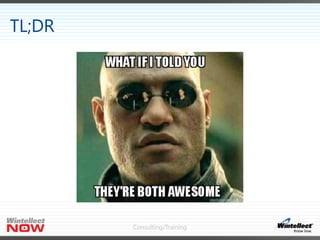
TL;DR
Consulting/Training
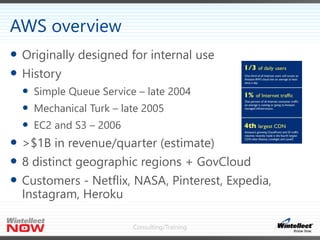
 Originally designed for internal use
 History
 Simple Queue Service – late 2004
 Mechanical Turk – late 2005
 EC2 and S3 – 2006
 >$1B in revenue/quarter (estimate)
 8 distinct geographic regions + GovCloud
 Customers - Netflix, NASA, Pinterest, Expedia,
Instagram, Heroku
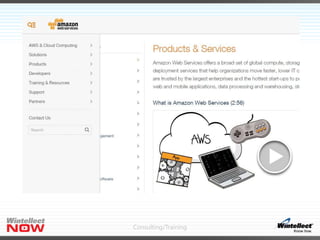
AWS overview
Consulting/Training
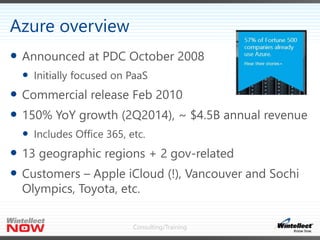
 Announced at PDC October 2008
 Initially focused on PaaS
 Commercial release Feb 2010
 150% YoY growth (2Q2014), ~ $4.5B annual revenue
 Includes Office 365, etc.
 13 geographic regions + 2 gov-related
 Customers – Apple iCloud (!), Vancouver and Sochi
Olympics, Toyota, etc.
Azure overview
Consulting/Training
Features and Capabilities
Performance/Scale/Reliability
Cost
Developer Productivity
Management
Consulting/Training
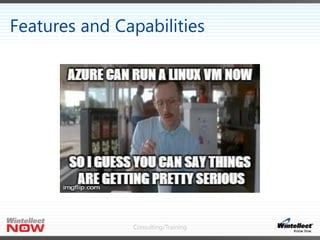
Features and Capabilities
Consulting/Training
Consulting/Training
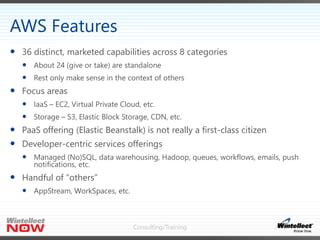
 36 distinct, marketed capabilities across 8 categories
 About 24 (give or take) are standalone
 Rest only make sense in the context of others
 Focus areas
 IaaS – EC2, Virtual Private Cloud, etc.
 Storage – S3, Elastic Block Storage, CDN, etc.
 PaaS offering (Elastic Beanstalk) is not really a first-class citizen
 Developer-centric services offerings
 Managed (No)SQL, data warehousing, Hadoop, queues, workflows, emails, push
notifications, etc.
 Handful of “others”
 AppStream, WorkSpaces, etc.
AWS Features
Consulting/Training
Consulting/Training
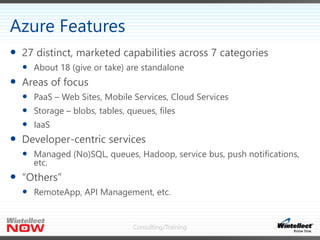
 27 distinct, marketed capabilities across 7 categories
 About 18 (give or take) are standalone
 Areas of focus
 PaaS – Web Sites, Mobile Services, Cloud Services
 Storage – blobs, tables, queues, files
 IaaS
 Developer-centric services
 Managed (No)SQL, queues, Hadoop, service bus, push notifications,
etc.
 “Others”
 RemoteApp, API Management, etc.
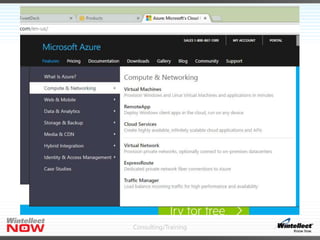
Azure Features
Consulting/Training
 IaaS
 Run anything in a VM
 Extend your datacenter into the cloud (virtual networks, etc.)
 Storage
 Raw, NoSQL, SQL, big data, CDN
 Access control
 IAM and Azure AD
 Legacy-application-as-a-service
 AWS AppStream and Azure RemoteApp
Commonality
Consulting/Training
 “View of the world”
 AWS – VM-first
 Azure – services-first
 PaaS – Azure has a clear advantage here
 Hybrid cloud connectivity – Azure has more emphasis, options
 Mobile back-ends
 Azure Mobile Services – mature, full-featured
 Amazon Cognito/Analytics/SNS – new offering, promising but still early days
 Azure has obvious ties into MS developer ecosystem
 Will Amazon create their own dev ecosystem?
 Feature differentiation
 Azure – native API Management
 AWS – native OLAP data warehousing
Key Differences
Consulting/Training
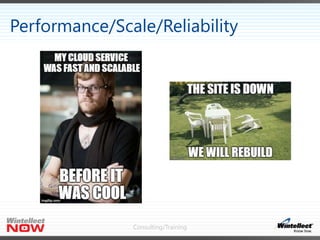
Performance/Scale/Reliability
Consulting/Training
 Server estimates (May 2013)
 160K web-facing (11.6M distinct, public web sites)
 50K non-web-facing
 VM sizes
 22 instance sizes across 7 categories
 General purpose, micro, compute-optimized, memory-optimized, storage-optimized, etc.
 On-demand, reserved, and spot pricing models
 Database sizes
 11 instances sizes across 3 categories (standard, memory-optimized, micro)
 SLA
 EC2 and RDS – 99.95%
 S3 – 99.9%
 Scale out – load balance All The Things
 Scale up – up to 32 cores, 244 GB of RAM per instance
AWS perf/scale/reliability
Consulting/Training
 Server estimates (July 2013)
 19K web-facing (170K distinct, public web sites)
 VM sizes
 10 instance sizes across 3 categories
 General purpose, compute-intensive, memory-intensive
 Fewer options than AWS (no GPU, storage-optimized, etc.)
 Database sizes
 8 instance sizes across 2 categories (general purpose, memory-intensive)
 SLA
 VMs and Cloud Services – 99.95%
 Pretty much everything else – 99.9%
 Scale out – load balancing using Traffic Manager (across one or more regions)
 Scale up – up to 16 cores, 112 GB of RAM per instance
Azure perf/scale/reliability
Consulting/Training
Cost
Consulting/Training
 Budget and tax implications
 Capex – Big, depreciating assets on the
balance sheet
 Opex - Fluid, less predictable (but smaller) ongoing expenses
 Developers – no longer downstream from IT decisions
 Public cloud allows “end-run” around traditional IT
 We control the meter (for better… and worse)
 “Spend” is now a noun
 You’re welcome
 Price usually not a differentiator
Economics o’ the Cloud
Consulting/Training
 Generally a pay-as-you-go model
 Paying the water bill vs. digging your own well
 Free usage tier
 12 month limit for new accounts
 Monthly credit for Linux/Windows micro VMs, relational and NoSQL
storage, etc.
 Discounts for education and startups
 Convenience vs. commitment
 On-Demand vs. Reserved vs. Spot Instances
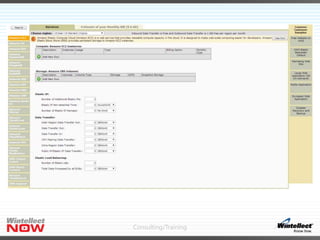
 Here Be Complexity
 Whitepapers, how-to videos, VC-backed third party providers, etc.
AWS Pricing
Consulting/Training
Consulting/Training
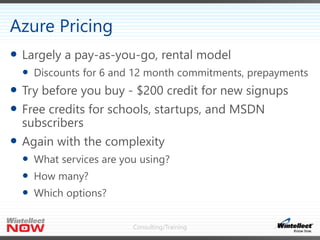
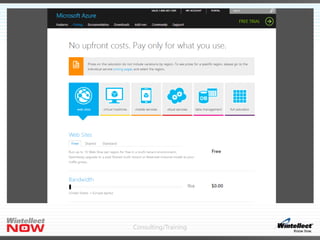
 Largely a pay-as-you-go, rental model
 Discounts for 6 and 12 month commitments, prepayments
 Try before you buy - $200 credit for new signups
 Free credits for schools, startups, and MSDN
subscribers
 Again with the complexity
 What services are you using?
 How many?
 Which options?
Azure Pricing
Consulting/Training
Consulting/Training
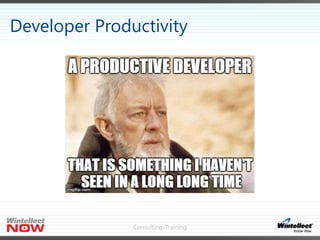
Developer Productivity
Consulting/Training
Consulting/Training
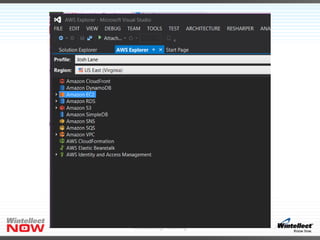
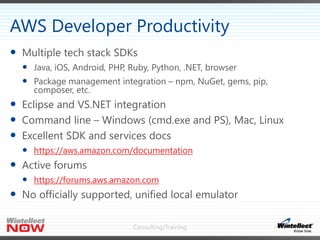
 Multiple tech stack SDKs
 Java, iOS, Android, PHP, Ruby, Python, .NET, browser
 Package management integration – npm, NuGet, gems, pip,
composer, etc.
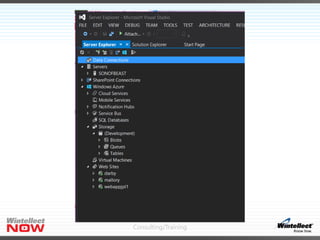
 Eclipse and VS.NET integration
 Command line – Windows (cmd.exe and PS), Mac, Linux
 Excellent SDK and services docs
 https://aws.amazon.com/documentation
 Active forums
 https://forums.aws.amazon.com
 No officially supported, unified local emulator
AWS Developer Productivity
Consulting/Training
Consulting/Training
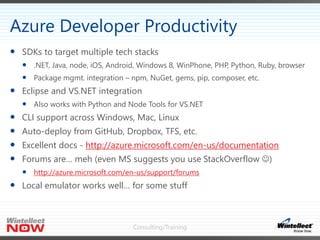
 SDKs to target multiple tech stacks
 .NET, Java, node, iOS, Android, Windows 8, WinPhone, PHP, Python, Ruby, browser
 Package mgmt. integration – npm, NuGet, gems, pip, composer, etc.
 Eclipse and VS.NET integration
 Also works with Python and Node Tools for VS.NET
 CLI support across Windows, Mac, Linux
 Auto-deploy from GitHub, Dropbox, TFS, etc.
 Excellent docs - http://azure.microsoft.com/en-us/documentation
 Forums are… meh (even MS suggests you use StackOverflow )
 http://azure.microsoft.com/en-us/support/forums
 Local emulator works well… for some stuff
Azure Developer Productivity
Consulting/Training
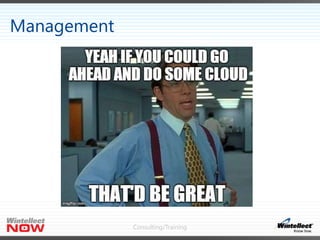
Management
Consulting/Training
Consulting/Training
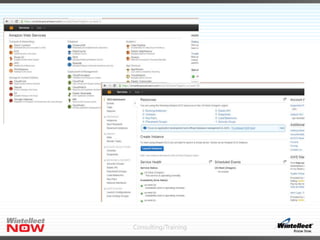
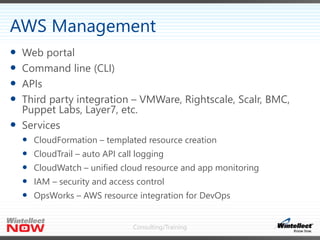
 Web portal
 Command line (CLI)
 APIs
 Third party integration – VMWare, Rightscale, Scalr, BMC,
Puppet Labs, Layer7, etc.
 Services
 CloudFormation – templated resource creation
 CloudTrail – auto API call logging
 CloudWatch – unified cloud resource and app monitoring
 IAM – security and access control
 OpsWorks – AWS resource integration for DevOps
AWS Management
Consulting/Training
Consulting/Training
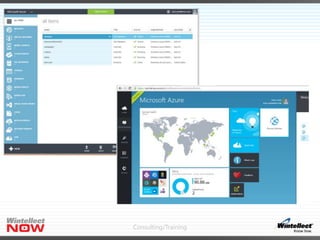
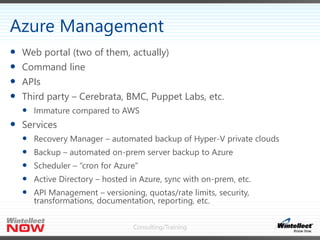
 Web portal (two of them, actually)
 Command line
 APIs
 Third party – Cerebrata, BMC, Puppet Labs, etc.
 Immature compared to AWS
 Services
 Recovery Manager – automated backup of Hyper-V private clouds
 Backup – automated on-prem server backup to Azure
 Scheduler – “cron for Azure”
 Active Directory – hosted in Azure, sync with on-prem, etc.
 API Management – versioning, quotas/rate limits, security,
transformations, documentation, reporting, etc.
Azure Management
Consulting/Training
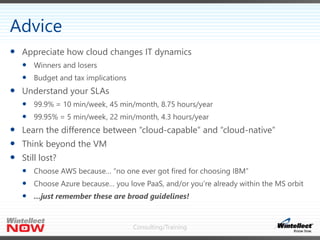
 Appreciate how cloud changes IT dynamics
 Winners and losers
 Budget and tax implications
 Understand your SLAs
 99.9% = 10 min/week, 45 min/month, 8.75 hours/year
 99.95% = 5 min/week, 22 min/month, 4.3 hours/year
 Learn the difference between “cloud-capable” and “cloud-native”
 Think beyond the VM
 Still lost?
 Choose AWS because… “no one ever got fired for choosing IBM”
 Choose Azure because… you love PaaS, and/or you’re already within the MS orbit
 …just remember these are broad guidelines!
Advice
Consulting/Training
Questions?

Azure vs AWS

  • 1.
  • 2.
  • 3.
    Consulting/Training consulting Wintellect helps youbuild better software, faster, tackling the tough projects and solving the software and technology questions that help you transform your business.  Architecture, Analysis and Design  Full lifecycle software development  Debugging and Performance tuning  Database design and development training Wintellect's courses are written and taught by some of the biggest and most respected names in the Microsoft programming industry.  Learn from the best. Access the same training Microsoft’s developers enjoy  Real world knowledge and solutions on both current and cutting edge technologies  Flexibility in training options – onsite, virtual, on demand Wintellect is the only company that offers the combined value of world class consulting services along with onsite, virtual and on-demand developer training. We help companies build better software, faster, helping you maximize and protect your consulting and training investments through ongoing knowledge transfer. who we are About Wintellect
  • 4.
  • 5.
    Consulting/Training  Originally designedfor internal use  History  Simple Queue Service – late 2004  Mechanical Turk – late 2005  EC2 and S3 – 2006  >$1B in revenue/quarter (estimate)  8 distinct geographic regions + GovCloud  Customers - Netflix, NASA, Pinterest, Expedia, Instagram, Heroku AWS overview
  • 6.
    Consulting/Training  Announced atPDC October 2008  Initially focused on PaaS  Commercial release Feb 2010  150% YoY growth (2Q2014), ~ $4.5B annual revenue  Includes Office 365, etc.  13 geographic regions + 2 gov-related  Customers – Apple iCloud (!), Vancouver and Sochi Olympics, Toyota, etc. Azure overview
  • 7.
  • 8.
  • 9.
  • 10.
    Consulting/Training  36 distinct,marketed capabilities across 8 categories  About 24 (give or take) are standalone  Rest only make sense in the context of others  Focus areas  IaaS – EC2, Virtual Private Cloud, etc.  Storage – S3, Elastic Block Storage, CDN, etc.  PaaS offering (Elastic Beanstalk) is not really a first-class citizen  Developer-centric services offerings  Managed (No)SQL, data warehousing, Hadoop, queues, workflows, emails, push notifications, etc.  Handful of “others”  AppStream, WorkSpaces, etc. AWS Features
  • 11.
  • 12.
    Consulting/Training  27 distinct,marketed capabilities across 7 categories  About 18 (give or take) are standalone  Areas of focus  PaaS – Web Sites, Mobile Services, Cloud Services  Storage – blobs, tables, queues, files  IaaS  Developer-centric services  Managed (No)SQL, queues, Hadoop, service bus, push notifications, etc.  “Others”  RemoteApp, API Management, etc. Azure Features
  • 13.
    Consulting/Training  IaaS  Runanything in a VM  Extend your datacenter into the cloud (virtual networks, etc.)  Storage  Raw, NoSQL, SQL, big data, CDN  Access control  IAM and Azure AD  Legacy-application-as-a-service  AWS AppStream and Azure RemoteApp Commonality
  • 14.
    Consulting/Training  “View ofthe world”  AWS – VM-first  Azure – services-first  PaaS – Azure has a clear advantage here  Hybrid cloud connectivity – Azure has more emphasis, options  Mobile back-ends  Azure Mobile Services – mature, full-featured  Amazon Cognito/Analytics/SNS – new offering, promising but still early days  Azure has obvious ties into MS developer ecosystem  Will Amazon create their own dev ecosystem?  Feature differentiation  Azure – native API Management  AWS – native OLAP data warehousing Key Differences
  • 15.
  • 16.
    Consulting/Training  Server estimates(May 2013)  160K web-facing (11.6M distinct, public web sites)  50K non-web-facing  VM sizes  22 instance sizes across 7 categories  General purpose, micro, compute-optimized, memory-optimized, storage-optimized, etc.  On-demand, reserved, and spot pricing models  Database sizes  11 instances sizes across 3 categories (standard, memory-optimized, micro)  SLA  EC2 and RDS – 99.95%  S3 – 99.9%  Scale out – load balance All The Things  Scale up – up to 32 cores, 244 GB of RAM per instance AWS perf/scale/reliability
  • 17.
    Consulting/Training  Server estimates(July 2013)  19K web-facing (170K distinct, public web sites)  VM sizes  10 instance sizes across 3 categories  General purpose, compute-intensive, memory-intensive  Fewer options than AWS (no GPU, storage-optimized, etc.)  Database sizes  8 instance sizes across 2 categories (general purpose, memory-intensive)  SLA  VMs and Cloud Services – 99.95%  Pretty much everything else – 99.9%  Scale out – load balancing using Traffic Manager (across one or more regions)  Scale up – up to 16 cores, 112 GB of RAM per instance Azure perf/scale/reliability
  • 18.
  • 19.
    Consulting/Training  Budget andtax implications  Capex – Big, depreciating assets on the balance sheet  Opex - Fluid, less predictable (but smaller) ongoing expenses  Developers – no longer downstream from IT decisions  Public cloud allows “end-run” around traditional IT  We control the meter (for better… and worse)  “Spend” is now a noun  You’re welcome  Price usually not a differentiator Economics o’ the Cloud
  • 20.
    Consulting/Training  Generally apay-as-you-go model  Paying the water bill vs. digging your own well  Free usage tier  12 month limit for new accounts  Monthly credit for Linux/Windows micro VMs, relational and NoSQL storage, etc.  Discounts for education and startups  Convenience vs. commitment  On-Demand vs. Reserved vs. Spot Instances  Here Be Complexity  Whitepapers, how-to videos, VC-backed third party providers, etc. AWS Pricing
  • 21.
  • 22.
    Consulting/Training  Largely apay-as-you-go, rental model  Discounts for 6 and 12 month commitments, prepayments  Try before you buy - $200 credit for new signups  Free credits for schools, startups, and MSDN subscribers  Again with the complexity  What services are you using?  How many?  Which options? Azure Pricing
  • 23.
  • 24.
  • 25.
  • 26.
    Consulting/Training  Multiple techstack SDKs  Java, iOS, Android, PHP, Ruby, Python, .NET, browser  Package management integration – npm, NuGet, gems, pip, composer, etc.  Eclipse and VS.NET integration  Command line – Windows (cmd.exe and PS), Mac, Linux  Excellent SDK and services docs  https://aws.amazon.com/documentation  Active forums  https://forums.aws.amazon.com  No officially supported, unified local emulator AWS Developer Productivity
  • 27.
  • 28.
    Consulting/Training  SDKs totarget multiple tech stacks  .NET, Java, node, iOS, Android, Windows 8, WinPhone, PHP, Python, Ruby, browser  Package mgmt. integration – npm, NuGet, gems, pip, composer, etc.  Eclipse and VS.NET integration  Also works with Python and Node Tools for VS.NET  CLI support across Windows, Mac, Linux  Auto-deploy from GitHub, Dropbox, TFS, etc.  Excellent docs - http://azure.microsoft.com/en-us/documentation  Forums are… meh (even MS suggests you use StackOverflow )  http://azure.microsoft.com/en-us/support/forums  Local emulator works well… for some stuff Azure Developer Productivity
  • 29.
  • 30.
  • 31.
    Consulting/Training  Web portal Command line (CLI)  APIs  Third party integration – VMWare, Rightscale, Scalr, BMC, Puppet Labs, Layer7, etc.  Services  CloudFormation – templated resource creation  CloudTrail – auto API call logging  CloudWatch – unified cloud resource and app monitoring  IAM – security and access control  OpsWorks – AWS resource integration for DevOps AWS Management
  • 32.
  • 33.
    Consulting/Training  Web portal(two of them, actually)  Command line  APIs  Third party – Cerebrata, BMC, Puppet Labs, etc.  Immature compared to AWS  Services  Recovery Manager – automated backup of Hyper-V private clouds  Backup – automated on-prem server backup to Azure  Scheduler – “cron for Azure”  Active Directory – hosted in Azure, sync with on-prem, etc.  API Management – versioning, quotas/rate limits, security, transformations, documentation, reporting, etc. Azure Management
  • 34.
    Consulting/Training  Appreciate howcloud changes IT dynamics  Winners and losers  Budget and tax implications  Understand your SLAs  99.9% = 10 min/week, 45 min/month, 8.75 hours/year  99.95% = 5 min/week, 22 min/month, 4.3 hours/year  Learn the difference between “cloud-capable” and “cloud-native”  Think beyond the VM  Still lost?  Choose AWS because… “no one ever got fired for choosing IBM”  Choose Azure because… you love PaaS, and/or you’re already within the MS orbit  …just remember these are broad guidelines! Advice
  • 35.