Microsoft And The CloudSimon DaviesMicrosoftsdavies@microsoft.comhttp://blogs.msdn.com/simondavies
AgendaOur Approach
Cloud offerings
What is the cloud being used for?
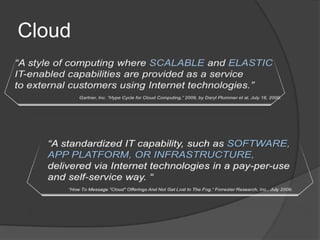
New opportunitiesCloud“A style of computing where SCALABLE and ELASTIC IT-enabled capabilities are provided as a service to external customers using Internet technologies.”Gartner, Inc. “Hype Cycle for Cloud Computing,” 2009, by Daryl Plummer et al, July 16, 2009.“A standardized IT capability, such as SOFTWARE,APP PLATFORM, OR INFRASTRUCTURE, delivered via Internet technologies in a pay-per-use and self-service way. ““How To Message "Cloud" Offerings And Not Get Lost In The Fog,” Forrester Research, Inc., July 2009.
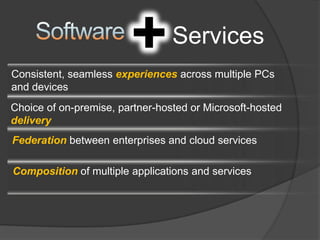
+ServicesSoftwareConsistent, seamless experiences across multiple PCs and devicesChoice of on-premise, partner-hosted or Microsoft-hosted deliveryFederation between enterprises and cloud servicesComposition of multiple applications and services
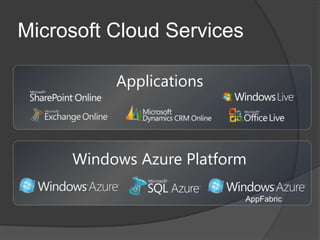
Microsoft Cloud ServicesApplicationsWindows Azure PlatformAppFabric
Windows Azure Platform
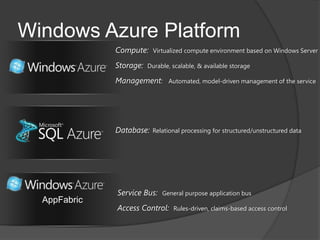
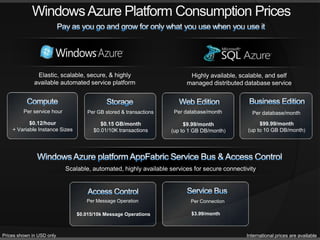
Windows Azure PlatformCompute:  Virtualized compute environment based on Windows ServerStorage: Durable, scalable, & available storageManagement:   Automated, model-driven management of the serviceDatabase:Relational processing for structured/unstructured dataAppFabricService Bus: General purpose application busAccess Control:  Rules-driven, claims-based access control
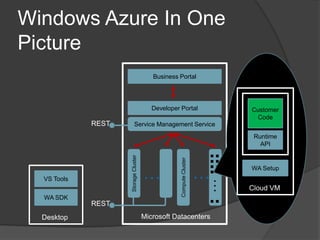
Windows Azure In One PictureBusiness PortalDeveloper PortalRESTService Management ServiceCustomer Code……Runtime APIStorage ClusterVS ToolsCompute Cluster …WA SDKWA SetupRESTMicrosoft DatacentersDesktopCloud VM
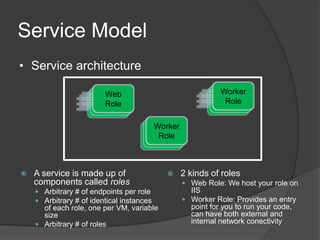
Service ModelService architectureWorker RoleWeb RoleWorker RoleA service is made up of components called rolesArbitrary # of endpoints per roleArbitrary # of identical instances of each role, one per VM, variable sizeArbitrary # of roles2 kinds of rolesWeb Role: We host your role on IIS Worker Role: Provides an entry point for you to run your code, can have both external and internal network conectivity
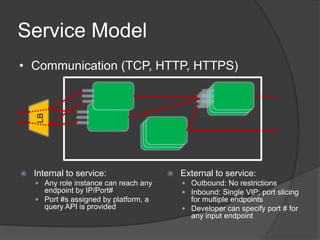
Service ModelCommunication (TCP, HTTP, HTTPS)LBInternal to service: Any role instance can reach any endpoint by IP/Port#Port #s assigned by platform, a query API is providedExternal to service:Outbound: No restrictionsInbound: Single VIP; port slicing for multiple endpointsDeveloper can specify port # for any input endpoint
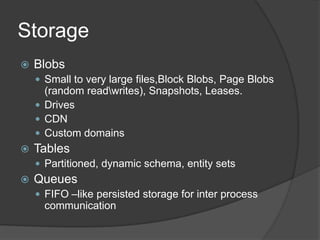
StorageBlobsSmall to very large files,BlockBlobs, Page Blobs (random read\writes), Snapshots, Leases.Drives CDNCustom domainsTablesPartitioned, dynamic schema, entity setsQueuesFIFO –like persisted storage for inter process communication
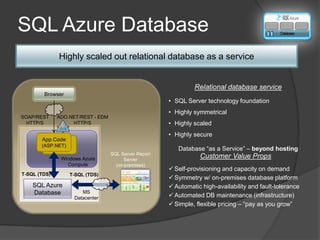
SQL Azure DatabaseHighly scaled out relational database as a serviceRelational database serviceSQL Server technology foundation
Highly symmetrical
Highly scaled
Highly secureDatabase “as a Service” – beyond hostingBrowserDatabaseSOAP/RESTHTTP/SADO.NET/REST - EDMHTTP/SMSDatacenterWindows Azure ComputeApp Code(ASP.NET)Customer Value PropsSelf-provisioning and capacity on demand
Symmetry w/ on-premises database platform
Automatic high-availability and fault-tolerance
Automated DB maintenance (infrastructure)
Simple, flexible pricing – “pay as you grow”SQL Server Report Server(on-premises)T-SQL (TDS)T-SQL (TDS)SQL AzureDatabase

Microsoft And The Cloud

  • 1.
    Microsoft And TheCloudSimon DaviesMicrosoftsdavies@microsoft.comhttp://blogs.msdn.com/simondavies
  • 2.
  • 3.
  • 4.
    What is thecloud being used for?
  • 5.
    New opportunitiesCloud“A styleof computing where SCALABLE and ELASTIC IT-enabled capabilities are provided as a service to external customers using Internet technologies.”Gartner, Inc. “Hype Cycle for Cloud Computing,” 2009, by Daryl Plummer et al, July 16, 2009.“A standardized IT capability, such as SOFTWARE,APP PLATFORM, OR INFRASTRUCTURE, delivered via Internet technologies in a pay-per-use and self-service way. ““How To Message "Cloud" Offerings And Not Get Lost In The Fog,” Forrester Research, Inc., July 2009.
  • 6.
    +ServicesSoftwareConsistent, seamless experiencesacross multiple PCs and devicesChoice of on-premise, partner-hosted or Microsoft-hosted deliveryFederation between enterprises and cloud servicesComposition of multiple applications and services
  • 7.
  • 8.
  • 9.
    Windows Azure PlatformCompute: Virtualized compute environment based on Windows ServerStorage: Durable, scalable, & available storageManagement: Automated, model-driven management of the serviceDatabase:Relational processing for structured/unstructured dataAppFabricService Bus: General purpose application busAccess Control: Rules-driven, claims-based access control
  • 10.
    Windows Azure InOne PictureBusiness PortalDeveloper PortalRESTService Management ServiceCustomer Code……Runtime APIStorage ClusterVS ToolsCompute Cluster …WA SDKWA SetupRESTMicrosoft DatacentersDesktopCloud VM
  • 11.
    Service ModelService architectureWorkerRoleWeb RoleWorker RoleA service is made up of components called rolesArbitrary # of endpoints per roleArbitrary # of identical instances of each role, one per VM, variable sizeArbitrary # of roles2 kinds of rolesWeb Role: We host your role on IIS Worker Role: Provides an entry point for you to run your code, can have both external and internal network conectivity
  • 12.
    Service ModelCommunication (TCP,HTTP, HTTPS)LBInternal to service: Any role instance can reach any endpoint by IP/Port#Port #s assigned by platform, a query API is providedExternal to service:Outbound: No restrictionsInbound: Single VIP; port slicing for multiple endpointsDeveloper can specify port # for any input endpoint
  • 13.
    StorageBlobsSmall to verylarge files,BlockBlobs, Page Blobs (random read\writes), Snapshots, Leases.Drives CDNCustom domainsTablesPartitioned, dynamic schema, entity setsQueuesFIFO –like persisted storage for inter process communication
  • 14.
    SQL Azure DatabaseHighlyscaled out relational database as a serviceRelational database serviceSQL Server technology foundation
  • 15.
  • 16.
  • 17.
    Highly secureDatabase “asa Service” – beyond hostingBrowserDatabaseSOAP/RESTHTTP/SADO.NET/REST - EDMHTTP/SMSDatacenterWindows Azure ComputeApp Code(ASP.NET)Customer Value PropsSelf-provisioning and capacity on demand
  • 18.
    Symmetry w/ on-premisesdatabase platform
  • 19.
  • 20.
    Automated DB maintenance(infrastructure)
  • 21.
    Simple, flexible pricing– “pay as you grow”SQL Server Report Server(on-premises)T-SQL (TDS)T-SQL (TDS)SQL AzureDatabase