

Medicare Secondary Payer Statute, Medicare Set-Asides and MMSEA Section 111 Mandatory Insurer Reporting
OverviewWho We AreWhat is the Medicare Secondary Payer Statute? Who We AreLegislation passed in 1981 that makes Medicare secondarily responsible for medical payments stemming from industrial injuries
 The intent is to assure that carriers are not improperly shifting the burden of the claimant’s medical expenses or future care to the Medicare system
 MSP statute prohibits Medicare from making payment if payment has been made or can reasonably be expected to be made by the following primary plans: group health plans, worker’s compensation plans, liability insurance(to include self-insurance) or no-fault insurance
 Pursuant to 1862(b)(2)(B)(ii) of the Act, Medicare has the right to sue and collect double damages					OverviewWho We AreMedicare Secondary Payer Statute - continued Who We AreIn 1999, Medicare conducted an audit and concluded they had paid out 43 Billion dollars in medical expenses that were compensable under worker’s compensation.
 In 2001, Medicare released the “Patel Memo”, which introduced the Medicare Set Aside(MSA) arrangement as the recommended vehicle for WC primary payers to protect Medicare’s “future interests” in WC settlements.
 In the event Medicare has made a conditional payment, under MSP primary payers are obligated to reimburse Medicare within 60 days if primary plan has or had a responsibility to do so – settlement, judgement, waiver and release  all demonstrate responsibility.
 Primary payers are also required to place Medicare on “notice” if it is demonstrated that Medicare has made payment for services for which the primary payer should have made payment.OverviewWho We AreProtecting Medicare’s Interests in Settlements Who We Are Past Interests – Reimbursement of Conditional Payments/Liens
 Future Interests – Medicare Set Asides
 Your Interests – Indemnification and Hold Harmless AgreementsOverviewWho We AreConditional Payments – “Consent to Release” vs. “Proof of Representation” Who We AreProof of Representation – The beneficiary has authorized the individual or entity(including an attorney) to act on the beneficiary’s behalf. The representative has no independent standing, but may receive or submit information/requests on behalf of the beneficiary, including responding to requests from the MSPRC, receiving a copy of the recovery demand letter if Medicare has a recovery claim, and filing an appeal(if appropriate) when that beneficiary is involved  in a liability, workers’ compensation or auto/no-fault situation. The exchange of information is a two way street.
 The individual or entity may provide necessary information to or interact with the MSPRC, on behalf of the beneficiary, in order to resolve Medicare’s Recovery Claim.
Needed to negotiate liens with CMS.OverviewWho We AreConditional Payments – “Consent to Release” vs. “Proof of Representation” Who We AreConsent to Release – The beneficiary has authorized the individual or entity to receive certain information from the MSPRC for a limited period of time.  The Release does not give the individual or entity the authority to act on the beneficiary’s behalf.  The exchange of information is a one way street
 The beneficiary has authorized the MSPRC to provide privacy protected data to the specified individual or entity, BUT this does NOT authorize the individual/entity requesting information to act on behalf of or make decisions on behalf of the  beneficiary.
 Needed to make Conditional Payment inquiries with CMSModel language for both can be found at www.msprc.info
OverviewWho We AreConditional Payments Inquiry – Lien Negotiation Process Who We AreStep #1: Notify Medicare Coordination of Benefits (COB) of the Claim:Send a completed form letter containing (claimant name, DOB, Medicare number, address, gender, Date of injury, insurance carrier, ICD-9 code) to the Medicare COB along with the signed CMS HIPAA form. *** If you are unable to obtain the signed HIPAA form from the claimant, you may still send this letter to notify Medicare of the injury claim but you must have the correct Medicare number prior to doing so. You will receive a “Right to Recovery” letter from CMS following notification of the claim. CMS will assign a CMS Case Control number to the claim. Utilize the CMS Case Control number and/or the claimants HICN/Medicare number in all future correspondence with Medicare. COBC c/o Coordination of Benefits Contractor  P.O. Box 33849 Detroit, MI 48232-5849
OverviewWho We AreConditional Payments Inquiry – Lien Negotiation Process Who We AreStep #2: Notify the Medicare Secondary Payor Recovery Contractor (MSPRC) to initiate the Medicare Conditional Payment Lien on the Claim:(This step should be completed prior to any settlement negotiations.)Send a form letter to the correct MSPRC address. You will need to include the same information as above and specifically request they start the conditional payment investigation and send you any lien information. The signed and returned CMS specific HIPAA (Health Insurance Portability and Accountability Act) form must accompany this document for the MSPRC to share any conditional payment lien information with you. You will receive an “Estimated Medicare Conditional Payment Lien” in approximately 60 days.This document will contain dates of service, ICD-9 diagnostic codes for which the medical treatment was needed, Total Charges, Reimbursed amount, and Conditional Payment amount. The Conditional Payment is the amount Medicare paid for medical services related to this claimant.
OverviewWho We AreConditional Payments Inquiry – Lien Negotiation Process Who We AreStep #2: ContinuedThis document will state “Refrain from Sending Payment at this Time.” This is just an estimated lien amount. You will not send payment to the MSPRC until after the settlement date and until after you receive the Final Conditional Payment Lien.   Review the lien information to evaluate which charges are related to the DOL injury/illness. If some of the charges are not related to the DOL injury/illness, you should complete written correspondence to the MSPRC with their evaluation and arguments as to why certain charges are unrelated to the DOL. This written communication should be followed up with a phone call 3 weeks to assure it was received and is being processed. The MSPRC will periodically send updated “Estimated Medicare Conditional Payment Liens” throughout the life of the file until the claim is settled full and final. MSPRC Auto/LiabilityPO Box 33828Detroit, MI 48232-3828Workers' Compensation MSPRC MSPRC WCPO Box 33831Detroit, MI 48232-3831
OverviewWho We AreConditional Payments Inquiry – Lien Negotiation Process Who We AreStep #3: Settle the Claim Full and Final and Obtain the Final Medicare Conditional Payment Lien:  Upon settlement of the claim; send a copy of the final settlement documents or the final settlement amount less procurement costs to both the MSPRC and the Medicare COB to notify them the case has been settled and to request the Final Medicare Conditional Payment Lien: The Final Medicare Conditional Payment Lien should be received within 60 days. Review the Final Lien request to evaluate which charges are related to the DOL injury/illness. If some of the charges are not related to the DOL injury/illness, you should send written correspondence to the MSPRC with their evaluation and arguments as to why certain charges are unrelated to the DOL. This written communication should be followed up with a phone call 3 weeks to assure it was received and is being processed.
OverviewWho We AreConditional Payments Inquiry – Lien Negotiation Process Who We AreStep #4: Payment to Medicare:  Make the appropriate payments to Medicare regarding the Final Conditional Payment Lien. OverviewWho We AreMedicare Set Asides Who We AreWhat are they? Monies set aside from a settlement to satisfy the Medicare Secondary Payer Statute requirements.
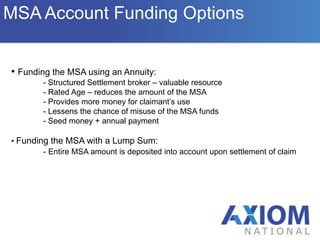
 That portion of the lump sum settlement amount that is to be used to pay for future medical, diagnostic and prescription drug costs that Medicare would otherwise have to pay for.
Lump sum settlement amount , per Medicare, includes but is not limited to: wages, attorney’s fees, all future medical expenses(to include Rx) and repayment of any Medicare conditional payments.  Also note that any previously settled portion of the WC claim must be included in computing the settlement amount.OverviewWho We AreWhen is a Medicare Set Aside Allocation required? Who We ArePer CMS memorandum of July 11, 2005, Medicare’s interests must be considered when settling any Workers’ Compensation case – even if the review thresholds are not met.  -> This criteria also applies to denied claims.MSP applies to cases that are 1) being closed, 2) require future medical care and 3) wherein the claimant is a “qualified individual”.Qualified Individual:Class 1:Claimant is a Medicare  beneficiary at the time of settlement
SSDI for 24 months or longer
ESRDClass II:Claimant has a “reasonable expectation” of becoming a Medicare beneficiary within 30 months of the date of settlement AND
Total settlement amount is $250,000 or greaterOverviewWho We AreWhat is Reasonable Expectation of Medicare Enrollment?Who We AreClaimant has applied for SSD
Claimant has been denied SSD, but anticipates appealing denial
Claimant is appealing or re-filing for SSD
Claimant is 62 ½ or older
Claimant has ESRD, however does not yet qualify as ESRD patientOverviewWho We AreCurrent Monetary Review Thresholds by CMSClaim?Who We AreCMS’ current review thresholds for WC cases are as follows: (1) The claimant is a Medicare beneficiary at time of settlement and the settlement amount is greater than $25,000 OR
 (2) The claimant is not a Medicare beneficiary at time of settlement but has a “reasonable expectation” of Medicare enrollment within 30 months of the settlement and the settlement amount is greater than $250,000.
 Again, “Reasonable expectation” includes, but is not limited to: situations where the claimant has applied for social security disability(SSD); claimant has been denied SSD but anticipates appealing the decision or re-filing for SSD; claimant is 62 years and 6 months old(meaning they will be eligible for Medicare in 30 months based on age); End Stage Renal Disease.
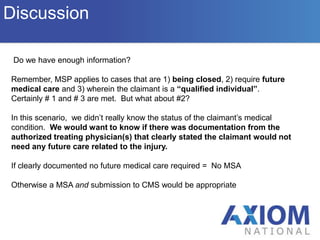
 CMS is on record as stating that these review thresholds are simply agency “workload review” thresholds and are NOT “safe harbors”. It is CMS’ position that their interests must always be considered and protected.OverviewWho We AreWhat is Needed to Complete an Accurate MSA?Who We Are The last two(2) years of medical reports, surgical/operative reports, diagnostic reports and the First Notice of InjuryPhysical Therapy notes, medical bills, etc are NOT needed The last two(2) years of payout history
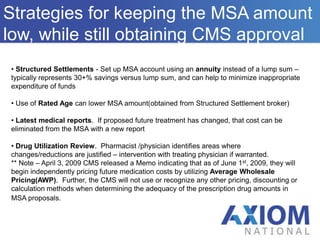
 Pharmacy printout for the last two(2) yearsThis is critical because 1) CMS is scrutinizing the Rx component of the 	MSA allocations ever since the June 2009 Memo was issued with 	respect  to AWP, and 2) CMS will require a pharmacy printout if the MSA 	is to be submitted
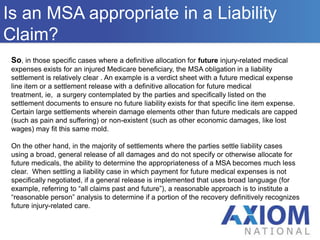
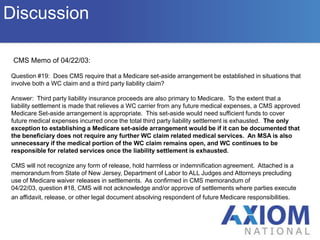
OverviewWho We AreIs an MSA appropriate in a LiabilityClaim?Who We Are First, an overview and some background: Despite all the rumors and misinformation circulating about, the new MMSEA statute(Section 111) does NOT contain any new requirements related to MSAs.

Axiom National MSA Workers Compensation and Liability

  • 1.
    Medicare Secondary PayerStatute, Medicare Set-Asides and MMSEA Section 111 Mandatory Insurer Reporting
  • 2.
    OverviewWho We AreWhatis the Medicare Secondary Payer Statute? Who We AreLegislation passed in 1981 that makes Medicare secondarily responsible for medical payments stemming from industrial injuries
  • 3.
    The intentis to assure that carriers are not improperly shifting the burden of the claimant’s medical expenses or future care to the Medicare system
  • 4.
    MSP statuteprohibits Medicare from making payment if payment has been made or can reasonably be expected to be made by the following primary plans: group health plans, worker’s compensation plans, liability insurance(to include self-insurance) or no-fault insurance
  • 5.
    Pursuant to1862(b)(2)(B)(ii) of the Act, Medicare has the right to sue and collect double damages OverviewWho We AreMedicare Secondary Payer Statute - continued Who We AreIn 1999, Medicare conducted an audit and concluded they had paid out 43 Billion dollars in medical expenses that were compensable under worker’s compensation.
  • 6.
    In 2001,Medicare released the “Patel Memo”, which introduced the Medicare Set Aside(MSA) arrangement as the recommended vehicle for WC primary payers to protect Medicare’s “future interests” in WC settlements.
  • 7.
    In theevent Medicare has made a conditional payment, under MSP primary payers are obligated to reimburse Medicare within 60 days if primary plan has or had a responsibility to do so – settlement, judgement, waiver and release all demonstrate responsibility.
  • 8.
    Primary payersare also required to place Medicare on “notice” if it is demonstrated that Medicare has made payment for services for which the primary payer should have made payment.OverviewWho We AreProtecting Medicare’s Interests in Settlements Who We Are Past Interests – Reimbursement of Conditional Payments/Liens
  • 9.
    Future Interests– Medicare Set Asides
  • 10.
    Your Interests– Indemnification and Hold Harmless AgreementsOverviewWho We AreConditional Payments – “Consent to Release” vs. “Proof of Representation” Who We AreProof of Representation – The beneficiary has authorized the individual or entity(including an attorney) to act on the beneficiary’s behalf. The representative has no independent standing, but may receive or submit information/requests on behalf of the beneficiary, including responding to requests from the MSPRC, receiving a copy of the recovery demand letter if Medicare has a recovery claim, and filing an appeal(if appropriate) when that beneficiary is involved in a liability, workers’ compensation or auto/no-fault situation. The exchange of information is a two way street.
  • 11.
    The individualor entity may provide necessary information to or interact with the MSPRC, on behalf of the beneficiary, in order to resolve Medicare’s Recovery Claim.
  • 12.
    Needed to negotiateliens with CMS.OverviewWho We AreConditional Payments – “Consent to Release” vs. “Proof of Representation” Who We AreConsent to Release – The beneficiary has authorized the individual or entity to receive certain information from the MSPRC for a limited period of time. The Release does not give the individual or entity the authority to act on the beneficiary’s behalf. The exchange of information is a one way street
  • 13.
    The beneficiaryhas authorized the MSPRC to provide privacy protected data to the specified individual or entity, BUT this does NOT authorize the individual/entity requesting information to act on behalf of or make decisions on behalf of the beneficiary.
  • 14.
    Needed tomake Conditional Payment inquiries with CMSModel language for both can be found at www.msprc.info
  • 15.
    OverviewWho We AreConditionalPayments Inquiry – Lien Negotiation Process Who We AreStep #1: Notify Medicare Coordination of Benefits (COB) of the Claim:Send a completed form letter containing (claimant name, DOB, Medicare number, address, gender, Date of injury, insurance carrier, ICD-9 code) to the Medicare COB along with the signed CMS HIPAA form. *** If you are unable to obtain the signed HIPAA form from the claimant, you may still send this letter to notify Medicare of the injury claim but you must have the correct Medicare number prior to doing so. You will receive a “Right to Recovery” letter from CMS following notification of the claim. CMS will assign a CMS Case Control number to the claim. Utilize the CMS Case Control number and/or the claimants HICN/Medicare number in all future correspondence with Medicare. COBC c/o Coordination of Benefits Contractor  P.O. Box 33849 Detroit, MI 48232-5849
  • 16.
    OverviewWho We AreConditionalPayments Inquiry – Lien Negotiation Process Who We AreStep #2: Notify the Medicare Secondary Payor Recovery Contractor (MSPRC) to initiate the Medicare Conditional Payment Lien on the Claim:(This step should be completed prior to any settlement negotiations.)Send a form letter to the correct MSPRC address. You will need to include the same information as above and specifically request they start the conditional payment investigation and send you any lien information. The signed and returned CMS specific HIPAA (Health Insurance Portability and Accountability Act) form must accompany this document for the MSPRC to share any conditional payment lien information with you. You will receive an “Estimated Medicare Conditional Payment Lien” in approximately 60 days.This document will contain dates of service, ICD-9 diagnostic codes for which the medical treatment was needed, Total Charges, Reimbursed amount, and Conditional Payment amount. The Conditional Payment is the amount Medicare paid for medical services related to this claimant.
  • 17.
    OverviewWho We AreConditionalPayments Inquiry – Lien Negotiation Process Who We AreStep #2: ContinuedThis document will state “Refrain from Sending Payment at this Time.” This is just an estimated lien amount. You will not send payment to the MSPRC until after the settlement date and until after you receive the Final Conditional Payment Lien.   Review the lien information to evaluate which charges are related to the DOL injury/illness. If some of the charges are not related to the DOL injury/illness, you should complete written correspondence to the MSPRC with their evaluation and arguments as to why certain charges are unrelated to the DOL. This written communication should be followed up with a phone call 3 weeks to assure it was received and is being processed. The MSPRC will periodically send updated “Estimated Medicare Conditional Payment Liens” throughout the life of the file until the claim is settled full and final. MSPRC Auto/LiabilityPO Box 33828Detroit, MI 48232-3828Workers' Compensation MSPRC MSPRC WCPO Box 33831Detroit, MI 48232-3831
  • 18.
    OverviewWho We AreConditionalPayments Inquiry – Lien Negotiation Process Who We AreStep #3: Settle the Claim Full and Final and Obtain the Final Medicare Conditional Payment Lien:  Upon settlement of the claim; send a copy of the final settlement documents or the final settlement amount less procurement costs to both the MSPRC and the Medicare COB to notify them the case has been settled and to request the Final Medicare Conditional Payment Lien: The Final Medicare Conditional Payment Lien should be received within 60 days. Review the Final Lien request to evaluate which charges are related to the DOL injury/illness. If some of the charges are not related to the DOL injury/illness, you should send written correspondence to the MSPRC with their evaluation and arguments as to why certain charges are unrelated to the DOL. This written communication should be followed up with a phone call 3 weeks to assure it was received and is being processed.
  • 19.
    OverviewWho We AreConditionalPayments Inquiry – Lien Negotiation Process Who We AreStep #4: Payment to Medicare: Make the appropriate payments to Medicare regarding the Final Conditional Payment Lien. OverviewWho We AreMedicare Set Asides Who We AreWhat are they? Monies set aside from a settlement to satisfy the Medicare Secondary Payer Statute requirements.
  • 20.
    That portionof the lump sum settlement amount that is to be used to pay for future medical, diagnostic and prescription drug costs that Medicare would otherwise have to pay for.
  • 21.
    Lump sum settlementamount , per Medicare, includes but is not limited to: wages, attorney’s fees, all future medical expenses(to include Rx) and repayment of any Medicare conditional payments. Also note that any previously settled portion of the WC claim must be included in computing the settlement amount.OverviewWho We AreWhen is a Medicare Set Aside Allocation required? Who We ArePer CMS memorandum of July 11, 2005, Medicare’s interests must be considered when settling any Workers’ Compensation case – even if the review thresholds are not met. -> This criteria also applies to denied claims.MSP applies to cases that are 1) being closed, 2) require future medical care and 3) wherein the claimant is a “qualified individual”.Qualified Individual:Class 1:Claimant is a Medicare beneficiary at the time of settlement
  • 22.
    SSDI for 24months or longer
  • 23.
    ESRDClass II:Claimant hasa “reasonable expectation” of becoming a Medicare beneficiary within 30 months of the date of settlement AND
  • 24.
    Total settlement amountis $250,000 or greaterOverviewWho We AreWhat is Reasonable Expectation of Medicare Enrollment?Who We AreClaimant has applied for SSD
  • 25.
    Claimant has beendenied SSD, but anticipates appealing denial
  • 26.
    Claimant is appealingor re-filing for SSD
  • 27.
    Claimant is 62½ or older
  • 28.
    Claimant has ESRD,however does not yet qualify as ESRD patientOverviewWho We AreCurrent Monetary Review Thresholds by CMSClaim?Who We AreCMS’ current review thresholds for WC cases are as follows: (1) The claimant is a Medicare beneficiary at time of settlement and the settlement amount is greater than $25,000 OR
  • 29.
    (2) Theclaimant is not a Medicare beneficiary at time of settlement but has a “reasonable expectation” of Medicare enrollment within 30 months of the settlement and the settlement amount is greater than $250,000.
  • 30.
    Again, “Reasonableexpectation” includes, but is not limited to: situations where the claimant has applied for social security disability(SSD); claimant has been denied SSD but anticipates appealing the decision or re-filing for SSD; claimant is 62 years and 6 months old(meaning they will be eligible for Medicare in 30 months based on age); End Stage Renal Disease.
  • 31.
    CMS ison record as stating that these review thresholds are simply agency “workload review” thresholds and are NOT “safe harbors”. It is CMS’ position that their interests must always be considered and protected.OverviewWho We AreWhat is Needed to Complete an Accurate MSA?Who We Are The last two(2) years of medical reports, surgical/operative reports, diagnostic reports and the First Notice of InjuryPhysical Therapy notes, medical bills, etc are NOT needed The last two(2) years of payout history
  • 32.
    Pharmacy printoutfor the last two(2) yearsThis is critical because 1) CMS is scrutinizing the Rx component of the MSA allocations ever since the June 2009 Memo was issued with respect to AWP, and 2) CMS will require a pharmacy printout if the MSA is to be submitted
  • 33.
    OverviewWho We AreIsan MSA appropriate in a LiabilityClaim?Who We Are First, an overview and some background: Despite all the rumors and misinformation circulating about, the new MMSEA statute(Section 111) does NOT contain any new requirements related to MSAs.

Editor's Notes

  • #6 We field a lot of questions about this so thought it was worthwhile to make the distinction.
  • #14 I know everybody here already knows this but, there seems to be some confusion about this question. There are really two questions that need to be asked: 1) Do we need an MSA and then 2) does it meet the Submission threshold?
  • #17 This is noteworthy because there exists, I think, an opportunity to make the process of referring an MSA less cumbersome and time consuming, not to mention an opportunity to reduce paper waste. What I mean is often times we receive large volumes of unnecessary and unneeded paperwork.
  • #18 Before we drill down a little bit here, any of the liability folks here utilizing MSA’s routinely, as a matter of course?
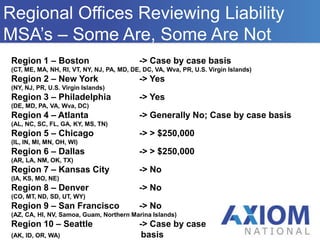
  • #23 On the next slide we will take a look at which Regional Offices are, and which are not currently reviewing Liability MSA’s. Essentially at this point it is up to each RO’s discretion.
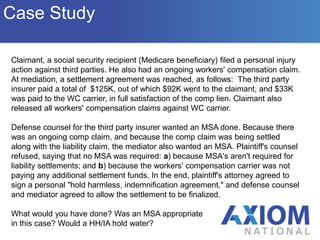
  • #25 This is an actual case, by the way.
  • #34 Before you go I have your Certificates…