•
•
•
•
•
•
•
CHAPTER 4
I Dealing with Third-Party
I Claims to Your Recovery
I
•
"
"
"
"I
I
I
I
JOEL DEVORE
Luvaas Cobb, Eugene
WM. KEITH DOZIER, JR.
Wm. Keith Dozier, LLC, Lake Oswego
I
I
I
I
I
I
I
I
I
I
I
I
I
I
I
I
I
I
I
I.
II.
Table of Contents (continued)
PARTB
THIRD-PARTY CLAIMS TO RECOVERY
Wm. Keith Dozier, Jr.
IDENTIFYlNG COMMON nURD-PARTY CLAIMS TO RECOVERY
Page
(NON-PIP) .......................................................... 4-31
A. Client Intake ................................................... 4-31
1. Intake Fonn ............................................. 4-31
2. Important Documents From Client ........................... 4-31
B. Important Documents to Obtain Early ............................... 4-31
PROVIDING NOTICE OF PERSONAL INJURY LITIGATION ............... 4-32
A. Medicare ..................................................... 4-32
B. Private Medical Insurers ......................................... 4-33
C. Workers Compensation .......................................... 4-33
D. Oregon Health Plan (State Medicaid Plan) ........................... 4-33
E. Crime Victims' Compensation Program ............................. 4-34
III. NEGOTIATING REIMBURSEMENT CLAIMS ............................ 4-34
A.
B.
C.
D.
E.
Medicare ..................................................... 4-34
1. Option to SelfCa1culate Final Conditional Payment Amount ....... 4-35
2. Medicare Set-Aside Allocations ............................. 4-35
Health Insurance Plans ........................................... 4-35
I. Self-Funded ERISA Plan or Simple Insured Health Plan? ......... 4-35
2. What Does the Plan Say About Reimbursement? ................ 4-36
3. "Equity Abhors a Windfall" - Recent Federal Cases ............. 4-36
4. Current Ninth Circuit Law Re: ERISA Plan Reimbursement ....... 4-36
5. Summary ............................................... 4-37
Workers Compensation .......................................... 4-37
1. Oregon Workers Compensation: ............................. 4-37
2. Washington Department ofLabor & Industries .................. 4-37
Oregon Health Plan (Medicaid) .................................... 4-38
Crime Victims' Compensation Program ............................. 4-38
IV. TfffiBANKRUPTCLIENT ............................................ 4-38
A.
B.
Initial Matters . . . . . . . . . . . . . . . . . . . . . . . . . . . . . . . . . . . . . . . . . . . . . . . . . . 4-38
Representation ................................................. 4-38
4-iii
Table of Contents (continued)
Page
ATTACHMENTS
"The Shrinking 800-Pound Gorilla," by Tim Nay ........................... 4-39
Reporting a Case to the Coordination ofBenefits Contractor (COBC) outline ..... 4-42
4-iv
I
I
I
•
•I
•
•
•I
I
I
I
I
I
I
I
I
PARTB
THIRD-PARTY CLAIMS TO RECOVERY
IdentifYing andNegotiating Common Third-Party Claims
Considerationsfor the Bankrupt Injured Party
Wm. Keith Dozier, Jr.1
I. IDENTIFYING COMMON THIRD-PARTY CLAIMS TO RECOVERY (NON-PIP)
A. Client Intake
1. Intake Form
Your intake form should request at least the following information to assist you and your
staffin identifying common 3rd party claims to a potential recovery:
•
•
•
•
•
•
•
2.
Private health insurer information.
Workers compensation claim information.
Is the injured party an Oregon Health Plan (Medicaid) insured?
Has the injured party received any compensation from the Crime Victims'
Compensation Program?
Is the injured party currently Medicare eligible?
Does the injured party received Social Security Disability benefits? If so, for how
long?
Is the injured party currently in bankruptcy or considering filing for bankruptcy
protection?
Important Documents From Client
Ask that the injured party gather and provide you all ofthe following case related materials
in their possession:
• All medical bills received.
• Any insurance cards or benefits plans.
• Employment benefits information.
• Workers compensation claim documents.
• Contact information for all other insurers.
• Correspondence with the local District Attorney's office or victim's advocate
regarding a criminal matter.
• Documents related to any application for Supplemental Security Income or Social
Security Disability benefits.
B. Important Documents to Obtain Early
Once initial information is gathered from the injured party the following documents are
important to obtam from non-defendant parties early irlthe case: - --
1 DISCLAlMER: This is written from a plaintiff lawyer's perspective because of the responsibilities involved and the
author's lack ofexperience in representing defendants or insurance companies. A sincere apology is offered to those in
the defense bar ifthese materials do not wholly address issues from your perspective.
4-31
• The injured party's employment file, including any health or disability insurance
plans.
• Payment ledgers from all insurers.
• The workers compensation claims file.
• All Medical bill ledgers and transmittal forms from medical providers.
II. PROVIDING NOTICE OF PERSONAL INJURY LITIGATION
A. Medicare
If the injured party is Medicare eligible, you should conduct a conditional payment
investigation. Even if Medicare has not paid any benefits on the injured party's behalf, the results
will provide written proof ofwhat Medicare's interest is with regard to a potential recovery. This
will help avoid delay in any settlement negotiations, whether or not Medicare seeks reimbursement.
Note that ifthe injured party is not near 65 years of age (a trigger for Medicare eligibility)
the liability insurer may nonetheless request written proof regarding eligibility. That is because
youngerindividuals mayalso beMedicare eligible. A common situationisMedicare eligibilitybeing
attained after the injured party has received Social Security Disability Income for a period oftwo
years. Be thorough and submit a Form 3288 to the social security administration requesting
information aboutthe injured party's legibility for Medicare. A copy ofthe form and its instructions
are available at: www.ssa.gov/online/ssa-3288.pdf.
It is vital to start the process ofdealing with Medicare issues early in the litigation process.
That is because determining Medicare's interest can be cumbersome. An outline of the reporting
process is contained in the attached: Reporting a Case to the Coordination ofBenefits Contractor
(COBC).
Ifyou chose to report the case to COBC by telephone (1-800-999-1118) it is wise to also
follow up with a written letter containing claims information to: MEDICARE - Coordinator of
Benefits, P.O. Box 33847, Detroit, MI 48232-5847. In additionto claim details regarding the parties
involved, your letter should also include the information required for "Proof of Representation."
Model language for a Proof of Representation letter is available at:
www.msprc.info/formslProofofRepresentation.pdf. Providingan abundance ofinformation early in
the process will likely avoid later delay.
After reporting, you will receive a "Rights and Responsibilities" letter from Medicare
Secondary Payer Recovery Contractor (MSPRC) as well as a cover sheet to use with all subsequent
correspondence.
Establish a "MyMedicare.gov" account for the injured party. Thereafter, the "MyMSP" tab
at that website can be used to view useful information. Often, you can obtain conditional payment
information long before the "Conditional Payment Letter" is mailed to you.
Eventually, you will receive a Condition Payment Letter indicating benefits paid and
Medicare's total reimbursement interest. Carefullyreviewthe Conditional Payment Letter to ensure
that Medicare did not include payments for medical bills unrelated to the injuries at issue.
At any pointthe injuredparty may consent to allow someone otherthanthe plaintiffs lawyer
to obtainconditional paymentinformationdirectlyfromMSPRC (client's otherrepresentatives, etc.).
4-32
I
:1
I
I
I
0
1
I
I
I
I
I
I
Model language for a Consentto Release is available at: www.msprc.info/formsIConsenttoRelease.
pdf?
B. Private Medical Insurers
Contact all private medical insurers ifpayments have or likely will be made on the injured
party's behalf. The following-shontd"be inttuded in your representation letter:
o A HIPPA medical information release.
o An explanation ofthe nature ofyour client's injuries.
• A request for a payment ledger for all benefits paid_
• A request for disclosure as to whether the insurer considers itself a self-funded
ERISA plan or an "insured" health plan.
o Request the following: All plan language - this includes the entire plan (not just
languagethatthe insurer says governs subrogation), the "SurrnnaryPlanDescription"
(SPD), and the plan's current 5500 annual report and that for the year in which your
client was injured.
• If it is not an ERISA plan - Request that they make an election under Oregon's PIP
statutes as to how they seek to be reimbursed. Ifit is not an ERISA plan - Ifdemand
has been made on the adverse driver or suit has been filed provide a copy of either
to the insurer, adhering to the requirements ofORS 742.536.
C. Workers Compensation
Provide the injured party's workers compensation carrier with a representation letter that
includes the following:
• A HIPPA medical information release.
• An explanation that the injured party is electing to pursue recovery for their injuries
directly from the at-fault party.
• A request for a complete copy ofthe claims file.
o A request for a detailed payment ledger.
Ifthe injured party is an Oregon insured, familiarize yourselfwith the detailed reporting and
election requirements contained in ORS 656.576-596. Ifthey are a Washington insured review the
requirements ofRCW 51.24.030.
IfWashingtonLabor & Industriesprovides workers compensation, submit an"Authorization
to Release Claim Information" form allowing you to access the injured party's claim information
on-line. (See: www.lni.wa.govlForms/pdfl10101Oaf.pdf).
D. Oregon Health Plan (State Medicaid Plan)
Provide the Personal Injury Liens Unit ofthe Oregon Department ofHuman Services with
a representation letter that includes the following:
• A HIPPA medical information release.
• A description ofthe injuries at issue.
2 Additional information regarding Proof of Representation as compared to Consent to Release is available at:
http://www.msprc.info/formsIPOR%20Powerpoint.pdf
4-33
• The names and addresses ofall parties against whom an action is brought or claim
is made.
• A copy ofthe demand or Complaint.
The specific reporting requirements are contained in ORS 416.530 and OAR 461-195-031O.
Prompt notice should be sent to:
DHS Personal Injury Liens Unit
POBox 14512
Salem, OR 97309-0416
Facsimile: 503-378-2577
E. Crime Victims' Compensation Program
Ifthe injured party was the victim in a criminal proceeding they may have received financial
benefits from the Crime Victims' Services Division ofthe Oregon DOI. Benefits could have been
paid directly or indirectly via payment to medical providers.
III.
Provide the Oregon DOJ with a representation letter including the following:
• The name and address ofthe assailant and ofany otherperson or entity against whom
the claim is made or action is brought.
• Ifthe claim is made or the action is brought against a corporation, the notice must
contain the address ofthe corporation's principal place ofbusiness.
The specific reporting requirements are at ORS 147.283. Prompt notice should be sent to:
Oregon DOJ-CVSD
1162 Court Street NE
Salem, OR 97310
Facsimile: (503) 378-5738
NEGOTIATING REIMBURSEMENT CLAIMS
Some 3rd party claims to any recovery are more "negotiable" than others. Hopefully, the
following information will provide greaternegotiatingpowerto help reduce third-party claims to the
injured party's recovery, ifany reduction is possible.
Never be afraid to ask for a reduction based on the chances ofrecovery versus the cost of
litigation. Keep inmind, however, that communications concerningthepersonal injurylitigationmay
be discoverable.
A. Medicare
Medicare will provide you (eventually) with a Conditional Payment Letter outlining what
they have paid and what they claimthey are owed. A "Final Demand Letter" will outline the payment
due. However, delays and complications mayarise depending on the nature eachparticular situation.
The detailed procedure and timeline ofMedicare recovery is currently somewhat in flux and
beyond the scope ofthis CLE. Parties with complex Medicare issues are encouraged to seek the help
4-34
I
I
I
I
[I
~
II
II
II
:1
I
•I
I
I
I
I
I
I
•
•
•
•
•
•
•
•I
I
of those specializing in Medicare recovery issues andlor familiarize themselves with the current
situation via additional CLE materials, etc.3
However, there are two specific issues you should be aware of:
1. Option to Self Calculate Final Conditional Payment Amount
Some claims may qualify for a streamlined self-calculation of your client's conditional
payment amount. This is the case ifthe injury occurred more than six months prior to calculation,
the recovery is $25,000.00 or less, and treatment for all injuries has been completed. Information
regardingthe self-calculationprocess is available at: msprc.info/forms/SelfCalculatedFinalCP.pdf.
2. Medicare Set-Aside Allocations
Ifthe injured party is reasonably expected to require medical care in the future a Medicare
Set-Aside Allocation (MSA) may be required per 42 C.F.R §411:1, et al. More information about
MSAs is available at: https://www.cms.gov/WorkersCompAgencyServices/04_wcsetaside.asp.
The process of creating a proposed Set-Aside and obtaiuing approval from the regional
Center for Medicare and Medicaid Services can take, at a minimum, 60 to 90 days. Therefore, it is
important to quickly determine whether an MSA is necessary.
Ifthe injured party's claim is settled it is possible to structure the future Medicare Set-Aside
Allocation using the net present value of the expected future benefits. Information about such
structured settlements can be obtained from the National Association of Medicare Set-Aside
Professionals at www.namsap.org .
B. Health Insurance Plans
The Employee RetirementIncome SecurityAct ofl974 (ERISA) regulates self-insuredplans
offered by private employers. 29 U.S.C. §1001, et seq. Oregon's PIP statutes normally govern
"insured" health plans offered by private employers and non-employment related plans. The
distinction as to which kind ofplan is at issue may determine the difficulty involved in negotiating
reimbursement.
ERISA plans commonly seek recovery on a "first dollar priority" basis without any
consideration for what the plan member's ultimate recovery may be or for paying a pro rata share
of attorney fees or litigation costs. In contrast, the Oregon PIP statutes govern private health
insurance plans not subject to the ERISA statutes.
1. Self-Funded ERISA Plan or Simple Insured Health Plan?
The so-called "savings clause" in ERISA section 514(b)(2)(a) allows states to regulate
insurance. However, the "deemer clause" in ERISA section 514(b)(2)(b) prohibits states from
deeming self-insured benefits plans as "insurance." As such, ifan employment plan is self-insured
then ERISA applies. lfthe plan is simply an '"insured" health plan then state insurance regulatory
laws apply.
, The attached recent article, The Shrinking BOO-Pound Gorilla, by Tim Nay (included with his permission) provides
some updated information on the current state ofaffairs.
4-35
Ifyou have obtained the 5500 annual reports for the plan they should indicate to you exactly
what kind ofplan is at issue.
2. What Does the Plan Say Abont Reimbursement?
Analyze all of plan language to detennine what it says about reimbursement rights and
whether the language is vague or there are iilconsistencies. Compare the SPD to the plan language
to see ifthere are any inconsistencies there. Then, consider the reimbursement language in the plan
in light oflanguage considered by the courts in the cases cited herein.
3. "Equity Abhors a Windfall" - Recent Federal Cases
ERlSA plans can only recover benefits in equity per ERlSA section 502(a)(3). Great West
Life & AnnuityIns. Co. v. Knudson, 534 U.S. 204 (2002). That sectionprovides for injunctive relief
or "other appropriate equitable relief." 29 U.S.C. §1132(a)(3).
In 2011, the U.S. Supreme Court issued its opinion in CIGNA v. Amara. CIGNA Corp. v.
Amara, 131 S. Ct. 1866 (2011). In that matter, the Court expanded the power and substance of
ERlSA section 502(a)(3), holding that when there is a violation ofthe requirements ofthe ERlSA
act and no remedy exists within the act, equity will provide one. Cigna Corp., 131 S. Ct. at 1878
(2011). However, the Court did not specifically address what equitable remedies should apply,
leaving that for the District court to decide.
Subsequently, the 3rdCircuitissued its opinion in USAirwaysv. McCutchen, U.s.App.Lexis
22883 (3rd Cir. 20II). In that matter the court considered whether the plan beneficiary could assert
the equitable defense of"unjust enrichment" in response to a claim for complete reimbursement by
an ERlSA plan. The beneficiary argued that the plan would be unjustly enriched if repaid in full
because the plan had not participated in the attorney fees and costs incurred to obtaining the
recovery.
Citing Knudsen, 534 U.S. at 209 (2009), the court in McCutchen held that the "appropriate
equitable relief' contemplated in section 502(a)(3) means something less than total relief. As a
result, the matter was remanded to the District Court for consideration ofwhat amount (less than the
total benefits paid) the plan was entitled to recover. McCutchen expressly determined that Congress
intended to limit the equitable relief available under §502(a)(3) by the application of equitable
defenses, specifically the doctrine of"unjust enrichment."
4. Current Ninth Circuit Law Re: ERISA Plan Reimbursement
The Ninth Circuit expressly applies the equitable "make whole" doctrine to ERlSA
reimbursement rights - the right to the plan's reimbursement arises only after the client has been
"made whole." Barnes v.Independent Auto Assn. olCA H&B Plan, 64 F3d 1389 (9th Cir. 1995);
Mangum v. Metropolitan Life Ins. Co., 2009 WL 700873 (D.Or. 2010); Cavanaugh ex reI.
Cavanaugh v. Providence Health Plan, 699 F Supp 2d 1209 (D.Or. 2010).
An analysis ofthe plan's language is required, however. That is because (per the ruling in
Barnes) ifthe plan expressly disavows the "make whole" doctrine then it may not apply. That case,
however, was decided long before the recent Supreme Court ruling in Amara.
Currently, there is at least one case pending in the Ninth Circuit Court ofAppeals dealing
with whether the "make whole" doctrine and other equitable defenses are available to reasonably
4-36
I
I
I
I
I
I
t
I
I
I
I
I
I
I
I
•
•I
I
I
I
I
•
•I
I
•
•
•I
limitthe amount ofERISAreimbursementregardless ofthe plan's language. CGITech & Solutions,
Inc. v. Rose, U.S. Dist.LEXIS 5317 (W.D. Wash. 2011). The matter was arguedonFebruary 9, 2012
and a ruling is pending. A recording of the oral arguments is available at:
www.ca9.uscourts.gov/mediaiview_subpage.php?pk_id=0000008682
We will have to wait and see ifthe result will be the same as in McCutchen.
5. Summary
Ifyou are dealing with an ERISA plan that does not expressly disavow the "make whole"
doctrine you have good argument for negotiating a reduction in the lien based on current Ninth
Circuit law. Even ifthe plan does disavow that doctrine, however, the recent expansion ofequitable
defenses by the Supreme Court in Amara and the subsequent ruling by the Third Circuit in
McCutchen each provide argument that the lien should be fairly reduced. Be on the look out for the
forthcoming ruling in Rose matter, however.
C. Workers Compensation
1. Oregon Workers Compensation:
Reimbursement of Oregon Workers Compensation out ofclient's recovery is governed by
the formula contained in ORS 656.593, "unless otherwise agreed by the parties." The formula
requires that costs and attorney fees be paid fIrst, then the benefIciary receives 1/3'd ofthe balance,
and the paying agency receives the remainder up to the total amount of benefIts paid and the net
present value of reasonably expected future expenditures for the benefIciary's care. Anything
remaining goes to the injured party.
Note that the carrier must approve of any settlement or it is voidable. ORS 656.587. In
circumstances wherethe recovery may berelatively small orunlikelythe agreed uponreimbursement
amount may be reduced.
2. Washington Department of Labor & Industries
Reimbursement ofL&I benefIts paid is governed by RCW 51.24.060. This statute requires
that the injured worker and L&I fIrst paythe attorney fees and litigation costsproportionately. Then,
the injured party receives 25% ofthe balance ofthe recovery. L&I is then reimbursed its remaining
lien amount with any remaining funds going to the injured worker.
With regard to future benefIts, the reimbursement statute states that L&I thereafter does not
have to make payment until the amount ofcosts incurred by the worker equal the amount he netted
from the settlement. RCW 51.24.060(l)(e).
The Department ofL&I or the self-insurer has sole discretion to compromise the amount of
their recovery, including the limitation on future benefIts. RCW 51.24.060(2). The factors to be
considered in making such a decision revolve around the likelihood ofthe injured worker achieving
a meaningful recovery on the injury claim. .
The Department of Labor & Industries must approve of and issue a formal order for the
distribution ofany recovery. RCW 51.24.060(6).
4-37
D. Oregon Health Plan (Medicaid)
Per ORS 416.540(2) and OAR 461-195-0305 the lien for Oregon Health Plan benefits paid
does not attach to attorney fees and costs incurred by the beneficiary in achieving their recovery.
Neither does it attachto the amountrecovered for medical expenses incurredfrom medical providers
other than DHS. -.-."
In addition, be aware ofthe holding inArkansas Dept. ofHealth andHuman Services, et al.
v. Ahlborn, 547 U.S. 268 (2006). The Supreme Court ruled that federal Medicaid law did not
authorize the Arkansas Medicaidplanto assert a lien on anything beyond the amount ofrecoveryfor
past medical expenses.
OHP liens can be negotiated based on the authorities above and considerations for the
difficulties that the injured party may face in achieving a recovery.
E. Crime Victims' Compensation Program
Per ORS 147.285 the Oregon Department ofJustice Crime Victims Compensation Program
(CVCP) will have a lien for "all assistance from the date of the injury that forms the basis ofthe
assistance to the date of the satisfaction of the judgment or final payment under the settlement
agreement or compromise." Further, per ORS 147.345(3) the Oregon DOJ may void a settlement
agreement if it has not provided approval. These liens are rarely reduced.
IV. THE BANKRUPT CLIENT
Ifthe injured party is bankrupt orwill likely become bankrupt during the course oflitigation
steps must be takento protecttheir interests in any recovery. Whatfollows is a very briefand general
overview of what should be considered. Any specific legal questions should be directed to the
injured party's bankruptcy counsel.
A. Initial Matters
Ifthe injured party is currently in bankruptcy, make the bankruptcy attorney aware ofyour
representation, the nature ofthe injuredparty's claim, and the date ofinjury. Bankruptcycounsel will
then be able to determine whether the claim needs to be scheduled as an asset of the bankruptcy
estate. Ifthe claim is not properly "scheduled," judicial estoppel may be an absolute defense to the
personal injury claim.
Be aware that there are limited exemptions within the bankruptcy code for claims based on
bodily injury and claims based on loss ofearnings capacity. Be sure to consider this when drafting
a complaint, settlement demand, or settlement agreement. Makethe bankruptcycounsel aware ofthe
damages claims that are being asserted so that he or she may properly schedule any available
exemptions.
B. Representation
Once your client's claim is scheduled in a bankruptcy proceeding you will be contacted by
the trustee. The trustee, on behalfofthe estate, is nowconsidered yourclient as well. Theywill likely
require review of the representation agreement you entered into with the injured party and may
require that they too become an expressed party to that agreement. As litigation progresses it is wise
to discuss the merits and problems ofthe personal injury case with the trustee. The trustee must be
made aware ofand approve any proposed settlement.
4-38
I
I
I
I
I
I
I
I
I
I
I
I
I
I
I
Tun Nay
By TimN4J'
OTLA Guardian
:,'
rrr.e following comments fro;" trial' ,
.1 lawyers reflect frustration with'
Medicare Secondary Payer (MSP) com-
pliance: "Medicare takes the joy out of
practicing law."p "This is unconstitu..
tional." "r called the MSPRC (Medicare
Secondary Payer Recovery Contractor)
to get updatedlien information andhung
up after 90 minutes on hold." "Howcan
theyignore the probate court's allocation
ofpolicy limits?" "Whyis Medicaresuch
a bigdcal now?" "rhiswasn'tsuch"pain
in the a** ten years ago." Specific com-
plaints include delays by CMS (The
Centers for Medicare and Medicaid
Services), complexity, liability exposure,
tre<jUelJt MSP policy changes, arrogant
" CUStomer service and otherworldly de-
Imands by defense counsel.
" MSP compliancehas been an irritable
" BOO-pound gorilla. But you can take
Isteps to gain better control ofMSP com-
, __ Tr'-4IL<lIt,1"·Ftzll2f}Jl
I
•
l I
P COMPLIANCE UPDATE
pliance. MSP reform bills are now in
Congress and recent case law has been
veryfuvorable. The gorilla is temporarily
an irritable chimp.
MSP compliance is about "consider-
ing/protecting" Medicare's interests hy:
• Recovery of conditional (pre-setde-
ment) Medicare payments.
• Medicare Set Aside (MSA) arrange-
ments reducingpostsetdementMedi-
care payments.
• Insurer reportingpursuant to Section
111 of the Medicare, Medicaid,
SCHIP ExtensionAct, December29,
2007 (MMSEA). Most trial lawyers
will rarely see Secdon 11I reporting,
•issUes. But·Section'.lll penalties have
driven the freot;ysurrounding1 and 2.'
Ourfirst encounter
Myfirst exposure to MSP compliance
camein 2002 from email on the IJstServ
of the National Academy of Elder Law
Attorneys (NAELA) asking about a
Medicare Set Aside (MSA) trust. I was
clueless. r contacted the individual to
learn about MSA trusts. I had trouble
understanding his explanation because
he used terms, sratutes, cases and Medi-
care literatureI'd neverrun across. Sound
fiuniliar?
.Since the late 80s, we)ve assisted
plaintiff's attorneys with POSt settlement
issues, especially maintaining SSI and
Medicaid benefits with special needs
trusts.l decided that day in 2002 to learn
everything I could about MSP compli-
ance. After nineyears oflearning, it's safe
to say that the only consrant in MSP
4-39
complianceis radical change. Readersare
encouraged to download the author's
materials from the March 2011 OTLA
presentation, "Medicare Secondary
Payer Compliance: The Plaintiff's Per-
spective" http://www.naylaw.comfpdfs!
oda.pM.
To gain better control ofMSP com-
pliance in your case, start early. CMS
does everything in slow motion. Don't
wait. For specific steps, see pages 3 and
4 of the materials. These steps will
eliminate months of waiting for CMS
and can elicit CMS conditional payment
information futer than using mail. Re-
mel!lber, there'~ no ,harD! ,taking!,!>ese,
steps if it later turn~,out:Medicare.'isfl'i '
inVCIJved. The timeyou invest isveryto;t
effective.
The many frustrations
CMS issuesvoluminous MSP compli-
ance changes released as memos, alerts,
MSP manual updates, "Do's and Don'ts,"
andTown Hall teleconferences - not as
amendments to the Medicare Secondary
Payerstatute, 42 U.S.c. 1395y(b) etseq.
(1980) or 42 C.F.R promulgations.
Keeping track of these sources requires
ongoing vigilance. None ofthese sourc-
es are subject to Congressional input or
APA (Administrative Procedures Act)
rulemaking procedures. Until very re-
cendy, most courts have afforded Chev-
ron deference to CMS interpretations of
Congressional intent, Chevron U.S.A.,
Inc., " NaturalResourcesDefense Cound4
Inc., 467 US 837 (1984.)
See MSP Comp/ia."p 42
IMSP C()mpIi4nc~
lowing: a. Paying Medicare; b. Ob- glimmer of hope that federal COUrtS
Condnuedfromp 11
taining CMS approval of an MSA might belisrening to claimants' attorneys
IThe recent"inyour face" ramping up amount and c. Funding the MSA and realizing that the emperor is not
ofMSP complianceseen by trial lawyers proposal. wearing clothes.
results from Section 111 of the "Medi- • Prohibiting the release ofany settle-
Icare, Medicaid, and SCHIP Extension ment funds to the client until CMS Breaking through
Acr," (MMSEA), December 29, 2007. has signed off. On May 5, 2011, the U.S. District
Section J11 of MMSEA implemented • Demanding MSA submission in lia- Court for Arizona issued awide ranging
Ibindingreporting requirements on insur- biliry cases (see Medicare Secondary MSP opinion char, ifupheld, could turn
ers, not ~ttorneys or their clients, with Payer Compliance, attachmenr 7 (ref- the BOO-pound gorilla into a chimp in
penalties to insurers ofup to $1,000 per orenced p 41 this issue». &ro, d. al" Scbclius, 2011 U.S. Dist.
Ida.y for failure to report injury-related LEXIS 58036 (2011). This is the second
medical services if an injured parry is In arecent case,defense counsel could Haro opinion and will nor be the last.
Medicare eligible. not be persuaded that a five-year-old ac- The first HarD opinion denied CMS's
ISection III reporting was ro begin ciden! victim was not on Medicare and motion to dismiss HarD, ct. alv. Sebelius,
January I, 2009. In a panic, the insur- would not "reasonably be expected to be 2010 U.S. Dist. (2010). The court de-
ance industry "pushed back" and many Medicare eligible within 30 months" of nied Chevron deference to all sources of
ISection III reporting requirements have the settlement date. The 30-month ex- CMS "authoriry" on several key MSP
been postponed multiple times byCMS. pectation of Medicare e1igibiliry only complianceissues, holdingthat: 1. CMS
January 1, 2012 is now the target date pertains to MSAartangementsinWork- maynot demand or collect repayment of
Ifor- comprehensive reporting and accrual ers7
Compensation) not pre-settlement conditional Medicare payments (with
offines. The CMS postponements didn't conditional payment recovery. After interest) until all possiblewaiver requests
calm the frenzy ofprotecting Medicare's sending defense counsel the language of and appeals are resolved (currently this
Iinterests in practice. 42 U.S.c. 13950, the federal statute for happens 60 days after the issuance ofthe
In addition to frustration with CMS Medicareeligibility, he remained unsatis- CMS final demand letter); 2. CMS may
in MSP compliance, add defense carrier lied. We senta SSA-3288 form to a local notpreclude «•••plaintiffs-attorneysfrom
Iand counsel reaction (or overreaction) to Social Securiry office. He was satisfied disbursingundisputed portions ofsettle-
MSP guidelines. The Section 111 only after seeing chat the child was not ment proceeds to their beneficiary c1i-
"$1,000 per day" fine appears to have eligible for Medicare or Social Security ents...t and 3. "There is no statutory
Ielevated MSA compliance to the top of Death Index from the response we pro- authority, express or implied, to suppOrt
every risk management program in the duced. a direct (MSP collection) action against
industry,justunderpreventingembezzl... Anecdotes I've heard from many trial attorneys, except to the extent they are
IIment. Examples include: lawyers involveMSP issnes thatfewMSP end-point recipients ofsetclement pro-
• Putting Medicare's name as a payee practitioners have everencountered. I've ceeds." (Insert added by author.) The
on the check, with or without prior posred many issue inquiries on the List- court enjoined CMS on the first two
Idiscussion and agreement (see Medi- ServoftheNationalAlliance ofMedica.re issues.
care Secondary Payer Compliance, P 6 Set Aside Professiona.ls (NAMSAP). By using the tips in Medicare Second-
(referenced p 41 this issue». Often, few or none of the NAMSAP ary Payer Compliance (referenced p 41
I• Demanding production of your di- members had seen these issues in their this issue), if you establish a "MyMedi-
enr's Social SecuriryAccountNumber practices.The issues involve almostevery care.gov" account for your client and go
(see Medicare SecondaryPayerCompli- facet ofMSP compliance, exceptSection to the "MyMSP" tab on the account, you
Iance, p II, 12 (referenced p 41 this 111 reporting and fines. The shock and canobtain conditional paymentinforrna-
issue». awe of$I,OOO perday fines drives many tion way before CMS finally sends the
0
Asking you to personally indemnifY of these MSP black holes we're seeing. final amount. You could then hold that
Ithe defendant onall MSP issues. This Whatwere experiencing maybe the new amount and a cushion of funds for
may be prohibited byOSB disciplin- "normal" in MSP compliance. safery (in case the MyMSP amount was
ary rules due to a possible conflict of Attorneyfrustrations have been mul- later increased) and distribute the resr.
Iinterest between the attorney and the tiplied when MSP policies and proce- CMS is taking the latest Httroopinion
client ifindemnification was acrually dures have been upheld by both federal seriously. In mid-June 2011, CMS an-
required. and state trial and appellate courts. nounced on www.msprc.info a tempo-
I• Creating arbitrary dares for the fol- However, two recent MSP cases offer a rary suspension of issuing Rights and
I)
4-40
TriIJ Lnvp·lUJl2(}JI
I
'[, Responsibilities letters, CPL and Final
it Demand letters. CMS then began issuing
s,updated letters in late June 2011. The
: result means that until the 20II Haro
iiiopinion is overturned, CMS collection
•practices will adhere to the opinion.
1'CMS may petition fur a temporary re-
.~ straining order during an"expected ap~­
((peal. The 201 1opinion also certified the
'd"'" defined as "...persons who are or
'Will besubjecc to MSP recovery,and from
whom defendant has demanded or will
ii.demand payment ofMSP claims befOre
"'there have been detenninations of the
correct amounts through the waiver or
hppeal process." The parties behind the
, Haro successes know every problem we
face in MSP compliance. CMS will not
{.get offlightly.
" In Bradley, et. alv. Sebelius, 621 E.3d
13.30 (11th Cir., 2010), the court over-
~turned the district court and denied
,Chevrondeference to CMS in awrongful
death case. Based on a thorough analysis
jofFlorida probate law and the facts, in-
eluding an e"tensive hearing on the
merits and serving notice on CMS, the
probate court ofAlachua Counry, Flori-
da held that CMS was entitled to
$787.50 ofthe $52,500 policylimits and
the children ofthe decedentwereentitled
to the remainder. The court noted that
CMS was served before the hearing but
failed to participate. "We conclude that
the deference given to the field manual...
by the Secretary and the Districc Court
is misplaced." Bradley's counsel were
awarded attorneyfees and costs pursuant
to 28 V.S.c. 2412(b) but were denied
an enhanced fee for bad faith.
In acurrentwrongful death case we'lre
involved in, CMS is indicating that it
will accepta Multnomab CounryProbate
Departmentorderallocating the $1 mil-
lion policy limits between two surviving
children and the conditional payment
claim of $27.3,227.61. One child lost a
limb in the Same accident and will have
ongoing future expenses and lost wages.
We are now preparing a pre-serdement
4-41
hearing, following as closely as possible
the Florida probate hearing and proce-
dure in Bradley, including notice to
CMS. We will then submit the order to
CMS for approval. This approach is not
to be confused with available post-settle-
ment CMS administrative remedies.
As a result ofthese and other recent
stare MSP cases, hope is running high
that change may be coming. A bipartisan
MSP reform bill, H.R. 1063, The
SMART ACT, received its first hearing
onJune 22, 2011. Hopefully, itwill move
forward to further shrink the MSP go-
rilla.
Tim Nay's settlement practice deals with
MSPcompliance, SpecialNeeds Trustsand
court apprwal ofsettlements, enhancing
clients' quality oflife. HIS firm, Nay do
Friedenberg, isanAnnualGoldSponsorof
OTLA. The firm is located at 6500 SW
Macadam Ave Ste 300, Portland OR
97239. Nay can be reached at tim@nay-
law.com or503-245·0894.
~
'~~SPRC
I
I
I
I
Reporting a Case to the Coordination o f .
Benefits Contractor (COBC) l'
In Liability Insurance, No-Fault Insurance 8:
Worker's Compensation Cases
1
.SPRC This document includes the following:
.. The Roles 8: Responsibilities of the Coordination
of Benefits Contractor (CaBC)
e Instructions for Reporting a Case to the CaBC
e Methods of Contacting the CaBC
• The Rights and Responsibilities Letter
e Conditional Payment Letter
I
I
I
I
•
-
•
-
•
•
•I
I
I
I
,
,
•,~.
~'ilt MSPRC
Coordination of Benefits Contractor (COBC)
Roles 8; Responsibilities
In Liability Insurance, No-Fault Insuranre &,Worker's Compensation Cases
• The CaBC collects information from multiple sources to research MSP
situations, as appropriate. (e.g. They collect the information from claims
processors, MMSEA Section 111 Mandatory Insurer Reporting submissions,
Initial Enrollment Questionnaire (IEQ), Worker's Compensation carriers)
• The CaBC is responsible for updates to MSP situations including
Insurance updates, address changes, changes in coverage effective
dates, etc.
f".eMSPRC Reporting a Case to CaBC
• Always contact the caBC first whenever you have a pending Liability, No-Fault,
or Workers' Compensation claim. Be prepared to provide the caBC with the
following information:
• Beneficiary Information
Beneficiary's Name
- Beneficiary's Health Insurance Claim Number (HICN)
- Beneficiary's Gender and Date of Birth
- Beneficiary's Address and Phone number
• Case Information
Date of injury/accident, date of first exposure, ingestion or, implant.
- Description of alleged injury or illness or harm.
- Type of Claim (Liability insurance, No-Fault insurance, Workers' Compensation).
Insurer/Workers' Compensation name and address.
• Representative Information
- Representative/attorney name
Law Firm name if the representative is an attorney
- Address and phone number
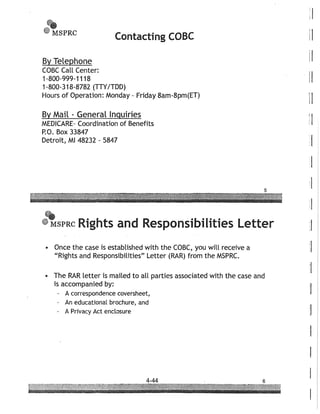
...• MSPRC
Contacting COBC
By Telephone
COBC Call Center:
1-800-999-1118
1-800-318-8782 (TTYITDD)
Hours of Operation: Monday - Friday 8am-8pm(ET)
By Mail - General Inquiries
MEDICARE- Coordination of Benefits
P.O. Box 33847
Detroit, MI 48232 - 5847
5
~
• MSPRC Rights and Responsibilities Letter
• Once the case is established with the COBC, you will receive a
"Rights and Responsibilities" Letter (RAR) from the MSPRC.
• The RAR letter is mailed to all parties associated with the case and
is accompanied by:
- A correspondence coversheet,
An educational brochure, and
A Privacy Act enclosure
i I
iI
iI
II
II
! I
If,
(
fJ'
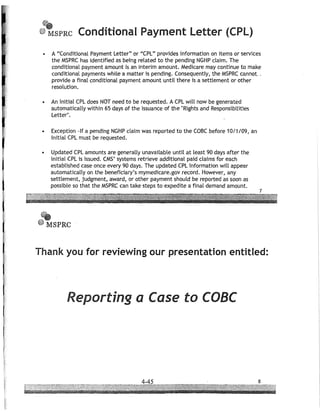
@~SPRC Conditional Payment letter (CPl)
• A "Conditional Payment Letter" or "CPL" provides information on items or services
the MSPRC has identified as being related to the pending NGHP claim. The
conditional payment amount is an interim amount. Medicare may continue to make
conditional payments while a matter is pending. Consequently, the MSPRC cannot. ,
provide a final conditional payment amount until there is a settlement or other
resolution.
• An initial CPL does NOT need to be requested. A CPL will now be generated
automatically within 65 days of the issuance of the "Rights and Responsibilities
Letter".
• Exception -If a pending NGHP claim was reported to the COBC before 10/1/09, an
initial CPL must be requested.
• Updated CPL amounts are generally unavailable until at least 90 days after the
initial CPL is issued. CMS' systems retrieve additional paid claims for each
established case once every 90 days. The updated CPL information will appear
automatically on the beneficiary's mymedicare.gov record. However, any
settlement, judgment, award, or other payment should be reported as soon as
possible so that the MSPRC can take steps to expedite a final demand amount.
fl'
.~SPRC
Thank you for reviewing our presentation entitled:
Reporting a Case to COBC

Pages from MVA Litigation CLE

  • 1.
    • • • • • • • CHAPTER 4 I Dealingwith Third-Party I Claims to Your Recovery I • " " " "I I I I JOEL DEVORE Luvaas Cobb, Eugene WM. KEITH DOZIER, JR. Wm. Keith Dozier, LLC, Lake Oswego
  • 2.
    I I I I I I I I I I I I I I I I I I I I. II. Table of Contents(continued) PARTB THIRD-PARTY CLAIMS TO RECOVERY Wm. Keith Dozier, Jr. IDENTIFYlNG COMMON nURD-PARTY CLAIMS TO RECOVERY Page (NON-PIP) .......................................................... 4-31 A. Client Intake ................................................... 4-31 1. Intake Fonn ............................................. 4-31 2. Important Documents From Client ........................... 4-31 B. Important Documents to Obtain Early ............................... 4-31 PROVIDING NOTICE OF PERSONAL INJURY LITIGATION ............... 4-32 A. Medicare ..................................................... 4-32 B. Private Medical Insurers ......................................... 4-33 C. Workers Compensation .......................................... 4-33 D. Oregon Health Plan (State Medicaid Plan) ........................... 4-33 E. Crime Victims' Compensation Program ............................. 4-34 III. NEGOTIATING REIMBURSEMENT CLAIMS ............................ 4-34 A. B. C. D. E. Medicare ..................................................... 4-34 1. Option to SelfCa1culate Final Conditional Payment Amount ....... 4-35 2. Medicare Set-Aside Allocations ............................. 4-35 Health Insurance Plans ........................................... 4-35 I. Self-Funded ERISA Plan or Simple Insured Health Plan? ......... 4-35 2. What Does the Plan Say About Reimbursement? ................ 4-36 3. "Equity Abhors a Windfall" - Recent Federal Cases ............. 4-36 4. Current Ninth Circuit Law Re: ERISA Plan Reimbursement ....... 4-36 5. Summary ............................................... 4-37 Workers Compensation .......................................... 4-37 1. Oregon Workers Compensation: ............................. 4-37 2. Washington Department ofLabor & Industries .................. 4-37 Oregon Health Plan (Medicaid) .................................... 4-38 Crime Victims' Compensation Program ............................. 4-38 IV. TfffiBANKRUPTCLIENT ............................................ 4-38 A. B. Initial Matters . . . . . . . . . . . . . . . . . . . . . . . . . . . . . . . . . . . . . . . . . . . . . . . . . . 4-38 Representation ................................................. 4-38 4-iii
  • 3.
    Table of Contents(continued) Page ATTACHMENTS "The Shrinking 800-Pound Gorilla," by Tim Nay ........................... 4-39 Reporting a Case to the Coordination ofBenefits Contractor (COBC) outline ..... 4-42 4-iv I I I • •I • • •I I I I I I I I I
  • 4.
    PARTB THIRD-PARTY CLAIMS TORECOVERY IdentifYing andNegotiating Common Third-Party Claims Considerationsfor the Bankrupt Injured Party Wm. Keith Dozier, Jr.1 I. IDENTIFYING COMMON THIRD-PARTY CLAIMS TO RECOVERY (NON-PIP) A. Client Intake 1. Intake Form Your intake form should request at least the following information to assist you and your staffin identifying common 3rd party claims to a potential recovery: • • • • • • • 2. Private health insurer information. Workers compensation claim information. Is the injured party an Oregon Health Plan (Medicaid) insured? Has the injured party received any compensation from the Crime Victims' Compensation Program? Is the injured party currently Medicare eligible? Does the injured party received Social Security Disability benefits? If so, for how long? Is the injured party currently in bankruptcy or considering filing for bankruptcy protection? Important Documents From Client Ask that the injured party gather and provide you all ofthe following case related materials in their possession: • All medical bills received. • Any insurance cards or benefits plans. • Employment benefits information. • Workers compensation claim documents. • Contact information for all other insurers. • Correspondence with the local District Attorney's office or victim's advocate regarding a criminal matter. • Documents related to any application for Supplemental Security Income or Social Security Disability benefits. B. Important Documents to Obtain Early Once initial information is gathered from the injured party the following documents are important to obtam from non-defendant parties early irlthe case: - -- 1 DISCLAlMER: This is written from a plaintiff lawyer's perspective because of the responsibilities involved and the author's lack ofexperience in representing defendants or insurance companies. A sincere apology is offered to those in the defense bar ifthese materials do not wholly address issues from your perspective. 4-31
  • 5.
    • The injuredparty's employment file, including any health or disability insurance plans. • Payment ledgers from all insurers. • The workers compensation claims file. • All Medical bill ledgers and transmittal forms from medical providers. II. PROVIDING NOTICE OF PERSONAL INJURY LITIGATION A. Medicare If the injured party is Medicare eligible, you should conduct a conditional payment investigation. Even if Medicare has not paid any benefits on the injured party's behalf, the results will provide written proof ofwhat Medicare's interest is with regard to a potential recovery. This will help avoid delay in any settlement negotiations, whether or not Medicare seeks reimbursement. Note that ifthe injured party is not near 65 years of age (a trigger for Medicare eligibility) the liability insurer may nonetheless request written proof regarding eligibility. That is because youngerindividuals mayalso beMedicare eligible. A common situationisMedicare eligibilitybeing attained after the injured party has received Social Security Disability Income for a period oftwo years. Be thorough and submit a Form 3288 to the social security administration requesting information aboutthe injured party's legibility for Medicare. A copy ofthe form and its instructions are available at: www.ssa.gov/online/ssa-3288.pdf. It is vital to start the process ofdealing with Medicare issues early in the litigation process. That is because determining Medicare's interest can be cumbersome. An outline of the reporting process is contained in the attached: Reporting a Case to the Coordination ofBenefits Contractor (COBC). Ifyou chose to report the case to COBC by telephone (1-800-999-1118) it is wise to also follow up with a written letter containing claims information to: MEDICARE - Coordinator of Benefits, P.O. Box 33847, Detroit, MI 48232-5847. In additionto claim details regarding the parties involved, your letter should also include the information required for "Proof of Representation." Model language for a Proof of Representation letter is available at: www.msprc.info/formslProofofRepresentation.pdf. Providingan abundance ofinformation early in the process will likely avoid later delay. After reporting, you will receive a "Rights and Responsibilities" letter from Medicare Secondary Payer Recovery Contractor (MSPRC) as well as a cover sheet to use with all subsequent correspondence. Establish a "MyMedicare.gov" account for the injured party. Thereafter, the "MyMSP" tab at that website can be used to view useful information. Often, you can obtain conditional payment information long before the "Conditional Payment Letter" is mailed to you. Eventually, you will receive a Condition Payment Letter indicating benefits paid and Medicare's total reimbursement interest. Carefullyreviewthe Conditional Payment Letter to ensure that Medicare did not include payments for medical bills unrelated to the injuries at issue. At any pointthe injuredparty may consent to allow someone otherthanthe plaintiffs lawyer to obtainconditional paymentinformationdirectlyfromMSPRC (client's otherrepresentatives, etc.). 4-32 I :1 I I I 0 1 I I I I I I
  • 6.
    Model language fora Consentto Release is available at: www.msprc.info/formsIConsenttoRelease. pdf? B. Private Medical Insurers Contact all private medical insurers ifpayments have or likely will be made on the injured party's behalf. The following-shontd"be inttuded in your representation letter: o A HIPPA medical information release. o An explanation ofthe nature ofyour client's injuries. • A request for a payment ledger for all benefits paid_ • A request for disclosure as to whether the insurer considers itself a self-funded ERISA plan or an "insured" health plan. o Request the following: All plan language - this includes the entire plan (not just languagethatthe insurer says governs subrogation), the "SurrnnaryPlanDescription" (SPD), and the plan's current 5500 annual report and that for the year in which your client was injured. • If it is not an ERISA plan - Request that they make an election under Oregon's PIP statutes as to how they seek to be reimbursed. Ifit is not an ERISA plan - Ifdemand has been made on the adverse driver or suit has been filed provide a copy of either to the insurer, adhering to the requirements ofORS 742.536. C. Workers Compensation Provide the injured party's workers compensation carrier with a representation letter that includes the following: • A HIPPA medical information release. • An explanation that the injured party is electing to pursue recovery for their injuries directly from the at-fault party. • A request for a complete copy ofthe claims file. o A request for a detailed payment ledger. Ifthe injured party is an Oregon insured, familiarize yourselfwith the detailed reporting and election requirements contained in ORS 656.576-596. Ifthey are a Washington insured review the requirements ofRCW 51.24.030. IfWashingtonLabor & Industriesprovides workers compensation, submit an"Authorization to Release Claim Information" form allowing you to access the injured party's claim information on-line. (See: www.lni.wa.govlForms/pdfl10101Oaf.pdf). D. Oregon Health Plan (State Medicaid Plan) Provide the Personal Injury Liens Unit ofthe Oregon Department ofHuman Services with a representation letter that includes the following: • A HIPPA medical information release. • A description ofthe injuries at issue. 2 Additional information regarding Proof of Representation as compared to Consent to Release is available at: http://www.msprc.info/formsIPOR%20Powerpoint.pdf 4-33
  • 7.
    • The namesand addresses ofall parties against whom an action is brought or claim is made. • A copy ofthe demand or Complaint. The specific reporting requirements are contained in ORS 416.530 and OAR 461-195-031O. Prompt notice should be sent to: DHS Personal Injury Liens Unit POBox 14512 Salem, OR 97309-0416 Facsimile: 503-378-2577 E. Crime Victims' Compensation Program Ifthe injured party was the victim in a criminal proceeding they may have received financial benefits from the Crime Victims' Services Division ofthe Oregon DOI. Benefits could have been paid directly or indirectly via payment to medical providers. III. Provide the Oregon DOJ with a representation letter including the following: • The name and address ofthe assailant and ofany otherperson or entity against whom the claim is made or action is brought. • Ifthe claim is made or the action is brought against a corporation, the notice must contain the address ofthe corporation's principal place ofbusiness. The specific reporting requirements are at ORS 147.283. Prompt notice should be sent to: Oregon DOJ-CVSD 1162 Court Street NE Salem, OR 97310 Facsimile: (503) 378-5738 NEGOTIATING REIMBURSEMENT CLAIMS Some 3rd party claims to any recovery are more "negotiable" than others. Hopefully, the following information will provide greaternegotiatingpowerto help reduce third-party claims to the injured party's recovery, ifany reduction is possible. Never be afraid to ask for a reduction based on the chances ofrecovery versus the cost of litigation. Keep inmind, however, that communications concerningthepersonal injurylitigationmay be discoverable. A. Medicare Medicare will provide you (eventually) with a Conditional Payment Letter outlining what they have paid and what they claimthey are owed. A "Final Demand Letter" will outline the payment due. However, delays and complications mayarise depending on the nature eachparticular situation. The detailed procedure and timeline ofMedicare recovery is currently somewhat in flux and beyond the scope ofthis CLE. Parties with complex Medicare issues are encouraged to seek the help 4-34 I I I I [I ~ II II II :1
  • 8.
    I •I I I I I I I • • • • • • • •I I of those specializingin Medicare recovery issues andlor familiarize themselves with the current situation via additional CLE materials, etc.3 However, there are two specific issues you should be aware of: 1. Option to Self Calculate Final Conditional Payment Amount Some claims may qualify for a streamlined self-calculation of your client's conditional payment amount. This is the case ifthe injury occurred more than six months prior to calculation, the recovery is $25,000.00 or less, and treatment for all injuries has been completed. Information regardingthe self-calculationprocess is available at: msprc.info/forms/SelfCalculatedFinalCP.pdf. 2. Medicare Set-Aside Allocations Ifthe injured party is reasonably expected to require medical care in the future a Medicare Set-Aside Allocation (MSA) may be required per 42 C.F.R §411:1, et al. More information about MSAs is available at: https://www.cms.gov/WorkersCompAgencyServices/04_wcsetaside.asp. The process of creating a proposed Set-Aside and obtaiuing approval from the regional Center for Medicare and Medicaid Services can take, at a minimum, 60 to 90 days. Therefore, it is important to quickly determine whether an MSA is necessary. Ifthe injured party's claim is settled it is possible to structure the future Medicare Set-Aside Allocation using the net present value of the expected future benefits. Information about such structured settlements can be obtained from the National Association of Medicare Set-Aside Professionals at www.namsap.org . B. Health Insurance Plans The Employee RetirementIncome SecurityAct ofl974 (ERISA) regulates self-insuredplans offered by private employers. 29 U.S.C. §1001, et seq. Oregon's PIP statutes normally govern "insured" health plans offered by private employers and non-employment related plans. The distinction as to which kind ofplan is at issue may determine the difficulty involved in negotiating reimbursement. ERISA plans commonly seek recovery on a "first dollar priority" basis without any consideration for what the plan member's ultimate recovery may be or for paying a pro rata share of attorney fees or litigation costs. In contrast, the Oregon PIP statutes govern private health insurance plans not subject to the ERISA statutes. 1. Self-Funded ERISA Plan or Simple Insured Health Plan? The so-called "savings clause" in ERISA section 514(b)(2)(a) allows states to regulate insurance. However, the "deemer clause" in ERISA section 514(b)(2)(b) prohibits states from deeming self-insured benefits plans as "insurance." As such, ifan employment plan is self-insured then ERISA applies. lfthe plan is simply an '"insured" health plan then state insurance regulatory laws apply. , The attached recent article, The Shrinking BOO-Pound Gorilla, by Tim Nay (included with his permission) provides some updated information on the current state ofaffairs. 4-35
  • 9.
    Ifyou have obtainedthe 5500 annual reports for the plan they should indicate to you exactly what kind ofplan is at issue. 2. What Does the Plan Say Abont Reimbursement? Analyze all of plan language to detennine what it says about reimbursement rights and whether the language is vague or there are iilconsistencies. Compare the SPD to the plan language to see ifthere are any inconsistencies there. Then, consider the reimbursement language in the plan in light oflanguage considered by the courts in the cases cited herein. 3. "Equity Abhors a Windfall" - Recent Federal Cases ERlSA plans can only recover benefits in equity per ERlSA section 502(a)(3). Great West Life & AnnuityIns. Co. v. Knudson, 534 U.S. 204 (2002). That sectionprovides for injunctive relief or "other appropriate equitable relief." 29 U.S.C. §1132(a)(3). In 2011, the U.S. Supreme Court issued its opinion in CIGNA v. Amara. CIGNA Corp. v. Amara, 131 S. Ct. 1866 (2011). In that matter, the Court expanded the power and substance of ERlSA section 502(a)(3), holding that when there is a violation ofthe requirements ofthe ERlSA act and no remedy exists within the act, equity will provide one. Cigna Corp., 131 S. Ct. at 1878 (2011). However, the Court did not specifically address what equitable remedies should apply, leaving that for the District court to decide. Subsequently, the 3rdCircuitissued its opinion in USAirwaysv. McCutchen, U.s.App.Lexis 22883 (3rd Cir. 20II). In that matter the court considered whether the plan beneficiary could assert the equitable defense of"unjust enrichment" in response to a claim for complete reimbursement by an ERlSA plan. The beneficiary argued that the plan would be unjustly enriched if repaid in full because the plan had not participated in the attorney fees and costs incurred to obtaining the recovery. Citing Knudsen, 534 U.S. at 209 (2009), the court in McCutchen held that the "appropriate equitable relief' contemplated in section 502(a)(3) means something less than total relief. As a result, the matter was remanded to the District Court for consideration ofwhat amount (less than the total benefits paid) the plan was entitled to recover. McCutchen expressly determined that Congress intended to limit the equitable relief available under §502(a)(3) by the application of equitable defenses, specifically the doctrine of"unjust enrichment." 4. Current Ninth Circuit Law Re: ERISA Plan Reimbursement The Ninth Circuit expressly applies the equitable "make whole" doctrine to ERlSA reimbursement rights - the right to the plan's reimbursement arises only after the client has been "made whole." Barnes v.Independent Auto Assn. olCA H&B Plan, 64 F3d 1389 (9th Cir. 1995); Mangum v. Metropolitan Life Ins. Co., 2009 WL 700873 (D.Or. 2010); Cavanaugh ex reI. Cavanaugh v. Providence Health Plan, 699 F Supp 2d 1209 (D.Or. 2010). An analysis ofthe plan's language is required, however. That is because (per the ruling in Barnes) ifthe plan expressly disavows the "make whole" doctrine then it may not apply. That case, however, was decided long before the recent Supreme Court ruling in Amara. Currently, there is at least one case pending in the Ninth Circuit Court ofAppeals dealing with whether the "make whole" doctrine and other equitable defenses are available to reasonably 4-36 I I I I I I t I I I I
  • 10.
    I I I I • •I I I I I • •I I • • •I limitthe amount ofERISAreimbursementregardlessofthe plan's language. CGITech & Solutions, Inc. v. Rose, U.S. Dist.LEXIS 5317 (W.D. Wash. 2011). The matter was arguedonFebruary 9, 2012 and a ruling is pending. A recording of the oral arguments is available at: www.ca9.uscourts.gov/mediaiview_subpage.php?pk_id=0000008682 We will have to wait and see ifthe result will be the same as in McCutchen. 5. Summary Ifyou are dealing with an ERISA plan that does not expressly disavow the "make whole" doctrine you have good argument for negotiating a reduction in the lien based on current Ninth Circuit law. Even ifthe plan does disavow that doctrine, however, the recent expansion ofequitable defenses by the Supreme Court in Amara and the subsequent ruling by the Third Circuit in McCutchen each provide argument that the lien should be fairly reduced. Be on the look out for the forthcoming ruling in Rose matter, however. C. Workers Compensation 1. Oregon Workers Compensation: Reimbursement of Oregon Workers Compensation out ofclient's recovery is governed by the formula contained in ORS 656.593, "unless otherwise agreed by the parties." The formula requires that costs and attorney fees be paid fIrst, then the benefIciary receives 1/3'd ofthe balance, and the paying agency receives the remainder up to the total amount of benefIts paid and the net present value of reasonably expected future expenditures for the benefIciary's care. Anything remaining goes to the injured party. Note that the carrier must approve of any settlement or it is voidable. ORS 656.587. In circumstances wherethe recovery may berelatively small orunlikelythe agreed uponreimbursement amount may be reduced. 2. Washington Department of Labor & Industries Reimbursement ofL&I benefIts paid is governed by RCW 51.24.060. This statute requires that the injured worker and L&I fIrst paythe attorney fees and litigation costsproportionately. Then, the injured party receives 25% ofthe balance ofthe recovery. L&I is then reimbursed its remaining lien amount with any remaining funds going to the injured worker. With regard to future benefIts, the reimbursement statute states that L&I thereafter does not have to make payment until the amount ofcosts incurred by the worker equal the amount he netted from the settlement. RCW 51.24.060(l)(e). The Department ofL&I or the self-insurer has sole discretion to compromise the amount of their recovery, including the limitation on future benefIts. RCW 51.24.060(2). The factors to be considered in making such a decision revolve around the likelihood ofthe injured worker achieving a meaningful recovery on the injury claim. . The Department of Labor & Industries must approve of and issue a formal order for the distribution ofany recovery. RCW 51.24.060(6). 4-37
  • 11.
    D. Oregon HealthPlan (Medicaid) Per ORS 416.540(2) and OAR 461-195-0305 the lien for Oregon Health Plan benefits paid does not attach to attorney fees and costs incurred by the beneficiary in achieving their recovery. Neither does it attachto the amountrecovered for medical expenses incurredfrom medical providers other than DHS. -.-." In addition, be aware ofthe holding inArkansas Dept. ofHealth andHuman Services, et al. v. Ahlborn, 547 U.S. 268 (2006). The Supreme Court ruled that federal Medicaid law did not authorize the Arkansas Medicaidplanto assert a lien on anything beyond the amount ofrecoveryfor past medical expenses. OHP liens can be negotiated based on the authorities above and considerations for the difficulties that the injured party may face in achieving a recovery. E. Crime Victims' Compensation Program Per ORS 147.285 the Oregon Department ofJustice Crime Victims Compensation Program (CVCP) will have a lien for "all assistance from the date of the injury that forms the basis ofthe assistance to the date of the satisfaction of the judgment or final payment under the settlement agreement or compromise." Further, per ORS 147.345(3) the Oregon DOJ may void a settlement agreement if it has not provided approval. These liens are rarely reduced. IV. THE BANKRUPT CLIENT Ifthe injured party is bankrupt orwill likely become bankrupt during the course oflitigation steps must be takento protecttheir interests in any recovery. Whatfollows is a very briefand general overview of what should be considered. Any specific legal questions should be directed to the injured party's bankruptcy counsel. A. Initial Matters Ifthe injured party is currently in bankruptcy, make the bankruptcy attorney aware ofyour representation, the nature ofthe injuredparty's claim, and the date ofinjury. Bankruptcycounsel will then be able to determine whether the claim needs to be scheduled as an asset of the bankruptcy estate. Ifthe claim is not properly "scheduled," judicial estoppel may be an absolute defense to the personal injury claim. Be aware that there are limited exemptions within the bankruptcy code for claims based on bodily injury and claims based on loss ofearnings capacity. Be sure to consider this when drafting a complaint, settlement demand, or settlement agreement. Makethe bankruptcycounsel aware ofthe damages claims that are being asserted so that he or she may properly schedule any available exemptions. B. Representation Once your client's claim is scheduled in a bankruptcy proceeding you will be contacted by the trustee. The trustee, on behalfofthe estate, is nowconsidered yourclient as well. Theywill likely require review of the representation agreement you entered into with the injured party and may require that they too become an expressed party to that agreement. As litigation progresses it is wise to discuss the merits and problems ofthe personal injury case with the trustee. The trustee must be made aware ofand approve any proposed settlement. 4-38 I I I I I I I I I I I I I I I
  • 12.
    Tun Nay By TimN4J' OTLAGuardian :,' rrr.e following comments fro;" trial' , .1 lawyers reflect frustration with' Medicare Secondary Payer (MSP) com- pliance: "Medicare takes the joy out of practicing law."p "This is unconstitu.. tional." "r called the MSPRC (Medicare Secondary Payer Recovery Contractor) to get updatedlien information andhung up after 90 minutes on hold." "Howcan theyignore the probate court's allocation ofpolicy limits?" "Whyis Medicaresuch a bigdcal now?" "rhiswasn'tsuch"pain in the a** ten years ago." Specific com- plaints include delays by CMS (The Centers for Medicare and Medicaid Services), complexity, liability exposure, tre<jUelJt MSP policy changes, arrogant " CUStomer service and otherworldly de- Imands by defense counsel. " MSP compliancehas been an irritable " BOO-pound gorilla. But you can take Isteps to gain better control ofMSP com- , __ Tr'-4IL<lIt,1"·Ftzll2f}Jl I • l I P COMPLIANCE UPDATE pliance. MSP reform bills are now in Congress and recent case law has been veryfuvorable. The gorilla is temporarily an irritable chimp. MSP compliance is about "consider- ing/protecting" Medicare's interests hy: • Recovery of conditional (pre-setde- ment) Medicare payments. • Medicare Set Aside (MSA) arrange- ments reducingpostsetdementMedi- care payments. • Insurer reportingpursuant to Section 111 of the Medicare, Medicaid, SCHIP ExtensionAct, December29, 2007 (MMSEA). Most trial lawyers will rarely see Secdon 11I reporting, •issUes. But·Section'.lll penalties have driven the freot;ysurrounding1 and 2.' Ourfirst encounter Myfirst exposure to MSP compliance camein 2002 from email on the IJstServ of the National Academy of Elder Law Attorneys (NAELA) asking about a Medicare Set Aside (MSA) trust. I was clueless. r contacted the individual to learn about MSA trusts. I had trouble understanding his explanation because he used terms, sratutes, cases and Medi- care literatureI'd neverrun across. Sound fiuniliar? .Since the late 80s, we)ve assisted plaintiff's attorneys with POSt settlement issues, especially maintaining SSI and Medicaid benefits with special needs trusts.l decided that day in 2002 to learn everything I could about MSP compli- ance. After nineyears oflearning, it's safe to say that the only consrant in MSP 4-39 complianceis radical change. Readersare encouraged to download the author's materials from the March 2011 OTLA presentation, "Medicare Secondary Payer Compliance: The Plaintiff's Per- spective" http://www.naylaw.comfpdfs! oda.pM. To gain better control ofMSP com- pliance in your case, start early. CMS does everything in slow motion. Don't wait. For specific steps, see pages 3 and 4 of the materials. These steps will eliminate months of waiting for CMS and can elicit CMS conditional payment information futer than using mail. Re- mel!lber, there'~ no ,harD! ,taking!,!>ese, steps if it later turn~,out:Medicare.'isfl'i ' inVCIJved. The timeyou invest isveryto;t effective. The many frustrations CMS issuesvoluminous MSP compli- ance changes released as memos, alerts, MSP manual updates, "Do's and Don'ts," andTown Hall teleconferences - not as amendments to the Medicare Secondary Payerstatute, 42 U.S.c. 1395y(b) etseq. (1980) or 42 C.F.R promulgations. Keeping track of these sources requires ongoing vigilance. None ofthese sourc- es are subject to Congressional input or APA (Administrative Procedures Act) rulemaking procedures. Until very re- cendy, most courts have afforded Chev- ron deference to CMS interpretations of Congressional intent, Chevron U.S.A., Inc., " NaturalResourcesDefense Cound4 Inc., 467 US 837 (1984.) See MSP Comp/ia."p 42
  • 13.
    IMSP C()mpIi4nc~ lowing: a.Paying Medicare; b. Ob- glimmer of hope that federal COUrtS Condnuedfromp 11 taining CMS approval of an MSA might belisrening to claimants' attorneys IThe recent"inyour face" ramping up amount and c. Funding the MSA and realizing that the emperor is not ofMSP complianceseen by trial lawyers proposal. wearing clothes. results from Section 111 of the "Medi- • Prohibiting the release ofany settle- Icare, Medicaid, and SCHIP Extension ment funds to the client until CMS Breaking through Acr," (MMSEA), December 29, 2007. has signed off. On May 5, 2011, the U.S. District Section J11 of MMSEA implemented • Demanding MSA submission in lia- Court for Arizona issued awide ranging Ibindingreporting requirements on insur- biliry cases (see Medicare Secondary MSP opinion char, ifupheld, could turn ers, not ~ttorneys or their clients, with Payer Compliance, attachmenr 7 (ref- the BOO-pound gorilla into a chimp in penalties to insurers ofup to $1,000 per orenced p 41 this issue». &ro, d. al" Scbclius, 2011 U.S. Dist. Ida.y for failure to report injury-related LEXIS 58036 (2011). This is the second medical services if an injured parry is In arecent case,defense counsel could Haro opinion and will nor be the last. Medicare eligible. not be persuaded that a five-year-old ac- The first HarD opinion denied CMS's ISection III reporting was ro begin ciden! victim was not on Medicare and motion to dismiss HarD, ct. alv. Sebelius, January I, 2009. In a panic, the insur- would not "reasonably be expected to be 2010 U.S. Dist. (2010). The court de- ance industry "pushed back" and many Medicare eligible within 30 months" of nied Chevron deference to all sources of ISection III reporting requirements have the settlement date. The 30-month ex- CMS "authoriry" on several key MSP been postponed multiple times byCMS. pectation of Medicare e1igibiliry only complianceissues, holdingthat: 1. CMS January 1, 2012 is now the target date pertains to MSAartangementsinWork- maynot demand or collect repayment of Ifor- comprehensive reporting and accrual ers7 Compensation) not pre-settlement conditional Medicare payments (with offines. The CMS postponements didn't conditional payment recovery. After interest) until all possiblewaiver requests calm the frenzy ofprotecting Medicare's sending defense counsel the language of and appeals are resolved (currently this Iinterests in practice. 42 U.S.c. 13950, the federal statute for happens 60 days after the issuance ofthe In addition to frustration with CMS Medicareeligibility, he remained unsatis- CMS final demand letter); 2. CMS may in MSP compliance, add defense carrier lied. We senta SSA-3288 form to a local notpreclude «•••plaintiffs-attorneysfrom Iand counsel reaction (or overreaction) to Social Securiry office. He was satisfied disbursingundisputed portions ofsettle- MSP guidelines. The Section 111 only after seeing chat the child was not ment proceeds to their beneficiary c1i- "$1,000 per day" fine appears to have eligible for Medicare or Social Security ents...t and 3. "There is no statutory Ielevated MSA compliance to the top of Death Index from the response we pro- authority, express or implied, to suppOrt every risk management program in the duced. a direct (MSP collection) action against industry,justunderpreventingembezzl... Anecdotes I've heard from many trial attorneys, except to the extent they are IIment. Examples include: lawyers involveMSP issnes thatfewMSP end-point recipients ofsetclement pro- • Putting Medicare's name as a payee practitioners have everencountered. I've ceeds." (Insert added by author.) The on the check, with or without prior posred many issue inquiries on the List- court enjoined CMS on the first two Idiscussion and agreement (see Medi- ServoftheNationalAlliance ofMedica.re issues. care Secondary Payer Compliance, P 6 Set Aside Professiona.ls (NAMSAP). By using the tips in Medicare Second- (referenced p 41 this issue». Often, few or none of the NAMSAP ary Payer Compliance (referenced p 41 I• Demanding production of your di- members had seen these issues in their this issue), if you establish a "MyMedi- enr's Social SecuriryAccountNumber practices.The issues involve almostevery care.gov" account for your client and go (see Medicare SecondaryPayerCompli- facet ofMSP compliance, exceptSection to the "MyMSP" tab on the account, you Iance, p II, 12 (referenced p 41 this 111 reporting and fines. The shock and canobtain conditional paymentinforrna- issue». awe of$I,OOO perday fines drives many tion way before CMS finally sends the 0 Asking you to personally indemnifY of these MSP black holes we're seeing. final amount. You could then hold that Ithe defendant onall MSP issues. This Whatwere experiencing maybe the new amount and a cushion of funds for may be prohibited byOSB disciplin- "normal" in MSP compliance. safery (in case the MyMSP amount was ary rules due to a possible conflict of Attorneyfrustrations have been mul- later increased) and distribute the resr. Iinterest between the attorney and the tiplied when MSP policies and proce- CMS is taking the latest Httroopinion client ifindemnification was acrually dures have been upheld by both federal seriously. In mid-June 2011, CMS an- required. and state trial and appellate courts. nounced on www.msprc.info a tempo- I• Creating arbitrary dares for the fol- However, two recent MSP cases offer a rary suspension of issuing Rights and I) 4-40 TriIJ Lnvp·lUJl2(}JI I
  • 14.
    '[, Responsibilities letters,CPL and Final it Demand letters. CMS then began issuing s,updated letters in late June 2011. The : result means that until the 20II Haro iiiopinion is overturned, CMS collection •practices will adhere to the opinion. 1'CMS may petition fur a temporary re- .~ straining order during an"expected ap~­ ((peal. The 201 1opinion also certified the 'd"'" defined as "...persons who are or 'Will besubjecc to MSP recovery,and from whom defendant has demanded or will ii.demand payment ofMSP claims befOre "'there have been detenninations of the correct amounts through the waiver or hppeal process." The parties behind the , Haro successes know every problem we face in MSP compliance. CMS will not {.get offlightly. " In Bradley, et. alv. Sebelius, 621 E.3d 13.30 (11th Cir., 2010), the court over- ~turned the district court and denied ,Chevrondeference to CMS in awrongful death case. Based on a thorough analysis jofFlorida probate law and the facts, in- eluding an e"tensive hearing on the merits and serving notice on CMS, the probate court ofAlachua Counry, Flori- da held that CMS was entitled to $787.50 ofthe $52,500 policylimits and the children ofthe decedentwereentitled to the remainder. The court noted that CMS was served before the hearing but failed to participate. "We conclude that the deference given to the field manual... by the Secretary and the Districc Court is misplaced." Bradley's counsel were awarded attorneyfees and costs pursuant to 28 V.S.c. 2412(b) but were denied an enhanced fee for bad faith. In acurrentwrongful death case we'lre involved in, CMS is indicating that it will accepta Multnomab CounryProbate Departmentorderallocating the $1 mil- lion policy limits between two surviving children and the conditional payment claim of $27.3,227.61. One child lost a limb in the Same accident and will have ongoing future expenses and lost wages. We are now preparing a pre-serdement 4-41 hearing, following as closely as possible the Florida probate hearing and proce- dure in Bradley, including notice to CMS. We will then submit the order to CMS for approval. This approach is not to be confused with available post-settle- ment CMS administrative remedies. As a result ofthese and other recent stare MSP cases, hope is running high that change may be coming. A bipartisan MSP reform bill, H.R. 1063, The SMART ACT, received its first hearing onJune 22, 2011. Hopefully, itwill move forward to further shrink the MSP go- rilla. Tim Nay's settlement practice deals with MSPcompliance, SpecialNeeds Trustsand court apprwal ofsettlements, enhancing clients' quality oflife. HIS firm, Nay do Friedenberg, isanAnnualGoldSponsorof OTLA. The firm is located at 6500 SW Macadam Ave Ste 300, Portland OR 97239. Nay can be reached at tim@nay- law.com or503-245·0894.
  • 15.
    ~ '~~SPRC I I I I Reporting a Caseto the Coordination o f . Benefits Contractor (COBC) l' In Liability Insurance, No-Fault Insurance 8: Worker's Compensation Cases 1 .SPRC This document includes the following: .. The Roles 8: Responsibilities of the Coordination of Benefits Contractor (CaBC) e Instructions for Reporting a Case to the CaBC e Methods of Contacting the CaBC • The Rights and Responsibilities Letter e Conditional Payment Letter
  • 16.
    I I I I • - • - • • •I I I I , , •,~. ~'ilt MSPRC Coordination ofBenefits Contractor (COBC) Roles 8; Responsibilities In Liability Insurance, No-Fault Insuranre &,Worker's Compensation Cases • The CaBC collects information from multiple sources to research MSP situations, as appropriate. (e.g. They collect the information from claims processors, MMSEA Section 111 Mandatory Insurer Reporting submissions, Initial Enrollment Questionnaire (IEQ), Worker's Compensation carriers) • The CaBC is responsible for updates to MSP situations including Insurance updates, address changes, changes in coverage effective dates, etc. f".eMSPRC Reporting a Case to CaBC • Always contact the caBC first whenever you have a pending Liability, No-Fault, or Workers' Compensation claim. Be prepared to provide the caBC with the following information: • Beneficiary Information Beneficiary's Name - Beneficiary's Health Insurance Claim Number (HICN) - Beneficiary's Gender and Date of Birth - Beneficiary's Address and Phone number • Case Information Date of injury/accident, date of first exposure, ingestion or, implant. - Description of alleged injury or illness or harm. - Type of Claim (Liability insurance, No-Fault insurance, Workers' Compensation). Insurer/Workers' Compensation name and address. • Representative Information - Representative/attorney name Law Firm name if the representative is an attorney - Address and phone number
  • 17.
    ...• MSPRC Contacting COBC ByTelephone COBC Call Center: 1-800-999-1118 1-800-318-8782 (TTYITDD) Hours of Operation: Monday - Friday 8am-8pm(ET) By Mail - General Inquiries MEDICARE- Coordination of Benefits P.O. Box 33847 Detroit, MI 48232 - 5847 5 ~ • MSPRC Rights and Responsibilities Letter • Once the case is established with the COBC, you will receive a "Rights and Responsibilities" Letter (RAR) from the MSPRC. • The RAR letter is mailed to all parties associated with the case and is accompanied by: - A correspondence coversheet, An educational brochure, and A Privacy Act enclosure i I iI iI II II ! I
  • 18.
    If, ( fJ' @~SPRC Conditional Paymentletter (CPl) • A "Conditional Payment Letter" or "CPL" provides information on items or services the MSPRC has identified as being related to the pending NGHP claim. The conditional payment amount is an interim amount. Medicare may continue to make conditional payments while a matter is pending. Consequently, the MSPRC cannot. , provide a final conditional payment amount until there is a settlement or other resolution. • An initial CPL does NOT need to be requested. A CPL will now be generated automatically within 65 days of the issuance of the "Rights and Responsibilities Letter". • Exception -If a pending NGHP claim was reported to the COBC before 10/1/09, an initial CPL must be requested. • Updated CPL amounts are generally unavailable until at least 90 days after the initial CPL is issued. CMS' systems retrieve additional paid claims for each established case once every 90 days. The updated CPL information will appear automatically on the beneficiary's mymedicare.gov record. However, any settlement, judgment, award, or other payment should be reported as soon as possible so that the MSPRC can take steps to expedite a final demand amount. fl' .~SPRC Thank you for reviewing our presentation entitled: Reporting a Case to COBC